Trump and Xi: The history of encounters between two superpower leaders | Donald Trump News

0

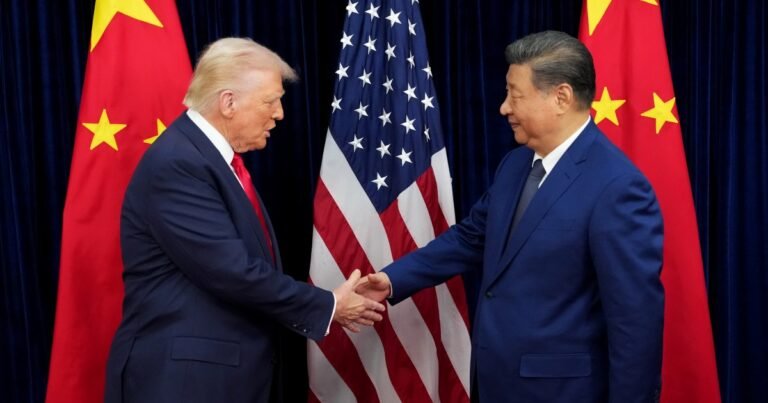
United States President Donald Trump’s visit to China this week will mark his seventh face-to-face meeting with Chinese President Xi Jinping.

The visit will also be the first trip by a US leader to China since 2017.

Recommended Stories

list of 4 itemsend of list

Trump and Xi’s three-day summit, which kicks off on Wednesday, is expected to focus on the US-Israel war on Iran, trade, and the status of Taiwan, among other issues.

Here’s a rundown of the past meetings between the leaders of the world’s two most powerful nations:

April 2017 in Palm Beach, US

The two first met at Trump’s private Mar-a-Lago resort on April 6, 2017, just a few months into his first term.

At the time of their meeting, Trump was coming off a presidential campaign that had heavily criticised China’s trade practices and their impact on the US economy.

Trump had also angered China by accepting a congratulatory phone call from then-Taiwanese President Tsai Ing-wen, breaking decades of diplomatic precedent set in 1979 when Washington cut off relations with Taipei.

During their Mar-a-Lago meeting, Trump appeared to build a personal rapport with Xi and said the two sides had made “tremendous progress” towards improving US-China relations.

The summit was largely overshadowed, however, by Trump’s decision to launch airstrikes on Syria, then led by Beijing-backed Bashar al-Assad, during Xi’s visit.

July 2017 in Hamburg, Germany

Xi and Trump met on the sidelines of the G20 summit on July 8, 2017, beginning a pattern of engagement that would see the leaders repeatedly cross paths at major international gatherings.

Their meeting focused heavily on North Korea’s nuclear programme and economic ties.

A month later, the Trump Administration fired its first shot in the US-China trade war by launching an investigation into alleged theft of US intellectual property.

By invoking Section 301 of the Trade Act of 1974, the White House would lay the groundwork to impose punitive tariffs on China.

Chinese President Xi Jinping and First Lady Peng Liyuan attend a dinner hosted by U.S. President Donald Trump at Trump's Mar-a-Lago estate in West Palm Beach, Florida, U.S., April 6, 2017. REUTERS/Carlos Barria
Chinese President Xi Jinping and First Lady Peng Liyuan attend a dinner hosted by US President Donald Trump at his Mar-a-Lago estate in West Palm Beach, Florida, on April 6, 2017 [Carlos Barria/Reuters]

November 2017 in Beijing, China

Trump landed in China on November 8, 2017 for a three-day visit, joined by a delegation of American CEOs and business leaders.

Trump’s itinerary included watching a Peking opera with Xi and his wife, visits to the Forbidden City and Palace Museum, a formal reception at the Great Hall of the People, a state banquet, and, finally, a private meeting with the Chinese leader.

Trump left China touting $250m in “business deals” spanning energy, agriculture, and technology, although some of the agreements were tentative or covered projects already under way.

The summit’s positive tone did not stop Trump from imposing tariffs on China a few months later.

December 2018 in Buenos Aires, Argentina

Trump and Xi held a dinner on December 1, 2018, on the sidelines of the G20 summit.

Months earlier, the Trump administration had imposed tariffs on $250bn worth of Chinese goods and banned US government agencies from using Chinese firms Huawei and ZTE, prompting Beijing to hit back with tariffs on $110bn worth of US goods.

Despite the tensions, the White House hailed the meeting as “highly successful”, and the sides agreed to begin negotiations on outstanding issues, including intellectual property protection and cybertheft.

June 2019 in Osaka, Japan

Trump and Xi came face-to-face at the G20 summit on June 29, 2019.

During their talks, the leaders agreed to a host of measures to de-escalate their rivalry, including a halt to new US tariffs, more open-ended trade negotiations, an easing of restrictions on Huawei, and a Chinese commitment to buy more US agricultural exports.

The US and China would months later sign a “phase one” trade deal, under which Washington agreed to roll back a number of tariffs and Beijing pledged to buy $200bn worth of US goods and services.

China ultimately did not meet its purchase commitments during the required timeframe, which overlapped with the collapse of global trade due to the COVID-19 pandemic.

U.S. President Donald Trump attends a bilateral meeting with China's President Xi Jinping during the G20 leaders summit in Osaka, Japan, June 29, 2019. REUTERS/Kevin Lamarque
US President Donald Trump attends a bilateral meeting with China’s President Xi Jinping during the G20 leaders summit in Osaka, Japan, on June 29, 2019 [Kevin Lamarque/Reuters]

October 2025 in Busan, South Korea

Trump and Xi held their first meeting in six years on the sidelines of the 2025 APEC summit on October 30, 2025.

The leaders met to extend a truce in a spiralling tariff war that briefly saw the US and China impose duties of 145 percent and 125 percent, respectively.

Despite the trade truce, the Trump administration imposed sector-specific tariffs on China and restrictions on Chinese technology exports in the run-up to the summit, while Beijing tightened export controls on rare earth minerals.

After their talks, Trump and Xi announced a one-year pause in their trade war.

Among other measures, the US eased its tariffs, while China agreed to drop some of its export restrictions on rare earths and resume purchases of US agricultural exports.


Source link

Access Denied

0

Access Denied You don’t have permission to access “http://hindi.news18.com/news/ajab-gajab/viral-woman-spends-1800-rupees-on-organic-mangoes-but-after-discovers-shocking-truth-10468426.html” on this server.

Reference #18.94adc17.1778586828.ded4992

https://errors.edgesuite.net/18.94adc17.1778586828.ded4992

EU defence ministers meet for talks on Ukraine – Europe live | World news

0

Key events

Three-day ceasefire between Russia and Ukraine ends with fresh waves of attacks

Today’s talks in Brussels come as the three-day ceasefire between Russia and Ukraine announced by president Donald Trump last week ended with a fresh wave of Russian strikes.

Smoke billows after debris from an intercepted Russian drone fell on the roof of a high-rise residential building in Kyiv, Ukraine. Photograph: Maxym Marusenko/EPA

AFP reported that Moscow launched a wave of more than 200 attack drones that damaged energy facilities and apartment buildings, killing at least one person.

In a post on X, Ukraine’s president Volodymyr Zelenskyy said that “Russia chose to end the partial silence that had lasted for several days.”

“Attack drones were shot down in the Dnipro, Zhytomyr, Mykolaiv, Sumy, Kharkiv, and Chernihiv regions, as well as in Kyiv and the region. Energy facilities, apartment buildings, and a kindergarten were damaged, and there was also a strike on an ordinary civilian locomotive on the railway… People have been reported injured as a result of these strikes. And, unfortunately, there are fatalities.”

Zelenskyy added that Ukraine “will respond in kind” to Russian attacks, before saying:

Russia must end this war, and it is Russia that must take the step toward a real, lasting ceasefire. Until that happens, sanctions against Moscow are necessary and must remain in place and be strengthened. It is important that there be no easing of pressure and that partners do not stand aside, but continue working together for security, justice, and a reliable peace.”


Source link

Access Denied

0

Access Denied You don’t have permission to access “http://hindi.news18.com/news/ajab-gajab/viral-india-highest-cinema-hall-ladakh-eleven-thousand-five-hundred-feet-pvr-inox-different-sound-experience-why-10468404.html” on this server.

Reference #18.490dde17.1778574280.363ba4de

https://errors.edgesuite.net/18.490dde17.1778574280.363ba4de

Access Denied

0

Access Denied You don’t have permission to access “http://hindi.news18.com/cricket/former-india-head-coach-rahul-dravid-said-the-grammar-of-t20-batting-has-undergone-a-complete-metamorphosis-of-late-and-bowlers-have-some-serious-catching-up-to-do-10468324.html” on this server.

Reference #18.490dde17.1778573975.363b37d8

https://errors.edgesuite.net/18.490dde17.1778573975.363b37d8

Access Denied

0

Access Denied You don’t have permission to access “http://hindi.gadgets360.com/telecom/one-airtel-launched-rebranded-black-plan-bundled-mobile-wifi-dth-plans-advance-payment-details-news-11483011” on this server.

Reference #18.4d560e17.1778576351.14ac2e8c

https://errors.edgesuite.net/18.4d560e17.1778576351.14ac2e8c

Palestine weekly wrap: Israeli settlers rampage through West Bank villages | Israel-Palestine conflict News

0

“We are building the Land of Israel and destroying the idea of a Palestinian state,” said Israeli Finance Minister Bezalel Smotrich on Friday. The action that brought on his comments: Israel’s uprooting of 3,000 Palestinian-planted trees in the occupied West Bank.

The destruction of the trees – so that illegal Israeli settlements can expand – was one of a number of Israeli actions this week that emphasised Israel’s continued push to expand its dominance over the West Bank. And it comes as Israel maintains its violent posture in Gaza – killing at least 13 Palestinians there, with a particular focus on police officers.

Recommended Stories

list of 3 itemsend of list

The Oslo bill

On Sunday, the Israeli Knesset Ministerial Committee backed a bill that would formally repeal the 1993 Oslo Accords – the cornerstone agreement that created the Palestinian Authority and divided the West Bank into Areas A, B and C. Limor Son Har-Melech, the far-right parliamentarian who submitted the legislation, was explicit about the intent: “We promised to prevent the establishment of a Palestinian state, and now it is time to encourage settlement in Areas A and B [with full and partial Palestinian administrative control respectively] and cancel the disastrous Oslo Accords.”

According to Israeli media reports, Prime Minister Benjamin Netanyahu requested that parliament postpone discussions of the bill. Justice Minister Yariv Levin, while falling in line with his party leader’s decision, expressed support for the bill in the future, saying “just as we returned to Sa-Nur, we will return to other places”.

Gaza and West Bank killings

In Gaza, a document obtained by the Times of Israel revealed that the so-called Board of Peace does not intend to hold Israel to ceasefire commitments if Hamas refuses to accept its disarmament framework – meaning Israel would not be pressured to stop its military strikes, aid restrictions, and continued expansion of the territory in Gaza under its control. At the same time, the European Union condemned Israel’s expansion of the “orange line” restricted zone, which now covers more than 60 percent of the Gaza Strip, saying it contradicts withdrawal commitments under the October “ceasefire”.

Meanwhile, Israeli strikes continued in Gaza throughout the week. Those killed include Azzam al-Hayya, the son of Hamas negotiator Khalil al-Hayya. Azzam al-Hayya died on Thursday from injuries sustained during an Israeli strike the night before in Gaza City.

Others killed in the last week include a child in Gaza City on May 5, two police officers in a Monday drone strike on a police vehicle in Khan Younis, and three more Palestinians in a strike on Maghazi refugee camp.

More than 854 Palestinians in Gaza have been killed by Israel since the October “ceasefire”, and the cumulative death toll since October 2023 is now more than 72,740.

In the West Bank, Israeli forces killed a Palestinian man on Monday during a raid on Qalandiya refugee camp; Israeli police said the man had opened fire on their forces, while the Palestinian state news agency Wafa reported that a resident was seriously injured by Israeli fire during the same operation – accounts that could not be independently reconciled.

According to the United Nations, at least 44 Palestinians have been killed in the West Bank in 2026 so far, including 13 by settlers – with more than 760 settler attacks documented, averaging six per day. Some 2,000 Palestinians, nearly 900 of them children, have been displaced in 2026 by settler violence and access restrictions alone.

Settler violence and land seizures

On Monday, the European Union agreed on a new set of sanctions targeting violent Israeli settlers in the West Bank, as well as Hamas officials. The move was rejected by the Israeli government, with Foreign Minister Gideon Saar saying the sanctions were “without any basis”.

And yet, on the ground, settlers were on the rampage throughout last week.

According to local Palestinian activist networks, settlers, some of whom were armed, hiked through the villages of Abwein and Jilijliya, near Ramallah, occupying the Ein Sala spring and denying residents access. In Jalud, in the northern West Bank, settlers used bulldozers to uproot hundreds of olive trees overnight. In Deir Istiya, in Salfit governorate, settlers established a new outpost on land belonging to an Islamic religious endowment, extending a water pipeline from the nearby Revava settlement through Palestinian olive groves.

An additional illegal outpost was reported by activists being erected on May 11 in Rammun, east of Ramallah. In Bardala in the Jordan Valley, Israeli forces accompanied by bulldozers demolished 1.4 hectares (14 dunams) of greenhouses and destroyed water pipelines, causing losses estimated at more than one million shekels ($344,610), according to locals. In Sinjil, settlers installed surveillance cameras on Palestinian-owned land and continued blocking agricultural roads.

Then, in al-Asa’asa, south of Jenin, settlers forced a Palestinian family to exhume their father – 80-year-old Hussein Asasa, who had died of natural causes and been buried with permits coordinated with Israeli security forces – and rebury him elsewhere, on the grounds that the cemetery was located near the recently resettled Tarsala outpost. United Nations Human Rights Office head Ajith Sunghay called the incident “horrifying,” saying it “embodies the dehumanisation of Palestinians that we are witnessing unfold across the entire occupied Palestinian territory”.

In Umm al-Khair in Masafer Yatta, settlers occupied a donor-funded football pitch on May 9, chanting religious verses while children in jerseys watched in silence, village leader Khalil al-Hathaleen confirmed to Al Jazeera. In Khirbet Abu Falah, east of Ramallah, photos and videos from activists showed settlers staging a predawn raid, torching a car and spray-painting “revenge” on a house wall.


Source link

OpenAI Launches Daybreak for AI-Powered Vulnerability Detection and Patch Validation

0

Ravie LakshmananMay 12, 2026Vulnerability / AI Security

OpenAI has launched Daybreak, a new cybersecurity initiative that brings together frontier artificial intelligence (AI) model capabilities and Codex Security to help organizations identify and patch vulnerabilities before attackers find a way in using the same issues.

“Daybreak combines the intelligence of OpenAI models, the extensibility of Codex as an agentic harness, and our partners across the security flywheel to help make the world safer for everyone,” the AI upstart said. “Defenders can bring secure code review, threat modeling, patch validation, dependency risk analysis, detection, and remediation guidance into the everyday development loop so software becomes more resilient from the start.”

Like Anthropic’s Mythos, the idea is to leverage AI to tilt the balance in favor of defenders and help detect and address security issues before they are found by bad actors. Access to the tooling remains tightly controlled for now, with OpenAI urging interested organizations to request for a vulnerability scan or contact its sales team.

Daybreak leverages Codex Security to build an editable threat model for a given repository that focuses on realistic attack paths and high-impact code, identify and test vulnerabilities in an isolated environment, and propose fixes.

The effort is built on the foundations of three models: GPT-5.5 (which has standard safeguards for general purpose use), GPT-5.5 with Trusted Access for Cyber (for verified defensive work in authorized environments), and GPT-5.5-Cyber (a permissive model for red teaming, penetration testing, and controlled validation).

Several major companies like Akamai, Cisco, Cloudflare, CrowdStrike, Fortinet, Oracle, Palo Alto Networks, and Zscaler are already integrating these capabilities under the Trusted Access for Cyber initiative, OpenAI said, adding it’s working with industry and government partners to deploy “more cyber-capable models” in the future.

The rollout comes as AI tools have shortened the time it takes to discover latent security issues that may have otherwise escaped notice, turning what would once have taken a significant amount of time and effort into a much shorter period of work. As a result, the patching process can struggle to keep up even under ideal conditions. 

Earlier this March, HackerOne paused its bug bounty program citing a shift in balance between vulnerability discoveries and the ability for open-source maintainers to address them, attributing it to how AI-assisted research has led to an uptick in the volume of new flaws and the speed at which they are identified.

This also has had the side effect of what’s called triage fatigue, where project maintainers are required to sift through a flood of vulnerability reports, some of which could be plausible-sounding but entirely hallucinated by the AI models.

As AI lowers the barrier to finding security flaws, companies like Anthropic, Google, and OpenAI have increasingly positioned AI security agents as a new operational layer to address the remediation bottleneck and safeguard digital infrastructure from potential exploitation.

In a post published last week, security researcher Himanshu Anand said “the 90 day disclosure policy is dead,” as large language models (LLMs) compress disclosure and exploit timelines to near-zero.

“When 10 unrelated researchers find the same bug in six weeks, and AI can turn a patch diff into a working exploit in 30 minutes, what exactly is the 90-day window protecting? Nobody,” Anand said.


Source link

Mexico cancels plan to cut school year for World Cup after backlash | World Cup 2026 News

0

Officials agree to keep the school calendar as originally planned, ending on July 15 and resuming on August 31.

Mexico has cancelled plans to shorten its school year before the World Cup after widespread backlash from parents, think tanks and local authorities, the government said.

Following an outpouring of criticism at an announcement by Education Secretary Mario Delgado that the school year would end about 40 days early, education and other government officials met on Monday to gather input from parents and consider options at a meeting announced by President Claudia Sheinbaum, who expressed scepticism of the proposed shortening.

At the meeting, it was agreed to keep the school calendar as originally planned and have it end July 15, with classes resuming August 31, the Education Department said.

“The idea is to keep the vacation period to six weeks, as it has always been, and perhaps some students will start early, while others will continue with the previous schedule,” Sheinbaum said earlier.

“The goal is for it to be a consensus decision,” she said. “Now we need to listen.”

Delgado, on Friday, unexpectedly announced the end of the school year on June 5, arguing the decision was also based on a heatwave.

Two states rejected the plan before it was ultimately cancelled.

Parents also questioned the measure, which, according to the think tank Mexico Evalua, would cause students to fall behind in their studies.

“The decision … will reduce effective learning time even more for 23.4 million students,” Mexico Evalua wrote in a report.

The World Cup tournament, hosted jointly by Mexico, the United States and Canada, kicks off on June 11 when Mexico take on South Africa at home in Mexico City.

Sheinbaum also guaranteed “conditions of security” necessary for the games as well as the completion of public works projects started before the tournament, particularly additions to the Azteca stadium and the Mexico City International Airport.


Source link

Access Denied

0

Access Denied You don’t have permission to access “http://hindi.news18.com/cricket/german-influencer-lizlaz-was-offered-money-to-spread-negativity-about-virat-kohli-describes-her-sudden-viral-fame-after-allegedly-king-kohli-liked-pictures-10468276.html” on this server.

Reference #18.94adc17.1778578136.dddb570

https://errors.edgesuite.net/18.94adc17.1778578136.dddb570