Google on Friday released security updates for its Chrome browser to address a security flaw that it said has been exploited in the wild.
The high-severity vulnerability, tracked as CVE-2026-2441 (CVSS score: 8.8), has been described as a use-after-free bug in CSS. Security researcher Shaheen Fazim has been credited with discovering and reporting the shortcoming on February 11, 2026.
“Use after free in CSS in Google Chrome prior to 145.0.7632.75 allowed a remote attacker to execute arbitrary code inside a sandbox via a crafted HTML page,” according to a description of the flaw in the NIST’s National Vulnerability Database (NVD).
Google did not disclose any details about how the vulnerability is being exploited in the wild, by whom, or who may have been targeted, but it acknowledged that “an exploit for CVE-2026-2441 exists in the wild.”
While Google Chrome is no stranger to actively exploited vulnerabilities, the development once again highlights how browser-based flaws are an attractive target for malicious actors, given that they are installed everywhere and expose a broad attack surface.
The disclosure of CVE-2026-2441 makes it the first actively exploited zero-day in Chrome that Google has patched in 2026. Last year, the tech giant addressed eight zero-day flaws in Chrome that were either actively exploited or demonstrated as a proof-of-concept (PoC).
Last week, Apple also shipped iOS, iPadOS, macOS Tahoe, tvOS, watchOS, and visionOS updates to address a zero-day flaw (CVE-2026-20700, CVSS score: 7.8) that had been weaponized as a zero-day to execute arbitrary code on susceptible devices as part of an “extremely sophisticated attack” targeting specific individuals who were running iOS devices running versions before iOS 26.
For optimal protection, users are advised to update their Chrome browser to versions 145.0.7632.75/76 for Windows and Apple macOS, and 144.0.7559.75 for Linux. To make sure the latest updates are installed, users can navigate to More > Help > About Google Chrome and select Relaunch.
Users of other Chromium-based browsers, such as Microsoft Edge, Brave, Opera, and Vivaldi, are also advised to apply the fixes as and when they become available.
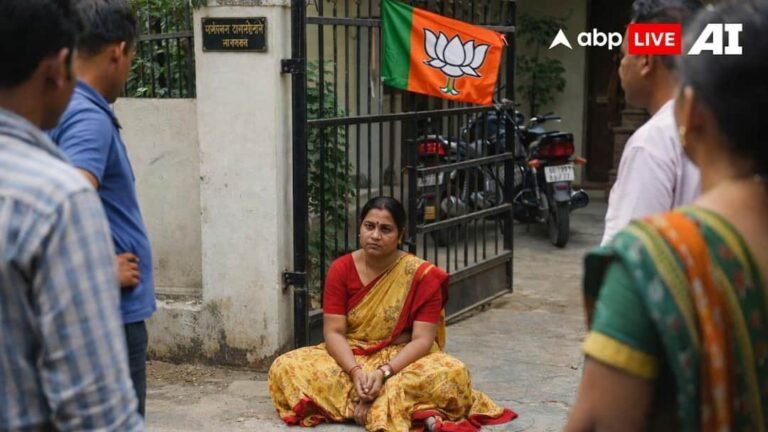
The atmosphere heated up in village Nanpur of Kundarki police station area of Moradabad, Uttar Pradesh, when a woman sat on strike outside the house of former BJP Mandal President. The woman Neeraj Kumari says that she is the wife of the leader and she should be accepted publicly. The woman has alleged that the former Mandal President had a long-term relationship with her after promising marriage and physically exploited her.
According to him, when he pressed for marriage, the marriage was also done in the temple, but now he is not being allowed to enter the house. The woman clearly says that until she gets the status of a wife, she will not move away from the door.
Police controlled the situation
As soon as information about the strike was received, a large number of people gathered in the village and a tense situation arose on the spot. On information, Kunderki police reached the spot and controlled the situation. The police tried to convince the woman and assured action after investigation. On the other hand, the former Mandal President has termed all the allegations as baseless and called it a conspiracy to tarnish the image.
Police started investigation
The police kept talking to both the parties till late night. Area officer Bilari Ashok Kumar said that both the parties have been called to the police station. After listening to both, further action will be taken on the basis of facts. At present, the police have started investigating the case on the basis of the woman’s complaint.
This matter has now become a topic of discussion in local politics. No statement from any senior BJP leader has come yet. While questions are being raised on the credibility of those who are accused themselves. BJP leaders are also shying away by saying that the matter is personal.
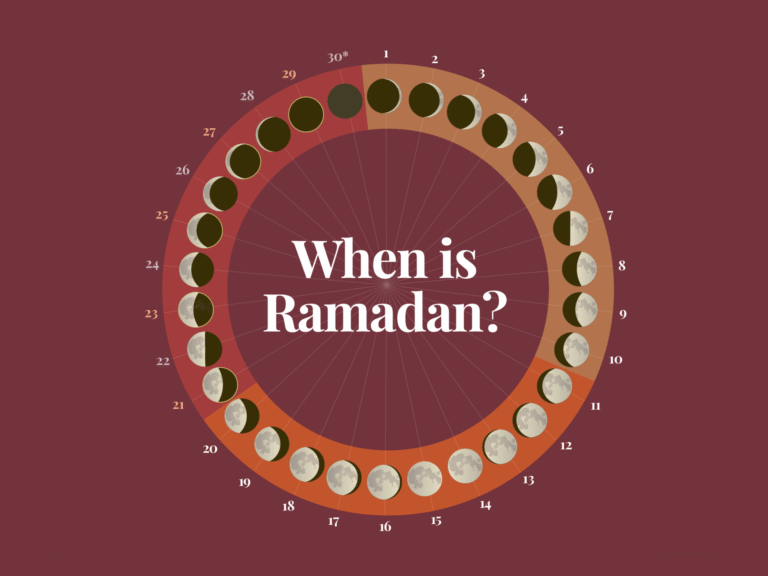
The first day of fasting for the Muslim holy month of Ramadan in Mecca, Saudi Arabia will be either Wednesday, February 18 or Thursday, February 19, depending on the sighting of the new moon.
Other countries follow their own moon sightings. Some use astronomical calculations for lunar phases, while others rely on traditional local sightings to confirm the start of the new month.
Recommended Stories
list of 3 itemsend of list
Ramadan is determined by the Islamic lunar calendar, which begins with the sighting of the crescent moon. Saudi Arabia and other Muslim-majority countries rely on the testimonies of moon sighters to determine the start of the month.
How is the Ramadan moon sighted?
For the moon to be visible, the crescent must set after the sun. This allows the sky to be dark enough to spot the small sliver of the new moon.
After the sun sets on the night of February 17, the 29th day of the month of Shaban in the Hijri calendar, moon sighters face west with a clear view of the horizon for a first glimpse of the crescent moon.
If the moon is sighted, the month of Ramadan begins, with the first day of fasting being February 18. Otherwise, Shaban will complete 30 days, and the first fasting day will be February 19.
In Saudi Arabia, testimonies of people who have spotted the moon are recorded, and the Supreme Court makes a decision on when Ramadan should begin.
(Al Jazeera)
In order to view the moon at sunset time, there are three important factors astronomers look for:
Elongation: The moon needs to be far enough from the sun to ensure its light is not drowned out. For a reliable naked-eye sighting, the moon must be 10-12 degrees away from the sun. If it is closer than 7 degrees, then the crescent may be physically too thin to reflect enough light for the human eye to see.
Altitude: The higher the moon is at sunset, the less it has to compete with the thick, hazy atmosphere and the glow of the sky near the horizon. An altitude of 10 degrees is typically sufficient for clear naked-eye visibility, while lower altitudes of 3 to 5 degrees may be adequate with the help of optical aids.
Lag time: This is the time between sunset and moonset. For reliable naked-eye viewing, there usually needs to be at least 45 minutes for the sky to darken enough to see the moon. Longer durations are even better.
When does Ramadan begin in different countries?
According to Crescent Moon Watch, a moon tracker run by the United Kingdom’s Nautical Almanac Office, Ramadan’s new moon will begin on February 17 at 3:01pm Mecca time (12:01 GMT).
On that night in Mecca, the sun will set at 6:19pm (15:19 GMT), and the moon will be visible for only three minutes, setting at 6:22pm (15:22 GMT). With the new moon only three hours and 18 minutes old, it is very unlikely that anyone across the globe will see the crescent moon that evening, meaning the first day of Ramadan will begin on February 19.
(Al Jazeera)
On the evening of February 18, the new moon should be visible in most parts of the world. By that time, the moon will be nearly 26 hours old. It will be higher in the sky and remain visible for much longer after sunset, making it easily observable to the public.
North America
The Fiqh Council of North America (FCNA) and the Islamic Society of North America (ISNA), both of which follow astronomical calculations, have officially announced that Ramadan will begin on February 18, 2026. Their calculations state that, at sunset somewhere on the globe, the elongation of the moon should be at least 8 degrees, and the moon must be at least 5 degrees above the horizon for it to be visible.
Europe
The European Council for Fatwa and Research (ECFR) has declared that Thursday, February 19, will be the first day of Ramadan. ECFR notes that while the astronomical birth of the moon occurs on Tuesday, it will be impossible to see that evening either with the naked eye or through telescopes and observational instruments. Turkiye has also declared February 19 as the first day of the holy month of Ramadan, for the same reasons.
Middle East
Most Middle Eastern nations, led by Saudi Arabia, will not make a final announcement until the evening of Tuesday, February 17. If the Saudi Supreme Court receives a testimony of a sighting on Tuesday night, it may declare Wednesday as the first day of Ramadan. But this is very unlikely for the reasons mentioned above.
Asia
Across Asia, the start of Ramadan 2026 will most likely be Thursday, February 19, as the moon will set before the sun in that part of the world on Tuesday night.
Singapore has officially confirmed the start of Ramadan to be on Thursday, while countries in South Asia including India and Pakistan have forecast Thursday, February 19 as the first day of fasting.
Africa
In Africa, the start of Ramadan follows a similar pattern to the rest of the world, with most countries anticipating it to begin on Thursday, February 19.
Oceania
The Australian National Imams Council have announced that Ramadan will commence on February 19.
(Al Jazeera)
Why is Ramadan holy for Muslims, and what is the significance?
Muslims believe that Ramadan is the month when the first verses of the Quran were revealed to the Prophet Muhammad nearly 1,450 years ago.
Throughout the month, observing Muslims fast from just before the sunrise prayer, Fajr, to the sunset prayer, Maghrib.
The fast entails abstinence from eating, drinking, smoking, and sexual relations to achieve greater “taqwa”, or consciousness of God.
Fasting is one of the five pillars of Islam, along with the Muslim declaration of faith, daily prayers, charity, and performing the Hajj pilgrimage to Mecca if physically and financially capable.
In many Muslim-majority countries, working hours are reduced, and most restaurants are closed during the fasting hours.
(Al Jazeera)
Ramadan greetings in different languages
Various Muslim-majority nations have a personalised greeting in their native languages. “Ramadan Mubarak” and “Ramadan Kareem” are common greetings exchanged over the month, wishing the recipient a blessed and generous month, respectively.
Shares of Fractal Analytics made a muted stock market debut on Monday, listing at ₹876 on the National Stock Exchange of India, a 2.66 per cent discount to the issue price of ₹900, while opening flat at ₹900 on the BSE.
The tepid listing reflected cautious investor sentiment toward the analytics firm despite moderate demand during its public offering.
Commenting on the company’s long-term outlook, Dr. Ravi Singh, Chief Research Officer at Master Capital Services Ltd, said, “Fractal Analytics is poised to take advantage of the expected growth of the global AI market to $310 billion by FY30. For long-term investors, Fractal Analytics offers a compelling case to stay invested given its strong positioning in the fast-growing global AI and analytics industry.”
The company’s ₹2,834 crore initial public offering was subscribed 2.66 times overall and saw participation from institutional investors, with anchor investors committing ₹1,248.26 crore ahead of the offer sale.
The price band for the issue was set at ₹857–₹900 per share, valuing the company at close to ₹15,500 crore. Fractal had earlier scaled down the size of the IPO from its originally proposed ₹4,900 crore, with the revised structure comprising a fresh issue of shares worth up to ₹1,023.5 crore and an offer for sale of ₹1,810.4 crore.
Brokerages said the subordinated listing was largely in line with expectations, given valuation considerations and broader market conditions.
According to the company’s offer documents, proceeds from the fresh issue will be deployed to invest in its subsidiary Fractal USA, repay debt, purchase laptops, establish new offices in India, and fund research and development as well as sales and marketing initiatives under its Fractal Alpha platform.
Additional funds are earmarked for acquisitions, strategic initiatives, and general corporate purposes.
With its listing completed, investors are expected to track the company’s execution on growth initiatives and global expansion strategy as it begins trading as a publicly listed analytics-focused technology firm.
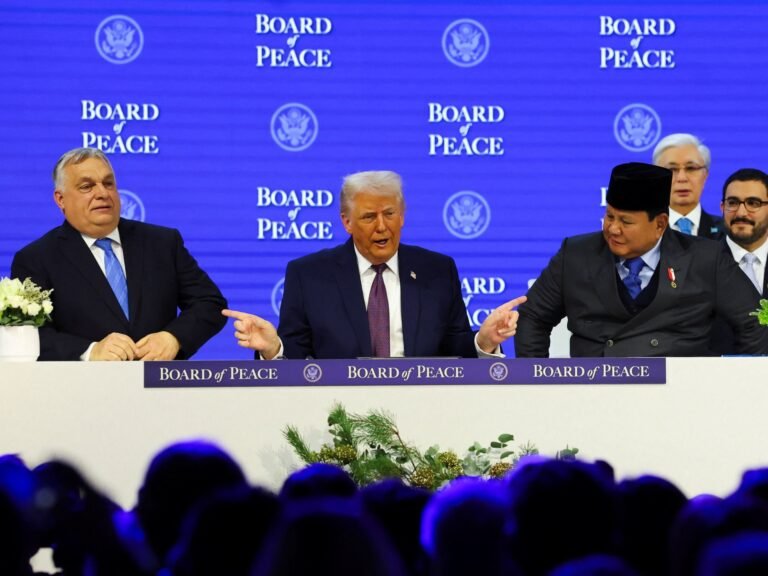
President Prabowo Subianto’s government said on February 10 that Indonesia is preparing to deploy up to 8,000 troops to a proposed multinational Gaza stabilisation force under Donald Trump’s so-called Board of Peace (BoP). The troop proposal forms part of Jakarta’s broader decision to participate in the BoP framework, an initiative conceived and driven by Trump. Together, these steps signal a significant shift in Indonesia’s longstanding foreign policy posture. At a time of intensifying geopolitical volatility, Jakarta appears to be committing itself to a project shaped around a single, deeply polarising political figure. The decision raises a fundamental question: is Indonesia advancing its national interests and diplomatic credibility, or allowing its foreign policy direction to be shaped by an external agenda?
Geopolitics is not a theatre for symbolic proximity to power but a disciplined calculation of national interest and sovereign credibility. Indonesia’s decision to engage with the BoP appears less like a carefully calibrated strategic choice and more like a reactive impulse that risks weakening the philosophical foundations of its diplomacy, built over decades. Indonesia’s international influence has historically rested on strategic equidistance rather than personal alignment with controversial leaders.
There is a growing sense that Jakarta risks acting out of geopolitical urgency. Yet the initiative Indonesia has chosen to support is led by a figure known for transactional diplomacy and disregard for international consensus. The implications extend well beyond Middle East peace initiatives. What is at stake is Indonesia’s reputation as an independent stabilising actor in global diplomacy.
If Indonesia proceeds with troop deployment under the BoP framework, the risks become even more acute. Gaza is not a conventional peacekeeping theatre. It is one of the most volatile and politically contested conflict environments in the world, where humanitarian imperatives and hard security objectives frequently collide. Deploying thousands of troops into such an arena without an inclusive multilateral mandate risks drawing Indonesia into a conflict environment where neutrality would be difficult to sustain.
The erosion of the ‘Free and Active’ doctrine
The most serious concern is the gradual erosion of Indonesia’s “Free and Active” foreign policy doctrine, the intellectual backbone of its diplomacy since the Djuanda Declaration and the Bandung Conference. Indonesia has historically positioned itself as a mediator rather than a follower of personalised diplomatic agendas.
By participating in an institution closely identified with Donald Trump, Jakarta risks legitimising unilateral approaches that often conflict with established international norms. “Free” diplomacy implies independence, and “active” diplomacy implies engagement driven by national priorities rather than external pressure.
Indonesia also risks being reduced to a symbolic endorsement of a United States-centred foreign policy outlook. If Jakarta drifts too far into this orbit, its leverage with other major actors, including China, Russia and ASEAN partners, could weaken. Indonesia’s leadership in Southeast Asia has depended on its credibility as a neutral stabilising force. That credibility may erode if it is seen as participating in great-power security agendas.
Indonesia’s respected record in United Nations peacekeeping has historically rested on internationally recognised neutrality under UN command structures. Participation in a BoP framework, which sits outside established multilateral systems, risks shifting Indonesia from neutral arbiter to participant in a political security architecture shaped beyond globally recognised peacekeeping norms.
More troubling is the precedent this sets. If foreign policy principles become negotiable in exchange for economic or strategic promises, Indonesia risks undermining the coherence of its diplomatic identity. Its constitutional commitment to promoting global peace and social justice depends on preserving policy independence.
The Palestine paradox
Indonesia’s participation in the BoP also creates a visible moral and constitutional tension. The Indonesian constitution explicitly rejects all forms of colonialism and emphasises international justice. Participation in an initiative led by the architect of policies historically skewed in Israel’s favour creates a contradiction that is difficult to reconcile.
Trump’s record in the region remains controversial. His decision to relocate the US embassy to Jerusalem altered decades of diplomatic consensus and drew widespread criticism across the Muslim world. For Indonesia, the world’s largest Muslim-majority nation and a consistent supporter of Palestinian statehood, association with this framework carries significant political sensitivity.
If the Board of Peace advances regional normalisation without firm guarantees of Palestinian sovereignty, Indonesia risks being linked to a process widely perceived as externally imposed. This would conflict with domestic public sentiment and weaken Indonesia’s moral leadership in forums such as the Organisation of Islamic Cooperation and the United Nations.
The troop deployment dimension deepens these concerns. The Gaza conflict landscape extends beyond Israeli and Palestinian actors to include broader regional power networks, including the so-called “Axis of Resistance”. Indonesian forces could be perceived by militant groups as extensions of Western-backed security arrangements, increasing the risk that peacekeeping troops become operational targets.
Strategic and economic trade-offs
Deploying 8,000 personnel overseas is not a marginal decision. For Indonesia, it represents a full brigade likely composed of some of its most capable units. At a time of rising tensions in the North Natuna Sea and intensifying Indo-Pacific competition, diverting elite forces to the Middle East risks diluting focus on core national defence priorities and stretching military readiness across distant theatres.
The financial dimension is equally significant. Sustaining thousands of troops in a devastated and heavily militarised enclave would require extensive logistical infrastructure. Even when operations receive international support, hidden costs often revert to national budgets. At a moment when Indonesia’s domestic economy requires stimulus and its defence sector seeks modernisation, allocating substantial resources to an expeditionary mission with uncertain strategic returns warrants serious parliamentary scrutiny.
Diplomatic engagement must deliver tangible dividends to the public, not impose new burdens on an already stretched state budget. Without clearly defined security or economic benefits, troop deployment risks appear as an expensive geopolitical gamble. Indonesia could find itself dependent on security arrangements shaped by shifting US domestic political priorities, creating commitments that may prove unreliable over time.
The absence of robust public debate surrounding this decision is equally concerning. Large-scale overseas military commitments require democratic oversight. Without transparency, foreign policy risks becoming an elite-driven exercise detached from national consensus.
Reputational risk and strategic myopia
Indonesia’s close association with an initiative so strongly linked to Donald Trump introduces long-term reputational risk. US politics remains deeply polarised. If future administrations distance themselves from Trump-era initiatives, Indonesia could face diplomatic exposure through no necessity of its own.
Foreign policy frameworks built around highly personalised leadership often prove unstable. Indonesia’s diplomatic partnerships have traditionally been grounded in multilateral institutions such as the United Nations and ASEAN, which provide durability precisely because they are not tied to individual leaders.
If the Board of Peace becomes politically contested or evolves into a coercive security instrument, Indonesia may struggle to disengage without reputational damage. Participation, therefore, concentrates diplomatic risk rather than diversifying it.
In a rapidly multipolar world, Indonesia does not require shortcuts to global influence. Its credibility has historically been built on independence, balance and principled diplomacy. The central question is whether Indonesia will preserve that tradition or compromise it in pursuit of geopolitical visibility and proximity to power. Indonesia deserves a far more independent role than that.
The views expressed in this article are the author’s own and do not necessarily reflect Al Jazeera’s editorial stance.
Satiksha Adarshi, resident of Pantnagar locality of Gaya district, was born on 2 March 2024. Presently her age is only 23 months, but at the age of 18 months she started being recognized as the youngest genius of the country. Satiksha, a 23-month-old little girl from Gayaji, Bihar, is no less than an ideal computer. At such a young age, Satiksha has surprised everyone by creating a world record by identifying 330 items. His name has been registered in the Worldwide Book of Records and Kalam World Records.
Satiksha’s extraordinary memory and observation skills have amazed the family and society. Satiksha accurately identified 330 different objects, animals, fruits, vegetables and other things in just 50 minutes. This feat was accomplished on 13 October 2025, when he was 1 year 7 months old. For this achievement, his name was registered in the Worldwide Book of Records, where he received a gold medal, certificate and other honours.
There is command on these things Satiksha is not only registered worldwide but also in Kalam World Records. Here he identified 410 items out of 500 cards. It includes flags of 53 countries, 25 alphabets, 19 professions, 26 wonders of the world, 26 animals and their babies, 27 freedom fighters, different colors-shapes, transport, birds, inventions, vegetables, flowers and many other categories. There were some cards which her mother had never identified, yet she would identify them correctly without hesitation.
Started training from the age of 3 months Satiksha’s mother Surbhi Kumari is a translator of Korean language and is working in a foreign company. She started studying genius children during her pregnancy and decided to introduce her child to extra activities like the children of developed countries. Recognition training was started from the age of 3 months with picture cards. Initially 1-2 cards were recognized in 1 minute, which gradually increased.
Surbhi says that getting addicted to knowledge instead of mobile has a positive effect on the child. In the game, cards were shown and people were asked who is Gandhiji? Which tricolor is it? And Satiksha used to give the correct answer by placing her hand. Although she is not able to speak completely yet, there is no lack of recognition.
Access Denied
You don’t have permission to access “http://hindi.gadgets360.com/mobiles/best-smartphones-under-rs-20000-india-2026-lava-poco-samsung-motorola-nothing-budget-mobiles-features-11009413” on this server.
Preparations for change of power have started in Bangladesh. The newly elected government of Bangladesh Nationalist Party (BNP) is going to take oath on Tuesday. Before the swearing-in ceremony of the government formed under the leadership of party president Tariq Rehman, Chief Advisor to the interim government, Muhammad Yunus has invited leaders of 13 countries to attend the ceremony.
Which countries got invitation According to the report, the countries that have been invited include India, China, Saudi Arabia, Turkey, Pakistan, United Arab Emirates, Qatar, Malaysia, Brunei, Sri Lanka, Nepal, Maldives and Bhutan. The swearing-in ceremony will take place in the South Plaza of the National Parliament. BNP got a big victory in the recently held 2026 general elections.
Statement regarding PM Modi BNP leader ANM Ehsanul Haq Milan on Saturday expressed hope that Prime Minister Narendra Modi would also be invited to the function. Speaking to journalists in Dhaka, he said that all leaders of South Asia should be invited. He said, ‘This is common courtesy. The organizers will do this work. We hope that the whole world will be with us.
BNP also thanked Prime Minister Narendra Modi for congratulatory message on its victory. The party wrote on X, ‘Hon. Narendra Modi Yes, thank you very much for your message. We are grateful to acknowledge the leadership of Tariq Rahman in BNP’s decisive victory in the national elections.
Emphasis on relations with India BNP has expressed its desire to build better relations with India. The party said it wants to work together with India with mutual respect and understanding of each other’s concerns. The statement said that both the countries can move forward together for peace, stability and development in the region.
Importance of 2026 elections The general elections held on 12 February 2026 are being considered special. This election took place after massive protests in 2024, due to which Sheikh Hasina, who was in power for a long time, had to step down. In the 300-seat Parliament, 151 seats are required to form a government and BNP won much more seats than this. After this, Tariq Rehman is being considered as a contender for the post of Prime Minister.
The Islamic Jamaat-e-Islami alliance has emerged as the main opposition in this election. The voting percentage was around 59 percent. Along with this, a constitutional referendum related to governance reform was also passed.
Access Denied
You don’t have permission to access “http://hindi.gadgets360.com/ai/ai-agents-will-replace-humans-customer-service-in-airbnb-news-11009401” on this server.
PM also says he will seek legal powers to act on a consultation that is considering an Australia-style social media ban for those below 16.
Published On 16 Feb 202616 Feb 2026
Share
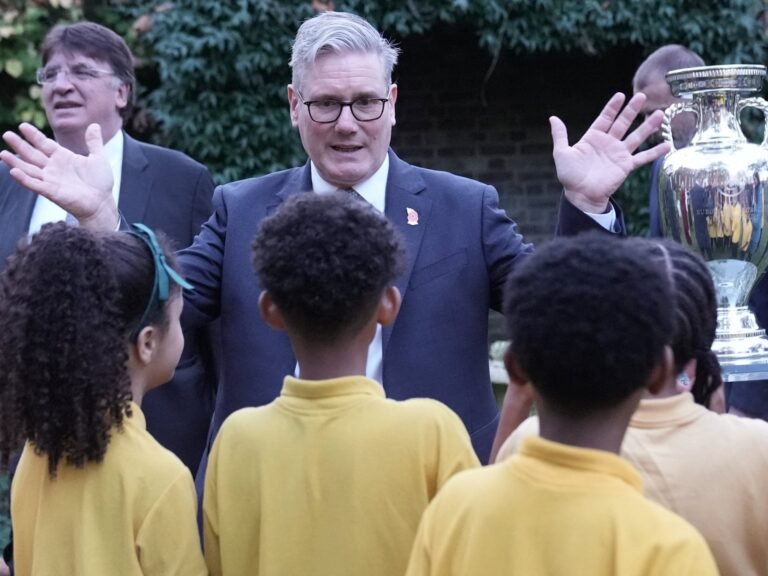
United Kingdom Prime Minister Keir Starmer has announced a crackdown on artificial intelligence chatbots that endanger children and pledged to seek broader powers to regulate internet access for minors.
Starmer’s office said on Monday that the government would target “vile and illegal content created by AI” and push for legal powers to act quickly on the findings of a public consultation that will consider a social media ban for children below 16 years of age.
Recommended Stories
list of 4 itemsend of list
The powers are likely to reduce parliamentary scrutiny of future curbs.
“Technology is moving really fast, and the law has got to keep up,” Starmer said in a statement.
“We are acting to protect children’s wellbeing and help parents to navigate the minefield of social media,” he said.
The measures will require all AI chatbot providers to abide by digital safety laws, including a ban on creating sexualised images without a subject’s consent. The move follows action against “non-consensual intimate images” created by the Grok chatbot on Elon Musk’s X platform.
Starmer’s office went on to explain its push for broader powers, saying it wants to act on the findings of the public consultation “within months, rather than waiting years for new primary legislation every time technology evolves”.
The measures will be introduced as an amendment to existing crime and child-protection legislation being considered by parliament.
The consultation, which begins in March, will consider measures like setting a minimum age limit for social media and a ban on children from using virtual private networks (VPNs) to access pornography.
It comes as more countries worldwide eye restrictions after Australia became the first nation to prohibit children below 16 from using social media platforms such as Instagram, Facebook, TikTok and YouTube.
Since Australia instituted the ban, social media companies have revoked access to about 4.7 million accounts identified as belonging to children below 16.
Under the country’s law, social media companies face fines of up to 49.5 million Australian dollars ($33.2m) if they fail to take reasonable steps to remove the accounts of children younger than 16 years old.
Starmer’s plan for age restrictions has received broad support from his Labour Party as well as the opposition Conservative Party, which is also seeking a social media ban on UK citizens below 16 years of age.
While aimed at shielding children, such measures often have knock-on implications for adults’ privacy and ability to access services, and have led to tension with the United States over limits on free speech and regulatory reach.
Websites such as image-hosting site Imgur, used to make memes and provide images for many general online discussion forums, blocked access to all UK users last year and gave them blank images instead, after tighter age-verification rules.
Some major pornography websites have also blocked access for UK users rather than verify their age.
However, such geographic restrictions can be circumvented by using readily available VPNs. The British government said its consultation on child safety would include potential age restrictions for VPNs.