Reference #18.6e560e17.1777872626.374e6ef2
https://errors.edgesuite.net/18.6e560e17.1777872626.374e6ef2
Reference #18.6e560e17.1777872626.374e6ef2
https://errors.edgesuite.net/18.6e560e17.1777872626.374e6ef2

In the mid-1990s, search engine designers settled on the user interface that dominates to this day: a text box into which users enter text, and a resulting list of websites.
Then came Garrett Gruener, David Warthen, and Gary Chevsky, who together devised Ask Jeeves – a search engine that offered the chance to ask natural language questions to a cartoon character that looked like a Butler.
Like a real-life gentleman’s gentleman, Jeeves would promptly and politely fetch whatever his master desired – in this case, a list of websites.
Ask Jeeves distinguished itself with its quirky approach, and in 1999 went public amid the stock market frenzy of the first dotcom boom. A year later it was laying off staff.
Search engines of the day relied on crawling the web and indexing it. In the late 1990s, Google started using its PageRank algorithm, which assessed the authoritativeness of sites based on the number and quality of backlinks. Google’s approach delivered more relevant results, and the company started to gain serious market share.
Rival crawler-based search outfits started to struggle, which may be why in 2004 Ask Jeeves acquired another early player, Excite.
A year later, Ask Jeeves was itself acquired by an outfit called Inter-Active Corp (IAC), which soon retired the Jeeves character.
The site persisted for years at ask.com, but never achieved much market share: IAC’s description of the service says it’s racked up 245 million global visits over 25 years, and reaches three percent of the global population.
Neither figure is enough for the site to feature in StatCounter’s list of the top five search sites since 2009.
Last Friday, the service shut its digital doors.
“Every great search must come to an end,” reads the ask.com website. “As IAC continues to sharpen its focus, we have made the decision to discontinue our search business, which includes Ask.com. After 25 years of answering the world’s questions, Ask.com officially closed on May 1, 2026.”
“We are deeply grateful to the brilliant engineers, designers, and teams who built and supported Ask over the decades. And to you – the millions of users who turned to us for answers in a rapidly changing world – thank you for your endless curiosity, your loyalty, and your trust.”
“Jeeves’ spirit endures.”
Indeed it does, because the new wave of AI-powered search allows natural language queries and – having scraped everything online without first asking for permission – gets the joke of a Butler/search engine.
The Register proved this when, in honor of Ask Jeeves’ passing, we prompted Google’s AI search to rename itself Jeeves and adopt the persona of a search Butler.
Google responded as follows:
Microsoft’s Copilot hedged, telling us “I can absolutely lean into a Butler persona for you – polished, attentive, and impeccably mannered – but I can’t rename myself or change my identity. I’m still Microsoft Copilot, your AI companion.”
But then Copilot got into the swing of things.
®
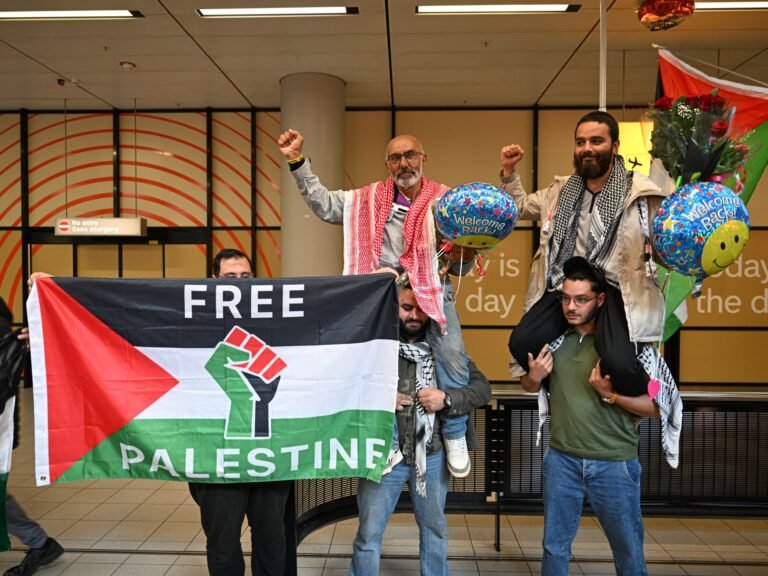
Two activists from the Global Sumud Flotilla arrived in the Netherlands after being released from Israeli custody. The flotilla was intercepted in international waters while carrying aid to the Gaza Strip. Two of their fellow activists remain in Israel for questioning.
Published On 4 May 2026
Kotak Mahindra Bank shares declined as much as 5 per cent in early trade on Monday, even as the lender reported a rise in fourth-quarter profit, with the stock reacting to mixed underlying cues and cautious commentary around growth and profitability.
The stock hit a low of ₹363 before recovering slightly to trade at ₹375.85 on the NSE, still down about 2 per cent and among the top losers in the Nifty 50.
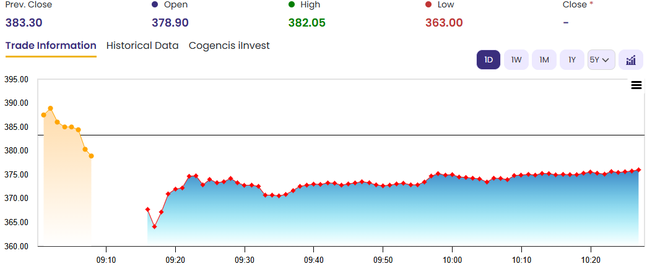
Kotak Mahindra shares
The private sector lender reported a 13 per cent yoy increase in standalone net profit at ₹4,027 crore for the March quarter, supported by steady growth in net interest income and a sharp decline in provisions. While profitability came in ahead of expectations, the market appeared to factor in concerns around sustainability of margins and growth momentum.
Brokerages largely acknowledged the earnings beat but offered a mixed outlook.
Morgan Stanley retained an overweight rating with a target price of ₹500, calling Q4FY26 a good quarter at attractive valuations. The brokerage said profit after tax, NIM, net interest income and core pre-provision operating profit all beat estimates, while slippages and credit costs declined sharply. It highlighted management’s confident commentary and sees the bank as a key pick amid macro risks given earnings resilience.
BofA maintained a buy rating with a target price of ₹460, noting that profit after tax beat estimates, aided by net interest margin expansion and lower provisions. It added that asset quality and margins improved, with return on assets expanding to 2.1 per cent, and expects loan growth momentum to pick up alongside recovery in unsecured lending and lower credit costs.
Macquarie, however, maintained a neutral stance with a target price of ₹460, stating that easing credit costs should support profitability. It noted that the earnings beat was largely driven by lower credit costs and improvement in retail segments, while margins remained stable due to a better deposit profile.
Elara Capital maintained a buy rating but lowered its target price to ₹473, citing near-term uncertainties. It said the bank has been delivering improving core performance despite a challenging environment and offers a relatively safer earnings compounding story, with return on assets around 2 per cent. It also noted that valuations remain attractive among large private banks, supporting a favorable risk-reward outlook.
Meanwhile, Ambit Capital remained more cautious, maintaining a sell rating with a target price of ₹380. The brokerage flagged concerns over the bank’s ability to balance faster growth with strong underwriting, noting that a shift toward higher-yield unsecured lending could increase operating expenses and credit cost volatility. It expects return on assets to remain around 2 per cent and highlighted that excess capital may weigh on return on equity over the medium term.
Published on May 4, 2026
Reference #18.4c560e17.1777872231.79b085f
https://errors.edgesuite.net/18.4c560e17.1777872231.79b085f
Iran may not be choking like a stuffed pig as Donald Trump predicted, but its economy is in serious difficulty as a combination of a massive war-damages bill, inflation, currency devaluation, unemployment and a contraction in oil revenues combine to leave the political elite worrying how hardline they can afford to be with their US negotiators. One estimate circulating in Iran’s media suggests the damage to the economy from the US-Israeli attacks is nine times the value of the Iranian budget last year.
The UN Development Programme has estimated that 4.1 million more Iranians could fall into poverty.
Trump made his prediction that Iran would choke on the basis that the country would soon run out of oil storage space because of the US naval blockade. On 26 April, he predicted that Iranian wells would “explode” in a “very powerful” destructive process starting in three days.
Behind this prediction was a belief that the US naval blockade launched on 13 April would prevent Tehran’s tankers from reaching the strait of Hormuz, depriving the Iranian regime of at least $175m (£129m) a day in oil export revenue. Once the oil was stuck inside the country, Iran would soon run out of storage, forcing it to close the taps. Such a closure would irreparably damage the wells.
“When it explodes, you can never, regardless, you can never rebuild it the way it was,” Trump told Fox News in an interview, adding that capacity would be reduced to about 50% of what it was “right now”. The US Treasury secretary, Scott Bessent, last week likened the Iranian leadership to “rats in a sewer pipe” who found it hard to understand what was going on. Kharg Island, Iran’s primary oil export hub, was “soon nearing capacity”, he said. For good measure Trump put a further squeeze on exports to China by imposing US sanctions on companies linked to Chinese refineries, a step that has led the Chinese ministry of commerce on Saturday to issue a counter-injunction.
Although it is true Iran is now producing more oil than it can export, it appears for the moment enough tankers are making it through the US naval blockade, while remedial steps such as flaring means storage space has not run out. Independent estimates, including from the Center on Global Energy Policy at Columbia University, suggest that Iran has up to three weeks of free useable storage capacity.
Yet something is putting renewed pressure on the Iranian currency. The value of the toman, the primary unit of currency used in commerce and daily life in Iran, has fallen almost 22% on the open market, to 190,000 to the dollar on Sunday.
Overall inflation is put at 73.5%, while food and beverage prices have surged 115%. The Iranian government on Sunday said it was considering doubling the value of the voucher it already gives citizens, an inflationary step in itself. The monthly minimum wage in Iran is less than 170m rials ($92), and that is after the government raised it by about 60% in March. Imported cars or iPhones are available only at incredibly high prices.
More than 23,000 factories and firms have been hit by US-Israeli airstrikes, resulting in a million jobs lost, according to Iran’s deputy work and social security minister, Gholamhossein Mohammadi. Unemployment, already high, has increased by an estimated 1 million people, with those reliant on digital trade worst affected. A digital-based economy cannot be shut in perpetuity, and at some point the needs of the economy may have to be put before those of security.
The Iranian communications minister, Seyed Sattar Hashemi, has repeatedly promised that the country’s digital lockdown is temporary, but he has no means of forcing the true decision-makers in the intelligence services to lift the restrictions.
Reza Olfatnasab, the head of the Union of Virtual Businesses, said in a statement: “The largest decrease in sales occurred in March. Unfortunately, businesses lost the key end-of-year market, and the issue of ‘non-profitability’ was very prominent and tangible during this period.”
According to him, even now some large businesses are facing a 40% to 50% drop in sales. This is despite the fact that these companies have 50 million to 60 million users and their apps are installed on most people’s phones in Iran.
“When large platforms with such dimensions and infrastructure suffer this level of sales decline, one can predict what a disaster and deep damage has occurred for small and micro businesses,” Olfatnasab said.
Ahmad Zeidabadi, a reformist journalist and political analyst critical of the government, said: “The internet and the economic conditions of the people are no joke. The reality is without the internet normal life and social stability are impossible.”
“If a fundamental solution is not quickly devised, exactly the event that opponents of internet connection fear will happen,” he added, in a reference to the renewal of January’s nationwide protests.
Nor has the rainy season delivered what was needed. A spokesperson for the country’s water industry said: “Despite a positive national index, 10 provinces remain below normal precipitation levels, mostly located in the downstream and upstream regions of the Alborz mountain range. These provinces include Tehran, Qom, Yazd, Isfahan, Qazvin, Alborz, Gilan, Mazandaran and Semnan.”
The spokesperson said the Tehran and Alborz regions had now entered their sixth consecutive year of drought.
Open debate about the best course for the Iranian negotiating team is circumscribed by state newspaper censorship, the effective closure of parliament, and of course by the continued internet shutdown that allows only certain licensed voices to be heard.
Despite reports of splits in the Iran negotiating team, in practice it seems only a small minority of parliamentarians have openly opposed talks, and this is the group that has always opposed reaching deals with the US. But that does not mean Iran is immune from pressure.
Reference #18.6e560e17.1777871004.3746c3a6
https://errors.edgesuite.net/18.6e560e17.1777871004.3746c3a6
For Sheina Gutnick, Bondi holds both treasured memories and torment. The place where her parents met, where she spent happy childhood summer days, is today, also the place where her father died defending his people.
“Bondi holds many complicated and conflicting feelings for me,” Gutnick told the opening day of public hearings of the royal commission on antisemitism and social cohesion.
Gutnick’s father, 62-year-old Reuven Morrison, was one of 15 people shot and killed at Bondi on December 14, allegedly by two Isis-inspired gunmen in an antisemitic terror attack on Jews celebrating Hanukah at a beachside event.
Morrison was killed after he threw bricks at the gunmen.
“It was somewhere where my parents had started their history together,” Gutnick, the commission’s first witness, said. “Somewhere I had spent many days in my childhood, I had beautiful memories there with my family, I had spent a lot of time there with my children during school holidays.
“And now Bondi holds a really heavy weight in our community’s heart.”
Gutnick’s father fled to Australia from Ukraine at the age of 14 and met his wife, another Jewish refugee, at the beach.
“He was deeply proud to have moved to Australia and been an Australian citizen, and grateful for a nation that welcomed Jews when so many others turned them away at that time.”
Gutnick told the commission that in December 2024 – a year before the Bondi massacre – she was walking through Westfield Bondi Junction with her baby when a man pointed at her Star of David necklace and called her a “fucking terrorist”.
“I felt shocked, exposed and unsafe. There were many people around me, but no one intervened,” she said.
She said she lived with a constant fear and a heightened sense of vigilance in public spaces.
Several members of Australia’s Jewish community have given evidence to the first day of public hearings of the royal commission before former high court justice Virginia Bell in Sydney.
An anonymised witness, AAK, told the commission how she had encountered rallies in the city that made her feel unsafe.
She said as Jewish people “we’ve had many generations of discrimination and we have a bit of a sixth sense when things are going to be potentially uncomfortable or even dangerous for us”.
AAK told a friend who reached out in support after the Bondi massacre that warnings from the Jewish community about the dangers of rising antisemitism were downplayed or ignored.
“Dead Jewish people don’t need love, alive Jewish people need people to listen to us when we tell people we feel like history is repeating itself.”
Another witness, given the pseudonym AAL, told the commission he had fallen in love with Australia while visiting from South Africa, and immediately felt Australia was his home. But he said the growing incidence and violence of antisemitism had made him question his family’s future in the country.
“I have to admit, things have changed: I really have to think very, very seriously whether this is the country for my grandchildren.”
The royal commission last week issued its interim report, focused on the intelligence and security response to the December attack on Bondi beach.
Bell addressed the commission to begin hearings Monday morning.
“The sharp spike in antisemitism that we’ve witnessed in Australia, has been mirrored in other western countries, and seems clearly linked to events in the Middle East.
“It’s important that people understand how quickly those events can prompt ugly displays of hostility towards Jewish Australians simply because they’re Jews. Displays of hostility that are sometimes expressed in images and sentiments that can sometimes be traced back to the Middle Ages if not earlier.”
The current fortnightly block of hearings is focused on defining antisemitism, its historical and contemporary manifestations and its current impact on Jewish Australians.
Counsel assisting the commission, Richard Lancaster SC, said subsequent hearing blocks will interrogate “the conduct of intelligence and law enforcement agencies in the lead-up to the attack … and in light of the terrorism threat level”.
A third hearing block will examine institutions and industries of concern, hearing evidence on the role of social media and “the radicalisation it may generate”.
On Monday morning, Bell announced the commission had granted the Jewish Council of Australia leave to appear at its first hearing block.
The progressive JCA, which states it has more than 2500 Jewish supporters across the country, says its intervention aims to ensure the Commission avoids treating the Jewish community as a political monolith.
Reference #18.57200117.1777915780.998b34
https://errors.edgesuite.net/18.57200117.1777915780.998b34
Ahmad al-Homsi is a deep sleeper, but when he was woken last month and told that Amjad Youssef, a Syrian intelligence officer who killed civilians in the 2013 Tadamon massacres, had been arrested, he bolted out of bed. He ran into the street to find other people already celebrating the news.
“We stayed out for almost three or four days celebrating. People from neighbouring areas sent camels, sheep, livestock for us to slaughter and distribute them to people. The tears of joy didn’t stop,” said al-Homsi, a 33-year-old activist with the Tadamon Coordination Committee, which documented the atrocities in the Damascus neighbourhood.
To al-Homsi and people all over the country, Youssef’s arrest was a milestone in Syria’s long road to achieving justice for the Assad regime’s atrocities. The video of Youssef killing blindfolded civilians as part of a series of massacres that killed at least 300 civilians had become synonymous with the regime’s brutality.
But al-Homsi’s joy turned to anger when he saw a seemingly forced confession released by Syria’s interior ministry last Sunday, in which Youssef was put in front of a camera and said he acted alone in his killing of civilians.
“Of course it upset us. Of course I didn’t like what he said. This was a cover-up for others [involved],” al-Homsi said. “There are many more criminals. We want to know everyone who held a position or was responsible at the time of the massacres.”
The aftermath of Youssef’s arrest has exposed a tug of war between two very different visions of transitional justice in Syria – and with it, of the country’s future. Victims of Assad’s atrocities, and those of other parties in the country’s long civil war, are demanding transparent processes of accountability. However, some in Syria’s new government have prioritised internal security, showcasing the arrest of some of Assad’s henchmen while making deals with others in the name of stability.
“We’ve moved from transitional justice into selective and performative justice,” said Ali Aljasem, a researcher at Utrecht University’s Centre for Conflict Studies. “The idea is, you arrest a couple of people, put them on TV and use them as scapegoats.”
Aside from Youssef’s confession video, Aljasem also pointed to the first hearing in the trial of Assad’s cousin Atef Najib, the former head of political security in Deraa province, last Sunday. The picture of Najib sitting in a courtroom cage, and being confronted by one of the teenagers whose torture he oversaw at the beginning of Syria’s revolution, has been hailed by the public as a first step towards transitional justice.
However, a narrow focus on showcasing the punishment of a few “bad guys” can distract from a proper reckoning with past crimes, said Nousha Kabawat, the head of the Syria programme at the International Centre for Transitional Justice.
“Transitional justice is not just a punitive process; it is about rebuilding a society and rebuilding trust. While some level of performance is part of this, it should not overshadow fairness, and the Syrian people should be treated as partners rather than spectators in the rebuilding process,” Kabawat said.
Aljasem, who co-authored a recent report on the government’s deal-making with former regime cronies such as Mohammed Hamsho and Samer Foz, warned that a security-first approach could have long-term consequences for Syria’s future. “These deals have nothing to do with justice or moving away from the past. Instead, they risk reproducing authoritarian structures from that past,” he said.
The government has worked out reconciliation deals with Assad-era war profiteers in return for assets and information, as well as temporarily shielding some past security officials in exchange for intelligence and to tamp down an insurgency by Assad loyalists on Syria’s coast.
Aljasem said a key middleman between the old and the new guard was Fadi Saqr, a former commander of the Assad regime’s NDF militia who has helped the government mediate with some regime figures while aiding in the arrest of others. Saqr is widely accused, however, of involvement in the mass killing of civilians in Tadamon and other Damascus districts. Saqr has denied responsibility.
“Even those now protecting Fadi will tell you he’s a criminal, but he’s useful to them,” Aljasem said. “Their reasoning is: if you arrest Fadi, you only arrest one person, but if you keep him, he will lead you to many others.”
The Syrian government is internally divided on the approach to transitional justice, but not all sides wield equal influence. While the administration has integrated former activists, lawyers and academics dedicated to transitional justice, analysts say decision-making on security issues lies with a narrow circle of confidants around the president, Ahmed al-Sharaa, who prefer a security-focused approach.
Cooperation between former regime officials and the government has angered victims, who, while understanding the need for stability, have been frustrated by the lack of transparency.
“We have trust in the government; we don’t want to immediately say: ‘No this is not correct.’ But we will demand our rights and the rights of all the families,” said al-Homsi, who has met Syrian officials to discuss Tadamon families’ concerns over the role of Saqr in the new government.
The strategy also risks undermining the credibility of some of the grassroots work that the government has done to encourage social cohesion. It has worked on inter-communal dialogue and has brought Assad-era perpetrators to face their victims in areas of north Syria such as Salamiyeh and Homs to try to defuse sectarian tensions there. The process, while successful in some areas, is uneven, and lags behind in other parts of Syria.
The legal structure of Syria’s nascent government is also not equipped to properly tackle the legacy of the civil war. The Syrian penal code does not define war crimes or crimes against humanity as independent legal categories and it may be many months before parliament passes a transitional justice law to address these issues.
Still, mounting popular pressure for justice has pushed certain parts of the government towards accountability.
The Guardian revealed on Thursday that the Commission for Transitional Justice was preparing a case against Saqr accusing him of war crimes and crimes against humanity – claims that he denies. The commission expects that a wider case will be mounted against those implicated in the Tadamon massacres, not just Youssef. “Just an arrest is not justice,” said Zahra al-Barazi, the commission’s deputy chair, referring to Youssef’s recent capture.
For years, al-Homsi documented atrocities in Tadamon in silence, stealing out when no one was watching to take pictures and gathering information in whispers. Now that Assad is gone, he is determined to see that evidence used. Only then can he and other residents of Tadamon move forward with their lives.
“People are returning and want to live in their homes. They want to rebuild,” said al-Homsi. “But we are standing there saying: ‘This entire place is a mass grave. It’s full of martyrs; you can’t build yet. You can’t erase the scene of the crime.’”