Nearly 10 people were detained in New York over the weekend as anti-ICE demonstrators were protesting against the arrest of an illegal immigrant accused of assault and drug possession, according to officials.
The protests erupted in Brooklyn’s Bushwick neighborhood after ICE arrested Chidozie Wilson Okeke, an illegal immigrant from Nigeria with previous arrests for assault and drug possession, according to the Department of Homeland Security.
Okeke entered the U.S. on a tourist visa in 2023 and overstayed his visa that required him to leave the country by Feb. 26, 2024, DHS said.
During an immigration enforcement operation on Saturday, Okeke refused to comply with ICE agents’ commands to exit his car and attempted to hit them with the vehicle, according to the agency. He is then accused of being “physically combative” and attempting to punch and elbow ICE agents.
The protests erupted in Brooklyn’s Bushwick neighborhood after ICE arrested Chidozie Wilson Okeke.(FNTV)
“Our officers followed their training and used the minimum amount of force necessary to make the arrest,” DHS said in a statement.
After his arrest, Okeke was taken to Wyckoff Heights Medical Center for a medical evaluation. Okeke “remained non-compliant during the medical evaluation, throwing himself to the floor and screaming,” DHS said, adding that he was eventually cleared by medical staff.
Video shows ICE agents dragging Okeke out of the hospital following his medical evaluation.
During the medical evaluation, a crowd of anti-ICE protesters gathered outside the hospital. DHS says the group damaged several ICE vehicles and assaulted agents, causing minor injuries.
Video shows ICE agents dragging Chidozie Wilson Okeke out of the hospital following his medical evaluation.(FNTV)
The NYPD said officers responded to reports of disorderly protesters outside the hospital between Stanhope and Stockholm streets on Saturday at around 10:25 p.m. Officers reported observing several people acting disorderly, obstructing vehicle traffic and blocking emergency entrances and exits to the hospital.
Officers issued repeated verbal warnings for the protesters to disperse and return to the sidewalks, according to the department.
Nine people were then taken into custody, including eight who were arrested and charged with resisting arrest, obstructing governmental administration, reckless endangerment and criminal mischief, the NYPD said. One person was issued a summons and released.
Nine protesters were then taken into custody, including eight who were arrested and charged.(FNTV)
The NYPD said it does not participate in civil immigration enforcement and had no prior awareness of the ICE operation.
New York City Mayor Zohran Mamdani told a Gothamist reporter after the incident on Saturday that ICE raids are “cruel and inhumane” and “they do nothing to serve in the interest of public safety, and I’ve said that even directly to the president.”
Steel Exchange India Limited has raised ₹40.32 crore through a mix of fresh warrant allotment and conversion of existing warrants into equity shares.
Steel Exchange India Limited announced on May 4, 2026, a capital strengthening exercise totaling ₹40.32 crore through a combination of fresh warrant allotment and conversion of existing warrants into equity shares.
The Visakhapatnam-based integrated steel maker has allotted 4,40,00,000 convertible equity warrants on a preferential basis at ₹9.45 per warrant, raising ₹10.40 crore on receipt of 25 per cent of the subscription amount. Simultaneously, the company converted 2,82,97,870 existing warrants — issued earlier at ₹14.10 per warrant — into equity shares after receiving the balance subscription money of ₹29.92 crore.
The company said the proceeds are intended to support operational expansion, improve working capital efficiency, and pursue strategic growth opportunities.
The announcement comes on a day when STEELXIND shares traded at ₹10.01 on the NSE, up 0.30 per cent from the previous close of ₹9.98. The stock touched an intraday high of ₹10.13 and a low of ₹9.95. Total traded volume stood at 5.51 lakh shares, valued at approximately ₹0.55 crore. The company’s total market capitalization stood at ₹1,248.47 crore as of 11.03 am.
The stock has been a notable outperformer over the past month, delivering returns of 32.58 per cent against the Nifty 50’s 6.55 per cent over the same period. On a one-year basis, the stock returned 23.73 per cent, compared to the Nifty 50’s -0.60 per cent. However, the three-year picture remains weak, with the stock down 38.02 per cent against the index’s 32.57 per cent gain. The 52-week range runs from ₹7.00 to ₹11.55, placing the current price in the upper half of that band.
Steel Exchange India, part of the Vizag Profiles Group, manufactures TMT rebars under the ‘SIMHADRI TMT’ brand and operates an integrated steel plant in Vizianagaram district near Visakhapatnam. The company also supplies steel to the armed forces and critical infrastructure projects, and is exploring specialty steels under the government’s PLI scheme.
{“_id”:”69f8e125fafaeb36130a0960″,”slug”:”ipl-2026-mi-vs-lsg-result-mumbai-indians-vs-lucknow-super-giants-key-highlights-analysis-points-table-update-2026-05-04″,”type”:”feature-story”,”status”:”publish”,”title_hn”:”MI vs LSG: Mumbai Indians’ biggest run in IPL Chase, beat Lucknow with eight balls to spare; Rohit-Richelton shine”,”category”:{“title”:”Cricket News”,”title_hn”:”cricket news”,”slug”:”cricket-news”}}
Rickelton and Rohit
– Photo: IPL
Expansion
With the help of a brilliant partnership between Rohit Sharma and Ryan Rickelton, Mumbai Indians defeated Lucknow Supergiants by six wickets. Lucknow batted brilliantly and scored 228 runs for five wickets in 20 overs. In reply, Rohit and Rickelton scored half-centuries for Mumbai, due to which the team won the match by scoring 229 runs for four wickets in 18.4 overs. This is the biggest run chase of Mumbai Indians in IPL. Earlier this season, Mumbai had achieved the target of 221 runs against Kolkata Knight Riders (KKR).
An AI system used to predict how much Kenyans can afford to pay for access to healthcare, has systemically driven up costs for the poor, an investigation has found.
The healthcare system being rolled out across the country, a key electoral promise of President William Ruto, was launched in October 2024 and intended to replace Kenya’s decades-old national insurance system.
Billed as “accelerating digital transformation”, it aimed to expand access to care to Kenya’s large informal economy: the day labourers, hawkers, farmers and non-salaried workers that make up 83% of its workforce.
‘No Kenyan will be left behind,’ William Ruto, Kenya’s president, said during the 2023 election. Photograph: AFP/Getty
“No Kenyan will be left behind,” Ruto told a crowded stadium in Kericho during his 2023 presidential campaign, announcing that every citizen would soon have access to affordable healthcare.
But his solution has instead sparked protests and anger, as healthcare contributions for millions of people are now calculated via a formula described as “flawed” and which sources have said has almost no transparency.
That solution, which Ruto has described as AI-powered, does not rely on the recent advances in artificial intelligence which underpin large language models such as ChatGPT – instead it uses a predictive machine learning algorithm. It now
determines healthcare contributions for millions of people through a means-testing process described as “flawed”, and which sources have described as having almost no transparency.
Through months of investigation, reporters at Africa Uncensored, in collaboration with Lighthouse Reports and the Guardian, were able to obtain key details of this system and audit how it worked. The findings reveal how, from the start, it was systematically overcharging the poorest Kenyans, overestimating their incomes, while undercharging the wealthiest by underestimating their incomes.
Every day, Grace Amani* sits in people’s homes to ask them questions from the odd to the intrusive. What type of toilet do you use? What is your roof made of? Do you own a radio?
She helps the occupants answer dozens of these questions – pit latrine, iron-sheet roof, no radio – on a digital questionnaire on their phones. People are often confused; some fear they are under investigation. When the form is complete, a number comes back as the algorithm calculates the sum the household must pay that year for public health insurance.
The mother of 10 is also among those who claim the system is not working as it should and is punishing the least well-off.
The people Amani registers are some of the poorest in Nairobi, Kenya’s capital, yet most are charged fees they cannot afford. She has watched families struggling to feed themselves charged a premium far beyond their means, many facing a sum of between 10% and 20% of meagre incomes.
Amani has also seen critically ill people who cannot get treatment because they have not been able to pay the amount the AI system says they should.
“People are dying, people are suffering,” she said.
A train runs through Kibera, Nairobi. Home to about 250,000 people, it is Africa’s largest slum and one of the biggest in the world. Photograph: Donwilson Odhiambo/Getty
The people she sees are exactly those the government promised would benefit most from the AI-driven health reforms. Those with the lowest incomes were supposed to be charged the minimum premium, or have their costs covered entirely. “They thought it was something that would help them,” Amani said.
Since its launch, the Social Health Authority (SHA) has been met with a barrage of criticism for misclassifying people, and setting unaffordable or incomprehensible premiums.
Kenyans without private insurance who do not pay their SHA premiums risk being turned away from health facilities or presented with steep hospital bills. For some, this has meant they can no longer access treatment. “People are dying at home,” Amani said. “Many people have been unable to go to hospital. Will they pay SHA, or pay for food, or pay for the small house they live in?”
On social media, Kenyans have flooded comment sections with accounts of charges they cannot pay. “From struggling to pay 500 Kenyan shillings [£2.90] previously to being billed 1,030 Kenyan shillings,” one wrote.
“God have mercy on me,” wrote one single mother, after her monthly contribution was set at 3,500 Kenyan shillings.
David Khaoya, a health economist who advised Kenya’s health ministry, said that when faced with the known flaws in the SHA’s formula, a choice was made.
The system’s constraints meant that it could either correctly assess poor households, or correctly assess rich ones. Khaoya said the government chose to prioritise accurately evaluating the wealthy, even if that meant overcharging the poor.
“If you identify a richer person as poor and therefore ask him to pay less, this person will never own up and say, ‘I’m actually supposed to be paying more,’” he said.
A patient gets weighed at a Kibera health centre. The new system aimed to expand the state’s services to people who have historically gone uncounted. Photograph: Brian Otieno/Global Fund
Kenya’s algorithmic healthcare system is structured on a decades-old World Bank bugbear: proxy means testing (PMT), a way of estimating the incomes of the poor based on their possessions and other life circumstances, such as how many children they have or whether they live alone.
PMT has been used in World Bank-funded programmes “all over Africa, all over Asia and the Pacific”, said Stephen Kidd, a development economist. It has often been set as a condition for a government to receive a loan.
In Kenya, this has meant deploying government volunteers such as Amani to households across the country to register their roofing materials, livestock and children – and feeding those details into an opaque algorithm to decide how much they earn and how much they must pay.
The audit tested the system against thousands of real households. For family after family, the system overestimated their means. For two farmers, their income was predicted as twice what it actually was 0 based on the fact that they have electricity and own their house.
Systems similar to the one built by SHA have been quickly spreading around the world in recent years – often pushed by the World Bank or other international donors.
Across Africa, Asia and Latin America, PMT algorithms have become popular in determining which households are “poor enough” to receive cash transfers, food subsidies and other benefits. These systems aim to expand the services of the state to people who have historically gone uncounted; the informal workforce whose inconsistent earnings do not fit neatly into income-based healthcare schemes.
But Kidd and other researchers have found that these systems simply do not work. In attempting to categorise a population as “poor” or “not poor”, most make significant errors. One poverty-targeted scheme in Indonesia that Kidd tested excluded 82% of the population it aimed to serve; another in Rwanda had an error of 90%.
Health volunteers carry out medical tests in Nairobi. Of 20 million people registered for the Social Health Authority, only 5 million regularly pay their premiums. Photograph: Sopa/LightRocket/Getty
In Kenya’s case, the SHA system appears to overcharge more than half of poor households, according to the investigative audit by Africa Uncensored and Lighthouse. The incomes of higher-income households are underestimated.
There is not a single reason for these inaccuracies, said Kidd. Poverty is a fluid category – and using factors such as an iron roof or a pit toilet to estimate a family’s wealth is an intrinsically imprecise undertaking.
But means-testing algorithms such as Kenya’s introduce a separate problem: they are opaque, and reduce a population’s faith in government services.
“It feels like a lottery,” said Kidd. “The lottery is not a great way of building trust.”
In Kenya, the system has led to widespread frustration. Yet its failings appear to have been anticipated by a report, authored by the international data consultancy IDinsight, and shared with the government before the system was implemented.
A therapist teaches a mother how to provide physiotherapy in Nairobi’s Mathare slum. Some have predicted that the SHA will collapse soon. Photograph: Tony Karumba/AFP/Getty Images
That report, obtained by reporters, found SHA’s system was flawed and “inequitable, particularly for low-income households”. Its basis for determining wealth “over-represents middle-income households and has very few data points from poverty pockets”. It was also “out-of-date with the current socioeconomic condition” in Kenya given the “multiple economic shocks” that had affected the country.
Despite this, Kenya deployed the SHA system anyway. Of more than 20 million people registered for SHA, only 5 million are regularly paying their premiums. Some hospitals are reporting large deficits as promised reimbursements from SHA remain unpaid.
Dr Brian Lishenga first heard of PMT at a conference in Naivasha, listening to a discussion among government officials and international donors. The chair of Kenya’s Rural and Urban Private Hospitals Association, Lishenga wanted to understand how the government planned to get tens of millions of informal workers to pay into the system.
He is now one of the system’s most vocal critics. “This is an experiment that has failed,” he said. “It’s a really poor tool for identifying poor households. It’s a great tool for helping the government run away from responsibility. A very great tool for that.”
Access Denied
You don’t have permission to access “http://hindi.news18.com/news/ajab-gajab/viral-american-man-gets-slap-from-curious-turtle-underwater-moment-turns-into-viral-fun-10441799.html” on this server.
Access Denied
You don’t have permission to access “http://hindi.gadgets360.com/internet/amazon-great-summer-sale-offers-revealed-on-earbuds-headphone-and-powerbank-news-11445301” on this server.
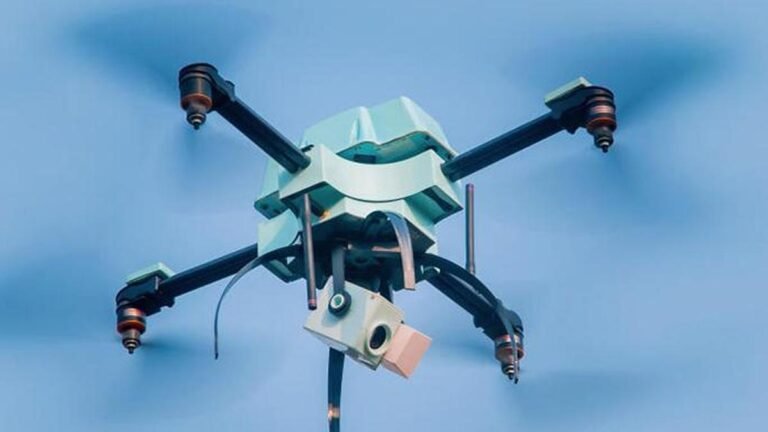
Shares of ideaForge Technology Limited surged nearly 18.5 per cent on Monday morning, touching a fresh 52-week high of ₹724, as investors reacted to the drone maker’s strongest-ever quarterly results reported.
The stock was trading at ₹721.75 on the NSE as of 10.46 am, up ₹112.55 from its previous close of ₹609.20. It opened at ₹710 and has ranged between ₹682.60 and ₹715.90 in intraday trade. The counter featured in the NSE’s top 10 most active stocks, with over 64.85 lakh shares traded and a turnover of ₹457.87 crore by mid-morning. Total market capitalization stood at approximately ₹3,121 crore.
The rally follows ideaForge’s Q4 FY26 results, in which the company posted its highest-ever quarterly revenue of ₹141.04 crore, up sharply from ₹20.31 crore in Q4 FY25. The company swung to a positive PAT of ₹59.99 crore in the quarter, compared to a loss of ₹25.71 crore a year ago. For the full year FY26, EBITDA turned positive at ₹27.12 crore against a loss of ₹31.53 crore in FY25. Total order booking for FY26 stood at approximately ₹530 crore, the highest in the company’s history, with an opening order book of ₹310 crore heading into FY27.
On a relative returns basis, the stock has significantly outperformed broader markets. It is up 80 per cent over the past month and nearly 88 per cent over the past year, against the Nifty 50’s gains of 6.4 per cent and losses of 0.7 per cent over the same periods. Year-to-date, ideaForge is up over 53 per cent while the benchmark index is down 7.5 per cent.
Sentiment has also been supported by strategic developments disclosed in the investor presentation, including the company’s first US order from the Lamar Police Department, becoming the first global drone company to train NATO forces at the US National Test Pilot School, and active development of combat drone capabilities. Sell-side pressure remains, with 54.97 per cent of the order quantity on the sell side against 45.03 per cent on the buy side, suggesting some profit-booking even as the stock holds near its highs.
Access Denied
You don’t have permission to access “http://hindi.gadgets360.com/mobiles/how-to-take-better-photos-from-budget-smartphone-easy-camera-tips-mobile-photography-tricks-features-11445264” on this server.
Japan’s prime minister, Sanae Takaichi, has called for “advanced discussions” on revising the pacifist constitution, as large demonstrations were held nationwide to oppose any changes to the country’s supreme law.
Speaking during an official visit to Vietnam, Takaichi said the constitution, which was written by US occupation forces after the second world war, “should periodically be updated to reflect the demands of the times”.
Takaichi and others on the conservative wing of the ruling Liberal Democratic party have long called for change, saying the current document restricts Japan’s ability to respond to growing security threats from North Korea and China.
Revisionists have set their sights on article 9 – the co-called “pacifist” clause – which forbids Japan from threatening or using military force to settle international disputes.
While controversial legislation passed a decade ago theoretically allows Japan to exercise collective self-defence – or coming to the aid of an ally under attack – Takaichi has turned reform into a focal point of her administration since becoming prime minister last autumn.
Any revisions would need to secure a two-thirds majority in both houses of Japan’s national diet – or parliament – and a simple majority in a national referendum.
People protest in support of Japan’s pacifist constitution in Tokyo on Sunday 3 May Photograph: Justin McCurry/The Guardian
Recent opinion polls reveal deep divisions among the public, from broad support for minor revisions, such as recognising the legal status of the self-defence forces, to opposition to fundamental changes to Japan’s postwar pacifism.
In a poll published at the weekend by the conservative Yomiuri Shimbun newspaper, 57% of respondents were in favour of revision, while a survey by the liberal Asahi Shimbun put support for reform at 47%.
The constitutional constraints placed on Japan’s military were highlighted in March, when Takaichi cited article 9 when she turned down a request – reportedly with reluctance – by Donald Trump to send the maritime self-defence forces to the strait of Hormuz.
On Sunday – constitutional memorial day – an estimated 50,000 people gathered at a park in Tokyo in support of the document, whose wording has remained unchanged since it went into effect on 3 May 1947.
Protesters holding anti-war placards said article 9 had succeeded in keeping Japan out of ill-advised US-wars, including Iran.
“Under Takaichi, Japan is following America like a dog follows its owner,” said Hiroko Maekawa, a councillor for a Tokyo ward. “The LDP wants to turn the self-defence forces into a traditional military, because they know the constitution, as it is, prevents them from doing that.”
Another local councillor, Megumi Koike, described Japan’s constitution as “a national treasure and a treasure to the world”.
Hiroko Maekawa attends a protest in support of Japan’s pacifist constitution in Tokyo on Sunday 3 May. Photograph: Justin McCurry/The Guardian
“Takaichi thinks that most Japanese people want to change the constitution because they believe there is a threat from China and North Korea, but that’s just not true,” she said. “We should be spending money on healthcare, education and jobs, not on more weapons.”
Demonstrations were held in dozens of other towns and cities on Sunday – a public holiday – attended by people old enough to recall how the postwar constitution had brought peace and stability to a country ravaged by conflict.
“I want to cherish the constitution like I do my own child, and pass it on to the next generation,” Haruka Watanabe, an 87-year-old protester in Osaka, told the Kyodo news agency.
As she prepared to travel to Australia to discuss energy security, critical minerals and defence with the prime minister, Anthony Albanese, Takaichi said the time for debate was almost over. “We mustn’t have discussion just for discussion’s sake,” she said in Hanoi, according to Kyodo.
“To retain the trust placed in them by the people, politicians must discuss the issue and make a decision.”
Although Trump has criticised Japan for not sending troops to the Middle East, the US embassy in Tokyo posted a message that could be interpreted as support for constitution, which went into effect during the US occupation led by Gen Douglas MacArthur, the supreme commander of the Allied Powers.
The document, the embassy said on its official X account, had upheld “popular sovereignty, respect for fundamental human rights, and pacifism”. It added: “This constitution, highly praised by Gen MacArthur in his memoirs, has continued to serve as the foundation of Japanese society for 79 years since its enactment, without ever having been amended.”
Sunday’s protest in Tokyo was the latest in a wave of demonstrations that are attracting people in greater numbers each time. An estimated 3,600 people demonstrated outside parliament in late February, swelling to 36,000 later that month.
Access Denied
You don’t have permission to access “http://hindi.news18.com/photogallery/sports/cricket-hardik-pandya-to-rishabh-pant-captain-fight-players-to-watch-out-for-in-mi-vs-lsg-ipl-2026-encounter-10440953.html” on this server.