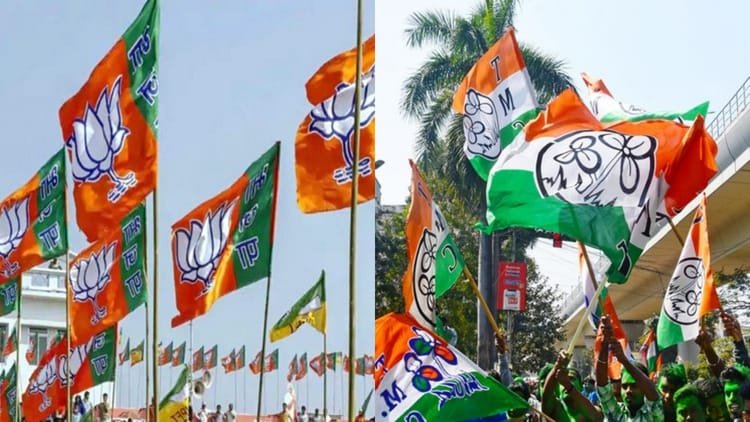
With the political temperature rising, the picture is clear in West Bengal this time too…the election will not be decided by any wave or face, but by the equations on the ground. The ruling Trinamool Congress is claiming its fourth consecutive innings with the help of its strong social alliance, women vote bank and welfare schemes. At the same time, taking lessons from the defeat of 2021, BJP is trying to make the contest direct and decisive through region-wise aggressive strategy. If the election data of 2021 is taken as any indication, then the key to power in Bengal lies not in any big narrative, but in the regional balance, social alliances and vote transfer spread from North to South and these equations will decide the fate of 2026.
The total assembly seats in Bengal are 294. In 2021, Trinamool had won 213 seats. BJP had got 77 seats. Four seats went to independents. This is not just an aggregate figure. Its real strength is understood when divided into geographical areas. The 2026 election is not just an election for change of power, but a direct contest between two different political models, welfare and regional identity versus development and national politics. Only the one who has mastered regional mathematics will be in power in Bengal.
On which issues are BJP and TMC face to face?
On the one hand, there is Trinamool Congress, which is contesting the elections keeping its welfare schemes and the issue of Bengali identity at the centre. The party is busy reaching out to voters directly with the help of schemes like financial assistance, free ration, health and social security for women. It is also giving edge to the debate of outsider versus local.
On the other hand, BJP is in the fray with the agenda of development, investment and strong infrastructure. She is making employment, industry and law and order the main issues. At the same time, it is fanning the issue of nationality through Bangladeshi infiltrators and is claiming rapid development through central schemes and double engine government. Analysts say that Bengal elections are once again making it clear that power here is not decided by any one issue, but by regional balance and vote transfer.
North Bengal: Challenge for Trinamool, lifeline for BJP
There are total 54 seats in North Bengal. This is considered the stronghold of BJP. In 2021, it got 30 seats, while Trinamool got 24. BJP gained a strong hold in the border and hilly areas. This was the area which established it as the main opposition in Bengal. BJP’s strategy in 2026 is to further increase its lead here, while the biggest challenge remains for Trinamool.
South and Central Bengal: This is where the keys to power lie
This is the biggest and decisive area from where the path of the government is decided. Rural vote bank and welfare schemes gave TMC a decisive lead here. There are total 167 seats here. Of these, Trinamool got 134 seats, while BJP got 29 and others got 4 seats.
Greater Kolkata: Trinamool’s impenetrable fort, BJP weak
The overwhelming support of urban, middle class and minority voters went with Trinamool. BJP still looks weak here at the level of organization and local leadership. There are a total of 33 seats here, out of which in 2021, Trinamool had to be content with 30 seats and BJP with only 3 seats.
Jangalmahal area: Mamata’s lost support base returned
In this tribal dominated area, Trinamool regained the lost support base after 2019. However, this area is not completely stable. Even a slight swing can change the result. Last time, Trinamool had won 25 out of 40 seats here, while BJP had got 15 seats.
other videos