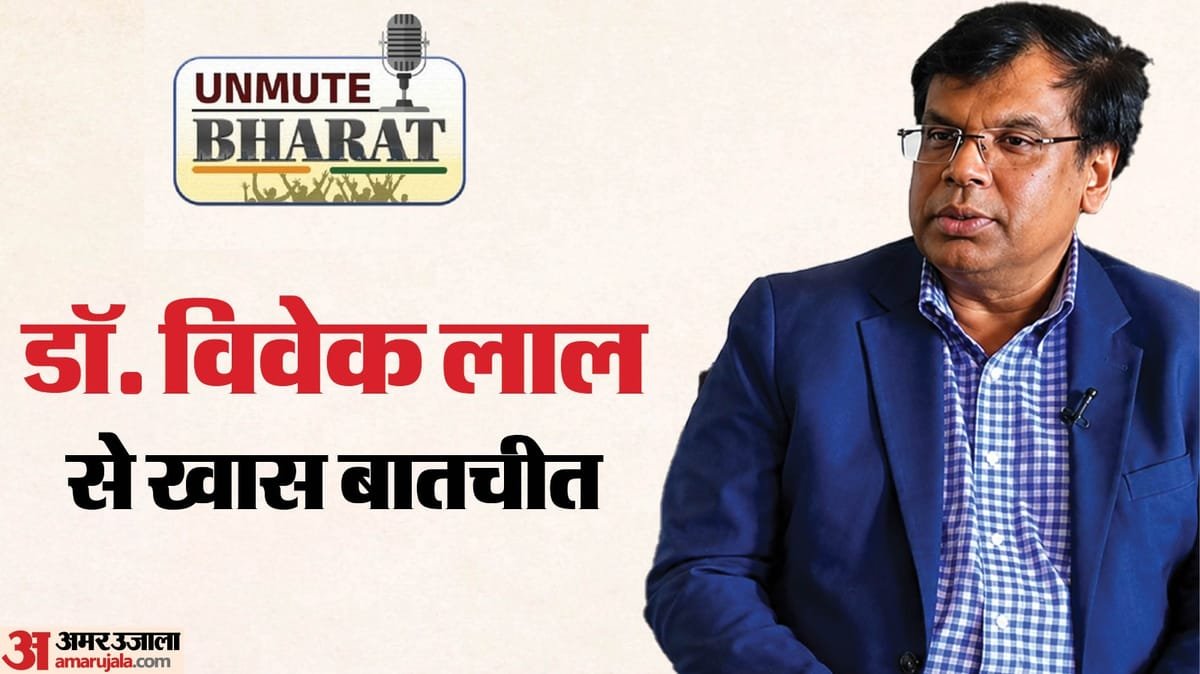
There is a big debate around the world about whether the role of army generals and admirals will end in the increasing era of Artificial Intelligence (AI) and automation? Will future wars be fought entirely by machines? Dr. Vivek Lal, Chief Executive Officer (CEO) of ‘General Atomics’, the world’s most advanced defense and drone technology manufacturing company, has completely broken this confusion in Amar Ujala’s special podcast ‘Unmute Bharat’. He clearly believes that no matter how much the autonomy of AI increases on the battlefield, destructive and important decisions cannot be left completely in the hands of machines.
The biggest moral and strategic requirement of modern war is ‘human in the loop’ i.e. human involvement in the decision process. The entire war cannot be automated at once. Navigating and handling AI and automation will require specialized skills, making the role of military commanders more important than ever in the future.
Flight from Jakarta to General Atomics
This vision of Dr. Lal is also important because he does not just handle the books of accounts of a company, but his decisions decide global diplomacy and security of countries. Born in Jakarta, this son of an Indian diplomat saw the world beyond the borders at a very young age. Paved the way for science, reached NASA’s laboratory, learned to fly a plane himself and today he is sitting on the chair from where the balance of power in the world is decided. From Boeing to Lockheed Martin and now as head of General Atomics, he believes understanding how science translates into power is the greatest need of the hour.
‘Peace through power’ and Dinkar’s message
Talking about the growing defense relations between India and America, he made it clear that this alliance is not just because of a common challenge in the form of China. Trade, democratic values and mutual trust have taken defense trade between the two countries from zero to $25 billion in the last few decades. On the contradiction of human rights and weapons manufacturing, Dr. Lal emphasized the principle of peace through strength. He clearly said that peace is protected not only by ideals but by capabilities. When a country looks weak, other countries try to dominate it. Linking this vision to the famous lines of national poet Ramdhari Singh Dinkar – ‘Forgiveness adorns that arm…’ he agreed that the idea of peace is incomplete without power.
‘Technological Triangle’ and India’s Potential for 2047
To establish India as a superpower by the year 2047, Dr. Lal suggested a technological triangle. This includes artificial intelligence, nuclear power for energy needs and unmanned aircraft (drone) systems. India’s biggest strength is its young talent. Dr. Lal believes that India has extraordinary potential to create great innovations at low cost. In cutting-edge technologies like drones and semiconductors, India can become not only a big market but also a country that provides solutions to the world. Today American companies are also learning from the talent of Indian startups.
Inspiration because did not choose the easy path
While giving the mantra of success to the youth, Dr. Lal gave the example of his own life journey. When the world was running towards IT and Computer Science, he chose his passion of Aerospace Engineering. He gave a message to the youth that they should decide their career not on the basis of trend but on the basis of their interest. Instead of skimming the surface of any topic, go deep into it and understand the basic principles.
My heart is still Indian
Dr. Lal, who directs the world’s most advanced defense systems, may live in America, but whenever he comes to India, he feels ‘homecoming’. His biggest aspiration is to see India become more technologically capable and self-reliant even after reaching the top of the global defense industry. Therefore, he also requests PM Modi to invest more in research and capitalize on the opportunities properly.