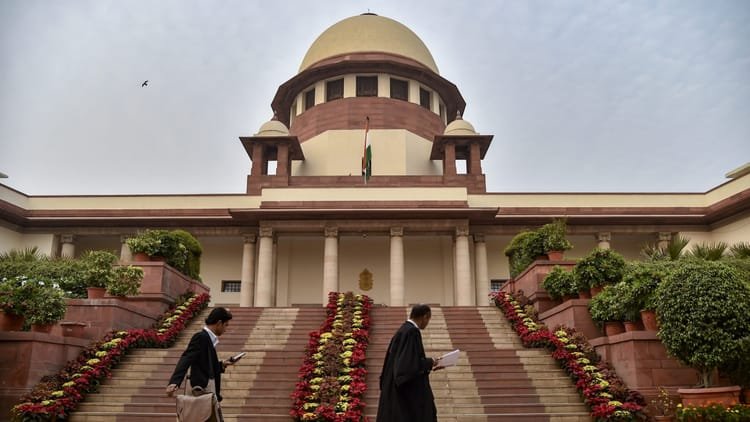
The Supreme Court has raised questions on the law of the Central Government regarding the appointment process of Chief Election Commissioner (CEC) and Election Commissioners (EC), the top posts of the Election Commission in the country. The court said that in the present selection system, the influence of the executive is so visible that it raises questions on the independence of the Election Commission.
The remarks came when the Supreme Court bench, comprising Justice Dipankar Datta and Justice Satish Chandra Sharma, was hearing petitions challenging the 2023 law under which the appointment process of the CEC and ECS has been fixed. The hearing has not been completed yet and the matter will be considered further on the next date.
Questions raised on selection committee
As per current law, the selection committee consists of the Prime Minister, the Leader of the Opposition in the Lok Sabha and a Union Minister nominated by the Prime Minister. The Supreme Court raised questions on this structure and asked why no independent member was included in it. The court remarked that in this system the decision process is almost fixed, because two members are associated with the government and the influence of the third member remains limited.
‘Leader of opposition only in formal role’
During the hearing, the court also said that the role of the leader of the opposition in the selection committee remains only symbolic. The Court questioned that if the final decision is already decided in the ratio of 2:1, then how realistic is the claim of balance in this committee. The court also asked whether any cabinet minister could be expected to go against the decision of the Prime Minister.
‘The Commission should not only appear independent, it should actually be’
During the hearing, Justice Dutta said that mere claim of independence is not enough, but the independence of the Election Commission should also be real and clearly visible. The Court reiterated that free and fair elections are part of the basic structure of the Constitution and for this the independence of the Election Commission is essential.
Government’s stand: Parliament’s authority over legislation
On behalf of the Central Government, Attorney General R. Venkataramani defended the law, saying that Parliament has the full right to make laws and it cannot be struck down in court merely on the basis of apprehensions. He said that the earlier directions of the Supreme Court were interim arrangements, which cannot disrupt the law made by the Parliament. The government’s counsel also argued that unless it is proved that the Election Commission is actually biased, the law cannot be held unconstitutional.
‘Why was the independent member not added?’
The court clarified that it is not saying that only the Chief Justice should be included in the selection committee, but the question is definitely why no independent member was kept. The court said that in other institutions, such as the appointment of heads of investigative agencies, independent members are involved, then why was this not done in an important institution like the Election Commission. The bench also clarified that its job is not to make policy, but to see whether the 2023 law is in accordance with Articles 14 and 324 of the Constitution.
Discussion on sending the matter to a larger bench
During the hearing, it was also considered to send this matter to the Constitution Bench (a larger bench of five judges), because it is an important constitutional question related to the interpretation of Articles 14 and 324. However, no consensus could be reached among all the parties on this and it was decided to continue the hearing further.
The process was amended in 2023
It is noteworthy that in 2023, the Constitution Bench of the Supreme Court had directed to include the Prime Minister, Leader of Opposition and Chief Justice in the appointments under the interim arrangement. But later the Parliament passed a new law and removed the Chief Justice from this committee and included a Union Minister.