Reference #18.94adc17.1779005511.31a5324
https://errors.edgesuite.net/18.94adc17.1779005511.31a5324
Reference #18.94adc17.1779005511.31a5324
https://errors.edgesuite.net/18.94adc17.1779005511.31a5324
Yogi government is going to take another big step towards connecting AYUSH medical education with modern technologies. The government is preparing to provide state-of-the-art 3-D anatomage tables (digital mortuaries) in AYUSH medical institutions to make studies and training more effective. Its objective is to provide modern and scientific study of human anatomy to the doctors and students associated with Ayurveda, Homeopathy and Unani systems.
In fact, availability of cadavers has long been a major challenge in medical education. In such a situation, due to limited resources for studying anatomy even in AYUSH institutes, students have to face difficulty in practical studies. In view of this, the Yogi government has prepared a strategy to connect modern digital technology with medical education. Uttar Pradesh will be the fourth state in the country to adopt it.
3-D Anatomage Table, also known as Digital Mortuary
Director General of AYUSH and Mission Director Chaitra V said that in view of the lack of availability of cadavers in medical education, the Yogi government has prepared a strategy to provide 3-D anatomy tables to the students of AYUSH institutes for studying anatomy. According to this Lucknow This facility will be provided in the Government Ayurveda College, Government Homeopathy Medical College and Government Takmeel-Uttab Unani College located there.
With this, students studying in the field of AYUSH and practicing doctors will be able to understand the internal structure of the human body in great detail even without an actual cadaver. He told that the 3-D Anatomage Table is a state-of-the-art digital equipment, which is also called “digital mortuary”. It is a large touch-screen based system that houses high-resolution 3-D models of the actual human body. Students and doctors can study the skin, muscles, nerves, blood vessels and bones of the human body by looking at it layer by layer.
Study of various organs from digital models
Director General of AYUSH said that the biggest feature of 3-D Anatomage Table is virtual dissection. In this, an actual dead body is not required, rather various parts of the body are studied through digital models. Students can rotate, zoom and view any part of the body from different angles with the touch of fingers on the screen.
Apart from this, the structures inside the body can also be understood in detail through facilities like X-ray view. This technology is not limited to education only, but is also proving useful in planning medical treatments and surgeries. In this, a three-dimensional model can be prepared by uploading the CT scan and MRI scan of the patients. This helps doctors to analyze diseases more accurately and plan treatment better.
UP will be the fourth state in the country to have the facility of 3-D anatomage table.
3-D Anatomage Table helps medical students to realistically understand the complex structures of the human body. This increases the practical understanding of the students and they can become more efficient doctors and surgeons in the future. At present this facility is available only in selected institutions of the country. Through this, virtual dissection is done in the department of ‘Anatomy’ at the All India Institute of Ayurveda, Delhi.
Apart from this, this technology is also being used in National Institute of Ayurveda, Jaipur and SDM Ayurveda College, Hassan, Karnataka. After the launch of this facility in Uttar Pradesh, the state will become the fourth state in the country, where 3-D anatomage table will be used in AYUSH medical education.
Chief Minister Yogi Adityanath Under the leadership of, work is going on rapidly towards developing world class infrastructure in Uttar Pradesh. In this sequence, with the aim of reducing traffic pressure and providing better connectivity between Noida and Delhi, the elevated road project being built from Mayur Vihar to Mahamaya flyover near Chilla Regulator is rapidly taking shape.
During this, Principal Secretary of Public Works Department, Ajay Chauhan said that this ambitious project being prepared by Uttar Pradesh State Bridge Corporation is being developed at a cost of approximately ₹ 892.75 crore. Under this project, a 5.57 km long 6 lane elevated road is being constructed, which will make the traffic between Noida, Greater Noida and Delhi more convenient.
The objective of this project is to solve the long standing heavy traffic problem in DSC Road and surrounding areas. After the construction of the elevated road, traffic will be able to directly reach Mahamaya flyover and expressway through Delhi’s Mayur Vihar, Noida Sector-14A, 15A, 16 and 18. This is also expected to significantly reduce traffic jams, travel time and pollution.
The monitoring and fast working style of the Yogi government can be gauged from the fact that the first milestone of the project has been achieved on time and currently the work is progressing as per the scheduled schedule. So far, the total physical progress of the project has been recorded at 52.11 percent and financial progress at 42.57 percent.
According to the State Bridge Corporation, so far the work of 1303 out of 1567 piles, 184 out of 271 pile caps and 410 out of 1310 girders has been completed in the project. At the same time, five major entry and exit ramps are also being built in the project, due to which Noida And uninterrupted traffic movement between different sectors of Delhi will be ensured.
The expressway, flyover and urban infrastructure based development policy of the Yogi government is establishing Uttar Pradesh among the states with the most modern connectivity network in the country. Chilla Elevated Road Project is also considered an important part of the same vision, which will give a new direction to the traffic system of NCR region in future.
The culture secretary, Lisa Nandy, has said the prime minister Keir Starmer will not have resigned by the school summer holidays, despite a major challenge to his leadership after the local election results.
“He was very clear with the cabinet on Tuesday, that if people want to challenge him there is a process for doing that, there is a way to trigger a leadership contest,” Nandy said. “Nobody has done that yet, despite the absolute feverish speculation.
“Most of it has turned out to be just froth and nonsense. We have got to get on with the job.”
Key events
Asked about former health secretary Wes Streeting’s call for the UK to re-join the European Union, the culture secretary called the stance “a bit odd”
Lisa Nandy said the government was “trying to take a far more pragmatic approach” of forming a closer relationship with the EU, “rather than re-opening the Brexit wars”.
Commenting on her former cabinet colleague’s position, Nandy said: “I just think it’s a bit odd if I’m honest. Essentially, If re-joining the EU is the answer to what we were just told loud and clear by the country and parts of the country like mine where we lost 25 out of 25 wards, then essentially what we are saying to people is life was fine in 2015, we just need to go back there.”
Nandy said Streeting will “hear loud and clear from people” while campaigning that the public in Leave voting areas did not agree with his stance.”
Asked by Trevor Phillips on Sky News why she had not told Andy Burnham to “stay in Manchester”, Lisa Nandy said she wanted the Greater Manchester Mayor – whose decision to stand as an MP has led to a by-election in Makerfield – to return to Westminster.
“When you say, ‘stay in Manchester’, we can hear you up north. Our voices matter in national politics. Andy brings a perspective from this part of the country that has not been heard loud and clear enough in Westminster for decades,” the culture secretary said.
The sort of fights we have been prepared to have in recent years, the fight for renters, the fight for workers, the fight for football fans – people need to see more of that from us. I think Andy can come and bring that perspective and that fight and that energy to this team.”
The culture secretary, Lisa Nandy, has said the prime minister Keir Starmer will not have resigned by the school summer holidays, despite a major challenge to his leadership after the local election results.
“He was very clear with the cabinet on Tuesday, that if people want to challenge him there is a process for doing that, there is a way to trigger a leadership contest,” Nandy said. “Nobody has done that yet, despite the absolute feverish speculation.
“Most of it has turned out to be just froth and nonsense. We have got to get on with the job.”
Reference #18.490dde17.1779023583.4aa763a0
https://errors.edgesuite.net/18.490dde17.1779023583.4aa763a0
Tech entrepreneurs have mocked the government’s capital gains tax changes by posting AI-generated photos of Anthony Albanese as their “new founder” and warning that increased taxes could push people away from working for new businesses or send startups overseas.
Startups and entrepreneurs may yet receive a carve-out in the federal government’s planned changes to the CGT discount, with the prime minister saying he wanted to support innovation and the treasurer, Jim Chalmers, revealing that consultation was continuing with the sector.
The CGT changes – replacing the 50% tax discount on profits with “cost-base indexation”, meaning tax on profits after inflation, and a minimum 30% tax rate – were strongly opposed by some tech founders. Early stage startup companies with little cashflow often offer employees equity in the company, or stock options, in lieu of higher pay, while founders can be motivated to take risks with new ventures by a large potential payday when they sell their companies. Both could be affected by the CGT changes, the Tech Council of Australia warned.
“There is work to do to ensure Australia’s startup community doesn’t become collateral damage as a result of proposed changes,” said the council’s chief executive, Kate Cornick.
Tim Wilson, the shadow treasurer, warned of “founder flight” overseas. The cofounder of Boost Juice, Janine Allis, also warned that winding back CGT discounts would discourage innovative businesses.
A minor trend emerged among startup founders after budget night, with several posting AI-generated photos of Albanese in their offices.
“He’s having a great time with his new 47% equity,” wrote Jacques Greeff, the founder of the communications app Kinso, who posted AI images of the prime minister in the office with his staff, coding their product and working with customers.
“With the tax changes, [the] incentive to grow a business is greatly reduced, but all the normal risks remain,” Greeff told Guardian Australia, warning it would be harder to attract talented employees if their equity stake was less lucrative.
“Australia should be encouraging young founders to build the next Canva. My fear is they don’t even attempt it now or, worse, they go overseas and build the next unicorn and Australia misses out entirely.”
Julian Fayad, the chief executive of the loan comparison platform LoanOptions.ai, posted AI images of Albanese sleeping in his company’s office and scrolling on his phone. He also warned of the impact on attracting workers and risk-taking.
Fayad took part in a roundtable meeting in Sydney on Saturday hosted by Wilson, where founders were critical of the government’s changes, and joined the shadow treasurer at a media conference afterward.
“With the 47% CGT, the government’s message to founders like me is that if we succeed, they want nearly half of the hard-earned reward,” Fayad said.
“When I look at what countries like Singapore and the UAE are doing to attract and retain founders; the incentives, the structures, the genuine support, and then look at what Canberra is doing, it’s hard not to feel abandoned and hindered.”
Alfie Robertson, the founder of the video editing app Roll, posted AI images of Albanese in the gym, recording a podcast and working on strategy. He also feared startups could look overseas.
“The concern is not just about tax,” he said. “It’s about incentives. Policies like this shape where founders choose to build, invest and stay.
“If Australia wants to compete globally for talent and innovation, it should be rewarding people who take productive risks to build companies, create jobs and grow the economy, not reducing the incentive to do so.”
Asked about the backlash on Friday, Albanese said he supported the startup sector, pointing to a range of budget incentives for research and development and instant asset write-offs. Chalmers conceded that startups may have “a different kind of cost base” to other industries.
“We had already been engaging with the tech sector, in particular, with the VC and startup sector to make sure that the changes accurately reflect the contribution that we seek from that really important part of the economy,” he said.
Cornick said the Tech Council welcomed the new R&D tax incentives and reforms to venture capital regulation, and was keen to continue consulting on the CGT.
The economist Saul Eslake said there may be a case for more generous treatment for CGT, specifically for new businesses starting from scratch, as they may be paying tax on all profits due to having no cost base to index. He backed the government’s moves to alter CGT for property and shares, and said it wasn’t unfair to expect startup founders to pay tax on business earnings but conceded some new businesses like startups may need incentives to encourage innovation and risk-taking.
“There are still pretty powerful incentives,” Eslake said. “If, instead of becoming a billionaire, you make $800m, is that less incentive?”
Another economist, Chris Richardson, warned that it would be a mistake to “bend” on the CGT.
He said incentives including R&D tax offsets and the instant asset write-off were better than carve-outs for future profits to support early-stage businesses. Richardson also backed the broader move towards taxing income from assets and income from labour in a more equal way.
“There’s a Warren Buffett quote: ‘You may run into someone with a terrific investment idea, who won’t go forward with it because of the tax he would owe when it succeeds. Send him my way. Let me unburden him.’”


Reference #18.c5d07868.1779003956.72e3e131
https://errors.edgesuite.net/18.c5d07868.1779003956.72e3e131
Yvette Cooper wrote a newspaper column about Palestine Action despite prosecutors warning it could prejudice criminal proceedings against six activists from the group, it can be revealed.
The then-home secretary wrote the column justifying Palestine Action’s proscription even though the Crown Prosecution Service advised it might unfairly impact a trial concerning a 2024 break-in at an Israeli arms manufacturer’s factory.
After a retrial, four of the defendants were convicted last week in relation to the raid on the Elbit Systems UK site near Bristol. It can now be reported that defence lawyers sought to halt the proceedings for alleged abuse of process, claiming Cooper’s column for the Observer was “an egregious example of contemptuous reporting which directly interferes with the court process”.
The article, on 17 August, said that charges against Palestine Action activists included a “terrorism connection” and also referred to violence, intimidation and “disturbing information” about future attacks.
In written submissions arguing that a fair trial would be impossible, the defence lawyers said the article was “dripping in innuendo. In one breath, she is saying that many important details cannot yet be publicly reported; in another, she is reporting some of those very details herself”.
In a pre-trial ruling last November, Mr Justice Johnson said: “It is to be taken that the home secretary was specifically advised that going ahead with the article might prejudice these proceedings, and that she went ahead anyway … The CPS made representations to the home secretary about the risk of prejudice. It follows that the home secretary took the action that she did, and made the public statements that she did, in the knowledge that these proceedings were extant and that there might well be a question as to the impact of her conduct and her statements on these proceedings.”
However, Johnson dismissed the defence application for abuse of process, saying: “The decision to proscribe Palestine Action was highly controversial and required public justification. It is unsurprising that the government sought publicly to justify the decision that it had taken and that it relied, in general terms (without naming individuals), on Palestine Action’s activities, including the activities that have resulted in these proceedings.
“In doing so, the home secretary ran a risk of causing some prejudice to these proceedings, but that is different from deliberately flouting a reporting restriction order.”
In arguing that there were “false and irremediably prejudicial public statements made by the government when seeking to justify proscription”, defence lawyers cited other articles, including a report in the Times that Home Office officials claimed Iran could be funding Palestine Action. The Home Office later distanced itself from the claim, which Johnson described as “misleading”.
The defence team also claimed there had been an abuse of process in the charges against the defendants having a terrorist connection, claiming that the authorities wanted to ban Palestine Action and “they were aware that this could not be done without pursuing terrorism related charges”. The jury was not told during the trial about the terrorist connection allegation, which could have resulted in Charlotte Head, 29, Samuel Corner, 23, Leona Kamio, 30, and Fatema Rajwani, 21, receiving much harsher sentences on 12 June for criminal damage.
The third and final ground for abuse of process alleged “collusion between the government and the Israeli state, Elbit Systems and the pro-Israeli lobby regarding the proscription”, citing meetings and/or communications involving the named parties.
Johnson ruled there was no political interference in the charging decision and that the communications with groups outside government did not come close to establishing improper conduct.
A Home Office spokesperson said: “The judge concluded that the article did not prevent a fair trial taking place.
“The trial found four Palestine Action members guilty of criminal damage, and one was also found guilty of grievous bodily harm.”
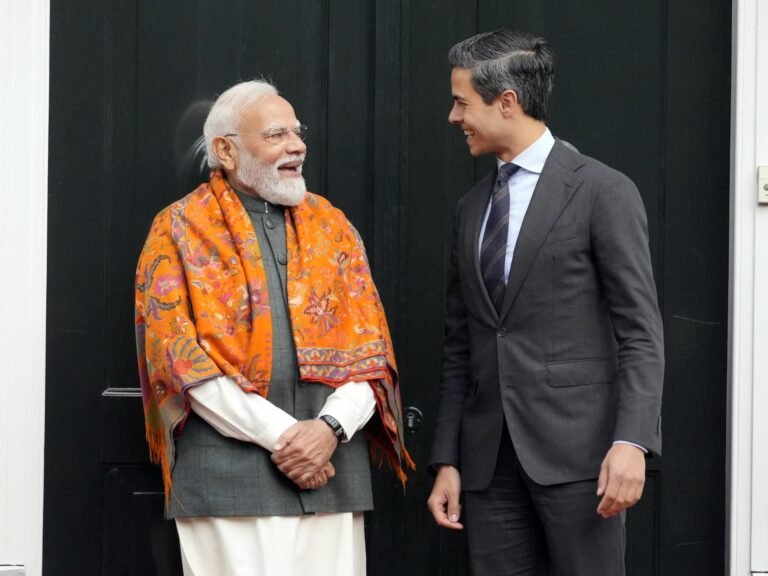
Prime Minister Narendra Modi says his talks with the Dutch PM also focused on expanding cooperation in defence and security.
Published On 17 May 2026
India’s Tata Electronics has signed a deal with Dutch technology giant ASML to build a major semiconductor plant in western India, as Prime Minister Narendra Modi visited the Netherlands during his European tour.
The agreement, announced on Saturday, will support the development of Tata’s semiconductor facility in Dholera, Gujarat – Modi’s home state.
ASML, Europe’s largest technology company by market value, manufactures advanced lithography machines used to produce high-end microchips found in products ranging from mobile phones to cars.
The Dutch company said it would help “establish and ramp up” production at the plant by supplying its cutting-edge chipmaking tools.
Tata Electronics plans to invest $11bn in the facility, which is expected to manufacture chips for artificial intelligence, the automotive industry and other sectors.
ASML chief executive Christophe Fouquet said the company saw “many compelling opportunities” in India’s growing semiconductor industry.
“We are committed to establishing long-term partnerships in the region,” Fouquet said in a statement.
The deal comes as India and the Netherlands move to deepen economic ties, with New Delhi seeking foreign technology and investment to boost manufacturing and create jobs.
The European Union has increasingly viewed India – the world’s most populous country and one of its fastest-growing economies – as a key future market.
During his visit, Modi held talks with Dutch Prime Minister Rob Jetten and met King Willem-Alexander.
“My conversations with Prime Minister Rob Jetten were extensive and covered a wide range of topics,” Modi wrote on X.
“One of them was defense and security. I spoke about the possibility of drawing up an action plan for the defense industry as quickly as possible. We can also collaborate in sectors such as space travel, maritime systems, and maritime security.”
Modi also addressed members of the Indian diaspora and is expected to inspect centuries-old Chola copper plates being returned to India by Leiden University.
Indian and Dutch officials are also discussing a more flexible visa arrangement for Indian students and workers in the Netherlands.
Modi will next travel to Sweden for talks with Prime Minister Ulf Kristersson focused on trade, innovation and green technology cooperation. The visit marks his second trip to the country since attending the first India-Nordic summit in 2018.

The investigation, which started after suddenly smoke was seen in a Punjab Mail coach in Firozpur in the month of March this year, has exposed a big racket of supplying fake electrical equipment in the Railways. The entire matter is related to fake safety equipment purchased under the official tender process of the Railways, which were fitted inside the coaches at the Matunga workshop of the Central Railway.
Considering the seriousness of the matter, the Railway Administration has officially lodged an FIR against the Kolkata-based supplier company at Shahu Nagar Police Station in Mumbai, which is directly accused of supplying fake Motor Protection Circuit Breaker (MPCB).
Actually, MPCB is a very important electrical safety component for railway coaches, whose main function is to protect the coach from major damage by stopping the power supply during overload or voltage fluctuation. Immediately after the incident, the Technical Investigation Committee constituted by the Central Railway made it clear in its report that a malfunction in these equipment could have directly posed a major threat to the safety of train passengers.
According to information received from railway officials, the Material Department of Central Railway had issued a tender for the purchase of these equipment on 8 November 2025, which this Kolkata company had won by claiming to provide genuine products of a reputed manufacturing company. After receiving the tender, a purchase order for 325 MPCBs was issued from the company on 10 December 2025, the delivery of which was handed over to the Railways in January 2026 with a forged test certificate of the original manufacturing company.
This complete security fraud came to light on March 7, 2026 when smoke was seen in coach number 222961 and initial investigation revealed that despite high voltage, these MPCBs were not tripped. When the Railway Administration, instead of just relying on the supplier’s documents, got it verified in detail, it came to light that this Kolkata company was not the authorized dealer of the original manufacturer and all the equipment was fake.
The confirmation of counterfeiting was further confirmed when on May 5, 2026, technical experts of the original manufacturing company certified in writing that at least five MPCBs from the supplied devices were completely counterfeit and their test certificates were also forged. On the basis of this detailed internal investigation and the report of experts, on the complaint of the Senior Material Manager of Matunga Workshop, Shahu Nagar Police has registered an FIR against the supplier under various sections of the Indian Code of Justice (BNS) and initiated further legal action.
