Officials of Delhi Auto Rickshaw Association had reached the Secretariat today to meet Delhi Chief Minister Rekha Gupta and Transport Minister Dr. Pankaj Kumar Singh. However, he could not meet the Chief Minister and the Transport Minister, but when he reached the Chief Minister’s office, his demand was heard and he was also given a receipt for his memorandum.
People of the Auto Rickshaw Association said that the fare was increased in 2025 also and now again the rate has been increased by two rupees per kg. But the fare has not increased since 2023. He said that everything from auto parts to tyres, CNG has become expensive, hence it has become our compulsion to increase the fare.
He said that if the government does not want the fare to increase then it should give us a subsidy of Rs 2 per kg, we will not increase the fare. If the government does not give subsidy and does not allow the fare to increase, then the auto drivers will go on strike. The strike will not end until the government accepts their demands.
Union officials accused of breach of promise
Sangh officials also accused the government of breaking promises and said that before forming the government, many promises were made during the elections but after winning the elections, all the promises were forgotten. Had gone to the Secretariat to remind him of those promises, but could not meet the CM. At present, if the government accepts the demand of the officials of Delhi Auto Rickshaw Association, then people are going to have to bear another burden of inflation.
Demand to increase minimum taxi fare
The people of Delhi Auto Rickshaw Association have demanded that the minimum taxi fare for the first kilometer should be increased from Rs 40 to Rs 70. Along with this, per km charges: The rate for non-AC taxis should be increased from Rs 17 to Rs 30 per kilometer and for AC taxis from Rs 25 to Rs 40 per kilometer.
Microsoft mitigation may bork inline images, calendar printing while admins wait for a proper patch
Microsoft has confirmed a vulnerability in on-premises Exchange Server that could result in surprise script execution in victims’ browsers.
Tracked as CVE-2026-42897, the flaw affects Outlook Web Access (OWA) and can be triggered by a specially crafted email opened in OWA, assuming “certain interaction conditions are met.” The prize for attackers is arbitrary JavaScript execution in the mark’s browser context.
The advisory describes the flaw as a spoofing vulnerability stemming from cross-site scripting, which will set alarm bells ringing for administrators, and it appears the vulnerability is being exploited. The bug was assigned a CVSS score of 8.1.
Exchange Server 2016, 2019, and the latest version, Exchange Server Subscription Edition (SE), are all affected regardless of their update level. A mitigation has been released via the Exchange Emergency Mitigation (EM) Service.
However, Microsoft warned the mitigation might break other things – inline images might stop working in the recipient’s OWA reading pane (use attachments instead) and the OWA Print Calendar functionality might not work (use a screenshot or the Outlook Desktop client).
Finally, OWA Light might not work properly. Microsoft deprecated this in 2024, so affected users should consider an upgrade.
The mitigation can also be applied manually in scenarios where customers are not using the EM service. These might be disconnected or air-gapped environments – exactly the sort of environments where on-premises Exchange tends to linger.
Microsoft is working on a full security update, although only the Exchange SE version will be publicly available. Exchange 2016 and 2019 customers will receive it only if enrolled in Period 2 of the Exchange Server Extended Security Updates (ESU) program. The second period of Exchange Server ESU kicked off this month, with Microsoft sternly warning that there would be no extensions past its end. The vulnerability does not affect Exchange Online.
Microsoft has not given any details on how the exploit works, nor how widely it is being exploited. ®
Beckham and his wife Victoria’s collective wealth reached the milestone this year, according to The Sunday Times Rich List.
Published On 15 May 202615 May 2026
Former Manchester United and England football star David Beckham has become Britain’s first billionaire sportsman, according to the 2026 Sunday Times Rich List.
Beckham and his wife Victoria’s collective wealth reached an estimated 1.185 billion pounds ($1.583bn) this year, the Rich List compilers said.
Recommended Stories
list of 4 itemsend of list
That moved them into second place in the list of the United Kingdom’s wealthiest sportspeople, behind the family of ex-Formula One chief executive Bernie Ecclestone, whose wealth was valued at 2 billion pounds ($2.7bn).
Beckham, who retired from playing in 2013, is a co-owner of Inter Miami, estimated to be Major League Soccer’s most valuable club at 1.07 billion pounds ($1.4bn).
The 51-year-old also has lucrative brand ambassador roles for companies including Adidas and Hugo Boss.
Beckham captained England and won the Premier League and Champions League during a glittering career with United, before spells at Real Madrid, LA Galaxy, AC Milan and Paris Saint-Germain.
Victoria Beckham’s wealth has largely been generated from her fashion label after she originally found fame as a member of pop band The Spice Girls.
Joining Beckham on the Rich List, seven-time Formula One champion Lewis Hamilton is fifth on the list, having built a fortune the Rich List calculated at 435 million pounds ($582m).
Reigning Masters golf champion Rory McIlroy is seventh with a 325 million-pound ($435m) valuation.
Boxer Anthony Joshua is placed at eighth with a fortune of 240 million pounds ($321m), one place above his heavyweight rival Tyson Fury, who is ninth on 162 million pounds ($217m).
Bayern Munich and England striker Harry Kane and retired former Wimbledon champion Andy Murray are joint 10th with 110 million pounds ($147m) each.
Among businesspeople with sporting associations, Manchester United co-owner Jim Ratcliffe has dropped down the overall Rich List.
His fortune shrank by 1.85 billion pounds ($2.5bn), according to the list compilers, to 15.194 billion pounds ($20.3bn).
The list compilers lowered the value of Ratcliffe’s petrochemicals company INEOS to 17 billion pounds ($22.7bn) owing to “rising debt, falling revenues and a loss of £515.7 million”.
Promoters Barry and Eddie Hearn have joined Britain’s billionaire club, with their combined wealth estimated at 1.035 billion pounds ($1.38bn).
Barry is the founder and president of Matchroom Sport, one of the leading promoters in boxing, darts and snooker, while his son Eddie is chairman of the organisation.
Access Denied
You don’t have permission to access “http://hindi.news18.com/videos/cricket/shardul-thakurs-4-wicket-haul-powers-mumbai-indians-to-a-stunning-win-in-dharamsala-10480284.html” on this server.
Access Denied
You don’t have permission to access “http://hindi.gadgets360.com/electric-vehicle/tesla-starys-first-showroom-in-bengaluru-will-soon-begin-delivery-of-model-yl-elon-musk-news-11500726” on this server.
The political controversy regarding a government school located in Parmat area of Kanpur is deepening. The school building has become very old and dilapidated, due to which regional Samajwadi Party MLA Amitabh Bajpai had decided to demolish the school and rebuild it. For this, the foundation stone laying program was fixed on May 15. However, right in front of this school is the house of BJP leader Suresh Awasthi.
Heavy police force deployed to stop the MLA
It is being told that BJP leader Suresh Awasthi had proposed to build a room in the school from the quota of MP Ramesh Awasthi, the foundation stone of which was to be laid by MP Ramesh Awasthi on May 14. But seeing the growing controversy, the MP distanced himself from the foundation stone laying program and refused to attend the program. At the same time, the question of the reputation of BJP leader Suresh Awasthi is also linked behind this entire controversy, because Samajwadi Party MLA Amitabh Bajpai wants to lay the foundation stone in front of his house, which is not acceptable to him.
In view of this, there is a tense situation in the area. Samajwadi Party MLA Amitabh Bajpai is going to lay the foundation stone for the reconstruction of the school on May 15 at 11 am, but before that, heavy police force has been deployed at his Kakadev residence. The police have converted the entire area into a cantonment to prevent the MLA from reaching the foundation stone laying site.
MLA will not wear clothes and slippers until school work is done
On this whole issue, MLA Amitabh Bajpai says that he will go to lay the foundation stone under any circumstances. He said that if the police stops him from going to the spot, he will lay the foundation stone through virtual medium. SP MLA Amitabh Bajpai, while submitting a memorandum to the Governor, said that an MLA was stopped from working in his own constituency and the havan-puja program organized by him was also not allowed to take place. MLA Amitabh organized the foundation stone laying ceremony at his own house and has vowed that until the school work is done, he will neither wear clothes on top nor slippers on bottom.
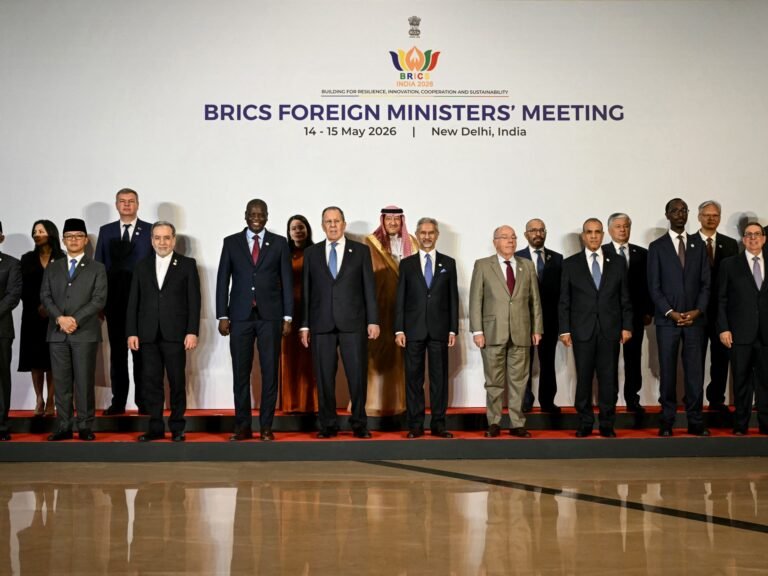
Islamabad, Pakistan – A two-day meeting of BRICS foreign ministers in New Delhi ended on Friday without a common position on the war on Iran, with the bloc’s outcome document acknowledging only that “differing views” remained among members.
It was the second consecutive BRICS gathering in India to fail to produce a consensus on the conflict involving the United States and Israel.
Recommended Stories
list of 4 itemsend of list
The meeting opened on Thursday at Bharat Mandapam in New Delhi under the chairship of Indian External Affairs Minister Subrahmanyam Jaishankar. It marked the first major ministerial engagement under India’s 2026 BRICS presidency.
The 10-member grouping of emerging economies coordinates on economic and security issues while seeking a greater voice for the Global South in institutions long dominated by Western powers. A leaders’ summit is scheduled for September in India.
The meeting unfolded against the backdrop of the US-Israel war on Iran, now in its 77th day.
The latest conflict began on February 28 with US and Israeli strikes on Iranian military sites, nuclear facilities and infrastructure. Since then, Iran closed the Strait of Hormuz to commercial shipping, global energy prices have surged and diplomatic efforts, including Pakistan-mediated talks in Islamabad last month, have stalled. The US also imposed a naval blockade on Iranian ports on April 13.
The BRICS meeting coincided with US President Donald Trump’s state visit to China, the first by an American president to Beijing in nearly a decade. Chinese Foreign Minister Wang Yi was in Beijing, so China was represented at the BRICS meet instead by its ambassador to India, Xu Feihong.
Alongside Araghchi, the meeting was attended by Russia’s Sergey Lavrov, Brazil’s Mauro Vieira, South Africa’s Ronald Lamola, and the foreign ministers of Indonesia, Egypt and Ethiopia.
Indian Prime Minister Narendra Modi met the visiting ministers on the sidelines before departing for Abu Dhabi.
The United Arab Emirates sent Khalifa bin Shaheen Al Marar, its minister of state for foreign affairs, rather than its foreign minister.
Iran-UAE confrontation
Iranian Foreign Minister Abbas Araghchi had initially avoided naming the UAE in his formal address once the summit began. Later, he said that it was not an act of restraint but “for the sake of maintaining unity”, according to Iranian state media.
Araghchi urged BRICS members to explicitly condemn what he described as US and Israeli “violations of international law” and to “take concrete action to halt warmongering and bring an end to the impunity of those who violate the UN Charter”.
“We believe that BRICS can, and must, become one of the principal pillars in shaping a more just, balanced and humane global order, an order in which might can never be right,” he said.
The UAE’s representative, Al Marar, used his own statement to single out Iran in his national statement and called for condemnation of Iranian actions, according to media reports.
The exchange exposed the deepest fault line within the expanded bloc, which now includes both Iran and the UAE as full members despite the two standing on opposite sides of an active conflict.
After all member states had spoken, Araghchi requested the floor again.
“The UAE was directly involved in the aggression against my country,” he told the gathering, according to the Iranian state media. “When the attacks started, they didn’t even issue a condemnation.”
He accused the UAE of allowing the US to use Emirati territory to launch attacks on Iran and said Emirati aircraft had directly participated in strikes.
“Yesterday it was revealed that UAE fighter jets participated in attacks against us and even took direct action against us. Therefore, the UAE is an active partner in this aggression,” he said, according to Iran’s IRNA news agency.
Araghchi also criticised Abu Dhabi for not condemning an attack on a school in Minab city on the first day of the conflict, in which Iran says about 170 students were killed.
Iran, he argued, had not attacked the UAE itself, but only US military bases located on Emirati territory.
The UAE rejected that characterisation. Abu Dhabi says Iranian strikes targeted energy infrastructure and civilian facilities inside the country, and that it has intercepted more than 2,800 Iranian drones and missiles since February 28.
Al Marar, for his part, reiterated the UAE’s demand for condemnation of Iranian attacks on energy infrastructure and other facilities.
Iran’s Foreign Minister Abbas Araghchi attends the BRICS foreign ministers’ meeting at Bharat Mandapam in New Delhi, India, on May 14, 2026 [Adnan Abidi/Reuters]
India’s Jaishankar, navigating the dispute as chair, called for “safe and unimpeded maritime flows through international waterways, including the Strait of Hormuz and Red Sea”, adding that unilateral sanctions “cannot substitute dialogue, nor can pressure replace diplomacy”.
He also reminded members that “it is essential for the smooth advancement of BRICS that later members fully appreciate and subscribe to the BRICS’ consensus on various important issues”.
On the sidelines, Jaishankar held a bilateral meeting with Araghchi and later posted on X that they had a “detailed” discussion on regional developments and bilateral ties.
No consensus again
This was not the first BRICS meeting in India to end without consensus over the Iran war.
On April 24, India hosted a BRICS deputy foreign ministers’ and special envoys’ meeting on the Middle East, also in New Delhi. That gathering ended without a joint statement, with India issuing only a chair’s summary.
Iran had pushed for language recognising that the US and Israel initiated the conflict, while the UAE demanded wording condemning Iranian strikes on Gulf states.
Since February 28, BRICS has not issued a single joint statement on the war, under India’s chairship.
The outcome document issued at the close of the meetings this week reflected the impasse.
On the conflict in the Middle East, it noted only that “there were differing views among some members” and listed a set of general principles – the need for dialogue and diplomacy, respect for sovereignty, unimpeded maritime flows and the protection of civilian lives – without naming any party or assigning responsibility.
Iran’s demand that the bloc condemn US and Israeli aggression went unmet. The UAE’s push for language condemning Iranian strikes went equally unmet.
Addressing a media briefing at the Iranian embassy in New Delhi on Friday, Araghchi appeared to blame the UAE — a BRICS member state that has “its own special relationship with Israel” — for there being no consensus document at the end of the meeting.
“The only reason they stopped the final statement was their support for Israel and the United States in their aggression against Iran, which is very, very unfortunate,” said Araghchi.
The Iranian diplomat went on to say that the country in question cannot be protected by the US and Israel, and that US military installations that were meant to provide it security had become a source of insecurity. “That was proved during this war,” said Araghchi.
The document did condemn “the imposition of unilateral coercive measures that are contrary to international law”, language widely understood as a reference to US sanctions on Iran, though Washington was not named.
On other agenda items, the meeting was more productive. Member states reached agreement on more than 60 issues, including energy cooperation, trade, digital infrastructure, climate action and multilateral reform.
Why it matters
For Jauhar Saleem, a former Pakistani diplomat, the outcome was unsurprising.
“BRICS is an organisation with some very important countries, but it remains a disparate group with very different foreign interests, perspectives and agendas,” he told Al Jazeera.
On the Iran war specifically, he said consensus was never realistic.
“There was no possibility of a joint approach to begin with, and negotiations on a joint statement quite expectedly turned out to be a damp squib,” he said.
Saleem argued that the episode reflected a broader shift in global diplomacy.
“Bloc politics is going to become increasingly irrelevant in this era where even the most cohesive alliances are almost breaking apart,” he said.
That dynamic, he added, plays to Pakistan’s strengths.
Islamabad has sought to position itself as a mediator between Washington and Tehran, hosting talks last month while maintaining channels with both sides.
“Pakistan’s balanced approach, focused on bilateralism, is more suited to these times where walking a diplomatic tightrope is a norm rather than a novelty,” Saleem said.
“Pakistan’s remarkable diplomacy goes to the trust it has created by taking principled positions on international issues rather than being swayed by short-term interests.”
Artificial intelligence (AI) already shows up in your phone, your searches and plenty of apps you use every day. Now, some Silicon Valley investors are betting the machines behind those AI answers could one day run at sea.
A company called Panthalassa has raised $140 million in new funding to develop and deploy autonomous, floating AI computing nodes powered by ocean waves. The Series B round brings Panthalassa’s total funding to $210 million, a sign that investors are taking this ocean-based AI idea seriously. The round was led by Peter Thiel, the Palantir co-founder, and the company says the money will help complete a pilot manufacturing facility near Portland, Oregon. Panthalassa also plans to deploy its Ocean-3 pilot node series in the northern Pacific Ocean later in 2026.
Instead of building another giant AI data center on land, Panthalassa wants to place computing power out at sea. Ocean waves would generate electricity. Seawater would help with cooling. Onboard computing systems would process AI prompts and send the results back to land through low-Earth-orbit satellites.
Sign up for my FREE CyberGuy Report
LOWERING YOUR ELECTRIC BILL COULD BE FLOATING IN THE OCEAN
Get my best tech tips, urgent security alerts and exclusive deals delivered straight to your inbox.
For simple, real-world ways to spot scams early and stay protected, visit CyberGuy.com– trusted by millions who watch CyberGuy on TV daily.
Plus, you’ll get instant access to my Ultimate Scam Survival Guide free when you join.
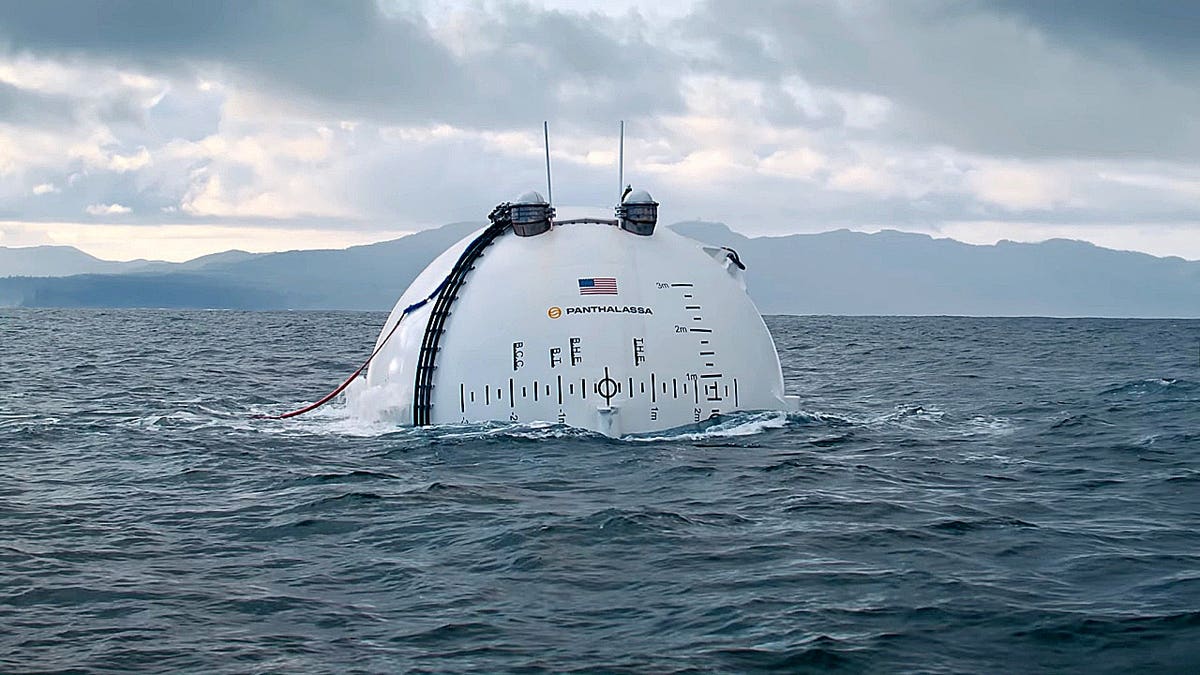
Panthalassa’s Ocean-2 prototype rides in open water during testing, giving a real-world look at the kind of floating wave-energy system behind the company’s ocean AI plan.(Panthalassa)
How AI data centers at sea could work
Panthalassa’s floating nodes are designed to capture wave motion and turn it into electricity. The company says it has spent a decade developing the technology behind its power generation, onboard computing and autonomous ocean operations. Its earlier Ocean-1, Ocean-2 and Wavehopper prototypes were tested in 2021 and 2024. Think of each node like a floating power station with AI hardware inside. Waves move the system. That motion helps drive a generator. The power then feeds the onboard chips.
WHY AI IS CAUSING SUMMER ELECTRICITY BILLS TO SOAR
The company’s plan is to use those chips for AI inference. That is the part of AI where a model responds to your prompt after it has already been trained. In simple terms, it is what happens when you ask a chatbot a question and get an answer back. That makes the ocean plan a little easier to understand. Training massive AI models requires huge data movement and tight coordination. Answering prompts may be more realistic for a floating node, at least in some situations.
Why AI data centers are moving offshore
AI data centers need huge amounts of electricity. They also need space, cooling systems and local support from communities that may not want a massive facility nearby. Those problems have pushed companies to look for unusual answers. Ocean-based computing is one of them.
Panthalassa says its nodes would operate far from shore in wave-rich parts of the ocean. The goal is to use that wave energy directly onboard instead of sending the power back to land. “We’ve built a technology platform that operates in the planet’s most energy-dense wave regions, far from shore, and turns that resource into reliable clean power,” said Garth Sheldon-Coulson, Panthalassa’s co-founder and CEO.
A SUPERCOMPUTER CHIP GOING TO SPACE COULD CHANGE LIFE ON EARTH
The ocean also offers cold surrounding water. That could help cool the chips onboard. Cooling is a major issue because data centers produce a lot of heat. Panthalassa is taking a different path from traditional land-based data centers. Instead of pulling more power from the grid, it wants floating nodes that generate their own electricity from waves.
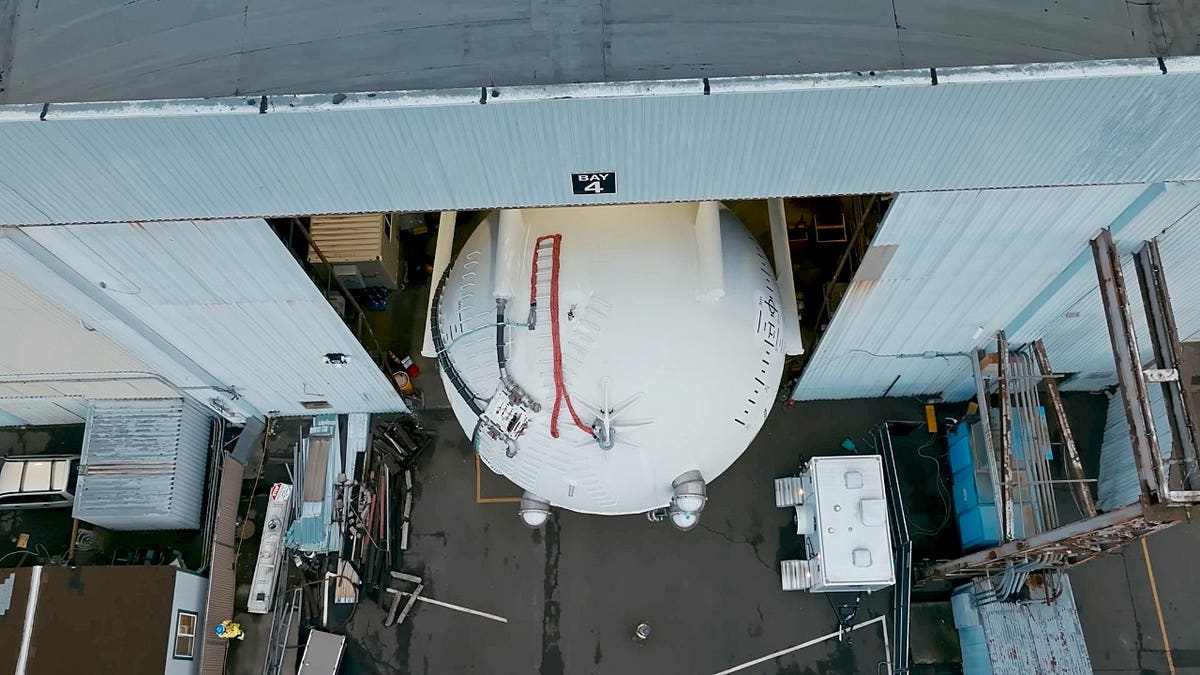
The Ocean-2 prototype sits inside a coastal facility, showing the size and shape of Panthalassa’s floating node before deployment at sea.(Panthalassa)
The satellite problem for ocean AI data centers
The ocean may help with power and cooling, but it creates another problem: connection. Traditional data centers rely on high-capacity fiber-optic connections because they need to move huge amounts of data fast. A floating node far out at sea may depend on low-Earth-orbit satellite links. That can work for some AI responses, but it may be slower and more limited than fiber.
SOLAR DEVICE TRANSFORMS USED TIRES TO HELP PURIFY WATER SO THAT IT’S DRINKABLE
The challenge grows when multiple nodes need to work together. AI systems often depend on fast communication between chips, servers and storage. If those parts are floating in the ocean and talking by satellite, coordination gets harder. That means AI data centers at sea may not replace land-based data centers anytime soon. They may be better suited for certain AI tasks where the model can live onboard, and the response does not require constant back-and-forth with other machines.
Repairing floating AI nodes could be difficult
There is another practical question: What happens when something breaks? A land-based data center can send in technicians. A floating AI node in rough seas may need a ship, special equipment and the right weather window. That adds cost and delay.
Panthalassa says it is developing autonomous systems meant for harsh ocean conditions. Its press release says Ocean-3 testing is meant to demonstrate AI inference and refine manufacturing before commercial deployments in 2027. Still, the ocean is brutal. Saltwater eats away at equipment. Storms can turn a routine repair into a major operation. Constant motion also puts stress on the hardware. For this plan to work, Panthalassa will have to show that each node can keep running for years in harsh ocean conditions without frequent human repairs.
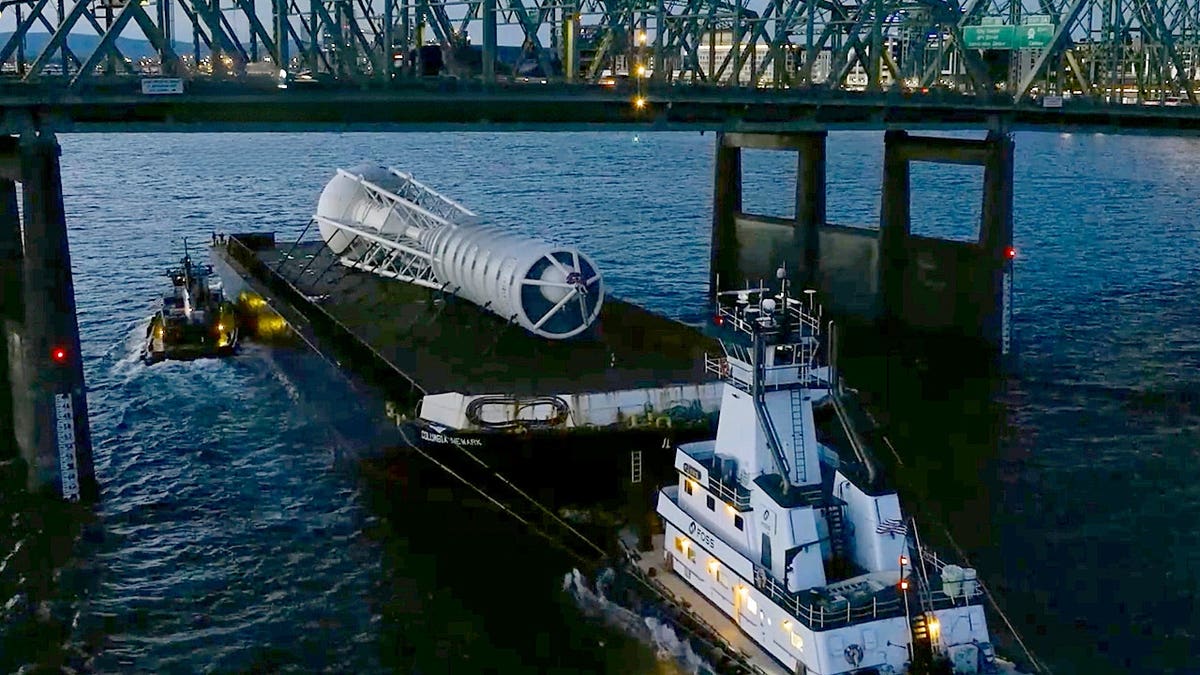
Panthalassa’s Ocean-2 prototype is transported by barge, a reminder that building AI infrastructure at sea also means solving major deployment and maintenance challenges.(Panthalassa)
Ocean data centers have been tested before
Ocean data centers are not new. Microsoft experimented with underwater data center servers through Project Natick, including tests in 2015 and 2018. Those tests showed that sealed underwater servers could run reliably while using seawater for cooling, with Microsoft reporting a lower failure rate than comparable land-based systems. Microsoft later ended the project.
Chinese companies have also reportedly pushed ahead with underwater data center projects near Hainan and Shanghai. Keppel has explored floating data center designs in Singapore, where land constraints make the concept especially attractive. Panthalassa’s plan goes in a different direction. It combines wave power with onboard AI chips and satellite-based results. It also depends on floating nodes that would need to operate far from the kind of support a normal data center gets. That is why the idea is getting attention. It is also why skepticism is fair.
FOX NEWS AI NEWSLETTER: SCAMMERS CAN EXPLOIT YOUR DATA FROM JUST 1 CHATGPT SEARCH
What AI data centers at sea mean for you
For now, this will not change how your phone or computer works. You will not suddenly see a “powered by ocean waves” label on your favorite AI app. But the bigger picture affects everyone. AI needs an incredible amount of electricity. As more companies add AI tools to their products, they need more places to run those systems. That pressure can affect energy grids, water use, local battles over new data centers and even your utility bills over time.
Panthalassa argues its approach could reduce the need for new data centers and power plants on land. That could ease pressure on local communities and the grid, but the company still has to prove the system can work reliably at sea. If ocean-based AI moves beyond testing, it could also raise fresh questions about marine maintenance, environmental oversight and who controls computing infrastructure in international waters.
Take my quiz: How safe is your online security?
Think your devices and data are truly protected? Take this quick quiz to see where your digital habits stand. From passwords to Wi-Fi settings, you’ll get a personalized breakdown of what you’re doing right and what needs improvement. Take my Quiz here: Cyberguy.com
Everyone is using AI on their phones and computers these days, but the heavy lifting often happens in huge data centers behind the scenes. That is why Panthalassa’s ocean plan is getting attention. The company wants to use waves for power and seawater for cooling. The hard part is proving that floating AI nodes can survive rough seas, limited satellite links and complicated maintenance. If Panthalassa can pull it off, ocean-based AI could become part of the tech we use every day. If it cannot, it may show just how difficult it is to keep feeding AI’s growing demand for power.
If this kind of ocean-powered AI takes off, would you worry about what these floating nodes could mean for our oceans? Let us know by writing to us at Cyberguy.com
Sign up for my FREE CyberGuy Report
Get my best tech tips, urgent security alerts and exclusive deals delivered straight to your inbox.
For simple, real-world ways to spot scams early and stay protected, visit CyberGuy.com– trusted by millions who watch CyberGuy on TV daily.
Plus, you’ll get instant access to my Ultimate Scam Survival Guide free when you join.
Copyright 2026 CyberGuy.com. All rights reserved.
Kurt “CyberGuy” Knutsson is an award-winning tech journalist who has a deep love of technology, gear and gadgets that make life better with his contributions for Fox News & FOX Business beginning mornings on “FOX & Friends.” Got a tech question? Get Kurt’s free CyberGuy Newsletter, share your voice, a story idea or comment at CyberGuy.com.
This year has not brought good for the farmers of Kashmir, especially this year is going to prove bad for the apple farmers. First Season The increase in the cost of production due to the impact of Corona and now the high prices of petrol and diesel has increased the problems of the farmers. In the month of May, apple orchards suffered 75-90 percent damage due to heavy hailstorm in many areas of North, South and Central Kashmir. There has been considerable damage to apple orchards in Baramulla, Kulgam, Shopian and Anantnag districts.
In fact, the increase in the prices of petrol and diesel due to the Iran war has increased the problems of the farmers. Paddy cultivation is to start in the next few days in Kashmir, but the medicinal season has already started in apple orchards. Everywhere people are seen working with small tractors running on diesel and sprayers running on petrol.
Increase in prices of petrol and diesel reduced farmers’ profits
Apart from this, high prices of petrol and diesel have reduced the profits of farmers. According to farmer Abdul Hameed of Saheb, Anantnag, ‘Diesel-petrol is used for every work, even diesel is sprayed to protect trees from diseases.
Farmer Abdul Hameed has also said that “Horticulture is already in trouble for the last several years. The rates are getting low. On one hand the prices of medicines are high and on the other hand the prices of diesel are now high. The government should withdraw this change.” The farmer also said that “For the new hybrid variety of apple orchards, the expenses have increased further…because there is a lot of use of drip irrigation and water pumps in them, the expenses of which have increased.”
Additional load increased due to increase in diesel prices
According to Sahil, a young and small farmer, where his orchard used to cost Rs 20,000 worth of diesel in a year, now it will cost him Rs 30,000 because everything in his orchard is mechanized. The farmer told that the apples are not fully ripe yet and the farmers are worried about the crop being ready and not getting good prices in the market. The farmer said that if the expenses increase and the prices remain the same then he will be called a farmer.
Microsoft is introducing a new capability that will allow it to remotely roll back problematic Windows drivers delivered through Windows Update.
Called Cloud-Initiated Driver Recovery, the new feature will remove the need for hardware partners or end users to manually fix driver issues once drivers have been distributed to devices. The recovery process is entirely managed by Microsoft, with no partner-side actions required, and will only be initiated for Windows drivers rejected due to quality issues during shiproom evaluation.
Under the current system, if a driver distributed through Windows Update has quality issues, the hardware partner must submit a replacement, or users must manually uninstall the faulty driver, which can leave devices using subpar drivers for a long time.
With Cloud-Initiated Driver Recovery, Microsoft can directly trigger a rollback to a previous, stable driver version (or the next best version available on Windows Update) without requiring new software or actions from hardware partners.
“Today, when a driver published through Windows Update is identified after distribution to have quality issues, the remediation path relies on the hardware partner to submit an updated driver — or on end users to manually uninstall the problematic driver themselves. This creates a gap where devices may remain on a low-quality driver for an extended period,” Microsoft said.
“With Cloud-Initiated Driver Recovery, Microsoft can now trigger a recovery action directly from the Hardware Dev Center (HDC) Driver Shiproom, rolling back a problematic driver to the previously known-good version via the Windows Update pipeline. This is handled through coordinated updates to the PnP driver stack and the driver flighting and publishing services.”
The company also noted that:
Devices where a Driver Shiproom-approved driver cannot be located will not attempt Cloud-Initiated Driver Recovery
Recovery is delivered through the existing Windows Update infrastructure — no new client agent or partner tooling is required.
The new Windows Update feature is being tested between May and August and will begin rolling back drivers rejected during Flighting or Gradual Rollout starting September 2026.
Last week, at WinHEC 2026 (the Windows Hardware Engineering Conference) in Taipei, Microsoft unveiled a Driver Quality Initiative (DQI) to raise driver quality, reliability, and security across the Windows ecosystem, in coordination with OEM, silicon, and hardware partners.
“In the months ahead, we will keep investing in the fundamentals that matter most to customers: reliability, security, performance, compatibility and quality,” Microsoft said. “We’ll also keep collaborating with OEMs, silicon partners, IHVs, ODMs and the broader hardware ecosystem through the Windows Resiliency Initiative, the new Driver Quality Initiative and the work we do together every day.”
In June 2025, Microsoft also announced plans to periodically remove legacy drivers from the Windows Update catalog to mitigate compatibility issues and security risks.
Automated pentesting tools deliver real value, but they were built to answer one question: can an attacker move through the network? They were not built to test whether your controls block threats, your detection rules fire, or your cloud configs hold.
This guide covers the 6 surfaces you actually need to validate.