Iran’s Foreign Minister Abbas Araghchi said that Israel’s assassination of Iranian Supreme National Security Council Secretary Ali Larijani will not deal a fatal blow to the country’s leadership. In an interview with Al Jazeera after Tehran confirmed Larijani’s killing, Arghachi said that America and Israel have yet to understand that Iran’s government is not dependent on any one person.
What did Araghchi say on Larijani’s death? He said that I do not understand why the Americans and Israelis have not yet understood that the Islamic Republic of Iran has a strong political structure, in which political, economic and social institutions are established. The presence or absence of any one person does not affect this structure. He further said that of course individuals are influential and each person plays his role. Some better, some worse, some less, but the important thing is that Iran’s political system is a very solid structure.
Referring to the assassination of Ali Khamenei, Araghchi said that the system continued to function despite the huge national loss. The Foreign Minister said, “We had no one more important than the leader and despite the leader being martyred, the system continued its work and immediately appointed a new leader.” He further said, “The same thing will happen if someone else is martyred. If the Foreign Minister ever gets martyred, someone else will be ready to take his place.”
Ghulamreza Sulemani also died Iran’s state media confirmed on Tuesday that Brigadier General Gholamreza Soleimani, head of the Basij, a paramilitary group under the Islamic Revolutionary Guard Corps, was also killed in an attack by the American-Zionist enemy. Soleimani, who was the commander of Basij, the country’s most powerful internal security force, for the last six years had emerged as a key leader in the fight.
What did Al Jazeera’s Marwan Bishara say? Al Jazeera senior political analyst Marwan Bishara said Israel has long engaged in killings of its political opponents, which is not normal in a war. He said, “In wars you do not start by killing political leaders, including elected leaders. This program of assassinations is hooliganism, it is terrorism, it is not the normal course of war.” Bishara said that the system in Iran is strong and the murder of a leader will not collapse the system, yet such murders definitely have an impact somewhere.
Araghchi said that we did not start the war. America started it and is responsible for all the human and financial consequences of this war, whether it is for Iran, the region or the whole world. America should be held accountable for all this.
Cape Town, South Africa – Just after sunrise, the call to prayer drifts across a community at the foot of Cape Town’s Table Mountain.
From the minaret of the Auwal Masjid – South Africa’s oldest mosque, built in 1794 – the adhan echoes through the narrow streets and brightly coloured houses of Bo-Kaap, a historically Muslim community.
Recommended Stories
list of 3 itemsend of list
But beneath that familiar call that has rung out for more than two centuries, a quieter shift is unfolding.
Across Bo-Kaap – and much of Cape Town’s inner-city – rising property prices, growing investor demand, and the rapid spread of short-term rentals are fuelling fears that one of the city’s oldest-living neighbourhoods could slowly disappear.
Heritage under siege
For local photographer Yasser Booley, the change has been gradual, but impossible to ignore.
“The biggest changes I have seen are the slow choking of my living culture through the accelerated sale of homes to high net worth individuals, the majority of whom have no connection to the place or the culture,” he says.
Booley, 50, an eighth-generation Bo-Kaap resident, grew up in a neighbourhood where extended families often lived within a few streets of one another – bound by mosques, schools, and a shared history shaped by culture, colonial rule, and apartheid.
Today, Booley says, that social fabric is under strain, as the neighbourhood’s growing popularity with tourists and investors begins to reshape everyday life – from the kinds of businesses opening in the area, to how homes are used.
For him, the changes are not only visible in who lives in the neighbourhood, but in how Bo-Kaap itself is being viewed from the outside.
Tourists stop outside shops in Bo-Kaap [Courtesy of Yasser Booley]
Across Cape Town’s prime property market, international demand has become increasingly visible. Data from the Seeff Property Group shows foreign buyers accounted for about 2.8 billion rand ($168m) – roughly a quarter of the 11.3 billion rand ($679m) in property sales across the Atlantic Seaboard and City Bowl in the past year.
And as demand from wealthy buyers grows, residents say the consequences are unfolding inside the neighbourhood itself.
Homes that once housed generations of the same families are increasingly sold to foreign investors or converted into short-term rentals like Airbnb.
Younger residents, meanwhile, are finding it even harder to remain in the neighbourhood their families have called home for decades – some, for centuries.
“I have seen my generation leave the Bo-Kaap en masse because they can’t afford to live here anymore,” Booley says. “Where young people do happen to have the resources to buy in the area, there seems to be an invisible barrier [to entry].”
For Booley, this raises a deeper question: whether the community that built Bo-Kaap can still afford to stay here.
“It is, culturally speaking, a dire state of affairs when the hard-fought battles of our ancestors come to nought, ” he says.
Tourism boom or housing squeeze?
In recent years, Cape Town’s rise as a global tourism destination has quietly transformed the economics of its inner-city housing market.
In 2025 alone, the city welcomed about 3.3 million international travellers, according to Airports Company South Africa.
For travellers, neighbourhoods clustered around the City Bowl, such as Bo-Kaap, have become central to that tourism economy, offering something increasingly rare in global cities: a historic district where culture, architecture and daily life still coexist.
But those same qualities have made the area prime real estate.
Short-term rental platforms have accelerated that shift.
Data from rental analytics firm AirDNA shows more than 31,000 active short-term rental listings operating across Cape Town, with some of the highest concentrations around the central business district – 26,000 Airbnb listings alone.
For property owners, the returns can be considerable. According to AirDNA, some short-term rentals in central Cape Town generate more than 400,000 rand ($24,000) a year – often far outpacing what traditional long-term rentals can bring in.
By comparison, a similar apartment rented long-term to a local tenant typically earns between 12,000 and 18,000 rand ($720 – $1,080) a month – or about 144,000 to 216,000 rand ($8,640 – $13,000) a year.
The sun rises over Cape Town’s Bo Kaap, an area situated close to the heart of Cape Town, where property prices are rising [Reuters]
But tourism is only one part of the story.
Cape Town has also become a magnet for remote workers and digital nomads – professionals earning salaries in stronger foreign currencies while living in South Africa.
In 2024, the government introduced a digital nomad visa allowing foreign remote workers employed abroad to live in South Africa for extended periods – as part of a push to attract international talent, tourism and investment.
Drawn by the city’s climate, scenery, and relatively lower cost of living, many can afford rents far beyond what most local residents earn.
“Remote workers and international buyers have put affordability beyond the means of locals,” argues Booley.
The gap between local incomes and housing costs is stark.
According to South Africa’s Quarterly Labour Force Survey, the median monthly salary in South Africa is estimated to be roughly 15,000 to 18,000 rand (about $800 to $950).
By contrast, long-term rentals in central Cape Town frequently exceed 20,000 rand ($1,200) per month, with some properties commanding significantly higher prices during peak tourist seasons.
Cape Town-based housing advocacy organisation Ndifuna Ukwazi says many low- and middle-income workers are increasingly being priced out of the inner city, despite holding full-time jobs.
The widening gap between wages and housing costs, it warns, is contributing to a growing class of the so-called “working homeless”- people who are employed but still unable to secure stable housing.
For the Bo-Kaap Civic and Ratepayers Association (BKCRA), a community organisation representing residents and property owners in the historic neighbourhood, the effects of the property boom are no longer theoretical. They are unfolding house by house, street by street.
“The community absolutely views the current situation as a form of economic displacement,” says Sheikh Dawood Terblanche, chairperson of the BKCRA.
He says while residents are not being forcibly removed by law, a quieter form of displacement is under way – driven by rising property prices, escalating municipal rates and the broader cost of living.
And the fears are not new.
In 2019, thousands of residents took to the streets of Bo-Kaap to protest against large-scale property developments they believed threatened the historic neighbourhood. The demonstrations drew national attention and eventually led to the area being granted a Heritage Protection Overlay Zone (HPOZ) status – designed to protect its distinctive architecture and streetscape.
But while the heritage designation helped shield the neighbourhood’s colourful houses from demolition, locals say it does little to protect the people who live inside them.
Instead, residents say the effects are increasingly felt right at their front doors.
“The pressure is intense and constant,” Terblanche says.
“Residents report being frequently approached by agents with high-cash offers, often targeted at elderly homeowners and the vulnerable.”
Vividly painted houses and a mosque are seen in Cape Town’s historic Bo-Kaap area [File: Mike Hutchings/Reuters]
The cost of staying
For some residents, the pressure does not come only from investors; it comes from the rising cost of remaining in the neighbourhood.
As property prices across Cape Town’s inner city have climbed over the past two decades, municipal valuations have risen alongside them. Higher valuations translate directly into higher property rates – turning once-modest family homes into expensive assets.
Across Cape Town, property values have risen by an average of about 10 percent a year, consistently outperforming other major metros, including the country’s economic hub, Johannesburg.
In some areas, the increases have been far steeper: property prices have climbed by more than 200 percent over the past decade, while municipal rates and charges have surged by nearly 500 percent.
For older residents in Bo-Kaap, the consequences can be particularly severe.
“For pensioners on fixed incomes, the resulting property rates are often higher than their monthly pensions. Many are forced to sell simply because they can no longer afford the ‘tax of living’ in their ancestral homes,” Terblanche says. South Africa’s state old-age pension is about 2,190 rand ($115) a month, paid through the South African Social Security Agency – leaving little room for homeowners facing rising municipal property rates.
For younger generations, the barrier is different: entry.
Property prices in Bo-Kaap have risen sharply over the past decade, as investor demand and tourism have driven up property values across the inner city.
One-bedroom entry-level homes now regularly sell for between 2.5 million and 3 million rand – roughly $135,000 to $160,000 – placing ownership far beyond the reach of many families whose roots in the area stretch back generations. Less than a decade ago, similar homes sold for about 1.6 million rand (around $100,000).
Across Cape Town more broadly, the affordability gap has widened dramatically. Research estimates that more than 90 percent of households cannot afford property in the City Bowl, where housing prices have risen far faster than wages.
Cape Town’s iconic Table Mountain looms behind the City Hall as the clock strikes noon above informal traders at the city’s Grand Parade [File: Mike Hutchings/Reuters]
The City’s position
But City of Cape Town officials say the pressures affecting neighbourhoods like Bo-Kaap must be understood within the broader transformation of the city.
In a written response, City spokesperson Luthando Tyhalibongo said Cape Town’s rapid growth is a major factor shaping its housing market.
“The success of Cape Town as a city has seen a population growth of almost a million new residents from semigration and other forces of urbanisation over the past decade alone,” he said, referring to the trend of South Africans internally migrating to better-run municipalities in the country.
He said housing affordability is also shaped by wider economic conditions.
“There is an income crisis in South Africa … The lack of economic [opportunities] continues to have a profound impact on income levels and affordability for most households.”
Tyhalibongo said the City is also trying to address the spatial legacy of apartheid-era urban planning, which left many lower-income households living far from economic centres. Some families on the urban periphery still spend about 40 percent of their income on transport just to reach work.
The City says it is attempting to expand housing supply – in a bid to promote accessibility to economic opportunities. “In the past two years, we’ve released more land for affordable housing than in the last 10 years,” it said.
The national government, meanwhile, says policies aimed at attracting digital nomads and foreign investment are designed to boost tourism, spending and economic growth.
In Bo-Kaap, however, residents say the challenge is not proximity to opportunity, but the growing cost of remaining in the neighbourhood itself.
What remains
As demand for prime inner-city property continues to grow, residents say heritage protection has exposed a deeper tension in Bo-Kaap.
“The living heritage, its people are not protected,” Terblanche says.
The houses of Bo-Kaap remain – a cascade of colour climbing the slopes beneath Table Mountain – just as they have for generations.
Five times a day, the call to prayer still rises from the minaret of the Auwal Masjid, marking the passage of time in a neighbourhood that has changed around it.
But for Booley, what is disappearing is far harder to preserve.
“The existential loss of the physical environment responsible for the passing on and the survival of a unique culture formed in the shadow of Table Mountain,” he says.
Then, he pauses.
“The reality is already here – the culture is under assault.”
An advert for an AI video editing tool which said it could “erase anything” – implying users could remove a woman’s clothing – has been banned.
The advertising regulator found the YouTube ad for PixVideo – AI Video Maker, seen in January, showing “before” and “after” images of a young woman, the first with a red scribble over her midriff and the second revealing her bare skin, was offensive.
Text across the bottom of the image said it could “erase anything”, followed by a heart-eye emoji.
The Advertising Standards Authority (ASA) ruled the advert was “irresponsible, included a harmful gender stereotype and was likely to cause serious offence”.
The decision came after eight people complained to the ASA that the ad sexualised and objectified women, and was irresponsible, offensive and harmful.
Image:The ad at the centre of the complaint. Pic: PA
Saeta Tech Ltd, trading as PixVideo – AI Video Maker, said it understood why the ad was considered likely to cause serious offence, but the concerns related to the advert’s presentation and messaging rather than the intended or permitted use of the product.
The company said its terms prohibited the creation of nude or sexually explicit content, and the app did not support, and was not designed to enable, the removal of clothing or the creation of nude imagery.
It added it had automated AI-based detection and blocking to prevent exposed or explicit imagery from being generated.
The tech firm said it had removed the ad and voluntarily suspended all advertising to carry out a “comprehensive” internal audit and fix the marketing.
The ASA acknowledged that the app did not permit users to create nude or sexually explicit content, but found the ad reduced the woman to a sexual object.
It said: “Furthermore, because the ad implied that viewers could use an app to remove a woman’s clothing, we considered it condoned digitally altering and exposing women’s bodies without their consent.
“We welcomed Saeta Techs’ willingness to remove the ad. However, for the reasons above, we considered that the ad was irresponsible, included a harmful gender stereotype and was likely to cause serious offence.”
The ASA ruled that the ad must not appear again.
“We told PixVideo – AI Video Maker to ensure that their ads were socially responsible and did not cause serious or widespread offence, including by featuring a harmful gender stereotype by objectifying and sexualising women,” the ASA added.
Access Denied
You don’t have permission to access “http://hindi.news18.com/news/ajab-gajab/viral-chilgoza-most-expensive-dry-fruit-india-takes-25-years-to-grow-sells-up-to-10000-per-kg-10284927.html” on this server.
Senate Democrats are set to grill Sen. Markwayne Mullin, R-Okla., during his confirmation hearing on Wednesday, his first hurdle to becoming the next Homeland Security chief.
Mullin’s confirmation hearing before the Senate Homeland Security and Governmental Affairs Committee comes as the Department of Homeland Security (DHS) remains shuttered over Democrats’ desire for stringent reforms to the agency’s immigration enforcement operations.
Senate Democrats on the panel plan to use those demands to gauge Mullin’s willingness to make changes at the agency. They have argued since current DHS Secretary Kristi Noem’s reassignment from the position that changes must go beyond a shift in personnel.
Sen. Markwayne Mullin speaks to reporters on the Capitol steps in Washington, D.C.(Tom Williams/Getty Images)
“He’s made some pretty incendiary statements that reflect his resistance to reform and would make him unqualified, unless he has a clear explanation and even retraction,” Sen. Richard Blumenthal, D-Conn., told Fox News Digital.
When asked if he wanted guarantees on changes to the agency, Blumenthal said Mullin “needs to make commitments for reform.”
“If he fails to make commitments to far-reaching and fundamental reform, he should be defeated and rejected,” he said.
Mullin also has an icy relationship with Sen. Rand Paul, R-Ky., who chairs the committee. When asked how the hearing could go, Paul said, “Come tomorrow, and you’ll find out more.”
Sen. Gary Peters, D-Mich., the top-ranking Democrat on the Homeland committee, said that he plans to give Mullin a fair shake but has questions about his colleague’s views on how the agency could change with him at the helm.
Sen. Richard Blumenthal, D-Conn., speaks to the press outside the Senate chamber after voting in the U.S. Capitol on Feb. 27, 2025, in Washington, D.C.(Getty Images )
“Certainly, I’d like to get his assessment of how he sees things currently and what he might change,” Peters told Fox News Digital. “That would be a fair range of questions.”
Senate Republicans are sprinting to move Mullin through the process, given that President Donald Trump wants Mullin in and Noem out by March 31. The confirmation hearing is the first step, and despite Democratic resistance, Mullin will likely clear that hurdle and head for a full vote in the Senate later this month.
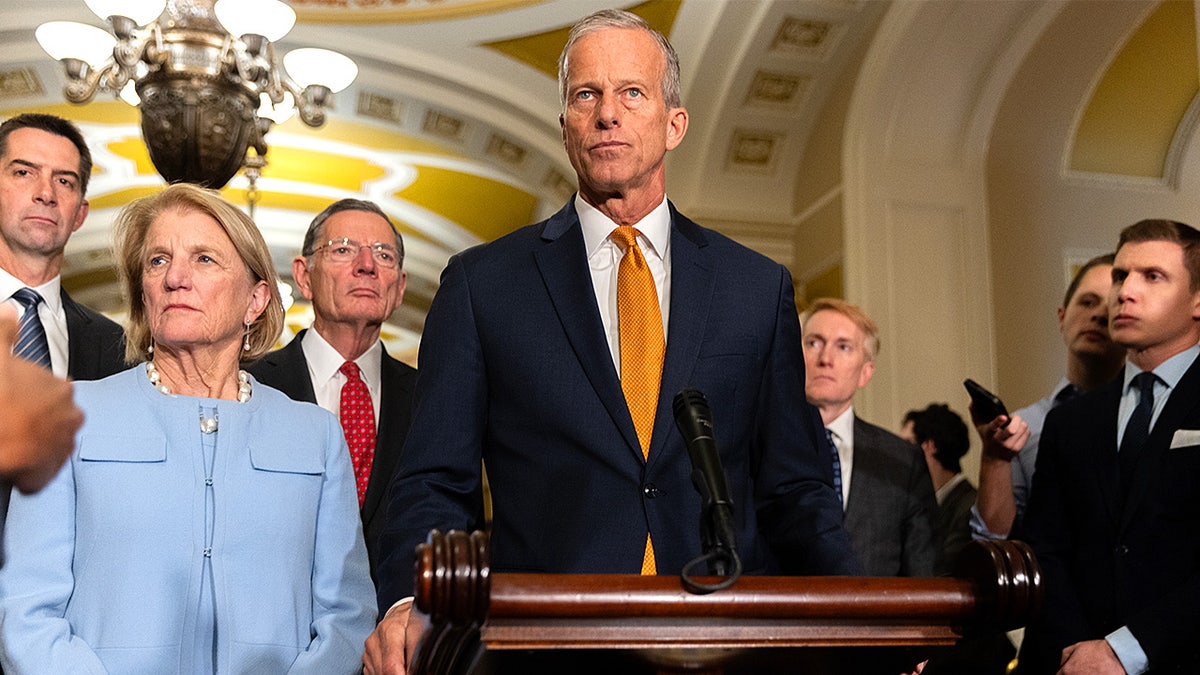
Senate Majority Leader John Thune, R-S.D., said he and his leadership team haven’t tried to corral votes for Mullin, but noted that Democrats would “decide to turn on one of their colleagues in the Senate” after getting exactly what they wanted: Noem replaced.
Senate Majority Leader John Thune speaks during a press conference with Senate Republican leadership following a policy luncheon on Capitol Hill in Washington, D.C., on Oct. 28, 2025.(Nathan Posner/Anadolu via Getty Images)
“He’s got good, strong relationships on the other side of the aisle,” Thune said. “And I mean, this is what the Democrats were clamoring for. They wanted a new change and shake-up in the leadership, and it’s now happening.”
While Mullin will walk into a hearing that will test his relationship with colleagues across the aisle, he does have at least one Democratic friend on the committee.
Sen. John Fetterman, D-Pa., who almost immediately came out in support of Mullin’s nomination, said he is still having conversations with the lawmaker about reforms to DHS. Fetterman planned to meet with Mullin ahead of the hearing.
“Is it controversial to talk to members of the opposite party? It might be controversial for some people, but that’s going to be an ongoing dialogue with him,” Fetterman said. “You know, I’ve said it, he’s a good dude, and I got to know him on a CODEL over the years.”
Alex Miller is a writer for Fox News Digital covering the U.S. Senate.
A high-severity security flaw affecting default installations of Ubuntu Desktop versions 24.04 and later could be exploited to escalate privileges to the root level.
Tracked as CVE-2026-3888 (CVSS score: 7.8), the issue could allow an attacker to seize control of a susceptible system.
“This flaw (CVE-2026-3888) allows an unprivileged local attacker to escalate privileges to full root access through the interaction of two standard system components: snap-confine and systemd-tmpfiles,” the Qualys Threat Research Unit (TRU) said. “While the exploit requires a specific time-based window (10–30 days), the resulting impact is a complete compromise of the host system.”
The problem, Qualys noted, stems from the unintended interaction of snap-confine, which manages execution environments for snap applications by creating a sandbox, and systemd-tmpfiles, which automatically cleans up temporary files and directories (e.g.,/tmp, /run, and /var/tmp) older than a defined threshold.
The vulnerability has been patched in the following versions –
Ubuntu 24.04 LTS – snapd versions prior to 2.73+ubuntu24.04.1
Ubuntu 25.10 LTS – snapd versions prior to 2.73+ubuntu25.10.1
Ubuntu 26.04 LTS (Dev) – snapd versions prior to 2.74.1+ubuntu26.04.1
Upstream snapd – versions prior to 2.75
The attack requires low privileges and no user interaction, although the attack complexity is high due to the time-delay mechanism in the exploit chain.
“In default configurations, systemd-tmpfiles is scheduled to remove stale data in /tmp,” Qualys said. “An attacker can exploit this by manipulating the timing of these cleanup cycles.”
The attack plays out in the following manner –
The attacker must wait for the system’s cleanup daemon to delete a critical directory (/tmp/.snap) required by snap-confine. The default period is 30 days in Ubuntu 24.04 and 10 days in later versions.
Once deleted, the attacker recreates the directory with malicious payloads.
During the next sandbox initialization, snap-confine bind mounts these files as root, allowing the execution of arbitrary code within the privileged context.
In addition, Qualys said it discovered a race condition flaw in the uutils coreutils package that allows an unprivileged local attacker to replace directory entries with symbolic links (aka symlinks) during root-owned cron executions.
“Successful exploitation could lead to arbitrary file deletion as root or further privilege escalation by targeting snap sandbox directories,” the cybersecurity company said. “The vulnerability was reported and mitigated prior to the public release of Ubuntu 25.10. The default rm command in Ubuntu 25.10 was reverted to GNU coreutils to mitigate this risk immediately. Upstream fixes have since been applied to the uutils repository.”
Radico Khaitan first entered the premium spirits segment in 2006 with the Magic Moments launch. (representational image)
Radico Khaitan‘s Magic Moments Vodka has crossed 8 million cases in sales in FY2025-26, up from 7.1 million cases the previous year, the New Delhi-based spirits company announced on March 18. The brand holds roughly 60 per cent of India’s vodka market and ranked sixth among vodka brands globally last year.
The growth has been driven in part by the company’s ‘Flavors of India’ range, with the recently launched Jamun SpicyMint variant reporting strong offtake. Earlier flavors including Alphonso Mango and Thandaai have also maintained consumer demand.
Managing Director Abhishek Khaitan pointed to a structural opportunity, noting that while vodka commands 20–25 per cent of the global spirits market, it accounts for under 4 per cent in India — leaving considerable room for category expansion.
Radico Khaitan first entered the premium spirits segment in 2006 with the Magic Moments launch. The brand’s portfolio now spans Semi-Premium and Premium categories, including the Remix, Verve, and Dazzle variants.
The company, founded in 1943 as Rampur Distillery, operates distilleries in Rampur, Sitapur, and Aurangabad, with a total owned capacity of 321 million liters and 44 bottling units. Its products are exported to over 100 countries.
Radico Khaitan shares were trading at ₹2,696.00 on NSE on today March 18, down 1.57 per cent from the previous close of ₹2,739.10 at 2.45 pm.
A grieving widow has received a criminal conviction over an unpaid £35 tax bill on her husband’s car, which wasn’t paid in the weeks after his death.
The 51-year-old woman was taken to court by the Driver and Vehicle Licensing Agency (DVLA) over the slip-up – which happened last July while she was in mourning and making funeral arrangements – despite her writing to explain.
The letter told the agency she didn’t drive, had never owned a car, had “very limited understanding of vehicle tax” and was going through an “extremely distressing and overwhelming period”.
The widow explained how English is not her first language and she had become “confused” about the tax requirements of her husband’s Jaguar.
“The vehicle was not used on any public road and was kept parked at my home address at all times,” she added.
But a magistrate opted to convict her and pass sentence rather than refer the case back to the DVLA to check if the prosecution remained in the public interest.
The widow, from near Chesterfield in Derbyshire, entered a guilty plea in writing and was sentenced by magistrate Dawn Towart to a six-month conditional discharge with an order to pay £85 in costs and the £35.84 car tax bill.
The case was brought through the controversial fast-track Single Justice Procedure (SJP) court system.
SJPs were introduced in 2015 for minor offences in magistrates’ courts, aiming to allow firms to fast-track prosecutions and pursue them behind closed doors. They have a history of convicting vulnerable people over unpaid household bills.
The DVLA has been supportive of SJP reform that would allow prosecutors to automatically see letters sent to the courts in mitigation.
The government has conducted a consultation on possible changes to the system, but has not taken any action in the year that has passed since it sought views on reform.
At her annual press conference on Tuesday, England and Wales’ top judge, Baroness Sue Carr, revealed that a “nuts and bolts” review of the SJP system had been undertaken.
She did not reveal the results of the audit and said decisions on the way the system itself operates are for politicians to answer, but stated: “The judges are applying the law as it applies.”
Access Denied
You don’t have permission to access “http://hindi.news18.com/videos/ajab-gajab/girls-danced-on-dj-vigorously-on-punjabi-songs-people-went-crazy-after-seeing-moves-10284874.html” on this server.
Last Friday, appalling news broke that a 19-year-old illegal immigrant student in the United States was criminally charged with nine counts of assault and battery for allegedly groping girls in the halls of a Fairfax County, Virginia, high school.
According to the mother of one of the alleged victims, the accused “sneakily walked up behind [the girls] and put his hand between their legs. It was not just a butt smack or a butt grab. It was a groping of a private area. It had been occurring for months.”
What is even more shocking is that Fairfax County Public Schools (FCPS) told parents of the alleged victims that the alleged assailant would be allowed to return to school upon his release.
This is just the latest disgrace for Virginia’s largest public school system — a district that has led the way in implementing far-left policies focused more on virtue signaling than on educating children.
The results are predictable and daunting: students are put in danger, teachers’ hands are tied, parents are kept out of the loop, and the quality of education steadily declines in a county where academic achievement was once heralded.
These are five examples of FCPS’s insanely misplaced priorities:
1. Illegal Immigrants Over Student Safety
FCPS officials proudly boast of their “Trust Policy,” which cites “a climate of fear and stress that would affect all students” if ICE were to detain parents while children are in school. To that end, FCPS Superintendent Michelle Reid has pledged to “do all that we can — to the fullest extent allowable by law —” to make FCPS a safe space for students and families who are in the country illegally. Law-abiding families are ignored.
The result of this policy is clear: when the assailant accused of groping is released, FCPS will welcome him back into its taxpayer-funded school system while continuing to expose every other student to uncertainty, if not danger.
Fairfax County Public Schools bus is seen outside of Lutie Lewis Coates Elementary School in Herndon, Virginia, Thursday, May 11, 2023.(Salwan Georges/The Washington Post via Getty Images)
FCPS said in a statement, “While Fairfax County Public Schools (FCPS) is unable to comment on specifics due to federal and state privacy laws, we prioritize student and staff safety and fully investigate any time someone reports an incident or says they do not feel safe at school. We are grateful to our law enforcement partners, who continue to work swiftly and thoroughly when there are safety concerns in our schools. The safety of all FCPS students and staff remains a top priority.”
2. Race-Based Discipline Policies
FCPS handles student discipline through an “equitable lens” designed to eliminate “discipline disproportionality” among students of different races. In plain terms, this means that if one racial group is disciplined at a rate higher than its share of the student population, FCPS will ease discipline for that group to bring the percentages into alignment, regardless of whether that discipline was warranted.
This outcome-based approach to discipline is not only arguably illegal but also renders schools demonstrably less safe. FCPS appears unconcerned with either outcome.
FCPS mandates that students be allowed to use the bathrooms and locker rooms corresponding to their self-selected “gender identity.” It is the student who objects to sharing a bathroom or locker room with a member of the opposite sex who is instructed to comply or use an alternative private facility.
The logo for the Fairfax County Public Schools in Fairfax County, Virginia.(Fairfax County Public Schools)
The consequences of this policy are already playing out. Just last year, a boy with facial hair and described as wearing “pants so tight they clearly outlined his genitalia,” began using a girls’ locker room at West Springfield High School, where he watched girls change in “various stages of undress.”
FCPS investigated the matter and concluded that all was well because the boy self-identified as a girl. In fact, FCPS is so committed to this policy — and so dismissive of its dangers — that it has refused to comply with the U.S. Department of Education’s demand to rescind it, risking millions of taxpayer dollars in federal funding in the process.
4. Keeping Secrets From Parents
FCPS has established a system designed to withhold information from parents when a child seeks to “socially transition” to a different sex while at school — whether by using a different name, different pronouns, or the bathrooms and locker rooms of the opposite sex. Under this system, FCPS educators are instructed to exclude information related to a student’s new “gender identity” from official records and to limit parents’ visibility into their children’s records, making them viewable only by district officials.
This scheme may circumvent the Family Educational Rights and Privacy Act, which grants parents the right to access their children’s official school records. FCPS is likely familiar with this federal law.
This practice is a clear attempt to cut parents out of decisions regarding their children’s health, emotional upbringing, and education. It also conflicts with recent Supreme Court decisions in Mahmoud v. Taylor and Mirabelli v. Bonta.
5. Possibly Selling Data to Communist China
It should be evident from the policies detailed above that FCPS appears to prioritize students in the country illegally over American students and gives short shrift to the constitutional rights of parents. But FCPS’ “America Last” mindset takes things to an entirely different level.
As reported by National Review, the watchdog group Parents Defending Education claims that FCPS provided intellectual property to the Chinese Communist Party. According to reports, a nonprofit associated with Thomas Jefferson High School — FCPS’s top-ranked STEM school — has received millions of dollars from CCP-affiliated entities, including one known as the “TJ Fund,” in exchange for information that amounts to a blueprint for China to replicate Thomas Jefferson High School and its educational success.
A spokesperson for FCPS told National Review, “The TJ Fund is a separate and independent 501(c)(3) entity that is not overseen by FCPS.”
The list could continue, but the bottom line is clear: FCPS’s track record makes it an untenable choice for families who expect their children to be protected.
Parents should avoid this school system if they can, and if they cannot, they must be extraordinarily diligent in protecting their children from a district that has repeatedly demonstrated it will not.
Ian Prior is Senior Counsel at America First Legal and the author of “Parents of the World Unite.” He previously served as Deputy Director of Public Affairs at the U.S. Department of Justice.