Visualising AI spending: How does it compare with history’s mega projects? | Technology News

0

Spending on AI is forecast to skyrocket to $2.5 trillion in 2026, dwarfing even the largest scientific and infrastructure projects.

World leaders and tech executives are convening in New Delhi for the India-AI Impact Summit 2026, focusing on the role of artificial intelligence in governance, job disruption and global collaboration.

However, behind these discussions lies the financial reality. Over the past decade, AI has drawn one of the largest waves of private investment in modern history, totalling trillions of dollars.

According to Gartner, a United States-based business and technology insights company, worldwide spending on AI is forecast to total $2.5 trillion in 2026, a 44 percent increase over 2025.

To understand the magnitude of these investments, Al Jazeera visualises the staggering amounts by comparing them with some of the largest projects ever created by humanity. We also highlight which countries are spending the most on AI and provide insights into expenditures on data centres, models, services, and security.

What does $1bn look like?

To help understand a trillion dollars, it is useful to first visualise what millions and billions of dollars look like by using a stack of US dollar bills.

If you break these amounts down using $100 bills, here is how they stack up:

  • $1,000 would form a stack about 1cm (0.393-inch) high.
  • $10,000 would form a stack approximately 10cm (3.93-inch) high.
  • $1m would fit inside a briefcase.
  • $10m would fit inside a very large suitcase.
  • $100m would fit on an industrial pallet stacked waist-high.
  • $1bn would create a building approximately 5.2 metres (17 feet) high, with a width and a length of about 2 metres (6.6 feet) each.

INTERACTIVE-What does $1bn look like-1771490010

Another way to think of it is if you spent $1 every second, it would take:

  • 11.5 days to spend $1m
  • 31 years to spend $1bn
  • 31,000 years to spend $1 trillion

In more tangible terms, $1bn is roughly equivalent to:

  • The estimated cost of the Grand Egyptian Museum in Giza, one of the largest archaeological museums in the world
  • The cost of constructing two to three modern football stadiums, depending on size and design
  • Buying 10 luxury private jets (at $100m each)
  • Buying 6.3 tonnes of gold (at $5,000 per ounce)
  • Buying 1 million high-end iPhones at retail price

$1.6 trillion already spent on AI

Over the past decade, AI-related investments have surged nearly 13-fold.

According to the 2025 AI Index Report by Stanford University, between 2013 and 2024, total global corporate investment in AI reached $1.6 trillion. This substantial expenditure dwarfs even the largest scientific and infrastructure projects of the 20th and 21st centuries.

To put the scale of AI investment into perspective, consider how it compares with some of the most ambitious and expensive projects in modern history. All figures are adjusted to 2024 US dollars:

  • The Manhattan Project (1942-46): $36bn
  • The International Space Station (1984-2011): $150bn
  • The Apollo Program (1960-73): $250bn
  • The US Interstate Highway System (1956-92): $620bn

INTERACTIVE-AI investment dwarfs world's mega projects-1771490007

In just over a decade, investment in AI has surpassed the cost of developing the first atomic bomb, landing humans on the moon and the decades-long effort to build the 75,440km (46,876-mile) US interstate highway network.

Unlike these landmark projects, AI funding has not been driven by a single government or wartime urgency. It has flowed through private markets, venture capital, corporate research and development, and global investors, making it one of the largest privately financed technological waves in history.

Global corporate investments in AI cover a vast array of operations, including mergers and acquisitions, minority stakes, private investments, and public offerings. These monumental expenditures highlight the extensive financial commitment to advance AI.

Which countries are spending the most on AI?

The AI investment surge is concentrated in just a few countries, where private capital has fuelled thousands of startups and shaped global innovation hubs.

The US has dominated AI spending, accounting for roughly 62 percent of total private AI funding since 2013. Between 2013 and 2024, US companies spent $471bn on AI. Chinese companies are the second-largest spenders at $119bn, followed by the United Kingdom at $28bn.

These figures exclude government spending, such as the US CHIPS Act or European national AI subsidies.

Global private investment in AI by country, 2013-24:

  • US: $471bn, supporting 6,956 newly funded AI companies
  • China: $119bn, 1,605 startups
  • UK: $28bn, 885 startups
  • Canada: $15bn, 481 startups
  • Israel: $15bn, 492 startups
  • Germany: $13bn, 394 startups
  • India: $11bn, 434 startups
  • France: $11bn, 468 startups
  • South Korea: $9bn, 270 startups
  • Singapore: $7bn, 239 startups
  • Others: $58bn

INTERACTIVE-Which countries are spending the most on AI-1771490012

AI spending to total $2.5 trillion in 2026

AI spending is forecast to skyrocket to $2.5 trillion in 2026, driven by a massive global build-out of data centres and services, according to Gartner.

The bulk of the spending is expected to go towards:

  • AI infrastructure: $1.37 trillion
  • AI services: $589bn
  • AI software: $452bn
  • AI cybersecurity: $51bn
  • AI platforms for data science and machine learning: $31bn
  • AI models: $26bn
  • AI application development platforms: $8.4bn
  • AI data: $3bn

By 2027, Gartner is forecasting that AI spending will surpass $3.3 trillion.

INTERACTIVE-AI forecast to total $2.52 trillion in 2026-1771490006


Source link

Como’s Fabregas, Milan’s Allegri and an alleged pull of Saelemaekers’ shirt | Football News

0

AC Milan’s 1-1 home draw with Como saw them drop seven points behind rivals Inter in the race for Italy’s Serie A title, but the result was even more infuriating for the Rossoneri and their supporters after a controversial incident involving a Milan counter and the opposition manager, Cesc Fabregas.

A coming together on the touchline, involving the former Arsenal and Barcelona midfielder while the ball was in play, resulted in play being stopped and the Milan manager, Massimiliano Allegri, being sent off.

Recommended Stories

list of 4 itemsend of list

The overview of the incident was not completely clear at the time and continued into post-match interviews, where the allegations and accusations increased.

What happened between Fabregas and Alexis Saelemaekers?

With the match level at 1-1 and with only 10 minutes to play, Milan attempted a counterattack on the left flank just in front of the Como technical area.

Rossoneri winger Alexis Saelemaekers was surrounded by Como defenders but attempted to cut infield to break clear of his opponents.

Rather than continue his run, however, the Belgium international instead ground to a halt and immediately turned to remonstrate with Como manager Cesc Fabregas.

The replays show Fabregas alongside Saelemaekers on the edge of the field of play, with Milan alleging the away team manager pulled the shirt of their player, preventing their attempted attack.

Why was AC Milan’s Allegri sent off for the incident with Fabregas?

A touchline bust-up ensued as the Milan bench, and their manager Allegri, confronted their opposite numbers from Como. Allegri was shown a red card by referee Maurizio Mariani for his part in the melee.

Fabregas’s assistant, and Como team manager, was also shown a red card.

What have Fabregas and Allegri said about the incident?

In his post-match interview, Allegri made no attempt to hide his annoyance about the incident.

“I believe there was a foul,” Allegri told the broadcaster, DAZN.

“Saelemaekers was starting a counterattack and was pulled by someone from the bench – I think it was Fabregas.”

AC Milan's Italian coach Massimiliano Allegri, left, leaves the field after his red card and argument with Como's Spanish coach Cesc Fabregas argue during the Italian Serie A football match
AC Milan coach Massimiliano Allegri is shown a red card by referee Maurizio Mariani [Daniele Mascolo/Reuters]

Later, Fabregas admitted that his behaviour was “unsporting” but said he had touched the ball with his hand and not pulled Saelemaekers’s shirt.

“I want to apologise first and foremost, I did something I am not proud of, and was unsporting,” Fabregas told DAZN. “We’ve got to keep our hands to ourselves … especially the coaches.

“I apologise, it was just a little touch and Allegri’s response was exaggerated, but I admit I shouldn’t have done it.

“I would’ve got angry too, so I can only apologise and say I hope it never happens again in my career.

“I touched the ball with my hand to prevent Milan from resuming play… I acted unsportsmanlike, and I apologise,” Fabregas said.

On Fabregas apologising for his part in the incident, Allegri replied: “I understand, but next time if someone runs down the line, I will make a sliding tackle and come in too.”

Allegri also defended his actions, saying he only left his technical area to “defend his player”.

Do Fabregas and Allegri have a history of poor behaviour?

Allegri is known for his calm approach on and off the field. The former midfielder had a reputation for seeing the game at a quicker pace than others and controlling the flow of play accordingly, an alertness he is also renowned for on the touchline.

Fabregas was an all-action midfielder for Arsenal, Barcelona, Chelsea and Spain, and – much like Allegri – was hugely gifted technically. Having spent the majority of his career in the fast-paced English Premier League with the two London sides, Fabregas was known for a fiery approach in the centre of the park.

As Como manager, Fabregas saw his team involved in a mass brawl during a preseason friendly in Spain against Real Betis last summer, which saw both sets of coaching staff drawn into the on-field scuffle where punches were thrown.

How did the Serie A game between AC Milan and Como play out?

Argentina midfielder Nico Paz put Como ahead in the 32nd minute following a clumsy error from Milan goalkeeper Mike Maignan.

The France number one tried passing the ball from the edge of his penalty area, but Paz swiftly intercepted it and shot through Maignan’s legs for his ninth league goal of the season.

Portugal winger Rafael Leao equalised midway through the second half for Milan with a neat lob after being set up by midfielder Ardon Jashari.

How is the rest of Serie A shaping up behind Inter and AC Milan?

The draw with Como extended Milan’s unbeaten streak in the league to 24 games, though the seven-point gap to rivals Inter is now looking substantial.

Second-placed Milan are four points ahead of defending champions Napoli in third.

Como moved into sixth spot on goal difference from Atalanta in the race for a Champions League place next season. Fifth-placed Juventus – formerly managed by Allegri – are four points ahead of Fabregas’s Como.


Source link

Why has Kwality Wall’s India share price fallen 15% since debut

0

Shares of Kwality Wall’s India Ltd have continued to decline in the four trading sessions since their market debut on February 16, 2026, emerging as the top loser on the Nifty 50 as sentiment remained cautious around valuation and sector pressures.

In the last three sessions, the stock slumped 15 per cent from a high of ₹31.29 to a low of ₹26.56.

Kwality Wall's trading trajectory shows weakness since listing (Source: NSE)

Kwality Wall’s trading trajectory shows weakness since listing (Source: NSE)

On Thursday, it dropped 4 per cent to touch a low of ₹28.10 on the National Stock Exchange. At 1.54 pm, the shares were trading at ₹28.12, hovering near the day’s low and extending the post-listing weakness.

KEY HIGHLIGHTS

  • Kwality Wall’s India shares fall for a fourth session after listing, topping Nifty 50 losers
  • Analyst cites open-offer pressure and sector headwinds

Market participants attributed the slide to a combination of technical and fundamental headwinds following the separation of the ice cream business from Hindustan Unilever. Analysts noted that subdued investor sentiment has persisted as investors assess the standalone valuation of the newly listed entity and near-term industry dynamics.

Vinod Nair, Head of Research at Geojit Investments Limited, said, “Post listing, the stock has faced valuation pressure, primarily due to subdued sentiment surrounding the ongoing open offer at an 29 per cent discount to the listed price, as well as trading restrictions following KWIL’s placement in the T-Group. Additionally, sequential margin pressures across peers and the inherently seasonal nature of the ice cream business have weighed on near-term performance.”

The open offer by Magnum Ice Cream Company forms part of Unilever’s broader strategy to separate and develop a dedicated global ice cream business.

Although near-term challenges and competitive pressures persist, the company’s specialized category focus, backing from a strong global parent, well-established brand strength, and scalable operating structure provide a solid foundation for long-term growth. These elements could contribute to a more favorable valuation outlook over the medium to long term, Nair added.

The company’s demerger, cleared by the National Company Law Tribunal and effective December 1, 2025, marked a structural shift aimed at unlocking value through a separate listing. However, analysts said the immediate response reflects uncertainty around earnings visibility, peer margin trends and the transition to independent trading dynamics rather than long-term fundamentals.

Listing details

Following the demerger of the ice cream business, shares of Kwality Wall’s India listed a₹29.80 apiece on the National Stock Exchange of Indiadown 25.87 per cent from the indicative price of ₹40.20. On the BSE Ltd, the stock opened at ₹29.90, marking a decline of 21.6 per cent compared with the indicative price of ₹38.15 per share.

The weak debut and subsequent decline have underlined cautious investor positioning as the market continues to evaluate the standalone growth outlook and competitive landscape for the company following its separation from its parent group.

Published on February 19, 2026

The cost of genocide: Israel’s war on Gaza by the numbers | Israel-Palestine conflict News

0

Since its genocidal war on Gaza began in October 2023, Israel has expended vast amounts of money and manpower on levelling the Palestinian territory and destroying its institutions.

It has killed more than 75,000 people in achieving this end, including tens of thousands of women and children. Of those who are still alive, many have suffered the effects of deliberately imposed starvation: first during Israel’s siege of northern Gaza in late 2024, which United Nations officials described as “apocalyptic”, and later during the man-made famine Israeli policies created in August 2025, when images of malnourished and starving children became commonplace on news bulletins around the world.

Recommended Stories

list of 3 itemsend of list

None of this has come cheap. Israel – backed by its principal ally, the United States – has poured billions of dollars into waging its war on Gaza. So how much does the killing of more than 75,000 Palestinians cost? How much do you need to spend on munitions to commit a genocide? And what is the impact of industrialised mass killing on an economy?

Here’s what we know.

How much money has Israel spent on the Gaza war?

The Bank of Israel put the overall economic toll of the war at about 352 billion shekels ($113bn). That total includes roughly 243 billion shekels ($78bn) in direct defence costs, 33 billion shekels ($10bn) for the property tax compensation fund, civilian outlays of 57 billion shekels ($18bn) and interest payments of 19 billion shekels ($6bn).

In early 2025, taking the Gaza war in isolation, Israel’s former chief military economic adviser, Gil Pinchas, estimated that the cost to Israel had been 150 billion shekels ($48bn), running at an average cost of 300 million shekels ($96.8m) per day. On average, 100 Palestinians were killed in Gaza every day, according to Philippe Lazzarini, commissioner-general of the United Nations Relief and Works Agency for Palestine Refugees (UNRWA).

“Every item the [Israeli army] uses in combat has a price tag in shekels, detailed in a special, highly specific price book,”  Pinchas told journalists, referring to the price paid by the Israeli army, and not Palestinians, for every combat ration, litre of fuel, vehicle, bullet and missile launched against Gaza. “The book is updated constantly, including during the war … We keep our finger on the pulse.”

How much of the war’s expenditure was spent on munitions?

We don’t know for sure.

Pinchas did say that Israel had spent 340 billion shekels ($109.8bn) on munitions since the war began, but nowhere near all of that has been used. A significant proportion of that money has also been spent on purchasing arms from Israeli manufacturers, which has helped to offset the wider impact of the war to the Israeli economy.

Line-by-line details for most military budgets are rarely available. But some insights can be gleaned from Israel’s other wars in the region.

According to an estimate midway through the war by the Wall Street Journal, Israel’s war on Iran was costing it $200m per day, with the missiles used to intercept Iranian rockets, sometimes reaching 400 a day, estimated at anywhere between $700,000 and $4m each.

In addition, Israel’s September 2024 attack on the Lebanese group Hezbollah’s communication devices, which relied on a plan that had been set into motion years earlier, is reported to have set the Israeli treasury back some one billion shekels ($323m).

What has been the overall cost to the wider Israeli economy?

Considerable, and much of that is down to manpower.

Of Israel’s 465,000 military reservists, upwards of 300,000 were deployed to Gaza during the first year of the war. This is in addition to 170,000 active-duty personnel. The cost of maintaining that number of active soldiers, as well as the impact to the wider economy due to the loss of workers called up as reservists, is astronomical.

According to Israel’s Treasury, some 70 billion shekels ($22.6bn) has been spent on its reserve forces alone during the course of the war, while the cost of maintaining its standing army in 2025 was estimated to be 15.37 billion shekels ($4.9bn).

The Bank of Israel estimates that the cost of one month of service for a military reservist is about 38,000 shekels ($12,300) in lost production.

With military budgets unlikely to recede in the wake of the genocide and other wars that Israel has engaged in over the past two years, a column in the Israeli liberal daily Haaretz suggested that over the next decade, the cost of the war could run to, at a minimum, 500 billion shekels ($161bn).

How much has Israel’s genocide cost the US?

More than many US voters might suppose.

According to Brown University’s 2025 Costs of War report, since October 7, 2023, the US has provided Israel with some $21.7bn in military aid.

In addition to that, the American taxpayer has funded US operations in support of Israel in Yemen, Iran and the wider Middle East at a cost of $9.65bn to $12.07bn, meaning a total US investment of somewhere between $31.35bn and $33.77bn on Israel’s wars since 2023.

How much will it cost to rebuild Gaza?

According to the United Nations, rebuilding Gaza – where Israel has destroyed the majority of buildings – would take decades and cost somewhere in the region of $70bn.

In a report, the UN noted that Israel’s military operations had “significantly undermined every pillar of survival” within the enclave and that the entire population of 2.3 million people faced “extreme, multidimensional impoverishment” – the term for poverty extending beyond financial duress to areas such as a lack clean water, proper sanitation, or education.


Source link

BJP councilor got support from Congress, Aditya Thackeray said – ‘His internal relations…’

0

Shiv Sena (UBT) leader Aditya Thackeray has expressed his opinion regarding the coming together of BJP and Congress in Bhiwandi, investigation into Ajit Pawar’s plane crash, security of Rohit Pawar, Galgotias University controversy and Rajya Sabha seat. He said that the party is fighting strongly and they have a direct connection with the public.

On 9 BJP councilors supporting Congress in Bhiwandi, Aditya Thackeray said that BJP and Congress have come together in many cities before. He also reminded that at some places BJP and AIMIM had also come together. According to him, what has happened in Bhiwandi exposes the internal relations of these parties. However, he reiterated that his party’s first and strongest relationship is with the people and they will continue the struggle.

Ajit Pawar plane crash and safety issue

On Jai Pawar’s demand for investigation into Ajit Pawar’s plane crash, Thackeray said that many questions have been raised. According to him, the investigation should be independent and impartial and should be under the supervision of the court.

On Supriya Sule’s demand to provide security to Rohit Pawar, he said that if public representatives are in need of security in every area, then it raises questions on the law and order of the state. This reflects serious concern over the state of the security system.

Galgotias University controversy and summit arrangements

On the Galgotias University controversy, Aditya Thackeray said that if any university has made a mistake then the entire summit should not be defamed. But he also said that such global events should focus on entrepreneurs and innovators rather than political faces.MeshK should be prominent.

Raising questions on the arrangements of the summit, he said that due to the arrival of a VIP at Bharat Mandapam, traffic was stopped for an hour and people had to walk 5 to 6 miles. The food had run out and the water arrangements were also not adequate. According to him, the arrangements could have been better.

Claim on Rajya Sabha seat

On the question of Rajya Sabha seat, Aditya Thackeray said that no formal discussion has taken place yet. However, according to numbers and rotation, this seat and the Legislative Council seat belong to his party. He clarified that this is Shiv Sena’s seat and he is firm on it. He will present the same stand in Maha Vikas Aghadi also and the situation will become clear in the further discussion.

ACME Solar seals 190 MW hybrid power deal with SECI

0

With this deal, ACME Solar has signed 1,240 MW worth of PPAs in the current financial year alone.

With this deal, ACME Solar has signed 1,240 MW worth of PPAs in the current financial year alone. | Photo Credit: 6okean

ACME Solar Holdings on Wednesday signed a 25-year power purchase agreement with Solar Energy Corporation of India (SECI) for a 190 MW wind-solar hybrid project, pushing its total PPA-signed capacity to 5,820 MW.

The agreement, executed through its subsidiary ACME Urja One Private Ltd, covers an ISTS-connected hybrid project that is part of a larger 380 MW tranche, with the PPA for the first half now formalised. The tariff has been adopted by the Central Electricity Regulatory Commission (CERC), and the power procurement plan has received approval from the relevant State electricity regulatory authority.

Under the agreement, ACME Solar is required to maintain a minimum annual capacity utilization factor of 50 per cent and meet 80 per cent of peak power demand on a daily basis. The company said grid connectivity for all project components — solar, wind and battery energy storage systems (BESS) — has been secured, and that completion timelines for the connectivity and transmission infrastructure fall within the contracted commercial operations date.

The project has been financed by Power Finance Corporation as part of a previously sanctioned Phase II package. SECI holds an AAA credit rating as a Central government enterprise.

With this deal, ACME Solar has signed 1,240 MW worth of PPAs in the current financial year alone. The Gurugram-based company has a total portfolio of 8,071 MW spanning solar, wind, storage and hybrid solutions, with 2,966 MW operational and 5,105 MW under construction, including approximately 17 GWh of BESS capacity.

The shares of Acme Solar Holdings Ltd were trading at ₹230 down by ₹0.93 or 0.40 per cent at 2.05 pm.

Published on February 19, 2026

Legal doping in sport: Records or Ethics? | Digital Series

0

Game Theory

As the Winter Games celebrate the Olympic motto, Faster, Higher, Stronger — Together, a new competition is openly allowing the use of performance-enhancing drugs. Samantha Johnson looks at the Enhanced Games and how doping, once sport’s red line, is now being marketed as innovation.


Source link

Access Denied

0

Access Denied You don’t have permission to access “http://hindi.gadgets360.com/ai/google-lyria-3-ai-music-generation-model-for-free-unveiled-news-11067744” on this server.

Reference #18.50200117.1771495783.13b8e8a8

https://errors.edgesuite.net/18.50200117.1771495783.13b8e8a8

Access Denied

0

Access Denied You don’t have permission to access “http://hindi.gadgets360.com/ai/chatgpt-maker-openai-partners-with-tata-group-will-build-ai-data-centre-in-india-news-11067061” on this server.

Reference #18.84adc17.1771543488.f1cf21b

https://errors.edgesuite.net/18.84adc17.1771543488.f1cf21b

Iran builds concrete shield at military site amid acute US tensions | Israel-Iran conflict News

0

Newly released satellite images show that Iran has recently built a concrete ‌shield over a new facility at a sensitive military site and covered it in soil, advancing work at a location reportedly bombed by Israel in 2024 amid soaring tensions with ⁠the United States and the threat of regional war.

The images also show that Iran has ⁠buried tunnel entrances at a nuclear site bombed by Washington during Israel’s 12-day war with Iran last year – which the US joined on Israel’s behalf – fortified tunnel entrances near another, and has repaired missile bases struck in the conflict.

Recommended Stories

list of 4 itemsend of list

They offer a rare glimpse of Iranian activities at some of the sites at the centre of tensions with Israel and the US.

Some 30km (20 miles) southeast of Tehran, the Parchin complex is one of Iran’s most sensitive military sites. Western intelligence has suggested Tehran carried out tests relevant to nuclear bomb detonations there more than 20 years ago. Iran has always denied seeking ⁠atomic weapons and says its nuclear programme is purely for civilian purposes.

Neither US intelligence nor the UN nuclear watchdog found any evidence last year that Iran was pursuing nuclear weapons.

Israel reportedly struck Parchin in October 2024. Satellite imagery taken before and after that attack shows extensive damage to a rectangular building at Parchin, and apparent reconstruction in images from November 6, 2024. Imagery from October 12, 2025, shows development at the site, with the skeleton of a new structure visible and two smaller structures adjacent to it.

Progress is apparent in imagery from November 14, with what appears to be a metallic roof covering the large structure. By February 16, it cannot be seen at all, hidden by what experts say is a concrete structure.

The Institute for ‌Science and International Security (ISIS), in a January 22 analysis of satellite imagery, pointed to progress in the construction of a “concrete sarcophagus” around a newly built facility at the site, which it identified as Taleghan 2.

ISIS founder David Albright wrote on X: “Stalling the negotiations has its benefits: Over the last two to three weeks, Iran has been busy burying the new Taleghan 2 facility … More soil is available and the facility ⁠may soon become a fully unrecognizable bunker, providing significant protection from aerial strikes.”

The institute also reported in late January that satellite images showed new efforts to bury two tunnel entrances at the Isfahan complex – one of the three ⁠Iranian uranium-enrichment plants bombed by the US in June during the war. By early February, ISIS said all entrances to the tunnel complex were ⁠”completely buried”.

Other images point to ongoing efforts since February 10 to “harden and defensively ⁠strengthen” two entrances to a tunnel complex under a mountain some 2km (1.2 miles) from Natanz – the site that holds Iran’s other two uranium enrichment plants.

This comes as Washington seeks to negotiate a deal with Tehran on its nuclear programme while threatening military action if talks fail.

On Tuesday, US and Iranian representatives reached an understanding on main “guiding principles” during a meeting in Geneva, but felt short of achieving any breakthrough. The meeting in the Swiss city came after a first round of talks in Oman on February 6.

Reports suggest that Tehran would make detailed proposals in the next two weeks to close gaps. Among the many hurdles in the negotiations is the US push to widen the scope of the deal to include restrictions on Iran’s ballistic arsenal and support for its allies in the region.

That is fuelled by Israel’s demands and regional narrative, with Israeli Prime Minister Benjamin Netanyahu repeatedly pressing US President Donald Trump to shift from nuclear-only parameters.

Tehran has insisted that these provisions are non-negotiable but that it is open to discuss curbs on its nuclear programme in exchange for sanctions relief.

A previous negotiating effort collapsed last year when Israel launched attacks on Iran, triggering the 12-day war that Washington joined in by bombing key Iranian nuclear sites.

As diplomacy forges a path, both parties are ramping up military pressure.

The Islamic Revolutionary Guard Corps (IRGC) held a series of war games on Monday and Tuesday in the Strait of Hormuz to prepare for “potential security and military threats”.

On Wednesday, Tehran announced new joint naval drills with Russia in the Sea of Oman. Rear Admiral Hassan Maqsoudlou said the exercises were aimed at preventing any unilateral action in the region, and enhancing coordination against threats to maritime security, including risks to commercial vessels and oil tankers.

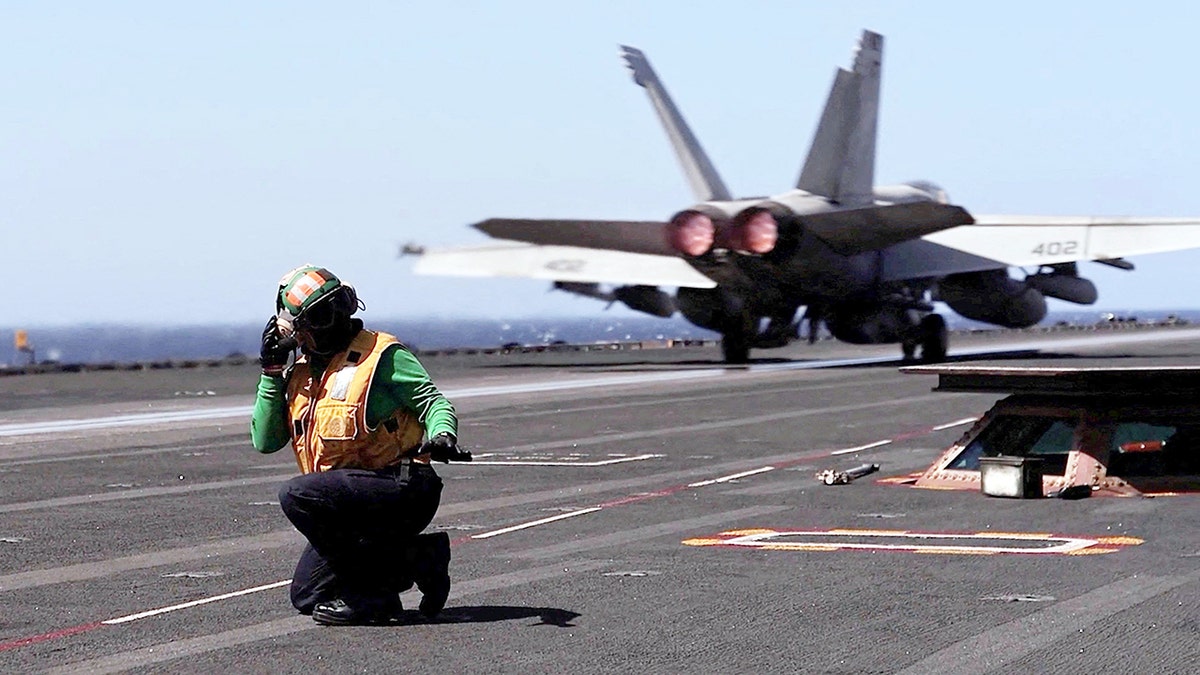
The US has also escalated its military build-up in the region. Trump has ordered a second aircraft carrier to the region, with the first, the USS Abraham Lincoln and its nearly 80 aircraft, positioned about 700 kilometres (435 miles) from the Iranian coast as of Sunday, according to satellite imagery.

The Trump administration also issued new threats against Tehran with White House press secretary Karoline Leavitt saying on Wednesday that “Iran would be very wise to make a deal” with the US. Trump escalated his rhetoric on social media.

“Should Iran decide not to make a Deal,” the US may need to use an Indian Ocean airbase in the Chagos Islands, “in order to eradicate a potential attack by a highly unstable and dangerous Regime”, he wrote on his Truth Social platform.


Source link