Dreams of survival: How war has restructured Gaza’s job market | Israel-Palestine conflict News

0

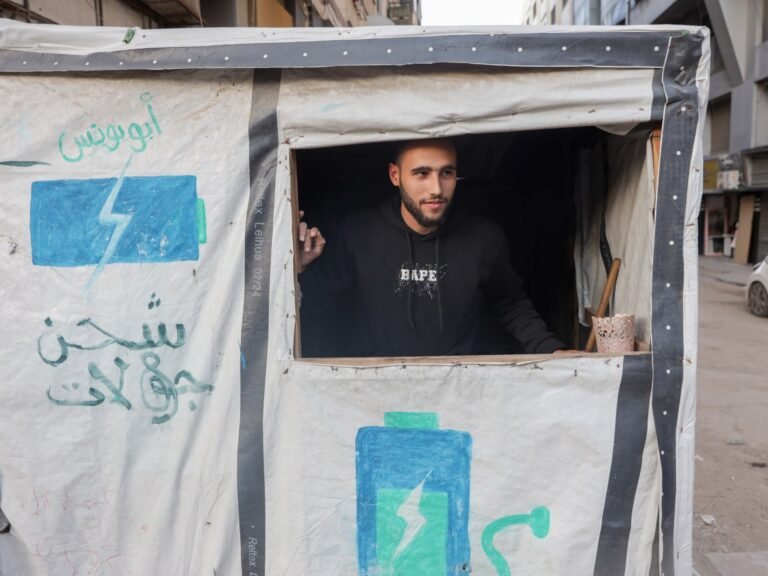
Gaza City – On a street corner in Gaza City’s Remal market, Abdulrahman al-Awadi stands inside a small tarpaulin-made tent that he set up as a mobile phone charging station, a job that emerged during the war and has since become his livelihood.

Al-Awadi has hung his artwork above shelves that hold mobile phones and charging units.

Recommended Stories

list of 3 itemsend of list

He checks the sunlight and the efficiency of the solar panel mounted above.

The 25-year-old, who graduated from Al-Aqsa University’s fine arts faculty two years before Israel’s genocidal war on Gaza began, never imagined he would end up standing on his street, watching phones being handed to him one after another to charge for one or two shekels.

“Before the war, I worked in fine arts and graphic design, and I was still taking my first steps in the world of exhibitions and advertising,” al-Awadi told Al Jazeera.

“Today, as you can see, I work behind a small ‘charging point’ near my home, trying to secure the bare-minimum income to get by.”

“I spent four university years in studios, working on art projects, exhibitions, and crafts. All of that has become memories, with no way back.”

During the war, al-Awadi was displaced with his family to southern Gaza for a year and a half. There, he tried to hold onto some of his experience in fine arts and design, but he was too distracted.

“I tried to go on YouTube and watch art exhibitions and artists’ work. I tried to refresh my knowledge, to draw and sketch,” he explained. “But everything around me was bombardment, destruction, and fear.”

Abdulrahman hangs what remains of his artwork inside the charging point, which now serves as his source of income [Abdelhakim Abu Riash/ Al Jazeera]
Abdulrahman al-Awadi hangs what remains of his artwork inside the charging point, which now serves as his source of income [Abdelhakim Abu Riash/ Al Jazeera]

Dreams disappear

Once al-Awadi was able to return to his home in Gaza City, he found that his drawings and tools had vanished. His room soon became a shelter for displaced relatives.

“[My drawings] were burned and destroyed in the shelling near our home. My tools, my colours, my studio… everything is gone,” he said.

He found himself forced to adapt, creating a new source of income from nothing.

“People come to charge their phones. One shekel [$0.30] per charge. Even a shekel is hard to find, because there’s almost no liquidity in the country.”

Survival economy

A-Awadi’s shift, from an artist to a participant in Gaza’s “survival economy”, illustrates a wider situation in which traditional professions have disappeared and new jobs, shaped by war and shortages, have emerged.

The economic situation in Gaza has sharply worsened since the war began, as widespread destruction, displacement, and the collapse of basic services have forced even skilled graduates to adapt to makeshift jobs.

With limited opportunities in their trained fields, many have turned to small-scale, often improvised work, such as charging phones, selling food and water, or providing essential services, to secure a daily income and support their families.

Rami al-Zaygh, an economic researcher who has conducted a study into the survival economy, told Al Jazeera that such make-shift professions have pulled many Palestinians “from the brink of certain death by providing a minimum level of income and meeting basic needs”.

“What has happened is that the war has pushed society back decades, bringing back professions that only a handful of people still practised, while also giving rise to jobs that had never previously existed in Gaza,” he said.

According to al-Zaygh, a common feature among these jobs is their simplicity, as they do not require specialised skills or advanced equipment.

“Most of this work is carried out using very basic tools, and relies on making use of any available resource for survival,” he added, noting that many such jobs show a degree of innovation, including finding ways of charging devices and batteries, or registering people on lists for aid.

These jobs are neither stable nor permanent, he said. “They are intermittent and constantly changing, shaped by the conditions of war itself, from bombardment and repeated displacement to instability, and are among the most difficult consequences of this war.”

These shifts reflect the collapse of Gaza’s economic structure. According to figures cited by al-Zaygh, the territory’s gross domestic product (GDP) has contracted by about 85 percent, while unemployment has surged to approximately 80 percent, with nearly the entire population now living below the poverty line.

Under these conditions, participation in the makeshift and unstable job market is no longer limited to a specific group, but has spread across all segments of society.

“Everyone has become involved in this economy – men and women, children and adults, students and graduates, even those with higher degrees – driven by necessity and desperation,” al-Zaygh said.

These jobs “emerged as an exceptional and temporary response in Palestinian life, but have developed over the course of the prolonged war, and may continue until the conditions that created them come to an end and stability returns”, he added.

Mustafa Bulbul, who holds a degree in business administration, currently runs a small stall selling boiled corn in Al-Rimal market in Gaza [Abdelhakim Abu Riash/ Al Jazeera]
Mustafa Bulbul, who holds a degree in business administration, now runs a small stall selling sweetcorn in Gaza’s Remal market [Abdelhakim Abu Riash/Al Jazeera]

‘Life here is merciless’

Mustafa Bulbul, 32, has also found himself working at a stall in Remal. He sells sweetcorn, working alongside his brother.

Mustafa, who holds a degree in business administration and used to work for a local company owned by relatives before the war, has lost everything he built in his professional life.

Now displaced from al-Shujayea in eastern Gaza City, he lives with his wife and three children in a tent near the market.

“I lost everything in the war… my home, my job, my profession. As you can see, I even lost my personal and academic identity,” Mustafa told Al Jazeera as he poured corn into cups for customers.

“Life here is merciless. As long as I have the responsibility of taking care of my children and family, I had to work in whatever job was available.”

Mustafa explained that work in business administration has become nearly nonexistent in Gaza.

“The company I worked for was destroyed, and its warehouses were destroyed as well. It’s now beyond the ‘yellow line’,” he said, referring to the areas of Gaza directly controlled by Israeli forces. “And it’s not the only one; thousands of private companies were destroyed during the war.

“The economy has completely collapsed. Anyone who finds any opportunity, even if it doesn’t suit them, takes it immediately.”

Even selling corn is a precarious business. Corn has periodically been unavailable in Gaza, alongside many other food items, especially during periods of famine brought on by Israeli restrictions on imports.

“We try to accept reality as much as we can, but things are fluctuating in a frightening way,” he said, describing the difficulty of securing not only corn but also cooking gas, which he recently replaced with charcoal and firewood.

“Everything is extremely expensive, and people’s purchasing power has dropped significantly,” he added, pointing to the chaos in market prices amid the shortages.

Despite everything, Mustafa continues to struggle to maintain a fragile balance between survival and dignity.

“I hope that one day, I can return to my previous job in business administration… to my good-looking clothes, my office, my old life… and that things improve, even a little.

“Everyone here is exhausted and worn down by life.”


Source link
Kim Jong-un Statement: North Korean dictator Kim Jong-un’s big statement regarding nuclear weapons amid war – ‘We have…’

0

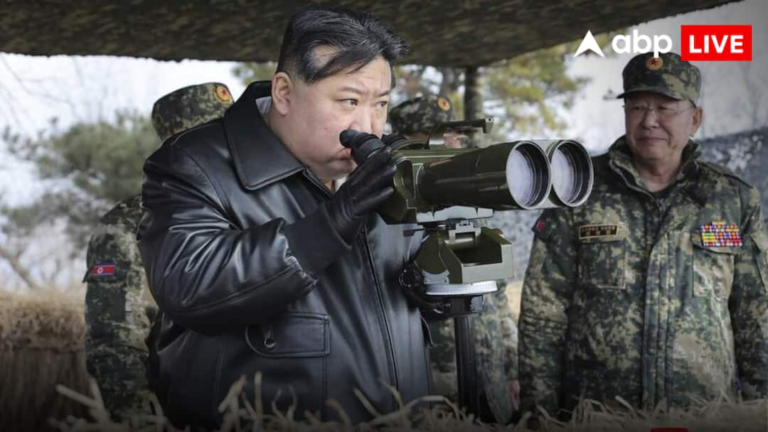
North Korean leader Kim Jong-un has given a big statement, which has become a topic of discussion in global politics. Amidst the ongoing war in the Middle East, Kim Jong-un said that seeing America’s attack on Iran, the question arises why North Korea should not have nuclear weapons.

Kim Jong-un’s statement indicates that if a country does not have strong defense (such as nuclear weapons) then it may be vulnerable to external attacks. This statement is being understood as if North Korea is trying to justify its nuclear program. He wants to show that nuclear power is the only guarantee of security.

What is the current situation in North Korea?

North Korea is already considered a country possessing nuclear weapons and has clashed with America several times on this issue. This statement of Kim has come at a time when there is a war going on in the Middle East. In such a situation, the arms race in the world may increase further. Small countries can also insist on nuclear power for their security.

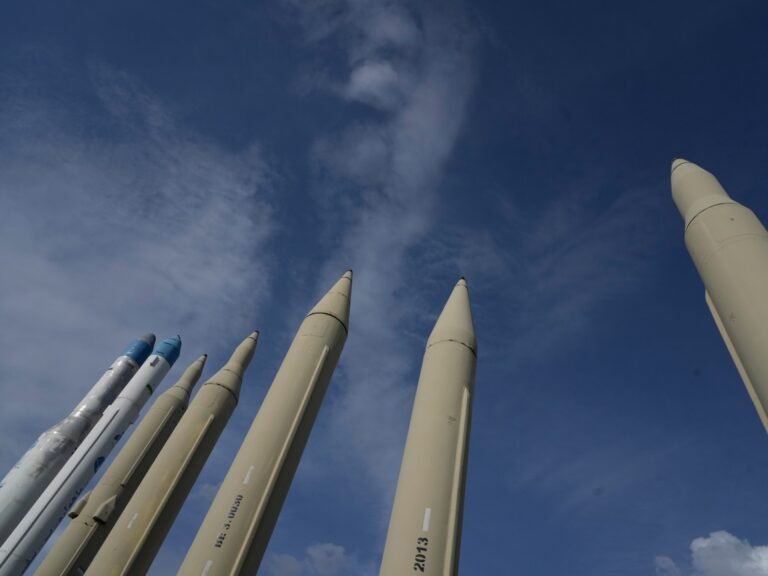
North Korea has a big missile

North Korea is among those countries in the world whose weapons are the main reason for their strength. Especially their nuclear weapons, missiles and large army make them different. If we talk about nuclear weapons, then according to estimates North Korea may have about 20 to 60 nuclear weapons. This country has conducted nuclear tests several times and is constantly trying to strengthen its weapons. This is the reason why even big countries of the world take it seriously.

North Korea is also far ahead in the matter of missiles. It has short range, medium range and long range missiles. The special thing is that its long-range ICBM missiles can go more than 10,000 kilometers, which means it has the capability to reach America.

Also read: Trump shocked by Iran’s conditions! Sent a list of 15 demands, how will the war stop?

Is Iran’s negotiating position stronger than when US-Israeli war started? | US-Israel war on Iran News

0

United States President Donald Trump has said that Washington is engaged in “productive” talks with Iran. Publicly, Iranian officials have rejected Trump’s claims, calling them fake news designed to ease oil prices.

Behind the scenes, Egypt, Turkiye and Pakistan have established an indirect channel of communication between American and Iranian officials in the past few days, two senior diplomatic sources in the region told Al Jazeera. Still, regardless of the small window for diplomacy that may have emerged, experts remain sceptical over the prospects for a ceasefire as the positions of the warring parties remain far apart.

The Iranian leadership’s stance on what concessions to extract from the US appears to have hardened since the start of the war on February 28, when the US and Israel attacked Iran, killing its then Supreme Leader Ayatollah Ali Khamenei.

The US and Israel insist that their nonstop attacks since then have significantly “degraded” Iran’s military capabilities – the Pentagon says 90 percent of Iran’s missile capacity has been wiped out. But Iran has shown it can still fire when it wants, and with precision.

In the Strait of Hormuz – a waterway through which a fifth of global oil exports pass – hundreds of vessels remain paralysed. And across the region, Iran has adopted an “eye for an eye” policy to re-establish deterrence and make sure that any threat is followed by action.

Just last week, Iranian forces hit Qatar’s main gas site – wiping out 17 percent of its export capacity – immediately after an Israeli attack on Iran’s South Pars field. After an attack on Iran’s Natanz nuclear power plant, two Iranian ballistic missiles pierced through Israel’s defence systems, hitting the southern cities of Arad and Dimona, wounding more than 180 people.

Iran’s aim now, say experts, is not merely a ceasefire but a post-war order that restores deterrence and secures long-term economic and security guarantees.

Iran’s new red lines

Iran’s political and military officials have said in recent days that they want payment repatriations, firm guarantees that Iran won’t be attacked again and a new regulatory framework for passage in the Strait of Hormuz.

Negar Mortazavi, a senior fellow at the Washington, DC-based Center for International Policy, says Tehran would seek to end the war on its own terms while extracting sanctions relief, reparations for damage and economic leverage.

“This chokehold on the Strait of Hormuz is now giving them ideas – ‘maybe we can charge passage fees like some other places in the world’ – there are those discussions in Iran,” Mortazavi said.

Iran is unlikely to forfeit that leverage without major concessions, analysts say. That is especially so, given how Iran feels the war has helped it win some economic relief that it didn’t get through diplomacy. On Friday, the Trump administration temporarily waived sanctions on the purchase of 140 million barrels of Iranian oil at sea in an attempt to ease oil prices.

What does the US want?

One of the various reasons the US president listed to justify launching a war on Iran was to prevent Tehran from getting a nuclear bomb – despite having claimed to have obliterated Tehran’s nuclear programme during the 12-day war last year.

On Monday, Trump said he still wants Iran to give up the more than 400kg of uranium enriched to near-weapons grade. Iranian officials say the stock is buried under the rubble of one of the nuclear sites struck by the US.

In the past, the US also wanted Tehran to dismantle its ballistic missile programme and stop supporting armed groups across the region. According to one of two sources who spoke to Al Jazeera, Washington has now proposed that Iran keep 1,000 medium-range missiles in its arsenal, a change compared with previous demands.

But any diplomatic breakthrough would have to emerge amid a complete lack of trust from the Iranian side. Trump bombed Iran twice while his envoys were negotiating with Iranian representatives – in June 2025 and February 2026 – and he has repeatedly said that his goal is regime change.

Questions over Iran’s negotiators

It is also unclear who in Iran would be in charge of any negotiations – direct or indirect – with Washington, after US and Israeli attacks killed prominent members of the Iranian leadership, including Ali Larijani, who was the interlocutor to many mediators from other countries.

On Tuesday, Iran appointed Mohammad Bagher Zolghadr as secretary of Iran’s Supreme National Security Council. Zolghadr is a former Islamic Revolutionary Guard Corps (IRGC) commander and the secretary of the advisory Expediency Council since 2023. His appointment suggests that any Iranian negotiations are going to be more tightly aligned with the IRGC ‘s threat perception and priorities, said Babak Vahdad, a political analyst focusing on Iran.

“Put bluntly: this looks less like a system preparing for compromise, and more like one preparing to manage prolonged confrontation,” Vahdad said.

Some experts have argued that Trump’s postponement of attacks on Iran earlier this week was aimed at calming down oil prices, which have jumped by more than 50 percent since the start of the war, while waiting for thousands of US Marines to reach the Middle East. Last week, 2,500 Marines, along with an amphibious assault ship, were deployed to the region. In mid -March, the Trump administration had also ordered the deployment of the Japan-based USS Tripoli, another amphibious assault ship believed to have on board thousands more Marines.

Trump has remained vague on whether he plans to send troops on the ground, but he has mulled the idea of seizing Iran’s Kharg island in the north of the Gulf, from which 90 percent of Iranian oil is exported.

“Diplomatic talk is one thing; what I see on the ground is something else,” said Abdulkhaleq Abdulla, a professor of political science from the United Arab Emirates.

Gulf states, as well as other international partners, would never accept a scenario where Iran retains control of the Strait of Hormuz – something that would give Iranians the upper hand on Gulf energy exports for the foreseeable future, said Abdulla.

And since it’s unlikely that Tehran will drop its leverage over the strait, there are few diplomatic solutions left: “It’s the duty of the international community to take it back, and there is one way to do it, the military way,” said Abdulla.


Source link

Access Denied

0

Access Denied You don’t have permission to access “http://hindi.news18.com/cricket/jackson-group-names-sourav-ganguly-as-its-first-brand-ambassador-ws-l-10306539.html” on this server.

Reference #18.4a200117.1774582798.1ac939b3

https://errors.edgesuite.net/18.4a200117.1774582798.1ac939b3

Access Denied

0

Access Denied You don’t have permission to access “http://hindi.gadgets360.com/internet/new-atm-rules-april-1-india-banks-limits-upi-cash-withdrawal-charges-hdfc-punjab-national-bank-jio-payments-news-11264163” on this server.

Reference #18.4d560e17.1774429845.167a23ca

https://errors.edgesuite.net/18.4d560e17.1774429845.167a23ca

Access Denied

0

Access Denied You don’t have permission to access “http://hindi.news18.com/cricket/8-iconic-ipl-stars-set-to-feature-in-psl-2026-a-new-chapter-in-t20-rivalry-ws-l-10307096.html” on this server.

Reference #18.49200117.1774586511.14854ddf

https://errors.edgesuite.net/18.49200117.1774586511.14854ddf

Manager of botnet used in ransomware attacks gets 2 years in prison

0

Hacker in prison

A Russian national has been sentenced to two years in prison after admitting that the phishing botnet he managed was used to launch BitPaymer ransomware attacks against 72 U.S. companies.

According to court documents, 40-year-old Ilya Angelov (who used the “milan” and “okart” online handles) was one of two leaders of a Russian cybercriminal operation tracked by the FBI gang as Mario Kart, and as TA551, Shathak, GOLD CABIN, Monster Libra, ATK236, and G0127 by threat analysts at various cybersecurity companies.

Angelov and the other co-manager recruited members and oversaw the operation’s malicious activities. The gang members filled a wide range of roles, including software coders responsible for developing malware, developing programs that distributed spam email, and customizing malware to evade security software.

“Through a massive spam email campaign—which could send 700,000 emails a day—the group distributed malware around the globe,” prosecutors said. “If an unwitting recipient clicked on an attachment to one of the group’s emails, concealed malware would infect their computer and add it to the Mario Kart botnet. At the height of the group’s operation, approximately 3,000 computers per day could be infected.”

The cybercrime gang used a massive botnet to distribute malware in large-scale phishing campaigns between 2017 and 2021, then sold access to infected devices to other cybercriminals, including affiliates involved in Ransomware-as-a-Service (RaaS) operations.

“This access was sold to other criminal groups, who typically engaged in ransomware extortion schemes: locking victims out of their computer networks and demanding extortion payments — commonly in cryptocurrency — to restore access,” the Justice Department said on Tuesday.

“The FBI has identified over 70 U.S. corporations that were infected with ransomware by one organization linked to Angelov’s group, resulting in over $14 million in extortion payments.”

While these attacks took place between August 2018 and December 2019 and were all linked to the BitPaymer ransomware operation, the IcedID cybercrime gang also paid Angelov and his accomplices another million dollars between late 2019 and August 2021 for access to their bots, but the resulting damage is not yet known.

In the past, TA551 has been linked to various malware operators and some ransomware affiliates. TA551 operators also partnered with the notorious TrickBot gang (Wizard Spider) in phishing campaigns that deployed Conti ransomware on targets’ compromised systems.

France’s Computer Emergency Response Team (CERT) also flagged TA551 as a collaborator in the Lockean ransomware operation, helping its affiliates drop ProLock, Egregor, and DoppelPaymer ransomware payloads on devices infected with the Qbot/QakBot banking trojan.

Malware is getting smarter. The Red Report 2026 reveals how new threats use math to detect sandboxes and hide in plain sight.

Download our analysis of 1.1 million malicious samples to uncover the top 10 techniques and see if your security stack is blinded.


Source link

Russia, Ukraine tit-for-tat attacks knock out power for over half a million | Russia-Ukraine war News

0

Some 450,000 people without electricity in Belgorod region, while power cut off for 150,000 consumers ‌in ​Chernihiv.

Russia and Ukraine have targeted each other’s energy facilities in tit-for-tat attacks, leaving hundreds of thousands of people without power, officials from both countries said, as the world’s attention has shifted to the US-Israel war on Iran.

Nearly half a ⁠million people were left without electricity in Russia’s Belgorod region, while 150,000 consumers ‌in the city of Chernihiv and surrounding areas were without power on Wednesday.

Recommended Stories

list of 3 itemsend of list

The electricity distribution company in Ukraine’s northern ⁠Chernihiv region said on Wednesday that the energy facility was damaged and repair work ⁠would begin as soon as ‌the security situation allowed.

Belgorod Governor Vyacheslav Gladkov said power outages affected some 450,000 people across several districts, including the regional capital ‌of Belgorod, with many residents also facing disruption to heating and water supply. The temperature in Belgorod hovers around 0C (32F).

Gladkov said repair works have already started, but that it would ⁠take several days to complete.

Belgorod, which ⁠lies about 40⁠km (25 miles) from the border with Ukraine, has been a frequent target of ‌Ukrainian drone and missile attacks in the four years since ‌Russia ‌invaded its neighbour.

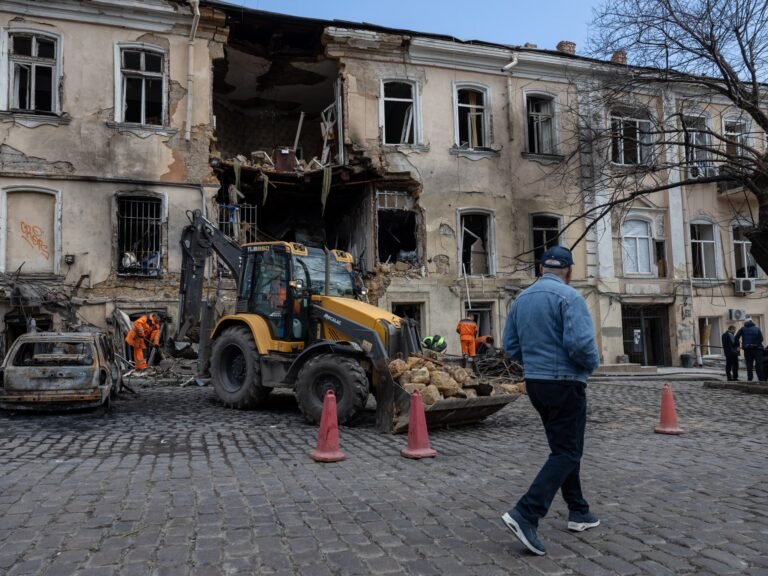
In Ukraine’s southern region of Odesa, Russian ⁠attacks ⁠late on Tuesday killed ⁠one person and wounded another, emergency services said.

The ‌attack damaged a private house, sparking a fire, and caused damage to six ⁠buildings nearby. Photos posted on Telegram by emergency ⁠services showed ⁠firefighters putting out ⁠flames in a partially destroyed building.

Meanwhile, in Russia, officials said on ⁠Wednesday a Ukrainian drone attack targeting a major oil export hub sparked a fire at the Baltic Sea port of Ust-Luga.

Alexander Drozdenko, governor of Russia’s Leningrad region, said the fire was being brought under control and that no casualties had been reported.

Ukraine has stepped up drone attacks on Russian oil refineries and export routes over recent weeks in an attempt to weaken Russia’s war economy.

According to Russia’s Ministry of Defence, 389 Ukrainian ‌drones were shot down across the country overnight, including over the Moscow region.

Meanwhile, Latvia, a NATO member, said ‌a drone ⁠from neighbouring Russia crashed in the country.

A Russian attack or a miscalculation involving a NATO member could prompt allies to invoke the mutual defence Article 5.


Source link

Access Denied

0

Access Denied You don’t have permission to access “http://hindi.news18.com/news/ajab-gajab/viral-jija-sali-jokes-in-hindi-jija-sali-jokes-devar-bhabhi-jokes-pati-patni-jokes-mast-chutkule-jija-sali-shayari-10306992.html” on this server.

Reference #18.6e560e17.1774428977.f9a6252

https://errors.edgesuite.net/18.6e560e17.1774428977.f9a6252

Access Denied

0

Access Denied You don’t have permission to access “http://hindi.gadgets360.com/social/parliament-panel-proposes-kyc-age-verification-for-social-media-dating-and-gaming-apps-news-11264065” on this server.

Reference #18.50200117.1774493999.2cf155aa

https://errors.edgesuite.net/18.50200117.1774493999.2cf155aa