
West Bengal HS Result 2026: West Bengal Council of Higher Secondary Education has officially declared the class 12th (HS) result today on May 14, 2026. All the students who appeared in the examination can get the result through their roll number and required login details. Hard copies of marksheets, passing certificates and registration certificates are also being distributed by the board across the state on the same day.

Farage’s Clacton-on-Sea constituency worst ‘tree desert’ in England, research shows | Access to green space
Nigel Farage’s constituency of Clacton-on-Sea is a “tree desert”, leaving people more exposed to air pollution, poorer health, lower life expectancy and the impact of rising temperatures, according to a new report.
The Essex town is rated the worst-performing for equal access to trees in England, with the highest proportion of urban residents – 98.2% – living in neighbourhoods with critically low access to trees.
The research, which covered the whole of the UK, found a significant north-south divide, with 15 of the worst-performing towns and cities for tree cover located in the north. Hartlepool’s population has particularly low access to trees, with 86.9% of residents at risk from a lack of access.
Caroline Gray, Woodland Trust tree equity programme officer, said: “More than a million people in the UK are living in these ‘tree deserts’, places of critically low tree equity where communities are missing out on the many benefits trees provide.
“That can mean hotter homes and streets, dirtier air, higher rates of asthma and heart disease, and poorer physical and mental health. These challenges affect daily life in countless ways and, combined with wider inequities, can even contribute to lower life expectancy.”
Scarcity of trees in urban areas puts people more at risk of stress, anxiety, depression and poor physical health, research suggests. Trees in urban environments reduce the risk of floods, keep the air cleaner and protect from rising temperatures.
The north-east was identified as the region with the highest number of “tree deserts”, with 13 of the worst-performing English towns. London and the south-east fare the best for access to tree density, including Woking and Tunbridge Wells, with five of the best-performing areas located in the capital, including Lambeth, Islington and Hackney.
Gray said everyone should have easy, nearby access to the environmental and health benefits of trees – known as tree equity. Wealthier areas, however, tend to have more tree abundance, while areas of social deprivation have far fewer trees.
The Woodland Trust said tree equity should be embedded into urban planning – and trees that are planted must be cared for and protected to ensure they continued to thrive and improved the quality of life of residents for years to come.
Gray added that the aim was not to criticise local authorities but to raise awareness of where people are most impacted in order to encourage greater support, investment and action. “Schools and communities in areas can apply for our free trees – we want to support local authorities and the people that live there.”
Councillor Adrian Smith, Cabinet Member for Environment at Tendring District Council (TDC), said that “the characterisation of areas such as Clacton as a ‘tree desert’ does not reflect the reality on the ground. More than 40,000 trees have been planted in Tendring in recent years, through the Tendring Woodland Initiative Group, and with support from partners including the Essex Forest Initiative. In addition, the council has planted more than 1,500 trees across many of our open spaces, helping to strengthen tree cover in our urban areas and bring the benefits of green infrastructure closer to residents, as part of the Urban Tree Challenge Fund. Alongside this, community-led planting projects, memorial tree additions within our cemeteries, and ongoing maintenance programmes further demonstrate our commitment to increasing biodiversity and enhancing green spaces across the district.”
The rankings reflect the scale of the population exposed to low tree equity, rather than simply identifying areas with the lowest overall tree cover. Tree equity does not just measure abundance, but also reflects whether areas have enough tree cover to meet local needs – for example, in areas of high air pollution, the need for access to tree cover would be greater than in an area with cleaner air.
Trees in urban areas create habitats for wildlife, help prevent flooding by acting as natural sponges and umbrellas, improve air quality and keep cities and towns shaded and cool. But they are under constant threat from development and under stress in many areas from climate breakdown.
In several cities, including Plymouth and Sheffield, the felling of urban trees has prompted public protests.
Source link
Most famous image of JMW Turner not a self-portrait, says expert | JMW Turner
In 2020, Tate Britain hosted the launch of a new £20 banknote bearing representations of The Fighting Temeraire by JMW Turner and the artist’s most famous self-portrait. Now a leading expert has said the latter work, part of the Tate collection, is not by Turner at all.
Dr James Hamilton, who has published books on Turner and staged exhibitions at museums and galleries nationwide, said that while the painting does depict the English Romantic painter, it is likely to be the work of his contemporary, John Opie.
Hamilton told the Guardian he started researching the portrait because “there’s nothing else like it in Turner’s work”. He said he “allowed its title to pass without comment” in his 1997 book, Turner – A Life, and even used it on the book’s cover, but had “failed to think hard enough about it”.
He now believes the portrait was misattributed after being included among nearly 300 oil paintings and 30,000 sketches and watercolours in the Turner Bequest following the artist’s death in 1851.
Hamilton said: “Turner’s relations challenged the will and, after a long, tortuous court case, the judge said the family can have the money and the nation gets the pictures – not only the ones that he wanted the nation to have, but everything by his hand in his studio … There were many pictures hanging in disarray in Turner’s house in Queen Anne Street.
“They had no way of knowing who the portrait might be by if it wasn’t by Turner and of course it was too good to lose. So it was lumped in with the rest. But it was never, even on early lists, a ‘self-portrait’. It was always a ‘portrait of Turner’. Gradually, over the years, it became an assumption that it was by him.”
The painting, dated c1799 when Turner was 24, was created by a master portrait painter with “brilliant dexterity”, Hamilton added.
He concluded that stylistic evidence points to Opie, who depicted his sitters in a similar “light emerging dramatically from dark”.
Among numerous examples of Opie’s work, Hamilton singled out a portrait of an unidentified young man in the San Diego Museum of Art. “This has a similar full-face directness as the Turner portrait – sparkly eyes, energetic shadow-play and a curious interest in untidy hair,” he said. “Indeed, the two portraits are immediately comparable.”
He noted that Opie painted numerous artists, including David Wilkie and Thomas Girtin, and that at least four of those portraits ended up with the sitters’ families. Opie is known to have admired Turner’s talent, and Hamilton suggested he may have given Turner’s portrait to its sitter as it then had “little or no commercial value to its creator”.
Writing in the spring issue of Turner Society News, which publishes his research this week, Hamilton calls on the Tate to reattribute the work to Opie. “Turner would not have appeared on the £20 note if there had not been so extraordinarily striking a portrait as this,” he argues. ‘So, if indeed he did, we should be grateful to Opie for taking Turner on as a sitter.”
Dr Pieter van der Merwe, the chair of the Turner Society, said that Hamilton had made “a good case for it not being a self-portrait, both on documentary grounds and from a lack of anything similar in his work, and a plausible but only speculative one for Opie”.
He added that he was “not aware of anyone tackling this so thoroughly before”, but expected the Tate not to change its attribution, “since there is also the legal point that the Turner Bequest only comprises work by him … If positively proved to be by anyone else, it might – at least in theory – become a ‘restitution’ issue”.
Turner stipulated in his will that his artworks should be housed together in a dedicated gallery. The fact they are split between the National Gallery and Tate Britain has long been criticised by Turner’s descendants and others.
Dr Selby Whittingham, a leading Turner scholar and former curator of Manchester Art Gallery is one such critic, who also remains convinced the portrait is correctly attributed. “I don’t think it’s by Opie. Its light tonality is characteristic of Turner’s work,” he said.
Hamilton said: “Nothing would please me more than for the Tate to show us that this is a self-portrait … But they haven’t … Don’t tell us, show us.”
A Tate spokesperson said: “As the home of the Turner Bequest, we always welcome new ideas about Turner’s life and new interpretations of his work. We look forward to exploring James Hamilton’s research further.”
Source link
Wife of Briton pleads for Saudi Arabia to release him from ‘arbitrary detention’ | Saudi Arabia
The wife of a British national who has been imprisoned in Saudi Arabia since 2024 for social media posts, has pleaded for his release as his wellbeing declines.
In November, the UN working group on arbitrary detention found Ahmed al-Doush was being detained arbitrarily under international law and recommended his immediate release, as well as the payment of compensation. The findings followed its eight-month inquiry
The plea for clemency by his wife, Amaher Nour, which is backed by Amnesty International, is less focused on the nature of the trial or the quality of Saudi justice, and is more a personal humanitarian appeal to the crown prince, Mohammed bin Salman.
Nour said: “One year and eight months have passed – long enough for us all to feel the weight of absence and the pain of separation. His return to his children has become a hope we hold on to every day. His return would restore stability to his family and give his children the chance to grow up in the care and embrace of their father, instead of living with this painful emptiness during their young years.”
The UK Foreign Office told the Guardian: “We are supporting a British man who is detained in Saudi Arabia and in contact with his family and local authorities.”
Officials said the Middle East minister, Hamish Falconer, has raised the case multiple times with his Saudi counterparts.
The UK has sent military assets to Saudi Arabia to help protect the country from Iranian attacks and is promising to send more to help open the strait.
Al-Doush, a British citizen born in Sudan, has four children, the youngest of whom is a year old and the others are aged 10 or younger. Al-Doush was arrested on a family holiday while his wife was pregnant with their fourth child.
Amnesty said: “Ahmed’s physical and mental health have sharply declined. Chronic restrictions on communication with his family have left him profoundly isolated and vulnerable. He has undertaken multiple hunger strikes in protest at the continued denial of contact with his wife and young children.
“Most recently, his condition has deteriorated to a level that has prompted serious fears of self-harm amounting to a risk to life. His family, his legal team and human rights advocates are united in their alarm: without urgent intervention, the consequences could be irreversible.”
The UN working group report on al-Doush was published in March 2026, but Saudi Arabia, instead of complying with the recommendation, confirmed in April that he had been found guilty and it had reduced his sentence to five years. Saudi Arabia has said the trial and detention was in line with domestic and international law.
According to the UN working group, al-Doush, who was based in Manchester, had been sentenced in March last year to 10 years in prison by a specialised criminal court because of social media posts that were more than five years old and an association with a critic of the Saudi government.
The judgment has not been made available to his family.
His lawyers said: “The weight of a lengthy prison sentence in a country he does not know for social media posts has been difficult for both Ahmed and his family to grasp.”
The UN working group found al-Doush’s detention arbitrary because he had been held incommunicado and not been informed promptly of the reasons for his arrest. It also found he was not brought before a judge for five months after his arrest and was denied access to his family for two and a half months. He was not granted a consular visit or a call to his family until November.
The working group concluded that he had been arrested purely because of a social media post and perceived association with a Saudi critic in exile. Al-Doush’s lawyers have said he is socially acquainted with the individual, but nothing more.
During his interrogation he was asked about his social media activity. His lawyers said his account had 37 followers and a history of only four posts in total, including one about a third country, believed to be Sudan, posted in 2018.
Saudi Arabia told the UN that al-Doush had committed terrorist crimes, including his support for terrorist ideology, his meeting with supporters and followers of terrorist ideology, and his use of the information network to commit terrorist crimes and to promote terrorist ideology. It said all proper procedures were followed, including consular access and the appointment of a lawyer of his choosing, and that the trial was heard in public and was fair.
Haydee Dijkstal, al-Doush’s barrister at 33 Bedford Row chambers, said the UK government “must use the UN decision to help one of its citizens resolve an unjust nightmare”.
The UN said the Foreign Officehad refused to share any information about al-Doush with his family for a two and a half months, citing data protection laws, a practice that has been repeatedly criticised by the families of other current and former detainees.
Source link
Kaynes Tech shares tumble over 19% after Q4 miss, JPMorgan downgrades

Kaynes Technology shares plunged over 19 per cent on Thursday after the company reported a weaker-than-expected March quarter performance and brokerage firm JP Morgan downgraded the stock citing concerns over slowing growth and execution visibility.
Shares traded at ₹3,438.30 on the NSE at 9.57 am after hitting a low of ₹3,366.10 from the previous close of ₹4,178.40.
The sharp decline in the stock came after the company’s quarterly results missed Street expectations across key parameters, while brokerages also flagged deterioration in the balance sheet and softer revenue outlook.
Kaynes Technology reported a 17 per cent yoy rise in standalone net profit at ₹70.94 crore for the March quarter, compared to ₹60.4 crore in the same period last year. However, revenue from operations declined 6.5 per cent yoy to ₹688.1 crore from ₹736.5 crore a year earlier. Revenue also moderated on a q-o-q basis amid softer business momentum.
For the full financial year FY26, the company’s profit after tax stood at ₹254.1 crore, compared to ₹209.9 crore in the previous year.
JPMorgan downgraded the stock to “neutral” from “overweight” and slashed its price target to ₹4,000 from ₹6,000 earlier. The brokerage cut its earnings estimates for Kaynes Technology by 12 per cent to 17 per cent over the next two years, citing lower expectations from both the core EMS and OSAT businesses.
The brokerage also reduced the valuation multiple for the company’s core EMS business to 33 times from 45 times earlier, due to expectations of slower revenue growth over the next two years and in the medium-to-long term, along with rising net working capital days.
While still expecting a strong 40 per cent revenue CAGR and 45 per cent earnings CAGR over financial year 2026-2028, thanks to the ramp-up of the OSAT and PCB business, we believe the stock will remain a ‘show me’ stock, until the gap between actual numbers and the company guidance narrows, JPMorgan said in its note.
Brokerage firm CLSA also expects a negative reaction to the stock following the results and highlighted further deterioration in the balance sheet as a key concern. However, the brokerage maintained its “outperform” rating on the stock with a price target of ₹4,200.
Published on May 14, 2026



The secret mission to rescue the UN’s vital Palestinian refugee archive | Refugees
East Jerusalem to Amman should have been an easy trip: a short drive down to the Dead Sea, across the border checkpoint and swiftly on to the Jordanian capital.
But in the early summer of 2024, the distance appeared an almost insurmountable obstacle to humanitarian workers from Unrwa (the United Nations Relief and Works Agency for Palestine Refugees), as they sought to safeguard huge quantities of archival documents vitally important to decades of recent Palestinian history.
A 10-month operation to save the archives kept by Unrwa in Gaza and East Jerusalem was reaching its final stages. The effort had been highly sensitive and sometimes dangerous. It had already involved dozens of Unrwa staff in at least four different countries, risky trips to rescue documents under bombardment, officials carefully carrying unmarked envelopes into Egypt, and precious boxes airlifted to safety in military planes.
But now time was running out. Unrwa’s sprawling compound in East Jerusalem had become the focus of a concerted Israeli effort to expel the agency, and a target of rightwing groups.
The significance of the Unrwa archives, much of which detailed Palestinians’ experiences as they fled or were forced from their homes during the wars that led to the foundation of Israel in 1948, was clear.
“Their destruction would have been catastrophic … If there is ever a just and durable solution to this conflict, then this is the only evidence people can use to show there were once Palestinians living in a particular place,” said Roger Hearn, a senior Unrwa official who oversaw the operation.
Such clandestine efforts were never supposed to be the task of Unrwa, which was founded in 1949 to provide healthcare, food and education to about 750,000 Palestinian refugees.
At the start of the war in Gaza, which followed the surprise Hamas attack on Israel that killed 1,200 people, mostly civilians, the organisation’s archives were spread across the countries where it works in the Middle East. In dusty boxes in the Unrwa compound in Gaza City were the original registration cards of Palestinian refugees who had sought safety in Gaza in 1948, as well as birth, marriage and death certificates dating back generations. These might allow Palestinians whose ancestors had been forced to leave their homes to trace family origins in what became Israel.
Despite previous efforts to scan the documents, hundreds of thousands of historical records remained only in paper form in 2023, vulnerable to fire, flood or deliberate destruction.
Jean-Pierre Filiu, a professor of Middle East Studies at Sciences Po in Paris, who visited Gaza during the war, described the documents as “crucial to the Palestinian experience”.
“There are testimonies of how people were forced to flee in 1948, where they came from, where their property was, what was destroyed. Two hundred thousand came to Gaza in between 1948 and 1949, from all over Palestine,” Filiu said.
For decades, Israel has been hostile to Unrwa, blaming the agency for keeping alive Palestinian hopes of a return to their original homes by granting refugee status to the descendants of those originally displaced. Israel has also frequently accused Unrwa of using text books in its schools that promote anti-Israel and antisemitic views.
After the 2023 Hamas raid, Israel alleged that Unrwa staff in Gaza had taken part in the attack. The agency later fired nine of its employees after an investigation.
The first stage of the document rescue operation was dramatic – and risky.
Days after its forces invaded Gaza, Israel ordered the evacuation of Unrwa’s offices in Gaza City. International staff left within hours, unable to take the vital archives with them.
“There was a real risk that the Israelis would move in and destroy them, or they would just be destroyed in a fire or an explosion or whatever,” said Sam Rose, the acting director of Unrwa affairs in Gaza.
Just months earlier, Unrwa’s digital registration system had to be temporarily shutdown after being hacked, and there was widespread anxiety too that another cyber-attack could wipe servers of the records that had already been scanned.
“There was this very dangerous period where we were getting many, many [cyber]attacks every day and genuinely thought we could see both the originals destroyed and any digital copies we had made. Then everything would have been gone for good,” Hearn said.
Despite continuing airstrikes and shelling in some of the most deadly attacks of Israel’s relentless offensive, which killed more than 70,000 people, mostly civilians, a small team of Unrwa officials drove rented pickup trucks back to the organisation’s sprawling compound in Gaza City. They made three trips to bring the documents south to a food warehouse in Rafah, on the border with Egypt.
But Cairo would not allow the archives out of Gaza unless Israel was consulted. Unrwa officials were certain that Israeli officials, who had imposed an almost total blockade on Gaza, would immediately understand the significance of the documents, and seize them or refuse to let them through. In 1982, when Israel invaded Lebanon, its military removed the archives of the Palestinian Liberation Organisation from offices in Beirut.
Instead, Unrwa officials with international passports were tasked with getting the archives out unobserved.
“If anyone was stopped at the border, they just said they were carrying paperwork. There was mountains [of documents] to take out. Everyone was carrying stuff with them,” said Rose.
Over the next six months, the documents were collated in Egypt and then transported by a Jordanian charity using the kingdom’s military planes as they returned to Amman after delivering aid for Gaza. The final cargo was on its way just two weeks before Israeli tanks moved to seize Rafah in May 2024, definitively blocking the way out.
But this still left another set of equally significant documents in Unrwa’s East Jerusalem compound that also needed urgent rescue.
Within weeks of the beginning of the two-year war, Israel had intensified its accusations that Unrwa was collaborating with Hamas, and launched a campaign of obstruction and harassment of the agency. By early 2024, the East Jerusalem compound was the target of protests and a series of arson attacks that caused extensive damage. Moves to expel Unrwa were gathering pace.
“In East Jerusalem, we had months of warnings that we would lose access [to our offices],” Rose said.
Efforts to persuade friendly diplomatic missions to store the archives were unsuccessful. So, with time running out, these too were removed by staff members and secretly transferred over several months, eventually reaching Unrwa offices in Jordan. In January 2025, new Israeli laws barred the agency from Israel and Israeli-occupied Palestinian territories.
In Amman, a new and extensive effort was launched to digitise the documents. Funded primarily by Luxembourg, more than 50 Unrwa staff worked in a crowded, cramped basement to scan by hand large numbers of postcard-sized original refugee registration documents as well as millions of other items.
“Now [the archives] are out of Palestine, but at least they are protected,” Filiu said.
With almost 30m documents now digitised, Unrwa aims to be able to provide every Palestinian refugee with their family tree and all supporting documents, as well as to build maps showing patterns of displacement in 1948. The archives will also provide a better understanding of the much-disputed events around the expulsion and flight of about 750,000 Palestinians at that time. Officials estimate the task could take another two years.
Dr Anne Irfan, a historian of the modern Middle East at University College London and author of the recently published A Short History of the Gaza Strip, said the documents provided a vital record of Palestinian national history.
“The Palestinians are a stateless people and without a fully unified national archive … so the Unrwa archive has a particular significance for them,” Irfan said.
The digitised archives open up multiple avenues of inquiry into the experience of Palestinian refugees, the role of the UN and international community, and core elements of Middle Eastern politics over the last 80 years, Irfan told the Guardian.
“It is highly contested history, and history that has potentially very real ramifications for the present.”
Source link
Toyota Starlet (Glanza) Crash Test: Zero Star in Adult Safety, know the full report of this car made in India – India-made Toyota Starlet Scores 0 Stars In Global Ncap Crash Test Check Details

Auto Desk, Amar Ujala, New Delhi
Published by: Amar Sharma
Updated Thu, 14 May 2026 10:27 PM IST
The India-made Toyota Starlet, which is essentially the South African version of the Toyota Glanza, has received a zero-star safety rating in the recent Global NCAP crash tests. Know complete details.

Toyota Starlet Side Impact GNCAP Car Crash Test – Photo: GNCAP
Donald Trump China visit: Soybean, proposal to form a joint trade board… What does Donald Trump want from China?
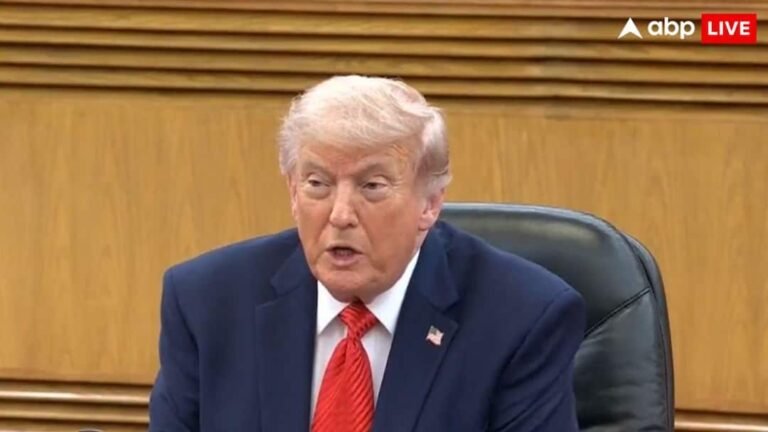
US President Donald Trump has reached China on a 2-day visit with his Laav-Lashkar. He is accompanied by Foreign Minister Marco Rubio, Defense Minister Pete Hegseth, US Trade Representative Jameson Greer, Eric Trump and Laura Trump and many others. Chinese President Xi Jinping in Beijing on Thursday (May 14) and donald trump A bilateral meeting took place between. During the meeting, Jinping and Trump praised each other. The Chinese President said that we are allies, not rivals.
Among the many topics of discussion between the two leaders, trade and economy remain the most important. Let us tell you that due to tension in trade relations, American companies are looking for suppliers outside China, while Chinese companies are now turning towards Europe instead of America.
Trump wants to sell soybeans to China
China has stopped purchasing soybeans and in such a situation Trump wants to sell more American agricultural products beef and soybeans to China. He is also in favor of increasing Chinese investment in America, but one of the main issues on which Trump is emphasizing is opening the Chinese market of 1.4 billion people to American companies. He believes that China has been adopting a very protectionist policy for a long time.
Proposal to form a joint trade board
In this direction, Trump wants to propose to China to form a joint trade board, where both the countries can sit and solve the problems related to bilateral trade. It is clear that Trump wants to return to America only after achieving some economic achievement from this trip.
Apart from this, China wants stability on the issue of tariffs because at one time Trump had imposed tariffs of up to 145 percent on Chinese goods. Beijing wants a system that will last for a long time and not change suddenly on the basis of a social media post.
Also read: Iran-US War: ‘America shows off’, Iran again winked at Trump, Garibabadi said – ‘India…’
Australians from hantavirus cruise ship to fly out of Netherlands in full PPE after plane and crew secured | Hantavirus
Four Australian citizens who were aboard the MV Hondius, the cruise ship at the centre of the hantavirus outbreak, will soon be home after the government secured a suitable aircraft and crew for the journey.
The health minister, Mark Butler, said the citizens, along with a permanent resident and a New Zealand citizen, were due to take off from the Netherlands on Thursday evening local time and would land in Perth on Friday afternoon.
“Six passengers are still in good health, they have all tested negative for hantavirus and are showing no symptoms as well,” Butler said.
“Passengers and crew members will travel this flight for its duration in full PPE. There are very strict conditions about the flight, the landing, and the quarantine arrangements.”
The passengers will be subject to a quarantine order, remaining at Western Australia’s Bullsbrook quarantine facility for at least three weeks. The flight crew bringing them home will also be required to quarantine, either in Australia or in another country.
The Department of Foreign Affairs and Trade had scrambled to find an aircraft and crew who were able to complete quarantine, after a 48-hour deadline was imposed on their international transfer through the Netherlands by Dutch authorities.
The outbreak now includes 11 reported cases, with nine officially confirmed. Three people have died.
The MV Hondius, which is registered in the Netherlands, is on its way to Rotterdam, with 25 crew members and two medical staff on board. It is expected to arrive on Monday. After disembarking, the crew will enter quarantine and the ship will undergo what its operator calls a “thorough cleaning and disinfection process”.
“The operation to bring all those on board home in the safest possible way was highly complex. It required intensive cooperation with national and international partners,” the Dutch government said in a statement on Tuesday. “The Dutch government thanks all those involved, including the shipping company, and expresses its gratitude and appreciation for the cooperation with Spain.”
The Australian government has been working around the clock to bring the group home.
“This is a difficult arrangement to make,” Butler told ABC News on Tuesday, adding the travellers were in “good health and relatively good spirits” at the time.
“You’ve got to have crew that are willing to isolate at the end of the flight, you’ve got to have a flight that has some refuelling arrangements put in place between the Netherlands and Australia,” Butler said. “And it’s important that we’ve put those quarantine arrangements in place, ready to go when they do land in Australia.”
Butler said the hantavirus had been listed under Australia’s Biosecurity Act, which allows the government to make quarantine orders.
Hantavirus, a group of viruses found around the world, is generally spread via infected rodents to humans through faeces, urine or saliva. Human-to-human transmission is very uncommon, but can occur through close and prolonged contact, the Australian Centre for Disease Control says.
Still, infection can be serious, resulting in critical illness or death. Three people have died from the outbreak, and a French woman is currently being treated after falling critically ill, with life-threatening heart and lung problems.
The World Health Organization maintains that the threat to the general public remains low, but officials have urged caution.
“At the moment, there is no sign that we are seeing the start of a larger outbreak,” Tedros Adhanom Ghebreyesus, the WHO director general, told reporters on Tuesday.
“But of course the situation could change, and given the long incubation period of the virus, it’s possible we might see more cases in the coming weeks.”
Butler said this week Australia’s quarantine protocols would be among the most stringent in the world.
Source link