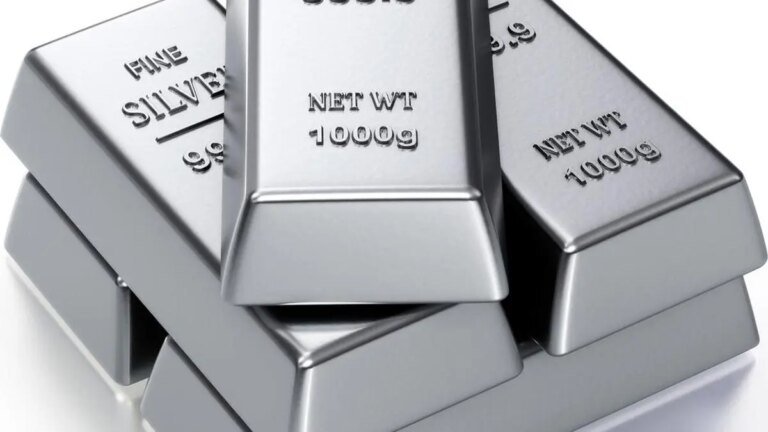
Silver tops $100/oz on Shanghai Futures Exchange, soars to record high in Mumbai spot market

0

Silver futures have topped $100 an ounce on the Shanghai Futures Exchange (SHFE), even as the white precious metal closed at a record high of ₹2,81,890 a kg in the Mumbai spot market.

On SHFE, silver March futures closed at 22,539 yuan a kg ($100.63 an ounce) after rising to a record high of 23,710 yuan ($105.87) on Thursday.

In the global market, silver ruled at $90.82 an ounce at 1730 hours IST, while March futures on COMEX were quoted at $90.65 an ounce. In the Mumbai spot market, silver opened at a record high of ₹2,82,720. On MCX, March silver futures ruled at ₹2,90,610 a kg.

why premium

Silver is quoting at a $10 premium on SHFE due to soaring domestic demand for the white precious metal in China from industries such as solar, electric vehicles and electronics, besides investment demand. Also, low inventories in China have compounded global supply shortage.

According to analysts, available physical silver stocks are being hoarded and accumulated by various countries and their agencies.

In the global market, silver has witnessed volatility with prices topping $93 an ounce and dropping to $86, before trading around $90 over the past two sessions.

Silver, which has seen gathering momentum in prices over the past three months, is facing a structural deficit since 2018 and it will likely continue this year too. One of the reasons is investments in mines have been slack, leading to the market depending on the white precious metal being available as a byproduct of copper, zinc or lead mining.

Gold-silver ration

Besides, use of silver for solar, electronics, electric vehicles and data centers has soared over the past decade by 50 per cent, while in the case of photovoltaics, it has more than doubled.

Meanwhile, the gold silver ratio has halved to 50:1 from 100:1 a year ago. This means, an ounce of gold can get only 50 ounces of silver now compared with 100 ounces a year ago.

Analysts say silver soars when the ratio shrinks below 50:1 and the white precious metal would soon top $100 in New York and London, too.

Published on January 16, 2026

How Indian jewelers are ensuring ethical sourcing and provenance in the natural diamond supply chain

0

Even as the demand for natural diamond jewelery continues to surge, across the Indian market, the focus on diamonds is no longer limited to cut, clarity or carat. The conversation has evolved, way beyond those limited questions, to include an interest in sourcing and origins.

Consumers now seek deeper knowledge and understanding of what they are buying, wearing, and passing on to the next generation. India accounts for 11 per cent of the global demand for natural diamond jewellery, which makes it the world’s second largest market ahead of China.

Demand for natural diamond jewelery in the country surged post-pandemic, which allowed Indian jewelers to dwell on how natural diamonds traverse through the supply chain, with emphasis on ethical sourcing and verified provenance.

It has been reported earlier that the global diamond market was valued at approximately $97.57 billion in 2024. That market is projected to grow to $138.66 billion by 2032, reflecting a compound annual growth rate (CAGR) of 4.5 per cent over this period. With natural diamonds becoming increasingly rarer to find—there have been no significant deposits discovered in recent years—they have become even more valuable as possessions and as a symbol.

The Gem and Jewelery Export Promotion Council (GJEPC), India’s apex body for the trade, had reported recently that the domestic gems and jewelery market is currently valued at $85-90 billion, and could touch $120 billion by 2030. It quoted a recent Deloitte report that projects a rise to $235 billion by 2035.

India’s diamond market is estimated at $6.2 billion in FY25, according to Wazir Advisors. It estimates that the market will grow by 2028, reaching $8.6 billion.

Aspirational spending

As India grows economically, with more disposable incomes among younger people, aspirational spending will rise, especially on categories like diamond jewellery. Understanding the origins of diamonds and their journey from rock to retail therefore becomes useful, for buyers and sellers.

The journey starts with identifying where a diamond comes from and which mine it was sourced from. This requires ascertaining the right manufacturing partners, who supply authentic and ethically sourced diamonds from proven mining companies like Rio Tinto, ODC (Okavango Diamond Company), De Beers and others.

Oversight follows identification, with audits across the supply chain. This covers the sourcing of raw materials to manufacturing of diamonds and jewelery to screening for natural diamonds. The Indian jewelery sector follows global standards set by the Responsible Jewelery Council (RJC), which establishes the premise for ethical practices—from sourcing through to delivery to the end consumer. Certification and audit checks help maintain discipline across each stage of the process, adding transparency and traceability for the customer’s satisfaction.

Technology has become central to how provenance is recorded. Blockchain platforms such as Tracr are used to document a diamond’s movement as it changes hands across the supply chain. RFID enables individual diamonds to be identified, while Sarine technologies, combined with blockchain and artificial intelligence (AI), support scanning and imaging that capture data at multiple points—from mine to market.

Kimberley process

Despite these measures, achieving complete transparency remains a challenge to the diamond supply chain. The chain induces multiple players, from artisanal miners and rough dealers to cutters, polishers, certification laboratories, wholesalers and retailers. With such a wide network, maintaining visibility at every stage is difficult.

The Kimberley Process Certification Scheme (KPCS) marked an early effort to address sourcing concerns, though its limited scope restricts traceability. The cost of blockchain systems also create barriers for miners and its complexity excludes them from traceability platforms.

Consumers are also looking for third party verification, hence RJC has been widely used as a global standard and hallmarking certification is also provided to them. Overall, due to the various technologies, diamond platforms and certification benchmarks, consumers are gaining trust and confidence around ethics, sustainability and provenance across the Indian jewelery sector.

Supported by certification frameworks and technology platforms, these efforts are strengthening confidence and shaping how Indian jewelers approach responsibly across the diamond supply chain.

(The author is Managing Director, PMJ Jewels)

Published on January 17, 2026
Silver slips from record highs as geopolitical tensions ease

0

In the international market, both silver and gold corrected during Asian trading hours.

In the international market, both silver and gold corrected during Asian trading hours.

Silver Futures ended their five-day record-breaking rally and declined by ₹4,027 to ₹2,87,550 per kg on Friday, while gold prices slipped to ₹1,42,601 per 10 grams as investors booked profits tracking weak global trends and a stronger US dollar.

On the Multi Commodity Exchange (MCX), silver futures for March delivery declined by ₹4,027, or 1.38 per cent, to ₹2,87,550 per kilogram in a business turnover of 9,890 lots. The white metal had touched an all-time high of ₹2,92,960 per kilogram on Thursday.

Commodities trading on the MCX remained shut during the morning session on Thursday due to civic elections in Maharashtra and later resumed trading in the evening session.

Gold futures also witnessed profit-taking by the traders on the domestic bourse. The yellow precious metal for February contract fell ₹520, or 0.36 per cent, to ₹1,42,601 per 10 grams in 14,194 lots.

“Gold and silver witnessed sharp volatility on Friday. Weaker than expected US weekly jobless claims strengthened the US dollar, while President Donald Trump’s softer stance on Iran reduced safe-haven demand for precious metals,” Rahul Kalantri, Vice-President of Commodities, Mehta Equities Ltd, said.

In the international market, both silver and gold corrected during Asian trading hours. On the Comex, silver for March contract slipped $1.93, or 2.10 per cent, to $90.41 per ounce. It had touched a record of $93.56 per ounce on Wednesday.

Gold futures for February delivery also dropped by $21.9, or 0.47 per cent, to $4,601.8 per ounce. The yellow metal had hit an all-time high of $4,650.50 per ounce on January 14.

“Recent US macroeconomic data has kept expectations of Federal Reserve rate cuts on hold for the first half of the year, pushing the dollar index to multi-week highs and creating near-term headwinds for bullion prices,” Kalantri added.

Published on January 16, 2026

Silver dips after US tariff pause, but set for hefty weekly gain

0

The tariff pause appears to be just a minor speed bump for silver, rather than a serious threat to a rally that's seen it triple in value over the past year.

The tariff pause appears to be just a minor speed bump for silver, rather than a serious threat to a rally that’s seen it triple in value over the past year.

Silver dropped on Friday after the US refrained from putting import tariffs on critical minerals, but was still up 15 per cent for the week on surging demand for precious metals.

The white metal fell as much as 2.3 per cent in Asian trading after a modest decline on Thursday. The threat of levies on minerals including silver and platinum had been one among several drivers of a breakneck rally, but US President Donald Trump stopped short of imposing the duties, while not ruling out doing so in future.

Still, the unpredictable nature of Trump’s policymaking “suggests that the practice of keeping metal onshore in the US to back short futures positions is likely to persist,” consultancy Metals Focus said in a note.

The tariff pause appears to be just a minor speed bump for silver, rather than a serious threat to a rally that’s seen it triple in value over the past year. In recent weeks, Trump’s renewed attacks on the Federal Reserve and his increasingly aggressive foreign policy have added more impetus. Silver jumped more than 20 per cent in the four sessions through Wednesday, while gold, platinum and palladium have also climbed.

Silver fell 0.8 per cent to $91.6861 an ounce as of 9:21 am in Singapore. Gold dipped 0.3 per cent to $4,603.49, but was up more than 2 per cent for the week, while platinum and palladium edged lower. The Bloomberg Dollar Spot Index was flat.

More stories like this are available on bloomberg.com

Published on January 16, 2026

Precious metals will likely see contrasting halves this year, says UBS

0

Precious metals will likely witness two different halves this year, with prices rising in the first and tapering off in the second, says UBS precious metal experts.

“In the first half, gold could rise to $5,000 an ounce and silver to $100 an ounce. In the second half, gold could be around $4,500 and silver at $75,” said Joni Teves, precious metal strategist at the Swiss-based bank.

Teves and UBS global head of precious metal distribution, Andrew Matthews, were addressing the Swiss Bank’s 2026 Precious Metal Media Briefing on Wednesday.

Long-term view

In the long-term, gold could rule at historic high levels as the yellow metal has become a core part of investments. “Gold will be more resilient,” said Matthews.

Stating that market tightness and speculation will continue to drive silver prices, he said high demand from India last year supported liquidity in London, which in turn led to speculation.

The historical imbalance in silver supply and demand has not been seen since the Hunt brothers episode in 1980. The market is in general deficit of the white precious metal, said Matthews, adding that backwardation (a situation in which spot prices are higher than futures) remains a factor.

Important ETF roles

High silver prices, however, have led to lower demand from India after October, while Chinese demand continues. “ETFs (exchange-traded funds) have played a significant role, particularly in China,” he said.

On the likely impact if the US Supreme Court rules against the Donald Trump administration’s tariffs, Matthews said there will be a temporary decline in bullion prices.

To another question, he said if the US eases curbs on imports of goods, it could ease the tightness in the silver market in non-US markets.

Teves said it would be healthy if the gold market turns cautious before moving up, though 2026 could witness a lot of volatility in silver.

Gold-silver ratio

“Silver usually outperforms gold and reacts more to a fall in gold prices. There could be more fall in the gold-silver ratio,” she said. Currently, the gold-silver ratio is 56.4:1, which means an ounce of gold can get 56.4 ounces of silver. A year ago, the ratio was 89.9:1.

Stating that gold is unstable with real rates, Teves said once the US Fed reaches the end of the cycle in lowering interest rates, growth would recover. This would put pressure on gold.

Matthews said ETFs are witnessing geographical diversification with a shift seen in India and China. “These markets are jewellery-driven. Retail demand suffered in these markets but that has been offset by investment demand,” he said.

Although ample gold supplies may be available in the world, they may not be in the “right location”. On the other hand, silver has seen more activity in the past three months, Mathews said.

Chinese order ‘misunderstood’

Teves said China’s order on registration for silver exports from January 1 has been misunderstood. “China said exporters should have a license for exports. It has been misunderstood. This will not have any impact on silver,” she said.

Central banks’ demand for gold could slow this year, but it would be difficult to pinpoint and say from which central bank demand for gold would emerge, said Teves.

On the platinum group metals, she said the demand for battery-driven vehicles is destructive for those driven on petrol. This would be negative for palladium, which is used as a catalytic converter in such vehicles.

Published on January 14, 2026

Gold, silver slide from record heights on profit-taking

0

In the previous session, gold bullion hit a record $4,642.72.

In the previous session, gold bullion hit a record $4,642.72.

Gold slipped on Thursday as investors booked profits after the yellow metal hit a record in the previous session, while an apparent softer tone from US President Donald Trump on the Federal Reserve chair and Iran also dampened safe-haven demand. Spot gold was down 0.7 per cent at $4,589.71 per ounce, as of 0501 GMT. In the previous session, bullion hit a record $4,642.72. US gold futures for February delivery ⁠fell 0.9 per cent to $4,594.10.

“Today, we’re seeing that gold is down a bit after (Trump) said maybe we’re not going to intervene in Iran, staving off safe-haven demand, but the ⁠larger story (of the metal’s rise) is not going away,” said Ilya Spivak, head of global macro at Tastylive.

With Iran’s leadership trying to quell the worst domestic unrest since the 1979 revolution, Tehran threatened US military bases in the region, in an attempt to deter Trump’s repeated threats of military intervention. At the White House, however, Trump suggested he was adopting a wait-and-see posture toward the crisis. Meanwhile, the president said on Wednesday that he has no plans to fire Fed Chair Jerome Powell, despite the Justice Department criminal investigation, but added it was “too early” to say what he would ultimately do.

The US weekly jobless claims for the first week of January will be released later in the day, which could provide clues on the Fed’s monetary policy path. Traders anticipate ⁠two interest rate cuts this year.

A low-interest-rate environment, geopolitical and economic uncertainty traditionally favor non-yielding assets such as gold. Spot silver slid 5.5 per cent to $87.62 per ounce after hitting an ⁠all-time high of $93.57 earlier in the session. Spot platinum receded 3.3 per cent to $2,305.90 per ounce, a one-week high, after scaling a record peak of $2,478.50 on December 29. Palladium lost 2.6 per cent to $1,778.80 per ounce and hovered near a ⁠one-week low.

Published on January 15, 2026

Silver tops ₹2.75 lakh/kg, gold near ₹1.5 lakh/10 gm as precious metals continue to dazzle

0

On Wednesday, silver surged to $91.48 before slipping below $90. At 1230 hours IST, silver ruled at $89.82 an ounce

On Wednesday, silver surged to $91.48 before slipping below $90. At 1230 hours IST, silver ruled at $89.82 an ounce | Photo Credit: istock.com

The precious metal complex continued to sparkle with silver heading towards a historic ₹3 lakh per kg, and gold towards ₹1.5 lakh per 10 gm as prices in the global market continued to soar.

According to Ponmudi R, CEO of Enrich Money, the precious metals are being driven by a powerful combination of haven demand, geopolitical uncertainty, and supportive macro conditions.

“The rally has been fueled by heightened concerns around US central bank independence following reports of a US criminal probe into Federal Reserve Chair Jerome Powell, which has unsettled markets and weakened confidence in monetary policy neutrality,” he said.

Bloomberg Said investors avoiding government bonds and currencies due to worries over ballooning debt levels has supported the rally. A relatively weak US dollar makes dollar-denominated commodities cheaper for many buyers.

On Wednesday, silver surged to $92.16 an ounce at 1950 hours IST. Silver futures for February delivery ruled at $92.15 an ounce on COMEX. In India, the Mumbai spot market price zoomed to end at ₹2,77,512 a kg. On MCX, silver rose to as high as ₹2,91,406 a kg before easing to ₹2,90,200.

Gold was up a percent to $4,632.54 an ounce, and February gold futures ruled at $4,643.74 an ounce. In the Mumbai spot market, gold closed at ₹1,42,015 per 10 gm. On MCX, February futures were quoted at ₹1,43,384 per 10 gm.

Other precious metals, platinum and palladium, surged in tandem with the yellow and white precious metals. Platinum surged to $2,430 an ounce before it pared gains to $2,405. Palladium was up at $1,903 an ounce.

Since the beginning of 2026, gold has gained over 7 per cent, silver 29 per cent, platinum 16 per cent and palladium 15 per cent.

Apurva Sheth, Head of Market Perspectives & Research, SAMCO Securities, said silver consolidated in the range between ₹2,22,502 and ₹2,54,174 a kg and there was a clear upside. The white precious metal has stayed above the key range for the third day in a row.

“The structure continues to show a sequence of higher highs and higher lows, reinforcing the strength of the ongoing trend. The earlier resistance zone around ₹2,59,574 has now turned into an important support area in the event of any interim pullbacks,” said Sheth.

The major medium target would be ₹2,96,737, while an extended move in a strong momentum environment could even open up levels closer to ₹3,94,034 over time, the SAMCO official said.

“It’s not just precious metals; the entire commodity basket is going through a supercycle,” said Sheth.

Ponmudi said beyond macro uncertainty, structural demand remains strong, led by continued central bank gold accumulation and rising industrial consumption of silver driven by solar, EVs, AI infrastructure, and electronics, even as supply constraints persist.

Published on January 14, 2026

Silver hits $90 mark for first time on rate cut bets & supply concerns

0

spot silver surged past $90 an ounce for the first time on Wednesday, driven by softer US inflation data that reinforced expectations of Federal Reserve interest rate cuts in 2026 amid persistent geopolitical tensions and supply constraints. Silver prices rose over 3 per cent to $90 per ounce by 0308 GMT.

The rally followed US core CPI data showing a 0.2 per cent monthly increase, below the expected 0.3 per cent, with the annual rate holding steady at 2.6 per cent. “Markets now anticipate two to three rate cuts by the Fed in 2026,” according to Rahul Kalantri, VP Commodities at Mehta Equities Ltd. The softer inflation print bolstered safe-haven demand for precious metals alongside civil unrest in Iran and heightened geopolitical risks.

Silver has experienced a historic surge in 2025, rising approximately 161 per cent year-to-date after hitting a record high of $86.62 in late December. The metal has since resumed its upward trajectory, outpacing gold’s 66 per cent gain and traditional assets including Bitcoin and the S&P 500.

“COMEX Silver is trading firm near $89.60, registering fresh higher highs on a near-daily basis,” noted Ponmudi R, CEO of Enrich Money. The rally is underpinned by structural factors including silver’s designation as a US critical mineral and a global supply deficit estimated at 2,500 tonnes annually. Industrial demand, particularly from solar panels, electric vehicles, and AI infrastructure, accounts for roughly 50 per cent of consumption, while supply remains constrained.

China’s new export restrictions, requiring licenses for companies producing at least 80 tonnes annually, could widen the global deficit to 5,000 tonnes. ETF inflows have resumed since May 2025 after years of liquidation, while inventories in London, China, and the US have fallen to multi-year lows.

On mcxsilver traded around ₹2,86,000, with Kalantri citing support at ₹2,69,810 and resistance at ₹2,84,470.

Published on January 14, 2026

Silver price rises to $90 per ounce for the first time

0

Silver prices rose ⁠more than 3% to $90 per ounce ⁠by 0308 GMT.

Silver prices rose ⁠more than 3% to $90 per ounce ⁠by 0308 GMT.

Spotsilver jumped above the key $90 an ounce level for the first time as soft US inflation data cemented interest rate cutbets by the US Federal Reserve on the back of geopolitical tensions, robust industrial and investment demand and tightening inventories.

Silver prices rose ⁠more than 3% to $90 per ounce ⁠by 0308 GMT.

Published on January 14, 2026

Silver soars to new high of over $88/oz; spot prices top ₹2.6 lakh a kg in India

0

The precious metals complex continued its sparkling run on Tuesday, with gold topping $4,600 an ounce and silver soaring to a new high over $88 an ounce on geopolitical crisis, particularly in the background of the brewing Iranian crisis.

In India, too, silver in the Mumbai spot market ended at a new high of ₹2,63,062 a kg, while March futures on MCX ruled at ₹2,79,419. At 2000 hours IST, silver ruled at $88.47 an ounce and February futures at $88.30.

Gold ruled at $4,625 an ounce and March gold futures were quoted at $4,635.29. In the Mumbai spot market, gold ended at ₹1,40.284 per 10 gm and February futures on MCX ruled at ₹1,42,858 per 10 gm.

Light jewelery demand up

Arthi Ramalingam, Founder & CEO, Eternz, said the current surge in gold and silver prices reinforces their role as trusted stores of value for Indian households amid geopolitical and macroeconomic uncertainty.

“At Eternz, we’ve seen a 20–30 per cent rise in demand for lightweight jewellery, while wedding and festive demand remains resilient,” she said.

Renisha Chainani, head of research at Augmont, said gold has decisively broken above its earlier resistance at $4,570, opening the door to higher levels. The next key targets are $4,745–4,750 (78.6% Fibonacci extension, ~₹1,46,000) and $4,966–4,970 (100% Fibonacci extension, ~₹1,52,500).

Complex’s gain in 2026

“Silver’s rally also looks set to extend further. Fibonacci projections point towards $88 (₹2,78,000) and $93 (₹2,93,000) in the coming weeks, while $70 remains a strong support zone,” she said.

Platinum and palladium, too, rose in line with gold and silver. Platinum was quoted at $2,388.50 an ounce and palladium at $1,919.50 an ounce.

Since the beginning of the year, the yellow metal has gained 7 per cent, the white precious metal over 24 per cent and platinum and palladium over 16.5 per cent.

Published on January 13, 2026