Changing tax rules for investors won’t shrink housing supply or raise rents. Just look at Victoria | Anthony Albanese

0

The Albanese government is preparing to unveil a budget that will recast housing as shelter – rather than a financial tool – in changes that have already sparked heated warnings that rents will rocket and housing supply will be curtailed.

Those warnings are best ignored.

It is now clear that Labor will usher in changes to negative gearing and capital gains tax designed to make property less attractive to new investors.

The government will have ample protection for existing property investors, known as grandfather provisions, which will give it some protection from a political backlash as it transitions Australia away from an unfair system without burning it to the ground.

To be clear, if the anticipated changed settings – a clampdown on negative gearing for future purchases and a less generous CGT discount – means a property is no longer attractive to prospective investors, that’s not a bad thing.

Course correction

Since 2020, investors have increased their share of new home loans from less than 30% to more than 40%, according to Australian Bureau of Statistics data, while owner-occupier levels have fallen.

This is part of a long-term trend, given that the proportion of housing stock owned by investors has been rising for decades.

Graph showing increase in investors’ share of new home loans, from about 24% in 2020 to 40% of new home loans at present

Traditionally, investors pursued different types of properties to owner-occupiers, but the tax incentives – including the Howard era 50% CGT discount – have been so good that the distinction has narrowed.

That has pitted investors against owner-occupiers across the country.

Michael Fotheringham, the managing director of the Australian Housing and Urban Research Institute, puts it this way: “It has become easier to buy a second, third or fourth home than it is to buy your first home – that’s a problematic policy setting.”

The favourable arrangements have allowed investors to overpay for properties in the knowledge they’ll use negative gearing to their advantage, before richly profiting upon sale, backed by a generous CGT discount.

Sign up for the Breaking News Australia email

This rewards poor decision-making by allowing the investor to recoup their overspend through tax deductions, insulating them from the consequences of paying too much for something.

While Australia’s housing crunch has been exacerbated by housing shortages and poor planning by a string of state and federal governments, the favourable tax settings for investors has made it worse.

Predictions of a market collapse or explosion in rents stemming from the budget reforms rely on an assumption that there will be a mass exodus of investors.

In reality, any divestment – if indeed the new policies cause divestment – simply means the properties will be put up for sale and bought by another investor or an owner-occupier.

There is no loss of housing stock, and one more renter may just find a permanent home.

Given new-built properties acquired after budget night are set to be exempt from the tax changes, any warnings about impacts on supply are largely moot. If anything, investors may be more enthused to support new builds than they were previously.

Labor’s anticipated changes are not a panacea, and more supply is critical, however the reforms will gently push Australia on to a more equitable trajectory.

Unfounded fears

Political reforms are usually met with dire warnings that do not come to pass, with Victoria a prime example.

In 2023, Daniel Andrews lumped the state’s 860,000 property investors with an extra $1,300 a year of land tax, on average, for Victoria’s Covid debt repayment plan.

Landlords complained and the Property Council of Australia warned rental supply could fall and push rents up.

Line graph showing rental supply dipped only slightly after the land tax hike announced in Victoria in 2023

Victoria’s rental stock fell about 3%, from 680,000 in June 2023 to 661,000 in December 2024, with the decline concentrated in the cities. It’s hovered at that point ever since.

Rents did not spike, with price growth slowing from mid-2023 to mid-2025 in Melbourne, according to Cotality data. Today, rents are rising at an annual pace of 5% or more in most Australian cities, but not in Melbourne.

With fewer rental properties available, rents might have been expected to pick up, but the loss of supply was balanced by easing demand. More renters began buying homes.

Line graph showing first home buyers in Victoria increased somewhat after 2023 while investing dipped slightly

Victoria already had more first home buyer loans than other states and has seen its lead grow since September 2023, ABS data shows.

Other states have seen first home buyer numbers stay flat.

Melbourne’s home prices have also been slower to rise than other cities. Its steady supply of new homes has helped but ABS data shows it also hasn’t seen the investor boom that has hit Brisbane and Perth.

The taxes have not killed off property investment. The number of investor home loans in Victoria rose 10% from 2023 to 2024, then another 20% in 2025. Loan Market data suggests there have been even more investor loans in 2026 up to April than in the same period last year.

Higher investor taxes seem to have helped Victorians enter the housing market without pushing up their rents.

There’s no reason more Australians won’t enjoy the same benefits.


Source link
Jeffries hits Trump on gas prices after urging GOP not to ‘play politics’ under Biden


NEWYou can now listen to Fox News articles!

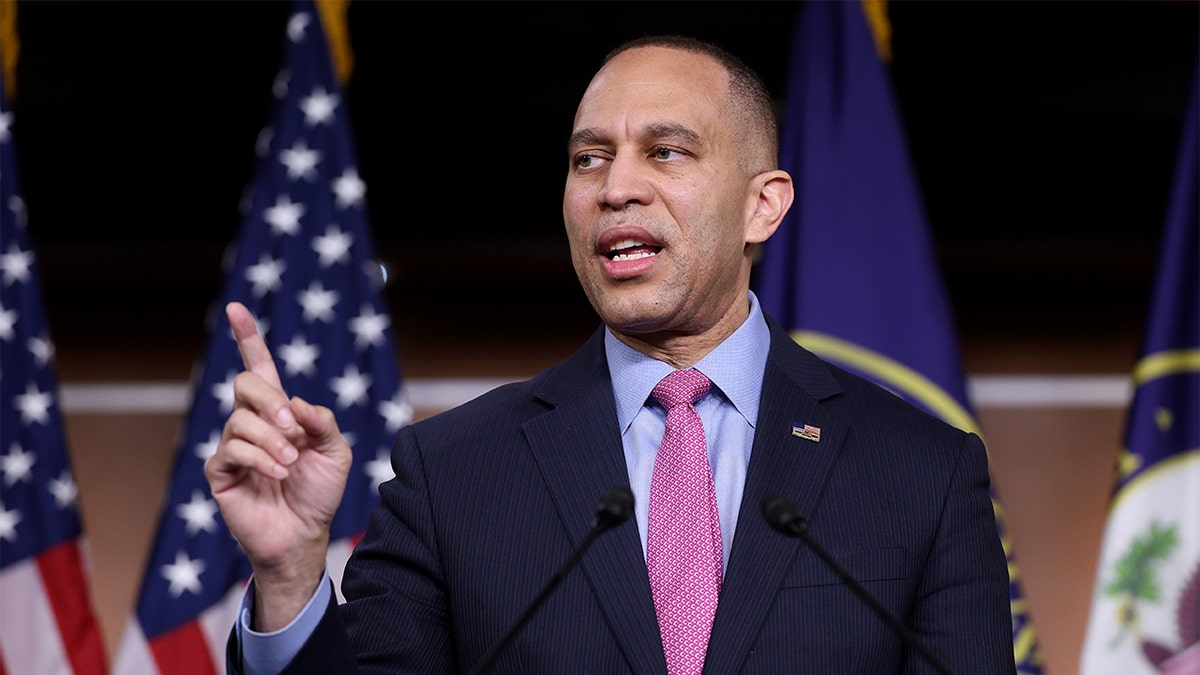
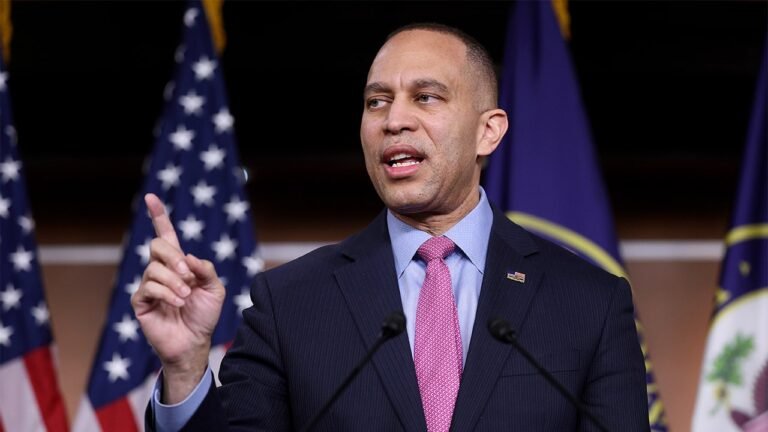
House Minority Leader Hakeem Jeffries, D-N.Y., is hammering President Donald Trump over surging gas prices tied to the war with Iran, arguing voter frustration could help Democrats win back the House in November. 

But four years ago, he urged Republicans not to “play politics” with record prices at the pump under former President Joe Biden.

“The average gas price is now $4.55 per gallon,” Jeffries wrote on social media Friday. “Is this what the golden age in America looks like?”

As the conflict drags on, disruptions to oil flows through the Strait of Hormuz have pushed fuel prices higher. The Trump administration’s effort to end the war appears to be stalling, even as a month-old ceasefire with Iran has largely held.

A container ship sitting at anchor in the Strait of Hormuz as a motorboat passes in the foreground

A container ship sits at anchor in the Strait of Hormuz off Bandar Abbas, Iran, as a motorboat passes in the foreground on May 2, 2026. (Amirhosein Khorgooi/ISNA)

GAS SURGE TIED TO IRAN CONFLICT HITS SWING STATES, TESTING TRUMP’S LOW-PRICE PITCH

Jeffries’ attack on gas prices is part of Democrats’ strategy to focus on affordability, as the party looks to unseat a swath of vulnerable Republicans in battleground House districts this year. 

Gas prices have risen on average by more than $1.50 — a roughly 50% increase — since Operation Epic Fury began on Feb. 28, according to AAA.

A recent Fox News Poll found that nearly 60% of voters said gas prices were a “major problem” for their household. Another 29% of respondents said price increases at the pump were a “minor problem.”

Voter concern about persistent inflation has contributed to Democrats holding an eight-point lead over Republicans on the issue, according to the April Fox News survey. Nearly three-quarters of voters believe the U.S. economy is getting worse, matching a record high that Fox News also observed under Biden in April 2023.

“The problem with this reckless war of choice is life has gotten more expensive,” Jeffries told CNBC’s “Squawk Box” in April.

But Jeffries struck a markedly different tone in March 2022, when gas prices surged following Russia’s invasion of Ukraine. Average gas prices ultimately rose to more than $5 per gallon in June of that year.

House Minority Leader Hakeem Jeffries speaking at a press conference at the U.S. Capitol

House Minority Leader Hakeem Jeffries speaks at a press conference on Department of Homeland Security funding at the U.S. Capitol in Washington, D.C., on Feb. 4, 2026. (Kevin Dietsch/Getty Images)

FROM BIDEN’S ‘WAR’ ON GAS PRICES TO ‘SMALL PRICE TO PAY’: GOP SHIFTS TONE AS IRAN CONFLICT HITS PUMPS

“It’s certainly my hope that my Republican colleagues won’t continue to play politics with an existential crisis for Ukraine, for Europe, for the West and for democracy because that is what is at stake right now,” Jeffries said during a March 2022 news conference, referring to a spike in gas prices. “It may be some sacrifice that is required across the world.”

“Certainly, we are seeing incredible sacrifice by the Ukrainian people,” he went on.

Asked by a reporter whether the Biden administration should ask Americans to temporarily work from home to ease the gas crisis, Jeffries replied, “Everything should be on the table” and suggested the private sector consider the idea.

“To the extent that corporate America, American businesses, as was the case during World War II, see themselves as part of the effort to ease the sacrifices that may be required here, I think that would be a positive development for the country,” he said. 

Fox News Digital reached out to a Jeffries spokesperson before publication.

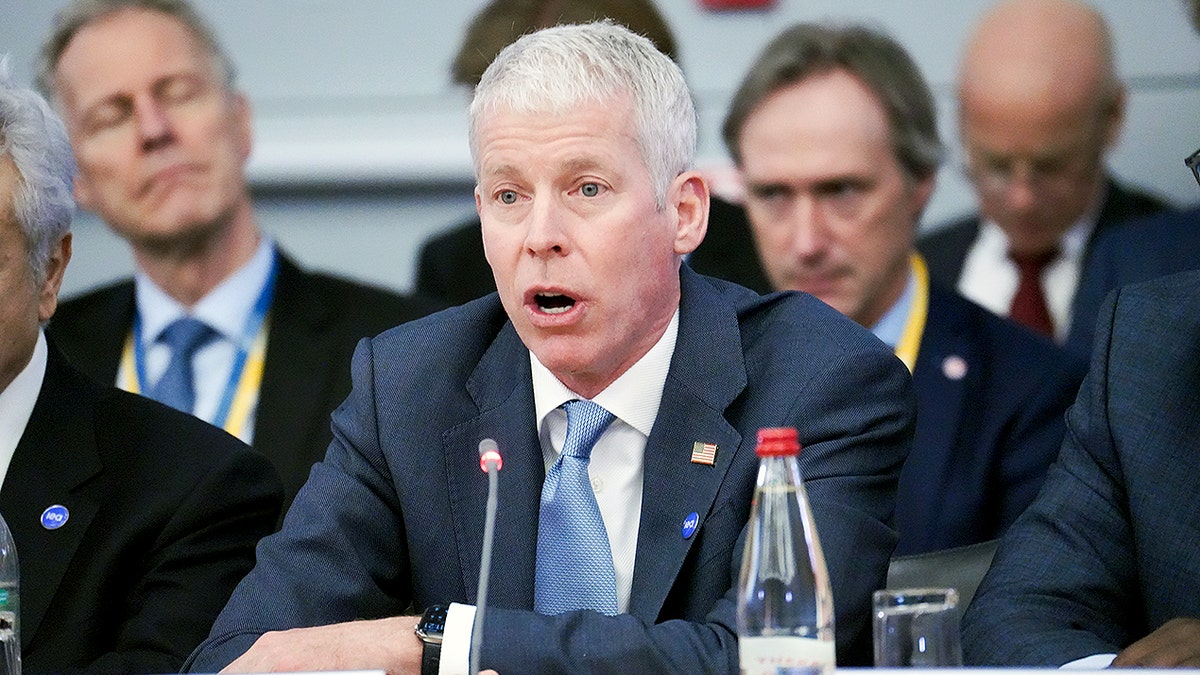
Energy Secretary Chris Wright has voiced optimism that gas prices will fall following the end of hostilities with Iran while conceding that Americans are experiencing “discomfort” in the short term.

Energy Secretary Chris Wright speaking at the International Energy Agency in France

Energy Secretary Chris Wright said Sunday that gas prices will ultimately “come back down lower than they were before” the war with Iran began in late February. (Ana Lopez/Getty Images)

CLICK HERE TO DOWNLOAD THE FOX NEWS APP

“I’m avoiding price predictions,” Wright told NBC’s “Meet the Press” on Sunday. “Gasoline and diesel prices are up, and they’ll remain up while this conflict is in place, and then they will come back down. And ultimately they’ll come back down lower than they were before.” 

“Ending Iran’s nuclear program, that is massively positive for the flow of energy,” Wright said. “Meaning more energy will flow in the future, meaning lower energy prices for Americans and the rest of the world.”


Source link

Instructure confirms hackers used Canvas flaw to deface portals

0

Instructure says hackers used Canvas flaw for extortion message on login portals

Education technology giant Instructure has confirmed that a security vulnerability allowed hackers to modify Canvas login portals and leave an extortion message.

BleepingComputer has learned that both the breach and defacements involved multiple cross-site scripting (XSS) vulnerabilities that enabled the attacker to obtain authenticated admin sessions.

The second hack was to draw attention and to pressure Instructure into entering negotiations to pay a ransom following an initial breach disclosed a week before.

Instructure is the developer of Canvas, a popular learning management system (LMS) used by schools and universities around the world to handle assignments and coursework.

On April 29, the company discovered that its network had been breached and “immediately revoked the unauthorized party’s access, started an investigation, and engaged outside forensic experts.”

A few days later, the company confirmed that data was stolen in the cyberattack, and ShinyHunters published Instructure on their data leak site, stating that they stole more than 3.6 terabytes of uncompressed data.

In an attempt to coerce Instructure into paying a ransom, the threat actor hacked Instructure again on May 7 using the same vulnerability used in the initial intrusion.

ShinyHunters injected malicious JavaScript exploiting XSS bugs within user-generated content features, which gave them access to authenticated admin sessions and allowed them to perform privileged actions.

In an email to BleepingComputer on Sunday, Instructure confirmed that the exploited security issue affected the Free-for-Teacher environment, the free, limited version of Canvas LMS for individual educators.

“The unauthorized actor made changes to the pages that appeared when some students and teachers were logged in through Canvas” – Instructure

At the time, the organization added that it temporarily took Canvas offline to prevent the malicious activity from spreading, determine the cause, and to “apply additional safeguards.”

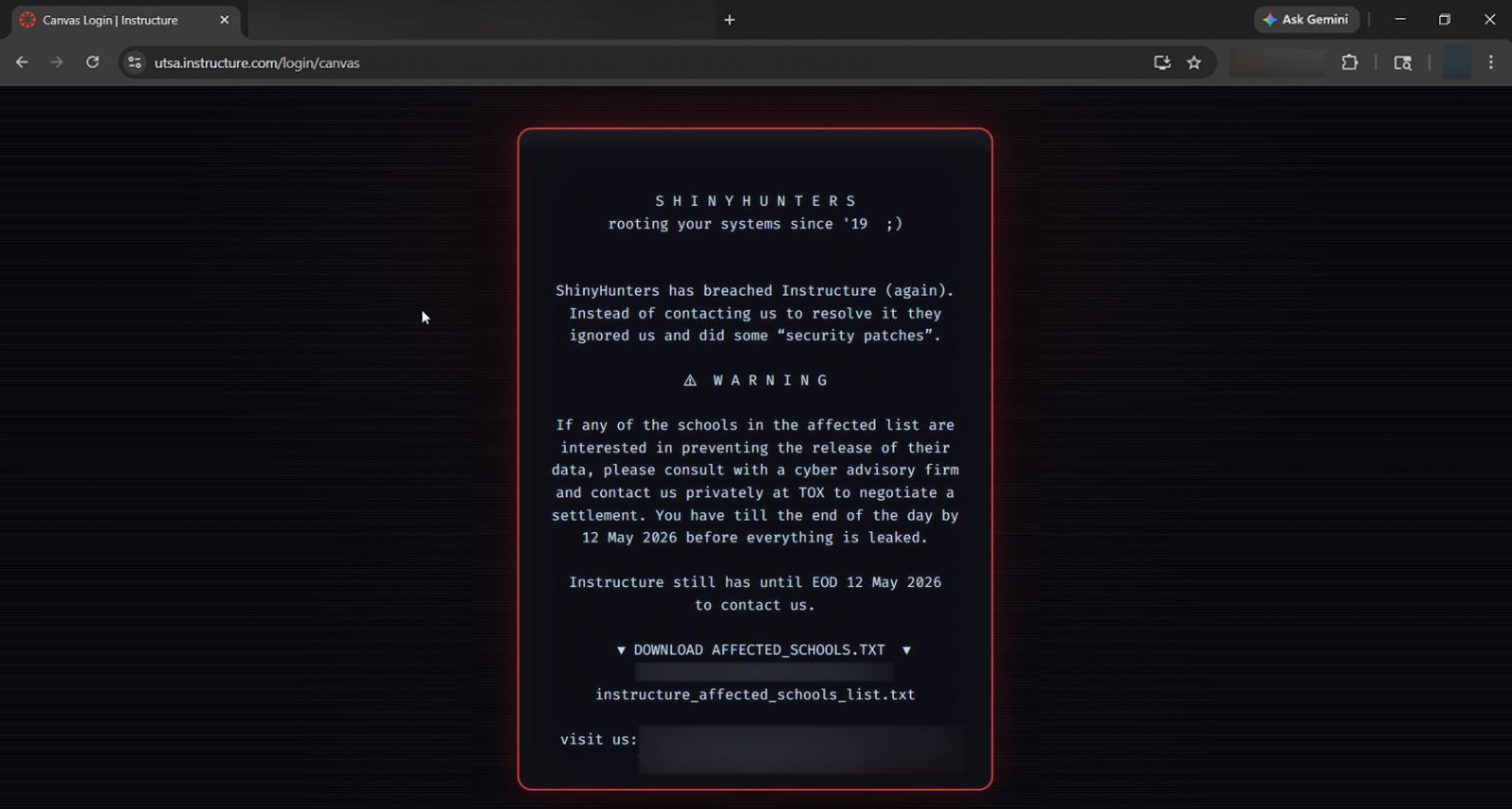
ShinyHunters used the flaw to add a message to Canvas login portals, warning that the company, as well as schools using its platform, had until May 12 to reach out and negotiate a ransom.

ShinyHunters message left on University of Texas San Antonio Canvas login page
Hackers’ message on the Canvas login page of the University of Texas San Antonio
​​​​

Instructure has shut down Free-For-Teacher accounts until the issues have been resolved. However, Canvas has been restored and is available for use since May 9th.

While no data was compromised when defacing Canvas login portals, the data that ShinyHunters exfiltrated in the first breach likely includes usernames, email addresses, course names, enrollment information, and messages.

According to ShinyHunters, the Instructure breach impacts 8,809 educational organizations (schools, universities, colleges, online platforms) and the hackers claim to have stolen 275 million records belonging to students, teachers, and other staff members.

article image

AI chained four zero-days into one exploit that bypassed both renderer and OS sandboxes. A wave of new exploits is coming.

At the Autonomous Validation Summit (May 12 & 14), see how autonomous, context-rich validation finds what’s exploitable, proves controls hold, and closes the remediation loop.

Claim Your Spot


Source link

Theatre streaming is not a threat to in-person attendance, new research shows | Theatre

0

Theatre streaming services and cinema screenings of stage performances are not a threat to “in-person” attendance and are making audiences more adventurous, according to new research commissioned by the National Theatre.

Introducing the findings on Monday, the NT’s director, Indhu Rubasingham, said that the boom in filmed theatre had raised major questions including the concern that popular initiatives such as NT Live and NT at Home would have a negative impact on live attendance. The organisation commissioned research by the agency Indigo to learn more about audiences’ attitudes to filmed theatre.

When asked about the specific benefits of watching theatre at home, the second most popular response to Indigo’s survey was “I can discover new performances I hadn’t considered before”. The most appealing benefit was “I can watch at my own convenience” – including the ability to pause a performance and return to it later. Other popular benefits were the ability to rewatch a show that the viewer had already enjoyed live in the theatre and the chance to watch more performances than you could manage in person.

Respondents highlighted that watching at home “is a lower risk way to try something new” and that financial pressure was a key reason that they attended in-person theatre less often than they would like. Indigo’s report states that “there is very little evidence that filmed theatre reduces in-person attendance of theatre overall” and that 93% of survey respondents who saw at least one filmed theatre production in the cinema or via streaming also attended a performance in person.

Kerry Radden, associate director at Indigo, said: “Our sector has been worrying about what filmed theatre means since the pandemic threw a spotlight on it. What our research discovered is that filmed theatre has the potential to grow audiences rather than being a threat to the live experience. The vast majority of people watching are also committed, frequent theatregoers.”

As part of the research, an online audience survey ran for 11 days and gathered roughly 5,500 responses from people based in the UK. The research revealed what Indigo call a hierarchy of choice in how to watch theatre, with in-person performance remaining the clear preference at 89%. The report states that “filmed theatre skews younger than in-person – streaming markedly so, with over half of under-35s streaming theatre in the last 12 months”. Streaming was also shown to increase access, as 20% of those who watch filmed theatre at home are disabled compared with 15% of in-person audiences.

Matt Risley, chief digital officer at the National Theatre, said: “Filmed theatre should never be framed as replacing the magic of a live performance; it’s a complementary offer that can lower barriers, support discovery and keep people connected to theatre over time.”

Jodie Comer won an Olivier award in 2023 for Prima Facie, which became an NT Live hit. Photograph: David Levene/The Guardian

In a panel discussion at the National Theatre, Tom Powis, executive director of the production company Wessex Grove, said that filmed theatre serves to “boost” the life of productions, which have a “short, finite” run in the theatre. Powis said that the film version of the West End hit Vanya, starring Andrew Scott, had been conceived by the play’s director Sam Yates as “its own artistic piece”. Director Justin Martin, whose productions of Suzie Miller’s legal dramas Prima Facie and Inter Alia both became NT Live hits, agreed that filmed theatre was becoming increasingly sophisticated and that “the more you do it the more you learn the potential of it”. He likened the closeups in the film version of Inter Alia to his own “rehearsal room experience” on the production, “being right there with an actor”.

Martin said that, when one of his productions is filmed and edited for the screen, “you can control rhythm in a different way” and the main bonus “is getting into closeup” so that audiences can see the detail of a performance. When he watched the film of Inter Alia, he said, “I had forgotten the nuance of what Rosamund [Pike, the lead actor] was doing.” Martin said future filmed theatre productions “have to be savvier” and use “more cameras, different angles” to push the new art form further.

Prima Facie has been watched by around 1.5 million people in cinemas since it was first released in 2022. Inter Alia was broadcast live to 50,000 people across the UK, and to date has been seen by more than 450,000 people in cinemas worldwide via NT Live – more than seven times the total in-person audience it reached during its run at the National. It is currently on in the West End and will transfer to Broadway later this year.

After the success of Prima Facie and Inter Alia, Martin and Miller are planning a third play to round off a legal trilogy, resulting in a streamable trilogy of films that would be “an experience you can’t have in the theatre, like a box set”, said Martin.

Rubasingham said that NT at Home and NT Live “aren’t side projects for us”. The initiatives are “part of us meeting audiences where they are” she added, and a way to “extend the life and reach of our performances”.


Source link

Ignoring Hindus has become a big issue in Pakistan, voice raised in the assembly, minister’s strange clarification

0

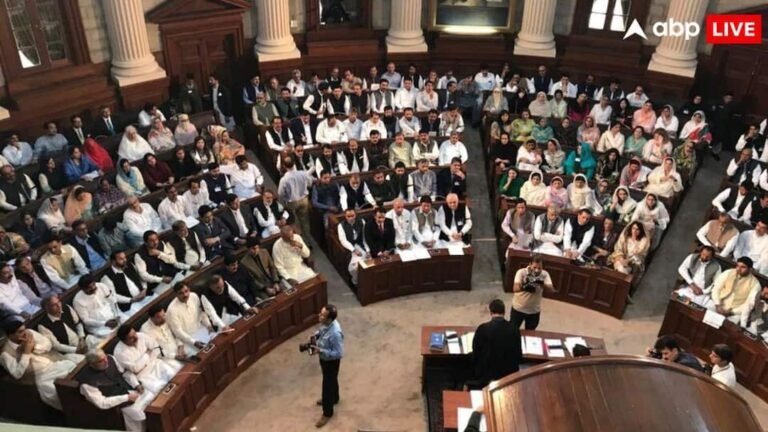
The political controversy over the neglect of minority communities has deepened in Pakistan’s Punjab province. MLAs in the Punjab provincial assembly accused the government of not allocating any funds for the conservation of churches and temples in the 2025-26 budget, while adequate funds were also not kept for the development of minority-dominated areas.

Ruling Pakistan Muslim League-Nawaz (PML-N) senator Baba Falbus Christopher said during the assembly session that “not even a single penny” was given for the repair and conservation of churches and temples in Punjab. The minority senator from the ruling party alleged that almost no budget was kept for the development of Christian dominated settlements. Christopher demanded from the government that adequate funds should be allocated for religious places and basic facilities of minority communities in the budget of 2026-27.

There is no concrete welfare scheme for Hindus: Basro
Meanwhile, Pakistan Peoples Party (PPP) Hindu MLA Basro ji said that a large number of Hindu population lives in South Punjab, but no concrete welfare scheme has been started for them. He alleged that the limited funds kept for the development of Hindu areas were also later withdrawn.

During the debate, Punjab Assembly Speaker Malik Muhammad Ahmed Khan also raised questions on the functioning of the Minority Affairs Ministry. This ministry is with the first Sikh minister of Pakistan, Ramesh Singh Arora. The speaker said that minority communities are still deprived of basic facilities like drinking water, sanitation and health, hence development funds should be spent on these needs first.

Also read:

Asim Munir On India: Pakistan’s three army chief Asim Munir’s direct threat to India – ‘The consequences will be painful…’

Problems of minorities have been going on since 1947: Arora
However, Minister Ramesh Singh Arora defended the government, saying that the problems of minorities have been going on since 1947 and they cannot be eliminated “overnight”. He claimed that Chief Minister Maryam Nawaz’s government has increased the budget of the Minority Affairs Department by 300 percent in the last two years.

According to human rights organization Minority Rights, minority communities like Christians, Hindus, Ahmadis, Sikhs and Kalash in Pakistan often live in an environment of poverty, discrimination and insecurity. The organization says that despite constituting about four percent of the country’s population, these communities often have to face treatment like “second class citizens”.

Read also

‘Trump’s entire tenure is a therapy session’, Iranian embassy taunts after rejecting Tehran’s new proposal

Access Denied

0

Access Denied You don’t have permission to access “http://hindi.news18.com/cricket/pak-vs-ban-1st-test-bangladesh-leads-by-179-runs-after-day-4-stumps-in-dhaka-both-teams-will-fight-for-win-on-last-day-10466434.html” on this server.

Reference #18.6e560e17.1778513358.c3b74f9

https://errors.edgesuite.net/18.6e560e17.1778513358.c3b74f9

Royal Opera House calls for release of Georgian bass singer jailed over democracy protests | Royal Opera House

0

The Royal Opera House in London has urged Keir Starmer to intervene in the case of Paata Burchuladze, a world-renowned bass singer who has been imprisoned in Georgia since October on a charge of leading a coup against the country’s authoritarian leader.

The 71-year-old has performed at the Royal Opera House and the Metropolitan Opera House in New York and collaborated with the likes of Luciano Pavarotti, Plácido Domingo and José Carreras. He was arrested after joining a protest outside the presidential palace in the Georgian capital, Tbilisi. Last week he was given a seven-year jail sentence which Burchuladze suggested to the court was equivalent to a life sentence given his age.

Burchuladze became a rallying figure at nightly demonstrations against the government’s perceived pivot away from the west last autumn. He frequently sang to protesters from the back of a flatbed truck in freezing temperatures, and on 4 October he read out at a declaration claiming “power returns to the people” and calling the government “illegitimate”.

He was subsequently detained with nine others accused of organising violence against the ruling regime, which is in effect led by Georgia’s richest man, the billionaire Bidzina Ivanishvili.

Ivanishvili is the chair of the ruling party, Georgian Dream, and was hit with sanctions by the US in 2024 for undermining Georgia’s democracy for the benefit of Vladimir Putin and Russia.

In a letter to the British prime minister, the Royal Opera’s director of casting, Peter Katona, claimed that Burchuladze was “being punished as a warning to others who dare oppose the regime”.

He wrote: “I am writing to draw your urgent attention to the situation of the world-renowned Georgian opera singer and our dear friend Paata Burchuladze, who is currently held in pre-trial detention and is under the criminal investigation by the pro-Russian, authoritarian regime in Georgia.

“The charges brought against Mr Burchuladze are entirely fabricated and unlawful. He is being persecuted solely because of his critical stance toward the ruling regime.”

Katona told Starmer that Burchuladze had had a distinguished career at the Royal Opera House and had performed there many times over the years since his debut in 1984. “We are also considering to invite him again, also in the future in more senior roles,” he said.

Paata Burchuladze in the Rimsky-Korsakov opera The Golden Cockerel at Sadler’s Wells in 1998. Photograph: Tristram Kenton/The Guardian

“Unfortunately, Paata Burchuladze is now among more than 100 political prisoners in Georgia. During recent peaceful demonstrations, more than 500 people were arrested, and more than 300 reported torture and ill treatment.

“Your attention and solidarity would mean a great deal to the people of Georgia, who are striving to preserve freedom, human rights, and their democratic future,” Katona said.

It is understood that the Royal Ballet and Opera has not received a response from Downing Street.

The Foreign Office has said it is monitoring developments closely and will “raise, where appropriate, the importance of safeguarding detainees’ rights, including access to legal representation and family communication”.

Burchuladze, who was born in Tbilisi, has been a high-profile pro-democracy campaigner in Georgia for more than a decade and formed a short-lived political party in 2016. He has also served as a goodwill ambassador for the UN and Unicef.

In a statement made shortly before he was sentenced last week, Burchuladze said: “I am convinced that recognisable figures such as myself, however comfortable our circumstances, must stand at the forefront and set an example in the fight to defend our homeland.”

During a previous court appearance, Burchuladze warned that the Georgian government was building an “iron fence” between Georgia and the west.

The appeal by Britain’s Royal Opera has been echoed by Christina Scheppelmann, the general artistic director at Belgium’s national opera, La Monnaie, in Brussels.

In a letter to the Belgian prime minister, Scheppelmann wrote: “It is evident that Mr Burchuladze cannot receive a fair trial. Like other political detainees, his fundamental rights are being violated and he is being punished as a warning to others who dare oppose the regime.”

Burchuladze is among 114 people in Georgia who have either been sentenced to jail or are being held in detention related to protests. The EU has suspended its negotiations over Georgia’s accession to the bloc as a result of the regime’s democratic backsliding.

Eka Gigauri, from the anti-corruption watchdog Transparency International, said: “These cases illustrate a clear pattern of punishment aimed at silencing those who oppose the ruling party’s pro-Russian policies and who peacefully defend Georgia’s democratic future in the face of increasing authoritarianism.”


Source link

Google says criminals used AI-built zero-day in planned mass hack spree

0


AI + ML

GTIG says AI-powered hacking has moved well beyond phishing emails and chatbot tricks

Google says crooks already have AI cooking up zero-days, and claims one nearly escaped into the wild before the company stopped it.

In a report shared with The Register ahead of publication on Monday, Google’s Threat Intelligence Group said that it has identified what it believes is the first real-world case of cyber-baddies using AI to discover and weaponize a zero-day vulnerability in a planned mass-exploitation campaign. 

The bug, a two-factor authentication bypass in a popular open source web-based administration platform, was reportedly developed by criminals working together on a large-scale intrusion operation.

GTIG said that the attackers appear to have used an AI model to both identify the flaw and help turn it into a usable exploit. Google worked with the unnamed vendor to quietly patch the issue before the campaign could properly kick off, which it believes may have disrupted the operation before it gained traction.

The company insists that neither Gemini nor Anthropic’s Mythos was involved, but said that the exploit itself looked suspiciously machine-made. According to the report, the Python script included what Google described as “educational docstrings,” a hallucinated CVSS score, and a polished textbook coding structure that looked heavily influenced by LLM training data.

Google said that the issue stemmed from developers hard-coding a trust exception into the authentication flow, creating a hole that attackers could exploit to sidestep 2FA checks. According to the firm, those higher-level logic mistakes are exactly the kind of thing modern AI models are starting to get surprisingly good at finding.

“While fuzzers and static analysis tools are optimized to detect sinks and crashes, frontier LLMs excel at identifying these types of high-level flaws and hardcoded static anomalies,” the report said.

John Hultquist, chief analyst at Google Threat Intelligence Group, said anyone still treating AI-assisted vulnerability discovery as a future problem is already behind.

“There’s a misconception that the AI vulnerability race is imminent. The reality is that it’s already begun. For every zero-day we can trace back to AI, there are probably many more out there,” Hultquist said.

“Threat actors are using AI to boost the speed, scale, and sophistication of their attacks. It enables them to test their operations, persist against targets, build better malware, and make many other improvements. State actors are taking advantage of this technology but the criminal threat shouldn’t be underestimated, especially given their history of broad, aggressive attacks.”

Google’s report suggests that the zero-day case is part of something much bigger. GTIG said North Korean crew APT45 had been using AI to churn through thousands of exploit checks and bulk out its toolkit, while Chinese state-linked operators were experimenting with AI systems for vulnerability hunting and automated probing of targets.

Google also described malware families padded out with AI-generated junk code designed to confuse analysts, Android backdoors using Gemini APIs to autonomously navigate infected devices, and Russian influence operations stitching fabricated AI-generated audio into legitimate news footage.

The awkward bit for everyone else is that this still appears to be the clumsy early phase. Google said mistakes in the exploit’s implementation probably interfered with the criminals’ plans this time around, but that may not stay true for long. ®


Source link

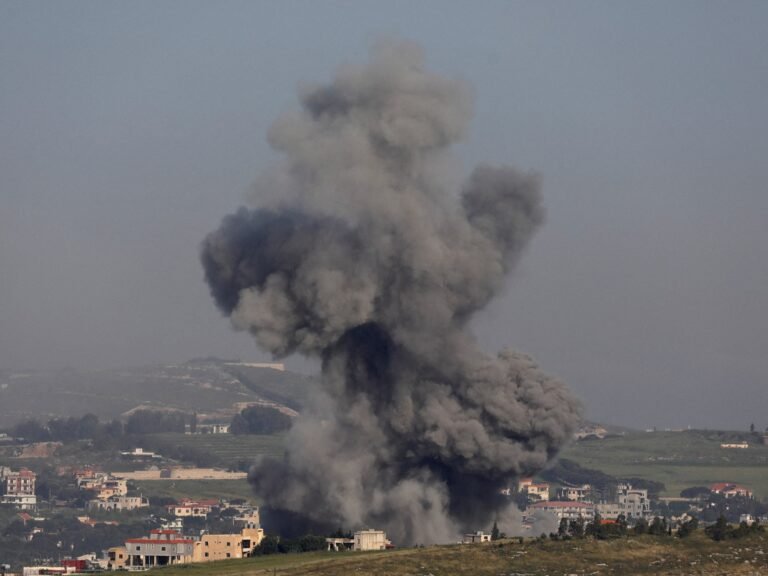
Israeli killings in Lebanon rise: Is even the pretence of a ceasefire over? | Israel attacks Lebanon News

0

The ceasefire in Lebanon that started on April 16 is increasingly coming under strain, with both Israel and Hezbollah ramping up attacks against each other.

The ceasefire began after six weeks of fighting between Israel and Hezbollah. But the following day, Lebanon’s army reported several violations by Israeli forces. Since then, both Israel and Hezbollah have continued attacks.

Recommended Stories

list of 3 itemsend of list

Is even the pretence of a ceasefire over? What could happen?

Here’s what we know:

What are Israel’s most recent attacks?

Since Israel began its war on Lebanon on March 2, at least 2,846 people have been killed and more than a million displaced.

Israel’s offensive has included a major ground invasion and the occupation of southern Lebanon. On Sunday, the Lebanese Health Ministry said Israeli attacks across the country had killed 51 people, including two medical workers.

“The Israeli enemy continues to violate international laws and humanitarian norms, adding more crimes against paramedics, as it directly targeted two points of the Health Authority in Qalawiya and Tibnin, Bint Jbeil district, in two raids,” the ministry said.

Since Israel’s war on Lebanon began on March 2, the United Nations says at least 103 Lebanese medical workers have been killed and 230 injured in more than 130 Israeli strikes.

“We’re under threat every second, every day,” Ali Safiuddin, the head of the Lebanese Civil Defence in Tyre in southern Lebanon, told Al Jazeera on Sunday. “We ask ourselves if we’re going to survive or if we’re going to die, we know we’ve already given up our lives by working here. We’ve lost so many people and it feels like we’re already gone as well.”

Al Jazeera’s Obaida Hitto, reporting from Tyre, said on Sunday that “international humanitarian laws are clear: medical personnel and first responders, like the Lebanese Civil Defence, must be protected in armed conflict, but on this front line, the question isn’t whether another strike is coming. It’s how many people will be left to answer the calls for help”.

Dr Tahir Mohammed, a war surgeon, and humanitarian worker who’s worked in both Gaza and Lebanon, told Al Jazeera that he saw parallels in Israeli actions in both places.

“We used to see our colleagues in Gaza come through the door all the time. I’ve had colleagues, nurses, medical students killed by Israeli weapons, and so to see the same policy of targeting healthcare workers in Lebanon … it’s consistent,” he said.

“If Israel had their way, they would absolutely occupy the entire southern region of Lebanon, and they would do it tomorrow. They have no care for life. I’ve seen it with my own eyes,” Mohammed added.

Israeli attacks continued on Monday.

An Israeli air strike on the town of Abba killed two people and wounded five, Lebanon’s National News Agency (NNA) said. Warplanes renewed their raids on the town of Kfar Remman for the second time in less than an hour, NNA added.

The Israeli military issued a new warning for southern Lebanon, telling residents of nine areas to flee before potential Israeli strikes. The areas are: Ar-Rihan (Jezzine), Jarjouaa, Kfar Reman, al-Numairiyah, Arab Salim, al-Jumayjimah, Machghara, Qlayaa (Western Bekaa) and Harouf.

Israel has repeatedly said that it is only targeting Hezbollah infrastructure, which is primarily in the south of Lebanon. But last week, Israel also bombed Beirut’s southern suburbs for the first time since the ceasefire began.

What have Hezbollah attacked?

The Lebanese armed group has continued striking Israeli forces.

Early on Monday, Hezbollah said it carried out 24 attacks targeting Israeli army positions, soldiers and military vehicles in southern Lebanon over the past 24 hours.

Targets included Israeli troop gatherings, Merkava tanks, bulldozers, military equipment and newly established command centres in several border areas, including Khiam, Deir Seryan, Tayr Harfa, Bayyada, Rashaf and Naqoura.

Operations involved explosive drones, rocket barrages, artillery shelling and guided missiles, with Hezbollah claiming “confirmed hits” in several attacks.

The Israeli military said it had intercepted “a suspicious aerial target” in southern Lebanon in an apparent reference to a drone launched by Hezbollah.

The Jerusalem Post said the Israeli military is struggling to respond to First Person View (FPV) drones launched by Hezbollah.

The newspaper said Hezbollah is using fibre optic threads to guide the drones and evade Israeli wireless jamming devices.

The Jerusalem Post noted that Hezbollah had released video of an FPV drone striking an Iron Dome battery on the northern border on Sunday.

During its visit to southern Lebanon last week, senior Israeli officials “outlined several new pilot programmes to better identify and shoot down FPVs”, but added that the “military is still trying to catch up in real time”.

On Monday, Hezbollah said its fighters targeted an Israeli military position in a house in Baydar al-Faqani in the town of Taybeh, forcing a retreat. Fighters attacked the position three times until an Israeli helicopter intervened to evacuate the wounded, the group said.

The Israeli army has not yet commented on the attack, but said three soldiers were injured by a booby-trap drone explosion in southern Lebanon.

The army earlier announced that a soldier was killed by a drone launched by Hezbollah near the Lebanese border.

So is the ceasefire just a pretence?

In theory, the ceasefire between Israel and Hezbollah does exist, but both warring parties have escalated attacks since it began.

The ceasefire followed a previous one, which had ostensibly been in effect since November 27, 2024. Since then, the United Nations counted more than 10,000 Israeli ceasefire violations and hundreds of Lebanese deaths.

“I don’t think the pretence of a truce was ever actually there, but I think Israel can continue [attacks] just as it can sign a peace agreement,” Israeli analyst Ori Goldberg told Al Jazeera.

“Israel doesn’t really care and will do as it is told. So far, the IDF [Israeli army] wants a win and a chance to apply its might, but that can change in a heartbeat,” he said.

Israel has repeatedly told the Lebanese government that Hezbollah must be disarmed for any ceasefire to last.

Hezbollah has long been considered the strongest military force in Lebanon, though it has been weakened by the war with Israel, and the killing of most of its leaders. Despite that, it retains the support of Lebanon’s Shia community, from which it emerged.

Hezbollah has said that Israel needs to withdraw from southern Lebanon, which was part of the ceasefire deal agreed in 2024. Fighting flared in October 2023 after Hezbollah fired rockets at Israel in solidarity with Palestinians in Gaza. At least 3,768 Lebanese were killed and 1.2 million displaced in Israeli attacks then.

Government leaders in Beirut have long been uneasy about Hezbollah’s influence in Lebanon. Last December, the government said it was close to completing the disarmament of Hezbollah south of the Litani River before a year-end deadline as part of the 2024 ceasefire deal with Israel.

At the start of the latest conflict, the Lebanese government outlawed Hezbollah’s military wing.

But in January, Israel said Hezbollah still had a presence close to the border and was rebuilding its military capabilities “faster than the [Lebanese] army is dismantling [them]”.

“What will happen between Israel and Lebanon depends on the US and the EU. If they force Israel’s hand, even peace can happen,” Goldberg said.

“More likely Israel will continue to bomb as negotiations continue, but it will be forced to stop occasionally,” he added.

What next?

The US State Department is planning two days of intensive talks between the governments of Israel and Lebanon on May 14 and 15.

“The negotiations in Washington, DC will advance “a comprehensive peace and security agreement that substantively addresses the core concerns of both countries”, the department said.

On May 8, Lebanon’s President Joseph Aoun received former Ambassador Simon Karam, who is leading the Lebanese delegation for the talks, and provided him with “directives ahead of his trip to Washington”.

Hezbollah will not be included in the talks and protested about them being held.

In an interview with Al Jazeera on April 17, after the ceasefire started, Hezbollah politician Ali Fayyad said the group would approach the newly announced ceasefire with “caution and vigilance”, and warned that any targeting of Lebanese sites by Israeli forces would constitute a breach.

David Wood, senior Lebanon analyst at the International Crisis Group, told Al Jazeera that, in the short term, much will hinge on talks between the Lebanese and Israeli delegations later this week.

“Those negotiations might result in another temporary extension of the current truce and keep some parts of Lebanon largely out of the firing line for now,” he said.

“Alternatively, the talks might fail completely and lead to the ceasefire’s total collapse,” he added.

“In either scenario, US President Donald Trump holds the necessary leverage to encourage the parties to prefer de-escalation and find a diplomatic way out of the disastrous war,” he said.


Source link

Access Denied


Access Denied You don’t have permission to access “http://news.sky.com/story/archaeologists-unearth-evidence-of-illicit-centuries-old-whisky-still-in-scotland-13542712” on this server.

Reference #18.c5d07868.1778512786.4337ba45

https://errors.edgesuite.net/18.c5d07868.1778512786.4337ba45


Source link