Trump unveils new rendering of planned White House ballroom addition

0

NEWYou can now listen to Fox News articles!

President Donald Trump on Tuesday shared a new rendering of the planned White House ballroom, touting the project as a historic addition he said would “serve our Country well” for “Centuries into the future.”

“This is the first rendering shown to the Public,” Trump wrote in a Truth Social post.

Trump said the rendering, shown from the perspective of the Treasury Building, depicts a plan to replace the existing East Wing with a new East Wing anchored by the White House’s first formal ballroom. 

He added that the structure would match the White House in height and scale.

SPRAWLING NEW $200M WHITE HOUSE BALLROOM TO BE PAID FOR BY TRUMP AND DONORS

A rendering of the proposed White House ballroom shared by President Donald Trump on Truth Social.

A rendering of the proposed White House ballroom shared by President Donald Trump on Truth Social on Feb. 3, 2026. (Donald Trump/Truth Social)

The 90,000-square-foot space, designed to seat roughly 650 guests, is already under construction and is expected to cost more than $200 million, with funding coming from Trump and private donors, the administration previously said.

“If you notice, the North Wall is a replica of the North Facade of the White House, shown at the right hand side of the picture,” Trump added in his post about the new rendering.

FROM THE OVAL OFFICE TO THE TRUMP KENNEDY CENTER, THE GILDED MAKEOVER EXPANDS

A rendering of the new White House ballroom.

The White House has never had a formal ballroom. (White House)

On July 31, White House press secretary Karoline Leavitt announced the planned construction of the sprawling ballroom

“The White House is currently unable to host major functions honoring world leaders in other countries without having to install a large and unsightly tent approximately 100 yards away from the main building’s entrance,” Leavitt said during a press briefing, adding the new ballroom will be “a much-needed and exquisite addition.”

A rendering of the new White House ballroom.

The new space is expected to seat around 650 guests. (White House)

Since returning to office, Trump, a former real estate developer, has embarked on a series of projects aimed at altering the look and feel of the White House and other iconic Washington landmarks. Over the weekend, the president announced in a Truth Social post that the Trump Kennedy Center will close later this year for a two-year renovation.

CLICK HERE TO DOWNLOAD THE FOX NEWS APP

In October, Trump unveiled a new monument planned to commemorate the nation’s 250th anniversary next year. The monument, a near twin of Paris’s iconic Arc de Triomphe, is meant to welcome visitors crossing the Memorial Bridge from Arlington National Cemetery into the heart of the nation’s capital.

Trump has also added golden accents to the Oval Office, added a “walk of fame” to the colonnade outside the Oval Office, renovated the Lincoln bathroom, paved part of the Rose Garden and installed two large American flags on the White House grounds.


Source link

When Cloud Outages Ripple Across the Internet

0

Recent major cloud service outages have been hard to miss. High-profile incidents affecting providers such as AWS, Azure, and Cloudflare have disrupted large parts of the internet, taking down websites and services that many other systems depend on. The resulting ripple effects have halted applications and workflows that many organizations rely on every day.

For consumers, these outages are often experienced as an inconvenience, such as being unable to order food, stream content, or access online services. For businesses, however, the impact is far more severe. When an airline’s booking system goes offline, lost availability translates directly into lost revenue, reputational damage, and operational disruption.

These incidents highlight that cloud outages affect far more than compute or networking. One of the most critical and impactful areas is identity. When authentication and authorization are disrupted, the result is not just downtime; it is a core operational and security incident.

Cloud Infrastructure, a Shared Point of Failure

Cloud providers are not identity systems. But modern identity architectures are deeply dependent on cloud-hosted infrastructure and shared services. Even when an authentication service itself remains functional, failures elsewhere in the dependency chain can render identity flows unusable.

Most organizations rely on cloud infrastructure for critical identity-related components, such as:

  • Datastores holding identity attributes and directory information
  • Policy and authorization data
  • Load balancers, control planes, and DNS

These shared dependencies introduce risk in the system. A failure in any one of them can block authentication or authorization entirely, even if the identity provider is technically still running. The result is a hidden single point of failure that many organizations, unfortunately, only discover during an outage.

Identity, the Gatekeeper for Everything

Authentication and authorization aren’t isolated functions used only during login – they are continuous gatekeepers for every system, API, and service. Modern security models, specifically Zero Trust, are built on the principle of “never trust, always verify”. That verification depends entirely on the availability of identity systems.

This applies equally to human users and machine identities. Applications authenticate constantly. APIs authorize every request. Services obtain tokens to call other services. When identity systems are unavailable, nothing works.

Because of this, identity outages directly threaten business continuity. They should trigger the highest level of incident response, with proactive monitoring and alerting across all dependent services. Treating identity downtime as a secondary or purely technical issue significantly underestimates its impact.

The Hidden Complexity of Authentication Flows

Authentication involves far more than verifying a username and password, or a passkey, as organizations increasingly move toward passwordless models. A single authentication event typically triggers a complex chain of operations behind the scenes.

Identity systems are commonly:

  • Resolve user attributes from directories or databases
  • Store session state
  • Issue access tokens containing scopes, claims, and attributes
  • Perform fine-grained authorization decisions using policy engines

Authorization checks may occur both during token issuance and at runtime when APIs are accessed. In many cases, APIs must authenticate themselves and obtain tokens before calling other services.

Each of these steps depends on the underlying infrastructure. Datastores, policy engines, token stores, and external services all become part of the authentication flow. A failure in any one of these components can fully block access, impacting users, applications, and business processes.

Why Traditional High Availability Isn’t Enough

High availability is widely implemented and absolutely necessary, but it is often insufficient for identity systems. Most high-availability designs focus on regional failover: a primary deployment in one region with a secondary in another. If one region fails, traffic shifts to the backup.

This approach breaks down when failures affect shared or global services. If identity systems in multiple regions depend on the same cloud control plane, DNS provider, or managed database service, regional failover provides little protection. In these scenarios, the backup system fails for the same reasons as the primary.

The result is an identity architecture that appears resilient on paper but collapses under large-scale cloud or platform-wide outages.

Designing Resilience for Identity Systems

True resilience must be deliberately designed. For identity systems, this often means reducing dependency on a single provider or failure domain. Approaches may include multi-cloud strategies or controlled on-premises alternatives that remain accessible even when cloud services are degraded.

Equally important is planning for degraded operation. Fully denying access during an outage has the highest possible business impact. Allowing limited access, based on cached attributes, precomputed authorization decisions, or reduced functionality, can dramatically reduce operational and reputational damage.

Not all identity-related data needs the same level of availability. Some attributes or authorization sources may be less fault-tolerant than others, and that may be acceptable. What matters is making these trade-offs deliberately, based on business risk rather than architectural convenience.

Identity systems must be engineered to fail gracefully. When infrastructure outages are inevitable, access control should degrade predictably, not completely collapse.

Ready to get started with a robust identity management solution? Try the Curity Identity Server for free.

Found this article interesting? This article is a contributed piece from one of our valued partners. Follow us on Google News, Twitter and LinkedIn to read more exclusive content we post.


Source link

Will Iran and Israel go to war? | Conflict News

0

US special envoy Steve Witkoff is yet again in Israel to discuss growing tensions with Iran.

Renewed threats to strike Iran have once again raised the stakes across the Middle East.

The United States and Israel have toughened their stance against Tehran in recent weeks as the country was gripped by nationwide protests. Iran accused Israel of interference in those demonstrations.

Recommended Stories

list of 3 itemsend of list

As the war rhetoric ramps up, Iran is threatening to inflict heavy damage on Israel, if it is attacked.

The tension between the two sides follows decades of mutual hostility that have shaped the geopolitics of the region.

So, does diplomacy stand a chance in this long-running conflict?

Presenter: Rishaad Salamat

Guests:

Thomas Warrick – Non-resident fellow at the Atlantic Council

Marzie Khalilian – Political analyst focusing on US-Middle East relations and an academic Researcher at Carleton University

Alon Pinkas – Former Israeli diplomat


Source link

Air India flight from Heathrow grounded after ‘possible defect’ with fuel control switch | World News

0

A Boeing 787-8 Dreamliner, operated by Air India, has been grounded after reports of a “possible defect” with a fuel control switch on the same model of aircraft which crashed in Ahmedabad last June.

Air India said it was getting “the pilot’s concerns checked on a priority basis” after the incident reported on the flight – AI132 – from Heathrow to Bengaluru on Monday.

It added the airline had previously examined the fuel control switches on its entire Boeing 787 fleet and “had found no issues”.

In a statement to Sky News, Boeing said: “We are in contact with Air India and are supporting their review of this matter.”

Last June, Air India Flight 171 to Gatwick struck a building shortly after take-off in Ahmedabad, killing 260 people. Briton Viswashkumar Ramesh was the only passenger who walked away from the wreckage.

According to a preliminary report, published by India’s Aircraft Accident Investigation Bureau (AAIB) in July, switches in the cockpit that controlled fuel were moved to a “CUTOFF” position.

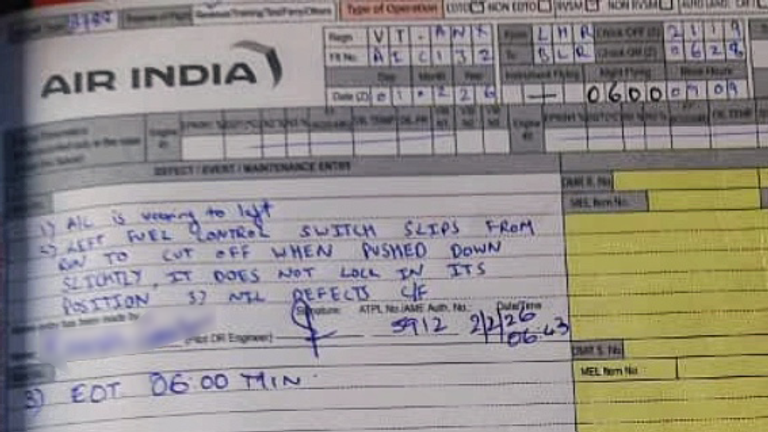
Paperwork has been seen by Sky News, reportedly showing a potential fault with a fuel control switch, which was logged by one of the pilots on Flight 132 after the plane landed early on Tuesday morning.

The entry reads: “LEFT FUEL CONTROL SWITCH SLIPS FROM RUN TO CUT OFF WHEN PUSHED DOWN SLIGHTLY. IT DOES NOT LOCK IN ITS POSITION.”

It is unclear why the crew decided to proceed with the flight if, as reported, the switch failed to remain locked in the “RUN” position and moved towards “CUTOFF” during engine start-up.

A log entry reports a defect on an Air India flight from London
Image: A log entry reports a defect on an Air India flight from London

Sky News understands this happened on two consecutive attempts during the engine start-up procedure.

A malfunction such as this, under specific conditions, could lead to an inadvertent engine shutdown in flight.

Captain Amit Singh, founder of the aviation safety group Safety Matters Foundation, said: “The incident is especially alarming as it mirrors a known risk previously identified by the US Federal Aviation Administration (FAA).

“In 2018, the FAA issued Safety Alert For Operators SAIB NM-18-33, explicitly warning that certain fuel control switches, including those on Boeing 787s, could malfunction in this exact manner, increasing the risk of accidental engine shutdown.”

A statement from Air India said: “We are aware that one of our pilots has reported a possible defect on the fuel control switch of a Boeing 787-8 aircraft.

“After receiving this initial information, we have grounded the aircraft and are involving the OEM [Original Equipment Manufacturer] to get the pilot’s concerns checked on a priority basis. The matter has been communicated to the aviation regulator, DGCA [Directorate General of Civil Aviation].

“Air India had checked the fuel control switches on all Boeing 787 aircraft in its fleet after a directive from the DGCA and had found no issues. At Air India, the safety of our passengers and crew remains top priority.”

👉Listen to The World with Richard Engel and Yalda Hakim on your podcast app👈

Captain Singh told Sky News: “The fuel switches are relevant to AI171 because it points to a possible hazard: unintended switch movement.

“Investigators can confirm or dismiss this using recorded data, switch inspection and maintenance records. It does not prove the cause, but it’s a sensible line to check.”

Air India crash survivor speaks to Sophy Ridge

In July, Air India said it had “completed precautionary inspections on the locking mechanism of Fuel Control Switch (FCS) on all Boeing 787 and Boeing 737 aircraft in its fleet” and “no issues were found”.

Captain Singh described the most recent report of an apparent fuel control switch issue as “deeply troubling” after the airline’s checks found no issues. “This discrepancy raises urgent questions,” he added.

Read more from Sky News:
Ukraine hits out at ‘infantile’ FIFA boss
Epstein: Mandelson urged to testify
ICE agents issued body-worn cameras

Sumeet Sabharwal was the captain on Flight 171, which crashed in June, and was in charge as the pilot-in-command, while Clive Kunder was the first officer flying the plane.

The initial report from investigators stated that, in an audio recording from the cockpit, one of the pilots is heard asking the other why he “cut off”, an apparent reference to the fuel control switches. The other pilot responds that he did not do so.

The 15-page report did not identify which comments were made by the flight’s captain and which were made by the first officer.


Source link

Washington Post editorial board argues raising taxes on rich would be fruitless

0

NEWYou can now listen to Fox News articles!

The Washington Post editorial board argued on Monday that raising taxes on top earners in the United States, a solution lauded by many prominent progressives, would be a fruitless endeavor based on new research.

The Post published an editorial titled “Little to gain by raising taxes on the rich,” citing a paper by three members of the “scrupulously nonpartisan” Joint Committee on Taxation which concluded, “Large changes in top tax rates around the revenue-maximizing rate yield small changes to revenue.”

“Politicians who want to raise taxes on the rich will be disappointed to learn they wouldn’t get much additional money to spend by doing so, though it would slow economic growth,” the outlet claimed.

WASHINGTON POST CITES U-HAUL DATA IN CALIFORNIA EXODUS TO ‘PRO-GROWTH’ STATES, SAYS ‘DECLINE IS A CHOICE’

Washington Post building

The Washington Post argued in a Monday editorial that there’s “little to gain by raising taxes on the rich.” (Kevin Carter/Getty Images)

The research paper referenced by the Post, titled “Laffer Curves Are Flat,” was written by economists Rachel Moore, Brandon Pecoraro and David Splinter, and used the “Laffer Curve” as a means to measure the trade-off between the top tax rate and revenue.

“Holding the rest of the tax system constant, they found the top federal rate to maximize total government revenue would be 39%, and that would only raise long-run revenue by 0.21%. Any top rate in the range of 30% to 45% raises roughly the same amount of total revenue over the long run. Go higher, and revenue falls,” the Post wrote.

Aside from pinpointing the optimal top rate, the Post highlighted the importance of considering how federal tax rates interact with state and local taxes.

NY POST, WSJ, NY TIMES AND WASHINGTON POST ALIGN AGAINST TRUMP ADMIN OVER ICE OPERATION IN MINNEAPOLIS

“If raising more federal revenue corresponds with reductions in state or local revenue, then there’s not much point in raising it, since those other jurisdictions are likely to beg Washington for funds,” the editorial board contended.

As noted by the Post, Moore, Pecoraro and Splinter concluded that determining the exact revenue-maximizing top rate isn’t very important.

A sign being held up at a protest

The Washington Post editorial board highlighted a report from economists Rachel Moore, Brandon Pecoraro and David Splinte that looked at how increasing the top tax rates would affect economic growth and revenue.  (DAMIEN MEYER/AFP via Getty Images)

“The relevant policy choice is between tax progressivity and growth: the equity-efficiency trade-off,” the economists wrote.

Referencing the economists’ findings, the Post contended that “small changes in revenue from raising the top rate” typically resulted in “significant reductions in economic growth from doing so.”

CLICK HERE FOR MORE COVERAGE OF MEDIA AND CULTURE

The editorial board argued that “a more progressive tax code means a smaller economy,” and that even modest increases to the top tax rate would result in “millions fewer jobs and an economy that’s worth trillions less, all with less revenue to show for it.”

Reflecting a broader trend for the historically liberal newspaper, the Post highlighted an argument long emphasized by conservative economists — that further redistribution of income through higher taxes and increased government transfers is counterproductive.

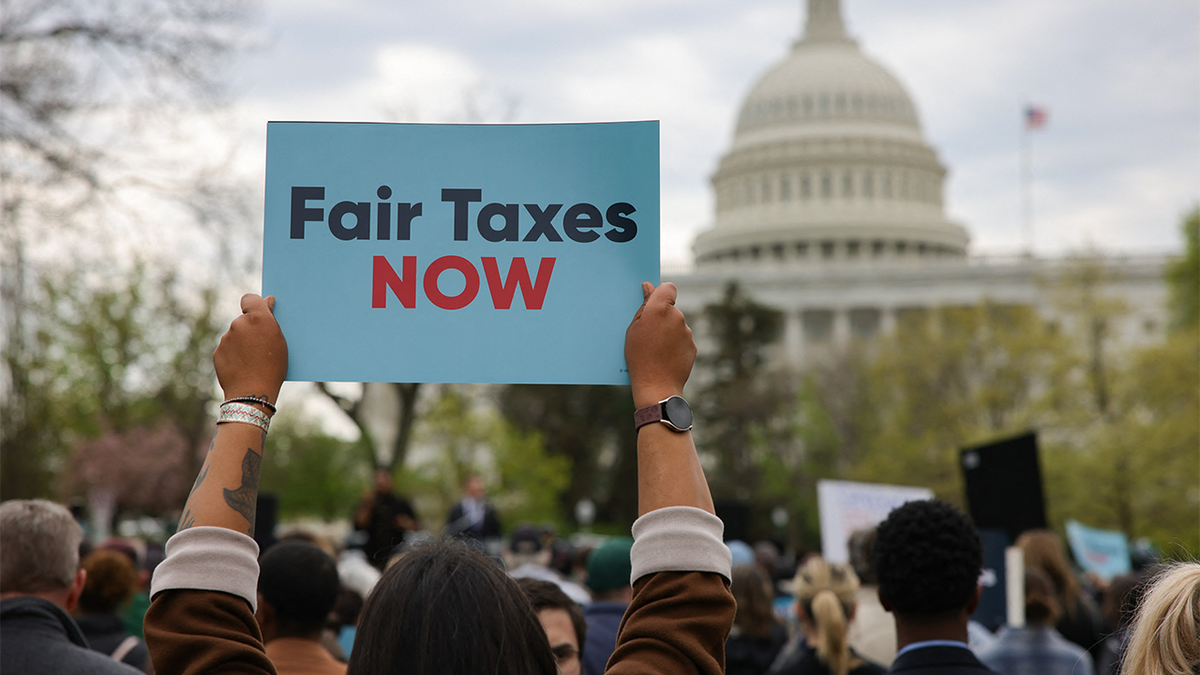
protests against tax cuts

People attend a press conference and rally in support of fair taxation near the U.S. Capitol in Washington, D.C,. on April 10, 2025.  (Bryan Dozier / Middle East Images / Middle East Images via AFP)

“A recent report from the Congressional Budget Office [CBO] found that the federal tax and transfer system significantly reduces income inequality,” the outlet noted. “While it’s true that the top 1 percent of income earners have gradually gained a larger share of pretax income over time, their share of the federal income tax burden has increased faster.”

Pointing to the CBO’s findings, the editorial board noted that “social insurance, taxes and transfers lower the most common measure of income inequality, something called the Gini coefficient, by 28 percent.”

CLICK HERE TO DOWNLOAD THE FOX NEWS APP

“Other rich countries have much less progressive tax systems, not because they tax the rich less, but because they tax the middle class more,” the Post added.

Wrapping up its thoughts, the editorial board concluded that making “an already progressive income tax a little more progressive isn’t worth the trouble.”


Source link

The Kimwolf Botnet is Stalking Your Local Network

0

The story you are reading is a series of scoops nestled inside a far more urgent Internet-wide security advisory. The vulnerability at issue has been exploited for months already, and it’s time for a broader awareness of the threat. The short version is that everything you thought you knew about the security of the internal network behind your Internet router probably is now dangerously out of date.
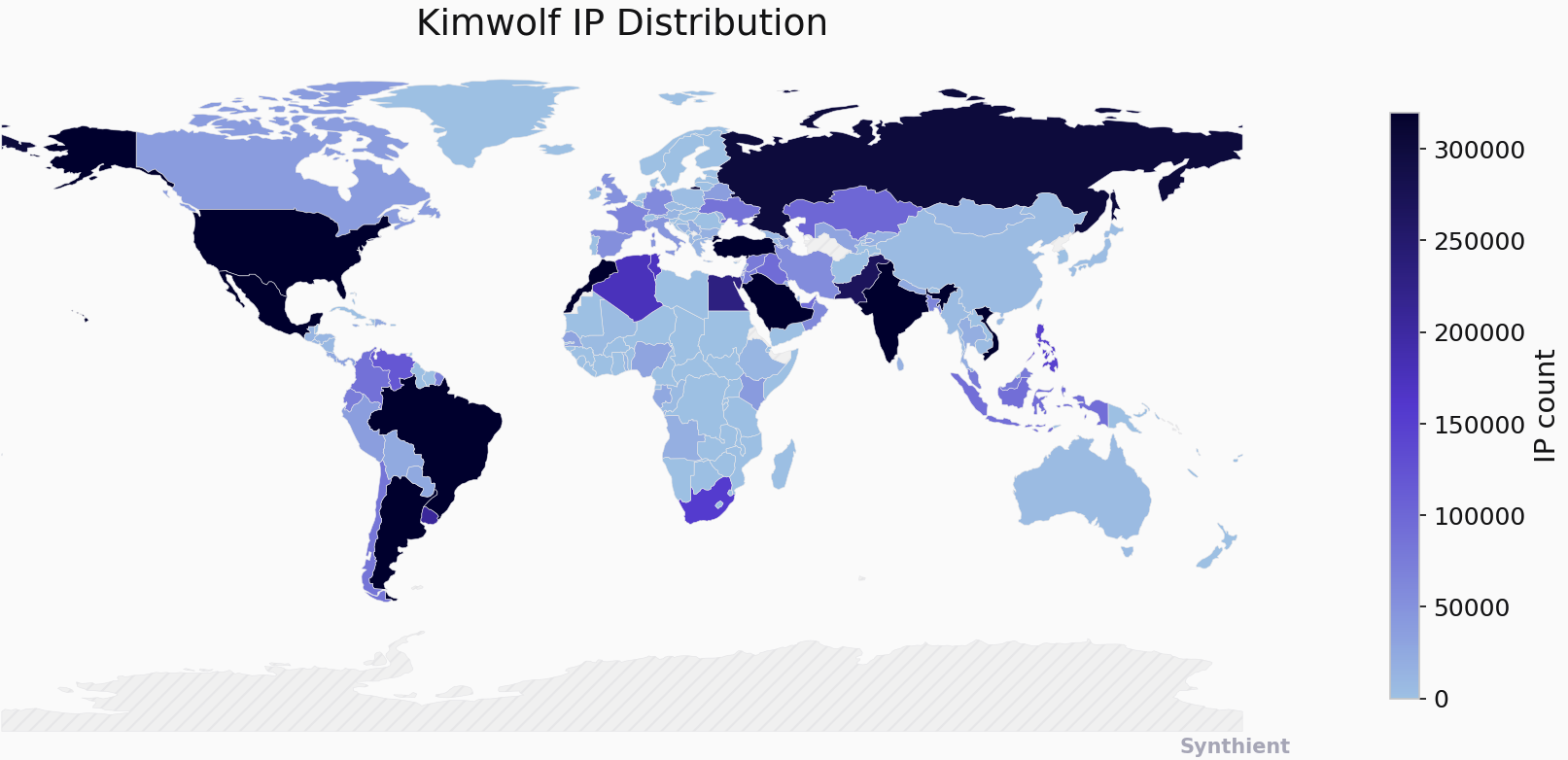
The security company Synthient currently sees more than 2 million infected Kimwolf devices distributed globally but with concentrations in Vietnam, Brazil, India, Saudi Arabia, Russia and the United States. Synthient found that two-thirds of the Kimwolf infections are Android TV boxes with no security or authentication built in.

The past few months have witnessed the explosive growth of a new botnet dubbed Kimwolf, which experts say has infected more than 2 million devices globally. The Kimwolf malware forces compromised systems to relay malicious and abusive Internet traffic — such as ad fraud, account takeover attempts and mass content scraping — and participate in crippling distributed denial-of-service (DDoS) attacks capable of knocking nearly any website offline for days at a time.

More important than Kimwolf’s staggering size, however, is the diabolical method it uses to spread so quickly: By effectively tunneling back through various “residential proxy” networks and into the local networks of the proxy endpoints, and by further infecting devices that are hidden behind the assumed protection of the user’s firewall and Internet router.

Residential proxy networks are sold as a way for customers to anonymize and localize their Web traffic to a specific region, and the biggest of these services allow customers to route their traffic through devices in virtually any country or city around the globe.

The malware that turns an end-user’s Internet connection into a proxy node is often bundled with dodgy mobile apps and games. These residential proxy programs also are commonly installed via unofficial Android TV boxes sold by third-party merchants on popular e-commerce sites like Amazon, BestBuy, Newegg, and Walmart.

These TV boxes range in price from $40 to $400, are marketed under a dizzying range of no-name brands and model numbers, and frequently are advertised as a way to stream certain types of subscription video content for free. But there’s a hidden cost to this transaction: As we’ll explore in a moment, these TV boxes make up a considerable chunk of the estimated two million systems currently infected with Kimwolf.

Some of the unsanctioned Android TV boxes that come with residential proxy malware pre-installed. Image: Synthient.

Kimwolf also is quite good at infecting a range of Internet-connected digital photo frames that likewise are abundant at major e-commerce websites. In November 2025, researchers from Quokka published a report (PDF) detailing serious security issues in Android-based digital picture frames running the Uhale app — including Amazon’s bestselling digital frame as of March 2025.

There are two major security problems with these photo frames and unofficial Android TV boxes. The first is that a considerable percentage of them come with malware pre-installed, or else require the user to download an unofficial Android App Store and malware in order to use the device for its stated purpose (video content piracy). The most typical of these uninvited guests are small programs that turn the device into a residential proxy node that is resold to others.

The second big security nightmare with these photo frames and unsanctioned Android TV boxes is that they rely on a handful of Internet-connected microcomputer boards that have no discernible security or authentication requirements built-in. In other words, if you are on the same network as one or more of these devices, you can likely compromise them simultaneously by issuing a single command across the network.

THERE’S NO PLACE LIKE 127.0.0.1

The combination of these two security realities came to the fore in October 2025, when an undergraduate computer science student at the Rochester Institute of Technology began closely tracking Kimwolf’s growth, and interacting directly with its apparent creators on a daily basis.

Benjamin Brundage is the 22-year-old founder of the security firm Synthient, a startup that helps companies detect proxy networks and learn how those networks are being abused. Conducting much of his research into Kimwolf while studying for final exams, Brundage told KrebsOnSecurity in late October 2025 he suspected Kimwolf was a new Android-based variant of Aisuru, a botnet that was incorrectly blamed for a number of record-smashing DDoS attacks last fall.

Brundage says Kimwolf grew rapidly by abusing a glaring vulnerability in many of the world’s largest residential proxy services. The crux of the weakness, he explained, was that these proxy services weren’t doing enough to prevent their customers from forwarding requests to internal servers of the individual proxy endpoints.

Most proxy services take basic steps to prevent their paying customers from “going upstream” into the local network of proxy endpoints, by explicitly denying requests for local addresses specified in RFC-1918, including the well-known Network Address Translation (NAT) ranges 10.0.0.0/8, 192.168.0.0/16, and 172.16.0.0/12. These ranges allow multiple devices in a private network to access the Internet using a single public IP address, and if you run any kind of home or office network, your internal address space operates within one or more of these NAT ranges.

However, Brundage discovered that the people operating Kimwolf had figured out how to talk directly to devices on the internal networks of millions of residential proxy endpoints, simply by changing their Domain Name System (DNS) settings to match those in the RFC-1918 address ranges.

“It is possible to circumvent existing domain restrictions by using DNS records that point to 192.168.0.1 or 0.0.0.0,” Brundage wrote in a first-of-its-kind security advisory sent to nearly a dozen residential proxy providers in mid-December 2025. “This grants an attacker the ability to send carefully crafted requests to the current device or a device on the local network. This is actively being exploited, with attackers leveraging this functionality to drop malware.”

As with the digital photo frames mentioned above, many of these residential proxy services run solely on mobile devices that are running some game, VPN or other app with a hidden component that turns the user’s mobile phone into a residential proxy — often without any meaningful consent.

In a report published today, Synthient said key actors involved in Kimwolf were observed monetizing the botnet through app installs, selling residential proxy bandwidth, and selling its DDoS functionality.

“Synthient expects to observe a growing interest among threat actors in gaining unrestricted access to proxy networks to infect devices, obtain network access, or access sensitive information,” the report observed. “Kimwolf highlights the risks posed by unsecured proxy networks and their viability as an attack vector.”

ANDROID DEBUG BRIDGE

After purchasing a number of unofficial Android TV box models that were most heavily represented in the Kimwolf botnet, Brundage further discovered the proxy service vulnerability was only part of the reason for Kimwolf’s rapid rise: He also found virtually all of the devices he tested were shipped from the factory with a powerful feature called Android Debug Bridge (ADB) mode enabled by default.

Many of the unofficial Android TV boxes infected by Kimwolf include the ominous disclaimer: “Made in China. Overseas use only.” Image: Synthient.

ADB is a diagnostic tool intended for use solely during the manufacturing and testing processes, because it allows the devices to be remotely configured and even updated with new (and potentially malicious) firmware. However, shipping these devices with ADB turned on creates a security nightmare because in this state they constantly listen for and accept unauthenticated connection requests.

For example, opening a command prompt and typing “adb connect” along with a vulnerable device’s (local) IP address followed immediately by “:5555” will very quickly offer unrestricted “super user” administrative access.

Brundage said by early December, he’d identified a one-to-one overlap between new Kimwolf infections and proxy IP addresses offered for rent by China-based IPIDEA, currently the world’s largest residential proxy network by all accounts.

“Kimwolf has almost doubled in size this past week, just by exploiting IPIDEA’s proxy pool,” Brundage told KrebsOnSecurity in early December as he was preparing to notify IPIDEA and 10 other proxy providers about his research.

Brundage said Synthient first confirmed on December 1, 2025 that the Kimwolf botnet operators were tunneling back through IPIDEA’s proxy network and into the local networks of systems running IPIDEA’s proxy software. The attackers dropped the malware payload by directing infected systems to visit a specific Internet address and to call out the pass phrase “krebsfiveheadindustries” in order to unlock the malicious download.

On December 30, Synthient said it was tracking roughly 2 million IPIDEA addresses exploited by Kimwolf in the previous week. Brundage said he has witnessed Kimwolf rebuilding itself after one recent takedown effort targeting its control servers — from almost nothing to two million infected systems just by tunneling through proxy endpoints on IPIDEA for a couple of days.

Brundage said IPIDEA has a seemingly inexhaustible supply of new proxies, advertising access to more than 100 million residential proxy endpoints around the globe in the past week alone. Analyzing the exposed devices that were part of IPIDEA’s proxy pool, Synthient said it found more than two-thirds were Android devices that could be compromised with no authentication needed.

SECURITY NOTIFICATION AND RESPONSE

After charting a tight overlap in Kimwolf-infected IP addresses and those sold by IPIDEA, Brundage was eager to make his findings public: The vulnerability had clearly been exploited for several months, although it appeared that only a handful of cybercrime actors were aware of the capability. But he also knew that going public without giving vulnerable proxy providers an opportunity to understand and patch it would only lead to more mass abuse of these services by additional cybercriminal groups.

On December 17, Brundage sent a security notification to all 11 of the apparently affected proxy providers, hoping to give each at least a few weeks to acknowledge and address the core problems identified in his report before he went public. Many proxy providers who received the notification were resellers of IPIDEA that white-labeled the company’s service.

KrebsOnSecurity first sought comment from IPIDEA in October 2025, in reporting on a story about how the proxy network appeared to have benefitted from the rise of the Aisuru botnet, whose administrators appeared to shift from using the botnet primarily for DDoS attacks to simply installing IPIDEA’s proxy program, among others.

On December 25, KrebsOnSecurity received an email from an IPIDEA employee identified only as “Oliver,” who said allegations that IPIDEA had benefitted from Aisuru’s rise were baseless.

“After comprehensively verifying IP traceability records and supplier cooperation agreements, we found no association between any of our IP resources and the Aisuru botnet, nor have we received any notifications from authoritative institutions regarding our IPs being involved in malicious activities,” Oliver wrote. “In addition, for external cooperation, we implement a three-level review mechanism for suppliers, covering qualification verification, resource legality authentication and continuous dynamic monitoring, to ensure no compliance risks throughout the entire cooperation process.”

“IPIDEA firmly opposes all forms of unfair competition and malicious smearing in the industry, always participates in market competition with compliant operation and honest cooperation, and also calls on the entire industry to jointly abandon irregular and unethical behaviors and build a clean and fair market ecosystem,” Oliver continued.

Meanwhile, the same day that Oliver’s email arrived, Brundage shared a response he’d just received from IPIDEA’s security officer, who identified himself only by the first name Byron. The security officer said IPIDEA had made a number of important security changes to its residential proxy service to address the vulnerability identified in Brundage’s report.

“By design, the proxy service does not allow access to any internal or local address space,” Byron explained. “This issue was traced to a legacy module used solely for testing and debugging purposes, which did not fully inherit the internal network access restrictions. Under specific conditions, this module could be abused to reach internal resources. The affected paths have now been fully blocked and the module has been taken offline.”

Byron told Brundage IPIDEA also instituted multiple mitigations for blocking DNS resolution to internal (NAT) IP ranges, and that it was now blocking proxy endpoints from forwarding traffic on “high-risk” ports “to prevent abuse of the service for scanning, lateral movement, or access to internal services.”
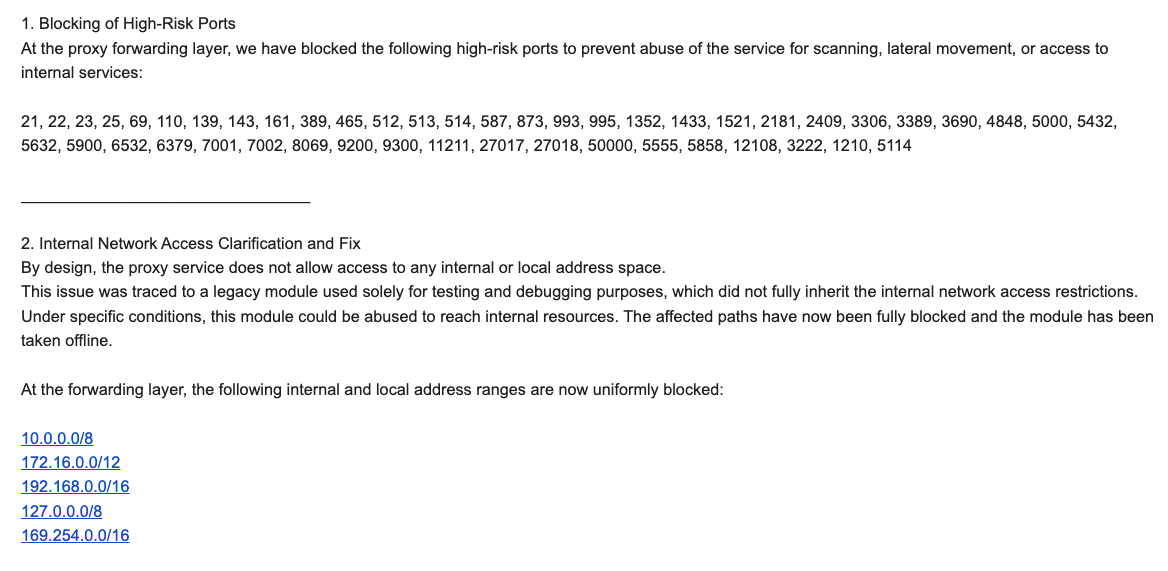
An excerpt from an email sent by IPIDEA’s security officer in response to Brundage’s vulnerability notification. Click to enlarge.

Brundage said IPIDEA appears to have successfully patched the vulnerabilities he identified. He also noted he never observed the Kimwolf actors targeting proxy services other than IPIDEA, which has not responded to requests for comment.

Riley Kilmer is founder of Spur.us, a technology firm that helps companies identify and filter out proxy traffic. Kilmer said Spur has tested Brundage’s findings and confirmed that IPIDEA and all of its affiliate resellers indeed allowed full and unfiltered access to the local LAN.

Kilmer said one model of unsanctioned Android TV boxes that is especially popular — the Superbox, which we profiled in November’s Is Your Android TV Streaming Box Part of a Botnet? — leaves Android Debug Mode running on localhost:5555.

“And since Superbox turns the IP into an IPIDEA proxy, a bad actor just has to use the proxy to localhost on that port and install whatever bad SDKs [software development kits] they want,” Kilmer told KrebsOnSecurity.
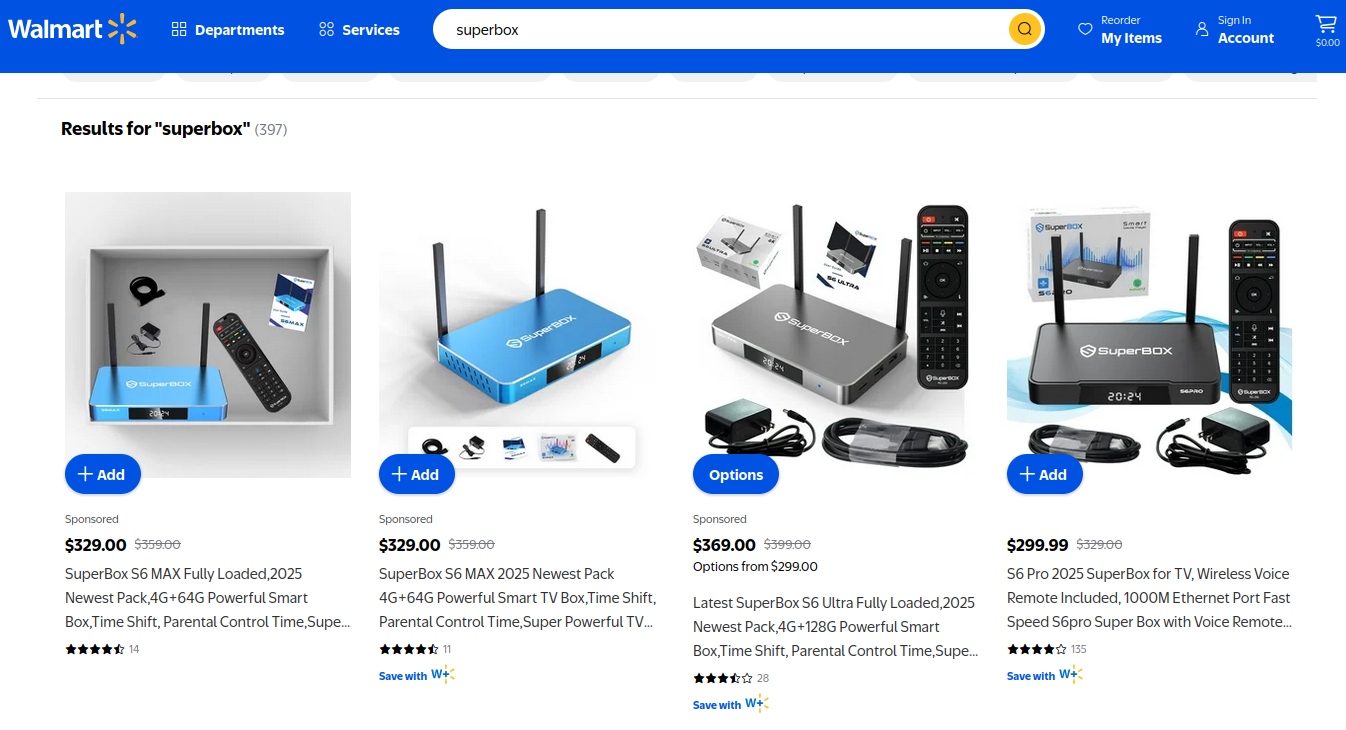
Superbox media streaming boxes for sale on Walmart.com.

ECHOES FROM THE PAST

Both Brundage and Kilmer say IPIDEA appears to be the second or third reincarnation of a residential proxy network formerly known as 911S5 Proxy, a service that operated between 2014 and 2022 and was wildly popular on cybercrime forums. 911S5 Proxy imploded a week after KrebsOnSecurity published a deep dive on the service’s sketchy origins and leadership in China.

In that 2022 profile, we cited work by researchers at the University of Sherbrooke in Canada who were studying the threat 911S5 could pose to internal corporate networks. The researchers noted that “the infection of a node enables the 911S5 user to access shared resources on the network such as local intranet portals or other services.”

“It also enables the end user to probe the LAN network of the infected node,” the researchers explained. “Using the internal router, it would be possible to poison the DNS cache of the LAN router of the infected node, enabling further attacks.”

911S5 initially responded to our reporting in 2022 by claiming it was conducting a top-down security review of the service. But the proxy service abruptly closed up shop just one week later, saying a malicious hacker had destroyed all of the company’s customer and payment records. In July 2024, The U.S. Department of the Treasury sanctioned the alleged creators of 911S5, and the U.S. Department of Justice arrested the Chinese national named in my 2022 profile of the proxy service.

Kilmer said IPIDEA also operates a sister service called 922 Proxy, which the company has pitched from Day One as a seamless alternative to 911S5 Proxy.

“You cannot tell me they don’t want the 911 customers by calling it that,” Kilmer said.

Among the recipients of Synthient’s notification was the proxy giant Oxylabs. Brundage shared an email he received from Oxylabs’ security team on December 31, which acknowledged Oxylabs had started rolling out security modifications to address the vulnerabilities described in Synthient’s report.

Reached for comment, Oxylabs confirmed they “have implemented changes that now eliminate the ability to bypass the blocklist and forward requests to private network addresses using a controlled domain.” But it said there is no evidence that Kimwolf or other other attackers exploited its network.

“In parallel, we reviewed the domains identified in the reported exploitation activity and did not observe traffic associated with them,” the Oxylabs statement continued. “Based on this review, there is no indication that our residential network was impacted by these activities.”

PRACTICAL IMPLICATIONS

Consider the following scenario, in which the mere act of allowing someone to use your Wi-Fi network could lead to a Kimwolf botnet infection. In this example, a friend or family member comes to stay with you for a few days, and you grant them access to your Wi-Fi without knowing that their mobile phone is infected with an app that turns the device into a residential proxy node. At that point, your home’s public IP address will show up for rent at the website of some residential proxy provider.

Miscreants like those behind Kimwolf then use residential proxy services online to access that proxy node on your IP, tunnel back through it and into your local area network (LAN), and automatically scan the internal network for devices with Android Debug Bridge mode turned on.

By the time your guest has packed up their things, said their goodbyes and disconnected from your Wi-Fi, you now have two devices on your local network — a digital photo frame and an unsanctioned Android TV box — that are infected with Kimwolf. You may have never intended for these devices to be exposed to the larger Internet, and yet there you are.

Here’s another possible nightmare scenario: Attackers use their access to proxy networks to modify your Internet router’s settings so that it relies on malicious DNS servers controlled by the attackers — allowing them to control where your Web browser goes when it requests a website. Think that’s far-fetched? Recall the DNSChanger malware from 2012 that infected more than a half-million routers with search-hijacking malware, and ultimately spawned an entire security industry working group focused on containing and eradicating it.

XLAB

Much of what is published so far on Kimwolf has come from the Chinese security firm XLab, which was the first to chronicle the rise of the Aisuru botnet in late 2024. In its latest blog post, XLab said it began tracking Kimwolf on October 24, when the botnet’s control servers were swamping Cloudflare’s DNS servers with lookups for the distinctive domain 14emeliaterracewestroxburyma02132[.]su.

This domain and others connected to early Kimwolf variants spent several weeks topping Cloudflare’s chart of the Internet’s most sought-after domains, edging out Google.com and Apple.com of their rightful spots in the top 5 most-requested domains. That’s because during that time Kimwolf was asking its millions of bots to check in frequently using Cloudflare’s DNS servers.

The Chinese security firm XLab found the Kimwolf botnet had enslaved between 1.8 and 2 million devices, with heavy concentrations in Brazil, India, The United States of America and Argentina. Image: blog.xLab.qianxin.com

It is clear from reading the XLab report that KrebsOnSecurity (and security experts) probably erred in misattributing some of Kimwolf’s early activities to the Aisuru botnet, which appears to be operated by a different group entirely. IPDEA may have been truthful when it said it had no affiliation with the Aisuru botnet, but Brundage’s data left no doubt that its proxy service clearly was being massively abused by Aisuru’s Android variant, Kimwolf.

XLab said Kimwolf has infected at least 1.8 million devices, and has shown it is able to rebuild itself quickly from scratch.

“Analysis indicates that Kimwolf’s primary infection targets are TV boxes deployed in residential network environments,” XLab researchers wrote. “Since residential networks usually adopt dynamic IP allocation mechanisms, the public IPs of devices change over time, so the true scale of infected devices cannot be accurately measured solely by the quantity of IPs. In other words, the cumulative observation of 2.7 million IP addresses does not equate to 2.7 million infected devices.”

XLab said measuring Kimwolf’s size also is difficult because infected devices are distributed across multiple global time zones. “Affected by time zone differences and usage habits (e.g., turning off devices at night, not using TV boxes during holidays, etc.), these devices are not online simultaneously, further increasing the difficulty of comprehensive observation through a single time window,” the blog post observed.

XLab noted that the Kimwolf author shows an almost ‘obsessive’ fixation” on Yours Truly, apparently leaving “easter eggs” related to my name in multiple places through the botnet’s code and communications:
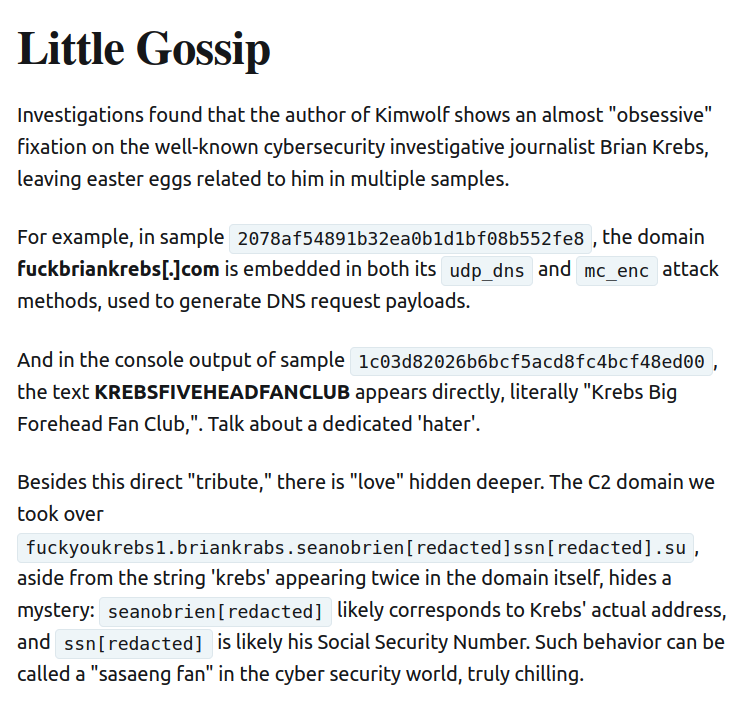
Image: XLAB.

ANALYSIS AND ADVICE

One frustrating aspect of threats like Kimwolf is that in most cases it is not easy for the average user to determine if there are any devices on their internal network which may be vulnerable to threats like Kimwolf and/or already infected with residential proxy malware.

Let’s assume that through years of security training or some dark magic you can successfully identify that residential proxy activity on your internal network was linked to a specific mobile device inside your house: From there, you’d still need to isolate and remove the app or unwanted component that is turning the device into a residential proxy.

Also, the tooling and knowledge needed to achieve this kind of visibility just isn’t there from an average consumer standpoint. The work that it takes to configure your network so you can see and interpret logs of all traffic coming in and out is largely beyond the skillset of most Internet users (and, I’d wager, many security experts). But it’s a topic worth exploring in an upcoming story.

Happily, Synthient has erected a page on its website that will state whether a visitor’s public Internet address was seen among those of Kimwolf-infected systems. Brundage also has compiled a list of the unofficial Android TV boxes that are most highly represented in the Kimwolf botnet.

If you own a TV box that matches one of these model names and/or numbers, please just rip it out of your network. If you encounter one of these devices on the network of a family member or friend, send them a link to this story and explain that it’s not worth the potential hassle and harm created by keeping them plugged in.
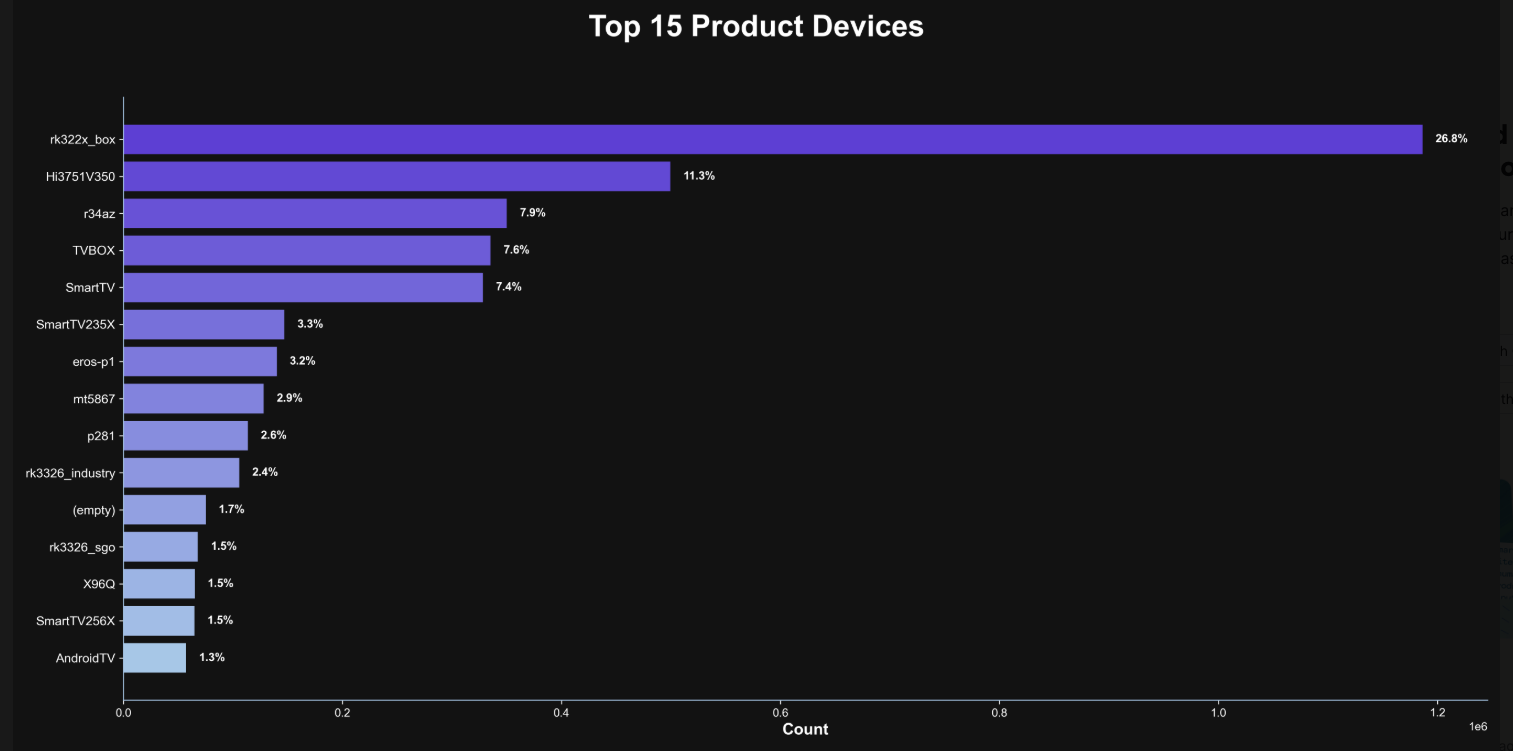
The top 15 product devices represented in the Kimwolf botnet, according to Synthient.

Chad Seaman is a principal security researcher with Akamai Technologies. Seaman said he wants more consumers to be wary of these pseudo Android TV boxes to the point where they avoid them altogether.

“I want the consumer to be paranoid of these crappy devices and of these residential proxy schemes,” he said. “We need to highlight why they’re dangerous to everyone and to the individual. The whole security model where people think their LAN (Local Internal Network) is safe, that there aren’t any bad guys on the LAN so it can’t be that dangerous is just really outdated now.”

“The idea that an app can enable this type of abuse on my network and other networks, that should really give you pause,” about which devices to allow onto your local network, Seaman said. “And it’s not just Android devices here. Some of these proxy services have SDKs for Mac and Windows, and the iPhone. It could be running something that inadvertently cracks open your network and lets countless random people inside.”

In July 2025, Google filed a “John Doe” lawsuit (PDF) against 25 unidentified defendants collectively dubbed the “BadBox 2.0 Enterprise,” which Google described as a botnet of over ten million unsanctioned Android streaming devices engaged in advertising fraud. Google said the BADBOX 2.0 botnet, in addition to compromising multiple types of devices prior to purchase, also can infect devices by requiring the download of malicious apps from unofficial marketplaces.

Google’s lawsuit came on the heels of a June 2025 advisory from the Federal Bureau of Investigation (FBI), which warned that cyber criminals were gaining unauthorized access to home networks by either configuring the products with malware prior to the user’s purchase, or infecting the device as it downloads required applications that contain backdoors — usually during the set-up process.

The FBI said BADBOX 2.0 was discovered after the original BADBOX campaign was disrupted in 2024. The original BADBOX was identified in 2023, and primarily consisted of Android operating system devices that were compromised with backdoor malware prior to purchase.

Lindsay Kaye is vice president of threat intelligence at HUMAN Security, a company that worked closely on the BADBOX investigations. Kaye said the BADBOX botnets and the residential proxy networks that rode on top of compromised devices were detected because they enabled a ridiculous amount of advertising fraud, as well as ticket scalping, retail fraud, account takeovers and content scraping.

Kaye said consumers should stick to known brands when it comes to purchasing things that require a wired or wireless connection.

“If people are asking what they can do to avoid being victimized by proxies, it’s safest to stick with name brands,” Kaye said. “Anything promising something for free or low-cost, or giving you something for nothing just isn’t worth it. And be careful about what apps you allow on your phone.”

Many wireless routers these days make it relatively easy to deploy a “Guest” wireless network on-the-fly. Doing so allows your guests to browse the Internet just fine but it blocks their device from being able to talk to other devices on the local network — such as shared folders, printers and drives. If someone — a friend, family member, or contractor — requests access to your network, give them the guest Wi-Fi network credentials if you have that option.

There is a small but vocal pro-piracy camp that is almost condescendingly dismissive of the security threats posed by these unsanctioned Android TV boxes. These tech purists positively chafe at the idea of people wholesale discarding one of these TV boxes. A common refrain from this camp is that Internet-connected devices are not inherently bad or good, and that even factory-infected boxes can be flashed with new firmware or custom ROMs that contain no known dodgy software.

However, it’s important to point out that the majority of people buying these devices are not security or hardware experts; the devices are sought out because they dangle something of value for “free.” Most buyers have no idea of the bargain they’re making when plugging one of these dodgy TV boxes into their network.

It is somewhat remarkable that we haven’t yet seen the entertainment industry applying more visible pressure on the major e-commerce vendors to stop peddling this insecure and actively malicious hardware that is largely made and marketed for video piracy. These TV boxes are a public nuisance for bundling malicious software while having no apparent security or authentication built-in, and these two qualities make them an attractive nuisance for cybercriminals.

Stay tuned for Part II in this series, which will poke through clues left behind by the people who appear to have built Kimwolf and benefited from it the most.


Source link

Global conflicts pushing humanitarian law to breaking point, report warns | Human Rights News

0

International humanitarian laws introduced after World War II are under unprecedented strain, the Geneva Academy of International Humanitarian Law and Human Rights has said in a new report.

In the full glare of the world’s media spotlight, Israel has been conducting its genocidal war against Palestinians in Gaza while the mass killing of civilians in Sudan has not stopped since the outbreak of that country’s war in 2023. Violence is ongoing elsewhere – from Myanmar’s civil war to conflict in Nigeria. Drone attacks targeting noncombatants have become commonplace in Ukraine while massacres of civilians across multiple conflicts continue, including in Ethiopia, Haiti, Myanmar, Yemen – all with apparent impunity.

Recommended Stories

list of 3 itemsend of list

The United States, historically the self-appointed world’s police officer, is in retreat and unwilling to uphold the humanitarian laws that for decades have provided some protection for civilians trapped in conflicts. That has left those laws under unprecedented strain around the world, the study of 23 of the world’s conflicts conducted by the academy concluded.

“The years 2024 and 2025 proved devastating to civilians with little evidence of willingness among warring parties to limit the barbarity inflicted upon the most vulnerable,” begins the report, War Watch, which tracked breaches of international humanitarian law in the conflicts from July 2024 to December.

The Geneva academy is a joint initiative of the University of Geneva’s Faculty of Law and the Graduate Institute of International and Development Studies.

“Murder, torture, and rape were widespread; civilians and their homes, schools, and hospitals were bombed regularly and sometimes systematically. Genocide – the intended destruction of a protected national, ethnic, religious, or racial group – was found by a United Nations Commission of Inquiry to have been perpetrated against Palestinians in Gaza by Israel. In October 2025, the spectre of genocide was revived in Sudan,” it said in the report, released on Monday, adding that while the threat to international humanitarian law was not yet existential, “it is at a critical breaking point.”

Few consequences

The academy’s report cast the world in an unforgiving light. Over the reporting period, civilians were abused, dispossessed and slaughtered on an almost industrial scale, it said.

Beyond Israel’s genocide in Gaza, which has killed more than 71,000 Palestinians, the research noted the ongoing carnage of Russia’s war in Ukraine, where the killing of civilians is escalating as the conflict grinds on and more people have been killed in the past year than during the conflict’s previous two years.

Rape and gender-based and sexual violence have been documented across a series of conflicts, from Sudan, where the paramilitary Rapid Support Forces (RSF) was accused of massacring civilians in the western city of el-Fasher, to what the report called the “epidemic” of rape in the Democratic Republic of the Congo.

Drone attacks against civilians have become a defining feature in multiple conflicts while, in Myanmar, the military government was accused of continuing to attack civilians. In one village, the report noted, residents who had fled returned to find that the few neighbours who remained behind had been dismembered and their heads placed upon a fence.

All appeared to be taking place with few consequences for the perpetrators.

“If you don’t sanction or communicate that there will be a sanction, illegal acts will continue,” the report’s lead author, Stuart Casey-Maslen, told Al Jazeera. “Genocide isn’t new. We saw evidence of genocide in [Sudan’s] Darfur around 2004, but as one of the UN experts that helped launch the report pointed out, extermination is ongoing in multiple areas of Sudan. We’re seeing gang rape being carried out by Rapid Support Forces (RSF) in the street with impunity, and the US, which could bring pressure on the UAE [which is accused of but denies arming the RSF] isn’t acting.”

Decline

The strain upon international humanitarian law is not the fault of the US alone, Casey-Maslen said,  Equally responsible were other actors, such as Russia, whose disregard for humanitarian law in Ukraine, the report’s authors said, has become almost systematic.

However, few would doubt that the US’s unquestioning support for Israel in its war on Gaza has gone a long way to undermining the principles of the humanitarian law it had historically claimed to champion.

Through two years of unremitting war, Israel has been accused of targetting civilians and engaging in torture, including rape, and the slaughter of civilians, all with US support.

“It has been obvious for some time that international humanitarian law has been dying in front of us,” said Geoffrey Nice, a human rights lawyer and former lead prosecutor in the war crimes trial of former Serbian President Slobodan Milosevic. “There has been a time lag between those with prescience but no official responsibility pointing this out and governments with responsibility explaining it to their voters, but here we are.”

US President Donald Trump’s second term in office has made observers particularly worried about the future of international law as his administration makes clear it is willing to ignore key aspects of it and carry out acts that are at best dubious under international law, such as the abduction of Venezuelan President Nicolas Maduro.

And according to Nice, Trump’s policy was already clear from his first term in office.

“For those paying attention, the first real sign was Trump’s speech to the UN during his first term when [in 2018] he withdrew from the Human Rights Council and expounded on a theme of sovereignty that seemed to evoke a kind of Westphalian world,” he said, referring to the principle in international relations in which each state retains absolute sovereignty over their own territory.

In the wake of his attack on Venezuela in early January, Trump went further still, telling The New York Times that the only constraint upon him was, not international law, but his “own morality”.

Outlook

Richard Gowan, the International Crisis Group’s programme director, said the report aligns closely with his organisation’s reporting from various warzones.

”Tragically, we see a growing number of armed groups targeting civilians in the knowledge that they are unlikely to face real political or legal penalties.

“There is a widespread sense that the laws of war are breaking down, and this is likely to lead to a vicious cycle in which combatants increasingly resort to atrocities to gain tactical or strategic advantage,” he said.

However, while international humanitarian law has been under unprecedented strain, its centre could still hold, Casey-Maslen suggested.

Organisations such as the International Court of Justice and International Criminal Court still have a huge role to play in ensuring that the protections afforded civilians under humanitarian law are maintained as long as those organisations themselves are respected, funded and not regarded as a convenience.

Likewise, states that still cling to the idea of international law could still exert influence over how their allies behave, Casey-Maslen said, pointing to the relatively limited number of civilian deaths that Western-equipped Ukraine had been accused of causing in comparison with Russia. What is critical, he said, was to retain the value of international law for all.

“When we lose international law, everyone loses, ” he said. “The Global South typically pays in lives and blood, and the West loses any sense of moral authority. We all end up poorer as a result.”


Source link

Albanian burglars chased by ex-Aston Villa and Brentford player jailed for break-in spree | UK News

0

Two Albanian burglars have been jailed for 56 months each after targeting seven properties, including the home of a footballer.

Denis Puka, 28, Erisjan Laska, 29, and a third unidentified man equipped themselves with masks, tools and walkie-talkies to go on a string of break-ins last year.

Their operation had been “sophisticated and well-planned”, Judge Steven Everett said.

The trio booked an Airbnb room in Warrington to use as a base for their offending. From there, they travelled into Cheshire in a Seat Leon car fitted with three false registration plates.

Among the properties they targeted between 5-7 June was that of Scott Hogan, 33, a former Aston Villa, Brentford and Birmingham City footballer who now plays for MK Dons.

On 7 June, he was woken up by torchlight shining though his bedroom window at around 11.30pm.

During the attempted burglary, Mr Hogan’s then-pregnant wife and his young daughter were in the house

Scott Hogan said the incident had led to 'many sleepless nights full of stress and anxiety'. Pic: AP
Image: Scott Hogan said the incident had led to ‘many sleepless nights full of stress and anxiety’. Pic: AP

Prosecutor Nardeen Nemat said: “The defendants climbed over the fence and into the garden. One defendant climbed onto the shoulder of another, and climbed up the trellising on the house to reach the bedroom window.

“Mr Hogan was in his bedroom when he was woken up by a torch light shining through his bedroom window. He looked out and saw three males on the ground.”

She added that Mr Hogan ran after the males, but the males ran away.”

‘Sleepless nights full of stress and anxiety’

He told the court that the incident had “led to many sleepless nights full of stress and anxiety”.

He said: “I can’t put into words completely what a dramatic effect this has had on me and my family.”

While nothing was stolen, Mr Hogan has since installed a new security system to protect his family.

Prior to the attempted raid on Mr Horgan’s house, two addresses were targeted on 5 June.

The defendants gained access to one of the properties, and ransacked every room except the bedroom, where their victims were sleeping, although nothing was stolen on either occasion.

Read more:
Masked thieves steal statue of local hero boxer
Snapchat predator coerced boys to perform sex acts

The following night they again came away empty handed after being disturbed while targeting houses in Grappenhall and Knutsford, but were later successful at a mansion in Northwich as the owners were away in holiday.

The defendants stole Breitling and Rolex watches – worth £9,000 in total.

They were arrested after the Seat Leon was recovered from a housing estate in Warrington more than a week later with various items found inside including mobile phones, clothing worn by the defendants, tools and the false registration plates.

Sentencing the pair on Tuesday, Judge Everett told them: “What is clear is that this was a sophisticated, well-planned conspiracy.

“Each of you should understand the sheer devastation you caused by your selfish and despicable acts.”


Source link

Trump signs legislation ending partial government shutdown

0

NEWYou can now listen to Fox News articles!

President Donald Trump has signed legislation ending the partial government shutdown that started Friday at midnight. 

The legislation Trump signed funds agencies including the Department of War, the Department of State, the Treasury Department and others through the end of September and the end of the fiscal year. 

However, it only funds the Department of Homeland Security (DHS) through Feb. 13, meaning Republicans and Democrats will be forced to work together to secure a longer-term funding plan for the agency. 

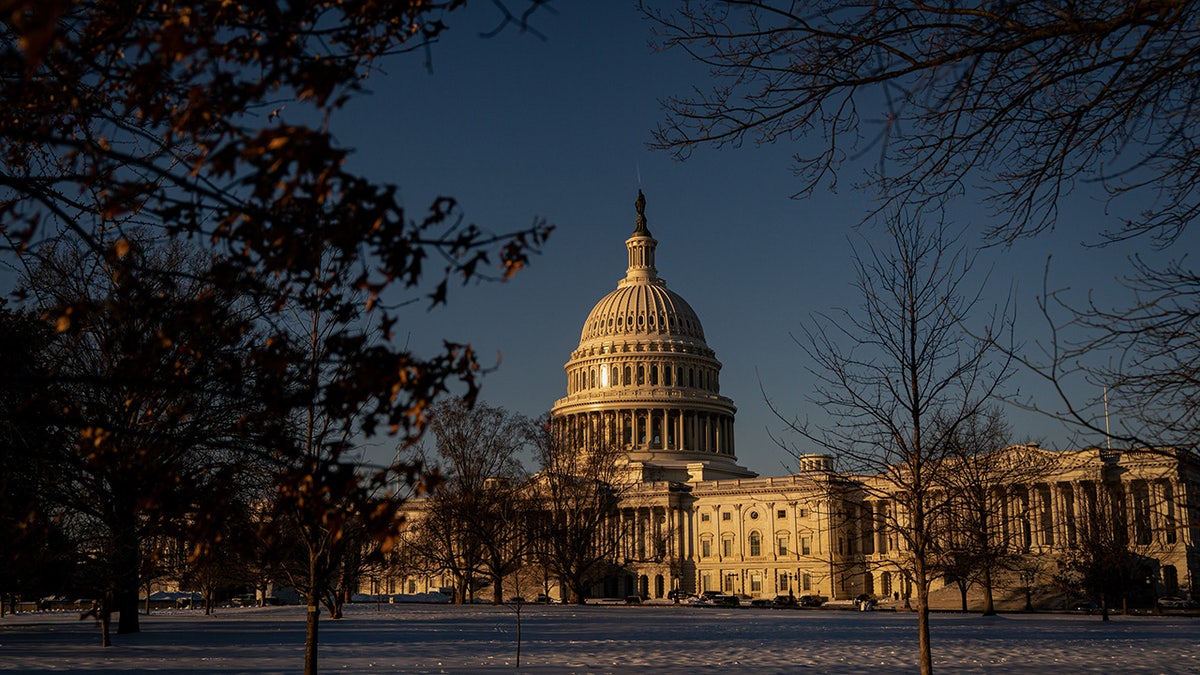
The US Capitol

President Donald Trump has signed legislation ending the partial government shutdown that started Friday at midnight.  (Al Drago/Bloomberg via Getty Images)

While the House had previously passed funding bills to keep the government open through the end of September, Democrats failed to get on board with the measures in response to Trump’s ramped-up immigration efforts in Minneapolis. 

DHS announced Operation Metro Surge in December 2025 to dispatch thousands of Immigration and Customs Control agents into the city. 

SENATE REPUBLICANS TEE UP KEY SHUTDOWN TEST VOTE AS DEMOCRATS DIG IN ON DHS FUNDING

As a result, Senate Democrats refused to get behind the deal due to its funding for DHS after two Customs and Border Patrol agents shot and killed Alex Pretti, a Department of Veterans Affairs ICU nurse, while he was recording federal immigration enforcement operations in Minneapolis in January. 

Photo of Alex J. Pretti

This undated photo provided by Michael Pretti shows Alex J. Pretti, the man who was shot by a federal officer in Minneapolis Jan. 24, 2026.  (Michael Pretti via AP)

Ultimately, the Senate passed the compromise spending measure Friday that would fund key agencies, but the House was out of session and couldn’t pass its version of the measure in time to prevent a partial government shutdown. The House ultimately passed the compromise deal Tuesday by a 217–214 margin.

CLICK HERE TO DOWNLOAD THE FOX NEWS APP

President Trump signs a bill into law surrounded by lawmakers

President Donald Trump signs the funding bill to end the U.S. government shutdown, at the White House in Washington, D.C., Nov. 12, 2025.  (Kevin Lamarque/Reuters)

The most recent shutdown comes on the heels of the longest government shutdown in U.S. history in fall 2025, where the government remained shuttered for more than 40 days in October and November 2025. 

On Nov. 12, 2025, Trump signed legislation that would continue to fund the government at the same levels during fiscal year 2025 through Jan. 30 to provide additional time to finalize a longer appropriations measure for fiscal year 2026.


Source link

Sudo’s maintainer needs resources to keep utility updated • The Register

0

It’s hard to imagine something as fundamental to computing as the sudo command becoming abandonware, yet here we are: its solitary maintainer is asking for help to keep the project alive.

It’s a common trope in the open-source computing community that a small number of solitary maintainers do a disproportionate amount of work keeping critical software going, often with little recognition or support. Ubuntu Unity and the NGINX Ingress Controller are just two examples we’ve covered in recent months, and now we can add another, far more critical one to the mix.

Sudo, for those not familiar with Unix systems, is a command-line utility that allows authorized users to run specific commands as another user, typically the superuser, under tightly controlled policy rules. It is a foundational component of Unix and Linux systems: without tools like sudo, administrators would be forced to rely more heavily on direct root logins or broader privilege escalation mechanisms, increasing both operational risk and attack surface.

“For the past 30+ years I’ve been the maintainer of sudo,” developer Todd C. Miller notes on his personal webpage. “I’m currently in search of a sponsor to fund continued sudo maintenance and development. If you or your organization is interested in sponsoring sudo, please let me know.” 

Miller has been maintaining sudo since 1993. According to sudo’s website, Miller’s former employer, Quest Software, served as sudo’s sponsor beginning in 2010, but its sponsorship of sudo ended in February 2024, which coincides with Miller’s departure from Quest subsidiary One Identity. 

Archived copies of Miller’s website suggest he’s been looking for a sudo patron since then.

That said, sudo updates haven’t dried up since then, with plenty of updates released since February 2024 according to sudo’s changelog, so Miller is clearly still working on it – and it definitely still needs updates. 

A number of security issues in sudo in recent years have needed patching, like a heap buffer overflow bug identified in 2021 that let any local user gain root-level privileges despite their account not being allowed to run sudo commands. The bug had been present for more than a decade, security researchers noted at the time. 

Memory issues have been a common problem for sudo, which has led to the development of sudo-rs, a reinvention of the utility built in Rust, which should make it memory safe and reduce Linux systems’ attack surfaces. Ubuntu switched to sudo-rs as the default sudo implementation with the release of Ubuntu 25.10 in October 2025.

Whether sudo will cede more ground to sudo-rs may in part have to do with whether Miller finds a sponsor to fund continued development of the utility. The Sudo Project has a number of individual sponsors on Github, but given the message on Miller’s site remains up two years after he posted it, those individuals likely aren’t footing enough of the bill to let him continue to invest time and energy into the project ad infinitum, just like so many other open source maintainers and developers also in his shoes

We reached out to Miller with questions on sudo’s future, but didn’t hear back. ®


Source link