Patch Tuesday, January 2026 Edition

0

Microsoft today issued patches to plug at least 113 security holes in its various Windows operating systems and supported software. Eight of the vulnerabilities earned Microsoft’s most-dire “critical” rating, and the company warns that attackers are already exploiting one of the bugs fixed today.

January’s Microsoft zero-day flaw — CVE-2026-20805 — is brought to us by a flaw in the Desktop Window Manager (DWM), a key component of Windows that organizes windows on a user’s screen. Kev Breen, senior director of cyber threat research at Immersive, said despite awarding CVE-2026-20805 a middling CVSS score of 5.5, Microsoft has confirmed its active exploitation in the wild, indicating that threat actors are already leveraging this flaw against organizations.

Breen said vulnerabilities of this kind are commonly used to undermine Address Space Layout Randomization (ASLR), a core operating system security control designed to protect against buffer overflows and other memory-manipulation exploits.

“By revealing where code resides in memory, this vulnerability can be chained with a separate code execution flaw, transforming a complex and unreliable exploit into a practical and repeatable attack,” Breen said. “Microsoft has not disclosed which additional components may be involved in such an exploit chain, significantly limiting defenders’ ability to proactively threat hunt for related activity. As a result, rapid patching currently remains the only effective mitigation.”

Chris Goettl, vice president of product management at Ivanti, observed that CVE-2026-20805 affects all currently supported and extended security update supported versions of the Windows OS. Goettl said it would be a mistake to dismiss the severity of this flaw based on its “Important” rating and relatively low CVSS score.

“A risk-based prioritization methodology warrants treating this vulnerability as a higher severity than the vendor rating or CVSS score assigned,” he said.

Among the critical flaws patched this month are two Microsoft Office remote code execution bugs (CVE-2026-20952 and CVE-2026-20953) that can be triggered just by viewing a booby-trapped message in the Preview Pane.

Our October 2025 Patch Tuesday “End of 10” roundup noted that Microsoft had removed a modem driver from all versions after it was discovered that hackers were abusing a vulnerability in it to hack into systems. Adam Barnett at Rapid7 said Microsoft today removed another couple of modem drivers from Windows for a broadly similar reason: Microsoft is aware of functional exploit code for an elevation of privilege vulnerability in a very similar modem driver, tracked as CVE-2023-31096.

“That’s not a typo; this vulnerability was originally published via MITRE over two years ago, along with a credible public writeup by the original researcher,” Barnett said. “Today’s Windows patches remove agrsm64.sys and agrsm.sys. All three modem drivers were originally developed by the same now-defunct third party, and have been included in Windows for decades. These driver removals will pass unnoticed for most people, but you might find active modems still in a few contexts, including some industrial control systems.”

According to Barnett, two questions remain: How many more legacy modem drivers are still present on a fully-patched Windows asset; and how many more elevation-to-SYSTEM vulnerabilities will emerge from them before Microsoft cuts off attackers who have been enjoying “living off the land[line] by exploiting an entire class of dusty old device drivers?”

“Although Microsoft doesn’t claim evidence of exploitation for CVE-2023-31096, the relevant 2023 write-up and the 2025 removal of the other Agere modem driver have provided two strong signals for anyone looking for Windows exploits in the meantime,” Barnett said. “In case you were wondering, there is no need to have a modem connected; the mere presence of the driver is enough to render an asset vulnerable.”

Immersive, Ivanti and Rapid7 all called attention to CVE-2026-21265, which is a critical Security Feature Bypass vulnerability affecting Windows Secure Boot. This security feature is designed to protect against threats like rootkits and bootkits, and it relies on a set of certificates that are set to expire in June 2026 and October 2026. Once these 2011 certificates expire, Windows devices that do not have the new 2023 certificates can no longer receive Secure Boot security fixes.

Barnett cautioned that when updating the bootloader and BIOS, it is essential to prepare fully ahead of time for the specific OS and BIOS combination you’re working with, since incorrect remediation steps can lead to an unbootable system.

“Fifteen years is a very long time indeed in information security, but the clock is running out on the Microsoft root certificates which have been signing essentially everything in the Secure Boot ecosystem since the days of Stuxnet,” Barnett said. “Microsoft issued replacement certificates back in 2023, alongside CVE-2023-24932 which covered relevant Windows patches as well as subsequent steps to remediate the Secure Boot bypass exploited by the BlackLotus bootkit.”

Goettl noted that Mozilla has released updates for Firefox and Firefox ESR resolving a total of 34 vulnerabilities, two of which are suspected to be exploited (CVE-2026-0891 and CVE-2026-0892). Both are resolved in Firefox 147 (MFSA2026-01) and CVE-2026-0891 is resolved in Firefox ESR 140.7 (MFSA2026-03).

“Expect Google Chrome and Microsoft Edge updates this week in addition to a high severity vulnerability in Chrome WebView that was resolved in the January 6 Chrome update (CVE-2026-0628),” Goettl said.

As ever, the SANS Internet Storm Center has a per-patch breakdown by severity and urgency. Windows admins should keep an eye on askwoody.com for any news about patches that don’t quite play nice with everything. If you experience any issues related installing January’s patches, please drop a line in the comments below.


Source link

UK’s Mandelson to resign from House of Lords over Epstein ties | Politics News

0

Police are looking into allegations Peter Mandelson may have passed sensitive government information to Jeffrey Epstein.

British politician Peter Mandelson is stepping down from the United Kingdom’s upper house of Parliament amid renewed scrutiny and the prospect of a criminal review into his ties to late sex offender Jeffrey Epstein.

The speaker of the House of Lords, Michael Forsyth, said on Tuesday that Mandelson, 72, had notified the chamber of his intention to resign. Forsyth said the move would come into effect on Wednesday.

Recommended Stories

list of 3 itemsend of list

Mandelson, a former UK ambassador to the United States and longtime senior figure in the country’s Labour Party, has come under intense pressure following the release of a new tranche of US government documents related to Epstein.

The material includes emails from Mandelson to Epstein sharing political insights, including market-sensitive information during the 2008 financial crisis that critics say may have broken the law.

British police have said they are assessing reports of possible misconduct “to determine if they meet the criminal threshold for investigation”.

The files also include bank documents suggesting Epstein transferred tens of thousands of dollars to accounts linked to Mandelson or his partner, Reinaldo Avila da Silva. Mandelson has said he does not recall such transactions and will examine the documents.

Additional material includes emails suggesting a friendly relationship between the two men after Epstein’s 2008 convictions for sex offences, as well as an image showing Mandelson in his underwear beside a woman whose face was obscured by US authorities.

Mandelson told the BBC that he “cannot place the location or the woman, and I cannot think what the circumstances were”.

Starmer says he’s ‘appalled’

British Prime Minister Keir Starmer on Tuesday told his cabinet he was “appalled by the information” regarding Mandelson and was concerned more details would come to light, according to a Downing Street readout of a cabinet meeting.

Starmer also said he has ordered the civil service to conduct an “urgent” review of all of Mandelson’s contacts with Epstein while he was in government.

“The alleged passing on of emails of highly sensitive government business was disgraceful,” the prime minister said, adding he was not yet “reassured that the totality of information had yet emerged” regarding Mandelson’s links with Epstein.

Mandelson, who was sacked from his post as British ambassador to the US in September following earlier revelations about his Epstein ties, quit the Labour Party on Sunday to avoid what he called “further embarrassment”.

In an interview with The Times conducted late last month and published on Tuesday, Mandelson described Epstein as a “master manipulator,” adding: “I’ve had a lot of bad luck, no doubt some of it of my own making.”


Source link

Signs of forced entry at home of missing US TV presenter Savannah Guthrie’s mother after ‘kidnap’ | US News

0

Investigators looking into the disappearance of US TV host Savannah Guthrie’s mother have found signs of forced entry at her Arizona home.

Savannah Guthrie is a main co-anchor on Today, the morning show on NBC News, the US sister network of Sky News.

A person familiar with the inquiry told the Associated Press that evidence in the home of Nancy Guthrie, 84, indicated that she had been kidnapped during the night.

They said that several of Nancy Guthrie’s personal items, including her mobile phone, wallet and her car, had been left in her property.

Investigators do not believe at this point that the abduction was part of a robbery, home invasion or kidnapping-for-ransom plot, the person said.

Police officers are currently reviewing information from licence plate cameras and surveillance video from nearby homes while working to analyse data from local phone towers.

Nancy Guthrie was first reported missing by her family after she failed to appear at church on Sunday.

She was last seen at her home near Tucson, Arizona, the night before at around 9.30pm.

In a social media post made on Monday, Savannah Guthrie described her mother as “a woman of deep conviction, a good and faithful servant”.

Neighbours of Nancy Guthrie show support for the family. Pic: AP
Image: Neighbours of Nancy Guthrie show support for the family. Pic: AP

She asked supporters to “raise your prayers with us and believe with us that she will be lifted by them in this very moment. Bring her home”.

Pima County Sheriff Chris Nanos urged whoever has Nancy Guthrie to free her because she could die without access to medication.

He said: “If she’s alive right now, her meds are vital. I can’t stress that enough. It’s been better than 24 hours, and the family tells us if she doesn’t have those meds, it can become fatal.”

He added that investigators has taken samples that they hoped would provide at least part of a DNA profile.

Nancy Guthrie. Pic: Pima county sheriff’s department
Image: Nancy Guthrie. Pic: Pima county sheriff’s department

People searching for Nancy Guthrie used drones and search dogs and were supported by volunteers and Border Patrol.

Search crews have now been pulled back, however.

Mr Nanos said: “We don’t see this as a search mission so much as it is a crime scene.”

He previously said that Nancy Guthrie’s disappearance was not “dementia related”.

Read more:
The key findings from Epstein files
Trump seeks $1bn in damages from Harvard

“She’s as sharp as a tack,” he said. “The family wants everyone to know that this isn’t someone who just wandered off.”

Savannah Guthrie often brought her mother on Today as a guest.

Speaking on the show in 2022 on Nancy Guthrie’s 80th birthday, she said: “She has met unthinkable challenges in her life with grit, without self-pity, with determination and always, always with unshakeable faith.

“She loves us, her family, fiercely, and her selflessness and sacrifice for us, her steadfastness and her unmovable confidence is the reason any of us grew up to do anything.”


Source link

House sends bill ending government shutdown to Trump’s desk after Dems buck Jeffries in final vote

0

NEWYou can now listen to Fox News articles!

The House of Representatives passed a federal funding bill aimed at ending the partial government shutdown on Tuesday, which will bring the four-day standoff to a close shortly after the legislation gets to President Donald Trump’s desk.

The funding bill is a compromise struck between Senate Democrats and the White House that would fund roughly 97% of the federal government through the end of fiscal 2026.

Trump played an integral role in hashing out the new deal and quelling a subsequent rebellion by conservative lawmakers to get it over the finish line.

House Minority Leader Hakeem Jeffries, D-N.Y., signaled he was strongly against the plan, despite his Senate counterpart’s role in putting it together. But several Democrats bucked his concerns in the end to vote in favor of it.

HOUSE CONSERVATIVES THREATEN EXTENDED SHUTDOWN OVER ELECTION INTEGRITY MEASURE

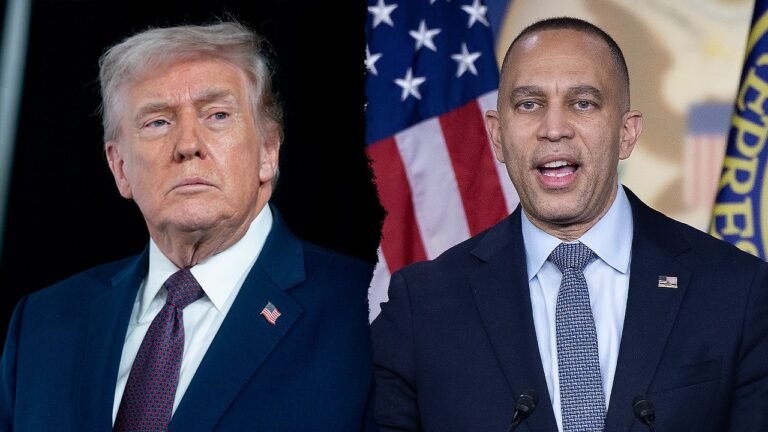
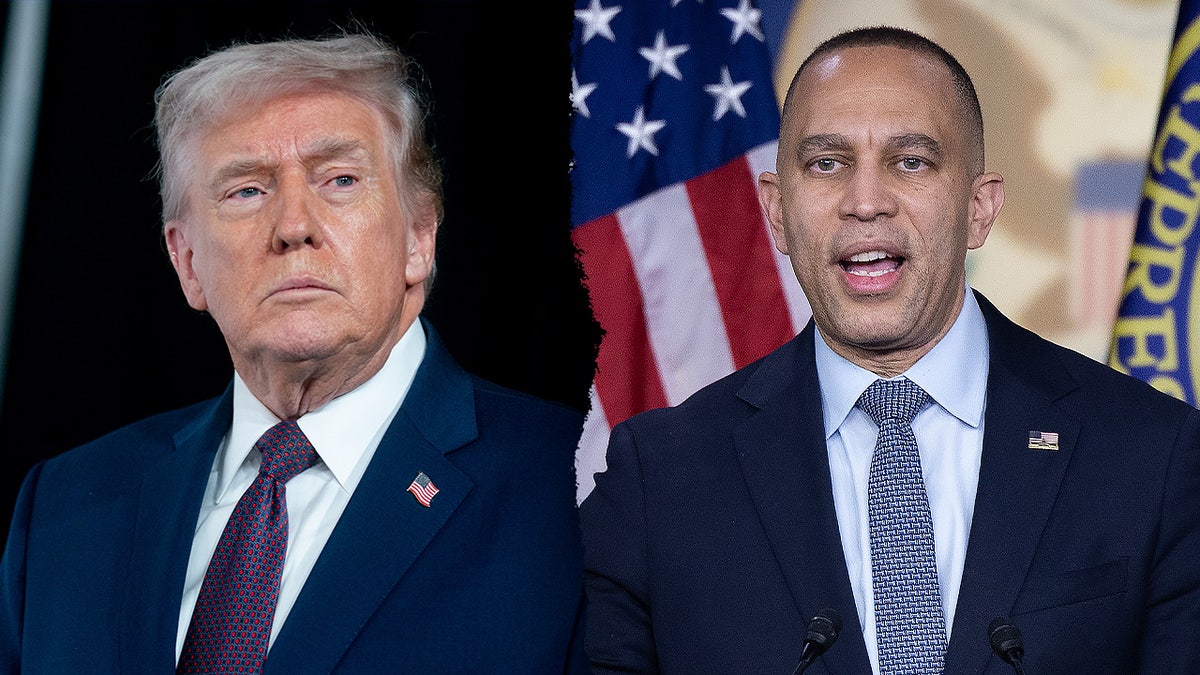
A split image of President Donald Trump and House Democratic Leader Hakeem Jeffries

The House of Representatives sent a bill to end the government shutdown to President Donald Trump’s desk after several Democrats bucked House Minority Leader Hakeem Jeffries’ warnings the left would not support it. (Stefani Reynolds/Bloomberg via Getty Images; Nathan Posner/Anadolu via Getty Images)

Democrats had initially walked away from a bipartisan House deal to finish funding the federal government through the end of fiscal 2026 on Sept. 30, rebelling against a bill funding the Department of Homeland Security (DHS) over Trump’s handling of unrest in Minneapolis.

Their mutiny left roughly 78% of the government’s yearly funding hanging in the balance because the DHS bill was lumped into a wider package authorizing budgets for the departments of War, Labor, Health and Human Services (HHS), Transportation, Housing and Urban Development (HUD), and Education.

The deal struck between Senate Democrats and the White House would fully fund those remaining areas while only extending current funding levels for DHS through Feb. 13, in order to give Democrats and Republicans time to hash out a longer-term bipartisan plan.

‘OPENING PANDORA’S BOX’: MIKE JOHNSON BACKS TRUMP AFTER WARNING WHITE HOUSE ABOUT DEAL WITH DEMOCRATS

Speaker Mike Johnson, R-La., told reporters on Tuesday that the legislation would succeed, though he hinted at some dissatisfaction with how negotiations played out.

“This is not my preferred route. I wanted to keep all six bills together,” Johnson said. “But listen, the president agreed with Schumer that they would separate Homeland, and we’ll do that, and we’ll handle it. … The Republicans are going to do the responsible thing.”

The Senate’s federal funding deal survived an important hurdle late Tuesday morning, clearing a House-wide “rule vote” to allow for lawmakers to debate the measure and set up a vote on final passage by early afternoon.

House Speaker Mike Johnson on Capitol Hill

Speaker of the House Mike Johnson, R-La., walks from the chamber to speak with reporters at the Capitol in Washington, Nov. 12, 2025. (J. Scott Applewhite/AP Photo)

SENATE REPUBLICANS PUSH FOR HOUSE GOP REBELLION AGAINST FUNDING PACKAGE, VOTER ID LEGISLATION

It comes after a pair of House conservatives announced they would be backing off their threats to sink the legislation during the rule vote if the legislation was not paired with an unrelated election integrity bill called the SAVE America Act.

Reps. Anna Paulina Luna, R-Fla., and Tim Burchett, R-Tenn., warned they would not support the bill during the rule vote without the SAVE America Act attached but pivoted on Monday night after a conversation with the White House.

“As of right now, with the current agreement that we have, as well as discussions, we will both be a yes on the rule,” Luna said. “There is something called a standing filibuster that would effectively allow Sen. Thune to put voter ID on the floor of the Senate. We are hearing that that is going well, and he is considering that…so we are very happy about that.”

GOVERNMENT SHUTS DOWN AGAIN AFTER DEMOCRATS REVOLT OVER DHS FUNDING

The SAVE America Act would require voter ID at the polls and create a new proof of citizenship mandate in the voter registration process.

But Luna’s insistence that Thune had embraced the standing filibuster, a little-known and antiquated legislative maneuver, appears it was not quite accurate.

Still, Thune said that there were Senate Republicans who “expressed an interest in that, so we’re going to have a conversation about it. But there weren’t any commitments made.”

He noted that forcing the standing filibuster to try and pass the SAVE America Act, or any of its variations coming from the House, would be a massive drain on time in the Senate.

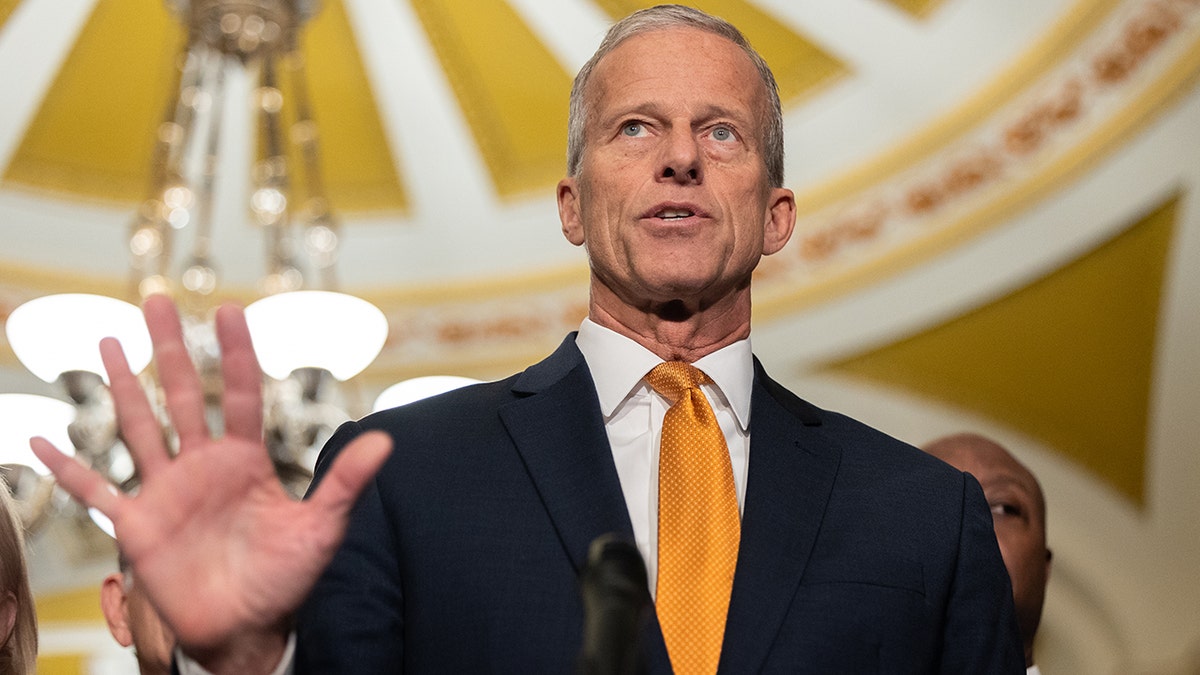
Sen. John Thune

Senate Majority Leader John Thune speaks at a press conference with other members of Senate Republican leadership following a policy luncheon in Washington, Oct. 28, 2025. (Nathan Posner/Anadolu via Getty Images)

Doing so “ties up floor time indefinitely,” Thune said. That’s because of rules that guarantee any senator gets up to two speeches on a bill. That, coupled with the clock being reset by amendments to the bill, means that the Senate could effectively be paralyzed for months as Republicans chip away at Democratic opposition.

“There’s always an opportunity cost,” Thune said.

CLICK HERE TO DOWNLOAD THE FOX NEWS APP

“Well, at any time there’s an amendment offered, and that amendment is tabled, it resets the clock,” he continued. “The two-speech rule kicks in again. So let’s say, you know, every Democrat enator talks for two hours. That’s 940 hours on the floor.”

It’s not immediately clear when Trump will sign the funding bill, but it’s expected the White House will want to move fast. The longest government shutdown in history, which lasted 43 days, just ended in November.


Source link

Critical React Native Metro dev server bug under attack • The Register

0

Baddies are exploiting a critical bug in React Native’s Metro development server to deliver malware to both Windows and Linux machines, and yet the in-the-wild attacks still haven’t received the “broad public acknowledgement” that they should, according to security researchers.

The vulnerability affects the React Native Community command line tool, a very popular npm package with nearly 2.5 million weekly downloads. React Native is a development tool created by Meta that allows users to build mobile applications for iOS and Android using JavaScript and React. 

The flaw, tracked as CVE-2025-11953, arises because the Metro development server started by the React Native Community command line tool exposes an endpoint vulnerable to OS command injection. This allows unauthenticated network attackers to send a POST request to the server and run malicious executables. Similarly, on Windows machines, miscreants can abuse the security hole to execute arbitrary shell commands with fully controlled arguments.

JFrog researchers discovered the vulnerability and disclosed it in early November after Meta issued a fix. The research team assigned it a critical, 9.8 CVSS severity rating, meaning it’s almost as bad as bugs get.

Bug hunters wasted no time publishing proof-of-concept exploits on GitHub, with one such POC being published the same day as the public bug disclosure.

“VulnCheck observed exploitation attempts as early as December, well before public discussion framed CVE-2025-11953 as anything more than a theoretical risk,” VulnCheck CTO Jacob Baines told The Register. “This demonstrates how quickly attackers can act once scanning becomes viable, and why developer tooling – widespread, inconsistently monitored, and often not treated as production-grade – represents a particularly attractive early target.”

In a Tuesday blog, Baines said the bug isn’t receiving the attention it deserves.

“Now, more than a month after initial exploitation in the wild, that activity has yet to see broad public acknowledgment, and EPSS [the Exploit Prediction Scoring System] continues to assign a low exploitation probability of 0.00405. This gap between observed exploitation and wider recognition matters, particularly for vulnerabilities that are easy to exploit and, as internet-wide search data shows, exposed on the public internet,” he wrote.

Baines said the first wave of exploitation began in December, with more attacks delivering the same payloads observed on January 4 and January 21.

These attacks used a multi-stage PowerShell-based loader delivered through cmd.exe, and the code disabled Microsoft Defender protections before retrieving and running the payload: a Rust-based binary with anti-analysis features, including runtime checks to help avoid detection via static inspection.

“The deliberate disabling of Microsoft Defender protections before payload retrieval indicates the attacker anticipated the presence of endpoint security controls and incorporated evasion measures into the initial execution flow,” Baines wrote in a Tuesday blog.

The attacks originated from the following IP addresses: 65.109.182.231, 223.6.249.141, and 134.209.69.155, with the “windows” payload hosted at 8.218.43.248:60124, and 47.86.33.195:60130 hosting both a “windows” and “linux” binary. ®


Source link

The Take: Will the US force regime change in Cuba? | News

0

US president wages maximum pressure campaign on Cuba’s already faltering economy.

Cubans are cooking on charcoal and facing worsening power blackouts after the US cut the island off of Venezuelan oil exports. US President Donald Trump promised Cuba will “fail” soon and threatened tariffs on any nations doing business with the island. Can Cuba’s communist government survive the latest US push for regime change?

In this episode:

Episode credits:

This episode was produced by Haleema Shah and Melanie Marich with Phillip Lanos, Spencer Cline, Chloe K. Li, Tuleen Barakat, Maya Hamadeh, and our host, Kevin Hirten. It was edited by Kylene Kiang. 

Our engagement producers are Adam Abou-Gad, Vienna Maglio, and Munera AlDosari. Andrew Greiner is lead of audience engagement.

Our sound designer is Alex Roldan. Our video editors are Hisham Abu Salah and Mohannad al-Melhem. Alexandra Locke is The Take’s executive producer. Ney Alvarez is Al Jazeera’s head of audio. 

Connect with us:

@AJEPodcasts on XInstagramFacebook, and YouTube


Source link

William Stevenson, Jill Biden’s ex-husband, charged with murder after death of wife in Delaware | US News

0


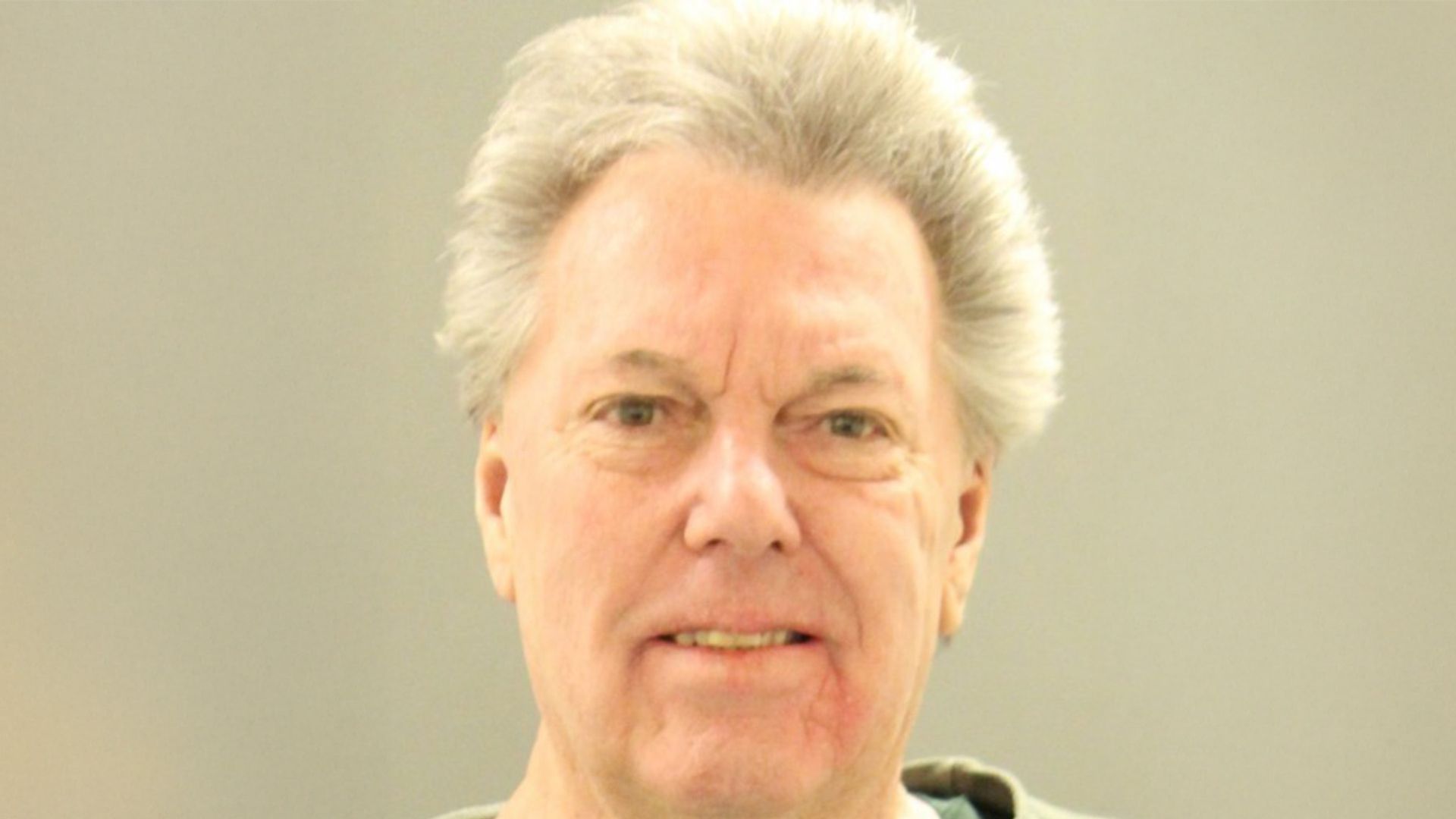
The ex-husband of former first lady Jill Biden has been charged with first-degree murder after the death of his wife.

William Stevenson, 77, was indicted on Monday by a grand jury in New Castle County, Delaware, in connection with the death of 64-year-old Linda Stevenson last year.

Mrs Biden married Stevenson in February 1970, when she was 18 years old and a student at the University of Delaware, and he was 23.

They were only married for five years. In March of 1975, she met then Democratic senator for Delaware Joe Biden, and a civil divorce between her and Stevenson was granted in May of that year.

New Castle County Police said Stevenson was taken into custody at the home in Oak Hill without incident on Monday afternoon.

He has since been arraigned and sent to the Howard Young Correction Institution in Wilmington, where he has been unable to pay a $500,000 (£365,207) cash bail.

According to authorities, at around 11.16pm on 28 December, officers responded to a reported domestic dispute at a residence in Oak Hill, just west of Wilmington in New Castle County.

Upon entering the home, emergency services found Mrs Stevenson unresponsive in the living room. She was later pronounced dead at the scene.

Read more from Sky News:
Coastal road swept away into sea
Teen boy’s four-hour swim to save family

Delaware state police say Mrs Stevenson’s body has been turned over to the Delaware Division of Forensic Science, where a post mortem examination will be conducted to determine the cause and manner of her death.

The office of Jill and ex-president Joe Biden declined to comment to Sky’s US partner network NBC News.


Source link

American athlete slams Canadian coach after court’s ruling on Olympic bid

0

NEWYou can now listen to Fox News articles!

Olympic hopeful Katie Uhlaender reacted to the Court of Arbitration for Sport (CAS)’s ruling after she made a case to join Team USA for the Milan Cortina Winter Games.

The CAS said it had no jurisdiction to consider her case against Bobsleigh Canada Skeleton (BCS) coach Joe Cecchini and the International Bobsled and Skeleton Federation (IBSF) over the results of the IBSF North American Cup Race and Skeleton qualification for a spot in the Winter Olympics.

Uhlaender appeared on Fox News Channel’s “America’s Newsroom” and told anchor Dana Perino that she didn’t necessarily disagree with the ruling but she is now at a crossroads.

CLICK HERE FOR MORE SPORTS COVERAGE ON FOXNEWS.COM

Katie Uhlaender at the 2018 Olympics

Katie Uhlaender (USA) competes in ladies skeleton heat 4 during the Pyeongchang 2018 Olympic Winter Games at Olympic Sliding Centre on Feb. 17, 2018. (Soobum Im/USA TODAY Sports)

“I don’t know that I disagree that it was out of their jurisdiction to be fair. The dispute happened prior to the 10-day window,” she said. “What I want to happen is – something. I don’t know what the solution is at this point because I’ve exhausted all of these pathways within the system and from what I could understand, it will be up to the IOC and potentially the IBSF to allocate an extra spot for extreme circumstances. But we don’t know who should ask for that or exactly how to do it. This is where I’d ask (Vice President) Vance for help.”

Uhlaender sought qualification after she missed out on the chance to qualify when Team Canada withdrew athletes from the North American Cup race in early January, reducing the number of points that the event could award. The point reduction made it impossible for Uhlaender to earn enough to qualify.

An investigation by the IBSF found that Team Canada intentionally manipulated the points at the competition in Lake Placid, New York. However, the IBSF also did not revise any of the results or deliver any penalties as a result. The U.S. Olympic and Paralympic Committee (USOPC) sent a letter to the International Olympic Committee (IOC) petitioning to have Uhlaender granted a spot. Fifteen other countries have joined in on that petition.

TEAM CANADA COACH SPEAKS OUT AFTER BEING FOUND TO HAVE MANIPULATED COMPETITION, US OLYMPIAN FIRES BACK

Katie Uhlaender poses for portrait

Katie Uhlaender of Team United States poses for a portrait during the Team USA Beijing 2022 Olympic shoot in Irvine, California, on Sept. 12, 2021. (Tom Pennington/Getty Images for Team USA)

“This is all within the rules. There’s nothing wrong with those things. And people can be strategic in the races that they participate. And she was doing that, and other nations were doing that, because you want to put your best foot forward,” Cecchini said. “This is a system flaw, if anything. But we were within the rules.”

Cecchini also took aim directly at Uhlaender, saying she isn’t a “top-tier athlete.”

“I don’t really wanna speak negatively about Katie, but Katie was not on the World Cup team. She wasn’t a top-tier athlete in that program anymore. She was at the end of her career. I would personally would rather race against Katie. She’s not as competitive as the other athletes,” he said. “It’s probably really unfair to say and not really where I want to go with this but that’s where we are with that.”

Uhlaender said on Fox News Channel that Cecchini wasn’t really addressing the issue at heart.

“I think that response says it all because he’s not addressing the issue at all, which is that he intentionally tricked all the countries into thinking this race was full points,” she said. “He urged me to come race there and then, at the last second, he pulled all of his athletes. He didn’t hide it. He told me, he told another coach that he did it for the points, and he knew he was going to hurt me and he knew he was gonna hurt the Denmark athlete and the Swiss girl might have to retire because of this and he didn’t care. He said he wanted to eliminate any possibilities that could threaten Canada’s second spot even if it was just 1%. And the sad part is, there was no threat.

“At the end of the races, the Korean athlete was not gonna surpass Canada. He hurt all of us just because he wanted to eliminate any possibility, which is not in the spirit of sport. And that’s the point. It’s not that it wasn’t within the rules – you should be able to pull athletes for legitimate reasons. But not to hurt people.”

Katie Uhlaender poses for a photo in September 2017

Team USA skeleton hopeful Katie Uhlaender poses for a photo during the 2018 U.S. Olympic Team media summit at the Grand Summit Hotel on Sept. 25, 2017. (Kevin Jairaj/USA TODAY Sports)

CLICK HERE TO DOWNLOAD THE FOX NEWS APP

Uhlaender added that she had hoped to be able to compete in her six Olympic Games and join Lindsey Vonn as the only two athletes to have competed in 2002 and 2026.

As of now, it doesn’t seem like it will happen.

Fox News’ Jackson Thompson contributed to this report.

Follow Fox News Digital’s sports coverage on X and subscribe to the Fox News Sports Huddle newsletter.


Source link

National Cyber Director wants help to cut cybersecurity regulations and renew CISA

0

The Trump administration needs help from industry to reduce the cybersecurity regulatory burden and to back important cyber legislation on Capitol Hill, among other areas, National Cyber Director Sean Cairncross said Tuesday.

“You know your regulatory scheme better than I do: Where there’s friction, where there’s frustration with information sharing, what sort of information is shared, the process through which it’s shared,” he said. “It is helpful for us to hear that and have that feedback so that we can address it, engage it and try to make it better.”

The Trump administration is interested in being a partner with industry rather than a “scold,” Cairncross said at an Information Technology Industry Council event. The Biden administration sought to impose more cybersecurity rules on the private sector than prior administrations.

Cairncross also called on industry to help pass the Cybersecurity Information Sharing Act of 2015, which has expired and dealt with short-term extensions in recent months as Congress stalls on what to do with a law that provides legal protections to companies that share cyber threat data with the government and each other.

The Trump administration would like to see the law extended as-is for 10 years.

“What we need from industry is an echo chamber up on the Hill to help make that happen,” he said. “I can go tell people how important this is, or the White House can weigh in, and we have done that. But when the people who are actually affected by this start to weigh in with members, that has an even greater impact.”

Overall, Cairncross wants industry to “show up and engage,” he said, as the administration has done with its forthcoming cybersecurity strategy, something he said would be rolled out “sooner rather than later.”

“Reach out to us,” he urged. “We will certainly be reaching out how we have gone about this strategic piece of this. Just from the outset, we have had a heavy industry engagement side of this and looked for feedback and thoughts. It’s been extremely helpful, and hopefully it has been successful in sending the message that we want to, which is, we are here to do everything we can to partner with industry.”

Tim Starks

Written by Tim Starks

Tim Starks is senior reporter at CyberScoop. His previous stops include working at The Washington Post, POLITICO and Congressional Quarterly. An Evansville, Ind. native, he’s covered cybersecurity since 2003. Email Tim here: tim.starks@cyberscoop.com.


Source link

Will Hezbollah continue to avoid responding to Israel’s attacks on Lebanon? | Israel attacks Lebanon News

0

Beirut, Lebanon – The Lebanese group Hezbollah has launched only one attack in the 14 months since a ceasefire with Israel began – despite more than 11,000 Israeli violations.

The Israeli attacks continue to devastate parts of southern Lebanon and the Bekaa Valley and are keeping approximately 64,000 Lebanese displaced.

Recommended Stories

list of 3 itemsend of list

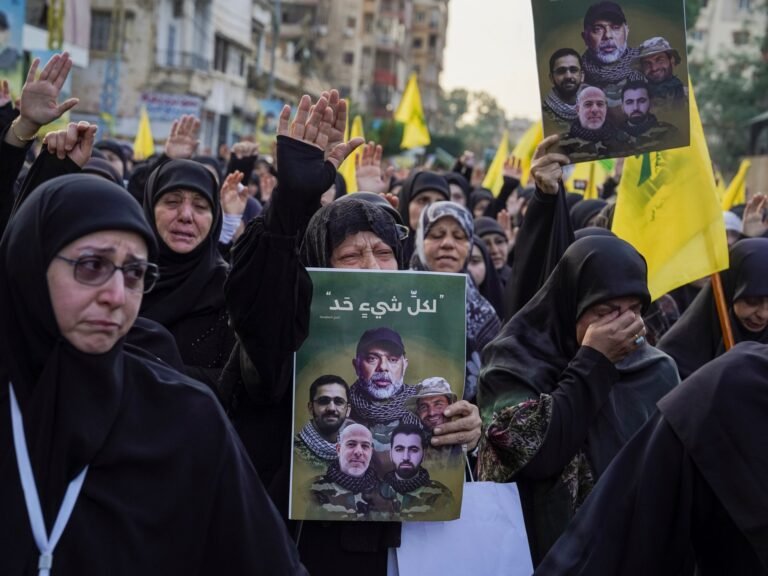
Hezbollah has not been in a position to respond after being weakened during the 2024 war, in which most of its military leadership was killed, including longtime Hezbollah chief Hassan Nasrallah, analysts say.

But the group hasn’t ruled out a response – especially as Hezbollah is increasingly under pressure to disarm.

“No one can predict when Hezbollah will respond,” Qassem Kassir, a journalist close to Hezbollah, told Al Jazeera. “It’s linked to the escalating Israeli aggression, [a Hezbollah response will happen] if a suitable opportunity presents itself, and in the event that diplomatic efforts fail.”

‘Hezbollah committed to the ceasefire’

When the ceasefire was announced between Hezbollah and Israel on November 27, 2024, the Lebanese group was badly weakened militarily and politically. The fall of its ally in Syria, the al-Assad regime, less than two weeks later, cut off a crucial land supply route used to transport financing and weapons from Iran.

The ceasefire stipulated that both Hezbollah and Israel would cease their attacks, Hezbollah would pull back its forces from south of the Litani River that runs across south Lebanon, and Israel would withdraw its forces from its northern neighbour.

But Israel has not stopped attacking Lebanon, and it continues to occupy five points in southern Lebanon. Other issues that are of importance to Hezbollah and the Lebanese state include the fate of Lebanese prisoners in Israeli jails and reconstruction, which Israel has prevented through the repeated targeting of construction equipment.

Still, Hezbollah has only attacked Israel once since November 2024. The lone strike was in December 2024, when Hezbollah responded to repeated Israeli attacks by firing at an Israeli military post. No one was harmed, but Israel responded to that attack by killing 11 people in Lebanon.

In the months since, Israel has killed more than 330 people in Lebanon, including at least 127 civilians, and a top Hezbollah commander, Haytham Ali Tabatabai.

“Hezbollah committed to the ceasefire in order to give the Lebanese state, government, and army the opportunity to implement the ceasefire and achieve demands through diplomatic means, as promised by the President of the Republic [Joseph Aoun],” Kassir said. “Furthermore, it wants to take the time to rebuild and allow people to return to their villages and homes.”

‘No position to respond’

For years, Hezbollah’s military capacity acted as a deterrent to Israeli aggression. But that changed after the last war.

Analysts said that should Hezbollah respond, it would likely incur the wrath of Israel’s military, bringing back a scale of violence that displaced more than 1.2 million people and killed thousands.

“Hezbollah is simply in no position today to respond to Israel,” Lebanese political analyst Karim Emile Bitar told Al Jazeera. “Any retaliation from Lebanon would provoke an uproar in the domestic political arena, and it is also likely to be highly ineffective from a military standpoint. The party is simply too weak to enter into such an endeavour.”

“Israel has changed the rules of engagement through deep intelligence penetration, cyber-enabled targeting, AI-assisted surveillance, and precision strikes that degrade command, logistics, and leadership,” Imad Salamey, a political scientist at the Lebanese American University, told Al Jazeera.

There is, however, one scenario that might force Hezbollah’s hand, analysts said. An attack on Iran, Hezbollah’s longtime benefactor, could kick the group into action.

On January 26, Hezbollah’s leader Naim Qassem delivered a televised speech addressing his party’s position on US threats to attack Iran.

“We are determined to defend ourselves,” Qassem said. “We will choose in due course how to act.”

Hezbollah is a notoriously secretive group. And following a war where the group felt exposed by Israeli intelligence, their secretiveness has likely intensified. Still, reports in local media and some analysts have spoken about a potential divide in the group over its position vis-a-vis Iran, and how disarmament should proceed, if at all.

Iran’s survival

With that in mind, some members of Hezbollah may view the survival of the Iranian government as existential and push them to attack the US’s most fervent regional ally, Israel.

“The only scenario in which [Hezbollah may attack Israel] is if there is a genuine, clear and present existential danger to the very survival of the Iranian regime and if the Iranian regime orders all its regional proxies to go all in,” Bitar said. “Otherwise, I think Hezbollah is most likely to stay out of it.”

Salamey said that only a “dramatic external shock” like a regional war including Iran would draw in the group. Otherwise, any response “would likely require a clear crossing of red lines that directly threaten Hezbollah’s core survival, not symbolic or tactical losses.”

Still, he said, “any response would likely be limited, calibrated, and asymmetric, aimed at signalling relevance rather than triggering full-scale war. Hezbollah currently lacks the strategic confidence, logistical depth, and political cover needed for broad escalation.”


Source link