Latest round of MITRE ATT&CK evaluations put cybersecurity products through rigors of ransomware 

0

MITRE Corporation released findings Wednesday from its latest round of ATT&CK evaluations, assessing the capabilities of enterprise cybersecurity solutions against some of the most prevalent ransomware tactics and North Korean malware.

The sixth such evaluation from the nonprofit research organization measured 19 different vendors’ ability to protect enterprise systems by evaluating them against two prominent ransomware strains -—Cl0p and LockBit — as well as North Korean-linked malware targeting macOS systems. For the latter, MITRE’s evaluation used advanced multi-stage malware emulations that highlighted sophisticated tactics, such as exploiting legitimate macOS utilities and stealthily exfiltrating sensitive data.

According to William Booth, the general manager of MITRE’s ATT&CK evaluations, the results revealed significant disparities between vendors’ detection rates and their ability to accurately distinguish malicious activity from benign system behavior.

“Some vendors had higher false-positive rates than detection rates, which indicates a need to better distinguish legitimate activity from malicious activity,” Booth told CyberScoop. 

How the tests were conducted 

The evaluation is conducted in multiple stages.

First, MITRE runs an initial emulation plan to assess the vendors’ baseline detection capabilities. This means they execute a series of malicious activities and see which ones the vendors can detect without any prior knowledge.

After this initial detection test, MITRE gives vendors a day to make configuration changes to their products. This could involve things like adding new detection logic, updating user interfaces, or making other adjustments to improve product performance.

The purpose of this configuration change period is to allow the vendors to enhance their products based on the initial test results. MITRE wants to see if the vendors can improve their detection and protection capabilities by making targeted changes.

In the second phase of testing, MITRE runs a separate emulation plan focused on the protection capabilities of the vendors’ products, complete with a new set of malicious activities that the vendors haven’t seen before.

By separating the detection and protection tests, and allowing the configuration changes in between, MITRE can assess how well the vendors can adapt and improve their security controls in response to new threats.

What the results show 

The organization explicitly states that “the evaluations do not rank vendors and their solutions, but instead provide insights” for organizations to make their own decisions based on their unique IT systems and threat models. However, Booth told CyberScoop there were surprising findings from the evaluation’s data. 

One of the most striking discoveries was that some vendors had higher false-positive rates than actual detection rates. Booth explained that this indicates a significant need for vendors to improve the specificity of their detection and blocking capabilities.

“There are certain vendors where you’ll see, yes, they had 100% detections, but their false-positive rate was also 90%,” Booth said. “That’s really interesting when you start to look at, OK, how can [vendors] determine what needs to be detected versus what is just noise?”

Another surprising finding was the difficulty vendors faced in protecting against threats in the post-compromise stage. Booth noted that MITRE’s evaluation placed a strong emphasis on assessing vendors’ ability to detect and mitigate ransomware activities after the initial breach, rather than just the initial infection.

“The assumption that you’re always going to block on the first piece of activity is not the case,” Booth said. “We’re focused on what happens after that initial compromise.”

Many vendors seemed to struggle with this post-compromise focus, as ransomware can often mimic normal system and file encryption behaviors. 

Booth also highlighted the varied approaches vendors are taking when it comes to detection, noting some key differences between machine learning-based methods and more heuristic-based techniques.

“There’s certainly some that are using AI, applying the language models on the raw data, and then there’s others that are using more of a heuristic approach,” Booth explained.

The evaluation revealed that these differing detection strategies can lead to vastly different results, both in terms of detection rates and false-positive rates.

A first for Mac

Booth told CyberScoop the inclusion of macOS in this latest evaluation round presented some unique challenges, noting that evaluating Mac-based threats required a different approach compared to previous Windows-focused assessments.

“MacOS was a bit tougher because there’s not a lot of public CTI [Cyber Threat Intelligence] on that,” Booth said.

That lack of public threat intelligence on Mac-targeted malware campaigns made it more challenging for MITRE to construct realistic, evidence-based emulation scenarios for the evaluation.

“There’s a lot that goes into formulating [the evaluation], in terms of our discussions with many different groups and organizations to get input into doing that. But Mac was hard because there’s not a lot of public CTI,” Booth acknowledged.

Despite these difficulties, MITRE included macOS in this round of testing to better reflect the evolving threat landscape. As more organizations adopt Apple devices, understanding the security capabilities of products against Mac-based attacks has become increasingly important.

Full list of vendors

The full cohort of products that MITRE evaluated included: 

  • AhnLab
  • Bitdefender
  • Check Point
  • Cisco Systems
  • Cybereason
  • Cynet
  • ESET
  • HarfangLab
  • Microsoft
  • Palo Alto Networks
  • Qualys
  • SentinelOne
  • Sophos
  • Tehtris
  • ThreatDown
  • Trellix
  • Trend Micro
  • WatchGuard
  • WithSecure

The evaluation results are publicly available on MITRE’s ATT&CK evaluation website. 

Greg Otto

Written by Greg Otto

Greg Otto is Editor-in-Chief of CyberScoop, overseeing all editorial content for the website. Greg has led cybersecurity coverage that has won various awards, including accolades from the Society of Professional Journalists and the American Society of Business Publication Editors. Prior to joining Scoop News Group, Greg worked for the Washington Business Journal, U.S. News & World Report and WTOP Radio. He has a degree in broadcast journalism from Temple University.


Source link

Governments, Telcos Ward Off China’s Hacking Typhoons

0

While the US government and at least eight telecommunications firms struggle to defend their networks against the China-sponsored Salt Typhoon group, other nations’ telecommunications firms have often been primary targets for advanced persistent threats (APTs) as well.

In 2023, China-linked group Earth Estries — which may overlap with Salt Typhoon — compromised telecommunications firms in the Asia-Pacific (APAC) and the Middle East and North Africa (MENA) regions, as well as the US. In 2022, a Chinese APT group alternatively known as Daggerfly and Evasive Panda infected systems at a telecommunications organization in Africa, installing a backdoor tool known as MgBot. And earlier this year, Chinese APT group Volt Typhoon targeted Singapore’s largest telco, Singtel, with attacks, although the company denies any of the probes were successful.

China has made infiltrating other nations’ networks a foundation of its geopolitical strategy, and other countries — and their citizens — should consider their networks no longer private, says David Wiseman, vice president of secure communications for cybersecurity firm BlackBerry.

“All countries need to assume they are affected,” he says. “The impact [of these attacks are] operational in that the government can no longer be confident using traditional phone calls and SMS. This is accelerating the usage of ‘over the top’ encrypted communications applications for official government communications.”

Over-the-top (OTT) applications and services are those that are delivered over the Internet, not through traditional telecommunications systems.

US telecommunications firms — including Verizon, AT&T, and T-Mobile — are struggling to clean their networks and prevent two Chinese groups, Salt Typhoon and Volt Typhoon, from persisting in their systems. Earlier this year, Salt Typhoon gained access to some of the telecom systems used to satisfy wiretap requests, while Volt Typhoon has compromised telecommunications and other critical infrastructure to pre-position ahead of possible region conflict.

Telecommunications infrastructure is one of the most attractive targets for nation-state actors, because they affect all facets of a country’s economy and provide in-depth data on its citizens, says Chris Henderson, senior director of threat operations at Huntress, a threat-intelligence firm.

“As telecommunication companies have grown from managing landline infrastructure to being one of the most data-rich organizations, their attractiveness to both for-profit groups and state-sponsored espionage has also grown,” he says, adding that they “know more about you than arguably any other organization — they understand where you have been physically located, who you are speaking with, and for how long.”

From Singapore to India and Beyond

China has long focused on the telecommunication firms of its regional rivals. In 2014, for example, the government of India accused Chinese equipment maker Huawei of hacking the state-owned Bharat Sanchar Nigam Limited (BSNL), after that firm used another Chinese service provider, ZTE, to provision its lines.

In 2023, an investigation by cybersecurity firm Trend Micro found that China-linked Earth Estries targeted at least 20 telecommunications and other infrastructure providers across Southeast and South Asia, South Africa, and Brazil, using a cross-platform backdoor.

Every country should act to defend their telecommunications infrastructure, says BlackBerry’s Wiseman. While the success of attacks on Singapore, India, and the US are among the few that have become public, other companies are likely breached and still not aware, he says.

Organizations and citizens should no longer assume that their communications are safe, Wiseman says.

“General harvesting of communication records to build out a continual understanding of changes in command-and-control networks is a key thing that can be done,” he says. “More concerning is that since the voice calls of specific people can be listened to along with reading of the SMS messages, there is the potential for more advanced communications manipulation.”

A Boost for Encryption

The Salt Typhoon attacks may push citizens — and possibly their governments — toward greater use of encryption. While the trend has been for authoritarian governments and security agencies — such as law enforcement and internal security groups — to argue for less encryption, or at least backdoors into encrypted systems, the global attacks on telecommunications technology demonstrate that even nations with well-considered, strict privacy laws are not safe havens, says Gregory Nojeim, senior counsel and director of the security and surveillance project at the Center for Democracy and Technology, a digital-rights group.

“Greater geopolitical tension breeds greater geopolitical incentive to gain access to other countries’ communications and that will also incentivize the adoption and use of encryption,” Nojeim says. “Hopefully, it will also incentivize the protection of encryption against proposals that would weaken it.”

In the US, government agencies such as the FBI have argued for law-enforcement backdoors into telecommunications networks and are calling for workers and citizens to use stronger encryption.

Meanwhile, telecommunications providers — whether private or state-owned — should focus more heavily on security, and their citizens should also adopt encrypted services, BlackBerry’s Wiseman says. “Many countries realized this earlier than the US [and] started widespread adoption of end-to-end app-based encrypted communications sooner,” he says. “The earliest movers were countries that did not have the same level of controls over their telecom network supply chains as the more developed countries.”

Most countries in the Global South score lower on rankings of Internet privacy than their peers in North America, Europe, and East Asia. However, lower privacy rights can mean citizens are more likely to use encrypted services, says CDT’s Nojeim.

“One lesson of Salt Typhoon is that people who live in democracies can’t comfort themselves that their own government won’t listen in absent a good reason,” he says. “Now they have to be concerned about foreign governments listening in, and the way to prevent that, again, is to use an encrypted service.”


Source link

Wyden proposes bill to secure US telecoms after Salt Typhoon hacks

0

Ron Wyden

U.S. Senator Ron Wyden of Oregon announced a new bill to secure the networks of American telecommunications companies breached by Salt Typhoon Chinese state hackers earlier this year.

Wyden’s “Secure American Communications Act” will order the Federal Communications Commission (FCC) to issue binding cybersecurity rules and implement the security requirements demanded since 1994 by legislation that instructs telecom providers to secure their phone and wireless networks from breaches.

Telecom carriers will have to test their systems annually for security vulnerabilities, patch them, and document their findings and “all corrective measures.” They’ll also have to contract independent auditors for annual compliance audits with FCC cybersecurity rules and document any noncompliance findings.

“It was inevitable that foreign hackers would burrow deep into the American communications system the moment the FCC decided to let phone companies write their own cybersecurity rules. Telecom companies and federal regulators were asleep on the job and as a result, Americans’ calls, messages, and phone records have been accessed by foreign spies intent on undermining our national security,” Wyden said today.

“Congress needs to step up and pass mandatory security rules to finally secure our telecom system against an infestation of hackers and spies.”

On Thursday, FCC Chairwoman Jessica Rosenworcel announced that the agency would also act “urgently” to ensure that American telecom carriers are required to secure their networks.

The Salt Typhoon telecom breaches

CISA and the FBI confirmed the hacks in late October following reports that Chinese threat actors had hacked multiple telcos, including T-Mobile, AT&T, Verizon, and Lumen Technologies.

Even though the timing of these breaches is still unclear, the Chinese hackers had access for “months or longer.” This reportedly allowed them to steal substantial internet traffic from carriers providing services to American businesses and millions of customers.

Last week, President Biden’s deputy national security adviser Anne Neuberger told reporters during a Wednesday press briefing that the Salt Typhoon hacking group breached eight U.S. telecoms and carriers in dozens of other countries.

The White House official said that “at this time, we don’t believe any classified communications have been compromised,” while a senior CISA official added in a Tuesday press call that they couldn’t “say with certainty that the adversary has been evicted.”

CISA and FBI officials also advised Americans to use encrypted messaging apps to minimize the risk of communications interception by Chinese hackers and released guidance to help telecom infrastructure system admins and engineers harden systems against Salt Typhoon attacks.

Also tracked as Earth Estries, Ghost Emperor, FamousSparrow, and UNC2286, the Salt Typhoon Chinese state-sponsored hacking group has been active since at least 2019, breaching government entities and telecom companies across Southeast Asia.


Source link

Cleo File Transfer Vulnerability Under Exploitation – Patch Pending, Mitigation Urged

0

Dec 10, 2024Ravie LakshmananVulnerability / Threat Analysis

Cleo File Transfer Vulnerability

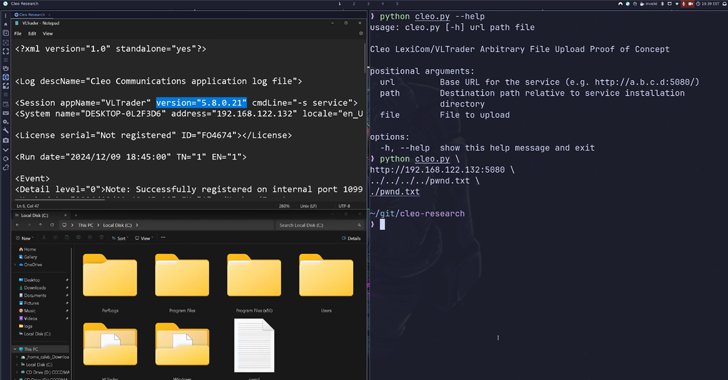
Users of Cleo-managed file transfer software are being urged to ensure that their instances are not exposed to the internet following reports of mass exploitation of a vulnerability affecting fully patched systems.

Cybersecurity company Huntress said it discovered evidence of threat actors exploiting the issue en masse on December 3, 2024. The vulnerability, which impacts Cleo’s LexiCom, VLTransfer, and Harmony software, concerns a case of unauthenticated remote code execution.

The security hole is tracked as CVE-2024-50623, with Cleo noting that the flaw is the result of an unrestricted file upload that could pave the way for the execution of arbitrary code.

Cybersecurity

The Illinois-based company, which has over 4,200 customers across the world, has since issued another advisory (CVE pending), warning of a separate “unauthenticated malicious hosts vulnerability that could lead to remote code execution.”

The development comes after Huntress said the patches released for CVE-2024-50623 do not completely mitigate the underlying software flaw. The issue impacts the below products and is expected to be patched later this week –

  • Cleo Harmony (up to version 5.8.0.23)
  • Cleo VLTrader (up to version 5.8.0.23)
  • Cleo LexiCom (up to version 5.8.0.23)

In the attacks detected by the cybersecurity company, the vulnerability has been found to be exploited to drop multiple files, including an XML file that’s configured to run an embedded PowerShell command that’s responsible for retrieving a next-stage Java Archive (JAR) file from a remote server.

Specifically, the intrusions leverage the fact files placed in the “autorun” sub-directory within the installation folder and are immediately read, interpreted, and evaluated by the susceptible software.

As many as at least 10 businesses have had their Cleo servers compromised, with a spike in exploitation observed on December 8, 2024, at around 7 a.m. UTC. Evidence gathered so far pins the earliest date of exploration to December 3, 2024.

Victim organizations span consumer product companies, logistics and shipping organizations, and food suppliers. Users are advised to ensure that their software is up-to-date to ensure that they are protected against the threat.

Ransomware groups like Cl0p (aka Lace Tempest) have previously set their sights on various managed file transfer tools in the past, and it looks like the latest attack activity is no different.

Cybersecurity

According to security researcher Kevin Beaumont (aka GossiTheDog), “Termite ransomware group operators (and maybe other groups) have a zero-day exploit for Cleo LexiCom, VLTransfer, and Harmony.”

Cybersecurity company Rapid7 said it also has confirmed successful exploitation of the Cleo issue against customer environments. It’s worth noting that Termite has claimed responsibility for the recent cyber attack on supply chain firm Blue Yonder.

Broadcom’s Symantec Threat Hunter Team told The Hacker News that “Termite appears to be using a modified version of Babuk ransomware, which, when executed on a machine, encrypts targeted files and adds a .termite extension.”

“Since we saw that Blue Yonder had an instance of Cleo’s software open to the internet via Shodan, and Termite has claimed Blue Yonder amongst its victims, which was also confirmed by their listing and open directory of files, I’d say that Gossi is correct in his statement,” Jamie Levy, Huntress’ Director of Adversary Tactics, told the publication.

“For what it’s worth, there have been some rumblings that Termite might be the new Cl0p, there is some data that seems to support this as Cl0p’s activities have waned while Termite’s activities have increased. They are also operating in some similar fashions. We’re not really in the attribution game, but it wouldn’t be surprising at all if we are seeing a shift in these ransomware gangs at the moment.”

(This is a developing story. Please check back for more updates.)


Found this article interesting? Follow us on Twitter and LinkedIn to read more exclusive content we post.


Source link

U.S. Offered $10M for Hacker Just Arrested by Russia – Krebs on Security

0

In January 2022, KrebsOnSecurity identified a Russian man named Mikhail Matveev as “Wazawaka,” a cybercriminal who was deeply involved in the formation and operation of multiple ransomware groups. The U.S. government indicted Matveev as a top ransomware purveyor a year later, offering $10 million for information leading to his arrest. Last week, the Russian government reportedly arrested Matveev and charged him with creating malware used to extort companies.

An FBI wanted poster for Matveev.

Matveev, a.k.a. “Wazawaka” and “Boriselcin” worked with at least three different ransomware gangs that extorted hundreds of millions of dollars from companies, schools, hospitals and government agencies, U.S. prosecutors allege.

Russia’s interior ministry last week issued a statement saying a 32-year-old hacker had been charged with violating domestic laws against the creation and use of malicious software. The announcement didn’t name the accused, but the Russian state news agency RIA Novosti cited anonymous sources saying the man detained is Matveev.

Matveev did not respond to requests for comment. Daryna Antoniuk at TheRecord reports that a security researcher said on Sunday they had contacted Wazawaka, who confirmed being charged and said he’d paid two fines, had his cryptocurrency confiscated, and is currently out on bail pending trial.

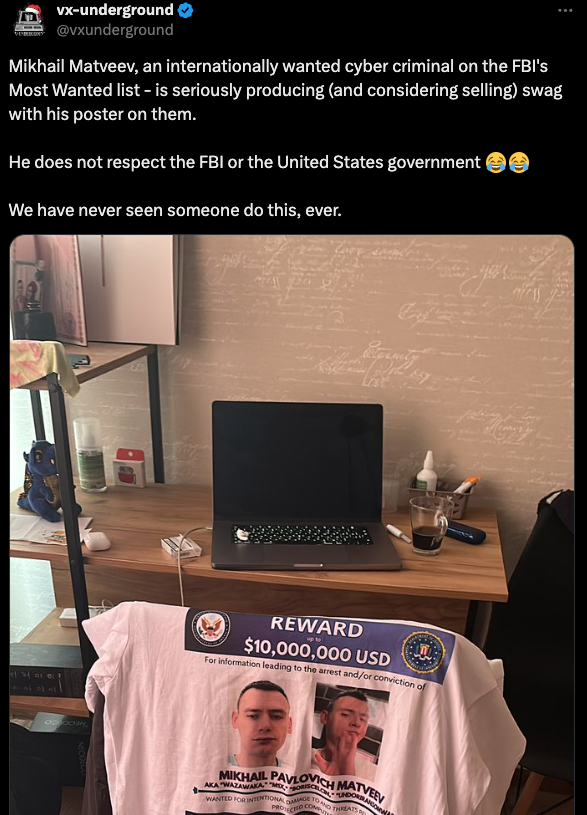
Matveev’s hacker identities were remarkably open and talkative on numerous cybercrime forums. Shortly after being identified as Wazawaka by KrebsOnSecurity in 2022, Matveev published multiple selfie videos on Twitter/X where he acknowledged using the Wazawaka moniker and mentioned several security researchers by name (including this author). More recently, Matveev’s X profile (@ransomboris) posted a picture of a t-shirt that features the U.S. government’s “Wanted” poster for him.

An image tweeted by Matveev showing the Justice Department’s wanted poster for him on a t-shirt. image: x.com/vxunderground

The golden rule of cybercrime in Russia has always been that as long as you never hack, extort or steal from Russian citizens or companies, you have little to fear of arrest. Wazawaka claimed he zealously adhered to this rule as a personal and professional mantra.

“Don’t shit where you live, travel local, and don’t go abroad,” Wazawaka wrote in January 2021 on the Russian-language cybercrime forum Exploit. “Mother Russia will help you. Love your country, and you will always get away with everything.”

Still, Wazawaka may not have always stuck to that rule. At several points throughout his career, Wazawaka claimed he made good money stealing accounts from drug dealers on darknet narcotics bazaars.

Cyber intelligence firm Intel 471 said Matveev’s arrest raises more questions than answers, and that Russia’s motivation here likely goes beyond what’s happening on the surface.

“It’s possible this is a shakedown by Kaliningrad authorities of a local internet thug who has tens of millions of dollars in cryptocurrency,” Intel 471 wrote in an analysis published Dec. 2. “The country’s ingrained, institutional corruption dictates that if dues aren’t paid, trouble will come knocking. But it’s usually a problem money can fix.

Intel 471 says while Russia’s court system is opaque, Matveev will likely be open about the proceedings, particularly if he pays a toll and is granted passage to continue his destructive actions.

“Unfortunately, none of this would mark meaningful progress against ransomware,” they concluded.

Although Russia traditionally hasn’t put a lot of effort into going after cybercriminals within its borders, it has brought a series of charges against alleged ransomware actors this year. In January, four men tied to the REvil ransomware group were sentenced to lengthy prison terms. The men were among 14 suspected REvil members rounded up by Russia in the weeks before Russia invaded Ukraine in 2022.

Earlier this year, Russian authorities arrested at least two men for allegedly operating the short-lived Sugarlocker ransomware program in 2021. Aleksandr Ermakov and Mikhail Shefel (now legally Mikhail Lenin) ran a security consulting business called Shtazi-IT. Shortly before his arrest, Ermakov became the first ever cybercriminal sanctioned by Australia, which alleged he stole and leaked data on nearly 10 million customers of the Australian health giant Medibank.

In December 2023, KrebsOnSecurity identified Lenin as “Rescator,” the nickname used by the cybercriminal responsible for selling more than 100 million payment cards stolen from customers of Target and Home Depot in 2013 and 2014. Last month, Shefel admitted in an interview with KrebsOnSecurity that he was Rescator, and claimed his arrest in the Sugarlocker case was payback for reporting the son of his former boss to the police.

Ermakov was sentenced to two years probation. But on the same day my interview with Lenin was published here, a Moscow court declared him insane, and ordered him to undergo compulsory medical treatment, The Record’s Antoniuk notes.


Source link

US military grounds entire Osprey tiltrotor fleet • The Register

0

The US Navy, Air Force, and Marine Corps have grounded their fleet of Boeing-Bell-made Osprey V-22s on safety grounds.

A spokesperson for the Naval Air Systems Command (NAVAIR) told The Register that the decision had been made following an incident where one of the aircraft made an emergency landing.

“Out of an abundance of caution, NAVAIR recommended an operational pause for all V-22 Osprey variants December 6. This decision comes following a recent precautionary landing of a CV-22. There were no injuries to the crew,” he explained.

“The safety of our V-22 aircrew is our top priority. We are committed to ensuring our Sailors, Airmen, and Marines are able to successfully complete their missions and return home safely.”

The move comes after a V-22, operating out of the Air Force Special Operations Command (AFSOC) in Florida, was forced to make a “precautionary landing,” its spokesperson told us. No one was injured in the incident.

The decision comes barely a year after the last grounding of the V-22 fleet, which came after a fatal crash by a V-22 operated by the Air Force which killed both pilots and six passengers. The cause of that crash was reportedly one of the two engines failed, and the fleet was grounded for three months of checks.

The aircraft’s tiltrotor design, while offering significant advantages in terms of speed, range, and short or vertical lift-off capability, is also incredibly complicated. The aircraft has gained a reputation for unreliability, with four crashes and 30 fatalities occurring during the nine-year testing period, and one ex-pilot has claimed the design was rushed through testing.

Last month an investigation by the Associated Press reported that the top three most serious types of incidents for the aircraft were up to 46 percent between 2019 and 2023, despite the total number of flying hours falling. Overall safety issues were up 18 percent in the same period.

The report suggests that the complex design of the Boeing-Bell aircraft, and the stresses and strains of flight, are causing parts to wear out more quickly than expected. Most of the accidents reported were related to engine issues and last month’s incident may have been more serious than the military is saying, otherwise why ground the entire fleet?

Nevertheless, the military isn’t giving up on the design. In 2022 the winner of the military’s Future Long-Range Assault Aircraft was announced and it’s another tiltrotor design — the Bell V-280 Valor. That aircraft is designed to replace the Black Hawk transport helicopter and is forecast to fly in 2027 at the earliest. ®


Source link

Work Pressure: How It Can Destroy Your Health, Relationships, and Life all Together

Hey yea.. Raj Bhat back with another (long – healthy) article.. shortly: you cannot be too fat (>25%) and camouflage it as chubby, you are medically unhealthy . This article is not completely from my mid info I have.. I had to consult one of my Doc Sister to get this chain of issue right… So the info in this article is totally legit and if you feel offended then you must look at your lifestyle and yourself and change it rather brew much hate or self satisfy unhealthy self as chubby! (both men and women). There are many reasons and situations I faced/heard to write this article I would like to list them, so you know its the fact
  • Recent EY incident, girls su*ide  due to work pressure
  • Growing number of fat people around
  • Increased chemicals and sweeteners in day to day food
  • False propaganda by food companies about junk food
  • Nasty work culture
  • The girls that personally i see in matrimony website
  • Number of fat girls (unhealthy fat > 25% body fat) pose/think that they are healthy.
  • No proper guidance from parents to get / be healthy
  • No self realisation that they are unhealthy(never seem themself in mirror)
The constant strain from long work hours, tight deadlines, and demanding bosses can set off a chain reaction, leading to a complete breakdown in health, relationships, and even your ability to conceive. What seems like just work stress can spiral into a lifestyle that wreaks havoc on your body and mind, affecting every aspect of your life, from physical well-being to intimacy, pregnancy and loose your motherhood!. Here’s how it happens.

1. The Root Cause: Work Pressure and Stress

It all starts with work pressure. You’re clocking in 12-14 hour days, often working from 9 AM to 11 PM, facing constant nagging from your managers. The stress becomes relentless, and suddenly, you’re not just mentally exhausted—you’re physically drained as well. Chronic stress sets in, and with it, your body begins to overproduce cortisol, the stress hormone. Elevated cortisol may help you push through the day, but it has devastating consequences for your long-term health(no apatite/start eating loads of junk food, no exercise, or no sense of health hence no exercise…. Much more to follow below with solution to change)

2. Sleep Deprivation: The First Domino Falls

Long work hours inevitably cut into your sleep. But you spend time watching social media, gossiping, thinking about others and making your health as last priority..no sleep .. no recovery in body.. high inflammation.. high cortisol.. total hormone imbalance. After months of averaging only five hours of sleep a night, your body is no longer getting the rest it needs to recover. Sleep deprivation wreaks havoc on your brain’s ability to regulate emotions, making you more prone to irritability and emotional outbursts. You’re yelling at your partner for small things, constantly on edge, and feeling like you’re in a fog. This emotional volatility is the first sign that your work stress is seeping into your personal life.

3. Poor Diet and Junk Food: The Comfort Trap

There is sense of proper nutritious food in Indian culture, everything was in control and in healthy proportion until the western food had come in directly as French fries type or indirectly as seed oils or sweeteners.. When you’re stressed and tired, healthy eating takes a back seat. It’s easier to grab junk food loaded with seed oils, preservatives, and artificial sweeteners like sucralose and maltodextrin. While these foods are convenient, they are also dangerous. The high sugar content causes spikes and crashes in your blood sugar, leading to mood swings and irritability. Even worse, these chemicals promote insulin resistance and increase inflammation, which directly disrupts your hormones.  

4. Hormonal Imbalance: The Silent Saboteur | Especially for Girls 20-26.

As cortisol levels rise and poor diet becomes the norm, your body’s natural hormonal balance starts to shift. Excess fat  in thighs, back and upper body area, from poor eating habits begins producing extra estrogen, which disrupts your menstrual cycle and ovulation. Combined with elevated cortisol and insulin resistance, this leads to a cascade of issues:
  • Irregular periods and anovulation (no ovulation).
  • Decreased libido and reduced sexual satisfaction.
  • Oxidative stress damages egg quality, reducing fertility – technically loosing your motherly hood! ( don’t say there is technology now, first get yourself healthy. technology is for inability not for laziness)
Suddenly, what started as work stress is now affecting your reproductive health, mood, and energy levels.

5. Impact on Relationships: The Emotional Fallout

As your body struggles under the weight of hormonal imbalances, sleep deprivation, and poor nutrition, it also begins to strain your most intimate relationships. You’re more irritable, emotional, and prone to lashing out. Emotional dysregulation caused by cortisol and lack of sleep makes it difficult to control your reactions, and the result is often anger or frustration directed at your partner. Over time, constant conflicts, blame, and misunderstandings erode emotional intimacy, creating distance in the relationship.

6. Fertility and Conception Struggles: The Long-Term Consequences

The combination of stress, poor diet, and lack of sleep has now infiltrated your reproductive system. Irregular ovulation, poor egg quality, and hormonal imbalances make it difficult to conceive. If conception does happen, the risks of miscarriage, gestational diabetes, and other complications are significantly higher due to the toll stress and poor health take on the body. What began as a work issue has now become a major fertility problem.

7. Pregnancy and Childbirth Complications

Even if you do manage to conceive, the journey is far from easy. Women who experience stress, poor diet, and hormonal imbalance face a higher risk of complications during pregnancy:
  • Pre-eclampsia, gestational diabetes, and preterm birth.
  • Longer, more difficult labors due to excess weight and weakened muscle tone.
  • Increased likelihood of needing a C-section or facing challenges with fetal positioning during delivery.
The physical toll of years of stress and poor habits can make childbirth a more dangerous and difficult experience than it needs to be.

8. Postpartum Struggles: The Cycle Continues

Even after the baby is born, the stress doesn’t stop. Postpartum recovery becomes more difficult due to weakened health, leading to fatigue and complications. Poor nutrition and hormonal issues can also hinder breastfeeding and increase the risk of postpartum depression, affecting your ability to bond with the baby and further straining your relationship with your partner.

My Thoughts and Conclusion

A girl/women’s first priority is to be happy, healthy and then be a good wife later in life while being a mother for her children. not the modern tale of independent work class women. Nature designed all types of male beings to fight and get things where female beings to nurture and raise. not the dissevers as humans do it. I am now saying taking up job is bad or working is bad, please don’t put me in that bracket… personally I come from family where both my grandparents were lecturers and even my parents are lecturers..so they have been healthy, balancing family and work all together in a wise way with good natural Indian traditional habits. What might seem like “just stress” from work can set off a chain reaction that disrupts your entire life—from your health to your ability to conceive, to your relationship with your partner. The hidden domino effect of long work hours, sleep deprivation, and poor diet is more destructive than many realize. Recognizing the full scope of these impacts can be a wake-up call to revaluate how we handle work stress before it leads to irreversible consequences on our health and happiness.
Mind-opening takeaway: Your job might be costing you more than just your time—it’s taking away your health, relationships, and future. So Girls/Ladies : First keep the natural traits of female as priority 1, workout / eat healthy, Meditate, join yoga class  then keep yourself healthy, then all the issues like PCOS, hormone imbalance everything will fade in no time… (learn to cook healthy food for your family 😜) And Men, there is another article in my mind its about :how a bad fat unhealthy low testosterone non masculine men are indirectly destroying society.  Shortly I tip you : Go to Gym/Do cardio/jog/work out, keep your testosterone high at peak, meditate and be a high value MAN.

What if you had a similar pager like one used in Lebanon blast?

Cyber physical threat might get a new angle from today , after the pager blast and in my terms I call it Cyber-Physical Warfare Immediate thing went to my mind after getting info about pager blast was: some years ago I had watched a movie where everyone uses a sim where the company offers free internet  free free calls etc.. and later after some time.. people starts revolting about some govt issue or something similar and this sim company owner using satellites and some kind of frequency used SIM and RF signal as weapon and made mobile generate some frequency so people go mad.. or… mobile blast or something like this.. Then I remembered about Elon Musk, Mukesh Ambani, Rothschild, Dark web intelligence about Pegasus, Israeli intelligence agency and much more… with bombarding logic of what if our mobile phones blast? a targeted blast based on sentiments of people? or people who speak against govt ? what if mobile actually produce frequency that interferes with brain and causes impairments etc??.. all of sudden i sound like a conspiracy theorist…?? Lets get into details?  The pager blast incident in Lebanon, allegedly orchestrated by Israeli intelligence, highlights the potential for cyber-physical attacks on everyday devices. Here’s how such attacks could work on mobile phones or similar devices, from a technical and cybersecurity perspective:

Technical Breakdown

  • Supply Chain Compromise: Devices can be tampered with during manufacturing or transit. For mobile phones, this could involve
  • Hardware backdoors: Hidden components like chips or explosives could be inserted.(we all know China is already behind such things)
  • Battery vulnerabilities: Exploiting the phone’s power systems to trigger overheating or explosions remotely(if you even now download a driver updater software for laptops, I bet that all of our battery drivers are out of date, if it was not patched by MS updates)

Remote Activation

    • Radio-frequency signals: Tampered phones could be triggered by RF signals or specific codes, much like pagers.
    • Malware: Phones could be infected with malware that manipulates their battery or processor to cause overheating or even physical destruction.
    • Over-the-air attacks: Vulnerabilities in communication protocols (e.g., SMS or Wi-Fi) could be used to send a command to compromised devices, triggering the attack.(Simple Flipper zero can do this!!)
  • Cyber-Physical Warfare: The convergence of cyberattacks with physical consequences (as seen in Stuxnet) points to a new era of warfare where any digital device could be turned into a weapon.

Cybersecurity Conspiracy:

  • Device Exploits: You might have all heard the phones blasting due to battery issue, in India I have seen many MI devices that were blasted and caused life changing harm to people, some lost ears, some list thigs , legs etc due to blast.
  • Its known fact that what all the technologies that we see today was already in use my military at least from 10 years.
  • So what if those mobile blasts were some kind of mis triggers of similar exploits? what if this is being hidden by govt, media or intelligence groups?
The pager blasts indicate how vulnerable personal devices are to cyber-physical attacks, emphasising the need for relooking what we buy? from who we buy? and finally Do we need it?  

Understaffed Cybersecurity Teams: The Hidden Backdoor for Hackers

I’ve been observing a troubling trend in the cybersecurity world. From what I’ve seen first-hand, many companies are seriously understaffed when it comes to fixing vulnerabilities. It’s not just a skills gap – there’s a real manpower shortage that I think is creating a perfect storm for APT groups.
  • Here’s what I’m seeing on the ground: Vulnerabilities are piling up because teams can’t push fixes through automated scripts from tools like Intune or PatchMyPC etc. I’ve observed these unpatched vulnerabilities showing up in scans from Tenable Nessus or Qualys, creating a growing list of security holes that align perfectly with the initial access techniques in the MITRE ATT&CK framework.
  • I’ve noticed companies aren’t ignoring security altogether: They’re implementing EDR solutions, Zscalar, Mimecast, and following NIST best practices like 2FA and authenticator apps. From my conversations with CISO and top level stakeholders, I’ve gathered they often think this is enough protection. Technically on ground i see it is a layer of defence. But – those unpatched vulnerabilities are still sitting there, waiting to be exploited by APT groups who are experts at living off the land.
  • What’s really concerning is how some companies are handling this problem: I’ve heard from by cyber friends from many companies, instead of fixing the vulnerabilities, they’re simply deleting them from scanners to meet SLAs or lower the workload.
This is especially dangerous because many of these vulnerabilities are rated critical or high and are often easily exploitable. This practice aligns with the MITRE ATT&CK technique T1562 (Impair Defenses), which I’ve observed being used by APT groups to maintain persistence.
  • The root cause? Understaffed teams: From what I’ve gathered, IT folks are swamped with incidents and user tickets, leaving little time for patching. I’ve looked into it, and the fix procedures are often available online and can be learned by any IT professional, but there’s just not enough manpower to get it done.
This situation is creating a real goldmine for hackers, particularly APT groups. In fact as you all might already know I am a good boy 🧢 but sometimes i  choose to see how bad boys do things 😉🤭 , Just a while ago even I have created a proof-of-concept script using AI that changes its digital signature every 5 seconds. Surprisingly, when I tested it, CrowdStrike didn’t flag it even as a low threat. This tool can be used to bundle malware, evading both static and behaviour-based detection – a technique I’ve observed being used in the wild by APT groups. From my analysis, this type of tool aligns with several MITRE ATT&CK techniques: – T1027 (Obfuscated Files or Information) – T1036 (Masquerading) – T1556 (Modify Authentication Process) I’ve noticed that APT groups are particularly adept at exploiting these gaps in vulnerability management to establish initial access (TA0001 in the MITRE ATT&CK framework) and maintain persistence (TA0003). The takeaway here is clear: From everything I’ve observed, companies need to take a hard look at how they’re actually handling vulnerabilities. Implementing new security controls is great, but if you’ve got unpatched software or drivers, those controls can be bypassed. It’s time to prioritize staffing for vulnerability management and take a more proactive approach to patching. Otherwise, we’re just leaving the door wide open for APT groups to move through the entire kill chain undetected. In my professional opinion, addressing this staffing issue isn’t just about security – it’s about survival in an increasingly hostile digital landscape. The APT groups I’ve been tracking are getting more sophisticated by the day, and understaffed security teams are fighting failing to fix vulnerability in time and an uphill battle they’re currently not equipped to win.

Redmi Pad Se 4g Review in hindi Price in india discounts features specifications

0

redmi pad se 4g Review: Xiaomi’s Redmi brand has been popular in India since its inception. It has rarely lost its grip on the mid-range smartphone market. The company would like to achieve the same position in the tablet category also. It is launching new tablets in the form of ‘Redmi Pad’, which have the power to attract customers with different prices and features. Redmi Pad Se 4g is the latest in this series. It came to us for review about a month ago. The starting price is Rs 10,999, making it the cheapest Redmi Pad in the market. Will this be a good option for people who have low budget or who want to buy a tablet for their children’s online education? A SIM can be installed in it, which supports 4G network, so will it be better for those who do not have high speed internet? How useful are its features? All this we saw with Redmi Pad Se 4g review I tried to find out…

Redmi Pad Se 4g Price in India

Redmi Pad Se 4g can be purchased in Forest Green, Ocean Blue and Urban Gray colors. Its price is Rs 10,999 for the 4GB + 64GB variant. The price of 4GB + 128GB model is Rs 11,999. The company is selling the cover of the tab separately, which works like a quick stand. Its price is Rs 999. It can be purchased from Flipkart, mi.com and Xiaomi’s retail stores. If you buy tab on ICICI Credit Card and Credit Card EMI, you will get an instant discount of Rs 1,000.

Redmi Pad Se 4g Design & Display

Pad Se 4g follows simple design. We reviewed the Urban Gray color variant. Its back is plastic, which has a matte finish. Don’t be disappointed after reading ‘plastic’, as the build quality is solid. On the back side, there is a camera module on the top left and Redmi branding at the bottom. The company did not ‘show off’ much more than that, which made its look decent. It is good looking from the front side also. Although the top and bottom bezels i.e. the empty area compared to the display is slightly more, one should not expect a very low screen to body ratio in this price range.
Latest and Breaking News on NDTV

This tab is thin with 8.8mm thickness. It is compact in size and was fitting comfortably in my hand. Its four edges are rounded. Speakers are provided on both the top and bottom sides. At the bottom, there is a Type-C port, a 3.5mm headphone jack and a microphone. It also has an IR blaster, so it can work as a remote. There is a power button and volume rocker on the right side. There is a SIM tray on the left side, in which 2 SIMs and an SD card up to 2 TB can be inserted. There is no fingerprint sensor in it.
Latest and Breaking News on NDTV

With form factors like compact feel, solid build and easy to carry, Redmi Pad Se 4g can be given full marks in design. My 6 year old daughter was also able to use it comfortably and did not find it too heavy as the weight is 375 grams.
Latest and Breaking News on NDTV

Redmi Pad Se 4g has an 8.7-inch HD Plus LCD display, whose resolution is 1340 X 800 pixels. The 8.7-inch screen may seem small compared to the 10-inch display tabs available in the market, but users buying the tab for the first time will find it bigger. The most important thing is that this screen size fits the purpose of a tablet. If it was less than this, it would have seemed small.
Latest and Breaking News on NDTV

The display of Redmi Pad Se 4g is ‘Scratch resistant Glass’. Even after using it for a month, there was no scratch on the display, but I suggest you to apply tempered glass. Initially, I was a bit surprised by the display because my smartphone has an AMOLED display with Full HD Plus resolution. Gradually my eyes adjusted to the HD Plus LCD screen. It is bright enough for indoor use. Its brightness goes up to 600 nits in sunlight and at times the display was fading in strong sunlight.

I did not face any problem in indoor use. The balance of colour-contrast was good. Xiaomi has said that this display is TUV Rhineland certified, which means that it does not cause much harm to the eyes if used for a long time. I streamed content from YouTube and Disney Hotstar in it. I didn’t enjoy it much in HD quality, but it didn’t tire my eyes too much.

Due to its compact design, this tab is easy to carry.

Due to its compact design, this tab is easy to carry.


It supports refresh rate up to 90 Hz, which results in smooth visuals during scrolling. Talking from the students’ point of view, the display of Redmi Pad Se 4g will not disappoint those who want to buy a tab for online studies. I read e-papers and online content in it. My experience was good. Still, it seems that if Redmi had offered Full HD Plus resolution in Pad Se 4g, it would have left no stone unturned in attracting people. Yes! Then the prices could have been a little higher.

Redmi Pad Se 4g Performance

Redmi Pad Se 4g has MediaTek’s Helio G85 processor. 4GB LPDDR4x RAM has been added to it. This combination completes day to day tasks with ease. I ran many of my favorite apps in this tab, most of them OTT apps, which performed flawlessly. This tab can handle the load of 10 to 12 tabs on Google Chrome. There was a slight lag occasionally when switching from one app to another. Social media apps like Facebook, Insta, WhatsApp also ran smoothly. App loading was seamless.

In terms of gaming, I did not find Redmi Pad Se 4g very powerful. I was able to play light games in it, but the bus simulator, which is my favorite, did not work at all in it. My daughter played light games like ‘Subway Princess’ and ‘Princess Salon’ in it, which went well.

The back cover can be attached separately to the tab, which also acts as a quick stand.

The back cover can be attached separately to the tab, which also acts as a quick stand.


Don’t expect much gaming from Redmi Pad Se 4G. Those whose focus is on online studies and some entertainment, it will not disappoint with its performance. By inserting an SD card up to 2TB in it, you will be able to store a lot of study material. It supports 4G network with 2 SIM trays. If you live in a remote area, where 5G network has not yet reached and there is no broadband internet, then you can choose Redmi Pad Se 4g.

Talking about benchmark scores, Redmi Pad Se 4g scored 413 in single-core test and 1429 in multi-core test in Geekbench test. In GFXBench’s T-rex, Manhattan 3.1 and Car Chase tests, it achieved 52fps, 29fps and 14fps respectively. The device achieved a score of 687 in the 3D Mark Wild Life test.

Redmi Pad Se 4g Software and Battery

Redmi Pad Se 4g runs on the latest Android 14, on which there is a layer of Xiaomi HyperOS. People who are used to Xiaomi interface will like the UI of Redmi Pad Se 4g. Even if the Pad Se 4G is your first Xiaomi or Redmi device, you will quickly adjust to its software. Leaving aside some bloatware, it has a very clean interface. All the useful apps are available on the home screen itself. Apps can be opened by moving the app drawer from right to left or from top to bottom. Notifications are available on lowering the screen on the top left side, while all the shortcuts are available on the right side. Things can be changed as per your choice by going to the settings. To some extent, I felt as if I was using a device other than a smartphone.
Latest and Breaking News on NDTV

Things like adapter, charging cable and SIM ejector tool are available in the box.


Redmi Pad Se 4g has a 6650mAh battery. Everyday life including social media scrolling, content streaming
With the needs of Rs. 500, this tab was able to last for about a day. But if you use it more for online classes, you may need to charge it before 24 hours. In our HD video loop test, the Redmi Pad Se 4g’s battery lasted 9 hours 36 minutes, which would be called average.

What disappointed me was the 10W charging support, which could have been at least 18W. The charger provided in the box charged the phone from zero to 18 percent in 30 minutes, 36 percent in one hour and 100 percent in 3 hours 40 minutes.

4g camera from redmi pad

Redmi Pad Se 4g has an 8MP back and 5MP front camera. Cameras do not play much role in any tablet and due to the presence of these sensors, Redmi Pad Se 4g Tab fulfills that responsibility completely. For example, students will be able to present themselves in video during online classes. I made some WhatsApp video calls from this tab. The experience was good. I found this sensor sufficient even for scanning documents etc. Complete photos could be taken, but not much detail was found in them.
Latest and Breaking News on NDTV

Redmi Pad Se 4g Verdict

Redmi Pad Se 4G has been introduced by the company as an affordable tablet, so our decision is also based on the same criteria. People who have to do a lot of gaming or stream a lot of content should leave Redmi Pad Se 4g out of their wishlist.

Those who are students or who need a tab for small needs like a shopkeeper or businessman for his business activities, a mother for the entertainment and studies of her small children and college going students can buy Redmi Pad Se 4g. Are.

Competition of Redmi Pad Se 4g Realme Pad Tablet, Motorola Moto Tab G62 LTE From devices like.