
The S&P 500 software index dropped 3.3%, logging its fifth consecutive day of losses, while small- and mid-cap indices saw gains of around 0.6–0.9%. Investors are wary of the crowded AI-driven rally and its impact on long-term growth. | Photo Credit: JEENAH MOON
The S&P 500 and the Nasdaq dropped on Tuesday as a broad selloff in software and cloud stocks blunted upbeat results from Palantir and kept investors on edge ahead of earnings from Alphabet and Amazon later this week.
Microsoft fell 2.3%, while Intuit and Atlassian slid more than 8% each. Adobe and Datadog dropped 6% each and Oracle slipped 2%.
CrowdStrike sank 3.8% and Snowflake dropped 8.2%, while Salesforce lost 5.6% and Accenture was down 8.6%.
Palantir, however, bucked the trend, rising 4.4% on strong results that reinforced investor enthusiasm for demand tied to AI.
The S&P 500 software and services index dropped 3.3%, on pace to log its fifth consecutive day of losses.
The retreat in high-flying software names followed fresh unease about how quickly newer, more capable artificial intelligence models could disrupt established businesses – reviving questions over whether today’s perceived AI winners can protect pricing power and long-term growth.
“We’ve got an expensive market and expectations are really high. Many areas, especially around AI, are priced for perfection. That’s just got us in a skittish environment,” said John Campbell, senior portfolio manager, Allspring Global Investments.
Of late, concerns that the AI-driven rally has become crowded have sparked a rotation into small caps and other overlooked pockets of the market.
The Russell 2000, which beat the S&P 500 in January, was up 0.9% on the day, while the mid-cap S&P 400 gained 0.9% and the small-cap S&P 600 added 0.6%.
Ben Falcone, managing director at Kayne Anderson Rudnick, said the small-cap lens offered a compelling counter-narrative – less about capex arms races and more about who quietly turns AI into durable earnings growth.
Investors were also still digesting a sharp selloff in gold and silver following the nomination of former Federal Reserve Governor Kevin Warsh, a development traders viewed as hawkish.
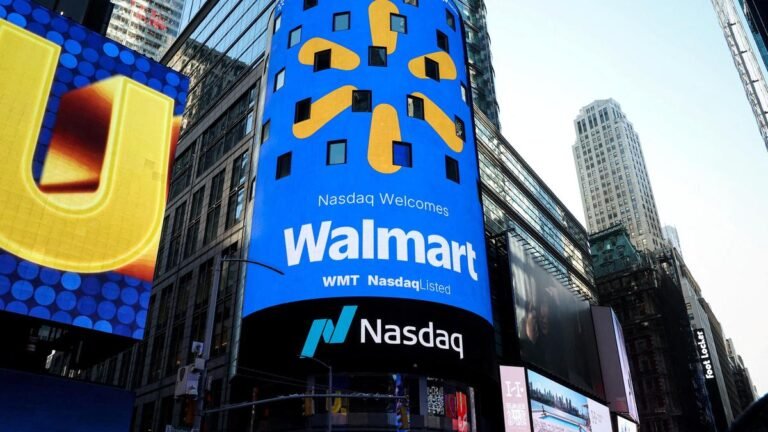
Away from technology, Walmart became the first retailer ever to hit $1 trillion in market valuation, with its shares rising 2.2%.
Among mega-cap movers, Alphabet edged up 0.1%, while Amazon dropped 2.4%.
Both the companies – members of the “Magnificent Seven” – are due to report later this week. Their results are another gauge of the race to commercialize AI and whether companies can show clearer, tangible returns on surging capital spending that can support their lofty price tags.
Advanced Micro Devices and server maker Super Micro Computer, both due to report after the close, fell over 0.5% each.
Meanwhile, Walt Disney named theme parks head Josh D’Amaro as CEO, placing a longtime insider at the helm and ending succession uncertainty. Its shares dipped 1.8%.
PayPal forecast 2026 profit below estimates, sending its shares plunging 18.4%.
At 11:12 am ET, the Dow Jones Industrial Average rose 41.07 points, or 0.08%, to 49,448.73, the S&P 500 lost 31.21 points, or 0.45%, to 6,945.23 and the Nasdaq Composite lost 240.62 points, or 1.02%, to 23,351.49.
EARNINGS DELUGE
With one quarter of the S&P 500 set to report quarterly results this week, analysts expect companies to have grown their earnings nearly 11% in the December quarter, up from an estimate of about 9% at the start of January, according to LSEG data.
Pfizer shares fell 3.6% despite posting fourth-quarter profit above estimates, while Merck rose 1.4% after quarterly results.
PepsiCo shares gained 3%, with the brand announcing a price cut on core brands such as Lay’s and Doritos.
Markets were also watching for a deal that is due to be passed by the House of Representatives later in the day to end the latest shutdown that has again thrown economic releases off schedule, delaying the closely watched January jobs report that had been due on Friday.
Tuesday’s JOLTS report has also been postponed.
Published on February 3, 2026