Things are not going so well for Russia | Russia-Ukraine war

0

The annual ritual that is the Victory Day Parade in Moscow serves a dual purpose. It reminds Russia’s citizenry and the Kremlin’s audience across the former Soviet Union of the glorious past. The muscle flexing on May 9 each year benchmarks Russia’s geopolitical fortunes.

Last year on the 80th anniversary of the Soviet triumph over Nazi Germany, Russian President Vladimir Putin was flanked by foreign dignitaries from far and wide: Chinese President Xi Jinping, Brazilian President Luiz Inacio Lula da Silva, Slovak Prime Minister Robert Fico, Serbia’s Aleksandar Vucic, Nicolas Maduro of Venezuela, Abdel Fattah el-Sisi of Egypt and Mahmoud Abbas, the head of the Palestinian Authority.

This year, the lineup was much less impressive. Leaders from Belarus, Kazakhstan, Laos, Malaysia and Uzbekistan attended – with Republika Srpska, Abkhazia and South Ossetia for some added flavour – but no heavy hitters like India or China.

The talk of Russia as a linchpin of a new multipolar world order rings a tad hollow today, not least because no heavy equipment was marched through during the parade out of fear of Ukrainian drone strikes. On top of it, United States President Donald Trump claimed credit for a three-day ceasefire between Moscow and Kyiv.

The relatively dull affair that was this year’s parade speaks volumes about Russia’s current state. On paper, everything is going just fine. Trump has not wholly abandoned the idea of a deal to freeze the war in Ukraine, even at the cost of major concessions by Kyiv. The current US National Security Strategy calls for “strategic stability” with Russia while blasting Europe’s “woke” policies.

The inconclusive war against Iran, meanwhile, has exposed the limits of US military might. Oil prices have jumped, filling Russia’s coffers and improving its fiscal balance. On top of it, Trump has removed sanctions on some Russian oil to increase the global supply. Meanwhile, the Europeans are signalling they want to talk to Moscow.

In reality, the mood is gloomy. The Russian war effort in Ukraine continues to be stalled no matter how much money, materiel and human lives the Kremlin throws into the meat grinder that is the so-called special military operation (SVO). Ukrainian drones have hit deep inside the Russian homeland with even Red Square apparently not being immune to aerial attack.

Trump has lost interest in wooing Putin. With Hungarian Prime Minister Viktor Orban gone, the European Union has consolidated ranks. In Russia itself, economic growth has plummeted from 4 percent in 2024 to a projection of just over 1 percent this year.

The prospects for long-term development, productivity growth and technological innovation are lacklustre. There are modest signs of discontent within the Russian elite. Even Putin’s sky-high popularity ratings are slightly down, according to pollsters.

The stifling of the mobile internet in Moscow and other big cities has been met with dismay. Russians could be excused for puzzling over how the SVO, sold as a glorious repeat of the 1941-1945 Great Patriotic War, has gone on longer than the latter with no end in sight. It is no wonder Putin felt compelled to say on Saturday that “the matter” is coming to an end.

While its resources are focused on Ukraine, Russia is on the back foot in what it still calls its “near abroad” too. The past week showed that Europe is gaining momentum there.

On Monday, Armenia hosted the annual summit of the European Political Community (EPC), where European leaders gathered. Ukrainian President Volodymyr Zelenskyy was in attendance too. Once Moscow’s loyal client and member of the Russia-led Collective Security Treaty Organisation and Eurasian Economic Union, Yerevan is now strengthening ties with the West.

Even if the EPC is dismissed as a pan-European talking shop – or maybe a transatlantic one, given that Mark Carney, the Canadian prime minister, came as well – observers cannot ignore the fact that it was followed by the first EU-Armenia summit.  The high-profile meeting signalled in no ambiguous terms that Yerevan sees its future in the EU. Strategically, it is looking at joining the trio of Ukraine, Moldova and Georgia.

The EU is reciprocating: The summit discussed up to 2.5 billion euros ($2.95bn) in investment in Armenia; cooperation on energy, transport and digital infrastructure; and visa liberalisation.

In parallel, both Armenia and Azerbaijan are courting the Trump administration. The two countries have welcomed the US as a peacebroker as they move closer to normalising ties. In August at the White House, Armenian Prime Minister Nikol Pashinyan and Azerbaijani President Ilham Aliyev signed a joint declaration pledging to seek peace.

In February, JD Vance became the first sitting US vice president to visit Yerevan and then hopped over to Baku. Armenians and Azeris are negotiating the opening of the Zangezur corridor running between Azerbaijan proper and its exclave Nakhchivan (from where the Aliyev family hails). The project has a name – Trump Route for International Peace and Prosperity.

In short, the US has scored a couple of points in Russia’s back yard with the help of Pashinyan and Aliyev. Moscow is watching from the sidelines as a former satellite drifts away from its embrace. And the EU but also Turkiye are to benefit because Armenia’s opening and interconnection with its neighbours favours their pro-integration agenda.

Of course, this does not mean that Armenia could simply jump ship from Russia to the West. Moscow retains stakes in the Armenian economy and, therefore, political leverage.

This will be put on display in the June general election, which will pit Pashinyan’s Civil Contract against the Armenia Alliance of former President Robert Kocharyan and Strong Armenia associated with the Russian-Armenian billionaire Samvel Karapetyan. Both Kocharyan and Karapetyan have strong connections to Moscow.

Public opinion is in favour of diversifying relations but not a complete break-up. That is a pragmatic position shared by Pashinyan too despite his focus on deepening ties with the West.

Russia failed to – or was reluctant to – support Armenia against Azerbaijan and prevent the loss of the Nagorno-Karabakh region, and Armenians are right to look for alliances elsewhere. But without a peace treaty with Azerbaijan and without full normalisation with Turkiye, one has to tread carefully and not burn bridges.

The Armenian leadership has to also factor in neighbouring Iran, with whom it enjoys positive ties. An escalation of the US-Israel war on Iran could threaten cross-border energy trade.

Putin would have loved to see Armenia and Azerbaijan attending Saturday’s parade. Ditto for Moldova, where pro-EU forces prevailed in the 2025 parliamentary elections. Or Georgia, which still has no diplomatic relations with Russia despite the rule of the authoritarian-minded Georgian Dream, a party viewed positively in the Kremlin.

The chances of those countries turning up next year are slim too. Even Kazakhstan and Uzbekistan will probably not confirm until the last minute, as they have been doing for years.

These days, Russia’s near abroad is much more abroad than near.

The views expressed in this article are the author’s own and do not necessarily reflect Al Jazeera’s editorial stance.


Source link

Timberwolves win, tie playoff series after Spurs’ Wembanyama ejected | Basketball

0

Edwards’s 36 points give Minnesota 114-109 win and tie the Western Conference semifinals 2-2 against San Antonio Spurs.

Anthony Edwards scored 16 of his 36 points in the fourth ‌quarter, and the Minnesota Timberwolves took advantage of Victor Wembanyama’s ejection to post a 114-109 win over the San Antonio Spurs.

The Timberwolves’ win on Sunday ⁠night in Minneapolis tied the Western Conference ⁠second-round series at two games apiece.

Recommended Stories

list of 4 itemsend of list

Naz Reid contributed 15 points and nine rebounds off the bench for Minnesota. He also took an elbow from Wembanyama into his chin on the play in which the Spurs star was ejected in the second quarter.

Jaden ⁠McDaniels scored 14 points, Julius Randle scored 12 and Rudy Gobert had 11 points and 13 rebounds for the Timberwolves. Ayo Dosunmu added 10 points for Minnesota.

De’Aaron Fox and reserve Dylan Harper scored 24 points each, and Stephon Castle added 20 for the Spurs. Devin Vassell tallied 14 points for San Antonio. Wembanyama ⁠had four points, four rebounds and no blocks in 12-plus minutes.

“We never expected them just to go away,” Timberwolves coach Chris Finch said. “They won a game in the Portland series without Wembanyama, so they’re very good, very good team.”

The Spurs trailed by seven before Harper made two free throws with 29.1 seconds left and Julian Champagnie hit two with 20.6 seconds remaining to bring San Antonio within 112-109.

Dosunmu answered with two free throws with 9.8 ‌seconds left as Minnesota closed it out.

“Just small-time plays,” Edwards told reporters when asked how the Timberwolves won Game 4. “Small-time plays win big-time games. That’s what we needed. Diving on the floor, offensive rebounds and it was a great sub by Finchie for putting in Ayo for that last minute and a half.”

Earlier, Wembanyama grabbed a rebound and was trying to protect the ball from two Timberwolves when he turned and unleashed a vicious right elbow into Reid’s chin and was called for a foul with 8:39 left in the first half.

The officiating crew studied views of the play before upgrading the foul to a flagrant 2, which is an automatic ejection. Crew chief Zach Zarba said, “There was wind-up, impact and follow-through above the neck ⁠of an opponent.”

“I’m glad he [Wembanyama] took matters into his own hands – not in terms of ⁠hitting Naz Reid, I want to be very clear about that,” Spurs coach Mitch Johnson said. “I’m glad Naz Reid is OK, and I didn’t want him to elbow him. But [Wembanyama’s] going to have to protect himself if no one else does it for him. And I think it’s disgusting.”

Minnesota led 60-56 at the break. Edwards scored 18 in the half while Castle led San Antonio with 14 ⁠first-half points.

Despite the loss of Wembanyama, the Spurs scored 20 of the first 28 points in the third quarter and led 76-68 after a basket by Vassell with 4:33 left in the period.

“I thought, offensively, we were really doing ⁠a lot of good things,” Finch said. “We lost our way a little bit and gave them ⁠life.”

San Antonio’s Keldon Johnson drove for a hoop with 21.9 seconds remaining for an 84-80 advantage entering the final stanza.

Fox buried a three-pointer to give San Antonio a 94-86 lead with 8:51 left in the contest before Edwards scored 12 points during the Timberwolves’ 14-5 run.

“We had a chance to win,” Johnson said. “We didn’t close it out the way we wanted to. … Minnesota made ‌some plays and finished the game.”

Edwards started the burst with a jumper, and he soon scored five consecutive points on a short floater and a long straightaway three-pointer to cut the Minnesota deficit to three with 7:10 remaining. He later canned two free throws with 5:51 left to bring the Timberwolves within ‌97-95 ‌before drilling a three-pointer 39 seconds later to give Minnesota a one-point edge.

Gobert later delivered a thunderous dunk to give the Timberwolves a 107-101 lead with 1:56 to play.

Minnesota shot 44.7 percent from the field, including 10 of 27 from three-point range, while the Spurs made 47.7 percent of their attempts and hit just six of 26 from behind the arc.

Game 5 is on Tuesday in San Antonio.


Source link

Access Denied

0

Access Denied You don’t have permission to access “http://hindi.gadgets360.com/electric-vehicle/elon-musks-tesla-stops-manufacturing-of-model-s-and-model-x-in-us-news-11477671” on this server.

Reference #18.480dde17.1778483316.313adb3b

https://errors.edgesuite.net/18.480dde17.1778483316.313adb3b

Urban Company shares slump 11% after Q4 loss widens on InstaHelp investments

0

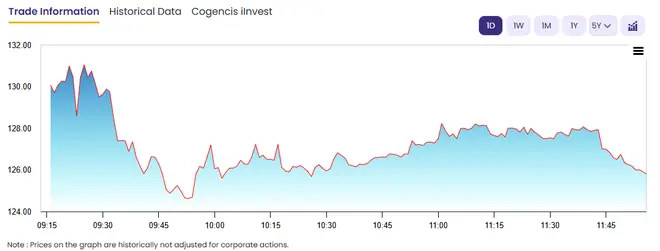
Urban Company shares tumbled 11 per cent on Monday after the company reported a sharp widening in March quarter losses due to continued investments in its quick-service platform InstaHelp.

At 12 noon, the stock traded at ₹125.97 on the NSEhitting a low of ₹124.40 from the previous close of ₹139.67.

Urban Company shares in focus

Urban Company shares in focus

The company posted a consolidated net loss of ₹161 crore for Q4FY26 compared with a loss of ₹2.84 crore in the corresponding quarter last year, primarily due to higher spending on expanding InstaHelp and strengthening its instant services business.

Despite the sharp increase in losses, brokerages remained constructive on the company’s long-term growth prospects, while cautioning that investments and competitive intensity in instant services could keep profitability under pressure in the near term.

Global brokerage Goldman Sachs maintained a neutral rating on the stock and marginally raised its target price to ₹140 from ₹139. The brokerage said the company delivered another strong quarter with broad-based growth acceleration across businesses. Goldman Sachs highlighted that India core services and the international business witnessed strong momentum, while operating leverage improved with expansion in India core EBITDA margins. However, the brokerage noted that overall EBITDA materially missed estimates due to elevated investments in InstaHelp.

The brokerage also sharply cut its long-term EBITDA estimates due to expectations of sustained losses in the instant services segment, although it said Urban Company continues to possess strong competitive moats.

Morgan Stanley maintained an overweight rating and raised its target price to ₹128 from ₹120. The brokerage said the company’s execution remained strong and noted that its market position in home services had become even stronger.

However, Morgan Stanley cautioned that the battle in the instant services market was intensifying amid aggressive capital raising by private competitors, which could result in elevated investments persisting for longer than expected.

Domestic brokerage Motilal Oswal initiated coverage on Urban Company with a neutral rating and a target price of ₹125. The brokerage said the company is well positioned to benefit from the gradual formalization of India’s fragmented home services market, supported by its nearly 70 per cent share in online home services and strong execution across micro-markets.

Motilal expects India consumer services net transaction value to grow at around 17 per cent CAGR over FY25-37 and sees EBITDA margins improving through operating leverage and higher user retention. However, it said current valuations already factor in much of the growth potential, while risks around competition, disintermediation and slower habit formation remain.

JM Financial maintained a reduce rating with a March 2027 target price of ₹130. The brokerage said that while management retained guidance for consolidated adjusted EBITDA breakeven by Q3FY28 and ₹10 billion adjusted EBITDA by FY31, investors may prefer to wait for better entry levels amid uncertainty around InstaHelp and an unfavorable near-term risk-reward profile.

Published on May 11, 2026

India-Bangladesh Relations: India or China? Bangladesh with whom? Humayun Kabir, close to Tariq Rehman, made a big announcement

0

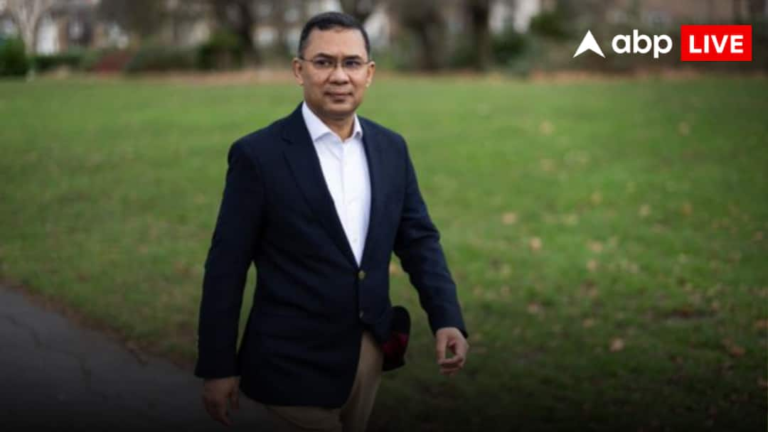
The Bangladesh government has given clear indications that it wants to maintain balance in its foreign policy and will not show inclination in favor of either India or China. Humayun Kabir, advisor on foreign affairs to Bangladesh Prime Minister Tariq Rahman, has said that Bangladesh will not become a football between China and India.

In a round table conference held in Dhaka, Humayun Kabir said that the foreign policy of the present government will be based on practical thinking, balance and national interests. He said that Bangladesh wants to maintain good and constructive relations with all major global powers.

Also read: ‘Trump’s entire tenure is a therapy session’, Iranian embassy taunts after rejecting Tehran’s new proposal

Bangladesh on relations with India and China

According to the report of The Business Standard, Kabir said that the government does not want to depend on any one country. Instead it will adopt a multi-pronged diplomatic policy. Regarding relations with India and China, he said that Bangladesh will maintain balanced relations with both the countries and will give priority to its national interests in every decision. He said that whether it is Washington, Beijing or New Delhi, Bangladesh wants to maintain balanced relations with all. Humayun Kabir described China as an important development partner of Bangladesh. He said that his recent visit to Beijing was very positive. Regarding Prime Minister Tariq Rahman’s “Bangladesh First” policy, he said that it does not mean separatism, but keeping the country’s sovereignty, development and national interests at the top.

Bangladesh’s opinion regarding Indo-Pacific region

Humayun Kabir said that foreign policy cannot be run only on the basis of idealistic slogans, but good behavior is also necessary in it. Regarding the Indo-Pacific region, he said that Bangladesh supports an open, cooperative and inclusive regional framework. He said Bangladesh will not support any one side in any global rivalry, but will actively participate in initiatives related to trade, connectivity, maritime security and sustainable development.

Also read: Shashi Tharoor On SIR: How did the bumper victory happen in Bengal? Shashi Tharoor told the reason why both Rahul Gandhi and Mamata Banerjee will be happy!

Titan shares crash 8% after PM Modi’s gold remark

0

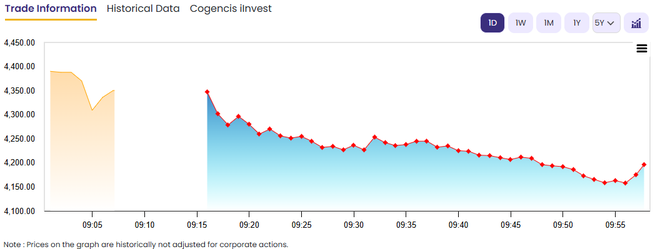
Titan Company shares fell 8 per cent in early trade on Monday after Prime Minister Narendra Modi urged citizens to avoid non-essential gold purchases for one year to help reduce pressure from forex outflows amid West Asia war, dampening sentiment around jewelery stocks despite Titan reporting a strong rise in fourth-quarter earnings.

The stock hit an intraday low of ₹4,150.10, down 7.9 per cent, from the previous close of ₹4,509. In the previous trading session, the stock scaled to a 52-week high of ₹4,605.

Titan shares lead Nifty 50 losers

Titan shares lead Nifty 50 losers

Titan posted a 35 per cent yoy rise in consolidated net profit at ₹1,179 crore for Q4FY26 compared with ₹871 crore in the year-ago period, aided by robust growth in its jewelery business and continued momentum across watches and wearables.

The company’s domestic jewelery business delivered healthy profitability, with EBIT margin at 11.1 per cent, ahead of investor expectations of 10.5-11 per cent. Within the domestic jewelery segment, Tanishq, Mia and Zoya reported EBIT margin of 11.3 per cent, while CaratLane margin stood at 8.3 per cent.

Domestic jewelery EBIT rose 41 per cent yoy, driven by strong buyer growth and higher gold prices. Consolidated jewelery EBIT margin, however, declined 100 basis points yoy to 10 per cent due to losses in the international business amid disruption in Middle East operations and consolidation of Damas financials from Q4FY26.

Management said the international jewelery business could return to positive margins within the next two to three quarters.

CLSA maintained an outperform rating with a target price of ₹5,249 and said standalone sales growth of 78 per cent yoy was led largely by average transaction value increases, while buyer growth returned to 8 per cent yoy. The brokerage added that India jewelery margin remained strong despite elevated gold prices and a lower studded jewelery mix.

Citi retained a neutral rating with a target price of ₹5,075 and noted that standalone jewelery revenue growth excluding bullion was ahead of estimates at 45 per cent yoy. However, jewelery margins contracted 135 basis points yoy to 10.5 per cent. The brokerage cautioned that sustained high gold prices may have led to preponement of consumer demand, making FY27 growth trends critical for valuations.

Goldman Sachs reiterated its buy rating with a target price of ₹5,400 and highlighted that domestic jewelery EBIT margin exceeded investor expectations. The brokerage said domestic jewelery EBIT growth remained healthy at 41 per cent yoy and noted that overseas margins were impacted by Middle East disruptions and Damas consolidation.

JP Morgan has upgraded the stock from neutral to overweight, setting the target price of 5,400.

BofA Securities maintained a buy rating with a target price of ₹4,830 and said Titan’s underlying earnings trajectory remained steady, with adjusted jewelery EBIT growth of 35 per cent yoy. The brokerage remained constructive on the company’s medium-term outlook, citing multiple levers to sustain 15-20 per cent revenue and earnings CAGR.

Jefferies retained a buy rating with a target price of ₹4,800 and said jewelery business revenue growth remained strong, supported by higher gold prices and a rebound in buyer growth. The brokerage added that watches also delivered a strong quarter, although overall EBITDA was marginally below expectations due to higher staff cost provisions.

Published on May 11, 2026

Access Denied

0

Access Denied You don’t have permission to access “http://hindi.news18.com/news/ajab-gajab/off-beat-plus-size-influencer-alex-aspasia-blames-ozempic-and-plastic-surgery-for-lack-of-recognition-of-natural-female-bodies-facts-10464680.html” on this server.

Reference #18.94adc17.1778482613.c6d0331

https://errors.edgesuite.net/18.94adc17.1778482613.c6d0331

Sovereign cloud is only possible if you’re Chinese or American: Gartner

0


Off-Prem

Which is awkward for European orgs who fear US clouds might leave the continent

It’s not possible to operate a completely sovereign cloud outside of China or the USA, according to Douglas Toombs, a VP analyst at Gartner.

Speaking at the analyst firm’s IT Infrastructure, Operations & Cloud Strategies Conference in Sydney today, Toombs said only the US and China make all the tech needed for a sovereign cloud. Buyers elsewhere can’t avoid relationships with foreign providers.

Toombs said that while US-based cloud vendors have created products they say can meet the needs of organizations that need a cloud that doesn’t have legal entanglements outside their chosen jurisdiction, the fact they’re ultimately owned by American corporations means it’s not possible to be certain a cloud provider can promise complete sovereignty.

Even on-prem clouds like AWS Outposts, Azure Local, or Oracle’s Dedicated Cloud Regions, “need to phone home,” he said.

The analyst doesn’t think attempts to create sovereign clouds will succeed. He mentioned past French attempts to create sovereign clouds named “Andromeda”, “Numergy,” and “Gaia-X”, which he says went nowhere – but did produce some nice white papers.

He also cited the The Rule of Three and Four, a maxim developed by Boston Consulting Group that asserts “A stable competitive market never has more than three significant competitors, the largest of which has no more than four times the market share of the smallest,” and argued that it predicts the cloud market has settled around AWS, Google, and Microsoft.

Toombs allowed that some smaller clouds could thrive and will make it feasible to create sovereign SaaS providers and products.

But he thinks that even aggressive moves to go on-prem won’t free organizations from dependency on US-owned clouds, an assertion he backed with the example of a Dutch healthcare provider that tried to build its own infrastructure but then experienced an outage when a supplier’s services went down along with a major cloud provider.

If sovereign clouds fail to develop, it may be problematic because some European organizations are worried US-based cloud operators might leave the continent, forcing them into hasty and risky migration projects, according to Adrian Wong, a Gartner Director Analyst who also spoke in Sydney today.

Wong said “heightened geopolitical tensions” are causing customers of major clouds to rethink their strategies, a decision he welcomes because he sees very few organizations bother to develop a cloud exit strategy.

“Exit plans are overlooked,” he said, and users are “very much locked in” – especially when they use cloud-native services or platform-as-a-service.

“Exiting within a timeframe of anything less than two years takes significant planning and investment,” he warned. “Exit strategies and plans are largely swept under the rug.”

Wong says he is now seeing “the pendulum swing.”

Not developing a cloud exit strategy is one of the ten big mistakes Wong sees users make. Also on his list are starting use of clouds with mission-critical and complex applications like ERP, assuming the cloud is appropriate for all applications, and expecting to get all the benefits of the cloud with every application.

He also said it’s folly to assume that going multi-cloud will improve availability – unless users first tackle the more complex and expensive task of making applications portable. Wong said organizations that use multiple clouds should do so to access specific features of each, not to improve resilience. ®


Source link

Access Denied

0

Access Denied You don’t have permission to access “http://hindi.news18.com/cricket/bhuvneshwar-kumar-created-history-becomes-oldest-indian-pacer-to-take-four-wicket-haul-against-mi-for-rcb-emulated-glenn-mcgrath-rare-feat-10464585.html” on this server.

Reference #18.490dde17.1778482310.31dfbdd8

https://errors.edgesuite.net/18.490dde17.1778482310.31dfbdd8

Access Denied

0

Access Denied You don’t have permission to access “http://hindi.gadgets360.com/home-entertainment/huawei-smart-screen-s7-miniled-tv-series-launched-98-inch-display-144hz-display-camera-specs-details-news-11477606” on this server.

Reference #18.4d560e17.1778481935.120d23eb

https://errors.edgesuite.net/18.4d560e17.1778481935.120d23eb