SAN FRANCISCO – The United States’ 250th birthday is a yearlong party, and the sports world is right at the center of it.
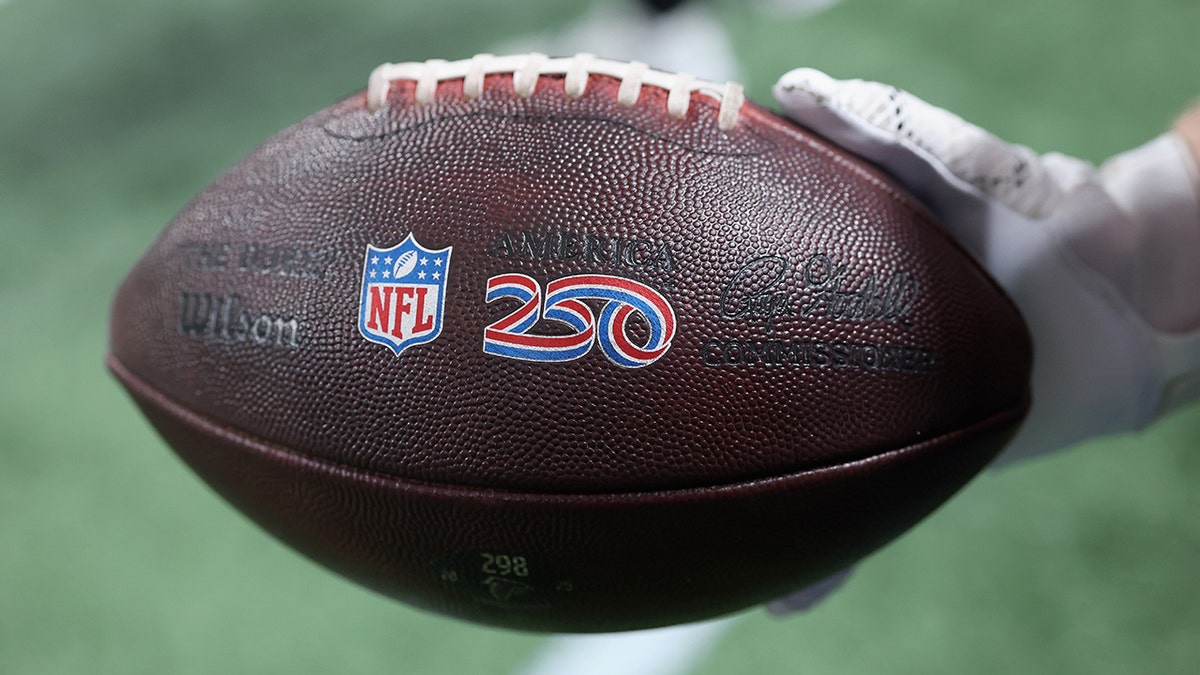
America250 and the NFL announced a partnership in November in which the America250 logo will be featured on footballs and fields beginning in Week 18 through the playoffs.
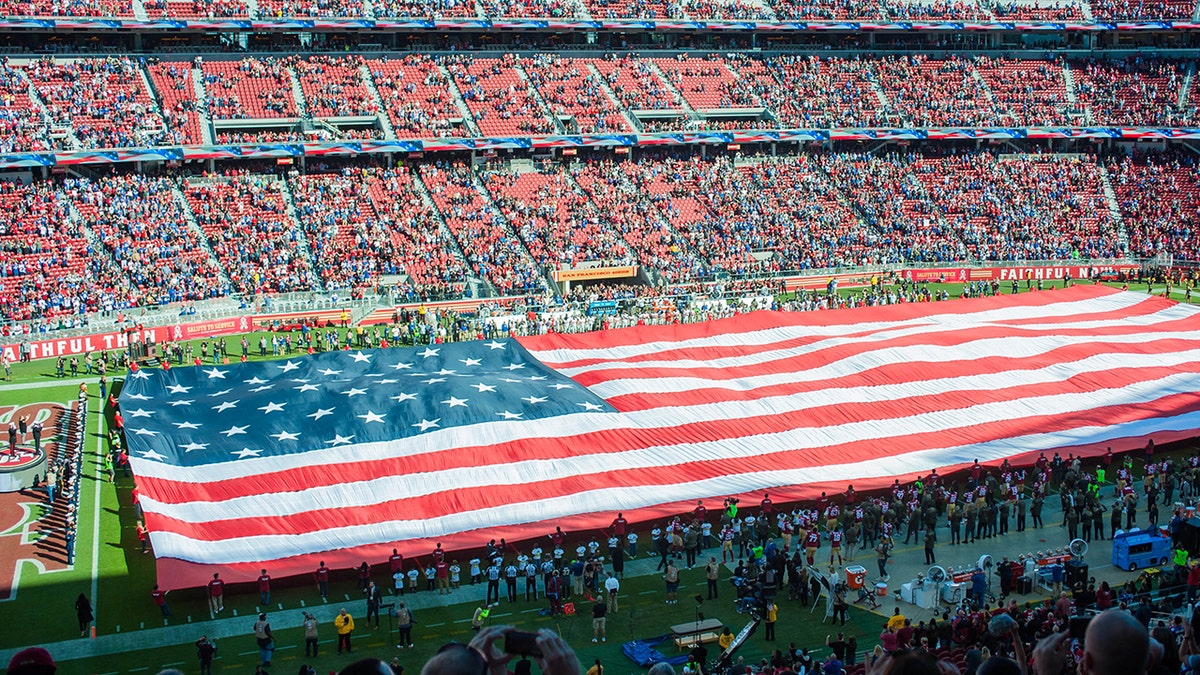
An American Flag is on the field prior to the regular season game between the San Francisco 49ers and the New York Giants on Nov. 12, 2017 at Levi’s Stadium in Santa Clara, California.(Samuel Stringer/Icon Sportswire via Getty Images)
“What better way to think about our country’s biggest milestone than being at our country’s biggest sporting event?” America250 chair Rosie Rios said to Fox News in San Francisco on Radio Row.
Fans will be part of an interactive experience before kickoff, where the America250 logo will appear in the stands, which will be filled in red, white and blue thanks to panels given to each fan in attendance, making for a picture-perfect patriotic scene that all will see on television.
For Rios, the celebration hits home — quite literally — as a Bay Area native. But as a mom of an athlete, Rios knows that sports are “a big part of American culture,” making America250’s involvement in the sports world inevitable.
“My kids are still big athletes, and I think for all of us, whether it’s football, whether it’s basketball, we know the eyes of the world are going to be watching what happens in the U.S. with the World Cup and then two short years later, with the Olympics,” Rios said. “While we’re not the world, but the world is us, and that comes with this responsibility of working closely to make sure that all 350 million Americans are engaged in this effort.”
A football with text that reads “America 250” is displayed for the camera during the game between the New Orleans Saints and Atlanta Falcons at Mercedes-Benz Stadium on Jan. 4, 2026 in Atlanta, Georgia. (Kevin C. Cox/Getty Images)
“To think this is all happening in Levi’s Stadium is so important, because this is my home. I was born and raised in the East Bay, I still live in the East Bay, so to come back home for the Super Bowl, it’s like winning the lottery,” Rios continued. “So to have the eyes of the world watching what happens at the Super Bowl, America250 will be front and center, we’ll be on the sidelines, we’ll have our flags flying as part of the flyover, we’ll have a very special interactive fan experience at the stadium that everyone’s going to get to see. For someone whose parents came to this great country in 1958, I am the American Dream, my kids are the American Dream, and to think this is all happening in the place where I was born and raised, it doesn’t get any better.”
President Donald Trump has not been shy about his love for sports, attending numerous events even during his presidency, including last year’s Super Bowl. Last year, he attended the FIFA Club World Cup, a New York Yankees game, the Ryder Cup, a Washington Commanders game, and others.
A general view of the America 250 logo on the sideline prior to an NFL football game between the Chicago Bears and Detroit Lions at Solider Field on Jan. 4, 2026, in Chicago, Illinois. (Todd Rosenberg/Getty Images)
“You’ll hear President Trump talk about it all the time, his role in the World Cup, his role in the Olympics, his role with America250, he is absolutely all in. We represent all three branches of government, I’m appointed by the president, and it is a great honor to serve my country in this way,” Rios said of Trump.
Questioned to Daddu – Which Berry do you like? Got such an answer, the boy got shocked after hearing it.
These days, videos of personal questions to people are being shared a lot on social media. In these questions, sometimes personal life and sometimes personal choices are asked. In this episode, a person had asked the elderly man about his favorite berry. But the answer he got was something he had never imagined. As soon as the man asked the old man which berry he liked the most, the man replied in a loud voice – Robbery. The boy got shocked after hearing this answer. As soon as the video was shared, it went viral. People enjoyed it a lot.
To add News18 as your favorite news source on Google click here Do it.
The Nifty IT index plunged nearly 6%, its steepest single-day fall in six years.
Markets closed marginally higher on Wednesday as a sharp selloff in information technology stocks, triggered by fears of artificial intelligence disrupting traditional software business models, offset gains in oil & gas and consumer-facing sectors, with the BSE Sensex rising 78.56 points or 0.09 per cent to close at 83,817.69 and the NSE Nifty adding 27 points or 0.10 per cent to settle at 25,754.55.
The Nifty IT index plunged nearly 6 per cent, its steepest single-day fall in six years, after US-based AI start-up Anthropic unveiled major upgrades to its Claude AI chatbot, including an end-to-end workflow automation productivity tool for legal services. “The selloff in the IT index was due to concerns that AI was creating more competition for software makers, after US AI-based Anthropic’s launch of a legal tool for its Claude AI chatbot,” said Sudeep Shah, Head – Technical and Derivatives Research at SBI Securities.
Infosys led the losers on the Nifty 50, crashing 7.37 per cent to ₹1,534.00, followed by TCS which tumbled 6.99 per cent to ₹2,999.90. HCL Tech declined 4.58 per cent to ₹1,617.60, Tech Mahindra fell 4.52 per cent to ₹1,639.00, and wipro dropped 3.79 per cent to ₹233.50. “While Oil & Gas, consumer durables, metals and automobile stocks recorded strong gains, IT stocks faced sharp selling pressure, tracking weakness in global technology shares. Sentiment in the sector deteriorated after AI start-up Anthropic unveiled an end-to-end workflow automation productivity tool, rekindling concerns that rapid advances in AI could disrupt traditional software business models and weigh on industry-wide profitability,” said Ponmudi R, CEO of Enrich Money.
On the gainers’ side, Trent surged 5.18 per cent to ₹4,021.00, eternal jumped 4.90 per cent to ₹293.50, ONGC advanced 3.50 per cent to ₹266.00, NTPC rose 2.30 per cent to ₹366.80, and Adani Ports gained 2.25 per cent to ₹1,565.20. Consumer Durables, Oil & Gas, and Metals indices led sectoral gains, each rising over 2 per cent, while the Nifty IT index’s 6 per cent decline made it the worst-performing sector. “Today, the benchmark indices witnessed narrow-range activity. The Nifty ended 48 points higher, while the Sensex was up by 79 points. Among sectors, the Consumer, Oil, and Gas indices rallied over 2 per cent, whereas the IT index corrected sharply, shedding nearly 6 per cent,” said Shrikant Chouhan, Head Equity Research at Kotak Securities.
Broader markets significantly outperformed the benchmark indices, with the Nifty Midcap 100 rising 0.63 per cent to 59,683.60 and the Nifty Smallcap 100 surging 1.27 per cent to 17,205.10. Market breadth remained firmly positive for the second consecutive session, with 2,726 stocks advancing against 1,477 declines on the BSE, reflecting an advance-decline ratio of 1.82. “Market breadth remained firmly positive, supported by a sustained rebound in midcap and smallcap stocks,” said Ajit Mishra, SVP Research at Religare Broking.
The Indian rupee snapped its two-day winning streakdepreciating 18 paise to close at 90.44 against the US dollar, weighed down by soft regional peers and rebounding commodity prices. “The Indian rupee’s two-day winning streak snapped today, weighed down by soft regional peers and a rebound in commodity prices. Market activity remained subdued as the focus shifts to Friday’s RBI interest rate announcement,” said Dilip Parmar, Research Analyst at HDFC Securities.
In commodities, spot gold extended gains for a second consecutive session, surging above $5,050 per ounce after aggressive dip-buying following last week’s brutal selloff. “Spot gold extended gains for a second consecutive session today, surging above $5,050/oz after rebounding sharply from lows below $4,500/oz hit last week,” said Kaynat Chainwala, AVP Commodity Research at Kotak Securities. WTI crude oil held above $64 per barrel after a massive 11 million-barrel inventory draw reported by the API raised expectations of a similar draw in upcoming EIA data.
Looking ahead, analysts expect the market to trade in a consolidation phase, with the Nifty’s immediate resistance placed at 25,800-25,850 levels and support at 25,600-25,500 zone. “After the recent sharp swings, some consolidation would be healthy as long as the Nifty holds the 25,400–25,500 zone. On the upside, the index may attempt a move towards the 26,000 level, followed by a gradual push towards record highs,” said Mishra. Market participants will closely monitor Friday’s RBI monetary policy decision and US jobs report for further directional cues.
Access Denied
You don’t have permission to access “http://hindi.gadgets360.com/ai/ai-in-hiring-bias-more-common-than-recruiters-admit-belgium-research-shows-news-10945504” on this server.
Goma, Democratic Republic of the Congo – In cities in the mineral-rich eastern Democratic Republic of the Congo (DRC), home to some of the world’s largest cobalt and copper reserves, eyes are on the outcome of a meeting happening thousands of kilometres away.
In Washington, DC, on Wednesday, United States Secretary of State Marco Rubio will host the inaugural Critical Minerals Ministerial, where delegations from 50 countries including the DRC will discuss efforts to strengthen and diversify mineral supply chains as the US seeks to counter China’s global dominance in the sector.
Recommended Stories
list of 3 itemsend of list
As part of a “resources-for-security” type deal agreed last year, the US signed a mining agreement with Kinshasa’s government to secure supplies of components essential to its technological innovation, economic power, and national security.
While Congolese President Felix Tshisekedi has touted the economic benefits of the endeavour, many in the country’s mining epicentre – trapped between poverty and armed violence – see only further oppression on the horizon.
“We are exploited in mineral extraction,” said Gerard Buunda, an economics student in Goma, the capital of North Kivu province, which is a significant source of the world’s coltan, tin and gold resouces. “There are investors who make us work; sometimes they chase us off our land and force us to work for them in their mines for their own selfish interests.
“We don’t want to be exploited any more.”
Buunda, 28, who was born not far from the mineral-rich city of Rubaya, condemns what he says are foreign multinationals exposing people to poverty and low wages, child exploitation, and environmental degradation – putting Congolese lives at risk.
He fears that the Donald Trump administration’s voracity for critical minerals could heighten socio-political instability in many parts of the world.
“Here in eastern DRC, the people who finance mineral exploitation, when they find new mines, buy land from local communities in collusion with our leaders and displace them, and this is the root cause of insecurity,” said Buunda.
He called on African leaders, especially those in the DRC, to avoid being “the fall guys” and instead keep an eye on the future of their own rare earths.
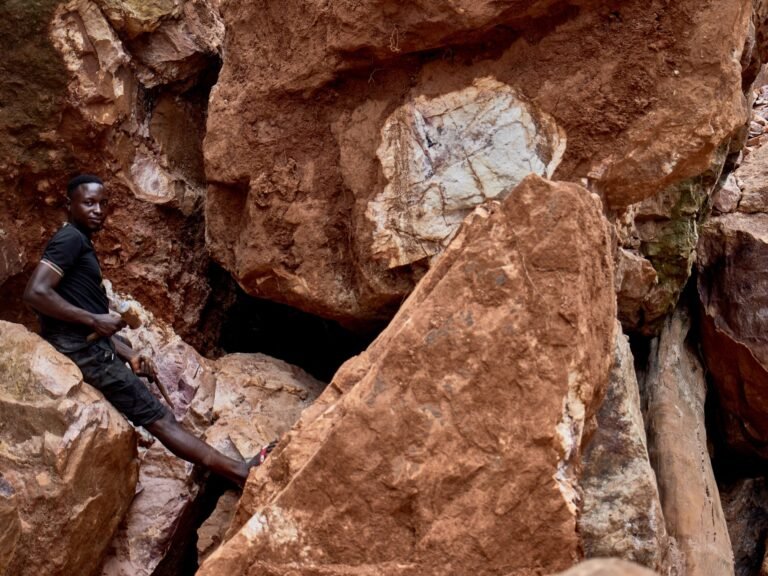
A miner holds newly extracted coltan ore in Rubaya, the Democratic Republic of the Congo [File: Moses Sawasawa/AP]
‘They said: please come and take our minerals’
With large deposits of cobalt and lithium – which are essential for electric vehicle batteries and renewable technologies – the Congolese authorities are promoting the DRC as a solution for the energy transition.
The US has shown interest, including directly linking security guarantees to resource extraction when it mediated the signing of a peace deal between conflict-prone neighbours DRC and Rwanda last year.
“I actually stopped the war with Congo and Rwanda,” Trump claimed in December. “And they said to me, ‘Please, please, we would love you to come and take our minerals.’ Which we’ll do.”
Koko Buroko Gloire, a Congolese international affairs commentator based in Kenya, doubts the DRC will gain anything solid from the deal with the US. The market for critical minerals, he believes, is attracting the “covetousness” of major world powers who are lining up for an “increasingly geopolitical” battle.
But at the end of the day, for the DRC, Koko says the benefits – or lack of them – will depend on the will of the Congolese leadership.
“If this deal will allow us, the Congolese people, to have roads from point A to point B, to have clean water, to have hospitals, to have water, I think it’s a good deal,” he told Al Jazeera, urging Congolese leaders to make sure the DRC does not come out empty-handed.
Before Trump came to office, former US President Joe Biden visited the region, in part to discuss the Lobito Corridor railway infrastructure project, which is currently in disrepair in DRC but will connect the country’s mining provinces to Angola, along the Atlantic Coast – a key port for the export of minerals from Africa to the US.
According to satellite image analysis carried out by Global Witness, up to 6,500 people could be affected by displacement linked to the development of the Lobito corridor in the DRC.
The campaign group said it conducted interviews with different social groups last year in DRC’s Kolwezi, and also visited the railway tracks that will be cleared during the rehabilitation.
It said it had found that the railway line runs through vulnerable communities that have benefitted little from the mining boom in Kolwezi, highlighting a “complex” legal situation where the status of houses and buildings along the railway line was disputed, as was the size of the area to be cleared.
For Global Witness, the Lobito corridor will be a “litmus test” for Western partners who claim that the project represents a more equitable model for resource exploitation.
Miners work at the D4 Gakombe coltan mining quarry in Rubaya, DRC [File: Moses Sawasawa/AP]
Local communities ‘negatively’ affected
Gentil Mulume, 35, is an activist in Goma, working on matters of transparency and good governance. He emphasises that the Washington meeting is not a dinner party but a call to demonstrate seriousness, particularly with regard to compliance with environmental standards, transparency in mining governance, and industrialisation.
He believes the importance of a mining agreement between the DRC and the US cannot be assessed solely in terms of its geopolitical or international economic significance.
“This type of agreement risks continuing structurally unbalanced partnerships in which the DRC remains a mere supplier of strategic raw materials for the benefit of Western powers,” he suggests.
John Katikomo, a Congolese environmental activist, says the foundations for a fair partnership between the DRC and the US are already off to a bad start, as the deal is “opaque” and authorities in Kinshasa have not disclosed details to citizens.
“Many people are misinformed, and there is poor distribution of resources in relation to these critical minerals. Will the population benefit from this?” he asked.
For Kuda Manjonjo, a Just Transition adviser with PowerShift Africa, a think tank based in Kenya, Africa holds a disproportionate share of the critical minerals essential to the energy transition, but remains marginalised in global value chains.
“This disparity reflects an unfair exploitation model that hinders local development,” he said, stressing the importance of rebalancing the situation, calling for fairer governance, local investment in mineral processing and transformation, and better African representation in strategic decisions on these resources.
Another resident of Goma, Daniel Mukamba, accused many multinationals of seeking to keep countries that are rich in natural resources burdened by the “resource curse” – which he believes becomes a “cancer” that is difficult to cure.
“If you look at the examples of Walikale and Rubaya, these are cities that produce a lot of minerals, including coltan, gold, cassiterite, and tourmaline, but the population remains poor,” Mukamba told Al Jazeera.
Both these resource-rich eastern cities are now held by the Rwanda-backed M23 rebel group, which seized control of much of the east of the country last year.
A January report published by the Global Initiative Against Transnational Organized Crime indicates that in South Kivu province in the east, opaque gold supply chains continue to be linked to conflict, human rights violations, and environmental damage.
US President Donald Trump shakes hands with President of the Democratic Republic of the Congo Felix Tshisekedi during a signing ceremony at the United States Institute of Peace in Washington, DC, December 4, 2025 [Kevin Lamarque/Reuters]
War means illegal exploitation of resources
Despite the US-brokered peace deal between DRC and Rwanda and a separate one brokered by Qatar between DRC and the M23 rebel alliance, fighting continues in eastern DRC and has approached regions rich in critical minerals.
In December, M23 seized the city of Uvira, some 300km (190 miles) from the lithium-rich province of Tanganyika. Although they have since withdrawn, several observers say there are clashes not far from Tanganyika province.
Many fear that increasing fighting could cause the risk of “uncoordinated” exploitation of mineral resources and are calling for a rapid resolution to the conflict.
“When there is war, there is illegal exploitation of our minerals,” said Chirac Issa, an environmental activist based in Tanganyika province. “There is no government order to regulate the work of miners. From an environmental standpoint, we fear that uncontrolled mining could contribute to pollution and endanger ecosystems.”
After the “resources-for-security” US-brokered deal with Rwanda was first reached in June, Congolese President Tshisekedi was optimistic about it, saying it aimed to “promote our strategic minerals, particularly copper, cobalt, and lithium, in a sovereign manner”, while “ensuring a more equitable distribution of economic benefits for the Congolese people”.
He also said it would “pave the way for local transformation, the creation of thousands of jobs, and a new economic model based on sovereignty and national added value”.
Corneille Nangaa, leader of the Alliance Fleuve Congo (AFC) allied with the M23 – which now administers the capitals of North and South Kivu provinces – however, called the mining partnership between the DRC and the US “deeply flawed and unconstitutional”. He said the plan suffers from a lack of transparency and last week criticised the “opacity surrounding the negotiations”. At a news conference in August, he also denounced the “sell-off” of the DRC’s natural resources.
Tshisekedi said last year that “the resources of the Democratic Republic of Congo will never be sold off or handed over to obscure interests,” and that the country “will sell neither its future nor its dignity”.
DRC’s resources, he affirmed, “will benefit the Congolese people above all”.
But for those same Congolese in Goma – watching this week as foreign officials in suits discuss plans for their resources at a formal event thousands of kilometres away – the future is not as secure as their president might believe.
‘Didi-Jija’ did a funny dance on the stage, won everyone’s heart, people said – ‘Relatives are not jealous!’
Often people also arrange for couple dance in marriage ceremonies. Some couple in the house, sister-brother-in-law, brother-sister-in-law, aunt-uncle dance together and win everyone’s heart. A few months ago, a video of one such couple was posted which is viral even today. A video posted on Instagram account @shivsingh_10 is becoming increasingly viral in which a couple is dancing on the stage. Perhaps this is a video taken during the Haldi and Mehndi ceremony. In this video, the couple is dancing with each other very lovingly, in which nothing looks vulgar or objectionable. For this reason people are liking this video very much. Many people even said that they must be the sister-in-law of that house, that is why they danced so comfortably. But seeing their love, many people also said that other relatives must have got jealous after seeing them. This video has received more than 2 crore views. (Note: If the user has any objection to the use of this video, he can contact News18 Hindi for its removal.)
To add News18 as your favorite news source on Google click here Do it.
Girls created havoc in college, danced vigorously on Guru Randhawa’s song, other students kept watching!
Nowadays, videos of college functions go viral on social media. In these, boys and girls are often seen dancing and singing. Recently, one such video is going viral which is of a college in Mangaluru, Karnataka. The name of the college is St. Aloysius PU College. In the video, two girls are dancing on Guru Randhawa’s song ‘Teri Ankh Katal’. His moves are so amazing that people are not able to live without praising him. The rest of the college students are watching him carefully. (Note: If the user has any objection to the use of this video, he can contact News18 Hindi for its removal.)
To add News18 as your favorite news source on Google click here Do it.
Boys came out on the road with bikes, started waving at high speed, then after seeing what happened, people said – felt very good!
Whenever boys go out to ride bikes on the road, they feel that the entire road belongs to them. Because of this, he moves at high speed, waving the car. Then they do not even think that because of them someone else may suffer. Recently, a video is going viral in which due to this action of the boys, their lives were in danger. This video has got 3 lakh views and it has been posted on @paavtyabois Instagram account. In the video, the boys are waving the car here and there. Suddenly the car swings and they fall down. People commented and said that they felt very good to see this because these boys deserved this. (Note: If the user has any objection to the use of this video, he can contact News18 Hindi for its removal.)
To add News18 as your favorite news source on Google click here Do it.
The FTSE-100 oil giant Shell is close to unveiling a revamped boardroom pay policy which would see its boss handed a multimillion-pound annual pay incentive.
Sky News has learnt that Shell has concluded a consultation with its largest shareholders which could result in Wael Sawan, chief executive, earning at least £4.5m more every year.
Investor sources said that Shell, which will report fourth-quarter and full-year results on Thursday, had drawn up plans to grant Mr Sawan a long-term incentive stock award worth up to nine times his base salary of £1.535m.
That would be a 50pc increase on the current remuneration policy, under which the Shell chief is eligible for an LTIP award of up to six times his salary.
Although the target award is significantly lower, in years of significant outperformance, it would mean Mr Sawan being handed an annual long-term stock award worth £13.815m – assuming his salary remains fixed at the current level.
In addition to an annual bonus worth up to £3.837m, or 250pc of his salary, that would make his total pay package, excluding pension contributions, worth up to £19.2m.
More on Royal Dutch Shell
That would continue to rank among the largest such pay deals for a FTSE-100, although as a constant fixture among the London stock market’s biggest companies, institutional shareholders are generally said to have expressed support for the move.
One said they backed the Shell board’s move so long as there was “clear evidence of pay for performance”.
Shell’s pay policy revamp comes during a period when FTSE-100 boards are seeking permission to elevate their CEOs’ pay amid concerns that they risk losing executives to US-based rivals.
There have also been a string of companies, led by the gambling group Flutter Entertainment, which have shifted their primary listings to New York with the objective of attaining a higher valuation.
This week, shares in AstraZeneca, the drugs giant, began trading in the US.
Sky News recently revealed plans drawn up by Rolls-Royce to significantly increase chief executive Tufan Erginbilgic’s potential pay package after overseeing a stellar turnaround of the aircraft engine maker.
Shell has a market value of just over £158bn, which is still significantly smaller than American peers ExxonMobil and Chevron.
Last year, Mr Sawan was paid £8.6m, while chief financial officer Sinead Gorman received a package worth £7.25m.
On Wednesday, Shell’s London-listed shares were trading at around 2833p.
They are up about 6pc over the last year.
In June, the company denied a Wall Street Journal report that it was in talks to buy troubled British rival BP, with Mr Sawan having said he saw greater value in buying back his own company’s stock.
In response to an enquiry from Sky News, a Shell spokesperson said: “Every three years, Shell seeks shareholder approval for a new Executive Director remuneration policy as a standard part of regulations for UK-listed companies.
“The last vote was in 2023, so this is part of the usual cycle.”
The company declined to comment on the specific details of its new pay policy.
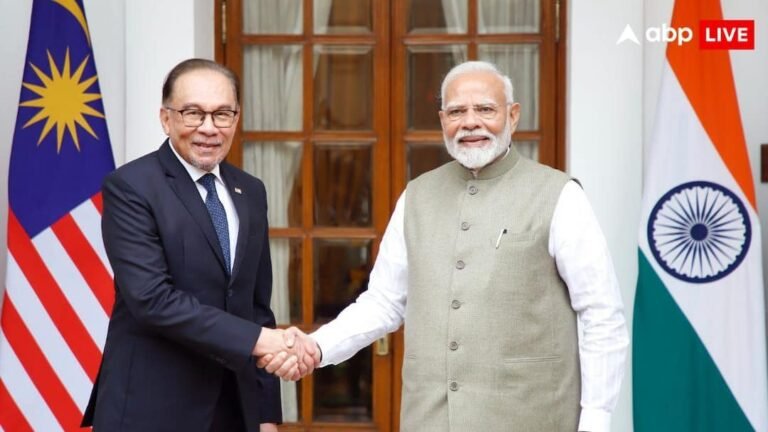
Indian Prime Minister Narendra Modi will visit Malaysia on his official two-day visit. PM Modi will make his visit between 7th to 8th February (2026). During this, he will meet Prime Minister Dato Seri Anwar Ibrahim in Kuala Lumpur, the capital of Malaysia. During this visit, he will also meet the Indian community living in Malaysia and participate in the Malaysian Forum. This will be PM Modi’s third visit to Malaysia. This information has been released by the Ministry of External Affairs.
India and Malaysia share long-standing friendly relations
Both countries currently share civilizational, historical and cultural ties. There has been friendship between the two countries for a long time. The Indian Foreign Ministry said that relations between the two countries have been friendly for a long time. About 29 lakh people of India live in Malaysia. This figure is the third largest figure of the Indian community in the world. Because of this, relations between the two countries have progressed stronger.
10th India-Malaysia CEO Forum organized
During their third visit, the Prime Ministers of both the countries will hold bilateral discussions. Apart from this, he will also discuss with the people of Indian community as well as representatives of industry and business sector. The 10th India-Malaysia CEO Forum will also be organized during the visit.
There will be discussion between the two countries on these areas and basic issues
During this visit, discussions will also be held on strengthening bilateral cooperation ranging from trade, investment, defence, security and maritime cooperation to digital and financial technology, energy, health, education, culture and tourism sectors. It is also expected that a consensus will be reached on future plans.
PM Modi last visited Malaysia in the year 2024
Prime Minister before this Narendra Modi Went in August 2024. Then there was a discussion about enhancing bilateral relations to comprehensive strategic partnership.