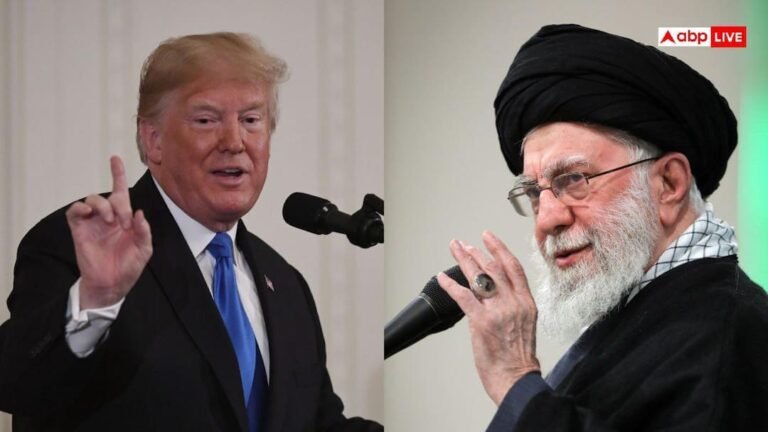
No solution to the ongoing tension between America and Iran was found even in Muscat’s talks with Oman. After the continuous threats of US President Donald Trump, the Middle East seems to be entangled in war once again. Meanwhile, Iran’s Supreme Leader Ayatollah Ali Khamenei did not participate in the 37-year-old annual meeting of Air Force commanders for the first time. Every year this meeting is held on 8 February.
Khamenei broke 37 years old tradition
According to the report of Iran International, Khamenei has been participating in this annual meeting of the Air Force every year since assuming power in 1989. Even when the world was in turmoil due to the Corona epidemic, Khamenei attended this meeting. The day marks the anniversary of 8 February 1979, when a group of Iranian Air Force fighters were part of Ruhollah Khomeini’s pledge to overthrow the Pahlavi dynasty. Before Khamenei, Khomeini was the Supreme Leader of Iran.
Danger of American attack looms on Iran
For the past four decades, February 8 has become a symbolic event, when Air Force personnel and commanders meet with Iran’s religious leadership every year on this date. The report claims that this year, instead of Khamenei, Chief of Staff of the Armed Forces Abdolrahim Mousavi met the commanders of the Army and Air Force. Khamenei’s absence from the Iranian Air Force comes at a time when the US has increased its military presence in the region and the threat of a possible military attack on Iran looms.
Benjamin Netanyahu will meet Trump
It was told by the Israeli Prime Minister’s Office that Benjamin Netanyahu will go to Washington on Wednesday (11 February 2026). There he will discuss the talks between Iran and America with US President Donald Trump. According to the statement, Netanyahu believes that talks with Iran must include the condition of banning ballistic missiles and ending the support given by Iran to its allied groups.
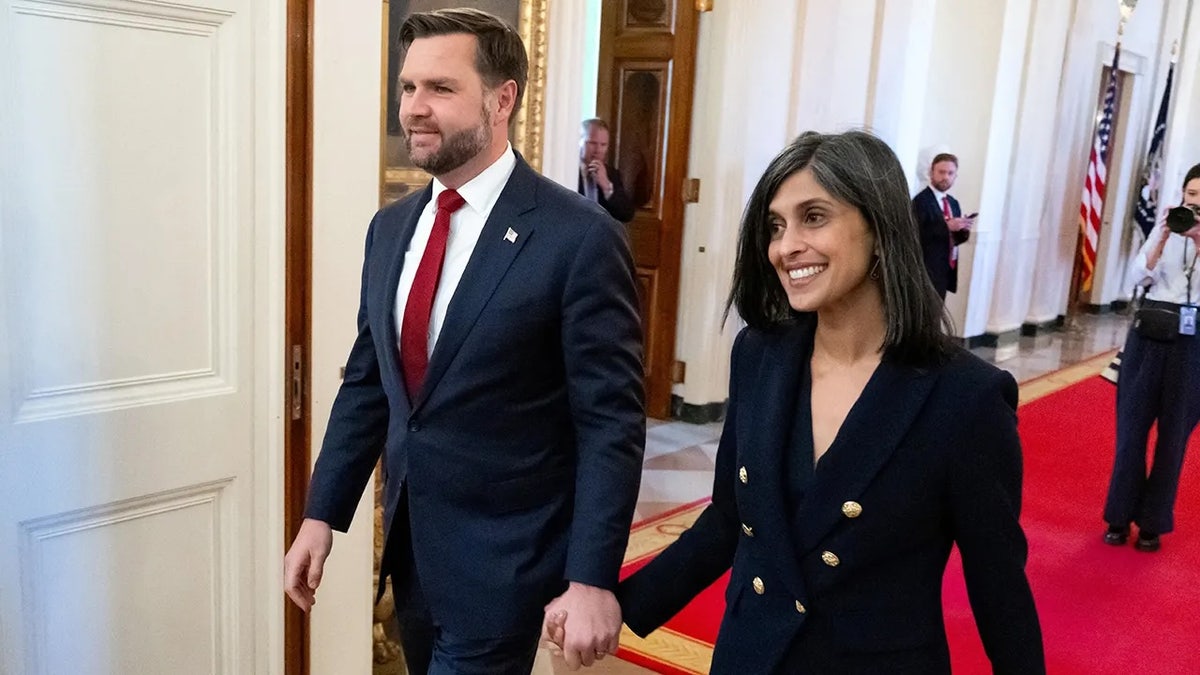
Second Lady Usha Vance’s announcement of baby number four was delightful and refreshing news. Having four children in the U.S. is not the norm these days. Across the U.S., women are having fewer children, or none at all. As a parent myself, I hope Vance’s news will encourage more women to do the same.
A woman’s decision to have children is often seen as a personal lifestyle choice. However, this decision also affects the nation: without enough births to maintain its population, a country struggles to sustain its economy, communities and culture.
We do not have to look far to see where this leads. The Free Press recently reported that Britain is facing a full-blown demographic crisis. Deaths are now poised to outnumber births. Many educated, prosperous and financially stable women say their decision not to have children is deliberate. One woman in The Free Press story noted, “It’s not that I don’t have reasons. It’s that I have too many. If you knocked one down, I’d just give you 10 more.”
The United States is experiencing a sustained decline in birth rate, which has lasted for over a decade and now puts the rate well below replacement level. This trend mirrors challenges seen elsewhere.
Usha Vance is pregnant with her fourth child but many American women won’t learn from her example.(Getty images)
The reasons women give for avoiding motherhood are real: children and childcare are expensive; many careers demand total availability during a woman’s prime fertility years. Often, the culture treats motherhood as a professional liability rather than a benefit to society.
But there is another factor few are willing to say out loud — one that affects women long before they ever consider having children. Increasingly, women are not delaying motherhood because they do not want families: they are having trouble finding men who are ready to build one.
Modern dating is broken, and pornography has played a devastating role. Millions of men now habitually consume pornography. Barna Group data from 2024 found that 78% of U.S. men (ages 13–65) consume pornography “to some extent.” But this is not harmless entertainment. Many studies have shown that heavy pornography consumption distorts expectations, damages emotional intimacy, reduces motivation and undermines real-world relationships.
Pornography can lead men to have distorted views of sex and women. A culture that normalizes constant sexual consumption trains men to expect gratification without sacrifice. Pornography promises connection but delivers isolation.
A lonely society, cut off from marriage, family, and genuine intimacy, does not reproduce itself. A culture that floods men with pornography should not be surprised when fewer of them step up as husbands and fathers. When men are trained to consume rather than commit, women ultimately pay the price, but so does the larger society.
Marriage does not collapse because women suddenly lose interest in family. It collapses when men stop pursuing commitment. Growing numbers of men are living disconnected lives, often alone, often online. Indeed, men are also being sold a lie that they have to have an enormous amount of money saved before they can commit to marriage and children.
Women are not often rejecting motherhood out of selfishness or ambition. They are responding rationally to a dating culture where emotional maturity, fidelity and long-term responsibility are increasingly rare.
America needs strong men who are willing to reject pornography and focus on leaving a legacy by building families. At the same time, women should resist the message that motherhood must be delayed until everything is “perfect.” That day will never arrive. And the reality is that fertility does not wait.
Often, the culture treats motherhood as a professional liability rather than a benefit to society.
Yes, economics matter. But economics alone cannot explain what is happening. Even countries with generous family benefits, paid leave, and subsidized childcare remain well below replacement fertility rates. When marriage weakens and meaning erodes, no amount of government spending can persuade people to build families.
Career success matters — education matters. But neither was ever meant to replace family, meaning, or legacy. A culture that treats children as optional accessories eventually runs out of people. That decline shows up in labor shortages, strained entitlement systems, and a shrinking pool of future caregivers, workers and citizens.
What is missing is a shared belief that marriage, motherhood and fatherhood are still good and worth protecting.
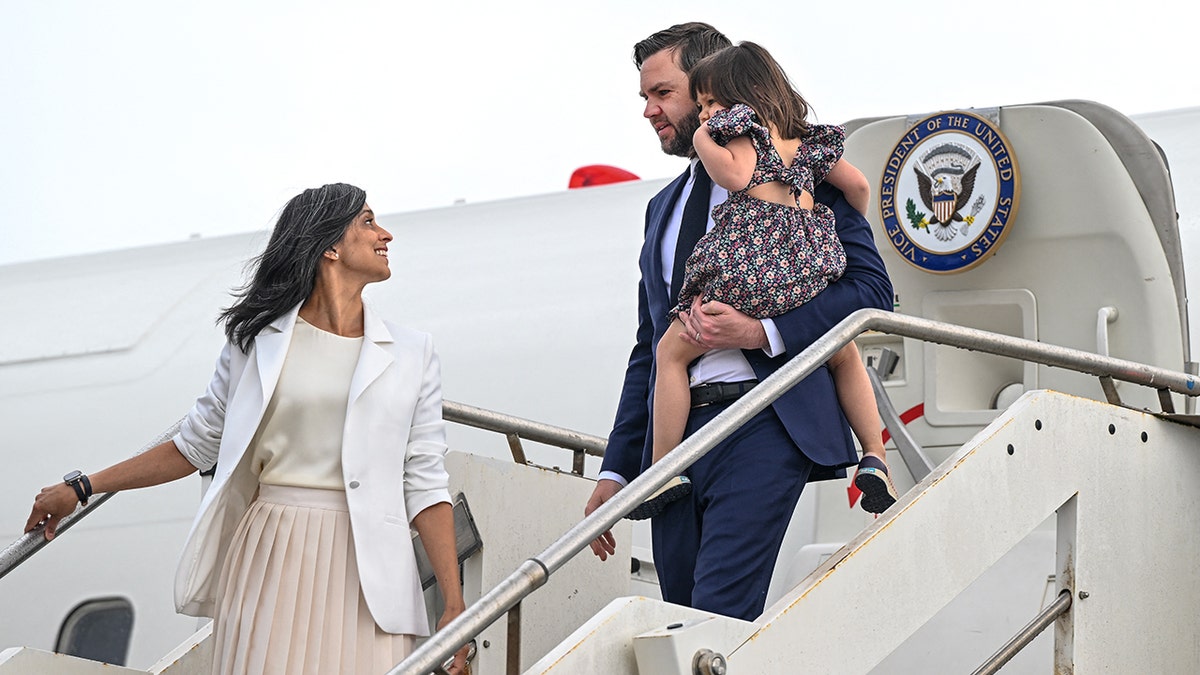
Second Lady Usha Vance looks back at U.S. Vice President JD Vance, carrying their daughter Mirabel as they disembark Air Force Two upon arriving at Rome Ciampino Airport, on April 18, 2025.(KENNY HOLSTON/POOL/AFP via Getty Images)
Each generation before us faced uncertainty, whether in the form of war, depression, or upheaval, and yet still chose to build families. They believed the future was worth the investment. A society that stops believing stops having children.
America now stands at a crossroads: we can rebuild a culture that honors marriage, supports motherhood, and calls men to responsibility, or we can manage decline and pretend it is progress. Children are not the problem: they are the point. Second Lady Vance models that well.
Penny Nance is CEO and president of Concerned Women for America, the nation’s largest public policy women’s organization.
Aaqib Nabi take 12 wickets in Ranji trophy match: Jammu and Kashmir fast bowler Aaqib Nabi has created a stir in Ranji Trophy with his powerful bowling. Aaqib Nabi created a stir in the match against Madhya Pradesh by taking 7 wickets in the first innings and 5 wickets in the second innings. Along with this, it is being said that IPL team Delhi Capitals has won the lottery in the form of Aaqib Nabi.
Aaqib Nabi took 12 wickets against Madhya Pradesh
New Delhi: Jammu and Kashmir fast bowler Aaqib Nabi has become a wicket machine in domestic cricket. Nabi has created a sensation with his lethal bowling against Madhya Pradesh in the knockout round of Ranji Trophy. In the quarter final match played in Indore, Nabi took a total of 12 wickets in the match with his strong bowling. Due to his tremendous bowling, Jammu and Kashmir defeated Madhya Pradesh by 56 runs in the quarter-final match and made it to the next round.
Aaqib Nabi, the hero of Jammu and Kashmir’s victory, took a total of 12 wickets in the match. In the first innings of the match, Nabi had taken a total of 7 wickets, while in the second innings also he opened his claws and took five wickets. In this way Aaqib Nabi took a total of 12 wickets in the match. Due to this strong game of Aaqib, Jammu and Kashmir kept Madhya Pradesh on the backfoot in the entire match and won easily.
What happened in the match between MP and Jammu and Kashmir?
Talking about this match, the Jammu and Kashmir team, batting first, was limited to 194 runs in 67 overs. In response to this score, Madhya Pradesh’s batting was also nothing special and the team was limited to just 152 in front of the lethal bowling of Aaqib Nabi. In this way Jammu and Kashmir had achieved a lead of 42 runs in the first innings.
After being bowled out cheaply in the first innings, Jammu and Kashmir batted with some caution in the second innings. Jammu and Kashmir scored 248 runs in the second innings, due to which Madhya Pradesh got the target of 291 runs in the fourth innings, but Aaqib once again wreaked havoc with his bowling. In the second innings, Aaqib again took five wickets, due to which the team folded by scoring 234 runs and Jammu and Kashmir team won the match by 56 runs.
Working as Chief Sub Editor in Network 18 Group since October 2025. 9 years experience in journalism. Started career with sports beat in ABP News Digital. Reputable institutions like India TV and Navbharat Times Group…read more
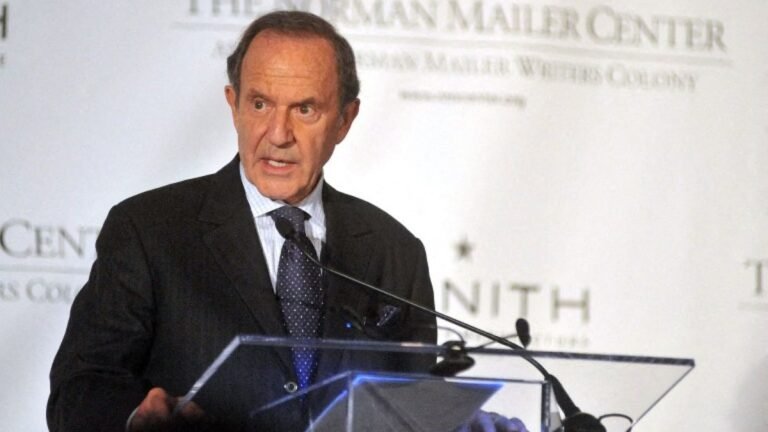
Jeffrey Epstein pressured a media tycoon he did business with to quash coverage of allegations of his sexual abuse of girls, according to documents released by the United States Department of Justice.
Epstein leveraged close personal and professional ties with the Canadian-American billionaire Mortimer Zuckerman to try to influence the New York Daily News’s coverage of allegations against him after his 2008 conviction for soliciting a minor for prostitution, the documents show.
Recommended Stories
list of 4 itemsend of list
After Epstein reached out to Zuckerman, the then-owner of the Daily News, the tabloid first delayed its coverage of the allegations and then omitted details that the late financier had specifically requested be left out, according to the documents.
In an email dated October 9, 2009, Epstein shared a “proposed answer” to questions from the newspaper with Zuckerman that disputed allegations made against him and his girlfriend Ghislaine Maxwell, who is currently serving a 20-year sentence for child sex trafficking.
The allegations, which had been put to Epstein and Maxwell by then-Daily News journalist George Rush, included accusations that the pair had subjected a minor known as “Jane Doe No 102” to routine sexual abuse and had engaged in threesomes with “various underage girls”.
The allegations also included claims that Maxwell kept a computer database of “hundreds of girls and oversaw the schedule of girls who came to Epstein’s homes”.
In the proposed response that he shared with Zuckerman, Epstein said “no sex occurred” with Jane Doe No 102 and she had admitted in a deposition to being an “escort, call girl, and a massage parlor worker since the age of 15”.
“All of the adult establishments in which she admitted working require proof of age. Rc the rest of the questions,” Epstein’s email to Zuckerman said.
“These are all malicious fabrications designed to get Mr Edwards clients more money than they normally receive though she did testify under oath that she made as much as 2000 per day,” the email said, referring to Bradley J Edwards, a Florida-based lawyer who has represented many of Epstein’s accusers.
Later that day, Zuckerman told Epstein in an email that the Daily News was “doing major editing over huge objections” and he would “c copy asap”.
“take ghislaine out. if possible,” Epstein responded in an email a few minutes later.
“the very first plaintiff, deposed admitted in a sworn videotaped statement that she lied and was an escort , call girl since age 15. SHE took the fifth. over 40 times.. its crazy.. thanks for you help.”
“Please call me asap,” Zuckerman wrote to Epstein several hours later, before asking Epstein to call him again later that night.
The Daily News ultimately published an article on December 19, 2009, that described Epstein reaching a settlement with his accuser for an undisclosed amount of money.
The article noted that Epstein was facing “more than a dozen” lawsuits from women who accused him of sexually abusing them but made no mention of Maxwell or the allegations against her.
Zuckerman, a staunch supporter of Israel who served as head of the America-Israel Friendship League and the Conference of Presidents of Major American Jewish Organizations, has never been accused of any involvement in Epstein’s crimes.
The front page of the New York Daily News on August 12, 2020 [Bebeto Matthews/AP]
Rush, who left the Daily News in 2010, confirmed that Epstein had tried to “cajole” Zuckerman, the current owner of US News & World Report, into burying or shaping the story to Epstein’s liking.
Rush said the Daily News decided to delay publication after Epstein offered the newspaper an interview.
“Unfortunately, Epstein immediately insisted that the interview be off the record. He also used the conversation to make remorseless claims that he was a victim of overzealous prosecutors and shyster lawyers,” Rush told Al Jazeera.
Rush said Zuckerman, who sold the Daily News in 2017, never suggested that the newspaper cancel the story altogether or publish coverage that was favourable to Epstein.
“I do recall being advised to leave Ghislaine Maxwell out of the story,” Rush said.
“At the time, the paper’s lawyers had libel concerns, and I saw it as a necessary compromise.”
Rush said he had objected to the efforts to interfere in his story but the episode did not cause a “newsroom furore”.
“Most people hadn’t heard of Epstein at that point. I didn’t like Epstein and Maxwell trying to appeal to the owner,” he said.
“But I was relieved that the story wasn’t killed, just delayed, and hopeful that Epstein might say something quotable in the interview. It speaks to Epstein’s arrogance that he thought he had the power to get Mort to do his bidding.”
Zuckerman’s personal assistant and the Zuckerman STEM Leadership Program, an initiative founded by the billionaire to fund scientific collaboration between the US and Israel, did not reply to requests for comment from Al Jazeera.
Ties for two decades
Zuckerman’s ties to Epstein stretch back more than 20 years.
In 2005, Zuckerman, who also owned The Atlantic magazine from 1984 to 1999, worked with Epstein on the short-lived relaunch of the gossip-and-entertainment magazine Radar.
After a US congressional panel in September released a scrapbook prepared for Epstein’s 50th birthday in 2003, Zuckerman was among a slew of high-profile names revealed to have sent the financier their well-wishes.
But the latest tranche of files from the 2019 prosecution of Epstein, released last week by US authorities, show that Zuckerman’s relationship with the sex offender was much closer than previously believed.
In 2008, Zuckerman sought Epstein’s advice on his plans for passing on his estate, sharing sensitive details about his financial affairs in the process, including a copy of his will and an evaluation of his assets that put his net worth at $1.9bn.
In 2013, Epstein drafted several agreements to provide Zuckerman with “analysing, evaluating, planning and other services” related to the billionaire’s plans for passing on his wealth.
Epstein proposed a fee of $30m in a proposal drafted in June 2013 before offering his services for $21m in a revised proposal that December, according to the documents.
In correspondence around this period, Zuckerman appeared to hold Epstein’s claimed expertise in high regard.
“Your questions have been critical to my growing understanding of how much lies ahead before my finances are properly organized,” Zuckerman wrote to Epstein in an email dated October 12, 2013, after the financier had earlier claimed to have identified “wild errors” in Zuckerman’s accounting of his finances.
“You have been an invaluable friend and In the most constructive way a provocateur I am completely grateful and am now beginning to focus, in on the issues you have raised. With appreciation from a hesitant amateur Mort.”
Documents that were included in the release by the US Department of Justice of its Jeffrey Epstein investigative files [File: Jon Elswick/AP]
It is not clear whether Zuckerman ultimately signed the agreement proposed by Epstein.
Zuckerman and Epstein communicated regularly, and the two men arranged numerous dinners and other meetings over the years, according to the documents, including at the financier’s Manhattan home.
“Mort is now booked for tonight at 8:30…i am being asked if you could see him this weekend…please advise,” Lesley Groff, Epstein’s personal assistant, wrote on May 5, 2015, in one of many emails detailing appointments.
While Zuckerman turned to Epstein for financial advice, he also appeared to regard him as a friend.
“Hi there. You are very special. And a great friend. Mort,” Zuckerman wrote to Epstein in an email dated August 24, 2014.
1500 years old history came alive in the sand of Rajasthan, a man took his life! Video went viral
There is no shortage of talent in the country. Earlier many talents used to remain hidden but ever since the craze of social media has increased, talent has started appearing from every corner. Now a video has surfaced of a talented person from the sand dunes of Rajasthan who created a sensation by playing the historical musical instrument Morchang. Morchang was played in the meetings of kings and emperors several hundred years ago. It was made of iron or copper, which was placed in the mouth and played by filling air with the tongue. But with time its trend ended. Now by playing this fifteen hundred years old instrument, the person has revived this art again. People are praising the video a lot.
To add News18 as your favorite news source on Google click here Do it.
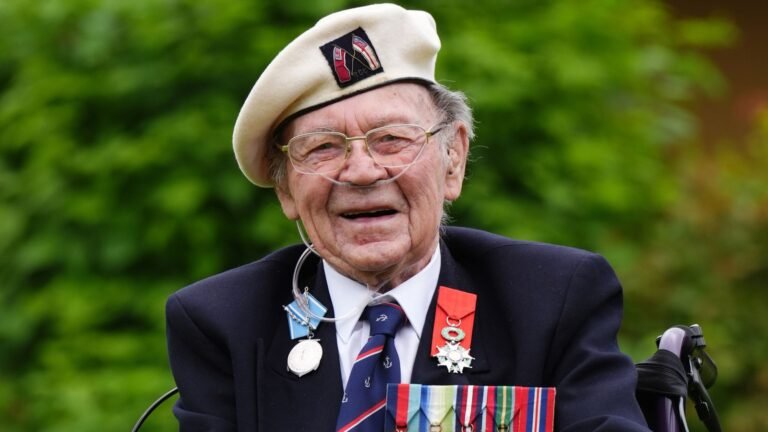
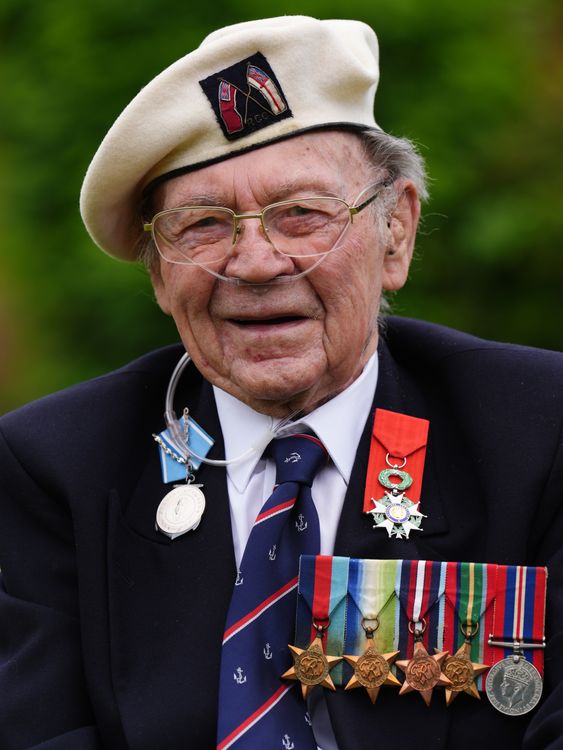
One of Scotland’s last surviving D-Day veterans has died aged 100.
Albert Lamond, who was born in Glasgow, was just 18 when he took part in the Allied invasion of Normandy on 6 June 1944, serving as a signalman aboard HMS Rowley.
He also served in the Pacific in the lead-up to VJ Day on 15 August 1945, when Japan announced its surrender to the Allied forces.
Mr Lamond’s family have spoken of their pride in the centenarian, who “never thought of himself as a hero” and “believed he was just doing his duty”.
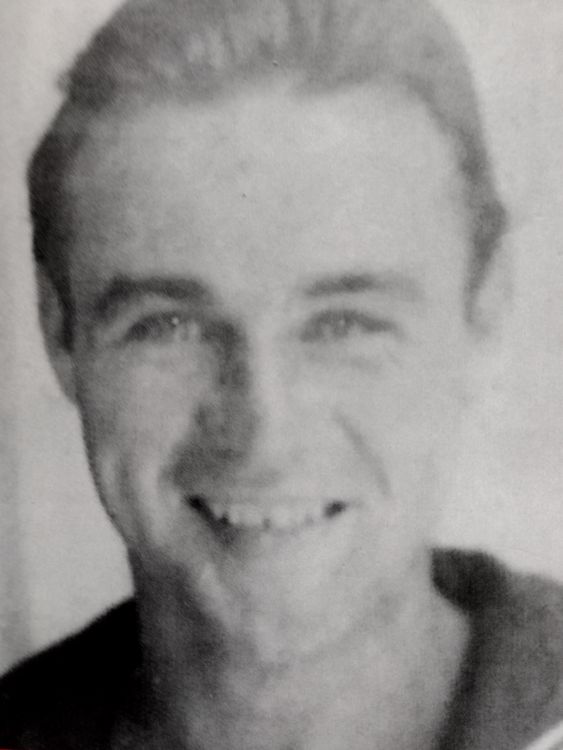
Image:Mr Lamond during his Royal Navy days. Pic: PA/Erskine Veterans Charity
His nephew Martin Lamond said: “We’re all deeply saddened by Albert’s passing. He was a joy to be around and an example to everyone right up to the last.
“He’ll be so greatly missed. Not only have Albert’s friends and family suffered a great loss, everyone has, even if they never had the pleasure of knowing him.
“Albert never thought of himself as a hero. He believed he was just doing his duty, and he carried the memory of those who didn’t make it with him throughout his life.
“We are incredibly proud of him and grateful for the time we had.”
Image:Pic: PA
Mr Lamond joined the Royal Navy in 1943.
He was on board HMS Rowley, part of the 3rd Escort Group, when it was deployed to rendezvous with battleship HMS Warspite as it travelled to Normandy to shell German troops.
The frigate’s role was to act as a first line of defence by circling HMS Warspite and it was expected that the sailors would sacrifice their lives.
Mr Lamond survived and, a year later, on VJ Day, his role was to evacuate Allied prisoners of war (PoW) from remote islands and transport them to Australia.
Mr Lamond, who was 19 at the time, described the PoWs as “living skeletons” but said they were still able to smile when they were rescued.
Marking the 80th anniversary of the landings in 2024, he said it was vital that future generations understood the reality and cost of war.
He said: “It was horrible. It lives with you forever. If we don’t pass the stories on, people will forget, and we can’t let that happen.”
Mr Lamond enjoyed a career on the railways after leaving the Navy, and later lived at McKellar House at Erskine Veterans Village in Renfrewshire.
Wing Commander Ian Cumming, chief executive at Erskine, said: “Albert represented the very best of his generation.
“He spoke honestly about his service, not to glorify war, but to make sure people understood its cost. Through his time at Erskine, he was committed to passing on those lessons.
“We won’t forget the ever-present twinkle in Albert’s eye, or his cheeky patter. We were truly privileged to care for and support him in later life.”
Mr Lamond will be laid to rest on Tuesday at Dalnottar Cemetery in Clydebank.
As someone who has spent decades training professional truck drivers, I take highway safety very seriously. America’s economy depends on a national freight network that moves goods through every state, across every major highway corridor, and into every community. When safety standards for commercial drivers are weakened anywhere, the consequences ripple across the entire country, putting motorists, supply chains and professional drivers at risk.
That’s why I was deeply troubled by recent remarks from Democratic Texas Rep. Jasmine Crockett during a House Judiciary Committee hearing, suggesting that English language proficiency is not necessary to safely operate a commercial motor vehicle. She equated it to the same practice as someone driving a rental car in a foreign country where they might not speak the language. Her assertion is misguided, dangerous and dismissive of the professionalism of America’s truck drivers.
Operating an 80,000-pound commercial vehicle is not remotely comparable to driving a passenger vehicle. A commercial driver is not simply following turn-by-turn directions from point A to point B. They are navigating complex highway systems, responding to emergency situations, complying with law enforcement instructions, interpreting roadside signage, understanding weather alerts, and coordinating with dispatchers, first responders and inspectors — often under intense pressure. English language proficiency is fundamental to every one of those responsibilities.
Across the United States, commercial trucks move agricultural products from rural communities, consumer goods through major interstate corridors and critical supplies to ports, factories, hospitals and distribution centers. From coast to coast, our economy relies on professional drivers to keep freight moving safely and efficiently. That makes strong, consistent safety standards not a regional concern, but a national imperative.
Rep. Jasmine Crockett, D-Texas, questioned the need for truck drivers to speak English.(John Medina/Getty Images for MoveOn)
Federal law has long required commercial drivers to demonstrate English language proficiency for good reason. A commercial driver’s license is not a checkmark on a piece of paper — it is a promise to the public. It tells every motorist sharing the road that the person behind the wheel of that truck has been properly trained, evaluated and held to consistent safety standards. Weakening or downplaying those requirements undermines trust in the Commercial Driver’s License (CDL) itself.
This debate cannot be divorced from a broader reality confronting the trucking industry. Across the country, regulators are uncovering bad actors who cut corners on training, falsify records, or exploit loopholes to push unqualified drivers onto public roads. These so-called “CDL mills” don’t just endanger safety — they devalue the hard work of legitimate drivers and reputable training schools that do things the right way.
As a training professional and chairman of the Commercial Vehicle Training Association (CVTA), I see the difference every day between real, rigorous instruction and sham operations that promise “fast” or “guaranteed” licenses. True commercial driver training takes time. It involves classroom instruction, hands-on skills development, supervised behind-the-wheel training, and clear communication between instructors and students. None of that works without a shared language.
To be clear, this is not about exclusion. Trucking has always been a pathway to opportunity for people from diverse backgrounds. CVTA supports expanding the workforce — but growth must never come at the expense of safety. Lowering standards does not solve labor shortages; it creates more crashes, more fatalities, more scrutiny and, ultimately, fewer good jobs.
Our drivers — professional men and women who earn their living the right way — deserve better than to have their work trivialized. Suggesting that language proficiency doesn’t matter insults the professionalism of drivers who take pride in mastering a demanding craft and meeting high expectations every single day.
The solution is not new laws or political talking points. The solution is consistent, nationwide enforcement of existing safety requirements. Regulators must fully enforce entry-level driver training rules, conduct meaningful audits and shut down fraudulent operators wherever they exist. Every state should continue partnering with federal agencies to ensure every CDL on the road represents real training, real accountability and real competence.
When you see a truck in the next lane, you should be confident that the driver can read the signs, understand emergency instructions, and respond correctly in a crisis. That confidence begins with maintaining — and enforcing — standards that put safety first.
Jeffrey Burkhardt is chairman of the Commercial Vehicle Training Association, the nation’s largest association of professional truck driver training programs.
Procession on bullock cart, 25 wedding guests, this old man narrated an interesting story of 83 years old
Ram Pher Yadav Sultanpur: 96-year-old Ram Pher Yadav, resident of Kunda Bhainropur village of Sultanpur, while sharing an interesting story of his marriage, told that at the age of just 13, he had gone as a groom riding on a bullock-cart, where his wedding procession stayed for two days. Ram Pher, who is very fond of music, still hums traditional songs, to listen to which people used to detain him for days. He becomes emotional remembering his late wife Savitri, who died 4 years ago, but Ram Pher admits that Savitri’s love never let him lack anything. Today, Ram Pher, who is living a happy life with a full and prosperous family of two sons and two daughters, now aims to spend the rest of his life laughing and travelling.
Opinion Thirty years is a big ol’ chunk of anyone’s life. It can take you from new parent to new grandparent, from bright young thing to mid-life crisis, and from shaver to graybeard. In the case of Todd C Miller, one thing hasn’t changed. He’s been the sole maintainer of the Linux sudo utility. He’s not giving up just yet, but he needs help and no help has come.…
Good morning. One of the staples of political journalism these days (for better or for worse) is the “how damaging?” question. With Westminster preoccupied with the question of how long Keir Starmer can last as prime minister following the resignation of Morgan McSweeney, his chief of staff, yesterday in the light of the Peter Mandelson/Jeffrey Epstein scandal, here is a summary of how long other prime ministers were able to stay on after key advisers quit.
Margaret Thatcher stayed in office, after the resignation of Alan Walters, for one year and one month.
Tony Blair stayed in office, after the resignation of Alastair Campbell, for three years and 10 months.
Theresa May stayed in office, after the resignation of Nick Timothy and Fiona Hill, for two years and one and a half months.
Boris Johnson stayed in office, after the resignation of Dominic Cummings, for one year and 10 months.
None of these are exact parallels. Most of these advisers were forced out because of pressure from MPs in the PM’s party, at least one (Mirza) was admired and her departure was a shock, but with McSweeney the picture is mixed. Many Labour MPs are glad to see him gone, but others credit him with winning them their seats and worry how the PM will manage without him.
The Cummings precedent is similar in some ways, because Cummings was the mastermind behind Johnson’s 2019 general election victory. McSweeney also gets credit for the Labour’s 2024 landslide. But only last night Prof Jane Green, who runs the British Election Study project, said “the major factors that contributed to the unique seats-votes outcome were outside Labour’s direct control” and the claim that McSweeney’s decision to focus on appealing to former Tories was a crucial factor has been shown by election analysis to be wrong. Besides, unlike Cummings, McSweeney remains hinged.
In some respects McSweeney is more similar to Nick Timothy and Fiona Hill. They were decisive in enabling Theresa May to become PM, just as McSweeney was instrumental in showing Starmer how he could win the Labour leadership. But Timothy and Hill were even more dominant in No 10 than McSweeney ever was. And they were forced out because they wrote a manifesto that lost an election, whereas McSweeney did the opposite.
In short, there is no way of knowing how this will turn out. But previous experience suggests that even a damaging resignation like McSweeney’s doesn’t make the PM’s resignation imminent.
But we have got an inkling of what might happen today. Starmer is due to address Labour MPs this evening and Jacqui Smith, the former Labour home secretary who is now a peer and skills minister, has been giving interviews this morning. Speaking on Times Radio this morning, she said Starmer deserved credit for “taking responsibility” for the Mandelson appointment.
The prime minister is taking responsibility. He took responsibility for the decision that was made about Peter Mandelson, although to be clear here it was of course Peter Mandelson that, in consistent lying and engagement with Jeffrey Epstein, let down the party and the government and the country. And I think that will become clearer as the information around the appointment is put out into the public domain.
According to Sam Blewett and Bethany Dawson in their London Playbook briefing for Politico, Labour First, the right-leaning Labour group that supports Starmer, has been urging its MPs allies to make this point at tonight’s PLP meeting. They say:
One riled MP forwarded Playbook a message the right-leaning Labour First faction has sent to backbenchers it reckons are loyal to Starmer, urging them to speak up in support at the PLP meeting. Talking points include how the PM “accepts his mistakes and apologises,” compared to the carousel of Tory leaders forced from office … and how the government is delivering on “many areas of incremental change.”
Here is our overnight story by Pippa Crerar summing up all yesterday’s developments.
And here is an analysis by Kiran Stacey.
Today we will be focusing mostly on this crisis. Here is the agenda.
2.30pm: Shabana Mahmood, the home secretary, takes questions in the Commons.
3pm: Nigel Farage, the Reform UK leader, gives a speech in Birmingham.
6pm:Keir Starmer addresses Labour MPs at a private meeting of the PLP in Westminster.
If you want to contact me, please post a message below the line when comments are open (between 10am and 3pm), or message me on social media. I can’t read all the messages BTL, but if you put “Andrew” in a message aimed at me, I am more likely to see it because I search for posts containing that word.
If you want to flag something up urgently, it is best to use social media. You can reach me on Bluesky at @andrewsparrowgdn.bsky.social. The Guardian has given up posting from its official accounts on X, but individual Guardian journalists are there, I still have my account, and if you message me there at @AndrewSparrow, I will see it and respond if necessary.
I find it very helpful when readers point out mistakes, even minor typos. No error is too small to correct. And I find your questions very interesting too. I can’t promise to reply to them all, but I will try to reply to as many as I can, either BTL or sometimes in the blog.
Key events
Emily Thornberry welcomes McSweeney’s resignation, saying it creates ‘opportunity’ for Starmer
Emily Thornberry, the Labour chair of the Commons foreign affairs committee, told the Today programme this morning that she was glad that Morgan McSweeney had resigned. She said:
I’m glad to see that the person who was the architect of Peter Mandelson’s appointment has taken responsibility and has gone … Morgan had become quite a divisive figure.
There were a couple of things that everyone agreed on, one was that he was brilliant, but I think the other one was that people felt he was in the wrong job, so I think it’s right that he’s gone, and I think it’s an opportunity.
Thornberry said that Keir Starmer was a “decent man”, but that he needed to “step up a bit more than he has” and that he neeed a “reset” offering “clear leadership”.
John Swinney, Scotland’s first minister, has said that he thinks Keir Starmer is in a position of “complete weakness” as PM. Speaking on BBC Radio Scotland, Swinney said:
All that’s happened in recent days demonstrates an appalling judgment by the prime minister in appointing Peter Mandelson as the ambassador to the United States.
Although Morgan McSweeney might have resigned, the person that took the decision to appoint Peter Mandelson was the prime minister and his position is a demonstration of his complete weakness as prime minister in the aftermath of this terrible decision.
Labour MP Andy McDonald says it will be ‘end’ for Starmer if he does not ‘own the error he’s made’
The Labour MP Andy McDonald told the Today programme this morning that it would be “the end” for Keir Starmer’s leadership if he failed to persuade backbenchers that he will change the way he operates for the better.
McDonald said:
If [Starmer] doesn’t own the error he’s made, and recognise the problem in front of it and articulate it and tell us how he’s going to deal with it, then I’m afraid it is coming to an end – if not today, but certainly in the weeks and months ahead.
He’s got to convince the PLP tonight that he’s got it and a change is necessary.
And the change that he promoted was no other than to purge the left, and it’s got us in this terrible mess that we’re in now.
McDonald said he wanted to see a change to a “more pluralist, democratic socialist agenda”.
McDonald, who served in shadow cabinet under Jeremy Corbyn, has been one of the MPs most critical in public of way Labour has been led by Starmer and Morgan McSweeney. In part he feels aggrieved because he was suspended from the party for five months for using words “the river and the sea” at a pro-Palestine rally, supposedly on the grounds that this was anti-Israel (it has echoes of a chant criticised as antisemitic), even though McDonald specifically said he wanted to see “Israelis and Palestinians, between the river and the sea … [living] in peaceful liberty”. Labour’s decision to suspend McDonald was criticised as excessive, and that is partly why he is so critical of the purges of the left overseen by McSweeney.
Badenoch says Starmer’s position now ‘untenable’
Kemi Badenoch, the Conservative leader, has said that Keir Starmer should resign given his decision to appoint Peter Mandelson as ambassador to Washington.
In an interview on the Today programme this morning, Badenoch said:
[Claiming] ‘I was badly advised’ is not a good excuse for a leader. Advisers advise, leaders decide. He made a bad decision, he should take responsibility for that … this man said that he was the chief prosecutor for the country, when did he start believing everything that people told him?
Peter Mandelson had been sacked twice for unethical behaviour. [Starmer] is allowing someone else to carry the can for a decision that he chose to make. But the real problem is that this country is not being governed.
Keir Starmer promised a government that would be whiter than white. His position now is untenable, because if he thinks that bad advice is enough for Morgan McSweeney to go, then, yes, I think that makes his position untenable.
Kemi Badenoch on the Today programme Photograph: BBC
Skills minister Jacqui Smith says she is sure Starmer won’t resign
In interviews this morning Jacqui Smith, the skills minister, insisted that Keir Starmer will carry on as PM.
She told Times Radio:
I think that the prime minister absolutely is determined to [carry on]. He’s determined and has taken responsibility for the mistakes made in appointing Peter Mandelson.
On the Today programme Nick Robinson told Smith that Pat McFadden, the work and pensions secretary, gave an interview yesterday morning saying it would be pointless for Morgan McSweeeny to resign. Only a few hours later McSweeney did just that. He asked Smith if she could be sure that Starmer too wasn’t about to resign.
Smith replied: “I am sure, yes.”
But when Robinson asked her if Starmer had told her that personally, Smith said she had not spoken to him directly. “I don’t believe he will [resign], I don’t think he should,” she said.
Good morning. One of the staples of political journalism these days (for better or for worse) is the “how damaging?” question. With Westminster preoccupied with the question of how long Keir Starmer can last as prime minister following the resignation of Morgan McSweeney, his chief of staff, yesterday in the light of the Peter Mandelson/Jeffrey Epstein scandal, here is a summary of how long other prime ministers were able to stay on after key advisers quit.
Margaret Thatcher stayed in office, after the resignation of Alan Walters, for one year and one month.
Tony Blair stayed in office, after the resignation of Alastair Campbell, for three years and 10 months.
Theresa May stayed in office, after the resignation of Nick Timothy and Fiona Hill, for two years and one and a half months.
Boris Johnson stayed in office, after the resignation of Dominic Cummings, for one year and 10 months.
None of these are exact parallels. Most of these advisers were forced out because of pressure from MPs in the PM’s party, at least one (Mirza) was admired and her departure was a shock, but with McSweeney the picture is mixed. Many Labour MPs are glad to see him gone, but others credit him with winning them their seats and worry how the PM will manage without him.
The Cummings precedent is similar in some ways, because Cummings was the mastermind behind Johnson’s 2019 general election victory. McSweeney also gets credit for the Labour’s 2024 landslide. But only last night Prof Jane Green, who runs the British Election Study project, said “the major factors that contributed to the unique seats-votes outcome were outside Labour’s direct control” and the claim that McSweeney’s decision to focus on appealing to former Tories was a crucial factor has been shown by election analysis to be wrong. Besides, unlike Cummings, McSweeney remains hinged.
In some respects McSweeney is more similar to Nick Timothy and Fiona Hill. They were decisive in enabling Theresa May to become PM, just as McSweeney was instrumental in showing Starmer how he could win the Labour leadership. But Timothy and Hill were even more dominant in No 10 than McSweeney ever was. And they were forced out because they wrote a manifesto that lost an election, whereas McSweeney did the opposite.
In short, there is no way of knowing how this will turn out. But previous experience suggests that even a damaging resignation like McSweeney’s doesn’t make the PM’s resignation imminent.
But we have got an inkling of what might happen today. Starmer is due to address Labour MPs this evening and Jacqui Smith, the former Labour home secretary who is now a peer and skills minister, has been giving interviews this morning. Speaking on Times Radio this morning, she said Starmer deserved credit for “taking responsibility” for the Mandelson appointment.
The prime minister is taking responsibility. He took responsibility for the decision that was made about Peter Mandelson, although to be clear here it was of course Peter Mandelson that, in consistent lying and engagement with Jeffrey Epstein, let down the party and the government and the country. And I think that will become clearer as the information around the appointment is put out into the public domain.
According to Sam Blewett and Bethany Dawson in their London Playbook briefing for Politico, Labour First, the right-leaning Labour group that supports Starmer, has been urging its MPs allies to make this point at tonight’s PLP meeting. They say:
One riled MP forwarded Playbook a message the right-leaning Labour First faction has sent to backbenchers it reckons are loyal to Starmer, urging them to speak up in support at the PLP meeting. Talking points include how the PM “accepts his mistakes and apologises,” compared to the carousel of Tory leaders forced from office … and how the government is delivering on “many areas of incremental change.”
Here is our overnight story by Pippa Crerar summing up all yesterday’s developments.
And here is an analysis by Kiran Stacey.
Today we will be focusing mostly on this crisis. Here is the agenda.
2.30pm: Shabana Mahmood, the home secretary, takes questions in the Commons.
3pm: Nigel Farage, the Reform UK leader, gives a speech in Birmingham.
6pm:Keir Starmer addresses Labour MPs at a private meeting of the PLP in Westminster.
If you want to contact me, please post a message below the line when comments are open (between 10am and 3pm), or message me on social media. I can’t read all the messages BTL, but if you put “Andrew” in a message aimed at me, I am more likely to see it because I search for posts containing that word.
If you want to flag something up urgently, it is best to use social media. You can reach me on Bluesky at @andrewsparrowgdn.bsky.social. The Guardian has given up posting from its official accounts on X, but individual Guardian journalists are there, I still have my account, and if you message me there at @AndrewSparrow, I will see it and respond if necessary.
I find it very helpful when readers point out mistakes, even minor typos. No error is too small to correct. And I find your questions very interesting too. I can’t promise to reply to them all, but I will try to reply to as many as I can, either BTL or sometimes in the blog.