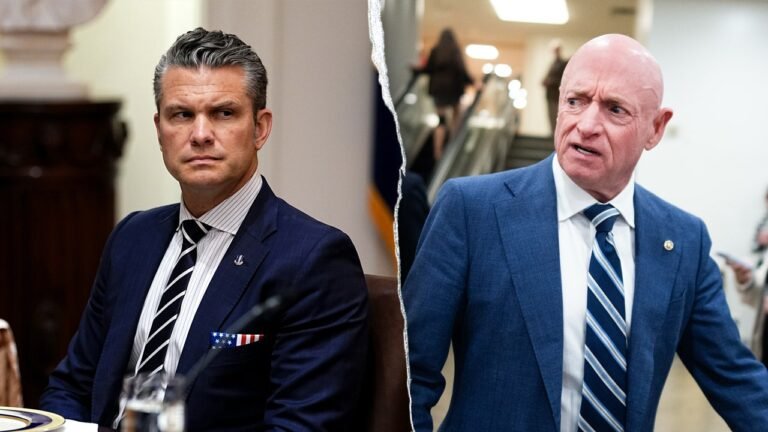
A federal judge on Thursday ruled the Pentagon cannot punish Sen. Mark Kelly, D-Ariz., a retired Navy pilot, for taking part in a video that called on U.S. military members to defy “illegal orders.”
U.S. District Judge Richard Leon, appointed by former President George W. Bush, found the Pentagon violated Kelly’s First Amendment right to free speech, and those of “millions of military retirees,” by censuring him Jan. 5.
Leon’s ruling blocks the Pentagon from demoting Kelly’s retired military rank of captain or reducing his pay during an ongoing lawsuit he brought against War Secretary Pete Hegsesth, the Department of War, the U.S. Navy, and Navy Secretary John Phelan.
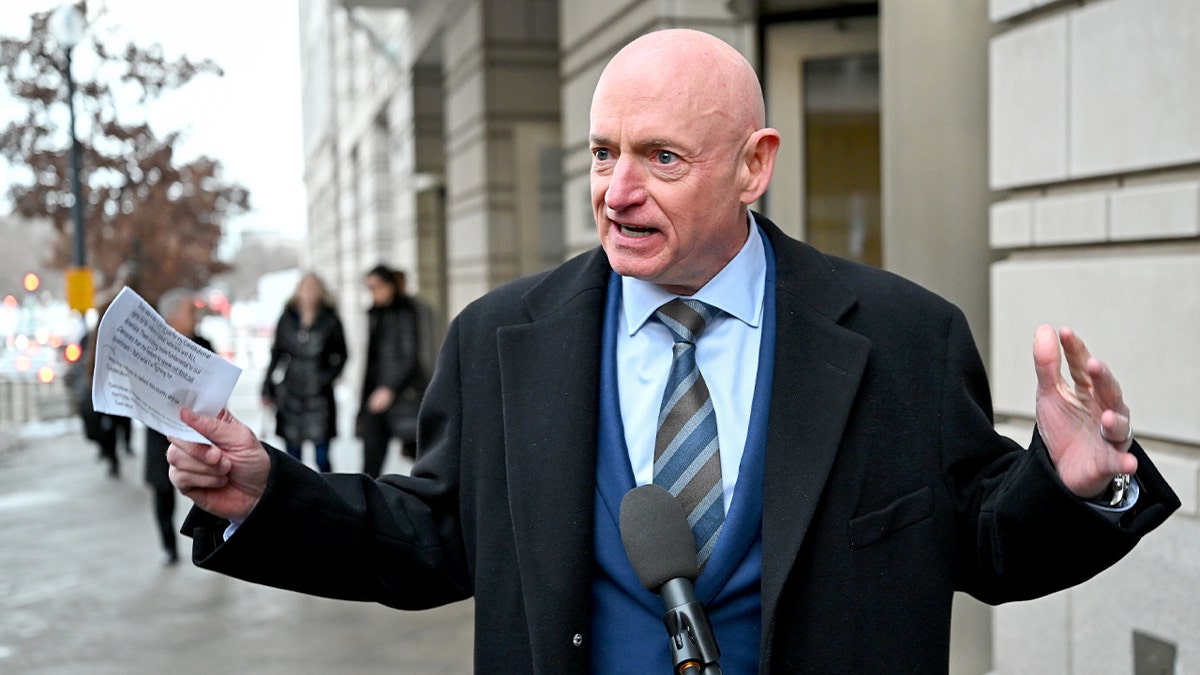
Sen. Mark Kelly, D-Ariz., speaks to members of the media outside federal court, Tuesday, in Washington, D.C.(Graeme Sloan/Bloomberg via Getty Images)
Following the judge’s decision, Hegseth took to X saying the administration will appeal.
“This will be immediately appealed,” he wrote in the post. “Sedition is sedition, ‘Captain.’”
His response echoed that of President Donald Trump, who previously accused the group of “sedition at the highest level,” further suggesting they should be executed.
The 90-second video, first posted by Sen. Elissa Slotkin, D-Mich., also featured military veteran Reps. Jason Crow of Colorado, Chris Deluzio of Pennsylvania, Maggie Goodlander of New Hampshire and Chrissy Houlahan of Pennsylvania.
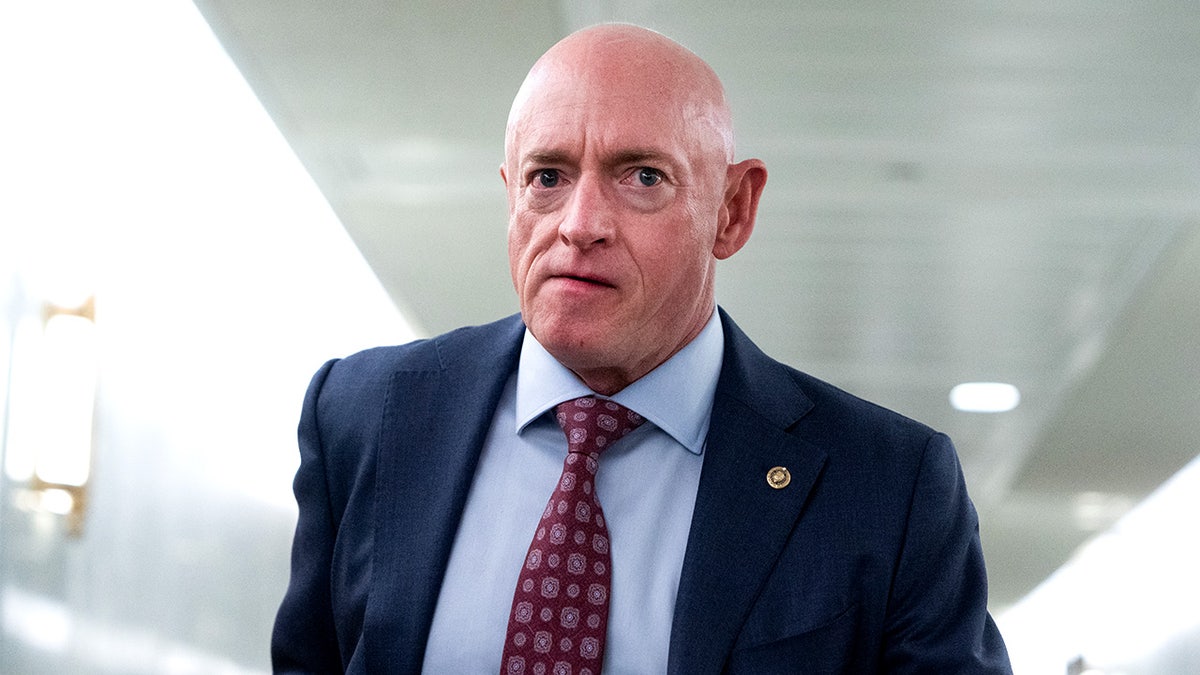
Following the decision, Kelly said the case sends a message to millions of retired veterans.(Tom Williams/CQ-Roll Call, Inc via Getty Images)
Hegseth said an investigation was launched into Kelly’s actions because he was the only lawmaker formally retired from the military and under the Pentagon’s jurisdiction.
In his ruling, Leon said Kelly is “likely to succeed” in his free speech argument and has shown irreparable harm.
“Rather than trying to shrink the First Amendment liberties of retired servicemembers, Secretary Hegseth and his fellow Defendants might reflect and be grateful for the wisdom and expertise that retired servicemembers have brought to public discussions and debate on military matters in our Nation over the past 250 years,” Leon wrote. “…To say the least, our retired veterans deserve more respect from their Government, and our Constitution demands they receive it!”
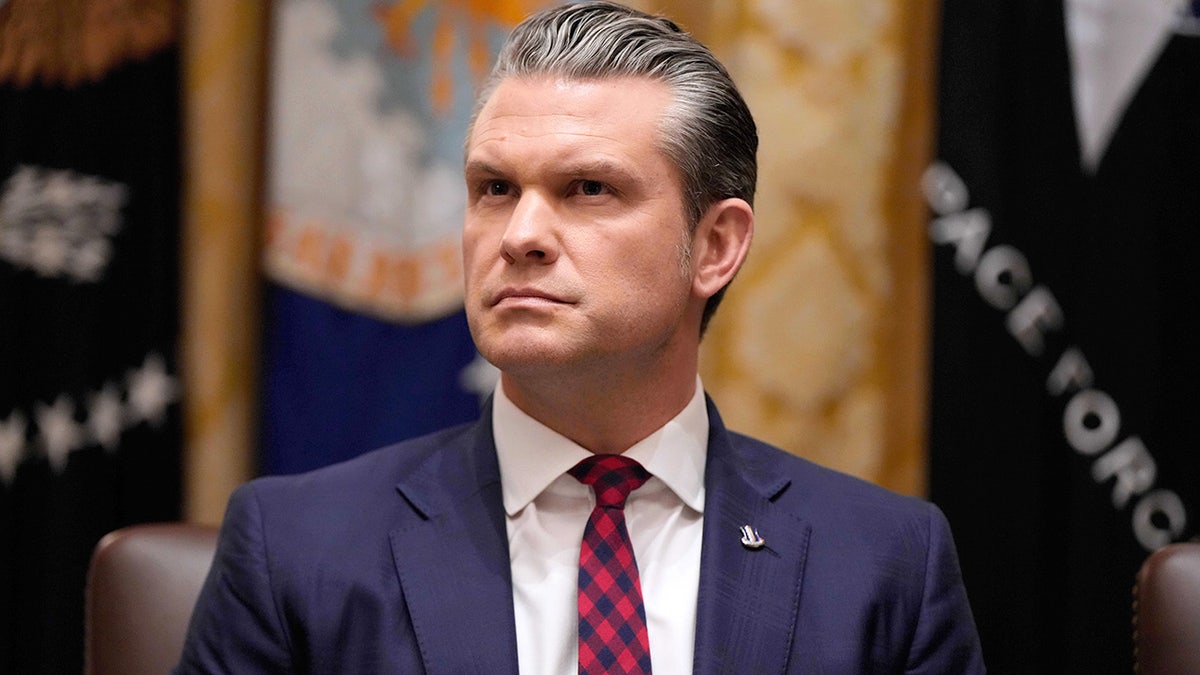
War Secretary Pete Hegseth is named in the lawsuit, along with other defendants.(Julia Demaree Nikhinson/AP)
Following the decision, Kelly said the case was sending a message to millions of retired veterans that “they too can be censured or demoted just for speaking out.”
A grand jury in Washington, D.C., on Tuesday refused the Department of Justice’s attempt to indict the group of lawmakers.
The Associated Press contributed to this report.
Alexandra Koch is a Fox News Digital journalist who covers breaking news, with a focus on high-impact events that shape national conversation.
She has covered major national crises, including the L.A. wildfires, Potomac and Hudson River aviation disasters, Boulder terror attack, and Texas Hill Country floods.
A new report from Google found evidence that state-sponsored hacking groups have leveraged AI tool Gemini at nearly every stage of the cyber attack cycle.
The research underscores how AI tools have matured in their cyber offensive capabilities, even as it doesn’t reveal novel or paradigm shifting uses of the technology.
John Hultquist, chief analyst at Google’s Threat Intelligence Group, told CyberScoop that many countries still appear to be experimenting with AI tools, determining where they best fit into the attack chain and provide more benefit than friction.
“Nobody’s got everything completely worked out,” Hultquist said. “They’re all trying to figure this out and that goes for attacks on AI, too.”
But the report also reveals that frontier AI models can build speed, scale and sophistication into a myriad of hacking tasks, and state-sponsored hacking groups are taking advantage.
Gemini was a useful, dynamic and convenient tool for many tasks, helping threat actors in a variety of different ways. In nearly all cases, Google’s reporting suggests that state-sponsored actors relied on Gemini as one tool among many, using it for specific purposes such as automating routine processes, conducting research or reconnaissance and experimenting with malware.
One North Korean group used it to synthesize open-source intelligence about job roles and salary information at cybersecurity and defense companies. Another North Korean group consulted it “multiple days a week” for technical support, using it to troubleshoot problems and generate new malware code when they got stuck during an operation. One Iranian APT used Gemini to “significantly augment reconnaissance” techniques against targeted victims. China, Russia, Iran and North Korea all also used Gemini to create fake articles, personas, and other assets for information operations.
“What’s so interesting about this capability is it’s going to have an effect across the entire intrusion cycle,” Hultquist said.
There are no instances of state groups using Gemini to automate large portions of a cyber attack, like a Chinese-government backed campaign identified by Anthropic last year. It suggests threat actors may still be struggling to implement fully or mostly-automated hacks using AI.
Hultquist said that some state groups, particularly those focused on espionage, may not find the speed and scale advantages of agentic AI useful if it results in louder, more detectable operations. In fact, while state actors continue to experiment with AI models, he believes on average these developments will help smaller cybercriminal outfits more than state-sponsored hackers.
But that could change in the future. Frontier AI companies like Anthropic and cybersecurity startups like XBOW have already developed models with powerful defensive cybersecurity capabilities in vulnerability scanning, reconnaissance and automation. Foreign governments with similar technology could use those same features for offensive hacking, as Chinese actors did with Claude before being discovered.
In December, the UK AI Security Institute’s inaugural report on frontier AI trends found that Al capabilities are improving rapidly across all tested domains, and particularly in cybersecurity.
And the gap between frontier and free, open-source models is shrinking. According to the institute, open-source AI models can now catch up and provide similar capabilities within 4-8 months of a frontier model release.
“The duration of cyber tasks that Al systems can complete without human direction is also rising steeply, from less than 10 minutes in early 2023 to over an hour by mid-2025,” the institute said in its Frontier AI Trends Report in December.
An Irish court apparently issued a warrant for the arrest of the Irish man currently embroiled in controversy with US Immigration and Customs Enforcement (ICE), which has been ramping up detentions and activity around the United States since last year.
Seamus Culleton has spent five months in US custody and faces deportation despite having a valid work permit in a case that has attracted widespread publicity. His lawyer called him a “model immigrant” with no criminal record.
On Thursday, it emerged that in April 2009 – a month after Culleton entered the US on a tourist visa – a district court in New Ross, County Wexford, Ireland, issued a warrant over the alleged possession of drugs for sale or supply the previous year. Culleton also faced charges of allegedly obstructing a garda – a police officer – during a search by throwing 25 ecstasy tablets on the ground, the Irish Times reported.
These disclosures have added a new dimension to a case that has become a lightning rod for concern about ongoing ICE immigration sweeps and detentions around the US.
In an RTE radio interview earlier this week from a detention centre in El Paso, Texas, Culleton compared conditions there to a concentration camp and said he feared for his safety. He appealed to the Irish government to raise his case with Donald Trump so that he could return to his wife, a US citizen, and his plastering company in the Boston, Massachusetts, area.
Politicians and commentators in Ireland denounced his detention and accused the taoiseach, Micheál Martin, of not doing enough.
Culleton, originally from County Kilkenny, entered the US in March 2009 on a visa waiver programme and overstayed the 90-day limit. After marrying a US citizen, Tiffany Smyth, and applying for lawful permanent residence, he obtained a statutory exemption that allowed him to work, according to his lawyer, Ogor Winnie Okoye.
Okoye said her client was “the perfect candidate” to have the government exercise favourable discretion on his behalf because he was not a flight risk nor “a criminal of any sort”. She initially gave his age as 42 and on Wednesday corrected that to 38, which matched the date of birth on Irish court records relating to Culleton’s drug case.
In a press conference, Okoye said she learned of the case through the media: “This is the first time that we are hearing about that,” she said. She also said her client would not be aware of any warrant that happened after he came to the US.
“A warrant is not a conviction, a warrant is not a criminal entry, so I will leave it at that until I understand the specific facts of the case,” she said.
Tricia McLaughlin, the assistant secretary of the US Department of Homeland Security, said in a social media post that Culleton had overstayed his visa and failed to depart the US. “He received full due process and was issued a final order of removal by an immigration judge on September 10th 2025.” He was offered the choice to be instantly deported to Ireland but instead “chose to stay in ICE custody”, she said, referencing his decision to contest his deportation.
Culleton has said his whole life is in the US and disputes a claim by ICE agents that he signed a form consenting to deportation.
Mark Hamill is under fire from some “Star Wars” fans after his reported autograph prices sparked sticker shock and sharp criticism online.
The actor, who played Luke Skywalker in multiple “Star Wars” films, is being slammed on social media over what critics say are sky-high fees for his signature at fan conventions.
At Hamill’s signing table, a sign laid out the prices in bold lettering: “Mark Hamill – Autograph Prices.” The sheet listed $400 for an 8-by-10 photo, $500 for premium items and $700 for bulky memorabilia, noting quantities are limited each day.
Others questioned whether the cost matches the value. “Is his autograph actually worth that kind of money?” one critic asked, as screenshots of pricing tiers circulated online.
Some also mocked the add-on fees, including higher charges for larger items. “I like the extra charge for the bulky autographs. Is that a bigger sharpie, or bigger thing? Is there a limit? I have so many questions,” another wrote on X.
One person wrote, “400 bucks to sign a name on a photo? F— me I like star wars but I could buy a months groceries with that money.”
Meanwhile, some defended Hamill, arguing that if he charged less, scalpers would resell for higher prices anyway.
Mark Hamill, Carrie Fisher and Harrison Ford on the set of “Star Wars: Episode IV – A New Hope.”(Getty Images)
Hamill paid tribute on X to the beloved character who has been in his life for over 40 years in 2019.
“As the end draws near—I can’t tell you how much 1 single role has meant to me over the years. Because of him, people feel they know me. Because of him, everyone is my friend. Because of him, it seems like the whole world is my family. I will be grateful for that… Forever. #BeingLuke,” Hamill penned.
Stephanie Giang-Paunon is an entertainment writer for Fox News Digital. Story tips can be sent to stephanie.giang@fox.com and on Twitter: @SGiangPaunon.
Today, at Wild West Hackin’ Fest, security researcher Wietze Beukema disclosed multiple vulnerabilities in Windows LK shortcut files that allow attackers to deploy malicious payloads.
LNK shortcuts were introduced with Windows 95 and use a complex binary format that allows attackers to create deceptive files that appear legitimate in Windows Explorer’s properties dialog but execute entirely different programs when opened.
The discovered issues exploit inconsistencies in how Windows Explorer prioritizes conflicting target paths specified across multiple optional data structures within shortcut files.
The most effective variants use forbidden Windows path characters, such as double quotes, to create seemingly valid but technically invalid paths, causing Explorer to display one target while executing another, while another uses non-conforming LinkTargetIDList values to execute a path other than the one displayed in the LinkInfo field.
“This results in the strange situation where the user sees one path in the Target field, but upon execution, a completely other path is executed. Due to the field being disabled, it is also possible to “hide” any command- line arguments that are provided,” Beukema said.
The most powerful technique identified involves manipulating the EnvironmentVariableDataBlock structure within LNK files. By setting only the ANSI target field and leaving the Unicode field empty, attackers can display a fake target such as “invoice.pdf” in the properties window while actually executing PowerShell or other malicious commands.
“Opening the LNK executes the “actual” target immediately, not having to open it twice. Additionally, because in this case the spoofed target is in TargetIdList and the actual target in EnvironmentVariableDataBlock, the actual target may utilise environment variables,” Beukema explained.
“The target program/file/directory is completely spoofed,” and “any command-line arguments are hidden,” the researcher also noted, which makes detection extremely difficult for users.
This is possible because, as Beukema said, Windows Explorer will treat all these malformed LNK shortcuts forgivingly, displaying spoofed information rather than rejecting invalid files.
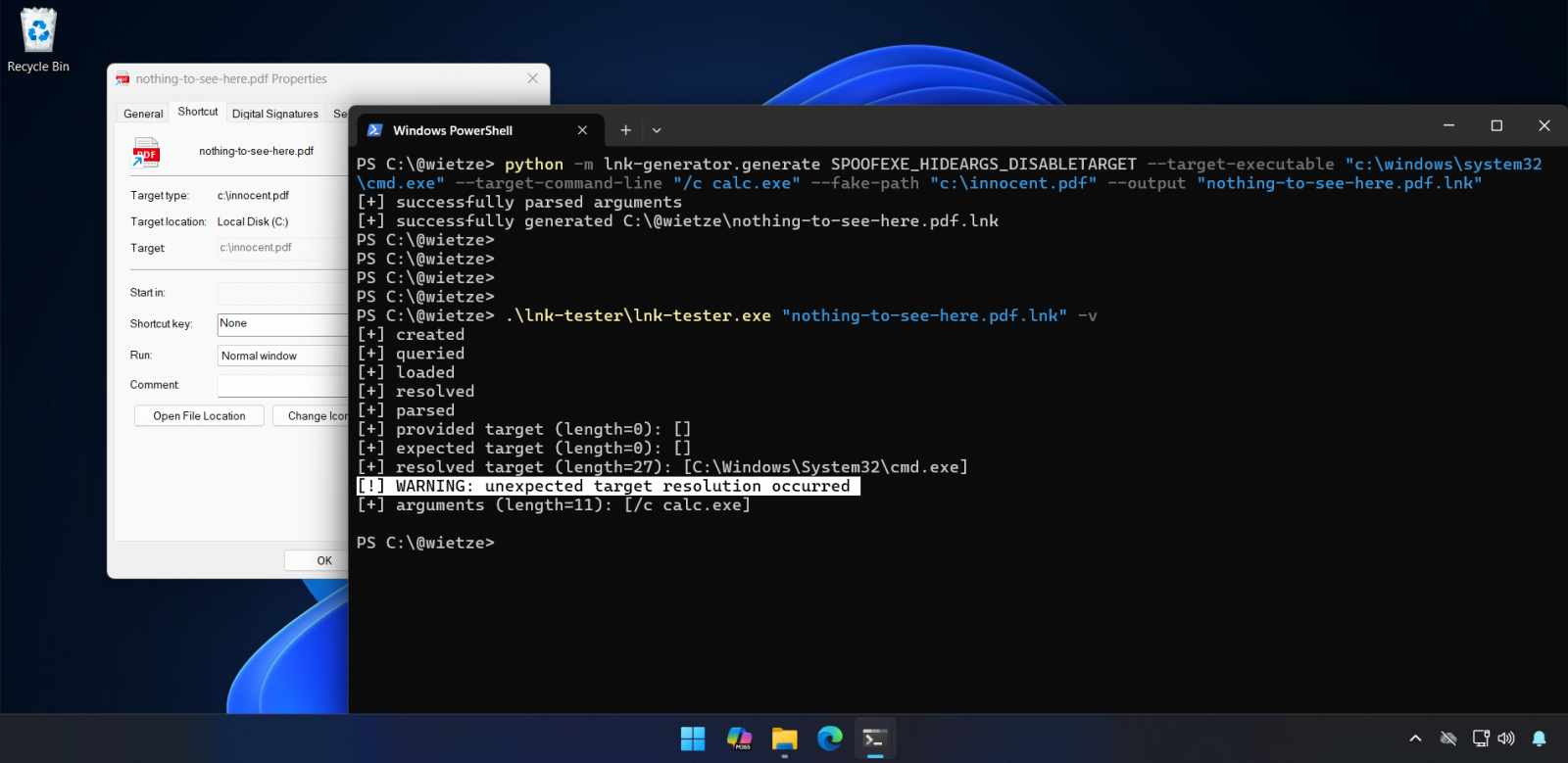
The researcher has also released “lnk-it-up,” an open-source tool suite that generates Windows LNK shortcuts using these techniques for testing and can identify potentially malicious LNK files by predicting what Explorer displays versus what actually executes.
lnk-it-up generating and testing a LNK file (W.J.B. Beukema)
MSRC: Not a vulnerability
When Beukema submitted the EnvironmentVariableDataBlock issue to the Microsoft Security Response Center in September (VULN-162145), Microsoft declined to classify it as a security vulnerability, arguing that exploitation requires user interaction and does not breach security boundaries.
“These techniques do not meet the bar for immediate servicing under our severity classification guidelines as they require an attacker to trick a user into running a malicious file,” a Microsoft spokesperson told BleepingComputer when asked whether the company plans to address any of the flaws.
“Microsoft Defender has detections in place to identify and block this threat activity, and Smart App Control provides an additional layer of protection by blocking malicious files from the Internet. As a security best practice, we strongly encourage customers to heed security warnings and avoid opening files from unknown sources.”
Microsoft also noted that Windows identifies shortcut files (.lnk) as potentially dangerous and, when attempting to open a .lnk file downloaded from the Internet, automatically triggers a security warning advising users not to open files from unknown sources. Microsoft strongly recommends heeding this warning.
However, Beukema added that “there is a reason attackers still like LNK files – users quickly click through these sorts of warnings. Otherwise, CVE-2025-9491 wouldn’t have been as ‘successful’ as it was either.”
CVE-2025-9491, the security vulnerability mentioned by the security researchers, is similar to the issues Beukema discovered and can be exploited to hide command-line arguments by using excessive whitespace padding. Cybercrime groups and state-backed hacking groups from North Korea, Iran, Russia, and China have been abusing this security flaw for years in zero-day attacks.
While initially Microsoft said that CVE-2025-9491 doesn’t break security boundaries and refused to fix the issue, it silently changed LNK files in June 2025 in an apparent effort to mitigate this actively exploited vulnerability.
As Trend Micro threat analysts revealed in March 2025, CVE-2025-9491 was already being widely exploited by at least 11 state-sponsored groups and cybercrime gangs, including Evil Corp, Bitter, APT37, APT43 (also known as Kimsuky), Mustang Panda, SideWinder, RedHotel, Konni, and others.
Cybersecurity firm Arctic Wolf also reported in October that the Mustang Panda Chinese state-backed hacking group was exploiting this Windows vulnerability in zero-day attacks targeting European diplomats in Hungary, Belgium, and other European nations to deploy the PlugX remote access trojan (RAT) malware.
Modern IT infrastructure moves faster than manual workflows can handle.
In this new Tines guide, learn how your team can reduce hidden manual delays, improve reliability through automated response, and build and scale intelligent workflows on top of tools you already use.
When India and Pakistan meet in the T20 World Cup on Sunday, the match will not just be significant for its on-field cricket action but also the political climate that has shrouded the encounter and the tournament itself.
The South Asian nations share a decades-old history of wars and hostile relations. The most recent encounter came in May 2025, when the nuclear-armed neighbours were engaged in a four-day cross-border conflict.
Recommended Stories
list of 4 itemsend of list
This 78-year-old bitter history has fuelled the sporting rivalry, which has – at times – led to tournament boycotts, cancelled matches and ground invasions.
Players from both teams have often been involved in heated encounters on the field, but have also publicly shared lighter moments off it.
However, the lingering hostility of the last conflict has made a severe and long-term impact on cricket, which is the most widely followed sport in South Asia.
We look back at the deteriorating cricket relations between India and Pakistan since the May conflict and the on-field events steeped in politics:
September 14 – No handshake row
The controversy began when India’s Suryakumar Yadav opted out of the customary pre-toss captains’ handshake with Pakistan’s Salman Ali Agha, prompting fans to wonder if politics were at play.
The doubts were cleared at the end of the match when, after hitting the winning runs, Yadav and his batting partner Shivam Dube walked off the field without approaching the Pakistani captain and team for the traditional post-match handshakes.
Pakistan’s players trudged off in a group and waited for the Indian squad, but the Indian contingent only shook hands with each other before walking into their dressing room and shutting the door as the waiting Pakistan players looked on.
Later, Yadav confirmed that his team had planned to not shake hands with Pakistani players all along, linking it to the April 22 attack in Indian-administered Kashmir that preceded the May conflict.
“A few things in life are above sportsman’s spirit,” the 35-year-old said.
India’s captain Suryakumar Yadav walks off after the toss as his Pakistan counterpart Salman Agha watches on before the start of their Asia Cup 2025 game [Sajjad Hussain/AFP]
September 17 – Pakistan refuse to take the field against UAE
The fallout of the handshake row carried over into Pakistan’s next group game in the Asia Cup, when they refused to take the field against the UAE in protest against match referee Andy Pycroft.
Pakistan insisted that Pycroft be removed from their fixture as he was the key official in the India match and helped carry out India’s request that the captains not shake hands at the toss.
“Andy Pycroft had barred the captains of India and Pakistan from shaking hands during their match,” the Pakistan Cricket Board (PCB) said in a statement.
The Pakistan-UAE match was delayed by an hour as negotiations took place behind closed doors, and Pycroft apologised for the “miscommunication”.
Pakistan’s captain Salman Agha and team manager Naveed Akram Cheema speak before the start of the match against the United Arab Emirates [File: Sajjad Hussain/AFP]
September 21 – Players exchange heated words, make references to conflict
When the teams met for the second time in the Asia Cup, players from both sides were seen exchanging verbal blows in the middle of the pitch.
Pakistan’s Haris Rauf had a go at India’s batter Abhishek Sharma, who later said his match-winning innings of 74 runs was a response to Pakistani players.
“The way they were coming at us without any reason, I didn’t like it at all,” Sharma said after the match.
Rauf was also seen making gestures towards the Indian supporters while fielding on the boundary. He held up his hands to indicate the numbers six and zero, a reference to Pakistan’s claim of downing six Indian jets during the May conflict.
The fast bowler also made gestures indicating an aircraft nosediving into the ground.
Following the match, the Board of Control for Cricket in India (BCCI) lodged a complaint with the International Cricket Council (ICC) against Rauf and Pakistani batter Sahibzada Farhan, who marked his half-century with a mock gun celebration.
Pakistan, too, lodged a complaint against India’s captain Yadav for using his post-match press comments to mention the Indian missile attacks in Pakistan.
Pakistan’s Haris Rauf speaks with India’s Abhishek Sharma, second left, as Shubman Gill watches during the Asia Cup match [File: Sajjad Hussain/AFP]
September 28 – India refuse to receive trophy from Pakistani official
The controversial tournament peaked in the final when India, who beat Pakistan by five wickets, refused to accept the Asia Cup trophy because it was presented by Mohsin Naqvi, who is the Asian Cricket Council (ACC) president as well as the chairman of the PCB.
Naqvi is also Pakistan’s federal interior minister.
“We have decided not to take the Asia Cup trophy from the ACC chairman, who happens to be one of the main [political] leaders of Pakistan,” Devajit Saikia, the chairman of the Board of Control for Cricket in India (BCCI), said.
The final award presentation was delayed by more than an hour due to India’s refusal and Naqvi’s insistence on presenting the trophy. The Indian team celebrated by pretending to hold a trophy.
India’s captain Yadav added it was the team’s decision to refuse the trophy and “no one told us to do it”.
India’s captain Suryakumar Yadav pretends to hold the trophy as his team celebrates their victory at the end of the Asia Cup 2025 final [File: Sajjad Hussain/AFP]
October 5 – Handshake row hits Women’s Cricket World Cup
When India and Pakistan faced off at the ICC Women’s World Cup 2025 in Sri Lanka, the Indian women’s team followed the precedent set by the men’s side by not offering to shake hands with the opposition.
India’s captain Harmanpreet Kaur and her Pakistani counterpart Fatima Sana walk past each other after the toss at their ICC Women’s Cricket World Cup 2025 match in Sri Lanka [Ishara S Kodikara/AFP]
November 4 – ICC sanctions Indian and Pakistani players for on-field behaviour
Five weeks after the conclusion of the Asia Cup, the ICC said Rauf, Farhan and Yadav had been found guilty of breaching its code of conduct and bringing the game into disrepute.
Yadav and Rauf were fined 30 percent of their match fees from the September 14 match and received two demerit points each, while Farhan walked away with a warning and one demerit point.
Rauf was found guilty of the same offence in the final and handed the same punishment, which led to a two-match ban on him.
Meanwhile, Indian pacer Jasprit Bumrah, who displayed a plane-crashing celebration of his own in the final, was also found guilty and handed one demerit point.
Jasprit Bumrah celebrates the wicket of Haris Rauf during the Asia Cup final [Altaf Qadri/AP]
January 25 – Pakistan casts doubt on T20 World Cup participation
Following Bangladesh’s ouster from the T20 World Cup, Pakistan said it would reconsider its own presence at the tournament.
“The prime minister is not in Pakistan right now. When he returns, I’ll be able to give you our final decision,” PCB chief Naqvi said.
February 1 – Pakistan announces boycott of India match
In an unprecedented decision at a World Cup, Pakistan’s government said its team would not take the field against India on February 15.
A few days later, Pakistan’s Prime Minister Shehbaz Sharif revealed the move was an act of solidarity with Bangladesh.
February 9 – Pakistan reverses boycott
More than a week later, Pakistan reversed its decision and said its cricket team had been ordered to take the field in the match on Sunday.
Pakistan’s government said it had “reviewed formal requests extended by the Bangladesh Cricket Board, as well as the supporting communications from Sri Lanka, the United Arab Emirates, and other member nations”, which sought “a viable solution to recent challenges”, referring to its decision to boycott the game.
“This government has cut waiting lists by more than 330,000, with hundreds of thousands more people treated within 18 weeks. That’s not happening by chance – it’s because we delivered record levels of care in 2025.”
That’s what Health Secretary Wes Streeting told us on Thursday, celebrating the fact that there are now 7.3 million cases on the NHS England elective treatment waiting list.
That waiting list remains 2.7 million cases longer than it was before COVID, and almost double what it was ten years ago.
But as Mr Streeting says, it’s down 330,000 in the 18 months since his party came to government. In the final year and a half of Rishi Sunak’s government, it rose by more than 400,000.
While that improvement is welcome, not all of what Mr Streeting said is strictly true. Not all of the fall in the number waiting is because the NHS delivered record levels of care in 2025.
A significant proportion is because Labour has incentivised NHS Trusts to improve “validation” efforts – checking the list and removing cases that don’t need to be there, even if they have not actually received any NHS care.
These cases are known as “unreported removals” and they are not recorded in any official NHS data.
Sky News analysis reveals that there have been 4.6 million such cases in the 18 months since Labour came to power, up from 4.3 million during the final 18 months of the previous government.
The increase in unreported removals is responsible for about 17% of the total change in direction of the waiting list, with 83% thanks to increased clinical activity.
If the number of unreported removals had remained the same as it was under the Conservatives, the waiting list would still have fallen, but by 110,000 rather than 330,000.
Three of the most prominent UK health thinktanks – the Health Foundation, Nuffield Trust and The King’s Fund – all told Sky News that while they welcome the fall to the waiting list, sustained improvements need to come from increased activity rather than data cleaning exercises.
Each of them also criticised the lack of transparency around the unreported removals data.
Responding to the comments, Chris Roebuck, head of profession for statistics at NHS England, said: “Unreported removals have accounted for around 15% of patients who come off the waiting list for decades – they are actually lower now than before the pandemic and it is the record level of operations, tests and scans being delivered by NHS staff that is now getting the waiting list down.
“Validation is not new and does not mean patients miss out on care – it is a routine clinical process that ensures people needing specialist care aren’t stuck behind patients left on the list in error or who no longer need treatment.”
Record highs for “trolley waits” at A&E
Other data released by the NHS on Thursday reveals that the state of NHS England emergency care in January was by one measure the worst since records began.
More than 71,000 people had “trolley waits” longer than 12 hours in January. A trolley wait is a wait to be admitted to hospital after a decision had been made in A&E that the patient needed to be admitted.
That’s the highest number since current records began in 2010, and more in one month than the total number of 12 hour waits recorded over more than eleven years between August 2010 and November 2021.
There were also more than 160,000 trolley waits longer than four hours in January, which was also the highest monthly figure on record.
The Data x Forensics team is a multi-skilled unit dedicated to providing transparent journalism from Sky News. We gather, analyse and visualise data to tell data-driven stories. We combine traditional reporting skills with advanced analysis of satellite images, social media and other open source information. Through multimedia storytelling we aim to better explain the world while also showing how our journalism is done.
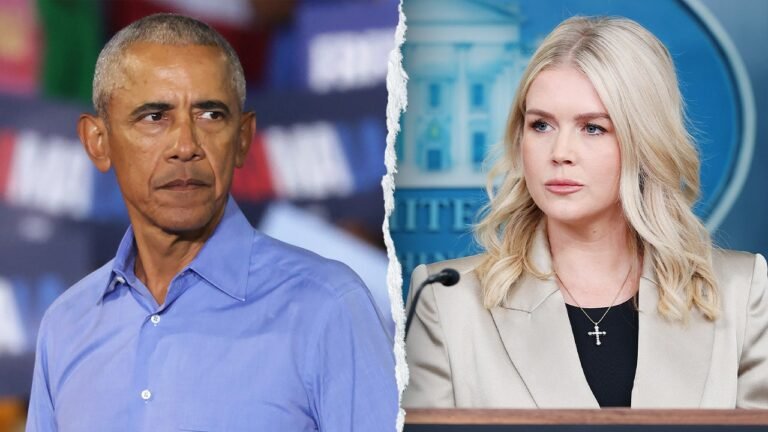
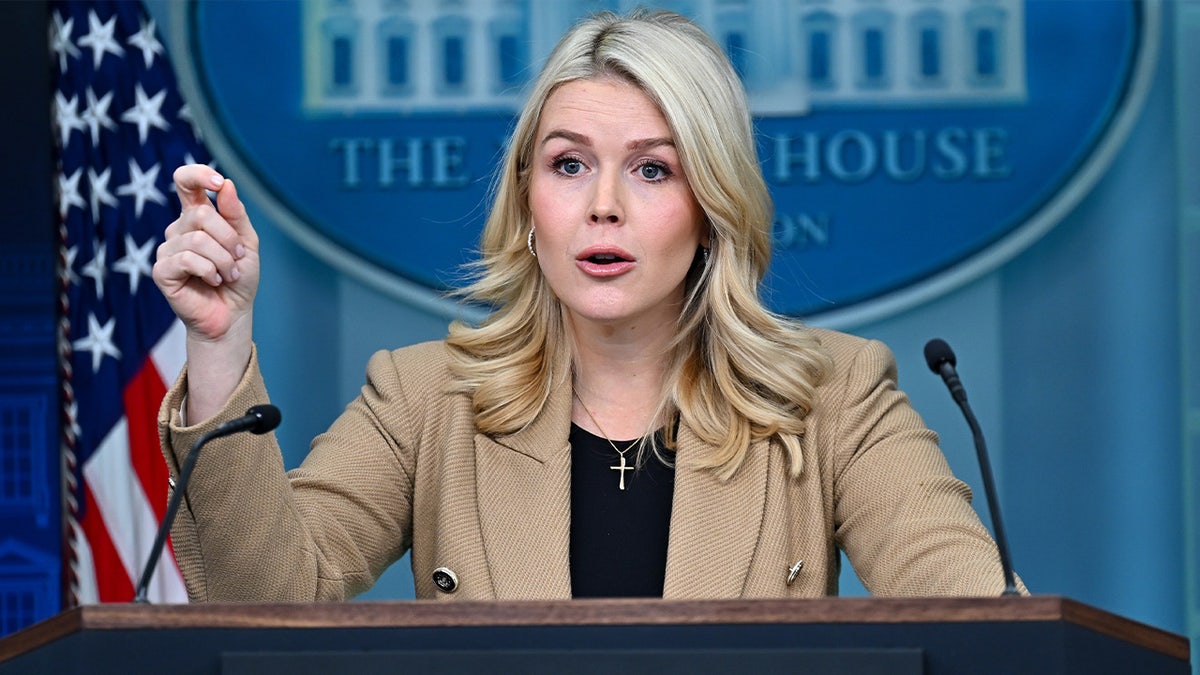
White House press secretary Karoline Leavitt is making an example of former President Barack Obama for encouraging voters and lawmakers to reject adopting national voter ID laws.
“You know how badly the Democrats are panicking when they bring out Obama to spread lies about voter ID,” Leavitt posted to X Thursday. “The fact is that nearly 90% of voters support” voter ID laws, she continued before posting two screenshots showing two polls reflecting Americans support such laws at around 83% support to 84% support.
Leavitt’s comments follow the House passing a massive election integrity overhaul bill Wednesday, which includes requiring voters to show a photo ID when casting ballots in federal elections. The bill overall aims to prevent noncitizens from voting in U.S. federal elections, with all but one Democrat, Rep. Henry Cuellar, D-Texas, voting against it.
Obama was among prominent Democrats encouraging House lawmakers to vote against the measure, claiming it will disenfranchise voters.
White House press secretary Karoline Leavitt is making an example of former President Barack Obama for encouraging voters and lawmakers to reject adopting national voter ID laws. (Graeme Sloan/Getty Images)
“Republicans are still trying to pass the SAVE Act—a bill that would make it harder to vote and disenfranchise millions of Americans,” he posted to X Wednesday evening. “Join @RedistrictAct and tell your member of Congress to vote no.”
Democrats have argued that voter ID laws can disenfranchise eligible voters because they often require specific, current government-issued IDs that may be a struggle to obtain due to costs, paperwork hurdles or limited DMV access. Republicans have rejected that argument, calling the requirement a common-sense safeguards that would boost confidence in elections, while simultaneously noting that most Americans already need IDs for everyday tasks.
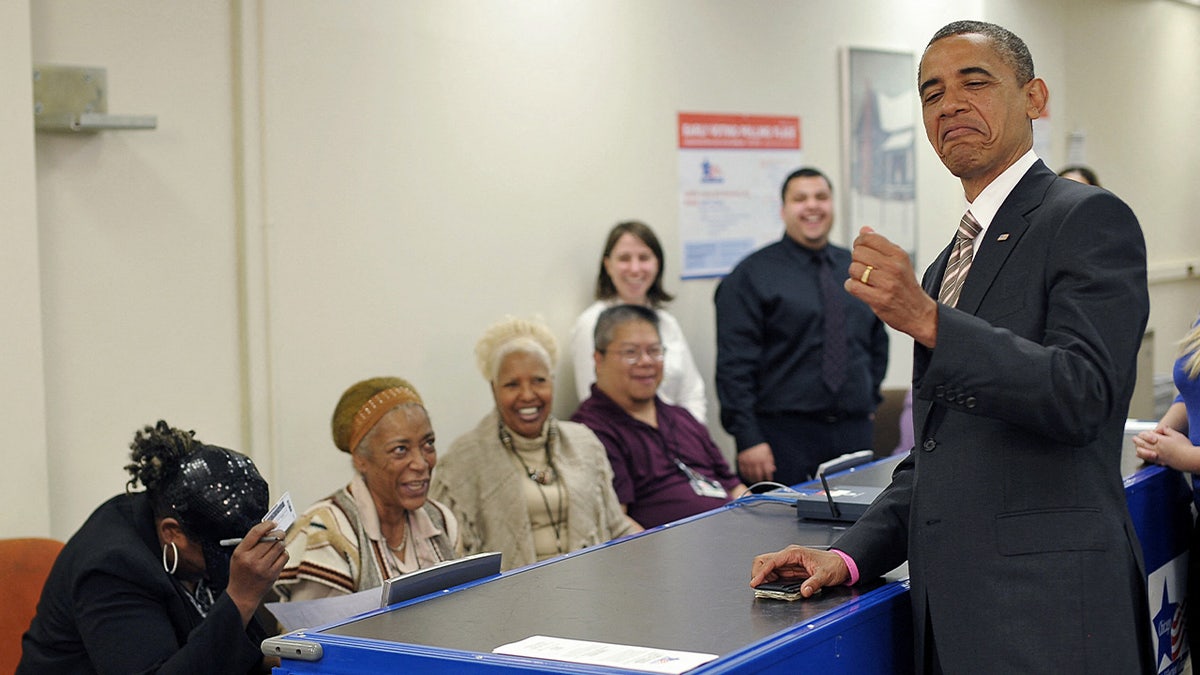
In another post, Leavitt shared that Obama presented his own driver’s license to vote in the 2012 election. Obama voted early that cycle and was seen on camera pulling his Illinois driver’s license from his wallet to flash to poll workers.
Then-President Barack Obama jokes with election worker Marie Holmes, left, who double-checked his photo on his driver’s license as he signed in for early voting Oct. 25, 2012, at the Martin Luther King Community Center in Chicago.(Mandel Ngan/AFP/Getty Images)
“Here is Barack Obama showing his photo ID to vote in a past election,” Leavitt posted. “Why are Democrats in Congress so opposed to making this a requirement across the country? Voter ID laws are common sense.”
White House spokeswoman Taylor Rogers added that IDs are frequently used by Americans to buy alcohol or get on a plane, which she said shows the hypocrisy of Democrats pushing against the election security overhaul.
“Barack Obama and the rest of the Democrats think Americans are stupid, which is why they are blatantly lying about the commonsense election integrity provisions in the popular SAVE Act,” Rogers told Fox News Digital.
“Americans need to show ID to buy alcohol, get on a plane, and even get into the Democratic National Convention — but these hypocrite Democrats don’t want voters to show their ID to cast a ballot. Congressional Democrats’ opposition to the SAVE America Act is indefensible and wildly out of step with the views of the American people.”
Fox News Digital reached out to Obama’s office Thursday for comment but did not immediately receive a reply.
Democrats have argued that voter ID laws can disenfranchise eligible voters because they often require specific, current government-issued IDs that may be a struggle to obtain due to costs, paperwork hurdles or limited DMV access.(Mark Kauzlarich/Bloomberg via Getty Images)
Called the SAVE Act, the legislation would additionally require information-sharing between state election officials and federal authorities in verifying citizenship on current voter rolls, as well as enable the Department of Homeland Security to pursue immigration cases if non-citizens were found to be listed as eligible to vote.
If passed, the new requirements could be implemented for the November midterm elections. It must first pass the Senate before it could land on President Donald Trump‘s desk.
Police have said they were called on multiple occasions to the home of the teenage suspect behind one of Canada’s deadliest school shootings after concerns were raised regarding mental health problems and weapons.
Six people, including a teacher and five children, were killed in a school shooting on Tuesday in the western Canadian town of Tumbler Ridge. About 25 other people were injured and two of them remain in critical but stable condition.
The suspect’s mother and step-brother were also found dead at the family home, while the suspected shooter was found at the school with a self-inflicted gunshot wound, the authorities said. Police later identified the suspect as Jesse Van Rootselaar, 18.
The office of the country’s prime minister, Mark Carney, said he would visit the small town of Tumbler Ridge, home to about 2,400 people, on Friday.
The people of Tumbler Ridge have been left in shock by the violent attack. Photograph: Paige Taylor White/AFP/Getty Images
Police said the motive for the attack remained unclear and that the investigation was still in its infancy. The family was known to authorities, Dwayne McDonald, a deputy commissioner of the Royal Canadian Mounted Police (RCMP), told reporters on Wednesday.
“Police had attended that residence on multiple occasions over the past several years dealing with concerns of mental health with respect to our suspect,” McDonald said. On different occasions the suspect had been apprehended under the country’s mental health act for assessment and follow-up, he added.
McDonald also said that at least one of the interactions with police related to weapons. “Police have attended that residence in the past, approximately a couple of years ago, where firearms were seized under the criminal code,” he said. “At a later point in time, the lawful owner of those firearms petitioned for those firearms to be returned and they were.”
The suspect had a firearms licence that had expired in 2024 and did not have any firearms registered in her name, he said.
Investigators attend Ridge secondary school, where the shooting took place, on Wednesday. Photograph: Eagle Vision Agency/AFP/Getty Images
With people across Canada horrified by the attack, questions were raised as to why firearms had been returned to a home where police had been called to attend to mental health concerns.
“I have a lot of questions,” the premier of British Columbia, David Eby, told reporters on Wednesday. “I know the people of Tumbler Ridge have a lot of questions.”
The former RCMP officer Sherry Benson-Podolchuk told the Canadian Broadcasting Corporation(CBC) that for police to have proceeded differently, Canada would need to change its laws to allow officers to seize firearms if they spot them while carrying out a mental health check.
The victims included Abel Mwansa Jr, according to local media reports. “I can’t handle this pain,” his mother, Bwalya Chisanga, wrote on Facebook. “In the morning my son went to school around 8:20am. The last word he said to me was, ‘Tell dad to come and pick (me up) at church when he comes back from work’.”
His father, Abel Mwansa, described him as a child with a scientific mind and bright future, who loved carrying out experiments. “If I had power to give life, I would have brought you back to life together with others that were killed alongside you,” he wrote on Facebook. “But, son, my power is limited, and seeing your child murdered at this age is heartbreaking.”
The family of Kylie Smith, 12, also said she had been killed in Tuesday’s shooting. She was the “light of her family,” her dad, Lance Younge, told CTV News. “She was just a beautiful soul. She loved art and anime. She wanted to go to school in Toronto and we just loved her so much. She was thriving in high school. She never hurt a soul.”
He urged people to keep the focus on the victims, many of whom had lost their lives before they were teenagers. “You want to put someone’s picture up on the news?” he said. “Put my daughter’s picture up.”
British Columbia school shooting ‘one of the worst’ in Canada’s history, officials say – video
Those killed on Tuesday included two people in a home residence that police said was linked to the suspect. Police later identified the two people as Van Rootselaar’s mother, 39, and 11-year-old step-brother. The CBC identified Van Rootselaar’s mother as Jennifer Strang.
Social media posts suggested a close-knit family where birthdays were celebrated and the children’s interests were championed. In 2021, Van Rootselaar’s mother linked to the suspect’s now-deleted YouTube channel, saying the posts were about “hunting, self reliance, guns and stuff”.
Court documents from 2015 obtained by the CBC said Strang and her children had “led an almost nomadic life”, moving across Canada multiple times in the last five years.
Speaking on Wednesday, police said they had “identified the suspect as they chose to be identified” in public and on social media. “I can say that Jesse was born as a biological male who, approximately six years ago, began to transition to female and identified as female, both socially and publicly,” said McDonald.
After an independent provincial legislator in British Columbia claimed, without evidence, that the shooting rampage was related to the suspect’s gender identity, campaigners and gun violence experts warned against generalising an entire demographic based on the actions of one person.
In the US, the Gun Violence Archive has said less than 0.1% of mass shootings between 2013 and 2025 were carried out by transgender people.
Instead, research suggests that transgender people are more than four times more likely to be the victims of crimes, including sexual and aggravated assault, than cisgender people.
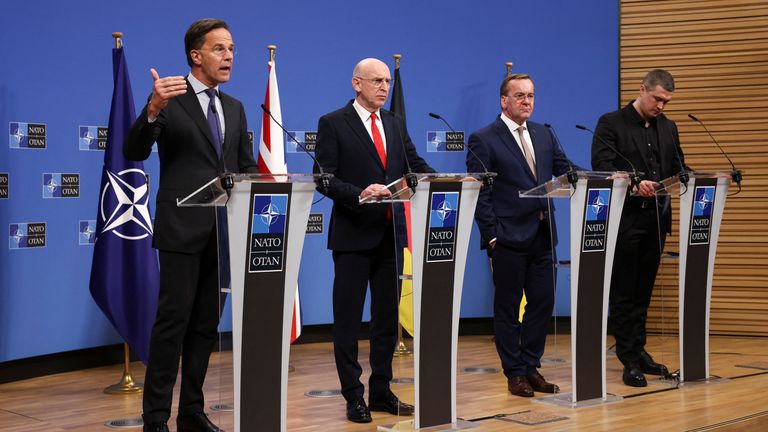
The UK and its European allies are scrambling to get serious about their own defences as Donald Trump, Xi Jinping and Vladimir Putin shape a new world order.
You can expect to hear multiple declarations from European leaders, including Sir Keir Starmer, about their respective plans to ramp up spending on defenceand security at a major security conference in Munich over the next three days.
But the key indicator to track is evidence of the rhetoric becoming cold, hard fighting reality.
It is certainly what the United States will be looking for – a form of scrutiny that became clear at a separate meeting of defence ministers from the NATOalliance in Brussels on Thursday.
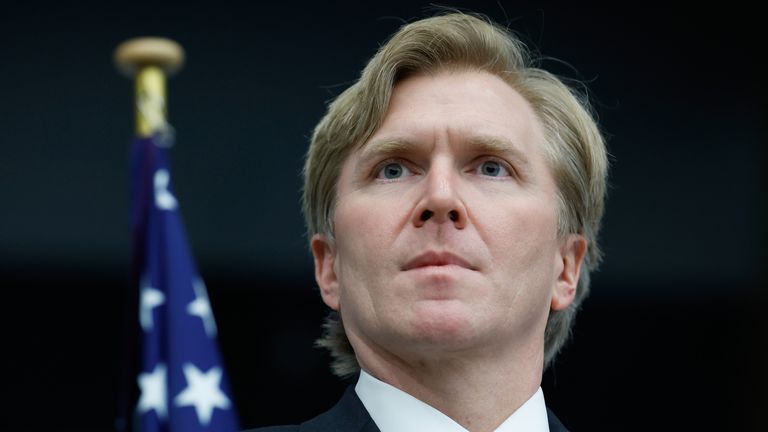
Elbridge Colby, the US under secretary of war policy – a deputy to Pete Hegseth who chose to miss the gathering in what some insiders saw as a signal of the US reducing the priority it places on its NATO membership, though others denied this was the case – delivered a striking speech to allies.
He said Europe must take the lead in defending itself, but – in words that will come as some relief to his counterparts – stressed that the US was not abandoning NATO.
Image:Elbridge Colby, the deputy of Pete Hegseth, took the US defence secretary’s place. Pic: Reuters
“The world that shaped the habits, assumptions, and force posture of NATO during the so-called ‘unipolar moment’ following the Cold War no longer exists,” Mr Colby said.
“Power politics has returned, and military force is again being employed at a large scale.”
The Trumpadministration official said his message was about giving a reality check to his partners, about the need to turn a pledge made at a major NATO summit last year to increase total defence and security spending to 5% of GDP into viable military capability.
“For Europe, it means moving beyond inputs and intentions toward outputs and capabilities,” Mr Colby said.
“Defence spending levels matter, and there is no substitute for it. But what matters at the end of the day is what those resources produce: ready forces, usable munitions, resilient logistics, and integrated command structures that work at scale under stress.
“It means prioritising war-fighting effectiveness over bureaucratic and regulatory stasis. It means making hard choices about force structure, readiness, stockpiles, and industrial capacity that reflect the realities of modern conflict rather than peacetime politics.”
Image:‘Defence spending levels matter, and there is no substitute for it’, Colby said. Pic: AP
These words should be triggering alarm bells in London and other – in particular Western – European capitals that have for too long relied on spin over substance when it comes to talking about defence.
The spending pledge last year comprises a commitment to increase spending on core defence to 3.5% of GDP by 2035, up from a target of 2%, with an additional 1.5% of GDP to be spent on an ill-defined bucket of wider security measures.
Donald Trump applauded the move, which he rightly received credit for forcing through. However, the US president talks as though those levels of defence spending have already been met.
In reality, many allies are planning to take advantage of the full ten-year timespan to reach the target – including the UK, even though it is a leading member of the alliance and a key partner of the United States.
Image:Pic: Reuters
Mr Starmer’s government is only planning to inch up core defence spending to 2.5% of GDP by next year, lift it to 3% by the next parliament, and only reach the full 5% by 2035.
Defence sources say this is far too slow given the scale of the challenge to rebuild the UK’s armed forces as well as wider national resilience.
It is also, as Mr Colby said, not just about how much money a country spends but what the cash is spent on and whether input translates to credible military output.
Again, on that point, the UK is seen to be falling short.
A plan for defence investment – due to be published last year – is yet to be revealed amid reports of a £28bn hole in the budget over the next four years.
At a press conference following the NATO conference, I asked John Healey, the defence secretary, if the UK was failing to meet the moment.
He strongly pushed back on this suggestion. “The UK has always met its commitments to funding NATO,” he said.
“The UK is putting more money into defence this year than it has done for 15 years – £270bn in this parliament alone. This is the largest increase since the end of the Cold War.”
But given that defence spending across NATO was repeatedly cut following the collapse of the Soviet Union, this is perhaps not the best measure to judge whether what is being spent now is actually enough. And many believe that it is not.