A third of Republicans would be less likely to vote in the midterms if they believe that the GOP has abandoned the abortion issue, according to a poll released on Thursday. The findings emphasize a perceived rift between pro-life advocates and the Trump administration, given the position of Health and Human Services (HHS) Secretary Robert F. Kennedy Jr.
John Rogers, a senior partner at Cygnal, a public opinion data firm that conducted the poll, said that their work proves abortion is still a “north star” topic for much of the Republican base.
“It’s a bedrock issue for Republican primary voters for decades,” Rogers said. “This is at the core of their worldview.”
In a memo accompanying the release of their findings, Rogers said voters specifically expressed disappointment with Kennedy over an HHS policy that enables continued access to abortion drugs through the mail.
Robert F. Kennedy Jr., US secretary of Health and Human Services (HHS), during a news conference on Dec. 18, 2025.(Stefani Reynolds/Bloomberg via Getty Images)
“Voters are overwhelmingly committed to pro-life principles, but frustrated with federal health agencies’ abortion policies under HHS Secretary Robert F. Kennedy Jr. The national data show a significant disconnect between base Republican voter expectations and current federal actions, creating real enthusiasm risks for the November midterm general election,” the memo states.
According to Cygnal’s findings, 32% of GOP voters said they will have decreased enthusiasm for voting in the midterm election “if Republican leaders weaken or abandon pro-life policies.”
That number overlaps with the 36% of the “most engaged” portion of the voter base.
Pro-life demonstrators hold a banner as they gather in front of the U.S. Supreme Court building during the annual March for Life rally, in Washington, D.C., Jan. 24, 2025. (Evelyn Hockstein/Reuters)
Marjorie Dannenfelser, the president of Susan B. Anthony Pro-Life America, a pro-life advocacy group, said Kennedy is risking turning that prediction into a reality by continuing mail-access to abortion drugs, a policy response to the COVID-19 pandemic.
“In failing to repeal Biden’s COVID mail order rule, [he] runs counter to the MAHA base,” Dannenfelser said on Thursday.
“51 senators, 145 representatives and 22 attorneys general have called for the end of mail-order abortion drugs and the immediate restoration of in-person dispensing,” Dannenfelser said.
On that issue specifically, Cygnal’s polling indicated that 80% of respondents overall believed that the FDA should require in-person visits to secure an abortion.
“They see a dissonance there,” Rogers said of Kennedy’s decision to continue the mail-order policy.
Health and Human Services Secretary Robert F. Kennedy Jr. speaks during an announcement addressing mental health and addiction initiatives in Washington, D.C., on Feb. 2, 2026.(Graeme Sloan/Bloomberg via Getty Images)
“I think they see the broader MAHA movement as an extension of their pro-life commitments.”
Dannenfelser warned that if voters don’t feel like the administration has moved in the right direction, Republicans could stand to lose their current grip on a governing trifecta.
“There is no amount of money that can overcome a reluctant voter base that sees failed action. What we might see is a loss in the House. Everyone assumes the Senate is fine. I would not assume that,” Dannenfelser said.
“I have no doubt that if we lose, the pro-life movement will be blamed No. 1,” she added.
Leo Briceno is a politics reporter for the congressional team at Fox News Digital. He was previously a reporter with World Magazine.
Written by Ivan Milenkovic, Vice President Risk Technology EMEA, Qualys
For the better part of the last decade,we have engaged in a comfortable fiction around security and development. If we could only “shift left” and get developers to take a modicum more responsibility for security alongside their coding, testing and infrastructure deployment, the digital world would become a safer, faster and cheaper place. Instead, the fundamental conflict between speed and security has got worse.
Why did this fail? Developers are under crushing pressure. The classic triangle of project management – Fast, Good, Cheap; pick two – has been smashed to pieces.
Businesses demand fast, good, cheap and secure. When push comes to shove, “fast” always wins. At the same time, we pushed too much cognitive load onto developers who were already drowning.
When they choose to use public container images to speed up development, they are trying to meet their goals, but they are also open to potential risk. So how can we understand what the real problem is, and then work to solve that?
Business demands beat security recommendations
There is a pervasive narrative in the security industry that developers are lazy or careless. This is absolutely not true. Developers are not lazy; they are overloaded, pragmatic professionals reacting to the incentives placed before them. If their bonus depends on shipping features by Friday and the security scan takes four hours to run and blocks the build, they will find a way around the scan.
Businesses demand results faster and faster, which has created an environment where security protocols are seen as a barrier to productivity rather than an integral part of engineering. When security tools are noisy, slow, and disconnected from the workflow, they are a barrier.
However, the result of this is that organisations have lost control of what is actually running in their environments. We have pipelines that deploy code automatically, infrastructure that scales up and down without human intervention, and AI agents that can now write and execute their own scripts.
Into this high-speed, automated chaos, we treat public registries like curated libraries, assuming that because an image is on Docker Hub, it must be safe. But pulling a container from a public registry like Docker Hub is a trust decision.
The likes of Docker, Amazon, Google and Microsoft all operate public container registries, so there is a natural assumption that they are safe.
This trust is misplaced. By the time that container image makes it to the deployment pipeline, it is already a trusted artifact, baked into the application.
The 2026 Forrester Wave™ for Cloud-Native Application Protection Platforms (CNAPP) provides objective analysis around cloud security.
Find out why Qualys is one of the leaders in the market today.
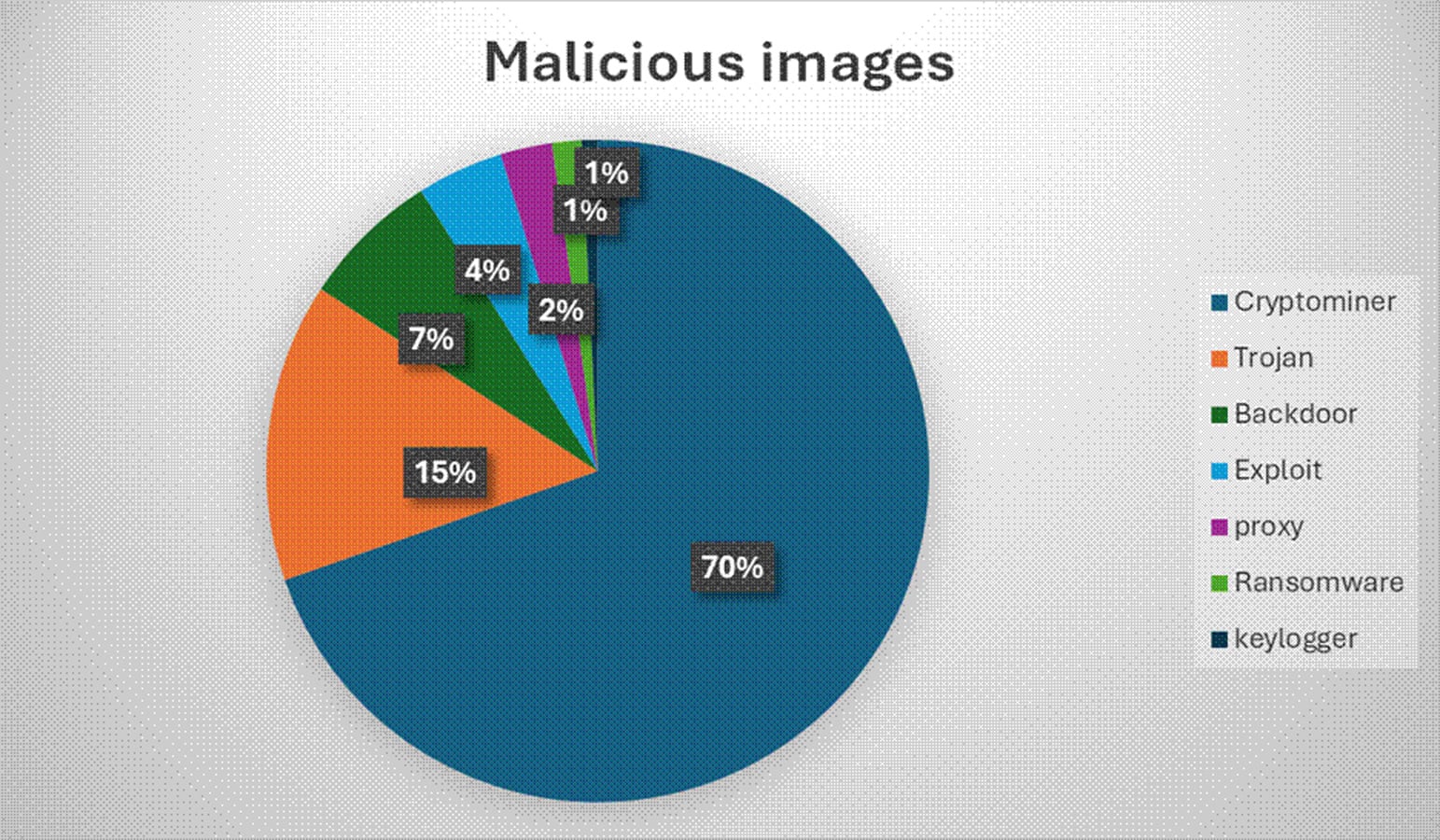
Of that total, around 2,500 images – approximately 7.3 percent of the sample – were malicious. Of the malicious images, 70 percent contained cryptomining software.
On top of this, 42 percent of images contained more than five secrets that could be used to get access to other resources or accounts. This includes valuable items like AWS access keys, GitHub API tokens, and database credentials baked directly into the image layers.
Qualys Research – make up of malicious images based on analysis of more than 2,500 confirmed malicious containers detected on DockerHub
In our analysis, the biggest issues around malicious containers are still very simple. Typosquatting is one of the most common methods that attackers use to get their malicious containers downloaded. The standard advice to “check the spelling” is essential, yes, but it is also a low-energy response to a high-stakes problem.
Telling a developer to “be more careful” is not a security strategy. While public registries are handy for speed, we should not be letting developers pull from public registries at all.
In a mature environment, every external image should be proxied through an internal artifact repository that acts as a quarantine zone. Yet that need for speed is not going to go away. Instead, we have to work on how to help developers move faster while keeping security in place.
This does mean more work for the infrastructure team, but that work should enable developers to move ahead faster and with less risk.
Shift down
The logic is that it is cheaper to fix a bug during design or coding than in production. Therefore, moving security earlier in the Software Development Life Cycle (SDLC) should reduce risks later. While this makes sense in theory, it asks developers to scan their own code, check their own dependencies, and manage their own infrastructure.
In reality, we just shifted the pain onward. It asks developers to manage vulnerabilities, configuration hardening, secret detection, compliance auditing, and so on. At the same time, those developers are measured primarily on feature velocity.
“Shift left” was supposed to make security collaborative. Instead, it simply moved the problem into every developer’s IDE. To fix this problem, we have to make security within infrastructure the default, rather than by design.
This involves real collaboration between developers and security – developers have to understand what they want to achieve and what will be required of what they build, while security will have to work around those requirements so they can be delivered securely. Both teams are responsible, but they both have to work at the speed that the business needs.
In practice, we can create a “golden path” for developers. If they use the standard templates, the pre-approved base images, and the official CI pipelines, security is free. If they want to go “off-road” and build something custom, then they have to do the additional work of security reviews and manual configurations.
This is also something that should be flagged back to the business from the start, so security and development present a united front around what the cost is.
Taking this approach incentivises secure deployment by making it the path of least resistance. It moves the responsibility down the stack to the infrastructure layer, managed by a specialised Platform Engineering team. And if something different is needed, that work can be done collaboratively to ensure it is right first time, rather than leading to more issues that need to be remediated.
For example, instead of asking a developer to please enable versioning on a specific S3 bucket, the platform team writes a policy using Terraform modules, Crossplane compositions, or Open Policy Agent that simply doesn’t allow a bucket to exist without versioning. The developer literally cannot make the mistake.
The platform corrects it automatically or rejects the request. Similarly, developers shouldn’t have to remember container scanning in their workflows, the CI pipeline should do it automatically. The admission controller should reject non-compliant images before they ever hit a cluster. The developer doesn’t need to know how the scan works, only that if they try to deploy a critical vulnerability, the door will be locked.
“Shift down” also means automating the fix. For instance if a vulnerability is found in a base image, the platform should automatically generate a Pull Request to upgrade it. If a runtime security tool detects a container behaving badly (e.g., spawning a shell for persistence), it shouldn’t just send an alert. It should kill the pod and isolate the node autonomously.
Rather than sticking with existing ways of running across security and development, we have to react to what is happening. This can mean we fundamentally change how we operate across teams.
If we continue with the “shift left” mentality of piling cognitive load onto developers, we will fail. We will burn them out, and they will bypass our controls simply so they can get what needs to be done for the business.
Instead, security has to be proactive around how to implement and support the right platforms for the business, so they can be made secure automatically.
Matt Goodwin, Reform UK’s candidate in the Gorton and Denton byelection, was accused by a young woman working at GB News of making inappropriate comments which she viewed as sexually harassing, the Guardian can reveal.
The junior staffer complained to HR last year alleging Goodwin had made inappropriate comments, one regarding her appearance, sources say. Goodwin, 44, volunteered an apology after the complaint had been raised.
The woman is understood to have complained to the network’s HR department in 2025. She later left the network for unrelated reasons.
Nigel Farage, the Reform UK leader, is understood to have been told by a senior member of staff at GB News about the complaint prior to Goodwin’s selection as the party’s candidate for next week’s byelection.
A number of sources have told the Guardian that they were aware of the woman’s complaint against Goodwin and that GB News had undertaken an inquiry into the complaint.
One source at the broadcaster said: “She was very upset at the time, and her colleagues were upset on her behalf that she was so distressed by the situation.”
Goodwin has denied acting inappropriately. A lawyer acting for him confirmed to the Guardian that a grievance had been raised. They said it related to two alleged verbal remarks made months apart and that no formal disciplinary action had been taken.
Get in touch
Contact us about this story
The best public interest journalism relies on first-hand accounts from people in the know. If you have something to share on this subject, you can contact us confidentially using the following methods:
Secure Messaging in the Guardian app
The Guardian app has a tool to send tips about stories. Messages are end to end encrypted and concealed within the routine activity that every Guardian mobile app performs. This prevents an observer from knowing that you are communicating with us at all, let alone what is being said.
If you don’t already have the Guardian app, download it (iOS/Android) and go to the menu. Select ‘Secure Messaging’.
SecureDrop
If you can safely use the tor network without being observed or monitored you can send messages and documents to the Guardian via our SecureDrop platform.
Our guide at theguardian.com/tips lists several ways to contact us securely, and discusses the pros and cons of each.
They said it was a “minor workplace matter” that had been resolved as a difference in perception or miscommunication. The investigator had found the young woman’s and Goodwin’s accounts of the situation were both credible, they said, giving Goodwin credit for offering an apology once the complaint had been raised.
Farage is understood to have decided the complaint was not serious enough to warrant a rethink about Goodwin’s selection. A source at GB News told the Guardian that Farage had characterised the complaint as “that is just Matt being Matt”.
Weeks after the complaint was raised, Goodwin was announced as the candidate for the byelection, which was triggered by the resignation of Andrew Gwynne for health reasons.
Goodwin has faced criticism during the campaign for comments he has made previously, including a 2024 suggestion that “young girls and women” should be given a “biological reality” check, described by the Labour MP Natalie Fleet as positing a “Handmaid’s Tale” future.
He has also been criticised for comments made last year on a podcast with the rightwing academic Jordan Peterson in which he said there had been a “feminisation of higher education”, after Peterson outlined this as a potential reason for “politically correct authoritarianism”.
Goodwin was described by some as a controversial choice for the byelection, after he claimed recently that UK-born people from minority ethnic backgrounds were not necessarily British. After announcing his candidacy, he was swiftly endorsed by the far-right agitator and convicted criminal Tommy Robinson.
In a blog entry written in 2023, Goodwin suggested the government should “remove personal income tax for women who have two or more children”.
Goodwin spent most of his career as an academic before turning his eye to politics. He has spoken at various Reform UK events over the last year, and he has a Substack blog with 90,000 followers where he posts essays detailing his views.
He left academia in 2024 when he took voluntary severance as a professor at the University of Kent.
Reform UK did not respond to a request for comment. Goodwin and GB News declined to provide an on-the-record comment.
Access Denied
You don’t have permission to access “http://hindi.gadgets360.com/ai/ai-cameras-save-270-elephants-in-odisha-near-railway-track-news-11113827” on this server.
The North American Aerospace Defense Command (NORAD) launched multiple U.S. fighter jets after tracking Russian military aircraft operating in the Alaskan Air Defense Identification Zone (ADIZ) on Thursday.
NORAD says it launched two F-16s, two F-35s, one E-3 and four KC-135s to “intercept, positively identify, and escort the aircraft until they departed the Alaskan ADIZ.”
“The Russian military aircraft remained in international airspace and did not enter American or Canadian sovereign airspace,” NORAD said in a press release. “This Russian activity in the Alaskan ADIZ occurs regularly and is not seen as a threat.”
Two Russian Tu-95s, two Su-35s, and one A-50 were identified in the ADIZ, though they did not enter American or Canadian sovereign airspace, according to NORAD.
U.S. F-16s, F-35s and support aircraft tracked and identified Russian bombers and fighters near Alaska as part of routine air defense operations in the strategically sensitive buffer zone.(Samuel King Jr./U.S. Air Force)
The ADIZ airspace is a designated region that requires strict identification procedures between U.S. and Russian aircraft operating in the area. It’s considered a buffer zone that acts as a boundary between the two countries.
“NORAD employs a layered defense network of satellites, ground-based and airborne radars and fighter aircraft to detect and track aircraft and inform appropriate actions. NORAD remains ready to employ a number of response options in defense of North America,” NORAD said in their statement on Thursday.
While this ADIZ isn’t sovereign U.S. airspace, the region is a strategic zone given its proximity to Russia. NORAD noted in their statement that the Russian activity that occurred on Thursday was not seen “as a threat.”
The military response comes as Kremlin spokesman Dmitry Peskov warned Iran and “all parties in the [Middle Eastern] region to exercise restraint and caution” as the U.S. continues to expand military presence overseas.
The world’s largest aircraft carrier, USS Gerald R. Ford, steams alongside USNS Laramie.(U.S. Naval Forces Central Command / U.S. 6th Fleet / Handout via Reuters)
“Russia continues to develop relations with Iran, and in doing so, we call on our Iranian friends and all parties in the region to exercise restraint and caution, and we urge them to prioritize political and diplomatic means in resolving any problems,” Peskov said Thursday, according to Reuters.
USS Gerald R. Ford, the world’s largest aircraft carrier, and its strike group were deployed from the Caribbean Sea toward the Middle East in early to mid-February.
The massive carrier was reportedly seen transiting through the Strait of Gibraltar into the Mediterranean Sea this month. USS Gerald R. Ford joins USS Abraham Lincoln and three guided-missile destroyers that also arrived in the Middle East in February.
President Donald Trump has demanded that Iranian Ayatollah Ali Khamenei abandon his nuclear ambitions and cease the suppression of protests.(Chip Somodevilla; Iranian Leader Press Office/Anadolu)
Alireza Jafarzadeh, deputy director of the Washington office of the National Council of Resistance of Iran (NCRI), said that satellite images show that the Iranian regime is attempting to restore “2 trillion” uranium enrichment capabilities at the Isfahan complex, despite talks between the Trump administration and the Middle Eastern country.
The U.S. Air Force and Navy strikes that occurred on June 22 targeted the Isfahan complex, as well as Fordow and Natanz.
In yet another software supply chain attack, the open-source, artificial intelligence (AI)-powered coding assistant Cline CLI was updated to stealthily install OpenClaw, a self-hosted autonomous AI agent that has become exceedingly popular in the past few months.
“On February 17, 2026, at 3:26 AM PT, an unauthorized party used a compromised npm publish token to publish an update to Cline CLI on the NPM registry: cline@2.3.0,” the maintainers of the Cline package said in an advisory. “The published package contains a modified package.json with an added postinstall script: ‘postinstall”: “npm install -g openclaw@latest.'”
As a result, this causes OpenClaw to be installed on the developer’s machine when Cline version 2.3.0 is installed. Cline said no additional modifications were introduced to the package and there was no malicious behavior observed. However, it noted that the installation of OpenClaw was not authorized or intended.
The supply chain attack affects all users who installed the Cline CLI package published on npm, specifically version 2.3.0, during an approximately eight-hour window between 3:26 a.m. PT and 11:30 a.m. PT on February 17, 2026. The incident does not impact Cline’s Visual Studio Code (VS Code) extension and JetBrains plugin.
To mitigate the unauthorized publication, Cline maintainers have released version 2.4.0. Version 2.3.0 has since been deprecated and the compromised token has been revoked. Cline also said the npm publishing mechanism has been updated to support OpenID Connect (OIDC) via GitHub Actions.
In a post on X, the Microsoft Threat Intelligence team said it observed a “small but noticeable uptick” in OpenClaw installations on February 17, 2026, as a result of the supply chain compromise of the Cline CLI package. According to StepSecurity, the compromised Cline package was downloaded roughly 4,000 times during the eight-hour stretch.
Users are advised to update to the latest version, check their environment for any unexpected installation of OpenClaw, and remove it if not required.
“Overall impact is considered low, despite high download counts: OpenClaw itself is not malicious, and the installation does not include the installation/start of the Gateway daemon,” Endor Labs researcher Henrik Plate said.
“Still, this event emphasizes the need for package maintainers to not only enable trusted publishing, but also disable publication through traditional tokens – and for package users to pay attention to the presence (and sudden absence) of corresponding attestations.”
Leveraging Clinejection to Leak Publication Secrets
While it’s currently not clear who is behind the breach of the npm package and what their end goals were, it comes after security researcher Adnan Khan discovered that attackers could steal the repository’s authentication tokens through prompt injection by taking advantage of the fact that it is configured to automatically triage any incoming issue raised on GitHub.
“When a new issue is opened, the workflow spins up Claude with access to the repository and a broad set of tools to analyze and respond to the issue,” Khan explained. “The intent: automate first-response to reduce maintainer burden.”
But a misconfiguration in the workflow meant that it gave Claude excessive permissions to achieve arbitrary code execution within the default branch. This aspect, combined with a prompt injection embedded within the GitHub issue title, could be exploited by an attacker with a GitHub account to trick the AI agent into running arbitrary commands and compromise production releases.
This shortcoming, which builds upon PromptPwnd, has been codenamed Clinejection. It was introduced in a source code commit made on December 21, 2025. The attack chain is outlined below –
Prompt Claude to run arbitrary code in issue triage workflow
Evict legitimate cache entries by filling the cache with more than 10GB of junk data, triggering GitHub’s Least Recently Used (LRU) cache eviction policy
Wait for the nightly publish to run at around 2 a.m. UTC and trigger on the poisoned cache entry
“This would allow an attacker to obtain code execution in the nightly workflow and steal the publication secrets,” Khan noted. “If a threat actor were to obtain the production publish tokens, the result would be a devastating supply chain attack.”
“A malicious update pushed through compromised publication credentials would execute in the context of every developer who has the extension installed and set to update automatically.”
In other words, the attack sequence employs GitHub Actions cache poisoning to pivot from the triage workflow to a highly privileged workflow, such as the Publish Nightly Release and Publish NPM Nightly workflows, and steal the nightly publication credentials, which have the same access as those used for production releases.
As it turns out, this is exactly what happened, with the unknown threat actor weaponizing an active npm publish token (referred to as NPM_RELEASE_TOKEN or NPM_TOKEN) to authenticate with the Node.js registry and publish Cline version 2.3.0.
“We have been talking about AI supply chain security in theoretical terms for too long, and this week it became an operational reality,” Chris Hughes, VP of Security Strategy at Zenity, said in a statement shared with The Hacker News. “When a single issue title can influence an automated build pipeline and affect a published release, the risk is no longer theoretical. The industry needs to start recognizing AI agents as privileged actors that require governance.”
The consultancy co-founded by Peter Mandelson has collapsed into administration, after a number of clients cut ties with the company over the former ambassador’s relationship with the convicted child sex offender Jeffrey Epstein.
Global Counsel, which Mandelson co-founded in 2010, said on Friday that it had stopped trading and its staff in the UK were being made redundant.
The London-based company employs about 100 people, the vast majority of whom are based in the UK. It also has employees in Berlin, Brussels, Doha and Singapore.
Administrators at Interpath said Global Counsel had “no option” but to enter administration after a number of its clients cut ties with the business, despite its attempts to distance itself from Mandelson and its other co-founder, Benjamin Wegg-Prosser.
The crisis hit Global Counsel after it emerged that Mandelson had sought Epstein’s advice on setting up the business in 2010, shortly after leaving office when Labour lost the general election.
Will Wright, the chief executive of Interpath and joint administrator, said on Friday: “While Global Counsel had grown over the past 15 years to become one of the UK’s leading public affairs consultancies, the rapid and sudden loss of clients over recent weeks has had a monumental impact on the business.
“We will now undertake a detailed review of the company’s assets and liabilities and explore the best route to realise the company’s assets.”
Interpath added that the immediate focus would be on supporting staff in the UK.
Files released by the US Department of Justice showed that Wegg-Prosser had met Epstein and shared the company’s business plan while Epstein was under house arrest in New York.
Abhishek or Tilak? Who will be out of the playing 11 against South Africa?
Last Updated:
India Likely Playing 11 vs South Africa: India will face South Africa on Sunday in the Super-8 round of T20 World Cup 2026. Akshar Patel’s return to the playing 11 is considered certain in this match to be held at Narendra Modi Stadium in Ahmedabad. The biggest puzzle for the team is the form of Abhishek Sharma, who has failed to open the account in three consecutive matches, which may open the doors for Sanju Samson. This match is very important for both the teams to take the lead in the race for the semi-finals.
Sanju Samson is practicing batting in the nets.
New Delhi. The bugle for the Super-8 stage of T20 World Cup 2026 has been sounded. India will play its first match against South Africa at Narendra Modi Stadium in Ahmedabad on Sunday. Before this high-voltage match, the Indian team management is considering major changes in the playing 11. Team India, which reached Super-8 while remaining invincible, now wants to take the field with its strongest team. There can be three changes in the Indian team. Sanju Samson is seen practicing batting. He is sweating profusely in the nets. The Indian team can face South Africa with three changes.
After being rested in the last match against Netherlands, India’s vice-captain Akshar Patel is almost certain to return to the playing eleven. Washington Sundar was given a chance in his place, but Sundar failed to capitalize on this opportunity. He bowled the quota of 4 overs, but did not get any wicket and did not even get a chance to bat. This is ‘home ground’ for Axar Patel as he represents Gujarat in domestic cricket. His experience on the Ahmedabad pitch can prove to be a trump card for India against South Africa.
Abhishek Sharma vs Sanju Samson: Opening mystery The biggest matter of concern for the Indian team is the form of number-1 batsman Abhishek Sharma in the ICC T20 rankings. After being out for a duck thrice in three matches of the group stage, the sword is hanging in his place. The management has Sanju Samson as an option. Although Samson is also struggling for consistency, his inning of 22 runs in 8 balls (3 sixes, 1 four) played against Namibia in Delhi on 12 February has caught the attention of the selectors. If Abhishek does not get another chance, then Samson may be seen opening with Ishan Kishan.
Trust in Tilak Verma remains intact The performance of 23-year-old left-handed batsman Tilak Verma from Hyderabad has not been as expected in the four matches of Group A. Despite this, the chances of dropping him against South Africa are slim. The main reason for this is that Tilak has been India’s most successful batsman in T20 against South Africa. His record against this team is motivating the team management to bet on him.
Bowling attack: Chakraborty and Bumrah’s fear India’s bowling has emerged as the biggest strength in this tournament. World number-1 T20 bowler Varun Chakraborty will take charge of the spin. Varun, who has taken 9 wickets in 4 matches in this World Cup, is India’s second most successful bowler against South Africa. The spinners are expected to dominate the Ahmedabad pitch, in such a situation the pair of Akshar and Varun will present a big challenge for the South African batsmen. Jasprit Bumrah and Arshdeep Singh will start the attack with the new ball, while Hardik Pandya and Shivam Dubey will provide support as medium pace bowlers.
Active in journalism for about 15 years. Studied from Delhi University. Interested in sports especially cricket, badminton, boxing and wrestling. Covered IPL, Commonwealth Games and Pro Wrestling League events. From February 2022…read more
Exchange traded fund concept. A bull and bear beside the golden text ETF. istock photo for BL | Photo Credit: aprott
Inflows into physically-backed gold exchange-traded funds retumed in the second week of February, after investors booked profits in the first week. However, inflows were lower than outflows.
According to data from the World Gold Council (WGC), assets under management (AUM) decreased to $655 billion in the week ending February 6, compared with $668.7 billion. However, it increased to $664.2 billion in the week ending February 13. While investors encashed $3.87 billion in the first week, they investors $2.34 billion in the second week.
Investments in gold ETFs matched were in line with the movement of precious metals in the global market. Gold soared to a record high of $5,608 in the fourth week of January before paring its gains. Investors began to switch from gold to other assets such as bonds after US Donald Trump nominated Kevin Warsh as the next US Fed chief.
Hawkish War impact
Gold is currently ruling at $5,030.77 an ounce, gaining nearly a percent on Friday following geopolitical tensions over the US-Iran standoff.
Warsh is perceived by the market as hawkish in his stance on interest rates, leading to traders moving out of precious metals, which were seen as the best investment bet till then in view of a falling dollar, tariff wars and geopolitical tensions.
Europe, which began to witness outflows from ETFs in January last week (encashing $942 million), continued to book profits in the first week of this month. The outflow in Europe was $3.08 billion, but inflows increased to $914 million in the second week.
Outflows and inflows in North America were almost similar, with investors encashing $692.6 million in the first week and returning to invest $625 million in the second week.
Indian trend
Gold holdings fell by about 30 tonnes in the first week compared with the week ending January 30 to 4,114.2 tonnes before rising 15 tonnes in the second week. Europe witnessed the biggest fall of 21.2 tonnes, followed by North America at 5.8 tonnes.
Though details of the gold ETFs trend in India is limited, provisional data show that AUM dropped from $19.8 billion in the last week of January to $18.5 billion. In the second week, there was a marginal rise to $18.6 billion.
Investors in the UK topped encashment in ETFs, taking away $1.91 billion in the first week, following a $363 million outflow in the last week of January. In the second week, inflows into the UK were $272 million.
Cautious Japanese
Outflows in the US were the second highest at $655 million in the first week, followed by Germany ($522 million), France ($474.3 million) and China ($413 million). In the second week, investors in South Africa and Turkey chose to book profits, but other countries saw investments resuming.
In the second week of this month, investors in the US and China led the return, investing $567. 9 million and $405.7 million, respectively. The Japanese, whose encashment was minimal when bullion prices crashed in the first week, were the third-highest investors, chipping in with $345.3 million.
Inflows in the UK, Germany and Switzerland were $272.1 million, $245.2 million and $217.9 million, respectively. France also saw an investment of $186 million. Details on Indian ETF flows are awaited.
Temperatures could reach 16C (61F) this weekend, marking the end of frosty weather in recent days, which had seen warnings for ice and snow.
But despite the milder, brighter and spring-like feel for many, some areas are also predicted to get showers and longer spells of heavy rain, increasing the risk of flooding on already saturated ground.
Sky News weather producer Jo Wheeler said some parts of the UK have experienced 51 consecutive days of rain during the start of 2026.
“If we’re looking for a glimmer of hope, let alone a glimmer of sunshine, it will turn milder over the next few days.
“Not a heatwave, let’s not get ahead of ourselves, but temperatures surpassing seasonal norms by a few degrees. However, conditions will remain unsettled with bouts of wet and windy weather spreading from the Atlantic.”
Image:Many areas have been hit with snow, like Bowes Castle in County Durham. Pic: PA
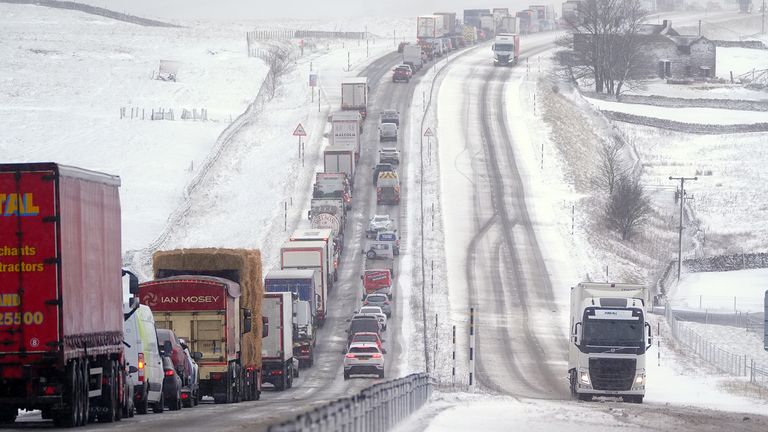
Image:Traffic is reduced to a crawl on the A66 in Cumbria. Pic: PA
After a spell of widespread frost and snowit is now predicted that temperatures will reach the early teens, with the potential for 16C (61F) in the south of England on Saturday, although it will be cooler further north.
The highest temperature recorded so far this year was 13.9C (57F) on 6 February.
But the Atlantic weather system means there’s rain ahead for some.
“It will be Northern Ireland and western Scotland that will bear the brunt of the wet weather over coming days, putting the highest rainfall totals in the northwest,” said Wheeler.
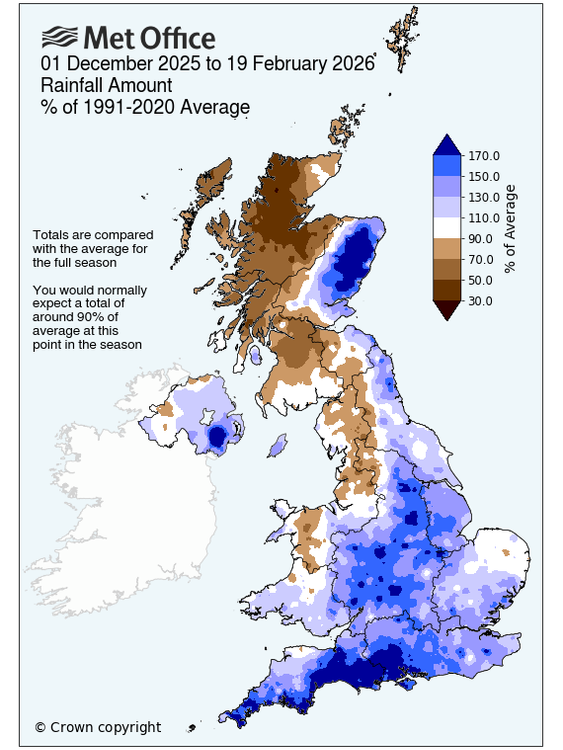
Downpours increase the risk of flooding returning after the start of 2026 brought seemingly relentless rain due to a “blocking pattern”.
Recent figures from the UK Centre for Ecology and Hydrology reveal Northern Ireland and the southwest of England had their wettest January on record.
It was also one of the five wettest Januarys since 1890 for southern counties of England.
The invisible threat that could flood your home
Flooding risk remains
More than 60 flood warnings remain in force in England, including the rivers Ebble, Wylye and Avon around Salisbury, River Avon in Ringwood and Christchurch, River Frome around Dorchester and the River Severn in Tewkesbury and the northern outskirts of Gloucester.
The Environment Agency has also issued several groundwater flood warnings in parts of Wiltshire, Hampshire and Dorset.
Groundwater flooding happens when the water table rises to the surface, with cellars and basements particularly at risk.
Image:UK rainfall totals since 1 December. Pic: Met Office
‘Don’t be fooled’
Low-pressure systems currently approaching the UK and Ireland are bringing up some warmth from Iberia.
“We can expect temperatures in the low to mid-teens over the weekend and into the coming week, which isn’t bad for late February,” said Wheeler.
But she warned against the change in weather lulling people into believing spring is just around the corner.
“Don’t be fooled!” she said. “There’s still the potential for temperatures to return to average values; maybe even lower than average. Gardeners be warned!”
Yellow warnings issued
Earlier this week, the Met Office had issued a series of yellow weather warnings for rain, snow and ice, partly caused by Storm Pedro – named by the French equivalent of the Met Office.
In addition, cold weather alerts were issued by the UK Health Security Agency (UKHSA) across most of England, apart from London and the southeast, until 6pm on Friday.