Reference #18.134adc17.1777820537.19ede12b
https://errors.edgesuite.net/18.134adc17.1777820537.19ede12b
Reference #18.134adc17.1777820537.19ede12b
https://errors.edgesuite.net/18.134adc17.1777820537.19ede12b

The pope urged the rememberance of journalists who lost their lives pursuing the truth, particularly in conflict areas.
Published On 3 May 2026
Pope Leo has marked World Press Freedom Day by condemning violations of media freedom around the world and paying tribute to journalists killed while reporting in conflict zones.
At the end of his weekly Sunday prayer in a sunny Saint Peter’s Square at the Vatican, the pontiff said the day highlighted both the importance of independent journalism and the growing threats faced by reporters.
“Today we celebrate World Press Freedom Day … unfortunately, this right is often violated, sometimes in blatant ways, sometimes in more hidden forms,” he said.
World Press Freedom Day, sponsored by the UN cultural agency UNESCO is intended to show support for media organisations that come under pressure or censorship. It is also an opportunity to commemorate journalists who have been killed at work.
The Roman Catholic leader urged the faithful to remember journalists and reporters who have lost their lives pursuing the truth, particularly in conflict areas.
“We remember the many journalists and reporters who have been victims of war and violence,” the pope said.
A report last month by the Watson Institute for International and Public Affairs’ Costs of War project found that Israel’s war on Gaza was the deadliest conflict for media workers ever recorded, with Israeli forces having killed 232 Palestinian journalists since October 2023.
More journalists have been killed in Gaza than in both world wars, the Vietnam War, the wars in Yugoslavia, and the United States war in Afghanistan combined, the report found.
In past speeches, the leader of the Catholic Church has described journalism as a pillar of society and democracy, and information as a public good that must be safeguarded and defended.
The pontiff has often thanked reporters for sharing the truth, saying that doing their job could never be considered a crime, and frequently calling for the release of journalists who have been unfairly detained or prosecuted.
Last week, the leading Paris-based press freedom NGO, Reporters Sans Frontières (RSF), or Reporters Without Borders, found that freedom of the press around the world has fallen to its lowest level in a quarter of a century.
For the first time since RSF started producing the index in 2002, it said more than half of the world’s countries fall into the “difficult” or “very serious” categories for press freedom – “a clear sign that journalism is increasingly criminalised worldwide”.

Reference #18.f3680117.1777819198.3ea3a577
https://errors.edgesuite.net/18.f3680117.1777819198.3ea3a577

Jim Furyk did not have to accept the U.S. captaincy for the 2027 Ryder Cup.
In fact, he had a glaring excuse not to. His first go-around as captain in 2018 was a nightmare as his American squad was embarrassed in France by Team Europe 17.5-10.5. From his captain’s picks to his pairings, and certainly the result, everything went wrong for Furyk and his squad at Le Golf National.
Nevertheless, when the PGA of America called on Furyk to give the captain role another go in another Ryder Cup across the pond in Ireland, he didn’t hesitate.
CLICK HERE FOR MORE OUTKICK SPORTS COVERAGE
While there is undoubtedly a redemption factor in all of this for Furyk, he didn’t lean into that angle while explaining why he wanted to take on the challenge a second time.
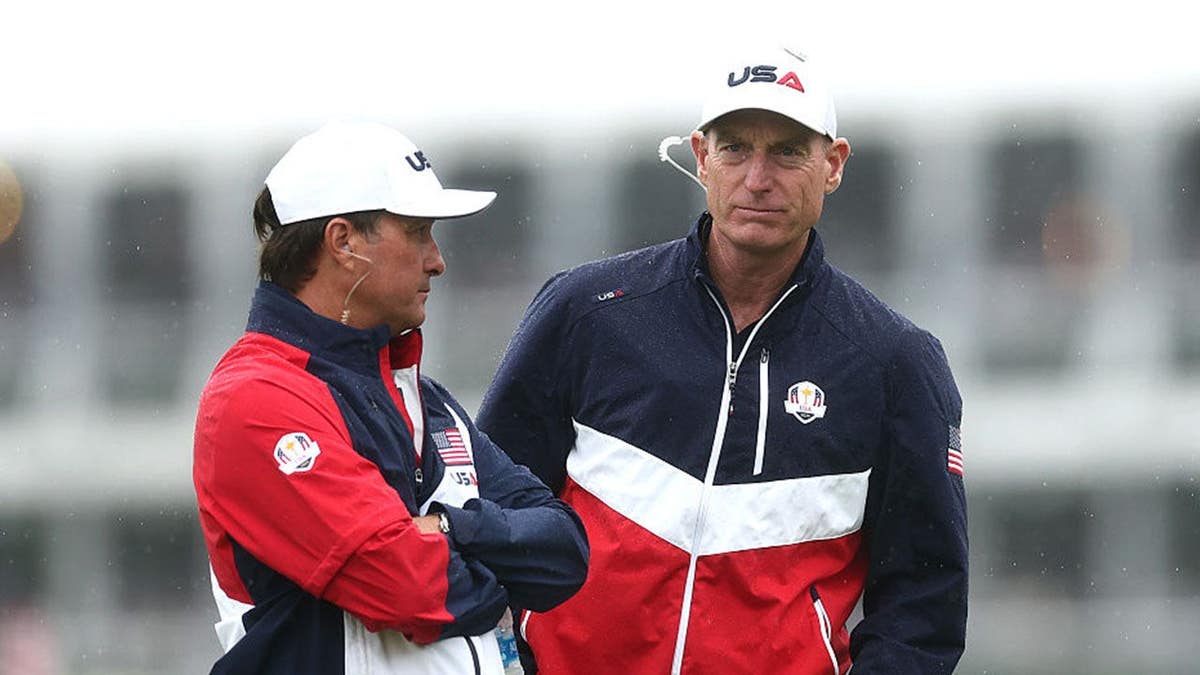
Vice captains Kevin Kisner and Jim Furyk of Team United States look on during a practice round prior to the Ryder Cup 2025 at Black Course at Bethpage State Park Golf Course on September 25, 2025 in Farmingdale, New York. (Photo by Maddie Meyer/PGA of America/PGA of America via Getty Images) (Maddie Meyer/PGA of America/PGA of America via Getty Images)
“I think it’s really the players,” Furyk explained during NBC’s Kentucky Derby broadcast on Saturday. “I mean, I’ve gotten to know this generation really well through Presidents Cups, Ryder Cups. I love these guys. They show heart, grit, passion. I see how much they love to compete, and I know how badly they want to win the Ryder Cup. And so I love team sports. I love banding together, pulling together, being with these guys in the locker room. And that’s the reason.”
SCOTTIE SCHEFFLER BACKS JIM FURYK AS U.S. RYDER CUP CAPTAIN, BUT WORDS ONLY MATTER SO MUCH

Jim Furyk coaches on the eighteenth green during a practice round of the Ryder Cup golf tournament at Bethpage Black in Bethpage, New York, on Sept. 25, 2025. (Dennis Schneidler/Imagn Images)
Furyk has been a vice captain on previous U.S. Ryder Cup staffs in years past, including in 2025 when the Americans lost to Team Europe at Bethpage Black in New York.
As a player, Furyk produced a Ryder Cup record of 10-20-4, but despite the multiple bad tastes the biennial event has left in his mouth, this stable of American players is one he very much believes in.
OUTKICK IS NOW ON THE FOX APP: CLICK HERE TO DOWNLOAD
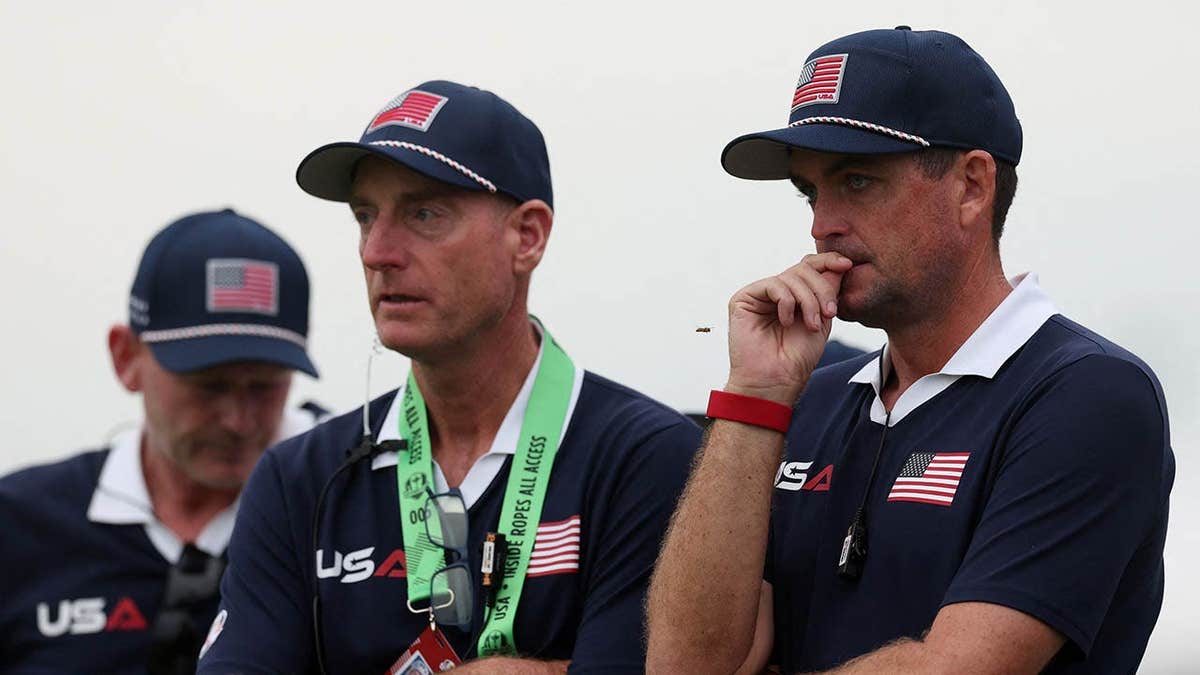
Team USA captain Keegan Bradley and vice captain Jim Furyk compete during the four-balls on the second day of the Ryder Cup at Bethpage Black in Bethpage, New York, on Sept. 27, 2025. (Paul Childs/Reuters)
The U.S. team room that Furyk will construct in 2027 will look nothing like it did in 2018, so, at the very least, he has that going for him.
The Americans have not hoisted the Ryder Cup on foreign soil since 1993. It’s no secret that the jaunt across the pond in ’27 will be a serious uphill battle for the red, white and blue, and while many see Furyk as a “sacrificial lamb” of sorts, it’s a low-risk, incredibly high-reward situation for the 55-year-old.
Reference #18.49200117.1777850600.13be9e16
https://errors.edgesuite.net/18.49200117.1777850600.13be9e16


Cybersecurity researchers have uncovered a large-scale fraud operation that uses Telegram’s Mini App feature to run crypto scams, impersonate well-known brands, and distribute Android malware.
A new report by CTM360 says the platform, dubbed FEMITBOT, is based on a string found in API responses and uses Telegram bots and embedded Mini Apps to create convincing, app-like experiences directly within the messaging platform.
Telegram Mini Apps are lightweight web applications that run inside Telegram’s built-in browser, enabling services such as payments, account access, and interactive tools without requiring users to leave the app.
According to a CTM360 report shared with BleepingComputer, the FEMITBOT platform is used to conduct multiple types of scams, including fake cryptocurrency platforms, financial services, AI tools, and streaming sites.
In various campaigns, threat actors impersonated widely recognized brands to increase credibility and engagement, while using the same backend infrastructure with different domains and Telegram bots.
Some of the brands impersonated in this campaign include Apple, Coca-Cola, Disney, eBay, IBM, Moon Pay, NVIDIA, YouKu,
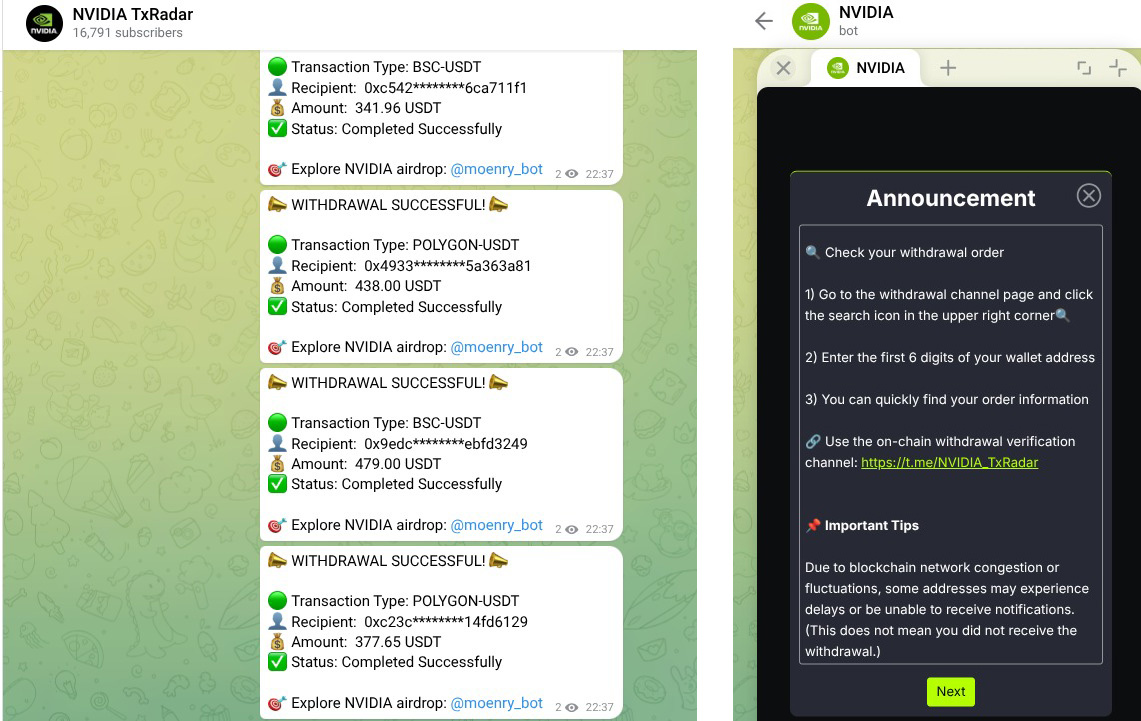
Researchers say the activity uses a shared backend, where multiple phishing domains use the same API response, “Welcome to join the FEMITBOT platform,” indicating they are all using the same infrastructure.

The operation uses Telegram bots to display phishing sites directly within the social media platform. When a user interacts with a bot and clicks “Start,” the bot launches a Mini App that displays a phishing page in Telegram’s built-in WebView, making it appear as part of the app itself.
Once inside, victims are shown dashboards with fake balances or “earnings,” often paired with countdown timers or limited-time offers to create a sense of urgency.
When users attempt to withdraw funds, they are prompted to make a deposit or complete referral tasks, a common tactic in investment and advance-fee scams.
The researchers say the infrastructure is designed to be used across different campaigns, allowing attackers to easily switch branding, languages, and themes.
The campaigns also use tracking scripts, such as Meta and TikTok tracking pixels, to track users’ activity, measure conversions, and likely to optimize performance.
Some Mini Apps also attempted to distribute malware in the form of Android APKs that impersonated brands like the BBC, NVIDIA, CineTV, Coreweave, and Claro.

Users are prompted to download Android APK files, open links within the in-app browser, or install progressive web apps that mimic legitimate software.
“The APK filenames are carefully chosen to resemble legitimate applications or use random-looking names that don’t immediately trigger suspicion,” explains CTM360.
“The APKs are hosted on the same domain as the API, ensuring TLS certificate validity and avoiding mixed-content warnings in the browser.”
Users should be cautious when interacting with Telegram bots that promote crypto investments or prompt them to launch Mini Apps, especially if they are asked to deposit funds or download apps.
As a general rule, Android users should avoid sideloading APK files, which are commonly used to distribute malware outside the Google Play Store.

AI chained four zero-days into one exploit that bypassed both renderer and OS sandboxes. A wave of new exploits is coming.
At the Autonomous Validation Summit (May 12 & 14), see how autonomous, context-rich validation finds what’s exploitable, proves controls hold, and closes the remediation loop.
Claim Your SpotReference #18.b3560e17.1777818916.9be7c74f
https://errors.edgesuite.net/18.b3560e17.1777818916.9be7c74f
Canada is to become the first non-European country to attend a meeting of the European Political Community when the prime minister, Mark Carney, joins Monday’s summit of the 48-plus nation grouping in Yerevan, Armenia.
Carney has said he is determined to build a new network of trade and diplomatic alliances after the loss of US markets under Donald Trump. His presence will also represent a show of western support for Armenia in its efforts to distance itself from Russia at a time when the US’s approach to Moscow’s opponents, such as Ukraine, is at best ambiguous. Canadian diplomats have rejected suggestions Ottawa might seek EU membership.
Trump’s plan to pull more than 5,000 troops out of Germany over the next year and the economic impact on western economies of a prolonged US-Iran conflict will be major subjects of discussion in Yerevan. Armenia shares a border with Iran, but unlike neighbouring Azerbaijan has not alleged Iranian missiles have landed in its territory.
Yerevan was chosen to host the EPC – an institution championed the French president, Emmanuel Macron, and which also includes the UK – to give Armenia a chance to showcase its strengthening links with Europe, and so continue its slow decoupling from Russia, its former backers. Its prime minister, Nikol Pashinyan, has pursued a policy of diversification that in practice is slowly drawing Armenia into the European ambit. His Civil Contract party is facing parliamentary elections in June, and is seeking a big win so he can continue efforts to make a peace with Azerbaijan. He faces three opposition parties more sympathetic to Russia.
Thomas de Waal, a senior fellow with Carnegie Europe specialising in the Caucasus region, said: “European leaders will have to walk a fine line in Yerevan. As they hold what looks like a pre-election rally for Pashinyan, they must also have a bigger conversation about building a more robust and less polarised Armenia.
“The country itself deserves full European attention. It is on the verge of a painful but transformative peace agreement with Baku that will lead to the reopening of its two long borders with Azerbaijan and Turkey, which have been closed since the 1990s. The country also has a historic opportunity to loosen its overdependence on Moscow as the war in Ukraine continues to distract and drain Russia.”
The day after hosting the EPC, Yerevan hopes the first bilateral summit between Armenia and the EU on Tuesday will result in the bloc offering extra funding to promote democracy as well as visa liberalisation. When the EU’s enlargement commissioner, Marta Kos, visited the country in March, she declared that “Armenia and the EU have never been closer”.
The country of 3 million people signed a comprehensive partnership agreement with the European Union in 2017. Last year, it adopted a law formally declaring its intention to apply for EU membership, taking the country in a very different political direction to neighbouring Georgia.
Armenia is a member of the Russian-led Eurasian Economic Union and the Moscow-led Collective Security Treaty Organisation (CSTO) alliance, although it froze its membership of the latter in 2024.
Vladimir Putin warned Armenia in April that it could not be a member of both the EU and CSTO. “It’s simply impossible by definition,” the Russian president told Pashinyan.
Macron has been the premier champion of closer European-Armenian ties and his attendance is being given a state-visit-level importance. He is also expected to attend a concert in Gyumri, Armenia’s second-largest city
The EPC, which was set up in 2022, brings together full members of the EU and the large constellation of nations outside the Brussels bloc, including the UK, Turkey, Norway, Switzerland, Iceland, Serbia and other Baltic nations.
The group has no formal secretariat and often avoids lengthy communiques in favour of bilateral leader-to-leader discussion.
The EPC was met with scepticism at its inception, with some fearing it was a sop for countries that had been waiting for years to have their applications for EU membership to be progressed. But the willingness of European leaders to continue to attend the summits suggests the gatherings serve a purpose.
With the support of Trump, Armenia and Azerbaijan initialled a peace agreement in Washington last August. The Azerbaijani side said it would fully sign up to the peace agreement once Armenia changed its constitution, claiming that it contains territorial claims against Azerbaijan, which Armenian authorities have repeatedly denied.

NEWYou can now listen to Fox News articles!
Three weeks after her husband’s funeral, Carol’s phone rings. The caller knows her husband’s name, their address and their daughter’s name, even mentioning that she lives across town.
He says he’s calling from a life insurance company and that there’s a policy ready to be paid out. He just needs Carol’s Social Security number and bank routing details to process it.
This scenario draws from real scams reported by fraud investigators and elder abuse advocates across the country. The details change, but the playbook stays the same.
The reason these attacks work so well comes down to something most grieving families never think to check.
HOW SCAMMERS TARGET YOU EVEN WITHOUT SOCIAL MEDIA

Scammers build detailed profiles using obituaries, public records and data broker sites often within days of a loss. (Kurt “CyberGuy” Knutsson)
Sign up for my FREE CyberGuy Report
Losing a spouse creates a perfect storm for scammers. Grief can leave you overwhelmed, and at the same time, you are handling financial decisions, paperwork and major life changes. That combination makes it easier for someone to catch you off guard.
THE ONE THING SCAMMERS CHECK BEFORE TARGETING YOU ONLINE
Meanwhile, your personal information becomes easier to find. Obituaries often include names, relationships and locations. Death records get filed with the Social Security Administration and added to the Death Master File. Probate filings can reveal property transfers, beneficiaries and account details.
Data brokers collect all of this and turn it into detailed profiles that almost anyone can access. According to research from a data privacy company analyzing five years of FBI Internet Crime Complaint Center data, about 52.5% of crimes reported by Americans over 60 in 2023 were either enabled or worsened by personal data available online. Widows, especially those managing estates alone, sit high on that target list.
Despite being in a high-risk group, taking these protective steps should keep scammers at bay. I know how overwhelming this time can be, so I recommend asking a trusted family member or friend for assistance setting things up. Though you should always refrain from sharing sensitive details like account numbers and your Social Security number.
THE DATA BROKER OPT-OUT STEPS EVERY RETIREE SHOULD TAKE TODAY
The first month is when the most damaging data gets published. So your first job is damage control.
Obituaries are the single most accessible data source scammers use after a death. A traditional obituary lists full names, survivor relationships, hometowns and sometimes even ages. That’s a complete family map, and in the wrong hands, it can be a powerful weapon.
You don’t have to skip the obituary. But consider removing or abbreviating the exact home city (use the region instead), names of minor grandchildren and the surviving spouse’s first and last name combined with their address. “Carol of Cleveland” is safer than “Carol Patterson of 114 Birchwood Lane, Cleveland.”
HOW TO REMOVE YOUR PERSONAL INFO FROM PEOPLE-SEARCH SITES
Before you can remove anything, you need to see what’s already there.
Go to Spokeo, Whitepages, BeenVerified and Intelius. Search your name and your spouse’s name. What you find will likely include your address, phone number, email addresses, relatives’ names and property records.
This snapshot is your starting point. Take screenshots. You’ll need them.
10 SIGNS YOUR PERSONAL DATA IS BEING SOLD ONLINE
It takes two minutes, and it’s free. Go to google.com/alerts and create alerts for:
If your information gets published anywhere new, you’ll get an email notification. This is your early warning system.
REMOVE YOUR PERSONAL INFO FROM THE WEB — STOP IT FROM COMING BACK

People-search sites can expose your address, relatives and contact details making it easier for scammers to target you. (Kurt “CyberGuy” Knutsson)
By now, your information has had weeks to spread. Manual opt-outs are worth doing, but here’s the reality: there are hundreds of data broker sites. Each one has its own removal process. Many require you to submit ID, wait days for confirmation, and then re-submit when your data reappears, because it will.
Prioritize manual opt-outs from the sites that appear in your Google search results. These carry the most weight because scammers often start with whatever Google surfaces first.
You can find these exposures quickly and easily with Incogni’s free scanner. This tool will scan the web for your personal information and email you a report with a list of results you can start with.
HOW TO HAND OFF DATA PRIVACY RESPONSIBILITIES FOR OLDER ADULTS TO A TRUSTED LOVED ONE
If you’d rather go about it on your own, some of the most common sites include:
Each one will ask you to verify your email. Follow through on every confirmation; unconfirmed requests don’t get processed.
Keep in mind that removing your information takes time and persistence. There are hundreds of data broker sites, and many of them re-list your information after it has been removed, especially when new public records become available.
Because of that, some people choose to use automated data removal services that send ongoing opt-out requests on their behalf. These services can help reduce the workload by continuously monitoring and removing listings as they reappear.
No matter which approach you take, consistency matters. Checking your information regularly and following up on removals helps limit what scammers can find.
Check out my top picks for data removal services and get a free scan to find out if your personal information is already out on the web by visiting Cyberguy.com
This step is urgent, and most people skip it entirely.
Data broker profiles almost always contain the exact answers to your bank’s security questions. Mother’s maiden name. Previous address. City where you were born. Scammers use these to impersonate you and access your accounts.
WHAT HACKERS CAN LEARN ABOUT YOU FROM A DATA BROKER FILE
Call your bank, brokerage and insurance companies. Ask to update your knowledge-based authentication questions. Use answers that are completely made up, something only you know and store them in a password manager. Don’t use any answer that appears anywhere in a data broker profile.
By now, the most urgent exposure has been addressed. These final steps close the remaining gaps and protect you in the long term.
A credit freeze prevents new credit accounts from being opened in your name. It’s free at all three major bureaus: Equifax, Experian and TransUnion, and TransUnion.
HOW TO SAFEGUARD YOUR CREDIT SCORE IN RETIREMENT AS FRAUD AND IDENTITY THEFT RISE AMONG SENIORS
Critically: freeze your spouse’s credit too. After a death, identity thieves frequently open new accounts in the deceased person’s name before the credit bureaus are updated. This is called ghosting, and it can haunt an estate for years.
To freeze a deceased spouse’s credit, contact each bureau individually and provide the death certificate. It’s a few phone calls. It’s worth every minute.
Families can submit a request to limit access to a deceased person’s Social Security data in certain contexts. Visit ssa.gov for current guidance. This won’t scrub the record entirely, but limiting access to the Death Master File reduces the pool of parties who can use it to enrich your data broker profile.
This isn’t directly a data privacy step, but it protects you from a related threat. Scammers who know about an estate sometimes pose as financial advisors, attorneys or government representatives to intercept beneficiary changes. Confirm all account changes directly through institutions you contact yourself, never through a number someone else gives you.
By this stage, your data is more controlled. Now the focus shifts to stopping scams before they escalate. Start by setting clear expectations with your family. Let them know you will never ask for money through an unexpected call, text or email. Creating a simple code word or check-in rule can stop panic-driven decisions, which is exactly what scammers rely on.
Next, slow down any urgent financial request. Scammers create pressure to force quick action. If someone claims there is a payout, problem or deadline, pause and verify it using a phone number or website you trust, not one they provide. It also helps to keep a short list of your financial institutions and their official contact details in one place. That way, you always know how to reach them directly without relying on incoming calls or messages.

Taking simple steps early, like removing your data and freezing your credit, can reduce your risk during the most vulnerable time. (Kurt “CyberGuy” Knutsson)
INSIDE A SCAMMER’S DAY AND HOW THEY TARGET YOU
Finally, be cautious in real-time conversations. Scammers often build trust by collecting small details over multiple interactions. Keeping answers brief and avoiding unnecessary personal details makes it that much harder.
Check out my top picks for data removal services and get a free scan to find out if your personal information is already out on the web by visiting CyberGuy.com
Get a free scan to find out if your personal information is already out on the web: CyberGuy.com
The first few months after losing a spouse bring enough decisions without adding fraud risks on top. Yet that is when your personal information spreads the fastest. Public records and data broker sites can quietly build a profile that scammers use against you. Early action makes a real difference. Limiting what gets published, removing existing data and securing your accounts all reduce your exposure. Even small steps, like updating security questions or freezing credit, can stop a scam before it starts. You do not need to handle everything at once. Start with a simple search of your name and review what appears. From there, take control at your own pace and protect what matters most.
If someone can piece together your personal life within days of a loss, how much of your information are you comfortable leaving online? Let us know by writing to us at CyberGuy.comCyberguy.com
CLICK HERE TO DOWNLOAD THE FOX NEWS APP
Sign up for my FREE CyberGuy Report
Copyright 2026 CyberGuy.com. All rights reserved.
Heathrow’s new chair has opened talks with airlines and the billionaire local landowner Surinder Arora to defuse a row that threatens to further delay the £49bn plan to build a third runway at Europe’s busiest airport.
Philip Jansen, who was appointed at the start of the year, is understood to have held meetings with the airport’s carriers and with Arora, who has been promoting his own £25bn expansion scheme, in the hope of finding the middle ground in a row over cost and service issues.
Last week the former BT boss and Thomas Woldbye, the chief executive of Heathrow, met International Airlines Group, the parent company of British Airways.
British Airways dominates Heathrow, accounting for more than 50% of slots, and the IAG chief executive, Luis Gallego, has said the cost of the third runway and associated works must be capped at £30bn.
Jansen is also understood to have held talks with Virgin Atlantic and Arora, a multibillionaire hotelier who has for years criticised the airport for “ripping off” passengers, airlines and retailers with high charges.
BA, Virgin and Arora are all part of Heathrow Reimagined, a campaign group seeking to drastically reduce the costs of operating at the airport. The airlines, as well as large carriers from the US, have refused to back the expansion plan “at any cost”.
Heathrow is considered to be Europe’s most expensive airport, and in March the UK aviation regulator rejected its plans to significantly raise its landing fees to fund a multibillion-pound upgrade.
“All airlines and their stakeholders agree over the necessity and long-term economic value of a third runway,” a source familiar with the talks said. “There are just differing points of view. Airlines want the lowest possible cost, other people want to get involved and think it can be done cheaper. Whatever happens, we are all going to have to work together. There needs to be good relations if we want to re-engineer a way forward.”
The chancellor, Rachel Reeves, has thrown the government’s weight behind the expansion, pledging that work will begin before the next election, after decades of controversy and opposition over costs and the local and environmental impact.
In November, ministers backed a plan for the runway to be up and running by 2035, before the rival proposal submitted by Arora Group, although Heathrow is still seeking formal planning approval to start construction by 2029.
Heathrow is owned by a consortium of investors led by the French company Ardian and includes the sovereign wealth funds of Qatar, Singapore and Saudi Arabia.
China Investment Corporation, which owns 10% of Heathrow, is reportedly considering selling its stake over concerns about rising costs as the expansion project rolls out, according to the Financial Times.
A spokesperson for Heathrow said: “As newly appointed Heathrow chairman, Philip Jansen is spending time meeting with the airport’s key stakeholders. Building constructive relationships with them and especially our airline and commercial partners is essential to deliver our shared goals of excellent customer experience and fulfil our vision of being an extraordinary airport, fit for the future.”
Jansen has built something of a reputation for bringing together opposing parties to tackle difficult corporate stalemates.
At BT he engineered the signoff of £15bn in funding to roll out full fibre broadband across the UK, after decades of wrangling between stakeholders, making a promise to “build like fury” and address the national embarrassment of the UK’s status as a global laggard in internet connectivity.
The beleaguered London-listed WPP drafted in Jansen as the chair at the beginning of last year, promptly resulting in the removal of the chief executive, Mark Read, as the advertising company restructures under the former Microsoft boss Cindy Rose.
Separately, Aviation Services UK, which represents ground-handling companies such as Menzies, Swissport and Dnata, wrote to the aviation minister, Keir Mather, warning that the sector may need a Covid furlough-style scheme for employees if there are widespread flight cancellations because of fuel shortages this summer.
The ground-handling sector, which manages baggage and check-in services at airports and employs about 30,000 people, is remunerated on the basis of planes flying routes.
The issue of cutting and rehiring staff, who require lengthy security vetting to work in airports, became apparent during the Covid pandemic, when shortages caused chaos as airports began to get back on their feet.
