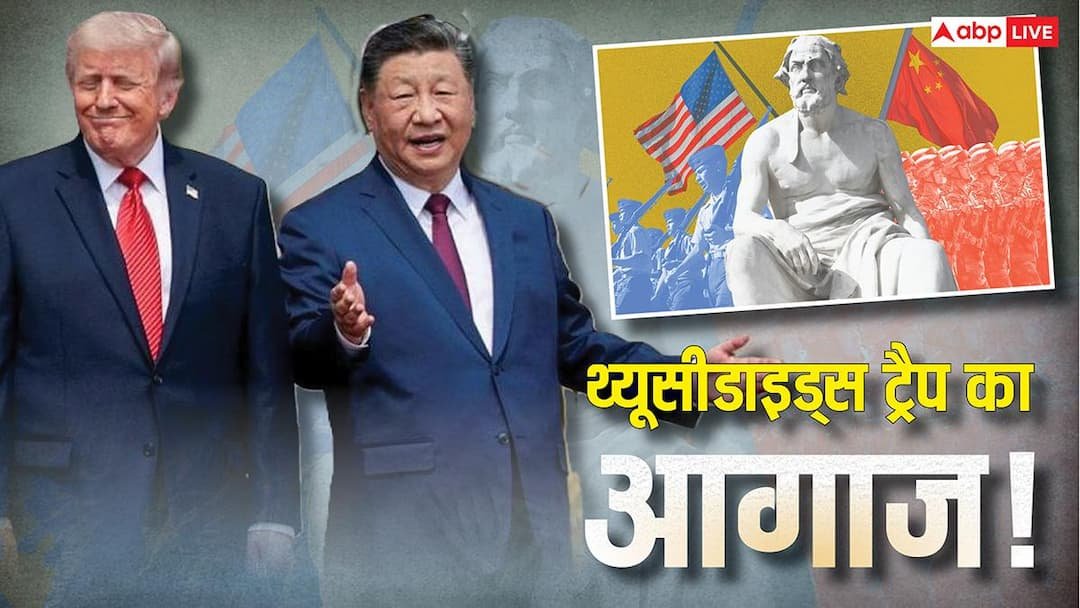
Whenever there is a big meeting between China and America, one term comes up again and again – ‘Thucydides Trap’. This is not a new rule of the game, but a bitter truth of 2,500 years old history, which explains the tension between the world’s two biggest powers even today. Let us understand this without any further ado…
Where did the name Thucydides come from?
This whole idea comes from the book of Thucydides, an old Greek historian. He had studied the ‘Peloponnesian War’ that took place between Athens and Sparta in about 400 BC very closely. At that time, Athens was rising rapidly and its growing power created fear in the minds of the old superpower Sparta. Thucydides then wrote a line that still applies today, ‘This war became necessary because the growing power of Athens had created fear in Sparta.’
Simply put, whenever a rising power (like China today) starts challenging an existing ruling power (like the US), the risk of conflict between them increases significantly. This is the Thucydides Trap. This is not a law, but a dangerous pattern repeated over and over again in history.
Direct war broke out in 12 cases
Professor Graham Allison of Harvard University, the biggest expert on this matter, studied the history of the last 500 years in depth. He conducted a total of 16 such case studies in the last 500 years where an emerging power directly challenged an established power. allison’s book ‘Destined for War: Can America and China Escape Thucydides’ Trap’ The surprising thing is that in 12 out of those 16 cases, outright war broke out. That means the probability of collision was up to 75 percent. There were only 4 cases where there was no bloodshed and that too because those countries acted with great understanding and diplomacy.
Why is America and China being discussed about this?
As of today, America is the number one economy in the world, but the pace of China is putting it to rest. China has emerged as the world’s factory. Its GDP was only 361 billion dollars in 1990, which will increase to more than 20 trillion dollars by 2025. On PPP basis, China is already the world’s largest economy. America is still ahead in nominal GDP, but China is rapidly catching up.
America’s GDP in 2023 was around $27.36 trillion, while China’s GDP was around $17.79 trillion. According to the International Monetary Fund (IMF), China’s economy may overtake America around 2030. This figure alone is the real root of Sparta’s fear. America feels that China is giving it a tough challenge not only in economy, but also in technologies like 5G and Artificial Intelligence, and in terms of military power in the South China Sea. This is the reason why in every meeting of the leaders of the two countries, this ‘trap’ is reminded that this obsession of getting ahead is not pushing the world towards a big war.
America’s defense budget in 2026 is approximately $831-954 billion, which is more than the next 6-7 countries in the world combined. China’s official budget is around $277–336 billion (with 7% growth), but PPP and actual spending estimates go above $500 billion. China’s navy is now the world’s largest in number of ships. Tension is increasing in Taiwan, South China Sea and Indo-Pacific.
So is the fight certain?
no way. Professor Allison himself says that traps are not mandatory, provided the leadership shows wisdom. Just as during the Cold War, America and the Soviet Union had opened the avenues of diplomacy and dialogue to avoid direct conflict, similarly in today’s situation, continuous dialogue is the only way out. This is the reason that whenever there is a dialogue between China and America, the discussion becomes intense about what steps both the countries are taking to avoid falling prey to this trap.
On May 13, 2026, Trump-Xi Jinping met in Beijing. Xi Jinping openly said, ‘The world has reached a new crossroads. Can China and America overcome the Thucydides Trap and create a new model of relations between big countries?’ Trump described the relationship as ‘strong’, but economic, technological and security issues (trade, tech, Taiwan, Iran) run deep on both sides. Ellison believes that even today, deep economic ties (trade, investment) and nuclear weapons between the two countries make war expensive. This is not just a term, but a mirror which shows how much wisdom is needed by the big powers of the world today.