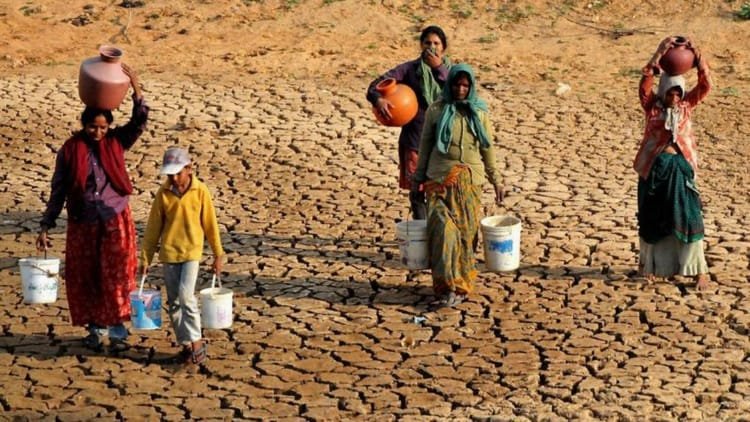
The risk of drought is increasing rapidly in India. Its most serious impact is being seen in the Ganga plains (IGP) and North-East India. According to recent scientific studies, weak monsoon, rising temperatures and over-exploitation of groundwater have taken the water crisis in the country to a new and dangerous level.
According to the study published in the journal Climate Change, a clear increase in drought and hydro-climatic instability has been recorded in six major regions of India, Western, Central, Himalayan, IGP, Peninsular and North-Eastern India. Drought measuring indicators like SPEI, SLA and NCS show that aridity is increasing rapidly in the country and new abnormal climate patterns are forming. SPEI values show the largest decline in IGP (-0.47) and North-East (-0.41), indicating severe drought. The Himalayas (-0.21) and Central India (-0.07) are relatively less affected.
According to experts, due to increase in temperature both day and night and decrease in rainfall, humidity in these areas is decreasing rapidly. According to the study published in PNAS Earth, Atmospheric and Planetary Sciences in September 2025, between 1991–2020 the Ganga River Basin suffered the most intense drought of the last 1,300 years.
national security issue
According to the Global Water Bankruptcy Report of the United Nations University, the water crisis has now become not only an environmental but also an economic, political and national security issue. According to expert Kaveh Madani, lack of water resources may increase conflicts between countries and societies in the future.
Change in agriculture sector is most important
According to the report, more than 85 percent of water use in India is in agriculture, so the solution should also be focused here. Technologies like drip irrigation, solar pumps, low water crops and soil moisture conservation will have to be adopted rapidly. Also, policy reforms are necessary to stop groundwater exploitation.
Lessons from Israel and California
Israel has mitigated the effects of drought through desalination, water recycling and economic diversification. California and Australia in the United States have remained economically stable despite major droughts due to strong water infrastructure and diversified economies. According to experts, the water crisis will not be solved through technology alone. This requires a combination of local knowledge, institutional reforms and economic diversity.
other videos