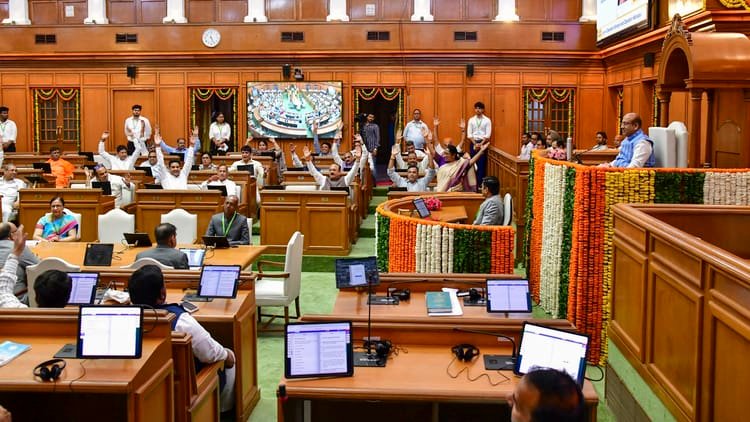
In the one-day special session of the Assembly on Tuesday, an important resolution was passed regarding the implementation of the Nari Shakti Vandan Act. There was a detailed discussion in the House on this resolution presented by Chief Minister Rekha Gupta. During the discussion, ministers and MLAs of the BJP government accused the opposition parties of adopting an anti-women attitude, while the Aam Aadmi Party MLAs, who were present in the House for some time, raised questions on the intentions of the BJP.
On this occasion, Chief Minister Rekha Gupta said that the issue of women’s reservation is related to the rights and dignity of half the country’s population and said that it is not just a bill, but a question of social justice and equal participation. She called on women that now is the time to stand up for their rights.
He stressed, “Now there will be no pleading, there will be a war, the great battle will be fierce.” The Chief Minister said that the Central Government made a historic effort to ensure 33 percent reservation for women in the Lok Sabha and Assemblies through the ‘Nari Shakti Vandan Act, 2023’, but the opposition parties stopped it from going ahead due to technical pretexts and political interests.
Describing the events that took place on 16, 17 and 18 April as a sad chapter of Indian democracy, the Chief Minister said that women across the country were hoping that the decades-long wait would end, but they were disappointed. He said that the Women’s Reservation Bill came to Parliament seven times in 27 years, but every time obstacles were created.
Rekha Gupta said that the Constitution gave equal rights to women, but they did not get political opportunities. The Chief Minister accused the opposition of indulging in “technical politics”, saying issues like delimitation, number of seats and regional balance were used as pretexts. While targeting the Aam Aadmi Party, Rekha Gupta said that a sacred word like ‘Satyagraha’ should not be used to avoid the judicial process. He alleged that some people consider themselves above the law and weaken democracy by raising questions on judicial institutions.