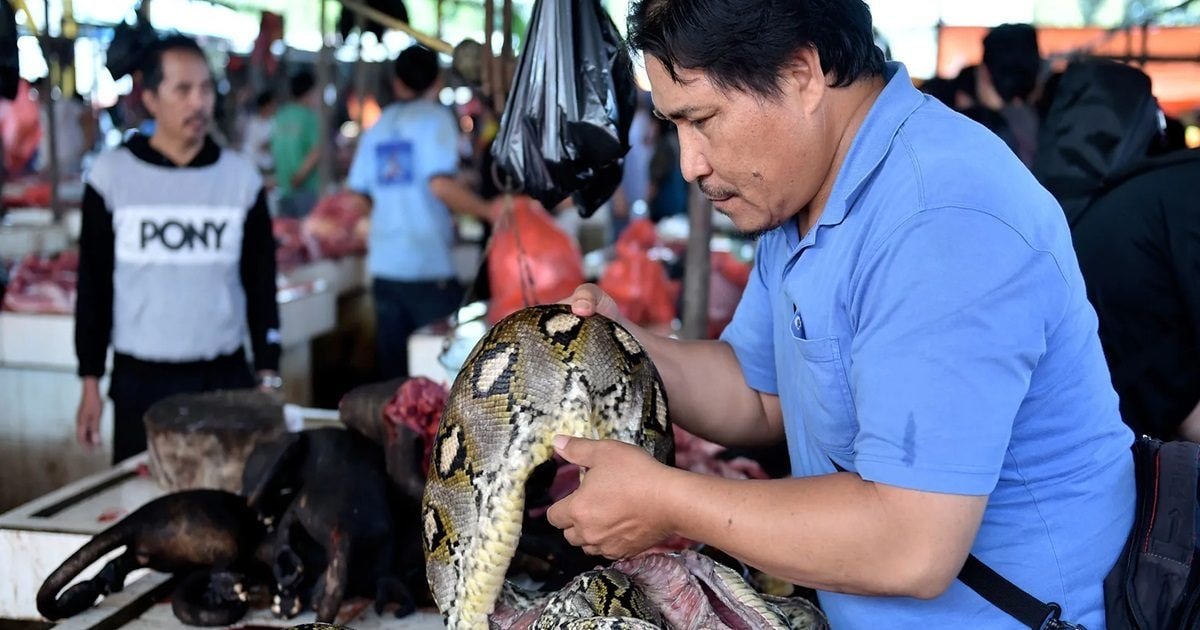
There is a market in Indonesia’s capital Jakarta which is famous all over the world for its unique and shocking reason. The largest and open market for snake meat is held here.
As soon as the evening falls, the streets of Mangga Besar area are decorated with stalls where live cobras and other snakes are sold. People get snakes bitten as per their wish. Someone kills him in a halal manner (by cutting his throat as per Islamic tradition) or by bludgeoning him – and then takes home his meat, blood, bile or other parts.
The market is quite famous
This market is very popular not only for the local people but also among the Chinese and other Asian tourists, because things like cobra, cobra blood shots and ‘cobra pakoras’ are available here. How did it all start? Snake meat and blood have been used as traditional medicine for centuries in Southeast Asia. People believe that cobra’s blood increases stamina, bile cures skin diseases and meat gives energy. This culture is very strong in Jakarta, especially in areas like Mangga Besar where street vendors set up stalls from 5-6 pm to 2 am.
this is the price
A set menu includes cobra, blood and bile, which costs around 90,000 to 300,000 Indonesian rupiah (about Rs 500-2000). King Cobra package is expensive because it is considered poisonous and rare. Recently a video went viral, in which dishes like cobra pakoras, snake blood and noodles were shown at a roadside stall in Jakarta. It is clearly visible in the video that live snakes are kept in crates and they are immediately cut and prepared on the demand of the customer. Netizens were surprised to see this because in India, snakes are considered revered and they are protected in festivals like Nag Panchami.
people eat with gusto
Eating snake is common in Indonesia. Indonesia is a Muslim majority country (87% of the population is Muslim), where meat of reptiles such as snakes is considered haram according to Islam. Yet this practice continues because it comes from pre-Islamic culture and many people consider it medicinal. Muslim customers are less, but demand remains due to the Chinese community and tourists. At some stalls, the snake is grilled and served with peanut sauce, onion and chili. The meat is chewy and lean, like chicken but tougher. This market is not limited to meat only. Shots are given by mixing snake blood with arak (local spirit), and the bile is dried and sold. Bivouac (Monitor Lizard) is also found at some places. Although wildlife trade is regulated, many reports talk about illegal trade. Even during the Corona period, snakes, bats and rats continued to be sold in some markets in Jakarta, which increased the risk of zoonotic diseases (diseases spread from animals to humans). The Indonesian government imposed some bans on wild animal trade, but enforcement is weak. Apart from Jakarta, snake meat is also available in markets like Tomohon (North Sulawesi), but Jakarta’s Mangga Besar is the most famous.