Last Updated:
Today, under the Tribes and Traditions series, we are going to tell you about that tribe of the country, where after marriage, it is not the bride but the groom who bids farewell and he goes to his wife’s house and stays there. Not only this, here the youngest daughter is the heir of the entire property of the family.

The youngest daughter also has the responsibility of taking care of her parents. (Photo- Wikimedia)
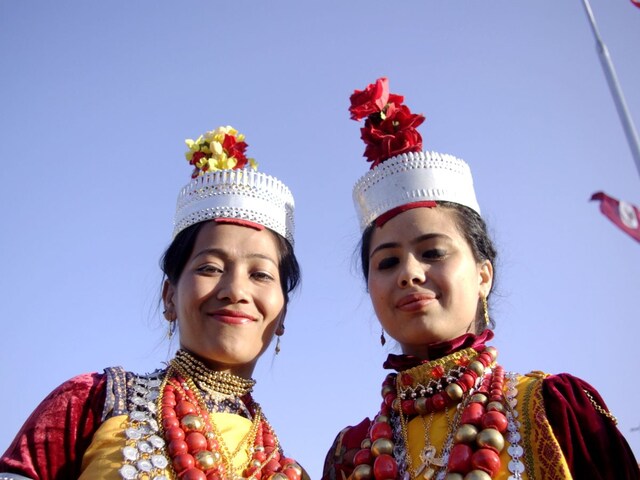
It is a custom all over the world that after marriage, girls bid farewell to Piya’s house, but have you heard about any place where boys bid farewell after marriage, while the heir of the property is the youngest daughter of the house? Perhaps many people may not be aware of this. In such a situation, let us tell you that something similar happens in Meghalaya, India. In the Khasi tribe living in the hills here, the groom bids farewell and he leaves his house and goes to live at his wife’s house. On the other hand, the daughters of the house marry their husbands and bring them home. This tribe, known in the world for its unique traditions, completely challenges patriarchal thinking. Here the head of the family is the mother and the lineage runs in her name. But there is a rule regarding property here, which makes it even more unique.
In fact, here all the wealth and land of the family is in the name of the youngest daughter only. In Khasi society this tradition is called ‘Ka Khadduh’. This simply means that not all the daughters will inherit the parents’ property, but only the youngest daughter. Elder daughters are not given any share in the property. However, the younger daughter does not get this right of mistress as a gift, instead she has to bear heavy responsibilities. It is the duty of the ‘Khadduh’ i.e. the youngest daughter of the house to serve her old parents till their last breath. Apart from this, it is also his responsibility to support and take care of the unmarried or needy brothers and sisters of the house. She is considered the main protector of the family’s religious customs and ancestor worship.
A couple from Khasi community. (Photo- Wikimedia)
The special thing is that even though she is the owner of the property, she cannot sell the ancestral land or house as per her wish. For this he has to take advice and permission from his maternal uncle or other male members of the family. The impact of these rules of property and inheritance is clearly visible on the social life here. If you go to the markets of Meghalaya, you will see women in charge of most of the shops. Here women are considered so economically strong that they not only run the household, but are also the real backbone of the economy of the society. Interesting thing is that if a daughter is not born in a family, then the people there consider it as the ‘end of the dynasty’. In such a situation, the family has to adopt another girl, whom they consider their ‘Khadduh’ so that the inheritance and name of the dynasty can be carried forward.
In Khasi society, a family is considered incomplete without a daughter, hence here the birth of daughters is not mourned but celebrated with drums. The traditions here tell us that daughters are not only the beauty of the house, but also the protector of the lineage and the foundation of the next generation. The style of marriage here is also different from the rest of the world. There is no place for dowry in the Khasi community and neither do the boys put any condition for marriage. When a boy likes a girl and the marriage is fixed, he leaves his ancestral home and settles in his wife’s house forever. Here the surname of the children is not that of the father, but that of the mother. In the modern era, while the world is talking about women empowerment, these hills of Meghalaya have been holding this matriarchal tradition close to their heart for centuries.
Men have started demanding rights in property!
Even today in the Khasi tribe, the younger daughters are the mistresses of the house, they are the ones who take care of their family i.e. parents and siblings. But gradually, due to external influence, some young men belonging to the Khasi community have started demanding equal property rights. They have also started questioning this tradition, but despite this the roots here are still as strong. Even today in Khasi society, women are recognized not only as the mistress of the house but also as the biggest protectors of their culture and tradition. This is the face of India that proves that traditions can be based not only around men, but also on the respect of women and their self-reliance.
About the Author

Working as Senior Associate Editor in News18 Hindi (Network 18) Digital. Incharge of International, Web Story, Offbeat, Regional Cinema. Active in media for more than one and a half decade. Apart from Network 18, Times Group, …read more