A retro tech enthusiast has demonstrated that it is possible to view media on LaserDisc using a relatively inexpensive digital microscope.
Shelby Jueden of the Tech Tangent YouTube channel was using the microscope to peer at some electronics, and after pointing it at a piece of optical media found he could discern the contents.
The optical media in this case was a LaserDisc. Jueden tried a compact disc for the sake of completeness, but since CDs use a digital encoding scheme, the chance of viewing anything recognizable is virtually non-existent. In a write-up of the observations, Jueden noted that “some format layout structures may be seen due to small and heavily repeated data” but nothing compared to what was identifiable on the decidedly analog LaserDiscs.
Jueden was able to view images from the disc thanks to how video data is stored on the LaserDisc. A video signal (typically composite) is encoded on the disc via a pattern of pits. A LaserDisc player reads these and reconstructs the original signal.
“LaserDiscs are an analog media, the data is encoded in the time between pits on an aluminum layer of the disc. This has a weak diffraction effect but it can still be seen,” he said.
“The ideal subject to look for on a disc to visibly see recognizable subjects is a vertically panning image. This could be a camera being moved up or down, or on-screen graphics scrolling on screen. Most movies contain scrolling graphics in the form of credits. As long as the speed of the vertical scroll is within a specific range, you will be able to see legible text in the same way that a slit scan camera works.”
So seeing high-quality video frames obviously won’t happen. But it is possible to pick out something like the credits of a film. In this case, Jueden was able to find the credits of the film True Grit in surprising clarity.
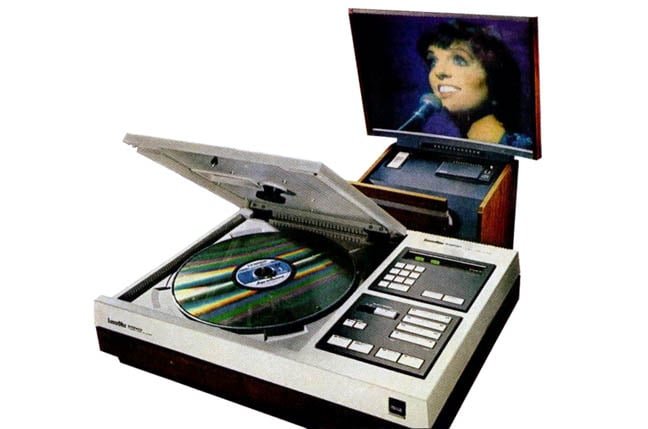
LaserDisc is very much a thing of the past, having been initially marketed in the 1970s but failing to achieve the mass-market adoption that DVD later would. Despite having higher quality playback, the tech struggled against the VHS format and, with few or no LaserDisc titles being released in the format’s later years, Pioneer pulled the plug in 2009.
Jueden’s microscope obviously can’t reconstruct a complete color frame, and how audio might be extracted is probably best left unexamined, yet there’s something genuinely compelling about seeing the video encoding laid bare, and wondering what home entertainment might have looked like had LaserDisc prevailed over VHS, DVD, and Blu-ray. ®