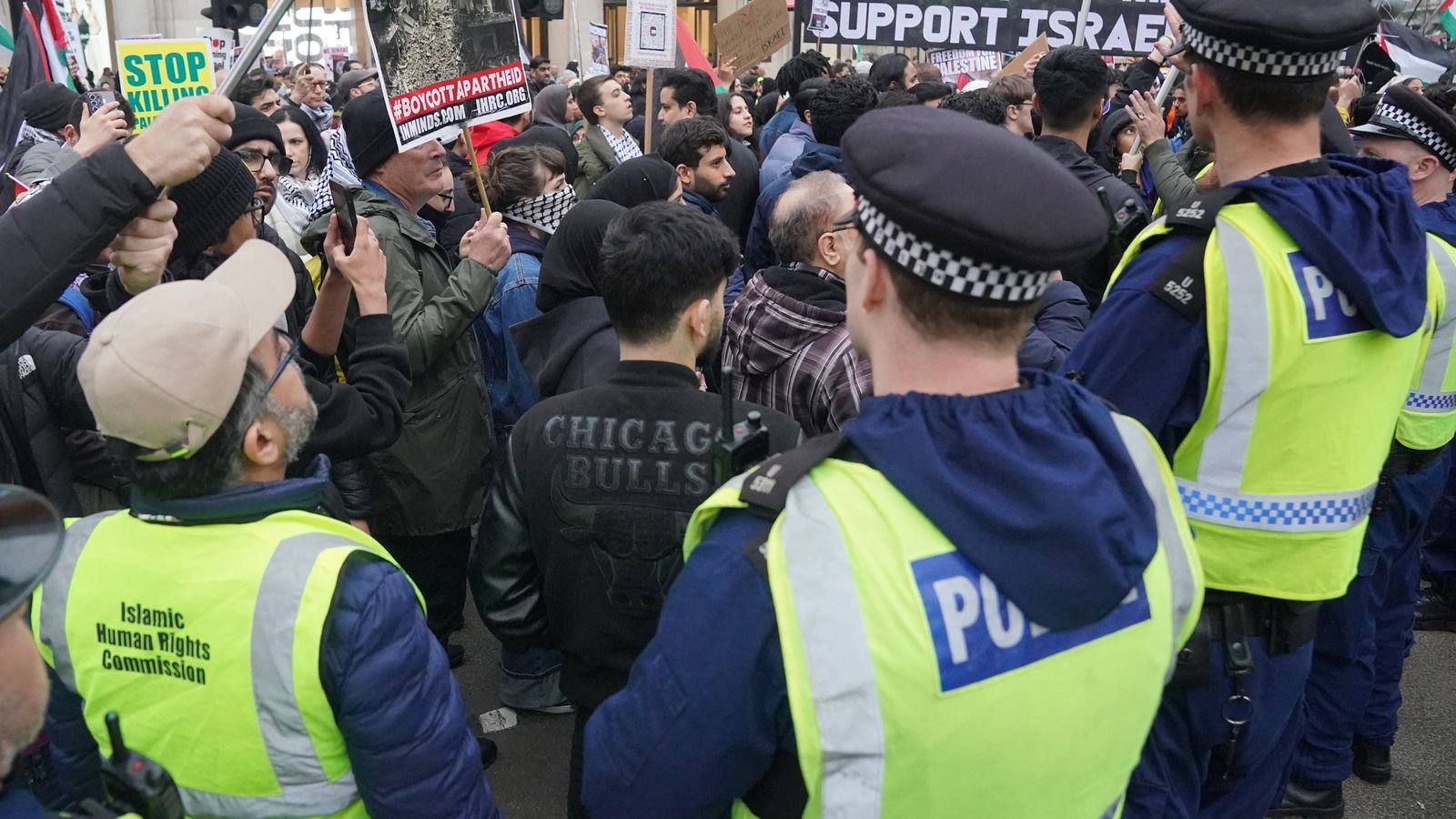
Police will use the River Thames to separate protesters and counter-protesters at the Al Quds Day rally in central London on Sunday.
A planned march to the Home Office was banned earlier this week after Home Secretary Shabana Mahmood approved a request from the Metropolitan Police to block it to “prevent serious public disorder”.
The Met added that the organisers, the Islamic Human Rights Commission (IHRC), were “supportive of the Iranian regime”. It is the first time a protest march has been banned by the Met in 14 years.
But the IHRC have said a “static” protest will go ahead, claiming the ban on the rally was a “politically charged decision”. It said the static protest is a peaceful, pro-Palestinian event.
Pic: PA
In a briefing on Thursday, Assistant Commissioner Ade Adelekan said the use of the Thames as a buffer between opposing groups is a “new bespoke tactic” to tackle the “unique set of circumstances” the Al Quds rally brings.
The Met are expecting at least 6,000 at the Al Quds protest, and an additional 6,000 counter-protesters – but warned there could be “significantly more” due to the volatile situation in the Middle East.
Protesters at the Al Quds march will be south of the River Thames on Albert Embankment, while counter-protesters will be contained within Millbank. Lambeth and Vauxhall Bridges will be shut to all traffic except emergency service vehicles.
More than 1,000 officers are set to police the event, including some from community policing and other forces. There will also be increased policing around other “vulnerable places” in London including areas with large Jewish communities.
Mr Adelekan said officers on the ground “will be briefed to act decisively”, including in relation to placards, flags and chanting.
The assistant commissioner also confirmed there will be a “zero tolerance approach” to hate crime, and anyone expressing support for proscribed organisations will face arrest.
The ban and policing measures “doesn’t completely remove risk of disorder”, Mr Adelekan said, but will make the protest “immeasurably easier to police”.
Read more:
Iran war latest
How Iran blocks the Strait of Hormuz
In its decision to request the ban on the march, the Met said it took into account the history of the Al Quds rally, community tensions and an “intelligence gap” among other factors.
The tradition of Al Quds Day started after the 1979 Iranian Revolution, and traditionally takes place on the last Friday of Ramadan. Marches are held around the world, and the day is described by the IHRC as an expression of support for Palestine.