At least 23 people have been killed and more than 100 others injured in multiple suspected suicide bombings in the north-eastern Nigerian city of Maiduguri, shattering its reputation as a relative oasis of calm in recent years as a long-running insurgency was pushed to the rural hinterlands.
Authorities said the explosions went off at the post office and market areas, as well as the entrance to the University of Maiduguri teaching hospital, on Monday evening during iftar, the breaking of fast in the month of Ramadan.
The post office and Monday market areas were regularly targeted by suicide bombers at the height of Nigeria’s Boko Haram insurgency, when Maiduguri was a conflict hotspot.
Ten years ago this month, 58 people were killed and more than 140 others injured in four separate suicide blasts including in both locations, in one of the deadliest days in the city’s history.
The latest explosions came on the heels of an attack at a military post on the outskirts of the city, the capital of Borno state, on Sunday night into Monday morning. While no group has yet claimed responsibility for the incident, Nigerian authorities said the reported bombings had been carried out by “suspected Boko Haram terrorist suicide bombers” using improvised explosive devices.
Members of the Nigerian Red Cross helping wounded victims into an ambulance. Photograph: Adewale Kolawole/Reuters
“The cowardly attacks targeted crowded public areas in an attempt by the terrorists to inflict mass casualties and create panic within the metropolis,” Sani Uba, a military spokesperson, said in a statement.
More than 2 million people have been displaced and hundreds of thousands killed in the region by Boko Haram and its offshoots, including the Islamic West Africa Province (ISWAP), as they battle the Nigerian state in an attempt to establish an Islamic caliphate.
Boko Haram was founded in 2002, but intensified attacks after the extrajudicial killing of its then leader, Mohammed Yusuf, in July 2009. During the regime of his successor, the more aggressive Abubakar Shekau, the sect splintered, with ISWAP becoming the more dominant faction and regularly engaging in lethal turf war with its rivals.
Most of the resulting terrorist activity has occurred in rural hinterlands outside Maiduguri, the birthplace of the insurgency. Until a Christmas Eve bombing at a mosque killed at least five people and wounded dozens more last year, there had not been a major attack since 2021 in the city. The mosque attack happened a day before airstrikes by the US in conjunction with Nigeria against Islamic State militants in the north-west.
Last April, the Borno governor, Babagana Zulum, raised the alarm that the jihadists were staging a comeback. Many fear that his warning, which led to a spat with federal authorities, was not properly heeded.
On Tuesday morning, President Bola Tinubu, who is on a state visit to the UK, announced that he had directed security chiefs to relocate to Maiduguri “to take charge of the situation” and “locate them, confront them and completely defeat them”.
Access Denied
You don’t have permission to access “http://hindi.news18.com/videos/ajab-gajab/red-saree-girl-dance-in-kitchen-on-lambi-lambi-chori-song-viral-video-10282030.html” on this server.
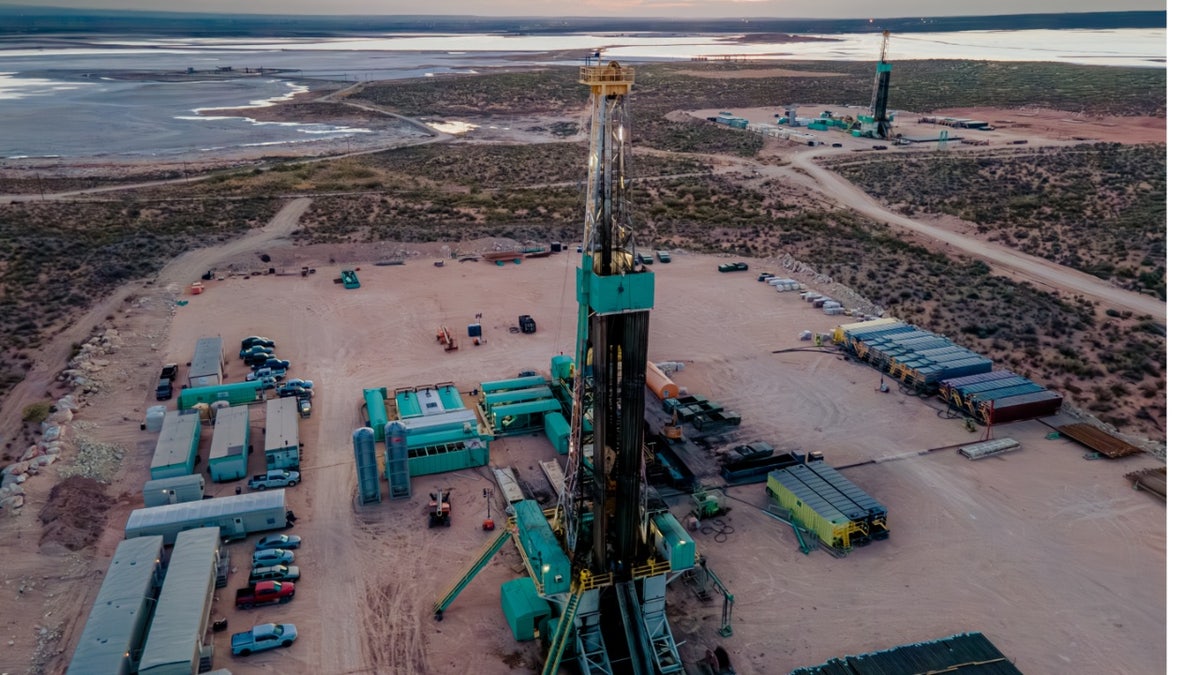
New York is making its poorest residents pay for a political fantasy. The Cuomo administration banned shale fracking in 2014, bowing to the noise of “fracktivists.” Hochul kept the ban and doubled down. The result: energy poverty for the people who can least afford it.
Twenty-six percent of New York City children live in poverty. Statewide, 2.7 million residents. Politicians respond with more taxation and finger-pointing at the Feds — but the real answer is sitting right underneath their feet. Trillions of cubic feet of natural gas, untapped, while Albany digs the hole deeper with bad policy and fills it with tax dollars.
The numbers tell the story. A 2025 Heritage Foundation study found that New York’s fracking ban has created a wealth gap of $11,000 per person — $27,000 per family — compared to Pennsylvania neighbors just across the border where fracking is allowed. Before the ban, those counties were economic equals. Since then, Pennsylvania landowners have been collecting thousands of dollars per acre in lease payments and a sixteen percent cut off the top of all gas sales. New Yorkers get nothing for their rich reserves. It’s state-sponsored pauperism.
If fracking were allowed, New York would receive billions in royalty payments. Tax receipts would swell from high-paying jobs and well-capitalized drillers. The tide from those trillions of cubic feet of natural gas would lift all boats.
I know this because I frack wells in New York. Mine might be the last company still standing. Over two decades, my company has fracked thousands of wells — no groundwater contamination, no low birth rates, no nosebleeds, no apocalypse. Nothing. Because fracking is safe. The data backs it up. But data deniers won’t have it, and so neither will the state’s neediest residents.
The green alternative isn’t clean — it’s just cleaner-looking. Renewable mandates come at the cost of massive land use, strip mining, toxic battery production, and a waste stream all their own. And every solar farm and wind turbine still has to be backstopped by natural gas or coal when the sun doesn’t shine and the wind doesn’t blow. Albany knows this, but presses on anyway — leaving New Yorkers with residential electric costs 40% above the national average and natural gas prices 23% higher. The state imports nearly 80% of its energy, much of it from Pennsylvania. It’s the equivalent of bumming cigarettes instead of buying them. The smoke still fills your lungs.
Cuomo and Hochul are masters of importing energy and exporting opportunity. They’ve bent before an unkind ideology at the expense of their poorest constituents. Natural gas is the lowest-hanging fruit New York has. It’s right there.
And this is still the “before” scenario. When AI data centers turn energy into a full-blown battleground — and they will — New York’s self-inflicted power shortage won’t just hurt the poor. It will hand the future to whoever has the gold. Governor Hochul, the fanatics you’ve been appeasing don’t pay those utility bills. Your constituents do. Open the taps.
An update has come in the case related to the allegations of sexual exploitation against Swami Avimukteshwarananda Saraswati. Accuser Ashutosh Brahmachari has filed a detailed written reply of 883 pages in compliance with the court order. He has claimed that he has solid evidence related to the alleged misdeeds with minor Batuks which he has presented in the court.
‘False affidavit filed regarding being Shankaracharya’
Ashutosh Brahmachari has also alleged that Swami Avimukteshwaranand has filed a false affidavit regarding being Shankaracharya. In this case also, he has said that he will present evidence before the High Court. He has made it clear that in this entire matter, he himself is presenting his views in the court and will oppose Shankaracharya’s regular bail application.
Instructions were given to file reply on March 12
Let us tell you that while hearing the anticipatory bail application of Swami Avimukteshwaranand on February 27, the single bench of Justice Jitendra Kumar Sinha had put an interim stay on the arrest. Also, instructions were given to all the parties to file their replies by March 12. However, Ashutosh Brahmachari could not file the reply that day citing security reasons, but now he has presented his side apologizing for the delay.
Apart from this case, another case could not be heard in the district court. Ashutosh Brahmachari’s statement could not be recorded due to the lawyers’ strike. This case is related to the attack on him on 18 January 2026, on the day of Mauni Amavasya. Now the next hearing on this will be on May 2.
Controversial voter ID bill to be taken up by Senate after Trump threats
Hello and welcome to the US politics live blog.
The voter ID bill, would require proof of US citizenship for new voters, could be taken up by the Senate as early as today.
The Save America act is a rebranded name for the Safeguard American Voter Eligibility act, or the Save act, a bill that has been circulating through Congress in some version for more than two years.
The US House passed the bill earlier this year, but it faces steep odds in the Senate, where it will need 60 votes to move forward because of the filibuster rule. Republican senators face heavy lobbying to lift the filibuster to advance the act.
Democrats are uniformly opposed to the legislation and expected to block its passage through the Senate. They say the legislation would disenfranchise millions of American voters who don’t have birth certificates or other documents readily available – both Republicans and Democrats who would be newly registering to vote.
The bill would require voters to provide proof of citizenship when they register and to present approved identification when they go to the polls, among other new rules that Trump and his most loyal supporters are pushing as part of an effort to assert more federal control over elections.
Federal law already requires that voters in national elections be US citizens. But the legislation would lay out strict new requirements for voters to prove their status. Last week, Trump threatened not to sign any bills until Congress approves the legislation.
“All voters must show proof of citizenship in order to vote,” the US president said during remarks on Monday at a Republican event in Miami. “No mail-in ballots, except for illness, disability, military or travel.”
The bill also directs states to turn voter rolls over to the Department of Homeland Security for citizenship verification. The justice department has sought access to voter rolls in many states, including filing lawsuits in some.
Voting rights advocates have said the bill would effectively prevent millions of Americans from voting – only about half of people have a valid US passport, and other documents, such as birth certificates, may not match up with people’s names. They have called attention to impacts on married women who changed their names whose documents may not be updated, saying the act could cause additional hurdles to voting for them.
In other developments:
Iran’s foreign minister, Abbas Araghchi, denied that he is in talks with Steve Witkoff, Donald Trump’s real-estate pal turned chief diplomat, and accused the US of leaking false claims that the two are in direct contact to calm panicked markets.
After Trump claimed that he had spoken to a former US president who told him that he approved of his attack on Iran, all four living former presidents denied having spoken with Trump about Iran.
The appointment of a controversial slate of vaccine advisers by Robert F Kennedy Jr likely violated federal law, a federal judge ruled, and all votes taken by the committee over the past year have been stayed.
Gregory Bovino, the US border patrol chief and frequent Fox News guest who was the face of the Trump administration’s mass deportation efforts until the killing of two protesters in Minneapolis by federal agents, said he will retire within weeks.
Trump, who once mocked the gestures of a New York Times reporter with a congenital condition that limits his ability to move his joints, claimed that the governor of California’s dyslexia means that he is “dumb”.
Key events
Illinois heads to elect next senator and five congressional district candidates
Rachel Leingang
Illinois voters on Tuesday will decide between a crowded field of Democratic candidates vying to be the state’s next senator as the midwestern state also nominates candidates for five open congressional seats.
Longtime Illinois senator Dick Durbin’s retirement leaves a competitive race that includes two US representatives and the lieutenant governor vying to replace him, with massive infusions of money coming to the candidates from outside groups, including donors affiliated with the American Israel Public Affairs Committee (Aipac), that are spending millions to sway voters.
The representatives running for Senate are leaving open contests for their seats, and other sitting Democratic representatives decided not to run for reelection. Among the contenders are seasoned politicians, former lawmakers seeking comebacks and progressive upstarts.
The open Senate and House seats in Democratic-leaning districts mean the primaries will likely decide who wins in the November general election. And because the state is reliably blue, the winners could be in office for long careers, like Durbin has been for over 29 years.
State-level races, including the governorship, are also on Tuesday’s ballot, with JB Pritzker running unopposed for a third term.
What does Trump’s restrictive voting bill include – and does it have a chance of becoming law?
Rachel Leingang
Donald Trump has vowed that he will not sign any other legislation until Republicans’ massive voting bill, the Save America act, is passed. The bill would upend voting for all Americans in the middle of a federal midterm election year and create costly, chaotic changes for elections workers.
The Senate is set to consider the legislation next week, though Senate leaders say they don’t have the votes to get over the filibuster hurdle, essentially dooming the bill for failure.
While the fate of the legislation remains unclear, the damage may already be done. If it doesn’t pass, the talking points surrounding it will play into false election narratives for Trump and his allies, giving fodder for ongoing conspiracies about stolen elections.
The Save America act is a rebranded and expanded version of last year’s Safeguard American Voter Eligibility (Save) act, which passed in the US House but didn’t get a vote in the Senate. This year’s version includes expansive documentary proof of citizenship requirements and criminal liability for election officials from the initial Save act, in addition to a very strict voter ID requirement for casting a ballot and a provision that requires states to regularly turn their voter rolls over to the Department of Homeland Security.
Every voter would be affected by the Save America act, said Xavier Persad, senior policy counsel at the American Civil Liberties Union, “regardless of political affiliation, all across the country”. It could disenfranchise potentially tens of millions of valid US voters, he said, as people would face more barriers to voting at every step of the process.
“It is a sweeping effort to solve a problem that doesn’t exist that would require a vast, expensive new bureaucracy to be built in a short few months before a major election,” said David Becker, director of the Center for Election Innovation & Research. “It’s a recipe for disaster.”
Changing the rules in the middle of the midterms, with primary elections already passed or underway in many states, would cause “absolute chaos”, said Gréta Bedekovics, director of democracy policy at the Center for American Progress.
“There’s no doubt in my mind that this would disenfranchise people,” she said.
Here’s what the bill includes, and its prospects for passage:
Controversial voter ID bill to be taken up by Senate after Trump threats
Hello and welcome to the US politics live blog.
The voter ID bill, would require proof of US citizenship for new voters, could be taken up by the Senate as early as today.
The Save America act is a rebranded name for the Safeguard American Voter Eligibility act, or the Save act, a bill that has been circulating through Congress in some version for more than two years.
The US House passed the bill earlier this year, but it faces steep odds in the Senate, where it will need 60 votes to move forward because of the filibuster rule. Republican senators face heavy lobbying to lift the filibuster to advance the act.
Democrats are uniformly opposed to the legislation and expected to block its passage through the Senate. They say the legislation would disenfranchise millions of American voters who don’t have birth certificates or other documents readily available – both Republicans and Democrats who would be newly registering to vote.
The bill would require voters to provide proof of citizenship when they register and to present approved identification when they go to the polls, among other new rules that Trump and his most loyal supporters are pushing as part of an effort to assert more federal control over elections.
Federal law already requires that voters in national elections be US citizens. But the legislation would lay out strict new requirements for voters to prove their status. Last week, Trump threatened not to sign any bills until Congress approves the legislation.
“All voters must show proof of citizenship in order to vote,” the US president said during remarks on Monday at a Republican event in Miami. “No mail-in ballots, except for illness, disability, military or travel.”
The bill also directs states to turn voter rolls over to the Department of Homeland Security for citizenship verification. The justice department has sought access to voter rolls in many states, including filing lawsuits in some.
Voting rights advocates have said the bill would effectively prevent millions of Americans from voting – only about half of people have a valid US passport, and other documents, such as birth certificates, may not match up with people’s names. They have called attention to impacts on married women who changed their names whose documents may not be updated, saying the act could cause additional hurdles to voting for them.
In other developments:
Iran’s foreign minister, Abbas Araghchi, denied that he is in talks with Steve Witkoff, Donald Trump’s real-estate pal turned chief diplomat, and accused the US of leaking false claims that the two are in direct contact to calm panicked markets.
After Trump claimed that he had spoken to a former US president who told him that he approved of his attack on Iran, all four living former presidents denied having spoken with Trump about Iran.
The appointment of a controversial slate of vaccine advisers by Robert F Kennedy Jr likely violated federal law, a federal judge ruled, and all votes taken by the committee over the past year have been stayed.
Gregory Bovino, the US border patrol chief and frequent Fox News guest who was the face of the Trump administration’s mass deportation efforts until the killing of two protesters in Minneapolis by federal agents, said he will retire within weeks.
Trump, who once mocked the gestures of a New York Times reporter with a congenital condition that limits his ability to move his joints, claimed that the governor of California’s dyslexia means that he is “dumb”.
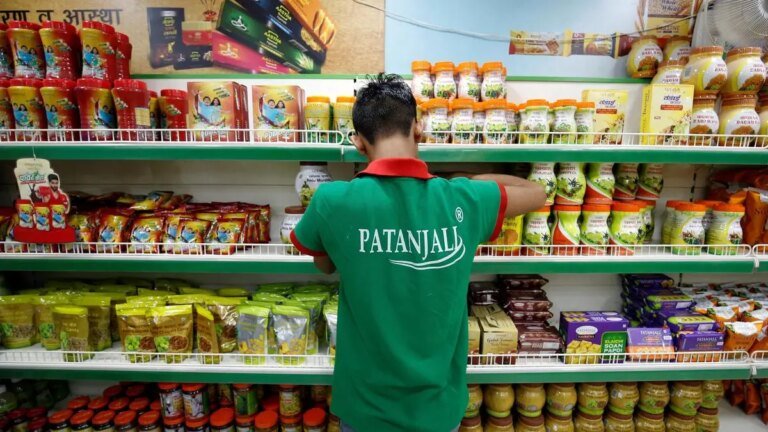
The management of Patanjali Foods (PFL) issued a cautiously optimistic commentary during our recent visit to its facility at Haridwar. It emphasized that the ongoing conflict in West Asia has not impacted spot prices of edible oils (c.70 per cent of revenue) so far. However, futures’ prices in Chicago vegetable oils have increased — the management indicated high correlation between crude oil (c.+12 per cent quarter on quarter in Q4FY26 so far) and edible oils. We believe prices of edible oils and biscuits (containing refined palm oil) are likely to move higher on the back of these trends. Cost-inflation in edible oils is largely pass-through.
While costs have started looking up, PFL has leveraged its pricing power and brand equity in maintaining double-digit sales growth despite sharp pricing in the earlier cost-upcycle. The favorable turn in foods’ growth across biscuits, staples and ethnic foods is a key positive; we believe growth is being driven by PFL’s expanding distribution network and the launch of premium variants – we expect FY25-28E sales’ CAGR of 7.5 per cent.
While near-term margin outcomes remains a monitorable, with the revenue contribution of FMCG products estimated to expand from 7 per cent in FY22 to c.32 per cent in FY28E, we expect PFL to garner superior blended margins over FY26E-28E.
We maintain our BUY rating with TP of ₹660, valuing the stock at P/E of 36x on December-2027E EPS (at a c.15 per cent discount to FMCG peers’ FY28E average).
Microsoft has released an emergency update to fix a Bluetooth device visibility issue on hotpatch-enabled Windows 11 Enterprise devices.
The Bluetooth devices will not appear in Windows Settings or Quick Settings, even though they’re functioning correctly and connected to affected systems.
This bug could also prevent some users from adding new Bluetooth devices because available devices will not appear in the connection list.
The out-of-band (OOB) KB5084897 hotpatch was released on Monday for systems running Windows 11 versions 25H2 and 24H2 and will install automatically without requiring a restart.
“Microsoft has identified an issue affecting hotpatch-enabled Enterprise editions of Windows where Bluetooth devices may not appear on the Bluetooth & devices page in Windows Settings or in Quick Settings, even though the devices are connected and functioning as expected,” Microsoft explained.
“In addition, users might be unable to add Bluetooth devices because available devices do not appear in the connection list.”
This OOB cumulative update includes all improvements and security patches that shipped with the March 2026 Windows hotpatch updates and will not install on Enterprise devices that receive standard Windows updates.
On Friday, Microsoft pushed another Windows 11 Enterprise OOB hotpatch (KB5084597) to patch three high-severity vulnerabilities in the Windows Routing and Remote Access Service (RRAS) management tool, which could allow attackers to execute malicious code remotely when connecting to a malicious server.
“An attacker authenticated on the domain could exploit this vulnerability by tricking a domain-joined user into sending a request to a malicious server via the Routing and Remote Access Service (RRAS) Snap-in,” the company noted in advisories issued last week.
“This issue only applies to a limited set of scenarios involving Enterprise client devices running hotpatch updates and being used for remote server management.”
As Microsoft explains, hotpatch updates apply vulnerability fixes by performing in-memory patching of running processes and updating files on disk, ensuring the fixes remain in place after rebooting the system.
Malware is getting smarter. The Red Report 2026 reveals how new threats use math to detect sandboxes and hide in plain sight.
Download our analysis of 1.1 million malicious samples to uncover the top 10 techniques and see if your security stack is blinded.
Turkana, Kenya – In the relentless heat of Kainama in Turkana county, Veronica Akalapatan and her neighbours walk several kilometres each day to a half-dried-up well surrounded by the parched earth of northern Kenya.
The dug-out hole in the ground with a wooden ladder is the only source of water in the area. Hundreds of people from several villages – and their livestock – share the well, most waiting hours to fill up small plastic buckets with meagre amounts of unclean water.
Recommended Stories
list of 3 itemsend of list
“Once we get here, we dig for water in the well and collect fruit. We wait for the water to fill the well,” says Akalapatan. “We take turns to fetch it because there is so little. There are many of us, and sometimes we fight over it.”
In Turkana, the land is rugged, roads disappear into dust, and villages are scattered across vast distances in a county of just more than a million people.
Despite it being the rainy season, weather experts warn that Turkana and other arid regions may receive little relief.
Authorities say drought is once again taking place, with 23 of Kenya’s 47 counties affected. An estimated 3.4 million people do not have enough to eat, at least 800,000 children show signs of malnutrition, and livestock – the backbone of pastoral life – are dying.
In Turkana alone, 350,000 households are on the brink of starvation.
“We are suffering from hunger,” Turkana elder Peter Longiron Aemun tells Al Jazeera.
“We don’t have water. Our livestock have died. We have nothing. We used to burn charcoal, but there are no acacia trees any more.”
Kenya is still recovering from one of its worst droughts in 40 years, which gripped the country between 2020 and 2023. The new weather crisis will likely make things worse.
But at the same time, experts note a stark paradox: Scarcity amid abundance.
Veronica Akalapatan at the bottom of a hand-dug well after collecting water in Turkana county [Allan Cheruiyot/Al Jazeera]
Food loss and food waste
While families face acute water shortages and hunger – with boreholes broken down, and wells and streams dried up – Lake Turkana’s water levels have risen in recent years, displacing some shoreline communities.
In other areas, sudden heavy rains trigger flash floods in normally dry riverbeds – known locally as luggas – yet the land remains largely barren. The water comes too fast, runs off too quickly and cannot sustain agriculture.
At the same time, while droughts lessen food supplies and global donor funding cuts have reduced food aid, not too far away, experts say, there is a surplus of food that does not make its way to those who need it.
“In Kenya, a quarter of the population faces severe food insecurity, even as up to 40% of the food produced is lost or wasted each year,” according to a September report by the World Resources Institute (WRI).
Food loss occurs on farms, and during the handling, storage and transportation of supplies, while food waste occurs in households, restaurants and in the retail sphere, WRI researchers noted.
In parts of the North Rift – one of Kenya’s breadbaskets – farmers have recorded good harvests. But high prices and widespread poverty mean pastoralist families in Turkana cannot easily afford food transported from surplus regions.
Security adds another layer of strain. Competition over water and pasture fuels tensions, cattle raids persist, armed bandits operate in remote areas, and security forces struggle to contain violence amid logistical and political challenges.
“The biggest problem in drought areas is security,” says Joseph Kamande, a food trader in Wangige in central Kenya.
Still, he believes the country has the potential to feed itself with better planning.
“The land is vast. Some of it is arable,” he says, adding that “water is the solution.”
Untapped aquifers
In Turkana, though there is severe drought, there are also untapped natural resources.
Hundreds of metres underground are multiple aquifers, layers of rock and soil containing water. The government is hoping to tap into these sources.
In 2013, two major aquifers were discovered, the Napuu aquifer and the Lotikipi aquifer. The largest covers roughly 5,000km (3,100 miles) and holds about 250 trillion litres (66 trillion gallons) of water.
It is said to have the capacity to supply Kenya with water for decades.
However, much of the water is salty and expensive to purify, so the project has stalled.
“The big challenge is salinity,” says Turkana County Water Director Paul Lotum.
“The national government and partners are mapping out pockets where water is safe and reliable. We are working bit by bit to harness it for communities.”
Until then, relief food remains essential for Turkana communities.
The government’s disaster management teams and other agencies are distributing water and food. But supplies are stretched thin. And getting aid to those who need it most is nearly impossible in some areas.
“Most government organisations are either closed or running leaner programmes,” says Jacob Ekaran, Turkana’s coordinator for the National Drought Management Authority.
“The resource basket has shrunk. But the government is trying to do more with what it has.”
A resident of Turkana displays wild berries collected for food in Loima, Turkana county. Families say the bitter berries have little nutritional value but are now a primary source of sustenance amid prolonged drought [Allan Cheruiyot/Al Jazeera]
‘I can’t find food’
When supplies run low, many people turn to wild berries and fruits.
In Lopur village, resident Akal Loyeit Etangana harvests berries that she then cooks in a small pot over an outdoor fire.
She says she has not had a proper meal in two weeks, so the fruit mixture keeps hunger away. Still, it carries almost no nutritional value.
“If it doesn’t rain, trees and leaves dry up. There is no water,” she laments, adding that clinics are also very far away and people have to walk long distances to get help.
In another village, Napeillim, resident Christine Kiepa worries that there is no food.
“I try to look for food. Sometimes it’s not there,” she says. “If I can’t find food, how do I survive?” she asks.
Villages in the region are slowly emptying. Male herders, who are usually the providers for their families, have moved to neighbouring counties in search of pasture and water for their dying livestock.
Only the elderly, women, young children and the weakest animals remain in the homesteads.
Still, there have been some gains in the region.
Since Kenya adopted a devolved system of government in 2013, Turkana has seen new schools and health centres built, irrigation schemes launched, boreholes drilled, and some roads tarmacked. Officials say investments in drought response have strengthened resilience.
“In the past, drought always degenerated into disaster. You would see reports of deaths,” says Ekaran from the drought management authority. “We are coming from one of the worst droughts in 40 years, but we did not record deaths. That is because of resilience building.”
Painful cycle
For generations, northern Kenya’s nomadic communities have depended on livestock. But climate change is forcing a reckoning. Calls for diversification – irrigation, drought-resistant crops and trees, large dams – have grown louder.
“We can change our community mindset,” says Rukia Abubakar, Turkana coordinator for the Red Cross.
“We can plant drought-resistant trees. We can do irrigation. Our soil is good for crop farming.”
These proposals are not new. They have surfaced after every drought, repeated in policy papers and political speeches.
Yet for many people in Turkana, the cycle feels painfully familiar and daily survival remains precarious.
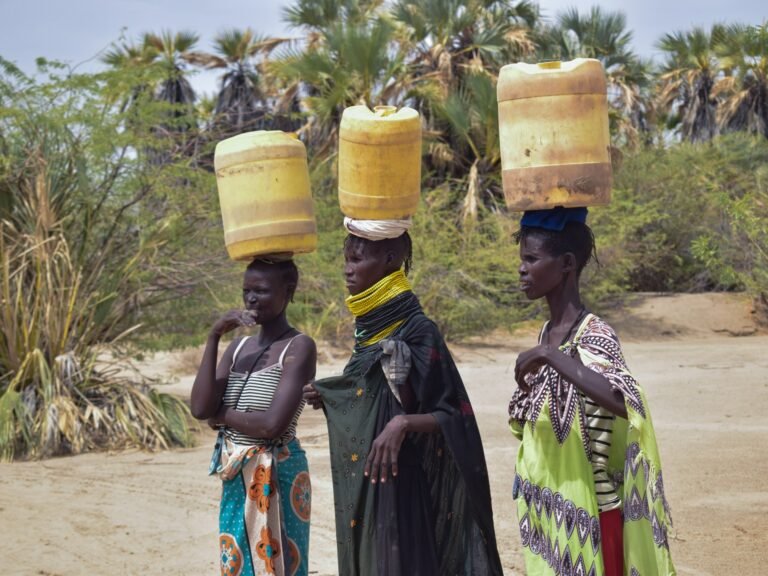
Back in Kainama, Akalapatan and her neighbours walk back from the water well through the vast, arid landscape, carrying a collection of filled yellow plastic buckets.
They finally return to their small community of thatched huts.
Akalapatan has managed to collect 20 litres (5 gallons) of water for her family for the day.
Her son eagerly fills a cup and gulps it down.
But she knows that what she has is barely enough for everyone, and she will soon have to make the journey to the well again.