The collapse of the US-based budget carrier due to a doubling in jet fuel prices will cost thousands of jobs.
Published On 2 May 20262 May 2026
Low-cost US carrier Spirit Airlines has said that all of its flights have been cancelled as it started an “orderly wind-down of operations,” after a potential White House bailout fell through.
“Spirit Aviation Holdings, Inc., parent company of Spirit Airlines … today regretfully announced that the Company has started an orderly wind-down of operations, effective immediately. All Spirit flights have been cancelled, and Spirit Guests should not go to the airport,” the airline said in a statement in the early hours of Saturday.
Recommended Stories
list of 4 itemsend of list
Spirit had 4,119 domestic flights scheduled between May 1 and May 15, offering 809,638 seats, according to the latest data from Cirium.
The collapse of the carrier due to a doubling in jet fuel prices during the two-month-old Iran war will cost thousands of jobs. It is also a blow to US President Donald Trump, who had proposed $500m to save Spirit despite opposition from some of his closest advisers and many Republicans in Congress.
Spirit had reached a deal with its lenders that would have helped it emerge from its second bankruptcy by late spring or early summer. But those plans derailed after the US war on Iran triggered a spike in jet fuel prices, upending Spirit’s cost projections and complicating its bankruptcy exit.
A Spirit board meeting had ended without an agreement to rescue the company, a person close to the discussions told the Reuters news agency late on Friday.
“Unfortunately, despite the Company’s efforts, the recent material increase in oil prices and other pressures on the business have significantly impacted Spirit’s financial outlook,” Spirit said in a statement announcing its “orderly wind-down”.
Trump on Friday said the White House had given Spirit and its creditors a final rescue proposal, after talks hit an impasse over a $500m financing package that would have helped the airline keep operating through bankruptcy.
“If we can help them, we will, but we have to come first,” Trump told reporters. “If we could do it, we’d do it, but only if it’s a good deal.”
Spirit’s restructuring plan assumed jet fuel costs of about $2.24 a gallon in 2026 and $2.14 in 2027, but prices had climbed to about $4.51 a gallon by the end of April, leaving the carrier unable to survive without new financing.
Transportation Secretary Sean Duffy told Reuters he had tried to get many airlines to buy Spirit but found no takers. “What would someone buy?” Duffy asked. “If no one else wants to buy them, why would we buy them?”
A creditor close to the deal said, “The Trump administration made an extraordinary effort to try and save Spirit, but you can’t breathe life into a corpse. Given that, the company should make its intentions clear for the sake of its customers and employees.”
No US carrier of Spirit’s size – it accounted for 5 percent of US flights at one point – has liquidated in two decades. Spirit helped keep fares lower in markets where it competed against major carriers.
Its collapse shows how the Iran war’s fuel-price shock has exposed weaker airlines. Across the globe, airlines have been increasing prices to reflect the high cost of jet fuel and some airlines have also cut flights.
German airline Lufthansa last month said it cancelled 20,000 flights in a bid to protect itself from the soaring cost of oil.
On Friday, Indian carrier Air India also said it has increased fuel surcharges on all flights and said it will cut 100 flights a day across domestic and international routes.
Hello and welcome to our live coverage of events in the Middle East.
The German defence minister, Boris Pistorius, said that it was “foreseeable” that the US would withdraw troops from Europe, after the Pentagon announced it would pull thousands of American soldiers from Germany.
US President Donald Trump said on Friday that the US will withdraw 5,000 active-duty troops from Nato ally Germany in the next six to 12 months, fulfilling his earlier threats after clashing with German chancellor Friedrich Merz over the Iran war.
Earlier this week, Merz said Iran had “humiliated” the US and questioned how Trump planned to end the conflict, saying: “The Americans obviously have no strategy.”
Responding to the announcement of plans to withdraw 5,000 US troops from Germany, Pistorius said: “It was foreseeable that the US would withdraw troops from Europe, including Germany.”
He added that Europeans must take greater responsibility for their own security, and that Germany was “on the right track” in this regard.
In other developments:
Trump said he is “not satisfied” with a new proposal from Iran on ending the war, as peace talks remain stalled despite a weeks-long ceasefire. Iran delivered the proposal text to mediator Pakistan on Thursday evening, Iranian state news agency Irna reported, without detailing its contents.
The US state department said it was approving military sales totalling more than $8.6bn to Middle Eastern allies Israel, Qatar, Kuwait and the United Arab Emirates. It came as Washington warned European allies including the UK, Poland, Lithuania and Estonia to expect long delivery delays for US weapons as it scrambles to replenish stockpiles depleted by the Iran war, according to a report in the Fianancial Times citing multiple sources.
In Lebanon, 12 people were killed in Israeli strikes in the south, Lebanon’s health ministry said, including in the town of Habboush, where the Israeli army had issued an evacuation order despite the continuing ceasefire. Israeli warplanes “launched a series of heavy strikes … less than an hour after” the warning, the state-run National News Agency said.
Smoke rises in Habboush, southern Lebanon, on Friday after Israeli strikes. Photograph: Reuters
The US Treasury Office warned that any shipping companies that paid tolls to Iran for passage through the strait of Hormuz, including charitable donations to organisations such as the Iranian Red Crescent Society, would risk punitive sanctions. Tehran has proposed charging fees on vessels passing through the strait, as part of a deal to end the war.
Trump wrote to US lawmakers on Friday declaring hostilities with Iran “terminated”, despite no change in the US military posture, as he faces continuing pressure at home to seek congressional authorisation for the war.
The state department’s announcement on Friday included approving military sales to Qatar of Patriot air and missile defence replenishment services costing $4.01bn and of advanced precision kill weapon systems (APKWS) costing $992.4m. They also included approval of the sale to Kuwait of an integrated battle command system costing $2.5bn and to Israel of APKWS costing $992.4m.
Iran’s supreme leader Ayatollah Mojtaba Khamenei urged his people to wage economic battle and “disappoint” its enemies, as the war and years of sanctions take a toll. In a written statement he also said “the owners of damaged businesses should avoid, as much as possible, layoffs and separation of their workforce”.
In the French port city of Nantes, once France’s largest departure point for ships that trafficked enslaved Africans across the Atlantic, a new wooden mast rises 18 metres into the sky from the waterside.
The Mast of Fraternity and Memory, inaugurated this month, marks a turning point in France’s complicated relationship with the legacy of its history of enslavement – just as the French president, Emmanuel Macron, comes under pressure to make key announcements on a process of reparatory justice.
“We’re not responsible for the past, but we are responsible for the present and future,” said Dieudonné Boutrin, a descendant of enslaved Africans who were trafficked from Benin to the French Caribbean island of Martinique.
Dieudonné Boutrin: ‘We’re not responsible for the past, but we are responsible for the present and future.’
Boutrin, 61, who created the mast, heads the grassroots organisation La Coque Nomade Fraternité, dedicated to “breaking the silence” around slavery and fostering discussion on reparatory justice and community relations.
The mast, a permanent, standalone structure, is unlike any other commemoration piece in France: conceived by descendants of enslaved people and built by local students at vocational colleges. Inaugurated this month alongside a new International Federation of Descendants of the History of Slavery, the mast is expected to be replicated in other cities in Europe, Africa, the Caribbean and the US, as a network of physical markers to the global movement for reparatory justice. The next one is likely to be built in Bristol, England’s historical slaving port.
The mast’s inauguration highlights how France is under pressure to announce a framework for discussions on reparatory justice in the coming weeks. Macron is entering his final months as president amid a growing political row over racism in politics, the media and society, and as the far right poll high in the runup to the 2027 presidential race.
The sense of urgency comes amid anger in France that its representatives – alongside those of UK and other European nations – abstained in March’s UN vote to describe the transatlantic chattel slave trade as the “gravest crime against humanity” and call for reparations as “a concrete step towards remedying historical wrongs”.
Victorin Lurel, a Guadeloupe senator, wrote in an open letter to Macron last month that France had committed a “moral, historic, diplomatic and political mistake” in abstaining and had “tarnished” its image internationally.
From the 16th to the 19th centuries, France, competing with Portugal and Britain, was the third largest of the European nations to traffic enslaved people across the Atlantic and Indian oceans. France was responsible for kidnapping and enslaving about 13% of the estimated 13 to 17 million men, women and children forced from Africa across the Atlantic.
In 2001, France made history as the first country in the world to recognise the slave trade and slavery as crimes against humanity in a law brought by Christiane Taubira, a leading MP from French Guiana. But as Macron prepares to host a ceremony to mark the 25th anniversary of the law on 21 May, campaigners and politicians say France must now go further with clear action on reparatory justice.
Paris is regarded as crucial to the global discussion on reparations, because several “overseas departments and regions” remain part of France – such as the Caribbean islands of Martinique and Guadeloupe, as well as French Guiana, the Indian Ocean island of Réunion and Mayotte. In these places, structural inequalities and disparities on employment, health, the cost of living, pollution and environmental safety are seen by local parliamentarians as a direct legacy of the mechanisms of enslavement and colonialism.
France is also facing demands for potentially billions of dollars in reparations to Haiti, after it imposed a harsh financial penalty on the country in 1825 to compensate owners of enslaved people after the Haitian revolution. That debt, which many Haitians blame for two centuries of turmoil, was only fully repaid to France in 1947. In 2025, Macron announced a joint commission with Haiti to examine the issue, with conclusions due by the end of this year.
The inauguration of the Mast of Fraternity and Memory in Nantes, where Boutrin has worked for decades after growing up in Martinique.
Boutrin’s initiative in Nantes shows how grassroots dialogue is shaping the mood in France and breaking taboos. He has worked in Nantes for decades in the public sector and as a trade unionist as well as running organisations on legacies of enslavement, but grew up in Martinique, where his father was a cabinet maker.
“My father taught us values. There were eight of us and my mother died when I was nine years old. There wasn’t money, we had to survive. Sometimes, I’d go two or three days without eating … It’s very complex. I know what misery is, I know where I come from, and I know how to fight to try to make sure that others don’t go through what I did.”
Boutrin said that growing up, there was a taboo about talking about being a descendant of enslaved people, a part of his heritage he did not look into until he arrived in Nantes. “It wasn’t spoken about,” he says. “At school we learned that we were the descendants of the Gauls … We didn’t talk about it. There was an aspect of shame around it, because enslavement had left such huge consequences.”
In recent years, protests in Martinique and Guadeloupe over the high cost of living have highlighted inequalities in French Caribbean départements. French national statistics show marked disparities between themand mainland France, with people on Martinique paying an estimated 30% to 42% more for food. There has been anger at the prominence in the islands’ economy of a handful of families descended from white owners of enslaved people – as well as the wide use of the toxic pesticide chlordecone to fight weevils on banana plantations, with devastating effects on health and cancer levels.
Boutrin said of the islands’ history of enslaved people: “It has created a huge consequence of trauma inside our minds today and that’s why I do what I do. All my work is to try to reconcile ourselves with this past and to try to push each person to rebuild in a different way to bring about change …… The only thing that interests me is that younger generations can live calmly together, can learn to understand and love one another.”
Dieudonné Boutrin with Pierre Guillon de Princé at the inauguration in Nantes.
Five years ago, Boutrin met Pierre Guillon de Princé, a descendant of 18th-century Nantes slave shipowners whose vessels had taken part in 18 expeditions between 1766 and 1788, transporting about 4,500 enslaved Africans to the Caribbean, at least 200 of whom died at sea. Guillon de Princé’s ancestors had also owned a sugar refinery and coffee production plant on Saint-Domingue, then France’s most important colony and centre of enslaved people, now Haiti.
Boutrin and Guillon de Princé, 86, began working together on educational tours of Nantes’s slavery history and to open up discussion on reparatory justice.
Guillon de Princé, at the Mast of Fraternity’s inauguration, made what is thought to be the first formal apology by someone in France for their family’s role in transatlantic slavery. “Faced with the rise of racism in our society, I felt a responsibility not to let this past be erased,” he said, pushing for dialogue on reparation.
Guillon de Princé, who worked for the water services at Nantes city hall, said he had not inherited wealth from his ancestors who had ultimately faced financial ruin. “But if there is shame, if we don’t speak about this, we can’t tackle the real problems of today,” he said. “I think the link is not made enough between enslavement and today’s racism.” He said his apology was directed to all communities in the Caribbean “for the impact of racism on their daily life, their health, their wellbeing”.
Jean-Marc Ayrault is pushing for moves on reparation in France.
Jean-Marc Ayrault, the former Socialist French prime minister and one of the politicians pushing for moves on reparation, said France must not be seen to be “sleeping through” this key moment in history and must galvanise other European countries.
Until now, France has focused principally on the restitution of artefacts of African cultural heritage looted during colonisation, with a new law expected to pass to streamline the process of returns that has been seen as too slow.
Organisations in France now want a focus on people and communities. Recourse through the courts has not proved viable – in 2023 France’s highest court, the cour de cassation, rejected a demand for state reparation for descendants of enslaved people that related principally to Martinique.
Before the Africa-France summit in Nairobi on 11-12 May, Samuel Okudzeto Ablakwa, Ghana’s foreign affairs minister, has said there were indications that France was ready to “collaborate” for “reparative justice”. A member of Macron’s entourage said France and Ghana would work together on this issue, “which is important for the president”.
Marie-Annick Gournet, an associate pro vice-chancellor for reparative and civic futures at Bristol University, was born in Guadeloupe. In Nantes for the inauguration, she said it was crucial for France to show action – not just words – on enslavement.
“In 2001, France recognised this as a crime against humanity, but if there are no actions to redress that issue then it’s just a void law,” she said. “I think France is very good at passing laws and making noise – specifically the right nose at political levels. But we are not seeing any change. There’s nothing in terms of repair. Yes, there’s a law recognising it but there is a reparatory justice work that needs to be done behind that.”
Gournet said of inequality in Martinique and Guadeloupe: “They are part of France without being part of France. And because people there are not treated in the same ways, it does feel that there’s a continuation of colonisation on these islands. Whether we like it or not, the reality is the disparity in terms of people’s experience which reflects exactly that. And if the government here and the people in power there are not ready to hear that, to understand that, words will only become words and there’s no change.”
Aïssata Seck, the director of France’s Foundation for the Remembrance of Slavery, an advisory body to the government partly funded by the state, said: “The question of reparations is still a taboo subject in France. A few years ago it was difficult even to say the word reparation.” But she said she hoped France was ready today to “open discussions … and to get people round the table to talk about the issue”. She said for France, this meant looking beyond “the prism of financial reparation” at issues of heritage, anti-racism and tackling inequality, particularly in the Caribbean.
Seck said: “It’s important to stress that France is the European country with the most people of African descent, and that is linked to a history of colonial enslavement and colonisation. Because we have that history, the means allocated to this must be substantial.”
Asher Craig, centre, former deputy mayor of Bristol, in Nantes.
In Nantes, Asher Craig, the former deputy mayor of Bristol who followed Boutrin’s long battle to get the Mast of Fraternity and Memory built, said: “Work like this, led by Black communities, is still not supported at the level it should be. That’s not accidental. It’s systemic. And if we are serious about justice, then funding, visibility, and power needs to follow.”
Access Denied
You don’t have permission to access “http://news.sky.com/story/teenager-arrested-on-suspicion-of-bomb-hoax-after-peter-kay-arena-evacuation-13539107” on this server.
Access Denied
You don’t have permission to access “http://hindi.news18.com/cricket/in-a-famous-2006-odi-south-african-bowler-roger-telemachus-conceded-19-runs-from-four-conceded cutive-no-balls-rather-than-in-one-ball-this-occurred-in-the-48th-over-of-the-historic-438-run-chase-match-ag-10428759.html” on this server.
President of America donald trump Has said that America entered the war with Iran because crazy people should not have nuclear weapons. Speaking at a program, he said that after the ceasefire this enmity has now ended. Meanwhile, there is news that Iran has sent a new proposal for talks to America through Pakistan. But Trump expressed dissatisfaction with this offer. He says that Iran is putting such conditions which he cannot accept. He also described Iran’s leadership as being unanimous.
Although talks are going on and the ceasefire has been going on for three weeks, Trump still said that the war is over. The White House has also informed Congress that hostilities with Iran have ended, while American troops are still deployed in the area. This matter has come to light at a time when the May 1 deadline has passed under the War Powers Resolution, which requires Congressional approval for military action within 60 days. Trump called this law unconstitutional and refused to accept it. At the same time, the efforts of the Democrats in the Senate to stop the war were also rejected.
The situation is not completely calm – Trump In a letter to Congress, Trump indicated that the situation has not completely calmed down. He said that America and its military still remain a threat from Iran and continuous efforts are being made to maintain peace. On the other hand, Iran says that it has the right to enrich uranium for peaceful purposes, while Western countries have been raising questions on this. Iran’s Foreign Minister Abbas Araqchi said that if America changes its attitude and stops exerting pressure, then the path to dialogue can open. He also said that Iran is fully prepared for its security.
Military action can be increased- Trump Trump also indicated that military action could be increased if necessary, but he also said that he did not want to do so. He said that there are only two options, either a full-scale attack or a compromise, and from a human point of view he considers compromise to be better.
The Himalayan nation restores centuries-old statue, stolen in the 1980s, to its original temple in capital Kathmandu.
Published On 2 May 20262 May 2026
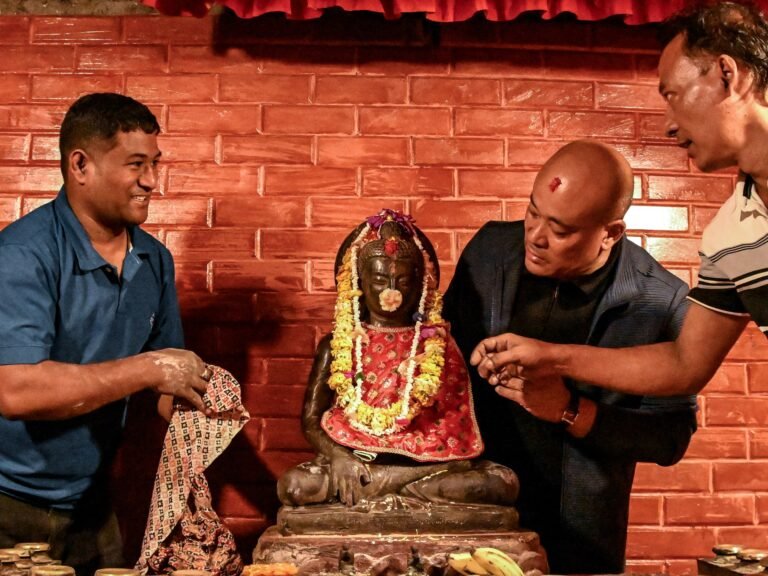
A centuries-old Buddha statue stolen from a Nepali temple has been reinstalled in its original location, one of several artefacts returned from foreign museums and collectors in recent years.
The statue, dating to the 13th century, was carried in a palanquin back to its pagoda-style temple in the capital, Kathmandu, to the sound of traditional music on Friday.
Recommended Stories
list of 4 itemsend of list
“I feel so happy, we all do. Our god is coming back,” temple-goer Sunkesari Shakya, 67, told the AFP news agency, recalling the day the statue was stolen, wreaking “havoc” in the community.
In a ceremony attended by a visiting United States envoy, the statue, which returned from New York in 2022, was placed back on its original stone plinth. The event coincided with the festival of Buddha Jayanti, marking the birth of the founder of Buddhism.
Devotees carry a sculpture of the Buddha to be reinstalled at a temple in Kathmandu [Prakash Mathema/AFP]
A replica that locals had been worshipping instead was moved to another area of the temple.
The statue was taken from the temple in the 1980s and later emerged at Tibet House US, a cultural centre in New York, where it was gifted by an unknown monk, according to Nepal’s Department of Archaeology.
Sergio Gor, Washington’s special envoy to South and Central Asia, told AFP, “One of the things we are focusing on is to be able to bring back some of these incredible artefacts that decades past got into the wrong hands.”
“We are trying to right a wrong from the past,” said Gor, who was on a three-day visit to Nepal.
Devotees carry a sculpture of the Buddha to be reinstalled at a temple in Kathmandu [Prakash Mathema/AFP]
Many in the Himalayan nation of 30 million people are deeply religious, and the country’s Hindu and Buddhist temples, as well as heritage sites, are an integral part of everyday life.
But many sites are bereft of centuries-old sculptures, paintings, ornamental windows and even doors, which were often stolen after the country opened up to the outside world in the 1950s.
Many pieces were taken with the help of corrupt officials to feed art markets in the US, Europe and elsewhere, although their export remains illegal.
About 200 artefacts have been returned to Nepal, according to the Archaeology Department, including wood and stone carvings, paintings, scriptures and idols of gods and goddesses. At least 41 artefacts have been placed back in their original locations.
“This is very important. Our statues are not just objects of art but part of a living heritage,” conservation expert Rabindra Puri told AFP.
Puri said there was growing momentum to return stolen artefacts. More than 400 are officially listed as missing, but experts estimate the actual number to be in the thousands.
Authorities are specifically seeking to return more artefacts from the US, France, Germany and the United Kingdom.
A minor scuffle during the Congress meeting in the politics of Madhya Pradesh has intensified the discussion in political circles. Senior Congress leader Digvijay Singh took a dig at state president Jitu Patwari and said that Patwari’s hold on AICC is not as much as his own. This comment came at a time when participation in the organization and electoral representation was being discussed in the meeting of the Scheduled Caste Department. This statement of Digvijay Singh is being seen as an indication of the changing leadership balance within the party.
Responding to this, Jitu Patwari said in a simple manner, “I am your disciple.” His answer lightened the atmosphere. Digvijay Singh also immediately reacted and said that “Now the Guru has become jaggery and the disciple has become sugar”, which created an atmosphere of laughter among the leaders and workers present in the meeting.
There was a stir in political circles due to mutual sarcasm
According to the information, in the evening Jitu Patwari reached Digvijay Singh’s residence to seek blessings. After the video of this meeting surfaced, there was a stir in the political circles. In the meeting, Digvijay Singh may have jokingly taunted Jitu Patwari that your hold in AICC is more than mine. You can get Venugopal Rao to write anything, when Jitu Patwari replied that I am your disciple and in response to this, Digvijay Singh said that now the Guru has become jaggery and the disciple has become sugar.
After this, Jitu Patwari also understood that somewhere Digvijay Singh was angry with him and to remove this resentment, Jitu Patwari reached Digvijay Singh’s official residence in Bhopal in the evening. As soon as Jitu reached, he first touched the feet of Digvijay Singh and took his blessings. There was a brief conversation between the two leaders and after that Jitu Patwari left his bungalow. Jeetu Patwari understands very well that if Digvijay Singh is angry with him then it is very important to express his anger because it has many advantages and disadvantages.
Access Denied
You don’t have permission to access “http://hindi.news18.com/cricket/kyle-jamieson-punished-gets-one-demerit-point-for-an-aggressive-send-off-to-rajasthan-royals-15-year-old-vaibhav-sooryavanshi-10428808.html” on this server.
A serious incident of bullying and challenging law and order has come to light from Hapur district of Uttar Pradesh. In a locality of Dehat police station area, some youth targeted a house and created a ruckus and pelted stones. This sudden attack created panic in the entire area and the people nearby got scared. As soon as the information about the incident was received, the police reached the spot, but by then all the accused youths had fled from there.
The attackers started pelting stones as soon as they reached outside the house.
It is being told that the attacking youth reached outside the house with stones in their hands and started pelting stones without any warning. At that time, women and children were present inside the house, who were badly frightened by this sudden attack. There was screams inside the house and the family members were forced to hide here and there to save their lives. The entire incident created an atmosphere of fear in the area.
The entire incident has been captured in the CCTV camera installed outside the house. It can be clearly seen in the video how the youth are aggressively attacking the house. This video is now becoming increasingly viral on social media, due to which both anger and concern have increased among the people.
Attacked on suspicion of keeping friend hostage inside the house
According to preliminary information, the reason for this attack is said to be a misunderstanding. The attackers had received information that one of their friends was being held hostage inside this house. Based on this suspicion, he took the law into his own hands and attacked. However, this claim has not been officially confirmed yet.
Police reached the spot and controlled the situation and took CCTV footage into their possession. At present, the police is busy identifying the accused and searching for them and a thorough investigation of the case is going on.