
Budget 2026 jitters spark sell-off on Dalal Street: Sensex crashes over 2400 pts, Nifty down 1%

0

Indian equities slumped sharply in mid trading session on Sunday as investors reacted nervously to the Union Budget, with broad-based selling dragging benchmark indices deep into the red. The sell-off was steeper in the broader market, where midcap and smallcap stocks slid 2–3 per cent, while all sectoral indices traded lower—led by PSU banks, financials, metals, chemicals and FMCG shares, which declined 2–4 per cent.

BSE Sensex was down 1,043.91 points, or 1.27 per cent, at 81,225.87 around 12.42 pm, after hitting an intraday low of nearly 2,400 points, while the Nifty 50 slipped 360 points, or 1.42 per cent, to 24,960.65, having fallen as much as 869 points earlier in the session.

Top movers

Max Health, Wipro, Sun Pharma, TCS and Dr Reddy’s Lab traded as major gainers, while Hindalco, Bharat Electronics, Shriram Finance, Coal India and SBI depreciated the most among Nifty 50 pack.

Market breadth remained weak, with declines far outnumbering advances in the session. Out of 3,113 stocks traded on the National Stock Exchange, as many as 1,938 traded lower, while only 1,083 advanced and 92 remained unchanged.

The number of stocks hitting 52-week lows at 160 sharply exceeded the 22 touching fresh highs, underscoring the risk-off mood. Meanwhile, 89 stocks were locked in the upper circuit, but a higher 99 hit the lower circuit, reflecting intense selling pressure across counters.

Sectoral impact following Budget

Defense stocks (BEL, GRSE and HAL), railway stocks such as BHEL, IRFC, IRCTC dragged following the budget presentation. Meanwhile, aqua and seafood stocks soared. Broking stocks witnessed pressure due to an increase in securities transaction tax (STT) on futures.

Shripal Shah, MD & CEO Kotak Securities, emphasized the steep increase in STT on futures and options will likely impact costs for traders, hedgers, and arbitrageurs. “This could cool derivative activity and lead to a reduction in volumes. The intent appears to be volume moderation rather than revenue maximization, as any potential revenue gain could be offset by lower derivative volumes.”

Under the midcap index, NTPC Green, Tata Communications, Swiggy, Motilal OFS and HUDCO rose 1-3 per cent, while National Aluminium, BSE, Muthoot Finance, BDL and Bank of India plunged 6-9 per cent.

Among smallcap, Anant Raj, Neuland Lab, IFCI, Zensar Tech and Trident soared 3-9 per cent, MCX, Hindustan Copper, Angel One, Nuvama, IIFL and Karur Vysya Bank shares dragged 6-13 per cent.

Despite the market trading in the red post-Budget, analysts remain constructive on several sectors. Abhinav Tiwari, Research Analyst at Bonanza, said infrastructure and capital goods are likely to emerge as key beneficiaries, citing the government’s decision to raise capital expenditure to ₹12.2 lakh crore.

Companies involved in construction, EPC, cement and industrial equipment are expected to see improved sentiment and earnings outlook.

“Higher allocations and policy support for electronics, semiconductors, chemicals, textiles, capital goods and container manufacturing strengthen India’s role as a global manufacturing hub. This is positive for electronics manufacturing services, specialty chemical companies and textile exporters, as it supports capacity expansion and long-term growth.

For banking and financials, the impact is largely neutral,” Tiwari said. He also highlighted that the budget is clearly supportive for IT services and data centres, pointing to tax certainty, higher safe-harbour limits and long-term tax incentives for global data-centre operations in India.

Published on February 1, 2026
Markets slip into red as budget optimism fades, Nifty down over 2%

0

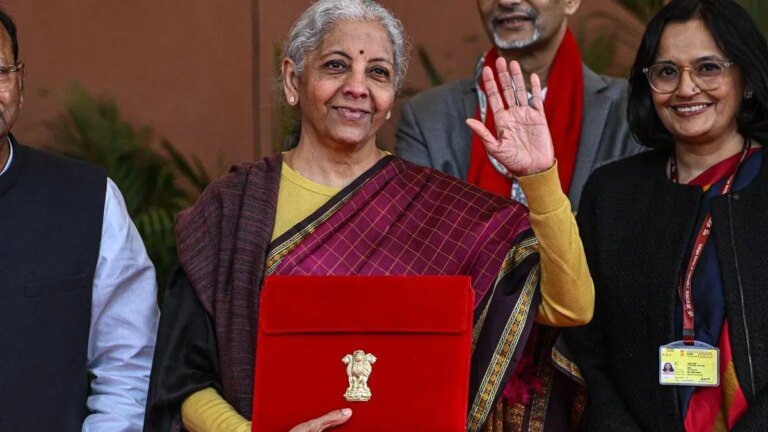
Nirmala Sitharaman, India's finance minister

Nirmala Sitharaman, India’s finance minister | Photo Credit: PRAKASH SINGH

Markets reversed early gains and slipped sharply into negative territory by afternoon on Sunday, February 1, as post-Budget optimism evaporated amid selling pressure across broader indices. The Sensex fell 1,483.53 points or 1.80 per cent to 80,786.25, while the Nifty declined 539.60 points or 2.13 per cent to 24,781.05 as of 12.30 pm IST.

Market breadth remained negative with 2,294 stocks declining against 1,602 advancing on the BSE, while 200 remained unchanged out of 4,096 stocks traded. A total of 178 stocks hit 52-week lows compared to just 65 touching 52-week highs, with 126 stocks locked in lower circuit and 175 in upper circuit.

Broader indices witnessed steeper losses, with the Nifty Midcap 100 down 1,754.00 points or 3.00 per cent at 56,639.95 and the Nifty Smallcap 100 falling 578.30 points or 3.43 per cent to 16,300.80. The Nifty Next 50 dropped 1,764.90 points or 2.60 per cent to 66,074.95, while sectoral indices including Nifty Financial Services, down 566.70 points or 2.07 per cent at 26,739.20, and Nifty Bank, lower by 1,035.00 points or 1.74 per cent at 58,439.15, also traded under pressure.

Only four stocks managed to stay in positive territory on the Nifty50. Max Healthcare led gainers, rising 2.62 per cent to ₹981.90, followed by Sun Pharma up 0.72 per cent at ₹1,606.80, Kotak Mahindra Bank gaining 0.59 per cent to ₹410.40 and Dr Reddy’s Laboratories higher by 0.44 per cent at ₹1,223.40.

Bharat Electronics emerged as the top loser, plunging 9.13 per cent to ₹408.00, followed by Hindalco down 6.06 per cent at ₹904.25, State Bank of India falling 5.13 per cent to ₹1,021.90, Jio Financial Services declining 4.17 per cent to ₹243.90 and HCL Technologies dropping 3.93 per cent to ₹1,628.90.

Sonam Srivastava, Founder and Fund Manager at Wright Research PMS, said “Union Budget 2026 is being read by markets as a continuation budget rather than a disruptive one, which in itself is a positive at this stage of the cycle.” She added that “the budget compresses macro risk premia rather than triggering an immediate earnings re-rating, which is healthy for medium-term equity returns.”

Published on February 1, 2026

Intellect Design Arena shares fall 14% after sharp profit decline despite revenue growth

0

Shares of Intellect Design Arena came under heavy selling pressure in early trade on Sunday, tumbling as much as 14 per cent to ₹785 before paring some losses to trade around ₹850.70, still down about 7 per cent from the previous close of ₹913.70. The decline followed the company’s quarterly earnings announcement, which showed a steep fall in profitability despite strong growth in revenue.

On a consolidated basis, the financial technology firm reported a net profit after tax of ₹27.42 crore for the quarter ended December 2025, marking a sharp 65 per cent drop from ₹70.8 crore in the same period last year. The company’s revenue from operations, however, rose 20 per cent year-on-year to ₹731.4 crore compared with ₹609.62 crore in the corresponding quarter of the previous fiscal.

On a standalone basis, Intellect Design Arena posted a net loss of ₹7.20 crore during the quarter under review, reversing from a profit of ₹34.16 crore reported in the year-ago period. The swing into losses at the standalone level added to concerns over margin pressures and cost dynamics in the core business.

Published on February 1, 2026

Access Denied

0

Access Denied You don’t have permission to access “http://hindi.gadgets360.com/home-entertainment/india-u19-vs-pakistan-u19-live-streaming-cricket-world-cup-2026-match-score-where-how-to-watch-star-sports-jiohotstar-news-10923626” on this server.

Reference #18.4d560e17.1774587794.1be7badf

https://errors.edgesuite.net/18.4d560e17.1774587794.1be7badf

IEX shares trade firm following Q3, Nuvama flags market coupling as major overhang for IEX

0

Shares of Indian Energy Exchange (IEX) witnessed intraday volatility on the NSEmoving in a narrow band between ₹125.80 and ₹128.36 before trading at ₹128.19, up about 1 per cent from the previous close of ₹126.79.

The movement in the stock comes after the power trading platform posted a steady performance for the December 2025 quarter on Thursday and announced an interim dividend.

The company reported a standalone net profit of ₹115.09 crore for the quarter, marking an 11.5 per cent rise from ₹103.15 crore in the same period last year. Revenue from operations increased to ₹143.90 crore, up 9.5 per cent from ₹131.31 crore a year earlier. The board also approved an interim dividend of ₹1.50 per share for FY25–26.

Brokerage firm Nuvama Institutional Equities, however, struck a cautious tone on the stock despite the earnings growth.

In its note, the brokerage said IEX posted Q3FY26 adjusted profit after tax of ₹1.19 billion, up 11 per cent year-on-year and broadly in line with expectations, even as the tax rate rose to 24.8 per cent compared with 23.7 per cent in the year-ago quarter.

Nuvama highlighted that volumes grew 8.5 per cent year-on-year, driven mainly by strong real-time market growth of 36 per cent, which was partly offset by a sharp 30 per cent decline in renewable energy certificates.

It added that weak power demand during the quarter has been supporting real-time market volumes, but warned that a rise in power deficits could lift spot prices and potentially compress exchange volumes.

The brokerage also pointed to market coupling as a major overhang for the stock, noting that ongoing litigation at the Appellate Tribunal for Electricity indicates procedural delays.

It has pushed the potential impact of market coupling to FY29 from its earlier FY28 assumption, factoring in possible loss of share in the day-ahead market and margin pressure.

While raising its FY28 earnings per share estimate by 18 per cent, Nuvama reiterated that headwinds from market coupling remain and maintained its ‘reduce’ rating on the stock with a discounted cash flow–based target price of ₹118.

Published on February 1, 2026

Access Denied

0

Access Denied You don’t have permission to access “http://hindi.gadgets360.com/ai/moltbook-ai-agents-social-network-going-viral-on-social-media-know-who-created-moltbook-how-it-works-news-10923342” on this server.

Reference #18.50200117.1774589385.346d8a7b

https://errors.edgesuite.net/18.50200117.1774589385.346d8a7b

Metal Stocks Plunge: Vedanta, Hindustan Copper, Nalco, Hindustan Zinc shares tank

0

Metal stocks faced sharp selling pressure in today’s trading session, with several heavyweight names sliding to their lower circuit limits amid broad weakness across the sector.

Investor sentiment turned cautious as concerns over global demand, commodity price volatility and risk-off mood in equities weighed heavily on metal counters.

Nifty Metal index traded 2 per cent lower at 11,572.70 at 10.52 am, after declining over 5 per cent to 11,218.80 against the previous close of 11,827.55.

Vedanta plunged 10 per cent, reflecting intense selling interest from the opening bell. The stock struggled to find buyers through the session, underscoring the nervousness surrounding diversified metal producers.

Shares traded 4 per cent lower at ₹656.60 at 10.44 am on the NSEfalling 10 per cent to ₹613.40 against the previous close of ₹681.55.

Hindustan Copper also witnessed a steep decline, sinking 19 per cent to ₹555.10. The sharp fall added to the overall gloom in the space, as traders rushed to cut exposure in metal-linked stocks.

National Aluminum Company, or Nalcodragged 14.5 per cent to ₹329.40, near the lower circuit of ₹327.65, extending losses as aluminum stocks mirrored weakness seen in global markets.

Hindustan Zinc was not spared either, falling nearly 14 per cent to ₹543.55. Market participants said the sell-off reflects heightened uncertainty around global economic growth and fluctuations in base metal prices, prompting investors to turn defensive in cyclical sectors.

Published on February 1, 2026

Why Silver Price crashes 40% from record peak?

0

Silver endured extreme volatility on Friday, plunging nearly 40 per cent from record highs above $118-$121 per ounce to around $74-$85, triggering lower circuit limits across all Silver Exchange Traded Funds (ETFs) in India.

On the Multi Commodity Exchange (MCX)silver corrected aggressively from peaks near ₹4,20,048 per kilogram to around ₹2,91,000-₹2,91,925.

“Due to the sharp decline in silver prices, with silver futures on MCX hitting lower circuit levels amid global commodity sell-off and profit-booking, all Silver ETFs across various mutual fund houses are likely to open at the lower circuit on the stock exchanges,” according to a market advisory sent to investors.

As per exchange rules, ETFs have a circuit limit of 20 per cent based on the previous trading day’s closing price.

The dramatic selloff came after President Trump’s nomination of Kevin Warsh as the next Federal Reserve Chair. Warsh, known for his hawkish stance on inflation, prompted a strengthening US dollar and rising real yields, triggering liquidation of leveraged positions across precious metals.

Kaynat Chainwala, AVP – Commodity Research at Kotak Securities, noted that “silver has corrected more sharply than goldwhich is typical following outsized gains given its higher volatility and exposure to industrial demand.” She identified strong support in the $95-$102 range.

Nikunj Saraf, CEO of Choice Wealth, highlighted that silver had hit ₹4,20,048 per kg on Thursday before the crash. Indian ETFs like Nippon India Silver plunged 14 per cent in a single day, mirroring the global selloff where spot silver fell 5.7 per cent to $109.55 per ounce.

Rajkumar Subramanian, Head – Product & Family Office at PL Wealth, noted that silver had exhibited a remarkable rally over the past year, rising from around ₹1.5-1.6 lakh per kg in early 2025 to above ₹4 lakh per kg by late January 2026, implying a 165-170 per cent gain.

“However, silver remains a volatile metal, with historical annualized volatility often in the 25-35 per cent range, higher than gold, and the sharp run-up increases the risk of near-term corrections,” he said.

Ponmudi R, CEO of Enrich Money, characterized the correction as “a leverage flush, sentiment reset, and tactical adjustment rather than a trend reversal.”

He identified critical support at $74-$70, aligning with the 50-day EMA, and noted that stability above this base could facilitate a rebound toward $82-$92-$100+. On MCX, he placed stronger support around ₹2,51,000-₹2,52,000.

Despite the sharp decline, analysts maintain that structural drivers remain intact, including persistent supply deficits and surging industrial demand from green energy, electric vehicles, AI, electronics, and solar sectors. The medium-term outlook remains constructive, though near-term volatility is expected to persist.

Published on February 1, 2026

Why Gold rate crashes 16% from record highs?

0

gold witnessed one of its sharpest corrections in decades on Friday, plummeting nearly 16 per cent from record highs above $5,480-$5,626 to trade around $4,745-$4,887 per ounce, as aggressive profit-booking followed the nomination of Kevin Warsh as the next US Federal Reserve Chair.

On the Multi Commodity Exchange (MCX)gold retreated from peaks near ₹1,80,000 per 10 grams to stabilize around ₹1,49,500-₹1,49,653.

The primary trigger was President Trump’s nomination of Warsh, known for his hawkish stance on inflation control and emphasis on Fed independence. The announcement prompted a rapid macro re-pricing with the US dollar strengthening and real yields rising, leading to violent liquidation of leveraged positions in precious metals.

“Gold witnessed sharp selling pressure after margin hikes triggered aggressive profit booking in CME, where prices corrected from the recent peak of $5,500 to near $5,000,” said Jateen Trivedi, VP Research Analyst at LKP Securities. He noted that MCX gold slipped from record highs above ₹1,80,000 to intraday lows near ₹1,55,000.

Kaynat Chainwala, AVP – Commodity Research at Kotak Securities, explained that bullion prices faced headwinds from a stronger US dollar and fears that Warsh, widely viewed as an inflation hawk, could tighten monetary policy. “A sharp correction in the Nasdaq and the risk of a broader yen carry-trade unwind pose the biggest downside risks to the gold rally,” she said.

Nikunj Saraf, CEO of Choice Wealth, described the 14 per cent plunge in Gold ETFs as “classic profit-taking after Thursday’s record highs on MCX.” He noted that spot gold fell 3.9-5 per cent to $5,183 per ounce.

Despite the severity of the pullback, analysts maintain that the secular bullish structure remains intact. Ponmudi R, CEO of Enrich Money, stated that core drivers persist including “relentless central bank gold accumulation, enduring geopolitical uncertainties and fiat diversification trends.” He characterized the correction as “a healthy reset purging excess leverage and speculative froth.”

Chainwala recommended a buy-on-dips strategy, with gold expected to find support in the $5,000-$5,100 zone. Trivedi expects CME gold to remain volatile in the $4,800-$5,200 range, while MCX gold is likely to oscillate between ₹1,58,000 and ₹1,70,000.

Dr. VK Vijayakumar, Chief Investment Strategist at Geojit Investments, noted that “the sharp correction in gold and silver, if it persists, can draw investors away from precious metals to equity.”

Published on February 1, 2026

Access Denied

0

Access Denied You don’t have permission to access “http://hindi.gadgets360.com/mobiles/huawei-nova-14i-price-hkd-1588-with-7000mah-battery-50mp-camera-launched-features-news-10922977” on this server.

Reference #18.4d560e17.1774592918.1c143ca3

https://errors.edgesuite.net/18.4d560e17.1774592918.1c143ca3