Gautam Gambhir Reaction Viral: Question to Gautam Gambhir on Pakistan’s boycott decision, head coach created a sensation with this reaction, VIDEO viral

0

Last Updated:

Gautam Gambhir Reaction Pakistan Boycott T20 World Cup 2026: Indian head coach Gautam Gambhir refused to comment on Pakistan’s boycott stand against India before the T20 World Cup 2026. The Pakistan government has not allowed its cricket team to play against India in the tournament.

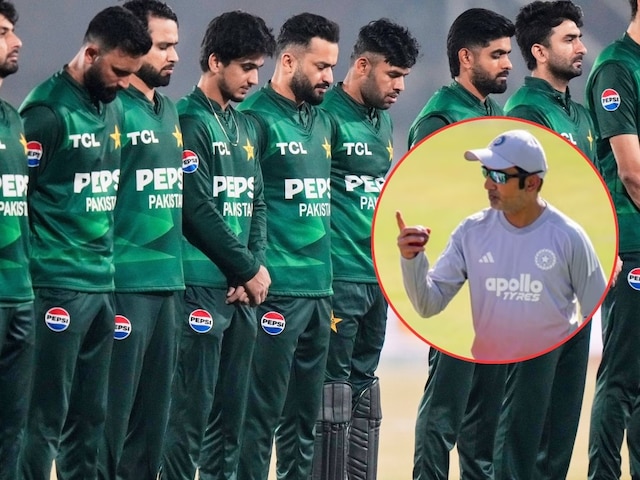
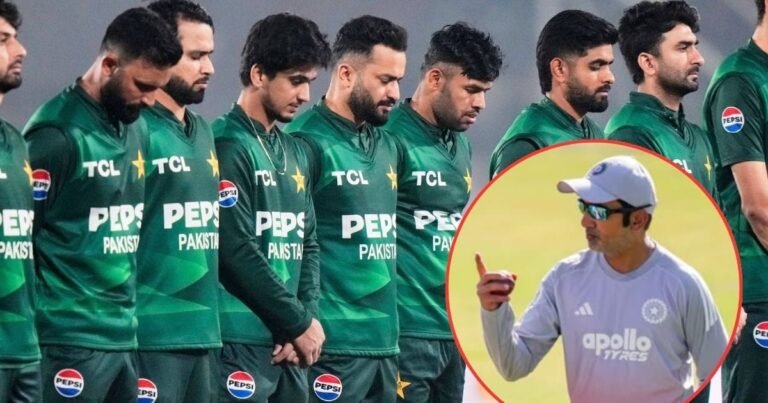
Gambhir questions on PAK's boycott decision, this reaction of the head coach created a sensationZoom
Gambhir’s reaction on Pakistan refusing to play against India goes viral.

New Delhi. There is an uproar before the T20 World Cup 2026. Pakistan, showing sympathy with Bangladesh, refused to play in the tournament against India, after which it is being criticized in world cricket. However, Pakistan has not officially informed ICC about its decision. Now what action ICC is going to take against PCB regarding this gimmick of Pakistan will be known later, but amidst this whole matter, a video of Team India’s head coach Gautam Gambhir is going viral. In fact, when Gautam Gambhir was asked a question about Pakistan’s decision to refuse to play the T20 World Cup match against India, the reaction he gave is making headlines.

When Gautam Gambhir was leaving for Mumbai, the media personnel at the airport asked him questions about Pakistan’s refusal to play in the T20 World Cup against India, but the head coach of Team India was seen avoiding saying anything on this issue. However, Gambhir first thanked the media for wishing well for Team India. After this, when he was questioned about Pakistan, he moved ahead without saying anything and did not give any reaction. During this time, at one point it seemed that Gambhir wanted to say something, but he stopped. Its video is going viral on social media.

Mozilla Adds One-Click Option to Disable Generative AI Features in Firefox

0

Ravie LakshmananFeb 03, 2026Artificial Intelligence / Privacy

Disable Generative AI Features

Mozilla on Monday announced a new controls section in its Firefox desktop browser settings that allows users to completely turn off generative artificial intelligence (GenAI) features.

“It provides a single place to block current and future generative AI features in Firefox,” Ajit Varma, head of Firefox, said. “You can also review and manage individual AI features if you choose to use them. This lets you use Firefox without AI while we continue to build AI features for those who want them.”

Mozilla first announced its plans to integrate AI into Firefox in November 2025, stating it’s fully opt-in and that it’s incorporating the technology while placing users in the driver’s seat.

The new feature is expected to be rolled out with Firefox 148, which is scheduled to be released on February 24, 2026. At the outset, AI controls will allow users to manage the following settings individually –

  • Translations
  • Alt text in PDFs (adding accessibility descriptions to images in PDF pages)
  • AI-enhanced tab grouping (suggestions for related tabs and group names)
  • Link previews (show key points before a link is opened)
  • AI chatbot in the sidebar (Using well-known chatbots like Anthropic Claude, OpenAI ChatGPT, Microsoft Copilot, Google Gemini, and Le Chat Mistral while navigating the web)

Mozilla said user choice is crucial as more AI features are baked into web browsers, adding that it believes in giving people control regardless of how they feel about the technology.

“If you don’t want to use AI features from Firefox at all, you can turn on the Block AI enhancements toggle,” Varma said. “When it’s toggled on, you won’t see pop-ups or reminders to use existing or upcoming AI features.”

Last month, Mozilla’s new CEO, Anthony Enzor-DeMeo, said the company’s focus will be on becoming a trusted software company that gives users agency in how its products work. “Privacy, data use, and AI must be clear and understandable,” Enzor-DeMeo said. “Controls must be simple. AI should always be a choice – something people can easily turn off.”


Source link

Trump scolds CNN reporter Kaitlan Collins for not smiling as she asks about Epstein abuse survivors – live | Trump administration

0

Trump scolds CNN reporter Kaitlan Collins for not smiling as she asks about survivors of Epstein’s abuse

Frustrated by her persistence in asking questions about Jeffrey Epstein during an Oval Office event he wanted to use to promote himself and his party, Donald Trump scolded the CNN correspondent Kaitlan Collins for supposedly not smiling enough in his presence.

The exchange began with Collins pointing out that Trump’s attempt to frame the disclosures in the latest batch of Epstein files as damning only for Democrats by pointing out that they also revealed that Epstein had close ties to two of his allies, Elon Musk and Howard Lutnick, his commerce secretary.

Trump shrugged dismissively as Collins mentioned Musk and Lutnick and said that while he had not read their friendly emails with Epstein, the late sex offender he was also friends with for 17 years. “I’m sure they’re fine,” Trump said, “otherwise there would’ve ben major headlines.” There were, in fact, headlines about the revelations that Musk and Lutnick were closer to Epstein than they had previously stated.

When Collins noted that “a lot of women who are survivors of Epstein are unhappy with” the way the justice department redacted the docuemnts, including, “entire witness interviews are totally blacked out”, Trump attempted to end the discussion by saying: “I think it’s really time for the country to get on to something else, now that nothing came out about me”.

Donald Trump chafed at questions about Jeffrey Epstein, the late sex offender he socialized with for at least 17 years, after signing a spending bill in the Oval Office on Tuesday.
Donald Trump chafed at questions about Jeffrey Epstein, the late sex offender he socialized with for 17 years, after signing a bill in the Oval Office on Tuesday. Photograph: Alex Brandon/AP

The president then suggested that there was “a conspiracy against me”, in reference to a previously disclosed email exchange in which the author Michael Wolff had urged Epstein to “help finish” Trump’s 2016 campaign by coming forward after the Access Hollywood recording of Trump’s claim that he liked to grab women by their genitals was published. Epstein, however, did not agree to do that, so there was no conspiracy.

When Trump tried to end the exchange by repeating, “I think it’s time, now, for the country maybe to get on to something else”, Collins asked: “But what would you say to people who feel they haven’t gotten justice, Mr President?”

“What did you say?” an irritated Trump shot back. He then launched into a personal attack on Collins, a former reporter for the conservative Daily Caller who he has repeatedly vented anger at during both of his terms in office.

“What would say to people the survivors who feel that they haven’t gotten justice?” Collins asked.

“You know, you are the worst reporter,” Trump said disdainfully. “You know, she’s a young woman,” Trump said the Republican lawmakers arrayed around his desk. “I don’t think I’ve ever seen you smile,” he said, turning back to Collins. “

“I’ve known you for ten years. I don’t think I’ve ever seen a smile on your face,” Trump said bitterly.

“Well,” Collins interjected, “I’m asking you about survivors of Jeffrey Epstein’s abuse, Mr President.”

Ignoring her reply, Trump continued his rant: “You know why you’re not smiling? Because you know you’re not telling the truth. And you’re a very dishonest organization, and they should be ashamed of you.”

“These are survivors of a sexual abuser” Collins replied.

Trump then ended the exchange by turning to another reporter who obliged by changing the subject away from Epstein, the notorious pedophile the future president called “a lot of fun to be with” at the height of his abuse. “It is even said that he likes beautiful women as much as I do, and many of them are on the younger side,” Trump said of his friend in 2002.

Trump’s aides were so proud of the tantrum he threw at Collins on Tuesday that they immediately clipped video of the exchange and posted it on an official White House social media account with a caption suggesting he had “nuked” her.

In 2020, Trump memorably stormed out of a news conference when Collins refused to help him take the floor away from another reporter Trump had cut off for asking what he called “a nasty question”.

Share

Updated at 

Key events

Judge orders federal officers to stop teargassing ‘Portland chicken’ and other nonviolent protesters and journalists at ICE facility

A federal judge in Portland, Oregon issued a temporary restraining order on Tuesday that bars federal officers from shooting or firing tear gas at nonviolent protesters and journalists outside an Immigration and Customs Enforcement (ICE) facility in the city’s residential South Waterfront neighborhood.

The case, part of a class-action lawsuit filed by the ACLU on behalf of a group of protesters and journalists, is titled Dickinson (a.k.a. “the Portland Chicken”) et al. v. Trump et al. in reference to one of the plaintiffs, Jack Dickinson, a protest organizer who wears a chicken costume draped in an American flag.

At the start of a 22-page order, US district Judge Michael Simon outlined what’s at stake in the case:

In a well-functioning constitutional democratic republic, free speech, courageous newsgathering, and nonviolent protest are all permitted, respected, and even celebrated. In an authoritarian regime, that is not the case. Our nation is now at a crossroads. We have been here before and have previously returned to the right path, notwithstanding an occasional detour. In helping our nation find its constitutional compass, an impartial and independent judiciary operating under the rule of law has a responsibility that it may not shirk. For that reason, and as more fully explained below, the Court grants Plaintiffs’ motion for a temporary restraining order.

In addition to Dickinson, who has been shot in the back with munitions, subjected to a barrage of pepper balls while seated peacefully on the sidewalk and pepper sprayed directly in the face twice, the other plaintiffs are: Richard Eckman, an 83-year-old protester whose walker was hit with chemical munitions; Laurie Eckman, an 84-year-old protester who walked home from one protest soaked in blood after she was shot in the head with a chemical impact munition while holding a sign; Mason Lake, a freelance video journalist who has been shot in the groin with a munition and maced directly in the face; and Hugo Rios, a freelance photojournalist who was shot with pepper balls approximately 20 times and had his camera broken while photographing officers firing pepper balls and throwing tear gas canisters at protestors who were dancing.

The order comes after federal officers fired massive amounts of tear gas at peaceful protesters, including children, and journalists outside the ICE facility on Saturday, and again on Sunday.

“Today’s ruling confirms what we’ve said from the beginning. Federal agents have used unconscionable levels of force against a community exercising their constitutional right to free expression,” Portland’s mayor, Keith Wilson, said. “Portlanders will continue to show up, stand with our immigrant neighbors, and win through peace. Peaceful civic participation isn’t a threat, and these new restrictions on federal agents are an important first step in ending the violence and harm we’ve witnessed in our community.”

Share

Updated at 


Source link

FIFA boss Gianni Infantino apologises for fans joke – and insists Trump deserved peace prize | World News

0

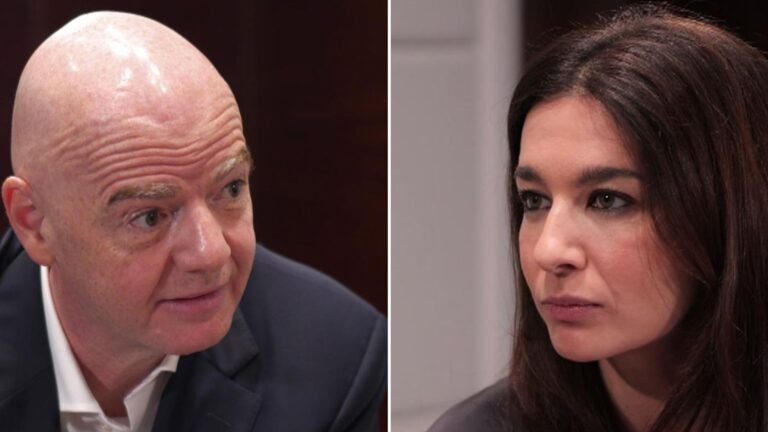
The president of world football’s governing body FIFA has apologised to British football fans after a comment which was criticised as a “cheap joke” by the Football Supporters’ Association.

Gianni Infantino suffered a backlash last month after joking that: “For the first time in history… no Brit was arrested during a World Cup. Imagine! This is something really really special”.

In a wide-ranging interview, Mr Infantino told The World with Yalda Hakim that the comments were “meant to be more of a light-hearted remark” aimed at highlighting that the 2022 Qatar World Cup “was a celebration” and “a peaceful event”.

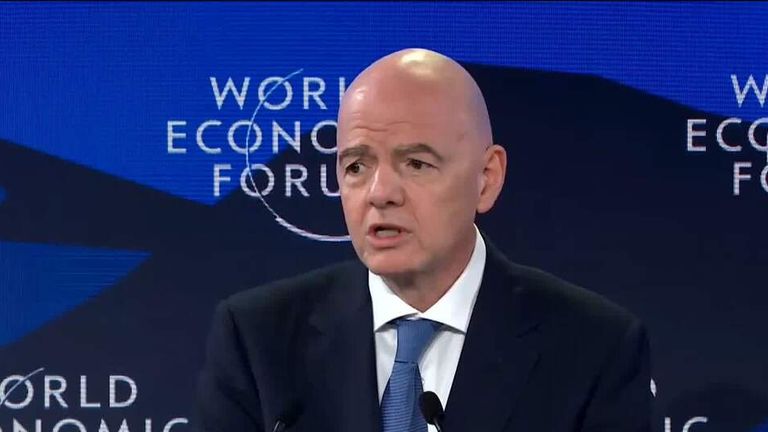
Gianni Infantino jokes about British fans
Image: Gianni Infantino jokes about British fans

The FIFA boss firstly apologised to fans from Scotland, Wales and Northern Ireland, saying that offending them was “not my intention”.

He went on to say that: “I’m a huge fan of English football”, adding that he had been wrong to refer to English people who “just go and riot around the world” at football matches as fans, instead referring to them as “criminals”.

Mr Infantino then highlighted and praised efforts made by England to tackle football violence.

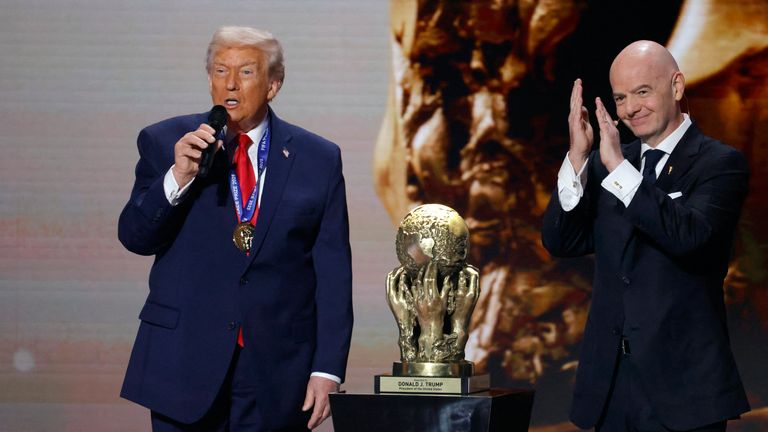
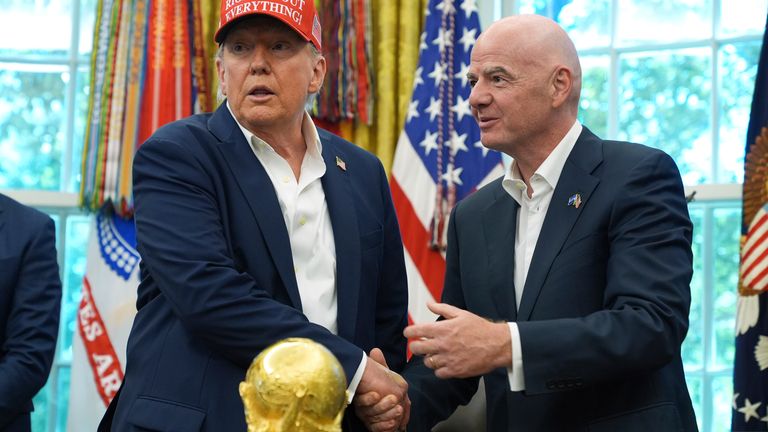
FIFA president Gianni Infantino presents the US president with the body's peace prize. Pic: Reuters
Image: FIFA president Gianni Infantino presents the US president with the body’s peace prize. Pic: Reuters

Analysis: Yalda Hakim speaks to FIFA president.

FIFA “goes hand in hand with peace”

Tackling violence and peace was a recurring theme for Mr Infantino.

The FIFA boss recognised the “strong reaction” to the organisation’s new peace prize but doubled down on the decision and the awarding of it to President Donald Trump.

The football president stated that FIFA’s slogan – football unites the world – “goes hand in hand with peace”.

The two presidents have struck up a close relationship. Pic: AP
Image: The two presidents have struck up a close relationship. Pic: AP

“So, whatever we can do to help peace in the world, we should be doing it, and for this reason, for some time we were thinking about [whether] we should do something to reward people who do something.”

Mr Infantino insists that person is Mr Trump, saying that “objectively, he deserves it”.

He then highlights Venezuelan opposition leader Ms Machado’s praise of Mr Trump. “It’s not just Gianni Infantino who said it… [there’s] a Nobel Peace Prize winner who said this.”

“He was instrumental in resolving conflicts and saving lives and saving thousands of lives.”

Mr Infantino praises Mr Trump for getting people on opposite sides of conflict into the same room.

He feels the same thing should happen in international football.

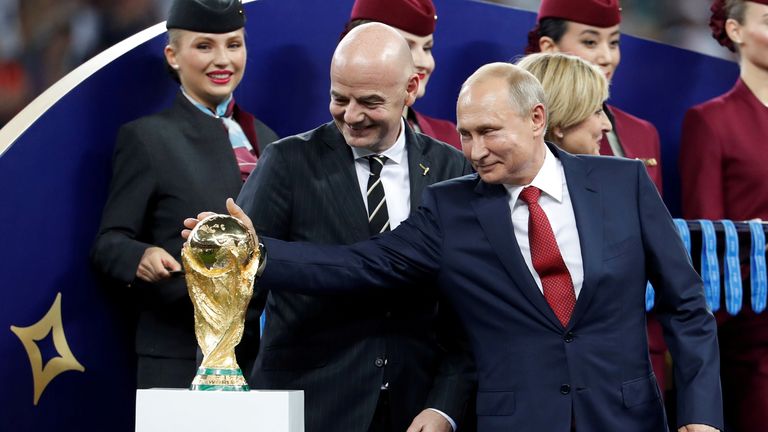
The FIFA president has said he would like to see Russian youth teams playing across Europe. Pic: Reuters
Image: The FIFA president has said he would like to see Russian youth teams playing across Europe. Pic: Reuters

“Never ban any country from playing football”

The FIFA president is unequivocal when asked if he would look at lifting the ban on Russia – put in place by FIFA and UEFA in 2022 following the country’s invasion of Ukraine.

“We have to,” he says.

“Definitely.”

“Because this ban has not achieved anything, it has just created more frustration and hatred.”

He goes on to say that he believes “having girls and boys from Russia being able to play football games in other parts of Europe would help.”

He is also against a ban on Israel, saying such a ban “is a defeat”.

The FIFA boss then goes further, saying he believes the organisation should look into changing its rules and “enshrine in our statutes that we should actually never ban any country from playing football because of the acts of their political leaders”.

“Somebody needs to keep the ties open.”

For this reason, he’s also not in favour of boycotts.

When asked about those who are calling for a boycott of the 2026 US World Cup due to concerns over President Trump’s immigration policies and safety issues, he disagrees.

He says there is never any call for boycotts by businesses or on diplomatic levels, and asks multiple times, “So why football?”.

“I think, in our divided world, in our aggressive world, we need occasions where people can come, can meet around the passion [for football].”

Infantino is controversial but consistent – the FIFA boss places football above politics

Yalda Hakim
Yalda Hakim

Lead world news presenter

@SkyYaldaHakim

Gianni Infantino is not a man for backtracking.

In an exclusive interview with me, the FIFA president doubled down on the “peace prize” he awarded to Donald Trump, rejected calls to boycott the World Cup in the United States, apologised for a joke he made about the arrest record of English fans in major tournaments – and insisted he didn’t regret his speech ahead of the Qatar World Cup declaring “today I feel…”

Over the course of an hour, I asked Gianni Infantino about the nature of his relationship with Donald Trump and the decision to award the US President a peace prize.

He acknowledged that there had been a “strong reaction” but defended the move, stating that it was consistent with his belief that football – and FIFA – should acknowledge anyone who was trying to bring an end to conflicts around the world.

Click the link to read more…

Women’s football is progressed through “engaging”

Mr Infantino speaks about how he navigates working with female players and progressing women’s football in some of the world’s most repressive regimes, like Iran and North Korea.

“These are things that take years,” and “you don’t achieve this with threats or sanctions,” he says.

“You achieve this by engaging.”

The FIFA boss explains how in Iran, he went several times to meet the president and officials, arguing in a “respectful way, without shouting and screaming” for women’s football.

He argues that “ultimately, we managed to succeed”.

Iranian women who were banned from entering stadiums since the revolution in 1979, are now allowed into stadiums, he says.

“And similarly, in North Korea, if you listen again to all our experts here, you shouldn’t have any relations with North Korea.

“I went to Pyongyang. I spoke to the regime. We spoke to them. And now we have these North Korean girls who are world champions in our youth categories.”

Sky News has reported on the Afghanistan women's football team training in England
Image: Sky News has reported on the Afghanistan women’s football team training in England

Read more from Sky News:
Trump to close Kennedy Center for two years
Oscar-nominated screenwriter arrested in Iran

“You integrate them and you make them feel part of the world, and I think this is very important.”

He says these maybe “some of the great achievements that we [FIFA] made”.

Mr Infantino also told Yalda Hakim about how he and FIFA helped to get women players out of Afghanistan after the Taliban regained power – some of those women ended up training in the UK.

“It was and it is the right thing to do.”

He explains how FIFA “developed women’s football in Afghanistan for some years”.

He says these women were “left to themselves” after the regime change and “we felt, that it was important to give a signal to help, to assist, all these Afghan girls and women who love the game”.

“Ultimately, we managed to, not just to help get these girls and women out and help them to have a new life, but also to give them a real, purpose in football.

“To have them coming together, train and play and represent somehow, their country with a team that is called Afghan Women United.”

Mr Infantino says FIFA must “just engage. But engage for everyone. Without taking sides”.


Source link

Coast Guard identifies 7 lost in Massachusetts fishing boat sinking tragedy

0

NEWYou can now listen to Fox News articles!

The U.S. Coast Guard has released the names of seven people who died aboard a Gloucester, Massachusetts, commercial fishing boat that sank Friday in frigid waters 25 miles off Cape Ann.

Coast Guard watchstanders received an emergency position indicating a radio beacon (EPIRB) alert at about 6:50 a.m. Friday registered to the 72-foot commercial fishing vessel Lily Jean.

USCG crews attempted to contact the boat, and after getting no response, issued an urgent marine information broadcast (UMIB), according to officials.

Multiple aircraft, cutters and small boats searched 1,047 square miles over 24 hours, finding debris near the location where the EPIRB was activated, along with one body and an unoccupied life raft that had been deployed.

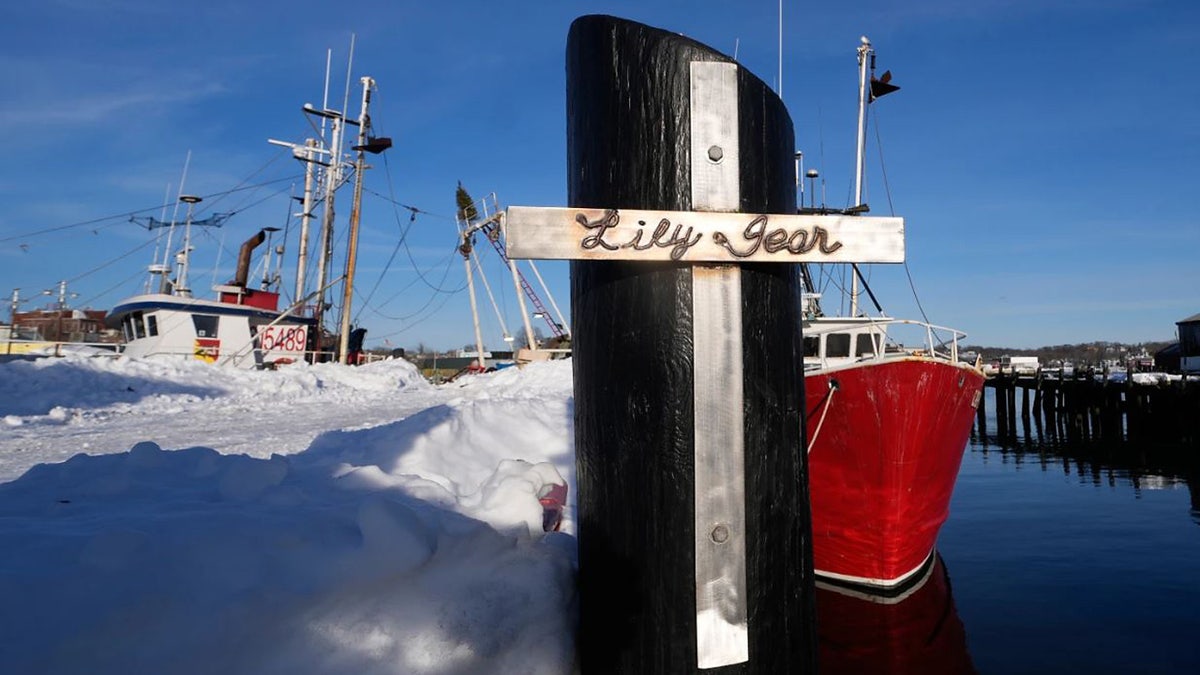
A crucifix, made by a friend of the captain of the fishing boat "Lily Jean", is displayed on the pier of the homeport of the fishing boat that went missing with seven onboard, Monday, Feb. 2, 2026, in Gloucester, Mass. (AP Photo/Charles Krupa)

A crucifix, made by a friend of the captain of the fishing boat Lily Jean, is displayed in Gloucester, Mass., on the pier at the homeport of the commercial trawler that sank off the coast with seven people on board. (AP Photo/Charles Krupa)

COAST GUARD SEARCHING FOR SURVIVORS AFTER COMMERCIAL FISHING BOAT SINKS OFF MASSACHUSETTS; 1 BODY RECOVERED

Search and rescue mission coordinators, on-scene commanders and the Coast Guard determined on Saturday all reasonable search efforts for the missing crew members had been exhausted.

The crew members presumed dead have been identified as: captain Accursio “Gus” Sanfilippo; crew member Paul Beal Sr.; crew member Paul Beal Jr.; crew member John Rousanidis; crew member Freeman Short; crew member Sean Therrien; and NOAA fisheries observer Jada Samitt.

Sanfilippo, a fifth-generation commercial fisherman, and his crew were featured in a 2012 episode of the History Channel show “Nor’Easter Men,” highlighting a fishing expedition in dangerous weather conditions, The Associated Press reported

Christine Porper of Gloucester, Mass. pauses at the fisherman's memorial near the homeport of a fishing boat that went missing with seven onboard, Monday, Feb. 2, 2026, in Gloucester, Mass. (AP Photo/Charles Krupa)

Christine Porper of Gloucester, Mass., pauses at the fisherman’s memorial, Monday, near the homeport of the fishing boat Lily Jean that sank with seven crew on board. (AP Photo/Charles Krupa)

COAST GUARD SEARCHES FOR SURVIVORS AFTER US STRIKES SUSPECTED NARCO-TERRORIST VESSELS IN EASTERN PACIFIC

Rear Adm. Michael Platt, commander of the Coast Guard Northeast District, has directed a district-level formal investigation, which is typically launched for incidents of “significant regional importance” or those that may reveal broader issues with a class of vessel or areas of technical concern.

Lt. Cmdr. Brett Igo, Coast Guard Northeast District investigation oversight coordinator, will serve as the lead investigating officer, receiving evidence and testimony using formal rules and procedures.

The National Transportation Safety Board (NTSB) will also participate in the investigation.

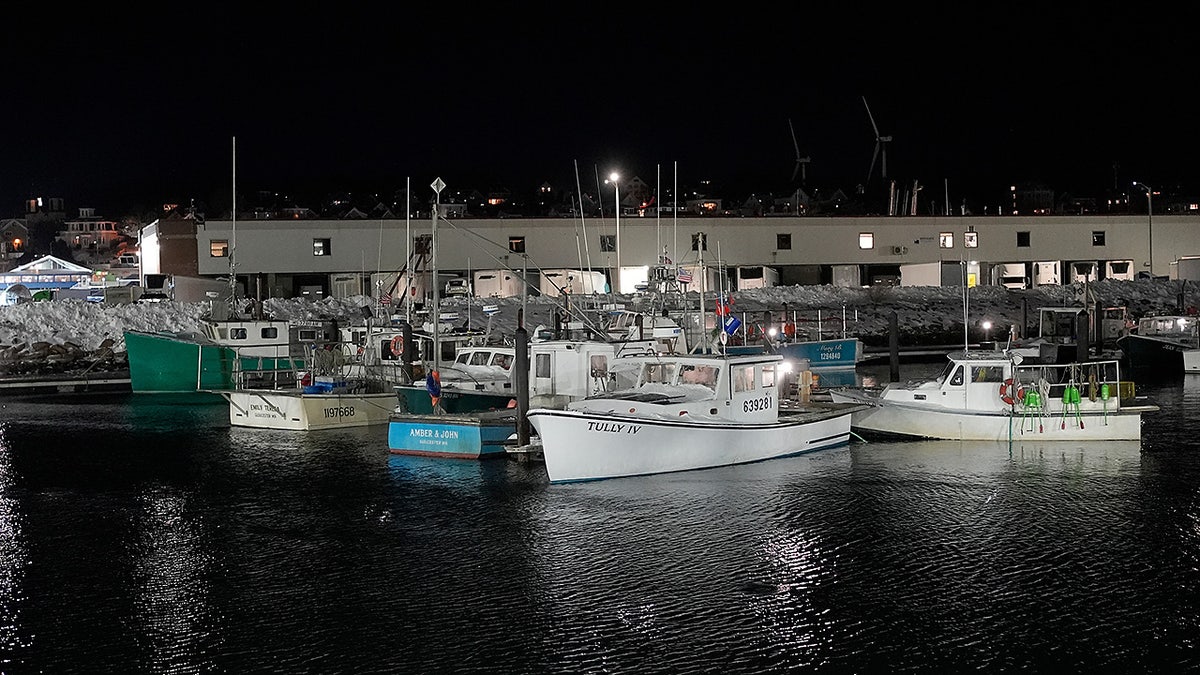
Fishing boats are tied up in Gloucester, Mass., , Friday, Jan. 30, 2026. AP Photo/Robert F. Bukaty

Authorities are investigating after a fishing boat disappeared off the coast of Gloucester, Mass., on Friday. (AP Photo/Robert F. Bukaty)

Based on its findings, the incident may be reviewed by a Marine Board of Investigation (MBI).

“The purpose of a Coast Guard investigation is to identify measures that can improve the safety of life and property at sea, not to assign civil or criminal blame,” the Coast Guard wrote in a statement.

CLICK HERE TO DOWNLOAD THE FOX NEWS APP

The investigation is expected to take several months to complete.

The Coast Guard declined to answer additional inquiries from Fox News Digital.

The Associated Press contributed to this report.


Source link

Dismantling Defenses: Trump 2.0 Cyber Year in Review

0

The Trump administration has pursued a staggering range of policy pivots this past year that threaten to weaken the nation’s ability and willingness to address a broad spectrum of technology challenges, from cybersecurity and privacy to countering disinformation, fraud and corruption. These shifts, along with the president’s efforts to restrict free speech and freedom of the press, have come at such a rapid clip that many readers probably aren’t even aware of them all.

FREE SPEECH

President Trump has repeatedly claimed that a primary reason he lost the 2020 election was that social media and Big Tech companies had conspired to silence conservative voices and stifle free speech. Naturally, the president’s impulse in his second term has been to use the levers of the federal government in an effort to limit the speech of everyday Americans, as well as foreigners wishing to visit the United States.

In September, Donald Trump signed a national security directive known as NSPM-7, which directs federal law enforcement officers and intelligence analysts to target “anti-American” activity, including any “tax crimes” involving extremist groups who defrauded the IRS. According to extensive reporting by journalist Ken Klippenstein, the focus of the order is on those expressing “opposition to law and immigration enforcement; extreme views in favor of mass migration and open borders; adherence to radical gender ideology,” as well as “anti-Americanism,” “anti-capitalism,” and “anti-Christianity.”

Earlier this month, Attorney General Pam Bondi issued a memo advising the FBI to compile a list of Americans whose activities “may constitute domestic terrorism.” Bondi also ordered the FBI to establish a “cash reward system” to encourage the public to report suspected domestic terrorist activity. The memo states that domestic terrorism could include “opposition to law and immigration enforcement” or support for “radical gender ideology.”

The Trump administration also is planning to impose social media restrictions on tourists as the president continues to ramp up travel restrictions for foreign visitors. According to a notice from U.S. Customs and Border Protection (CBP), tourists — including those from Britain, Australia, France, and Japan — will soon be required to provide five years of their social media history.

The CBP said it will also collect “several high value data fields,” including applicants’ email addresses from the past 10 years, their telephone numbers used in the past five years, and names and details of family members. Wired reported in October that the US CBP executed more device searches at the border in the first three months of the year than any other previous quarter.

The new requirements from CBP add meat to the bones of Executive Order 14161, which in the name of combating “foreign terrorist and public safety threats” granted broad new authority that civil rights groups warn could enable a renewed travel ban and expanded visa denials or deportations based on perceived ideology. Critics alleged the order’s vague language around “public safety threats,” creates latitude for targeting individuals based on political views, national origin, or religion. At least 35 nations are now under some form of U.S. travel restrictions.

CRIME AND CORRUPTION

In February, Trump ordered executive branch agencies to stop enforcing the U.S. Foreign Corrupt Practices Act, which froze foreign bribery investigations, and even allows for “remedial actions” of past enforcement actions deemed “inappropriate.”

The White House also disbanded the Kleptocracy Asset Recovery Initiative and KleptoCapture Task Force — units which proved their value in corruption cases and in seizing the assets of sanctioned Russian oligarchs — and diverted resources away from investigating white-collar crime.

Also in February, Attorney General Pam Bondi dissolved the FBI’s Foreign Influence Task Force, an entity created during Trump’s first term designed to counter the influence of foreign governments on American politics.

In March 2025, Reuters reported that several U.S. national security agencies had halted work on a coordinated effort to counter Russian sabotage, disinformation and cyberattacks. Former President Joe Biden had ordered his national security team to establish working groups to monitor the issue amid warnings from U.S. intelligence that Russia was escalating a shadow war against Western nations.

In a test of prosecutorial independence, Trump’s Justice Department ordered prosecutors to drop the corruption case against New York Mayor Eric Adams. The fallout was immediate: Multiple senior officials resigned in protest, the case was reassigned, and chaos engulfed the Southern District of New York (SDNY) – historically one of the nation’s most aggressive offices for pursuing public corruption, white-collar crime, and cybercrime cases.

When it comes to cryptocurrency, the administration has shifted regulators at the U.S. Securities and Exchange Commission (SEC) away from enforcement to cheerleading an industry that has consistently been plagued by scams, fraud and rug-pulls. The SEC in 2025 systematically retreated from enforcement against cryptocurrency operators, dropping major cases against Coinbase, Binance, and others.

Perhaps the most troubling example involves Justin Sun, the Chinese-born founder of crypto currency company Tron. In 2023, the SEC charged Sun with fraud and market manipulation. Sun subsequently invested $75 million in the Trump family’s World Liberty Financial (WLF) tokens, became the top holder of the $TRUMP memecoin, and secured a seat at an exclusive dinner with the president.

In late February 2025, the SEC dropped its lawsuit. Sun promptly took Tron public through a reverse merger arranged by Dominari Securities, a firm with Trump family ties. Democratic lawmakers have urged the SEC to investigate what they call “concerning ties to President Trump and his family” as potential conflicts of interest and foreign influence.

In October, President Trump pardoned Changpeng Zhao, the founder of the world’s largest cryptocurrency exchange Binance. In 2023, Zhao and his company pled guilty to failing to prevent money laundering on the platform. Binance paid a $4 billion fine, and Zhao served a four-month sentence. As CBS News observed last month, shortly after Zhao’s pardon application, he was at the center of a blockbuster deal that put the Trump’s family’s WLF on the map.

“Zhao is a citizen of the United Arab Emirates in the Persian Gulf and in May, an Emirati fund put $2 billion in Zhao’s Binance,” 60 Minutes reported. “Of all the currencies in the world, the deal was done in World Liberty crypto.”

SEC Chairman Paul Atkins has made the agency’s new posture towards crypto explicit, stating “most crypto tokens are not securities.” At the same time, President Trump has directed the Department of Labor and the SEC to expand 401(k) access to private equity and crypto — assets that regulators have historically restricted for retail investors due to high risk, fees, opacity, and illiquidity. The executive order explicitly prioritizes “curbing ERISA litigation,” and reducing accountability for fiduciaries while shifting risk onto ordinary workers’ retirement savings.

At the White House’s behest, the U.S. Treasury in March suspended the Corporate Transparency Act, a law that required companies to reveal their real owners. Finance experts warned the suspension would bring back shell companies and “open the flood gates of dirty money” through the US, such as funds from drug gangs, human traffickers, and fraud groups.

Trump’s clemency decisions have created a pattern of freed criminals committing new offenses, including Jonathan Braun, whose sentence for drug trafficking was commuted during Trump’s first term, was found guilty in 2025 of violating supervised release and faces new charges.

Eliyahu Weinstein, who received a commutation in January 2021 for running a Ponzi scheme, was sentenced in November 2025 to 37 years for running a new Ponzi scheme. The administration has also granted clemency to a growing list of white-collar criminals: David Gentile, a private equity executive sentenced to seven years for securities and wire fraud (functionally a ponzi-like scheme), and Trevor Milton, the Nikola founder sentenced to four years for defrauding investors over electric vehicle technology. The message: Financial crimes against ordinary investors are no big deal.

At least 10 of the January 6 insurrectionists pardoned by President Trump have already been rearrested, charged or sentenced for other crimes, including plotting the murder of FBI agents, child sexual assault, possession of child sexual abuse material and reckless homicide while driving drunk.

The administration also imposed sanctions against the International Criminal Court (ICC). On February 6, 2025, Executive Order 14203 authorized asset freezes and visa restrictions against ICC officials investigating U.S. citizens or allies, primarily in response to the ICC’s arrest warrants for Israeli Prime Minister Benjamin Netanyahu over alleged war crimes in Gaza.

Earlier this month the president launched the “Gold Card,” a visa scheme established by an executive order in September that offers wealthy individuals and corporations expedited paths to U.S. residency and citizenship in exchange for $1 million for individuals and $2 million for companies, plus ongoing fees. The administration says it is also planning to offer a “platinum” version of the card that offers special tax breaks — for a cool $5 million.

FEDERAL CYBERSECURITY

President Trump campaigned for a second term insisting that the previous election was riddled with fraud and had been stolen from him. Shortly after Mr. Trump took the oath of office for a second time, he fired the head of the Cybersecurity and Infrastructure Security Agency (CISA) — Chris Krebs (no relation) — for having the audacity to state publicly that the 2020 election was the most secure in U.S. history.

Mr. Trump revoked Krebs’s security clearances, ordered a Justice Department investigation into his election security work, and suspended the security clearances of employees at SentinelOne, the cybersecurity firm where Krebs worked as chief intelligence and public policy officer. The executive order was the first direct presidential action against any US cybersecurity company. Krebs subsequently resigned from SentinelOne, telling The Wall Street Journal he was leaving to push back on Trump’s efforts “to go after corporate interests and corporate relationships.”

The president also dismissed all 15 members of the Cyber Safety Review Board (CSRB), a nonpartisan government entity established in 2022 with a mandate to investigate the security failures behind major cybersecurity events — likely because those advisors included Chris Krebs.

At the time, the CSRB was in the middle of compiling a much-anticipated report on the root causes of Chinese government-backed digital intrusions into at least nine U.S. telecommunications providers. Not to be outdone, the Federal Communication Commission quickly moved to roll back a previous ruling that required U.S. telecom carriers to implement stricter cybersecurity measures.

Meanwhile, CISA has lost roughly a third of its workforce this year amid mass layoffs and deferred resignations. When the government shutdown began in October, CISA laid off even more employees and furloughed 65 percent of the remaining staff, leaving only 900 employees working without pay.

Additionally, the Department of Homeland Security has reassigned CISA cyber specialists to jobs supporting the president’s deportation agenda. As Bloomberg reported earlier this year, CISA employees were given a week to accept the new roles or resign, and some of the reassignments included relocations to new geographic areas.

The White House has signaled that it plans to cut an additional $491 million from CISA’s budget next year, cuts that primarily target CISA programs focused on international affairs and countering misinformation and foreign propaganda. The president’s budget proposal justified the cuts by repeating debunked claims about CISA engaging in censorship.

The Trump administration has pursued a similar reorganization at the FBI: The Washington Post reported in October that a quarter of all FBI agents have now been reassigned from national security threats to immigration enforcement. Reuters reported last week that the replacement of seasoned leaders at the FBI and Justice Department with Trump loyalists has led to an unprecedented number of prosecutorial missteps, resulting in a 21 percent dismissal rate of the D.C. U.S. attorney’s office criminal complaints over eight weeks, compared to a mere .5% dismissal rate over the prior 10 years.

“These mistakes are causing department attorneys to lose credibility with federal courts, with some judges quashing subpoenas, threatening criminal contempt and issuing opinions that raise questions about their conduct,” Reuters reported. “Grand juries have also in some cases started rejecting indictments, a highly unusual event since prosecutors control what evidence gets presented.”

In August, the DHS banned state and local governments from using cyber grants on services provided by the Multi-State Information Sharing and Analysis Center (MS-ISAC), a group that for more than 20 years has shared critical cybersecurity intelligence across state lines and provided software and other resources at free or heavily discounted rates. Specifically, DHS barred states from spending funds on services offered by the Elections Infrastructure ISAC, which was effectively shuttered after DHS pulled its funding in February.

Cybersecurity Dive reports that the Trump administration’s massive workforce cuts, along with widespread mission uncertainty and a persistent leadership void, have interrupted federal agencies’ efforts to collaborate with the businesses and local utilities that run and protect healthcare facilities, water treatment plans, energy companies and telecommunications networks. The publication said the changes came after the US government eliminated CIPAC — a framework that allowed private companies to share cyber and threat intel without legal penalties.

“Government leaders have canceled meetings with infrastructure operators, forced out their longtime points of contact, stopped attending key industry events and scrapped a coordination program that made companies feel comfortable holding sensitive talks about cyberattacks and other threats with federal agencies,” Cybersecurity Dive’s Eric Geller wrote.

Both the National Security Agency (NSA) and U.S. Cyber Command have been without a leader since Trump dismissed Air Force General Timothy Haugh in April, allegedly for disloyalty to the president and at the suggestion of far-right conspiracy theorist Laura Loomer. The nomination of Army Lt. Gen. William Hartman for the same position fell through in October. The White House has ordered the NSA to cut 8 percent of its civilian workforce (between 1,500 and 2,000 employees).

As The Associated Press reported in August, the Office of the Director of National Intelligence plans to dramatically reduce its workforce and cut its budget by more than $700 million annually. Director of National Intelligence Tulsi Gabbard said the cuts were warranted because ODNI had become “bloated and inefficient, and the intelligence community is rife with abuse of power, unauthorized leaks of classified intelligence, and politicized weaponization of intelligence.”

The firing or forced retirements of so many federal employees has been a boon to foreign intelligence agencies. Chinese intelligence agencies, for example, reportedly moved quickly to take advantage of the mass layoffs, using a network of front companies to recruit laid-off U.S. government employees for “consulting work.” Former workers with the Defense Department’s Defense Digital Service who resigned en-masse earlier this year thanks to DOGE encroaching on their mission have been approached by the United Arab Emirates to work on artificial intelligence for the oil kingdom’s armed forces, albeit reportedly with the blessing of the Trump administration.

PRESS FREEDOM

President Trump has filed multibillion-dollar lawsuits against a number of major news outlets over news segments or interviews that allegedly portrayed him in a negative light, suing the networks ABC, the BBC, the CBS parent company Paramount, The Wall Street Journal, and The New York Times, among others.

The president signed an executive order aimed at slashing public subsidies to PBS and NPR, alleging “bias” in the broadcasters’ reporting. In July, Congress approved a request from Trump to cut $1.1 billion in federal funding for the Corporation for Public Broadcasting, the nonprofit entity that funds PBS and NPR.

Brendan Carr, the president’s pick to run the Federal Communications Commission (FCC), initially pledged to “dismantle the censorship cartel and restore free speech rights for everyday Americans.” But on January 22, 2025, the FCC reopened complaints against ABC, CBS and NBC over their coverage of the 2024 election. The previous FCC chair had dismissed the complaints as attacks on the First Amendment and an attempt to weaponize the agency for political purposes.

President Trump in February seized control of the White House Correspondents’ Association, the nonprofit entity that decides which media outlets should have access to the White House and the press pool that follows the president. The president invited an additional 32 media outlets, mostly conservative or right-wing organizations.

According to the journalism group Poynter.org, there are three religious networks, all of which lean conservative, as well as a mix of outlets that includes a legacy paper, television networks, and a digital outlet powered by artificial intelligence.  Trump also barred The Associated Press from the White House over their refusal to refer to the Gulf of Mexico as the Gulf of America.

Under Trump appointee Kari Lake, the U.S. Agency for Global Media moved to dismantle Voice of America, Radio Free Europe/Radio Liberty, and other networks that for decades served as credible news sources behind authoritarian lines. Courts blocked shutdown orders, but the damage continues through administrative leave, contract terminations, and funding disputes.

President Trump this term has fired most of the people involved in processing Freedom of Information Act (FOIA) requests for government agencies. FOIA is an indispensable tool used by journalists and the public to request government records, and to hold leaders accountable.

Petitioning the government, particularly when it ignores your requests, often requires challenging federal agencies in court. But that becomes far more difficult if the most competent law firms start to shy away from cases that may involve crossing the president and his administration. On March 22, the president issued a memorandum that directs heads of the Justice and Homeland Security Departments to “seek sanctions against attorneys and law firms who engage in frivolous, unreasonable and vexatious litigation against the United States,” or in matters that come before federal agencies.

The Trump administration announced increased vetting of applicants for H-1B visas for highly skilled workers, with an internal State Department memo saying that anyone involved in “censorship” of free speech should be considered for rejection.

Executive Order 14161, issued in 2025 on “foreign terrorist and public safety threats,” granted broad new authority that civil rights groups warn could enable a renewed travel ban and expanded visa denials or deportations based on perceived ideology. Critics charged that the order’s vague language around “public safety threats” creates latitude for targeting individuals based on political views, national origin, or religion.

CONSUMER PROTECTION, PRIVACY

At the beginning of this year, President Trump ordered staffers at the Consumer Financial Protection Bureau (CFPB) to stop most work. Created by Congress in 2011 to be a clearinghouse of consumer complaints, the CFPB has sued some of the nation’s largest financial institutions for violating consumer protection laws. The CFPB says its actions have put nearly $18 billion back in Americans’ pockets in the form of monetary compensation or canceled debts, and imposed $4 billion in civil money penalties against violators.

The Trump administration said it planned to fire up to 90 percent of all CFPB staff, but a recent federal appeals court ruling in Washington tossed out an earlier decision that would have allowed the firings to proceed. Reuters reported this week that an employee union and others have battled against it in court for ten months, during which the agency has been almost completely idled.

The CFPB’s acting director is Russell Vought, a key architect of the GOP policy framework Project 2025. Under Vought’s direction, the CFPB in May quietly withdrew a data broker protection rule intended to limit the ability of U.S. data brokers to sell personal information on Americans.

Despite the Federal Reserve’s own post-mortem explicitly blaming Trump-era deregulation for the 2023 Silicon Valley Bank collapse, which triggered a fast-moving crisis requiring emergency weekend bailouts of banks, Trump’s banking regulators in 2025 doubled down. They loosened capital requirements, narrowed definitions of “unsafe” banking practices, and stripped specific risk categories from supervisory frameworks. The setup for another banking crisis requiring taxpayer intervention is now in place.

The Privacy Act of 1974, one of the few meaningful federal privacy laws, was built on the principles of consent and separation in response to the abuses of power that came to light during the Watergate era. The law states that when an individual provides personal information to a federal agency to receive a particular service, that data must be used solely for its original purpose.

Nevertheless, it emerged in June that the Trump administration has built a central database of all US citizens. According to NPR, the White House plans to use the new platform during upcoming elections to verify the identity and citizenship status of US voters. The database was built by the Department of Homeland Security and the Department of Governmental Efficiency and is being rolled out in phases to US states.

DOGE

Probably the biggest ungotten scoop of 2025 is the inside story of what happened to all of the personal, financial and other sensitive data that was accessed by workers at the so-called Department of Government Efficiency (DOGE). President Trump tapped Elon Musk to lead the newly created department, which was mostly populated by current and former employees of Musk’s various technology companies (including a former denizen of the cybercrime community known as the “Com”). It soon emerged that the DOGE team was using artificial intelligence to surveil at least one federal agency’s communications for hostility to Mr. Trump and his agenda.

DOGE employees were able to access and synthesize data taken from a large number of previously separate and highly guarded federal databases, including those at the Social Security Administration, the Department of Homeland Security, the Office of Personnel Management, and the U.S. Department of the Treasury. DOGE staffers did so largely by circumventing or dismantling security measures designed to detect and prevent misuse of federal databases, including standard incident response protocols, auditing, and change-tracking mechanisms.

For example, an IT expert with the National Labor Relations Board (NLRB) alleges that DOGE employees likely downloaded gigabytes of data from agency case files in early March, using short-lived accounts that were configured to leave few traces of network activity. The NLRB whistleblower said the large data outflows coincided with multiple blocked login attempts from addresses in Russia, which attempted to use valid credentials for a newly-created DOGE user account.

The stated goal of DOGE was to reduce bureaucracy and to massively cut costs — mainly by eliminating funding for a raft of federal initiatives that had already been approved by Congress. The DOGE website claimed those efforts reduced “wasteful” and “fraudulent” federal spending by more than $200 billion. However, multiple independent reviews by news organizations determined the true “savings” DOGE achieved was off by a couple of orders of magnitude, and was likely closer to $2 billion.

At the same time DOGE was slashing federal programs, President Trump fired at least 17 inspectors general at federal agencies — the very people tasked with actually identifying and stopping waste, fraud and abuse at the federal level. Those included several agencies (such as the NLRB) that had open investigations into one or more of Mr. Musk’s companies for allegedly failing to comply with protocols aimed at protecting state secrets. In September, a federal judge found the president unlawfully fired the agency watchdogs, but none of them have been reinstated.

Where is DOGE now? Reuters reported last month that as far as the White House is concerned, DOGE no longer exists, even though it technically has more than half a year left to its charter. Meanwhile, who exactly retains access to federal agency data that was fed by DOGE into AI tools is anyone’s guess.

KrebsOnSecurity would like to thank the anonymous researcher NatInfoSec for assisting with the research on this story.


Source link
Wall Street falls as AI competition hits software stocks ahead of big tech earnings

0

        Software stocks including Salesforce, Adobe and Intuit suffered steep losses as markets reassessed lofty AI valuations.

Software stocks including Salesforce, Adobe and Intuit suffered steep losses as markets reassessed lofty AI valuations. | Photo Credit: Brendan McDermid

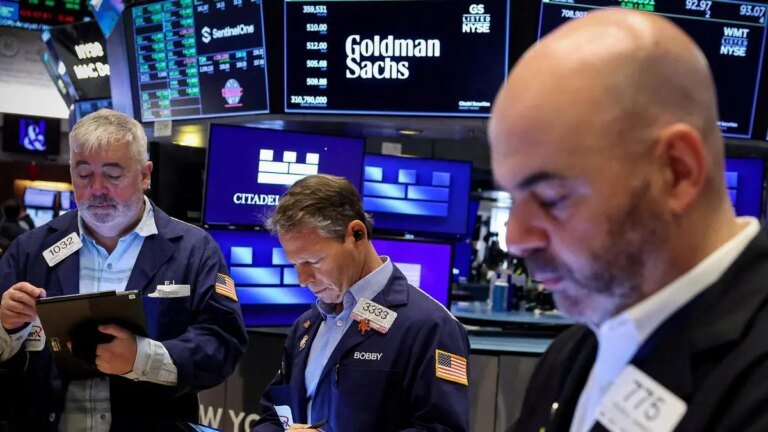
Wall Street ended sharply lower on Tuesday as investors worried about AI creating more competition for software makers, keeping them on edge ahead of quarterly reports from Alphabet and Amazon later this week.

AI heavyweights Nvidia and Microsoft each fell almost 3%. Alphabet dropped 1.2% ahead of its report on Wednesday, while Amazon declined 1.8% ahead of its Thursday report.

Investors in recent months have become pickier about AI-related stocks, looking for companies generating measurable returns from their outsized investments in the new technology.

Wall Street’s attention on Tuesday turned to technology companies that could face steeper competition and lower margins as a result of AI. One catalyst driving those concerns was Anthropic’s launch of a legal tool for its Claude AI chatbot.

“We’re looking at a lot of software names that are seen as companies that may well be disrupted when we start to see the advancement of artificial intelligence. We’re seeing a lot of software companies across the spectrum get hit,” ⁠said Art Hogan, chief market strategist at B. Riley Wealth.

Salesforce, Datadog and Adobe lost about 7%, Synopsys and Atlassian fell about 8%, and Intuit slumped 11%.

AI data firm Palantir bucked the trend, rallying almost 7% after strong quarterly results late on Monday. The S&P 500 software and services index fell 3.8%, down for a fifth consecutive ⁠day.

“We’ve got an expensive market and expectations are really high. Many areas, especially around AI, are priced for perfection. That’s just got us in a skittish environment,” said John Campbell, senior portfolio manager, Allspring Global Investments.

Healthcare stocks came under pressure after Wegovy maker Novo Nordisk warned that it expected a steep decline in annual sales. ‌The company’s US-listed shares plunged nearly 15%.

Rival Eli Lilly fell 3.9%, while obesity drugmaker Structure Therapeutics lost ‌6.75%.

Walmart climbed about 3% to become the first brick-and-mortar retailer ever to hit $1 trillion in stock market value.

Advanced Micro Devices fell 1.7% ahead of its quarterly report after the bell.

Walt Disney dipped 0.2% after it named theme parks head Josh D’Amaro as CEO, placing a longtime insider at the helm and ending succession uncertainty.

PayPal slumped 20% after it forecast 2026 profit below estimates.

The S&P 500 declined 0.84% ​​to end the session at 6,917.81 points.

The Nasdaq declined 1.43% to 23,255.19 points, while the Dow Jones Industrial Average declined 0.34% to 49,240.99 points.

Even as the S&P 500 ended lower, advancing issues outnumbered falling ones within the index by a 1.2-to-one ratio.

With Tuesday’s losses, the S&P 500 is up about 1% in 2026 and the Nasdaq is flat.

Volume on US exchanges was heavy, with 23.5 billion shares traded, compared to an average of 19.6 billion shares over the previous 20 sessions.

Six of the 11 S&P 500 sector indexes declined, led lower by information technology, down 2.17%, followed by a 1.28% loss in communication services.

EARNINGS DELUGE

With one quarter of the S&P 500 set to report quarterly results this week, analysts expect ⁠companies to have grown their earnings nearly 11% in the December quarter, up from an estimate of about 9% at the start of January, according to LSEG data.

Pfizer fell 3.3% despite posting fourth-quarter profit above estimates, while Merck rose 2.2% after its quarterly results.

PepsiCo gained 4.9% after the company announced price cuts ⁠on core brands such as Lay’s and Doritos.

Meanwhile, legislation to end a US government shutdown narrowly cleared a procedural hurdle in the House of Representatives, setting up a vote on final passage later in the day.

The partial shutdown has postponed releases of key jobs data on Friday along with the JOLTS report, originally expected on Tuesday.

The S&P 500 posted 81 new highs and 28 new lows; the Nasdaq recorded ⁠202 new highs and 311 new lows.

Published on February 4, 2026

Italy ready to impress in T20 World Cup debut against Scotland | Cricket News

0

As a child growing up in the small village of Marawila, about 20 minutes from Negombo, Sri Lanka, Crishan Kalugamage played in the streets and at school, running in hard and bowling fast.

But money was tight and economic opportunities limited, so when Kalugamage was 15, his parents packed up and moved with their three children to Tuscany, Italy, in search of a better life.

Recommended Stories

list of 3 itemsend of list

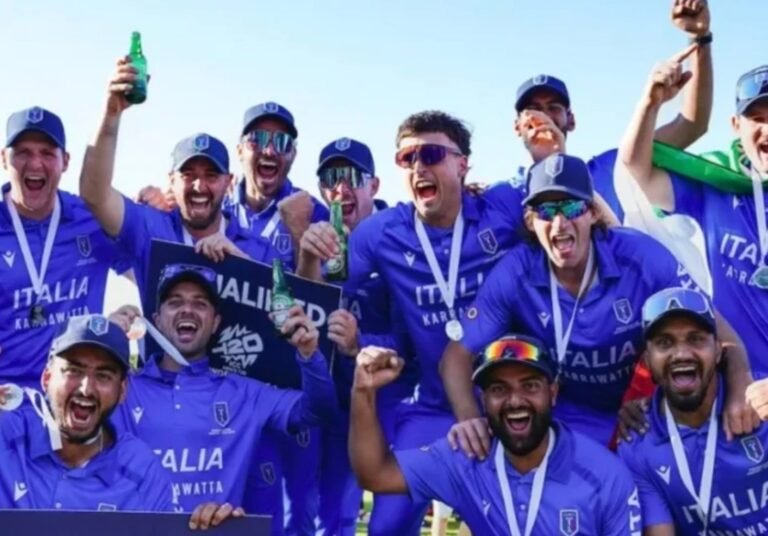
Kalugamage could never have dreamed that 21 years later, he would pack his bags again, now a talented leg spinner on his way to India, about to represent Italy in a debut T20 World Cup match against Scotland in Kolkata on Monday.

Italy cricket: older than you think

When English expatriate Herbert Kilpin founded the Milan Foot-Ball and Cricket Club in 1899, he couldn’t have envisioned an Italian team playing in front of thousands of fans in India and broadcast to millions around the world.

While AC Milan has since morphed into a football colossus, cricket has taken much longer to develop in Italy. But the country’s inclusion in the ICC Men’s T20 World Cup 2026, co-hosted by India and Sri Lanka, represents a huge step for the Azzurri.

Italy’s success at the European qualification last July, in which they finished second to the Netherlands, guaranteed a World Cup debut. Their 12-run victory over Scotland secured their progression and stunned the cricket world; Scotland, one of the most successful second-tier nations, were expected to finish in the top two.

A standout performance by allrounder Harry Manenti, who scored a run-a-ball 38 and took five wickets, and a 21-ball 50 from Emilio Gay, absent from the current squad through injury, turned the tournament on its head. Italy qualified through a superior net run rate, although Bangladesh’s late withdrawal from the T20 World Cup handed Scotland a last-minute berth.

Italy join Scotland, Nepal, West Indies and England in Group C of the 16-team tournament, with the top two progressing to the Super Eight phase. Their coach, former Ireland international Kevin O’Brien, has set his sights on reaching the knockout stage and was encouraged by the team’s performance in a pre-tournament tri-series against Ireland and the Netherlands in Dubai.

“We’re targeting to win games and, ultimately, want to qualify from the group,” said O’Brien. “We’ve got a very experienced squad, maybe not necessarily at World Cups, but we’ve certainly got players who have been playing professional cricket for numerous years.

“On our day, we can compete with any of the four other teams in our group. We beat Ireland in a T20 chasing 157, so that gives us a lot of confidence.”

Wayne Madsen in action.
Wayne Madsen, who also plays for Derbyshire and the London Spirit in the UK, is the captain of the Italy national team [File: Adam Davy/PA Images via Getty Images]

Who’s in Italy’s squad?

The 15-player squad is a mixture of five “home-base” players and others drawn from Australia, South Africa and England who qualify as Italian through relatives. None were born in Italy, although several hold Italian passports.

There are two sets of Australian brothers: Harry and Ben Manenti, and Justin and Anthony Mosca. Both Manenti brothers have played in Australia’s Big Bash League, and Ben played in South Australia’s title-winning Sheffield Shield team last season.

Other notable names include 37-year-old former South Africa international, JJ Smuts, who recently qualified through his wife’s heritage. A regular on the T20 franchise circuit, the explosive top-order batter and handy left-arm orthodox spinner is expected to lead the way with both bat and ball.

The captain is 42-year-old Wayne Madsen, a South African-born batter who moved to England and is currently the Derbyshire club captain, armed with the experience of 253 first-class appearances. Grant Stewart, originally from Australia, is another experienced professional in English domestic cricket, where he plays for Kent.

Aside from Kalugamage, who is now a leg spinner, there are four home base players. Zain Ali is a towering all-rounder who was born in Pakistan and moved to Italy with his family as a two-year-old. Hassan Ali and Syed Naqvi also have Pakistani roots, while Jaspreet Singh was born in India and raised in Italy.

Rounding out the squad are Marcus Campopiano, who hails from England, South African-born Gian Piero Meade and England-based Australian player Thomas Draca.

The authenticity issue

There will undoubtedly be questions about whether a side fielding several players who have played much of their cricket in other countries can truly be considered Italian, or if their inclusion is helping Italian cricket grow in any meaningful way.

O’Brien is adamant that the team identity is based firmly around Italian culture.

“Before the qualifiers, they spoke about why they’re playing for Italy,” said O’Brien. “A lot of the players have a deep connection to the country through parents or grandparents, a lot of them certainly when it comes to Italian culture. The home-based players all speak Italian fluently, three or four of the non-Italian-based players speak it fluently. It’s an important thing that we do, and something that brings the people, the players and the culture and cricketing history in Italy all together.”

O’Brien has experience of playing international cricket with players of mixed backgrounds, and he likens the current Italian squad to that of Ireland’s debut World Cup squad in 2007, which included several players from Australia and South Africa, although he acknowledges Ireland had a stronger domestic system.

“The difference is the club cricket. You’re not going to get somebody from Australia to come over and be a professional in one of the clubs in Milan or Rome, because the standard isn’t there at the moment.

“There’s a strong understanding and passion for cricket in Italy, and the Federation is getting into schools. They are making steps, trying to take cricket more into the grassroots level in Italy.

“Of course, it’s going to be difficult. But if you don’t take these baby steps, you’ll never know where the sport can get to, and World Cups, it’s gonna grow the interest. You might not see the results for 10 years or so, but this World Cup can be a huge springboard for cricket in the country.”

Italy players in action
Italy have already signalled their intensions for the T20 World Cup, defeating Canada by 10 runs in Chennai, India, on Monday [Courtesy: International Cricket Council]

Chrishan’s story

Kalugamage’s journey highlights the importance of accessibility. After moving to a small town near Lucca, he turned to athletics in the absence of cricket and trained with Olympic gold medallist Marcell Jacobs, excelling in the long jump.

He discovered a local team before joining Roma Cricket Club, where he still plays, juggling cricket with 700-kilometre (435-mile) round trips from Lucca, where he works as a pizza chef.

“I lost a lot of jobs playing cricket in Italy, because I’m working in the restaurant,” said Kalugamage. “Sunday is the very busy day, so sometimes when I asked to leave to play cricket, they said ‘No, you can’t do it.’ But I leave my job, and I play cricket.”

Kalugamage’s development as an international leg spinner is remarkable considering Italian club cricket is played on a synthetic pitch typically used by junior and recreational players. O’Brien believes he could be a trump card for Italy with his quick leg breaks and googlies.

But Kalugamage also represents potential talent and passion. He cried with joy when Italy secured their qualification and says he has witnessed the sport’s growth in his adopted country.

“What we are actually thinking is that after the World Cup, it will be even bigger, and maybe a lot of young kids will be attracted by cricket and performances of our team.”

World Cup ambition

O’Brien knows what it’s like to shake up the established order. In 2011, he scored the then fastest World Cup century – off just 50 balls – in what was, at the time, the highest successful World Cup chase as Ireland defeated England.

“There’s a big similarity between where we are to where Irish cricket was in 2007, in terms of the strength of the teams. So there’s absolutely no reason why this Italian team can’t go into a group and win games and qualify for the Super Eight.”

For Kalugamage, who has never played in front of a large crowd, just making it to the world stage is a fulfilment of his childhood dreams.

“Il cricket e la mia vita,” he smiled when asked what the game means to him.

Cricket is my life.


Source link

Is Cristiano Ronaldo on strike? The transfer story behind ‘unhappy’ £500,000-a-day star’s absence | Ents & Arts News

0

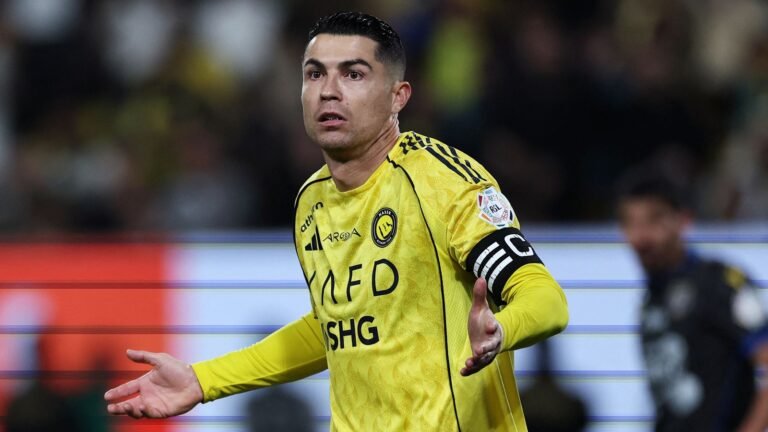
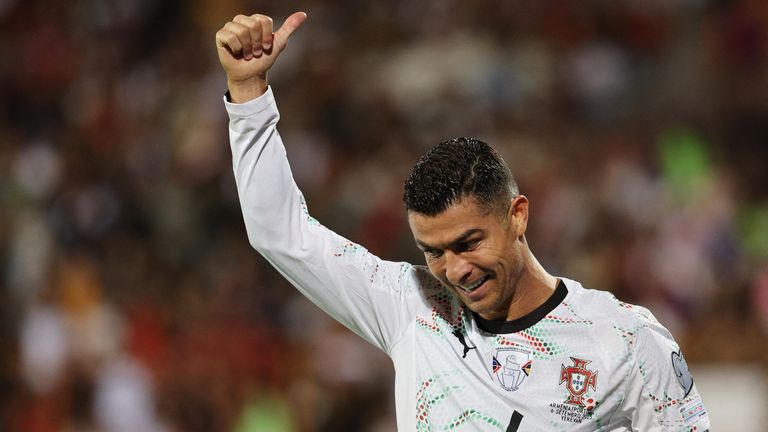
Cristiano Ronaldo appears to have gone on strike at his Saudi Arabian club.

The Al Nassr forward, who reportedly earns £500,000 a day, was noticeably absent from his team’s Saudi Pro League match against Al Riyadh on Monday.

Ronaldo is reportedly unhappy with the way the club he plays for is being run, Sky Sports News reports.

The 40-year-old is said to feel that other clubs that are also owned by Saudi Arabia’s Public Investment Fund (PIF) are getting preferential treatment, especially in the transfer market.

Cristiano Ronaldo signed an initial two-year deal with Al Nassr in 2022 after leaving Manchester United. Pic: Reuters
Image: Cristiano Ronaldo signed an initial two-year deal with Al Nassr in 2022 after leaving Manchester United. Pic: Reuters

Second-placed Al Nassr are one of four Saudi Pro League clubs owned by PIF, the other three being Al Hilal, Al Ahli and Al Ittihad.

Al Nassr beat Al Riyadh 1-0 without Ronaldo thanks to a goal from former Liverpool winger Sadio Mane.

The story behind Ronaldo’s absence

Sky Sports News’ chief correspondent Kaveh Solhekol said: “The reason he didn’t play is he’s unhappy with the way Al Nassr have been run.

“He thought, in this [transfer] window, that the club would dig deep, bring in reinforcements and strengthen their squad. He feels that hasn’t happened.

“And that’s why he’s effectively gone on strike.”

The Portugal international, who has repeatedly been ranked as one of the world’s highest-paid athletes, reportedly became the first billionaire footballer last year.

Read more from Sky News:
Captain found guilty of killing crew member in North Sea collision
Resident doctors vote to continue industrial action

Ronaldo signed a two-year deal with Al Nassr in 2022 after leaving Manchester United following an explosive television interview in which he said that he felt “betrayed” by the Old Trafford club – and “did not respect” the team’s then-manager, Erik ten Hag.


Source link
ICE support billboard appears in San Francisco ahead of Super Bowl LX

0

NEWYou can now listen to Fox News articles!

An advertisement showing support for Immigration and Customs Enforcement (ICE) has appeared on a digital billboard in San Francisco ahead of Super Bowl LX, which is expected to draw large crowds to the Bay Area later this week. 

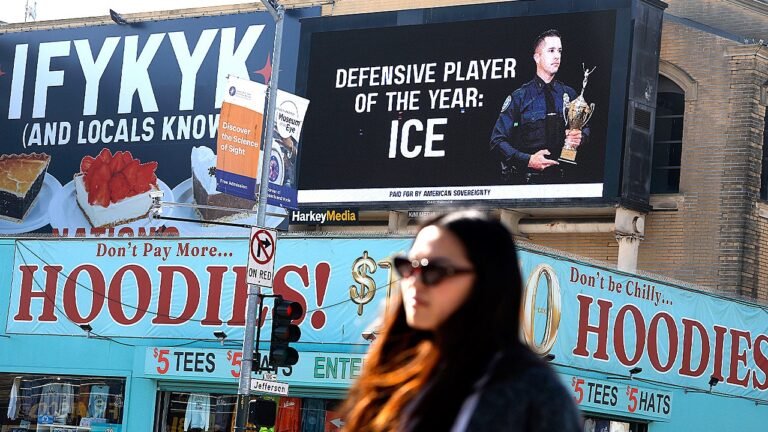
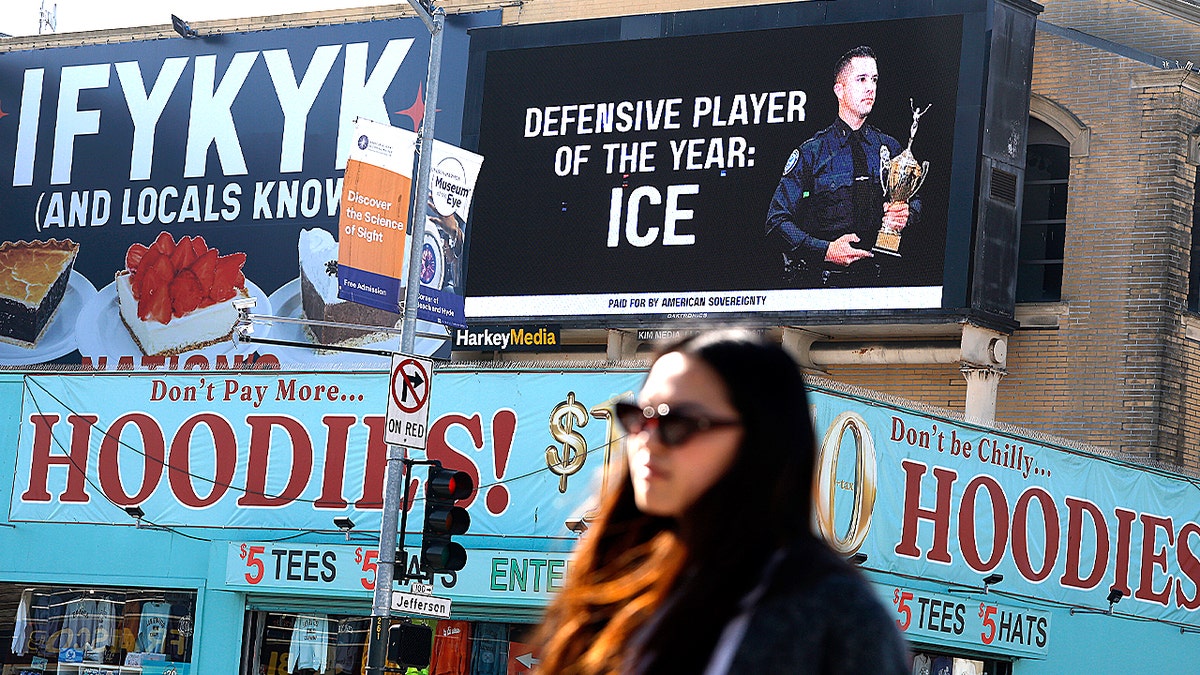
One of the ads displayed celebrated the federal agency in a football-themed tribute, saying “Defensive player of the year: ICE” alongside a photo of an agent holding a trophy. 

Conservative nonprofit American Sovereignty, which funded the billboard, unveiled the ad on Jan. 30, coinciding with a previous announcement that it planned to launch a separate multimillion-dollar campaign promoting ICE and stronger border security.

“We are saluting the brave Immigration and Customs Enforcement agents who work every day in defense of America with billboards and ads in San Francisco for #SuperBowlLX,” the nonprofit said in a post on X. “Thank you, @ICEgov, for defending our country. #StandWithICE.”

NFL CONFIRMS NO ICE OPERATIONS PLANNED AT SUPER BOWL LX

billboard that says "defensive player of the year: ICE"

ICE billboard in San Francisco’s Fisherman’s Wharf neighborhood displays “Defensive player of the year: ICE.” (Justin Sullivan/Getty Images)

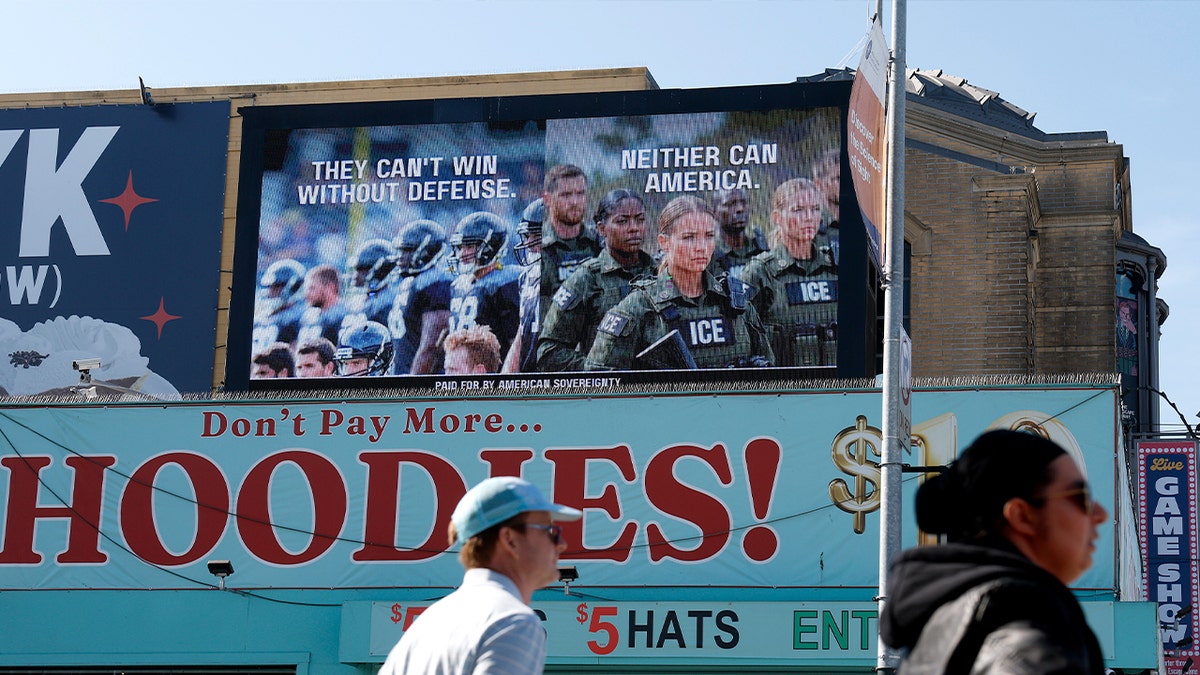
The digital billboard displayed a series of football‑themed messages in support of ICE, including “They can’t win without defense, neither can America” and “Cheering because the home team finally started investing in defense.”

“Defense Wins Championships. It’s also critical for a safe nation,” the nonprofit added in a post on social media.

The announcement came as the nonprofit said last week that it plans to launch a multimillion-dollar advertising campaign over the weekend to rally support for ICE. According to the group, two pro-ICE ads will run nationally, with additional emphasis on the District of Columbia, North Carolina, Michigan, and Georgia.

NFL’S ROGER GOODELL BELIEVES BAD BUNNY ‘UNDERSTANDS’ SUPER BOWL LX PLATFORM IS MEANT TO UNITE AMID ICE OUTCRY

billboard says "cheering because the home team finally started investing in defense."

A pro-ICE billboard popped up in San Francisco on Feb. 3, 2026, ahead of Super Bowl week. (Justin Sullivan/Getty Images)

The Bay Area has historically been opposed to ICE operations. On Monday, dozens of people from community groups, immigrant rights organizations, and labor unions rallied in San Jose in protest of the agency. 

The demonstrations come amid concern among local activists that ICE could increase its presence around Levi’s Stadium in Santa Clara and the surrounding area during Super Bowl week.

However, the NFL confirmed Tuesday that ICE agents will not be conducting immigration enforcement operations at the event.

billboard says "they can't win without defense, neither can America."

A view of a pro-ICE billboard in the Fisherman’s Wharf neighborhood on February 03, 2026, in San Francisco, California. (Justin Sullivan/Getty Images)

CLICK HERE TO DOWNLOAD THE FOX NEWS APP

“There are no planned ICE or immigration enforcement operations that are scheduled around the Super Bowl or any of the Super Bowl-related events,” NFL Chief of Security, Cathy Lanier, spoke during a news conference.

Fox News’ Charles Creitz contributed to this report.


Source link