Hunk Companion WordPress plugin exploited to install vulnerable plugins

0

WordPress

Hackers are exploiting a critical vulnerability in the “Hunk Companion” plugin to install and activate other plugins with exploitable flaws directly from the WordPress.org repository.

By installing outdated plugins with known vulnerabilities with available exploits, the attackers can access a large pool of flaws that lead to remote code execution (RCE), SQL injection, cross-site scripting (XSS) flaws, or create backdoor admin accounts.

The activity was discovered by WPScan, who reported it to Hunk Companion, with a security update addressing the zero-day flaw released yesterday.

Installing vulnerable plugins

Hunk Companion is a WordPress plugin designed to complement and enhance the functionality of themes developed by ThemeHunk, a provider of customizable WordPress themes, so it’s more of an add-on rather than a standalone plugin.

According to WordPress.org stats, Hunk Companion is currently used by over 10,000 WordPress sites, so it’s a relatively niche tool in the space.

The critical vulnerability was discovered by WPScan researcher Daniel Rodriguez and is tracked as CVE-2024-11972. The flaw allows the arbitrary installation of plugins by means of unauthenticated POST requests.

The issue impacts all versions of Hunk Companion before the latest 1.9.0, released yesterday, which addressed the problem.

While investigating a WordPress site infection, WPScan discovered active exploitation of CVE-2024-11972 to install a vulnerable version of WP Query Console.

This is an obscure plugin last updated over 7 years ago, which the hackers exploited to execute malicious PHP code on the targeted sites, leveraging the zero-day RCE flaw CVE-2024-50498.

“In the infections we’ve analyzed, attackers use the RCE to write a PHP dropper to the site’s root directory,” explains WPScan.

“This dropper allows continued unauthenticated uploads via GET requests, enabling persistent backdoor access to the site.”

It’s worth noting that Hunk Companion fixed a similar flaw in version 1.8.5, which was tracked under CVE-2024-9707, but apparently, the patch wasn’t adequate, and ways to bypass it exist.

Given the flaw’s severity and its active exploitation status, users of Hunk Companion are recommended to update to 1.9.0 as soon as possible.

At the time of writing, the latest version has been downloaded roughly 1,800 times, so at least eight thousand websites remain vulnerable to exploitation.


Source link

Secret Blizzard Deploys Kazuar Backdoor in Ukraine Using Amadey Malware-as-a-Service

0

Dec 11, 2024Ravie LakshmananMalware / Cyber Espionage

Amadey Malware-as-a-Service

The Russian nation-state actor tracked as Secret Blizzard has been observed leveraging malware associated with other threat actors to deploy a known backdoor called Kazuar on target devices located in Ukraine.

The new findings come from the Microsoft threat intelligence team, which said it observed the adversary leveraging the Amadey bot malware to download custom malware onto “specifically selected” systems associated with the Ukrainian military between March and April 2024.

The activity is assessed to be the second time since 2022 that Secret Blizzard, also known as Turla, has latched onto a cybercrime campaign to propagate its own tools in Ukraine.

“Commandeering other threat actors’ access highlights Secret Blizzard’s approach to diversifying its attack vectors,” the company said in a report shared with The Hacker News.

Some of the other known methods employed by the hacking crew include adversary-in-the-middle (AitM) campaigns, strategic web compromises (aka watering hole attacks), and spear-phishing.

Cybersecurity

Secret Blizzard has a track record of targeting various sectors to facilitate long-term covert access for intelligence collection, but their primary focus is on ministries of foreign affairs, embassies, government offices, defense departments, and defense-related companies across the world.

The latest report comes a week after the tech giant, along with Lumen Technologies Black Lotus Labs, revealed Turla’s hijacking of 33 command-and-control (C2) servers of a Pakistan-based hacking group named Storm-0156 to carry out its own operations.

The attacks targeting Ukrainian entities entail commandeering Amadey bots to deploy a backdoor known as Tavdig, which is then used to install an updated version of Kazuar, which was documented by Palo Alto Networks Unit 42 in November 2023.

The cybercriminal activity tied to Amadey, which often includes the execution of the XMRig cryptocurrency miner, is being tracked by Microsoft under the moniker Storm-1919.

Amadey Malware-as-a-Service

It’s believed that Secret Blizzard either used the Amadey malware-as-a-service (MaaS) or accessed the Amadey command-and-control (C2) panels stealthily to download a PowerShell dropper on target devices. The dropper comprises a Base64-encoded Amadey payload that’s appended by a code segment, which calls back to a Turla C2 server.

“The need to encode the PowerShell dropper with a separate C2 URL controlled by Secret Blizzard could indicate that Secret Blizzard was not directly in control of the C2 mechanism used by the Amadey bot,” Microsoft said.

The next phase involves downloading a bespoke reconnaissance tool with an aim to collect details about the victim device and likely check if Microsoft Defender was enabled, ultimately enabling the threat actor to zero in on systems that are of further interest.

At this stage, the attack proceeds to deploy a PowerShell dropper containing the Tavdig backdoor and a legitimate Symantec binary that’s susceptible to DLL side-loading. Tavdig, for its part, is used to conduct additional reconnaissance and launch KazuarV2.

Microsoft said it also detected the threat actor repurposing COOKBOX, a PowerShell backdoor tied to a different Russia-based hacking group called Flying Yeti (aka Storm-1837 and UAC-0149), to deploy a PowerShell dropper that embeds Tavdig.

Cybersecurity

Investigation into how Secret Blizzard gained control of the Storm-1837 backdoor or Amadey bots to download its own tools is presently ongoing, the tech giant noted.

Needless to say, the findings once again highlight the threat actor’s repeated pursuit of footholds provided by other parties, either by purchasing the access or stealing them, to conduct espionage campaigns in a manner that obscures its own presence.

“It is not uncommon for actors to use the same tactics or tools, although we rarely see evidence of them compromising and using other actors’ infrastructure,” Sherrod DeGrippo, director of Threat Intelligence Strategy at Microsoft, told The Hacker News.

“Most state-sponsored threat actors have operational objectives that rely on dedicated or carefully compromised infrastructure to retain the integrity of their operation. This is potentially an effective obfuscation technique to frustrate threat intelligence analysts and make attribution to the correct threat actor more difficult.”


Found this article interesting? Follow us on Twitter and LinkedIn to read more exclusive content we post.


Source link

How Cryptocurrency Turns to Cash in Russian Banks – Krebs on Security

0

A financial firm registered in Canada has emerged as the payment processor for dozens of Russian cryptocurrency exchanges and websites hawking cybercrime services aimed at Russian-speaking customers, new research finds. Meanwhile, an investigation into the Vancouver street address used by this company shows it is home to dozens of foreign currency dealers, money transfer businesses, and cryptocurrency exchanges — none of which are physically located there.

Richard Sanders is a blockchain analyst and investigator who advises the law enforcement and intelligence community. Sanders spent most of 2023 in Ukraine, traveling with Ukrainian soldiers while mapping the shifting landscape of Russian crypto exchanges that are laundering money for narcotics networks operating in the region.

More recently, Sanders has focused on identifying how dozens of popular cybercrime services are getting paid by their customers, and how they are converting cryptocurrency revenues into cash. For the past several months, he’s been signing up for various cybercrime services, and then tracking where their customer funds go from there.

The 122 services targeted in Sanders’ research include some of the more prominent businesses advertising on the cybercrime forums today, such as:

-abuse-friendly or “bulletproof” hosting providers like anonvm[.]wtf, and PQHosting;
-sites selling aged email, financial, or social media accounts, such as verif[.]work and kopeechka[.]store;
-anonymity or “proxy” providers like crazyrdp[.]com and rdp[.]monster;
-anonymous SMS services, including anonsim[.]net and smsboss[.]pro.
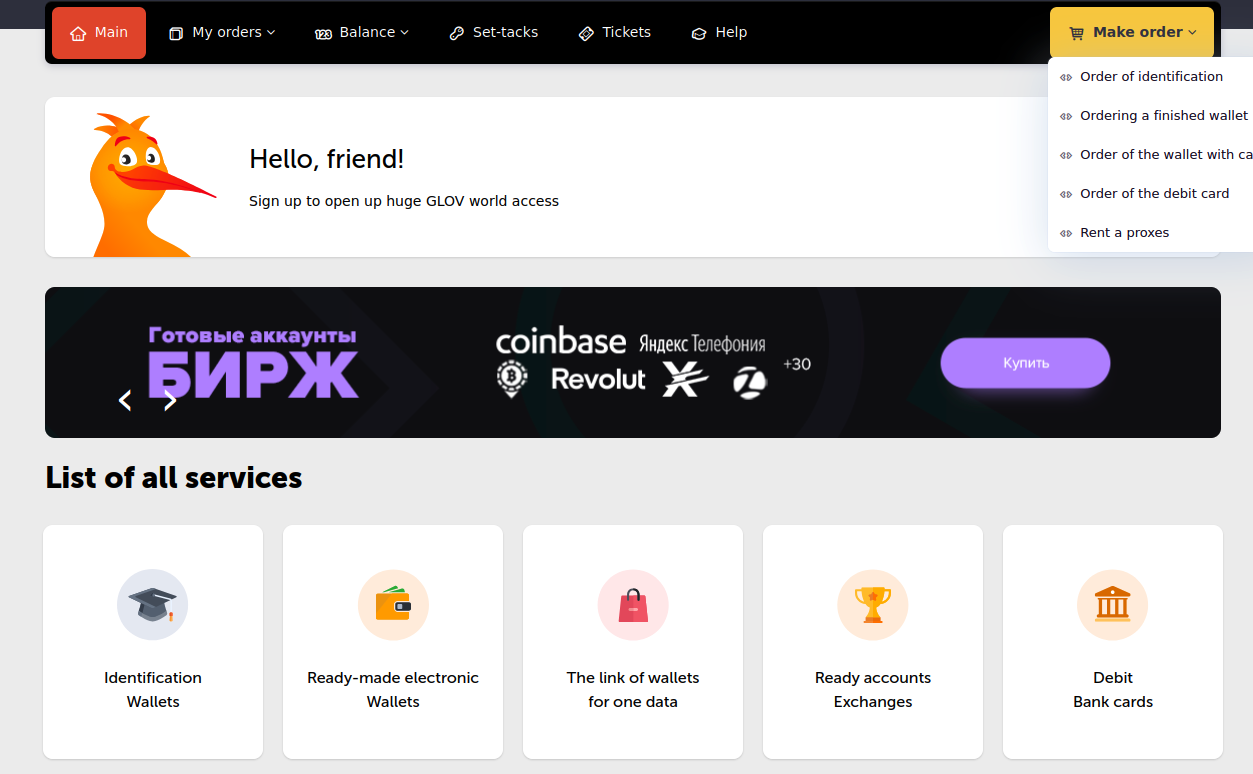
The site Verif dot work, which processes payments through Cryptomus, sells financial accounts, including debit and credit cards.

Sanders said he first encountered some of these services while investigating Kremlin-funded disinformation efforts in Ukraine, as they are all useful in assembling large-scale, anonymous social media campaigns.

According to Sanders, all 122 of the services he tested are processing transactions through a company called Cryptomus, which says it is a cryptocurrency payments platform based in Vancouver, British Columbia. Cryptomus’ website says its parent firm — Xeltox Enterprises Ltd. (formerly certa-pay[.]com) — is registered as a money service business (MSB) with the Financial Transactions and Reports Analysis Centre of Canada (FINTRAC).

Sanders said the payment data he gathered also shows that at least 56 cryptocurrency exchanges are currently using Cryptomus to process transactions, including financial entities with names like casher[.]su, grumbot[.]com, flymoney[.]biz, obama[.]ru and swop[.]is.

These platforms are built for Russian speakers, and they each advertise the ability to anonymously swap one form of cryptocurrency for another. They also allow the exchange of cryptocurrency for cash in accounts at some of Russia’s largest banks — nearly all of which are currently sanctioned by the United States and other western nations.
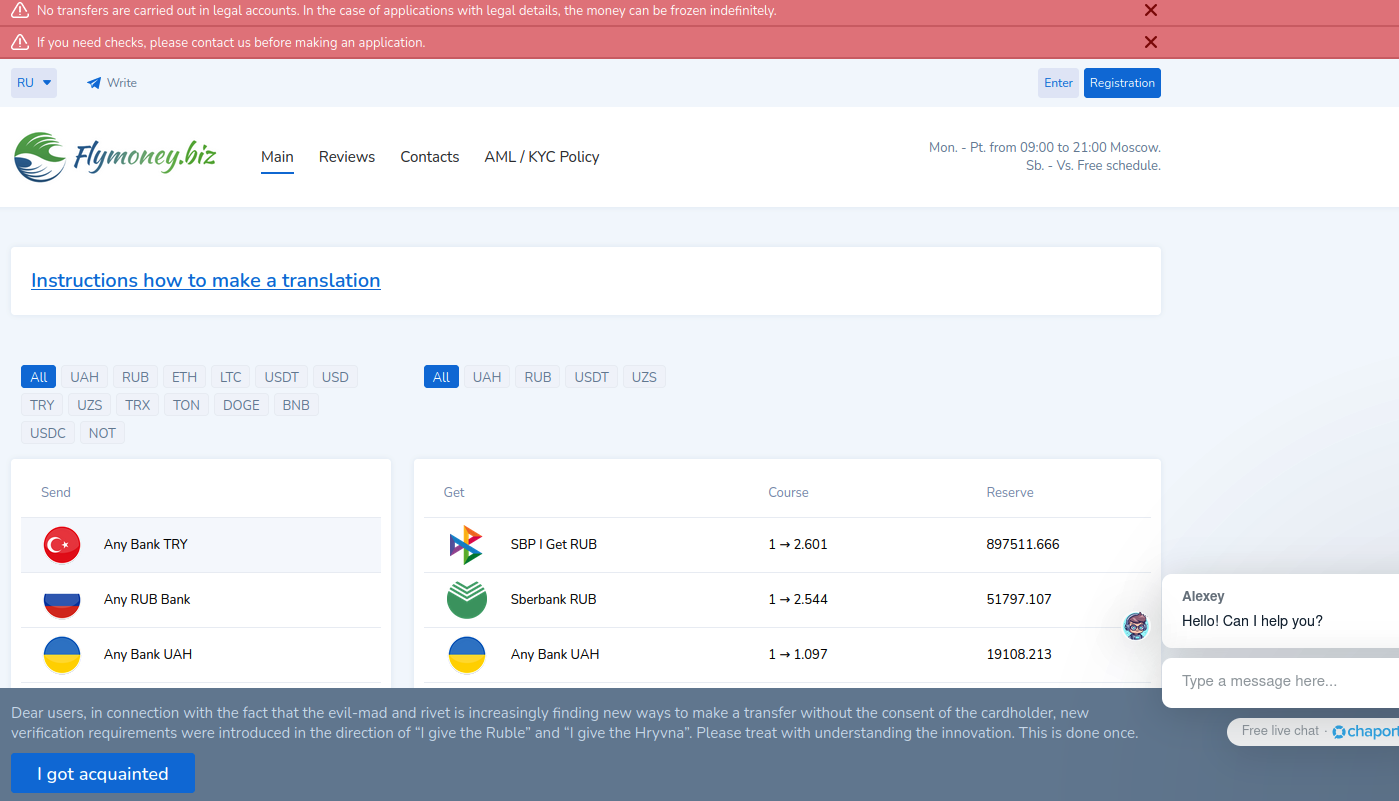
A machine-translated version of Flymoney, one of dozens of cryptocurrency exchanges apparently nested at Cryptomus.

An analysis of their technology infrastructure shows that all of these exchanges use Russian email providers, and most are directly hosted in Russia or by Russia-backed ISPs with infrastructure in Europe (e.g. Selectel, Netwarm UK, Beget, Timeweb and DDoS-Guard). The analysis also showed nearly all 56 exchanges used services from Cloudflare, a global content delivery network based in San Francisco.

“Purportedly, the purpose of these platforms is for companies to accept cryptocurrency payments in exchange for goods or services,” Sanders told KrebsOnSecurity. “Unfortunately, it is next to impossible to find any goods for sale with websites using Cryptomus, and the services appear to fall into one or two different categories: Facilitating transactions with sanctioned Russian banks, and platforms providing the infrastructure and means for cyber attacks.”

Cryptomus did not respond to multiple requests for comment.

PHANTOM ADDRESSES?

The Cryptomus website and its FINTRAC listing say the company’s registered address is Suite 170, 422 Richards St. in Vancouver, BC. This address was the subject of an investigation published in July by CTV National News and the Investigative Journalism Foundation (IJF), which documented dozens of cases across Canada where multiple MSBs are incorporated at the same address, often without the knowledge or consent of the location’s actual occupant.

This building at 422 Richards St. in downtown Vancouver is the registered address for 90 money services businesses, including 10 that have had their registrations revoked. Image: theijf.org/msb-cluster-investigation.

Their inquiry found 422 Richards St. was listed as the registered address for at least 76 foreign currency dealers, eight MSBs, and six cryptocurrency exchanges. At that address is a three-story building that used to be a bank and now houses a massage therapy clinic and a co-working space. But they found none of the MSBs or currency dealers were paying for services at that co-working space.

The reporters found another collection of 97 MSBs clustered at an address for a commercial office suite in Ontario, even though there was no evidence these companies had ever arranged for any business services at that address.

Peter German, a former deputy commissioner for the Royal Canadian Mounted Police who authored two reports on money laundering in British Columbia, told the publications it goes against the spirit of Canada’s registration requirements for such businesses, which are considered high-risk for money laundering and terrorist financing.

“If you’re able to have 70 in one building, that’s just an abuse of the whole system,” German said.

Ten MSBs registered to 422 Richard St. had their registrations revoked. One company at 422 Richards St. whose registration was revoked this year had a director with a listed address in Russia, the publications reported. “Others appear to be directed by people who are also directors of companies in Cyprus and other high-risk jurisdictions for money laundering,” they wrote.

A review of FINTRAC’s registry (.CSV) shows many of the MSBs at 422 Richards St. are international money transfer or remittance services to countries like Malaysia, India and Nigeria. Some act as currency exchanges, while others appear to sell merchant accounts and online payment services. Still, KrebsOnSecurity could find no obvious connections between the 56 Russian cryptocurrency exchanges identified by Sanders and the dozens of payment companies that FINTRAC says share an address with the Cryptomus parent firm Xeltox Enterprises.

SANCTIONS EVASION

In August 2023, Binance and some of the largest cryptocurrency exchanges responded to sanctions against Russia by cutting off many Russian banks and restricting Russian customers to transactions in Rubles only. Sanders said prior to that change, most of the exchanges currently served by Cryptomus were handling customer funds with their own self-custodial cryptocurrency wallets.

By September 2023, Sanders said he found the exchanges he was tracking had all nested themselves like Matryoshka dolls at Cryptomus, which adds a layer of obfuscation to all transactions by generating a new cryptocurrency wallet for each order.

“They all simply moved to Cryptomus,” he said. “Cryptomus generates new wallets for each order, rendering ongoing attribution to require transactions with high fees each time.”

“Exchanges like Binance and OKX removing Sberbank and other sanctioned banks and offboarding Russian users did not remove the ability of Russians to transact in and out of cryptocurrency easily,” he continued. “In fact, it’s become easier, because the instant-swap exchanges do not even have Know Your Customer rules. The U.S. sanctions resulted in the majority of Russian instant exchanges switching from their self-custodial wallets to platforms, especially Cryptomus.”

Russian President Vladimir Putin in August signed a new law legalizing cryptocurrency mining and allowing the use of cryptocurrency for international payments. The Russian government’s embrace of cryptocurrency was a remarkable pivot: Bloomberg notes that as recently as January 2022, just weeks before Russia’s full-scale invasion of Ukraine, the central bank proposed a blanket ban on the use and creation of cryptocurrencies.

In a report on Russia’s cryptocurrency ambitions published in September, blockchain analysis firm Chainalysis said Russia’s move to integrate crypto into its financial system may improve its ability to bypass the U.S.-led financial system and to engage in non-dollar denominated trade.

“Although it can be hard to quantify the true impact of certain sanctions actions, the fact that Russian officials have singled out the effect of sanctions on Moscow’s ability to process cross-border trade suggests that the impact felt is great enough to incite urgency to legitimize and invest in alternative payment channels it once decried,” Chainalysis assessed.

Asked about its view of activity on Cryptomus, Chainanlysis said Cryptomus has been used by criminals of all stripes for laundering money and/or the purchase of goods and services.

“We see threat actors engaged in ransomware, narcotics, darknet markets, fraud, cybercrime, sanctioned entities and jurisdictions, and hacktivism making deposits to Cryptomus for purchases but also laundering the services using Cryptomos payment API,” the company said in a statement.

SHELL GAMES

It is unclear if Cryptomus and/or Xeltox Enterprises have any presence in Canada at all. A search in the United Kingdom’s Companies House registry for Xeltox’s former name — Certa Payments Ltd. — shows an entity by that name incorporated at a mail drop in London in December 2023.

The sole shareholder and director of that company is listed as a 25-year-old Ukrainian woman in the Czech Republic named Vira Krychka. Ms. Krychka was recently appointed the director of several other new U.K. firms, including an entity created in February 2024 called Globopay UAB Ltd, and another called WS Management and Advisory Corporation Ltd. Ms. Krychka did not respond to a request for comment.

WS Management and Advisory Corporation bills itself as the regulatory body that exclusively oversees licenses of cryptocurrencies in the jurisdiction of Western Sahara, a disputed territory in northwest Africa. Its website says the company assists applicants with bank setup and formation, online gaming licenses, and the creation and licensing of foreign exchange brokers. One of Certa Payments’ former websites — certa[.]website — also shared a server with 12 other domains, including rasd-state[.]ws, a website for the Central Reserve Authority of the Western Sahara.

The website crasadr dot com, the official website of the Central Reserve Authority of Western Sahara.

This business registry from the Czech Republic indicates Ms. Krychka works as a director at an advertising and marketing firm called Icon Tech SRO, which was previously named Blaven Technologies (Blaven’s website says it is an online payment service provider).

In August 2024, Icon Tech changed its name again to Mezhundarondnaya IBU SRO, which describes itself as an “experienced company in IT consulting” that is based in Armenia. The same registry says Ms. Krychka is somehow also a director at a Turkish investment venture. So much business acumen at such a young age!

For now, Canada remains an attractive location for cryptocurrency businesses to set up shop, at least on paper. The IJF and CTV News found that as of February 2024, there were just over 3,000 actively registered MSBs in Canada, 1,247 of which were located at the same building as at least one other MSB.

“That analysis does not include the roughly 2,700 MSBs whose registrations have lapsed, been revoked or otherwise stopped,” they observed. “If they are included, then a staggering 2,061 out of 5,705 total MSBs share a building with at least one other MSB.”


Source link

Krispy Kreme admits there’s a hole in its security • The Register

0

Doughnut slinger Krispy Kreme has admitted to an attack that has left many customers unable to order online.

According to a mandatory 8-K filing [PDF], on November 29, the biz was notified regarding unauthorized access to a portion of its IT systems. Its security team waddled into action and sprinkled in support from “leading cybersecurity experts,” but said that delays in online orders were going to be hard to swallow for some.

“The expected costs related to the incident, including the loss of revenues from digital sales during the recovery period, fees for our cybersecurity experts and other advisors, and costs to restore any impacted systems, are reasonably likely to have a material impact on the company’s results of operations and financial condition,” it reported. “The company holds cybersecurity insurance that is expected to offset a portion of the costs of the incident.”

The pastry purveyors remain tight-lipped about the nature of the incident. When asked if this was a straight-up ransomware attack, a data-theft incident, or a secondary ransomware extortion attempt that goes after customers, it declined to comment.

“We’re experiencing certain operational disruptions due to a cybersecurity incident, including with online ordering in parts of the United States. We immediately began taking steps to investigate, contain, and remediate the incident with the assistance of leading cybersecurity experts and other advisors,” a spokesperson told The Register.

“We, along with them, continue to work diligently to respond to and mitigate the impact from the incident, including the restoration of online ordering. Our fresh doughnuts are available in our shops as always! Additionally, our fans can also visit their nearest grocery or convenience store to enjoy our doughnuts.”

The filing does appear to be a little late. The SEC requires companies to report “material” cybersecurity incidents within four business days, which suggests Krispy Kreme’s disclosure might be a little late out of the oven. Again, the company has no comment on the issue.

But the timing of the attack is certainly interesting. The US celebrated its Thanksgiving holiday on November 28 this year. With IT staff enjoying a break and incident response times slowed, holidays are an ideal time to hit servers, and there’s also a marked increase in general computer crime, for example the 2023 MOVEit intrusion was timed for America’s Memorial Day weekend.

As ever, if you’re a regular customer, check any credit cards associated with your bun account. A cholesterol check might be in order too. ®


Source link

Latest round of MITRE ATT&CK evaluations put cybersecurity products through rigors of ransomware 

0

MITRE Corporation released findings Wednesday from its latest round of ATT&CK evaluations, assessing the capabilities of enterprise cybersecurity solutions against some of the most prevalent ransomware tactics and North Korean malware.

The sixth such evaluation from the nonprofit research organization measured 19 different vendors’ ability to protect enterprise systems by evaluating them against two prominent ransomware strains -—Cl0p and LockBit — as well as North Korean-linked malware targeting macOS systems. For the latter, MITRE’s evaluation used advanced multi-stage malware emulations that highlighted sophisticated tactics, such as exploiting legitimate macOS utilities and stealthily exfiltrating sensitive data.

According to William Booth, the general manager of MITRE’s ATT&CK evaluations, the results revealed significant disparities between vendors’ detection rates and their ability to accurately distinguish malicious activity from benign system behavior.

“Some vendors had higher false-positive rates than detection rates, which indicates a need to better distinguish legitimate activity from malicious activity,” Booth told CyberScoop. 

How the tests were conducted 

The evaluation is conducted in multiple stages.

First, MITRE runs an initial emulation plan to assess the vendors’ baseline detection capabilities. This means they execute a series of malicious activities and see which ones the vendors can detect without any prior knowledge.

After this initial detection test, MITRE gives vendors a day to make configuration changes to their products. This could involve things like adding new detection logic, updating user interfaces, or making other adjustments to improve product performance.

The purpose of this configuration change period is to allow the vendors to enhance their products based on the initial test results. MITRE wants to see if the vendors can improve their detection and protection capabilities by making targeted changes.

In the second phase of testing, MITRE runs a separate emulation plan focused on the protection capabilities of the vendors’ products, complete with a new set of malicious activities that the vendors haven’t seen before.

By separating the detection and protection tests, and allowing the configuration changes in between, MITRE can assess how well the vendors can adapt and improve their security controls in response to new threats.

What the results show 

The organization explicitly states that “the evaluations do not rank vendors and their solutions, but instead provide insights” for organizations to make their own decisions based on their unique IT systems and threat models. However, Booth told CyberScoop there were surprising findings from the evaluation’s data. 

One of the most striking discoveries was that some vendors had higher false-positive rates than actual detection rates. Booth explained that this indicates a significant need for vendors to improve the specificity of their detection and blocking capabilities.

“There are certain vendors where you’ll see, yes, they had 100% detections, but their false-positive rate was also 90%,” Booth said. “That’s really interesting when you start to look at, OK, how can [vendors] determine what needs to be detected versus what is just noise?”

Another surprising finding was the difficulty vendors faced in protecting against threats in the post-compromise stage. Booth noted that MITRE’s evaluation placed a strong emphasis on assessing vendors’ ability to detect and mitigate ransomware activities after the initial breach, rather than just the initial infection.

“The assumption that you’re always going to block on the first piece of activity is not the case,” Booth said. “We’re focused on what happens after that initial compromise.”

Many vendors seemed to struggle with this post-compromise focus, as ransomware can often mimic normal system and file encryption behaviors. 

Booth also highlighted the varied approaches vendors are taking when it comes to detection, noting some key differences between machine learning-based methods and more heuristic-based techniques.

“There’s certainly some that are using AI, applying the language models on the raw data, and then there’s others that are using more of a heuristic approach,” Booth explained.

The evaluation revealed that these differing detection strategies can lead to vastly different results, both in terms of detection rates and false-positive rates.

A first for Mac

Booth told CyberScoop the inclusion of macOS in this latest evaluation round presented some unique challenges, noting that evaluating Mac-based threats required a different approach compared to previous Windows-focused assessments.

“MacOS was a bit tougher because there’s not a lot of public CTI [Cyber Threat Intelligence] on that,” Booth said.

That lack of public threat intelligence on Mac-targeted malware campaigns made it more challenging for MITRE to construct realistic, evidence-based emulation scenarios for the evaluation.

“There’s a lot that goes into formulating [the evaluation], in terms of our discussions with many different groups and organizations to get input into doing that. But Mac was hard because there’s not a lot of public CTI,” Booth acknowledged.

Despite these difficulties, MITRE included macOS in this round of testing to better reflect the evolving threat landscape. As more organizations adopt Apple devices, understanding the security capabilities of products against Mac-based attacks has become increasingly important.

Full list of vendors

The full cohort of products that MITRE evaluated included: 

  • AhnLab
  • Bitdefender
  • Check Point
  • Cisco Systems
  • Cybereason
  • Cynet
  • ESET
  • HarfangLab
  • Microsoft
  • Palo Alto Networks
  • Qualys
  • SentinelOne
  • Sophos
  • Tehtris
  • ThreatDown
  • Trellix
  • Trend Micro
  • WatchGuard
  • WithSecure

The evaluation results are publicly available on MITRE’s ATT&CK evaluation website. 

Greg Otto

Written by Greg Otto

Greg Otto is Editor-in-Chief of CyberScoop, overseeing all editorial content for the website. Greg has led cybersecurity coverage that has won various awards, including accolades from the Society of Professional Journalists and the American Society of Business Publication Editors. Prior to joining Scoop News Group, Greg worked for the Washington Business Journal, U.S. News & World Report and WTOP Radio. He has a degree in broadcast journalism from Temple University.


Source link

Governments, Telcos Ward Off China’s Hacking Typhoons

0

While the US government and at least eight telecommunications firms struggle to defend their networks against the China-sponsored Salt Typhoon group, other nations’ telecommunications firms have often been primary targets for advanced persistent threats (APTs) as well.

In 2023, China-linked group Earth Estries — which may overlap with Salt Typhoon — compromised telecommunications firms in the Asia-Pacific (APAC) and the Middle East and North Africa (MENA) regions, as well as the US. In 2022, a Chinese APT group alternatively known as Daggerfly and Evasive Panda infected systems at a telecommunications organization in Africa, installing a backdoor tool known as MgBot. And earlier this year, Chinese APT group Volt Typhoon targeted Singapore’s largest telco, Singtel, with attacks, although the company denies any of the probes were successful.

China has made infiltrating other nations’ networks a foundation of its geopolitical strategy, and other countries — and their citizens — should consider their networks no longer private, says David Wiseman, vice president of secure communications for cybersecurity firm BlackBerry.

“All countries need to assume they are affected,” he says. “The impact [of these attacks are] operational in that the government can no longer be confident using traditional phone calls and SMS. This is accelerating the usage of ‘over the top’ encrypted communications applications for official government communications.”

Over-the-top (OTT) applications and services are those that are delivered over the Internet, not through traditional telecommunications systems.

US telecommunications firms — including Verizon, AT&T, and T-Mobile — are struggling to clean their networks and prevent two Chinese groups, Salt Typhoon and Volt Typhoon, from persisting in their systems. Earlier this year, Salt Typhoon gained access to some of the telecom systems used to satisfy wiretap requests, while Volt Typhoon has compromised telecommunications and other critical infrastructure to pre-position ahead of possible region conflict.

Telecommunications infrastructure is one of the most attractive targets for nation-state actors, because they affect all facets of a country’s economy and provide in-depth data on its citizens, says Chris Henderson, senior director of threat operations at Huntress, a threat-intelligence firm.

“As telecommunication companies have grown from managing landline infrastructure to being one of the most data-rich organizations, their attractiveness to both for-profit groups and state-sponsored espionage has also grown,” he says, adding that they “know more about you than arguably any other organization — they understand where you have been physically located, who you are speaking with, and for how long.”

From Singapore to India and Beyond

China has long focused on the telecommunication firms of its regional rivals. In 2014, for example, the government of India accused Chinese equipment maker Huawei of hacking the state-owned Bharat Sanchar Nigam Limited (BSNL), after that firm used another Chinese service provider, ZTE, to provision its lines.

In 2023, an investigation by cybersecurity firm Trend Micro found that China-linked Earth Estries targeted at least 20 telecommunications and other infrastructure providers across Southeast and South Asia, South Africa, and Brazil, using a cross-platform backdoor.

Every country should act to defend their telecommunications infrastructure, says BlackBerry’s Wiseman. While the success of attacks on Singapore, India, and the US are among the few that have become public, other companies are likely breached and still not aware, he says.

Organizations and citizens should no longer assume that their communications are safe, Wiseman says.

“General harvesting of communication records to build out a continual understanding of changes in command-and-control networks is a key thing that can be done,” he says. “More concerning is that since the voice calls of specific people can be listened to along with reading of the SMS messages, there is the potential for more advanced communications manipulation.”

A Boost for Encryption

The Salt Typhoon attacks may push citizens — and possibly their governments — toward greater use of encryption. While the trend has been for authoritarian governments and security agencies — such as law enforcement and internal security groups — to argue for less encryption, or at least backdoors into encrypted systems, the global attacks on telecommunications technology demonstrate that even nations with well-considered, strict privacy laws are not safe havens, says Gregory Nojeim, senior counsel and director of the security and surveillance project at the Center for Democracy and Technology, a digital-rights group.

“Greater geopolitical tension breeds greater geopolitical incentive to gain access to other countries’ communications and that will also incentivize the adoption and use of encryption,” Nojeim says. “Hopefully, it will also incentivize the protection of encryption against proposals that would weaken it.”

In the US, government agencies such as the FBI have argued for law-enforcement backdoors into telecommunications networks and are calling for workers and citizens to use stronger encryption.

Meanwhile, telecommunications providers — whether private or state-owned — should focus more heavily on security, and their citizens should also adopt encrypted services, BlackBerry’s Wiseman says. “Many countries realized this earlier than the US [and] started widespread adoption of end-to-end app-based encrypted communications sooner,” he says. “The earliest movers were countries that did not have the same level of controls over their telecom network supply chains as the more developed countries.”

Most countries in the Global South score lower on rankings of Internet privacy than their peers in North America, Europe, and East Asia. However, lower privacy rights can mean citizens are more likely to use encrypted services, says CDT’s Nojeim.

“One lesson of Salt Typhoon is that people who live in democracies can’t comfort themselves that their own government won’t listen in absent a good reason,” he says. “Now they have to be concerned about foreign governments listening in, and the way to prevent that, again, is to use an encrypted service.”


Source link

Wyden proposes bill to secure US telecoms after Salt Typhoon hacks

0

Ron Wyden

U.S. Senator Ron Wyden of Oregon announced a new bill to secure the networks of American telecommunications companies breached by Salt Typhoon Chinese state hackers earlier this year.

Wyden’s “Secure American Communications Act” will order the Federal Communications Commission (FCC) to issue binding cybersecurity rules and implement the security requirements demanded since 1994 by legislation that instructs telecom providers to secure their phone and wireless networks from breaches.

Telecom carriers will have to test their systems annually for security vulnerabilities, patch them, and document their findings and “all corrective measures.” They’ll also have to contract independent auditors for annual compliance audits with FCC cybersecurity rules and document any noncompliance findings.

“It was inevitable that foreign hackers would burrow deep into the American communications system the moment the FCC decided to let phone companies write their own cybersecurity rules. Telecom companies and federal regulators were asleep on the job and as a result, Americans’ calls, messages, and phone records have been accessed by foreign spies intent on undermining our national security,” Wyden said today.

“Congress needs to step up and pass mandatory security rules to finally secure our telecom system against an infestation of hackers and spies.”

On Thursday, FCC Chairwoman Jessica Rosenworcel announced that the agency would also act “urgently” to ensure that American telecom carriers are required to secure their networks.

The Salt Typhoon telecom breaches

CISA and the FBI confirmed the hacks in late October following reports that Chinese threat actors had hacked multiple telcos, including T-Mobile, AT&T, Verizon, and Lumen Technologies.

Even though the timing of these breaches is still unclear, the Chinese hackers had access for “months or longer.” This reportedly allowed them to steal substantial internet traffic from carriers providing services to American businesses and millions of customers.

Last week, President Biden’s deputy national security adviser Anne Neuberger told reporters during a Wednesday press briefing that the Salt Typhoon hacking group breached eight U.S. telecoms and carriers in dozens of other countries.

The White House official said that “at this time, we don’t believe any classified communications have been compromised,” while a senior CISA official added in a Tuesday press call that they couldn’t “say with certainty that the adversary has been evicted.”

CISA and FBI officials also advised Americans to use encrypted messaging apps to minimize the risk of communications interception by Chinese hackers and released guidance to help telecom infrastructure system admins and engineers harden systems against Salt Typhoon attacks.

Also tracked as Earth Estries, Ghost Emperor, FamousSparrow, and UNC2286, the Salt Typhoon Chinese state-sponsored hacking group has been active since at least 2019, breaching government entities and telecom companies across Southeast Asia.


Source link

Cleo File Transfer Vulnerability Under Exploitation – Patch Pending, Mitigation Urged

0

Dec 10, 2024Ravie LakshmananVulnerability / Threat Analysis

Cleo File Transfer Vulnerability

Users of Cleo-managed file transfer software are being urged to ensure that their instances are not exposed to the internet following reports of mass exploitation of a vulnerability affecting fully patched systems.

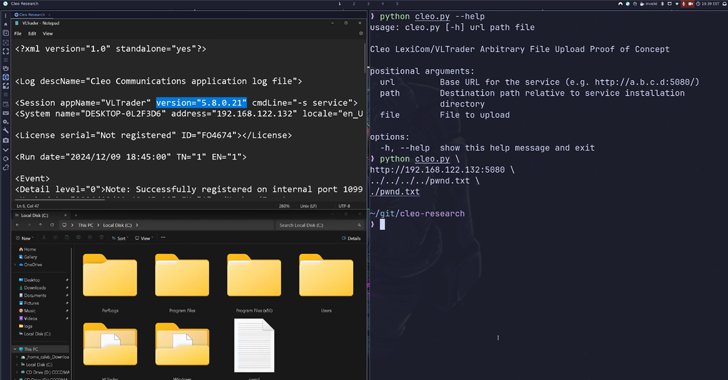
Cybersecurity company Huntress said it discovered evidence of threat actors exploiting the issue en masse on December 3, 2024. The vulnerability, which impacts Cleo’s LexiCom, VLTransfer, and Harmony software, concerns a case of unauthenticated remote code execution.

The security hole is tracked as CVE-2024-50623, with Cleo noting that the flaw is the result of an unrestricted file upload that could pave the way for the execution of arbitrary code.

Cybersecurity

The Illinois-based company, which has over 4,200 customers across the world, has since issued another advisory (CVE pending), warning of a separate “unauthenticated malicious hosts vulnerability that could lead to remote code execution.”

The development comes after Huntress said the patches released for CVE-2024-50623 do not completely mitigate the underlying software flaw. The issue impacts the below products and is expected to be patched later this week –

  • Cleo Harmony (up to version 5.8.0.23)
  • Cleo VLTrader (up to version 5.8.0.23)
  • Cleo LexiCom (up to version 5.8.0.23)

In the attacks detected by the cybersecurity company, the vulnerability has been found to be exploited to drop multiple files, including an XML file that’s configured to run an embedded PowerShell command that’s responsible for retrieving a next-stage Java Archive (JAR) file from a remote server.

Specifically, the intrusions leverage the fact files placed in the “autorun” sub-directory within the installation folder and are immediately read, interpreted, and evaluated by the susceptible software.

As many as at least 10 businesses have had their Cleo servers compromised, with a spike in exploitation observed on December 8, 2024, at around 7 a.m. UTC. Evidence gathered so far pins the earliest date of exploration to December 3, 2024.

Victim organizations span consumer product companies, logistics and shipping organizations, and food suppliers. Users are advised to ensure that their software is up-to-date to ensure that they are protected against the threat.

Ransomware groups like Cl0p (aka Lace Tempest) have previously set their sights on various managed file transfer tools in the past, and it looks like the latest attack activity is no different.

Cybersecurity

According to security researcher Kevin Beaumont (aka GossiTheDog), “Termite ransomware group operators (and maybe other groups) have a zero-day exploit for Cleo LexiCom, VLTransfer, and Harmony.”

Cybersecurity company Rapid7 said it also has confirmed successful exploitation of the Cleo issue against customer environments. It’s worth noting that Termite has claimed responsibility for the recent cyber attack on supply chain firm Blue Yonder.

Broadcom’s Symantec Threat Hunter Team told The Hacker News that “Termite appears to be using a modified version of Babuk ransomware, which, when executed on a machine, encrypts targeted files and adds a .termite extension.”

“Since we saw that Blue Yonder had an instance of Cleo’s software open to the internet via Shodan, and Termite has claimed Blue Yonder amongst its victims, which was also confirmed by their listing and open directory of files, I’d say that Gossi is correct in his statement,” Jamie Levy, Huntress’ Director of Adversary Tactics, told the publication.

“For what it’s worth, there have been some rumblings that Termite might be the new Cl0p, there is some data that seems to support this as Cl0p’s activities have waned while Termite’s activities have increased. They are also operating in some similar fashions. We’re not really in the attribution game, but it wouldn’t be surprising at all if we are seeing a shift in these ransomware gangs at the moment.”

(This is a developing story. Please check back for more updates.)


Found this article interesting? Follow us on Twitter and LinkedIn to read more exclusive content we post.


Source link

U.S. Offered $10M for Hacker Just Arrested by Russia – Krebs on Security

0

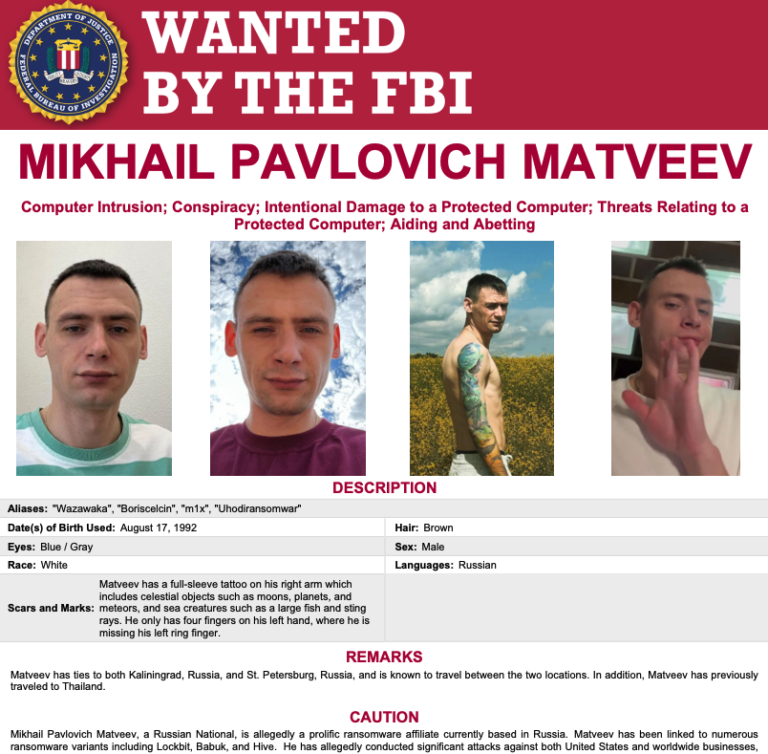
In January 2022, KrebsOnSecurity identified a Russian man named Mikhail Matveev as “Wazawaka,” a cybercriminal who was deeply involved in the formation and operation of multiple ransomware groups. The U.S. government indicted Matveev as a top ransomware purveyor a year later, offering $10 million for information leading to his arrest. Last week, the Russian government reportedly arrested Matveev and charged him with creating malware used to extort companies.

An FBI wanted poster for Matveev.

Matveev, a.k.a. “Wazawaka” and “Boriselcin” worked with at least three different ransomware gangs that extorted hundreds of millions of dollars from companies, schools, hospitals and government agencies, U.S. prosecutors allege.

Russia’s interior ministry last week issued a statement saying a 32-year-old hacker had been charged with violating domestic laws against the creation and use of malicious software. The announcement didn’t name the accused, but the Russian state news agency RIA Novosti cited anonymous sources saying the man detained is Matveev.

Matveev did not respond to requests for comment. Daryna Antoniuk at TheRecord reports that a security researcher said on Sunday they had contacted Wazawaka, who confirmed being charged and said he’d paid two fines, had his cryptocurrency confiscated, and is currently out on bail pending trial.

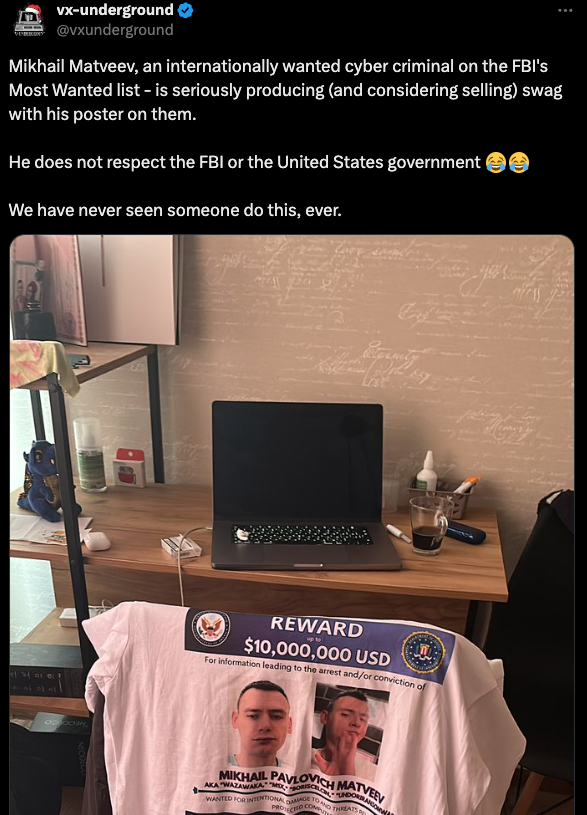
Matveev’s hacker identities were remarkably open and talkative on numerous cybercrime forums. Shortly after being identified as Wazawaka by KrebsOnSecurity in 2022, Matveev published multiple selfie videos on Twitter/X where he acknowledged using the Wazawaka moniker and mentioned several security researchers by name (including this author). More recently, Matveev’s X profile (@ransomboris) posted a picture of a t-shirt that features the U.S. government’s “Wanted” poster for him.

An image tweeted by Matveev showing the Justice Department’s wanted poster for him on a t-shirt. image: x.com/vxunderground

The golden rule of cybercrime in Russia has always been that as long as you never hack, extort or steal from Russian citizens or companies, you have little to fear of arrest. Wazawaka claimed he zealously adhered to this rule as a personal and professional mantra.

“Don’t shit where you live, travel local, and don’t go abroad,” Wazawaka wrote in January 2021 on the Russian-language cybercrime forum Exploit. “Mother Russia will help you. Love your country, and you will always get away with everything.”

Still, Wazawaka may not have always stuck to that rule. At several points throughout his career, Wazawaka claimed he made good money stealing accounts from drug dealers on darknet narcotics bazaars.

Cyber intelligence firm Intel 471 said Matveev’s arrest raises more questions than answers, and that Russia’s motivation here likely goes beyond what’s happening on the surface.

“It’s possible this is a shakedown by Kaliningrad authorities of a local internet thug who has tens of millions of dollars in cryptocurrency,” Intel 471 wrote in an analysis published Dec. 2. “The country’s ingrained, institutional corruption dictates that if dues aren’t paid, trouble will come knocking. But it’s usually a problem money can fix.

Intel 471 says while Russia’s court system is opaque, Matveev will likely be open about the proceedings, particularly if he pays a toll and is granted passage to continue his destructive actions.

“Unfortunately, none of this would mark meaningful progress against ransomware,” they concluded.

Although Russia traditionally hasn’t put a lot of effort into going after cybercriminals within its borders, it has brought a series of charges against alleged ransomware actors this year. In January, four men tied to the REvil ransomware group were sentenced to lengthy prison terms. The men were among 14 suspected REvil members rounded up by Russia in the weeks before Russia invaded Ukraine in 2022.

Earlier this year, Russian authorities arrested at least two men for allegedly operating the short-lived Sugarlocker ransomware program in 2021. Aleksandr Ermakov and Mikhail Shefel (now legally Mikhail Lenin) ran a security consulting business called Shtazi-IT. Shortly before his arrest, Ermakov became the first ever cybercriminal sanctioned by Australia, which alleged he stole and leaked data on nearly 10 million customers of the Australian health giant Medibank.

In December 2023, KrebsOnSecurity identified Lenin as “Rescator,” the nickname used by the cybercriminal responsible for selling more than 100 million payment cards stolen from customers of Target and Home Depot in 2013 and 2014. Last month, Shefel admitted in an interview with KrebsOnSecurity that he was Rescator, and claimed his arrest in the Sugarlocker case was payback for reporting the son of his former boss to the police.

Ermakov was sentenced to two years probation. But on the same day my interview with Lenin was published here, a Moscow court declared him insane, and ordered him to undergo compulsory medical treatment, The Record’s Antoniuk notes.


Source link

US military grounds entire Osprey tiltrotor fleet • The Register

0

The US Navy, Air Force, and Marine Corps have grounded their fleet of Boeing-Bell-made Osprey V-22s on safety grounds.

A spokesperson for the Naval Air Systems Command (NAVAIR) told The Register that the decision had been made following an incident where one of the aircraft made an emergency landing.

“Out of an abundance of caution, NAVAIR recommended an operational pause for all V-22 Osprey variants December 6. This decision comes following a recent precautionary landing of a CV-22. There were no injuries to the crew,” he explained.

“The safety of our V-22 aircrew is our top priority. We are committed to ensuring our Sailors, Airmen, and Marines are able to successfully complete their missions and return home safely.”

The move comes after a V-22, operating out of the Air Force Special Operations Command (AFSOC) in Florida, was forced to make a “precautionary landing,” its spokesperson told us. No one was injured in the incident.

The decision comes barely a year after the last grounding of the V-22 fleet, which came after a fatal crash by a V-22 operated by the Air Force which killed both pilots and six passengers. The cause of that crash was reportedly one of the two engines failed, and the fleet was grounded for three months of checks.

The aircraft’s tiltrotor design, while offering significant advantages in terms of speed, range, and short or vertical lift-off capability, is also incredibly complicated. The aircraft has gained a reputation for unreliability, with four crashes and 30 fatalities occurring during the nine-year testing period, and one ex-pilot has claimed the design was rushed through testing.

Last month an investigation by the Associated Press reported that the top three most serious types of incidents for the aircraft were up to 46 percent between 2019 and 2023, despite the total number of flying hours falling. Overall safety issues were up 18 percent in the same period.

The report suggests that the complex design of the Boeing-Bell aircraft, and the stresses and strains of flight, are causing parts to wear out more quickly than expected. Most of the accidents reported were related to engine issues and last month’s incident may have been more serious than the military is saying, otherwise why ground the entire fleet?

Nevertheless, the military isn’t giving up on the design. In 2022 the winner of the military’s Future Long-Range Assault Aircraft was announced and it’s another tiltrotor design — the Bell V-280 Valor. That aircraft is designed to replace the Black Hawk transport helicopter and is forecast to fly in 2027 at the earliest. ®


Source link