Far-right activists barred from UK ahead of Tommy Robinson rally | Tommy Robinson

0

Eleven foreign far-right activists have been blocked from the UK ahead of a rally by Tommy Robinson supporters as Keir Starmer accused him of “peddling hatred and division”.

The archbishop of Canterbury urged people to “choose hope”, and faith leaders spoke out before the rally on Saturday, the second of its kind after more than 100,000 attended one last year.

Live facial recognition will be used for the first time as part of a protest policing operation, while Public Order Act conditions are being imposed on a big pro-Palestinian march and the self-styled Unite the Kingdom event promoted by Robinson, whose real name is Stephen Yaxley Lennon.

Starmer, who met senior police figures and officers involved in Saturday’s operation, said: “We are in a fight for the soul of this country, and the Unite the Kingdom march this weekend is a stark reminder of exactly what we are up against. Its organisers are peddling hatred and division, plain and simple.

Keir Starmer meets Met police
commander Clair Haynes to discuss planning before the weekend’s protests in London.
Photograph: Peter Nicholls/Reuters

“We will block those coming into the UK who seek to incite hatred and violence. For anyone who sets out to wreak havoc on our streets, to intimidate or threaten anyone, you can expect to face the full force of the law.”

However, Downing Street said in a statement that Starmer had “made clear he recognises that the majority expected to attend are law-abiding citizens, who want to protest peacefully, and urged everyone attending a protest to act with decency and respect”.

The prime minister later appeared in a video, published on social media, in which he described the rally’s organisers as “convicted thugs and racists” and said it was “a reminder of what we’re up against in the battle of our values”.

A range of groups and figures from the British far right and Christian nationalism are expected to attend the event, which will call for a general election, and marks a pivot by Robinson towards encouraging his supporters to get involved in political campaigning and voting.

Tommy Robinson, whose real name is Stephen Yaxley-Lennon, has begun to encourage supporters to get involved in political campaigning. Photograph: Isabel Infantes/Reuters

Speakers who have been announced include Siobhan Whyte, the mother of Rhiannon Whyte, a woman who was stabbed to death by an asylum seeker staying at the hotel where she worked.

Those banned from entering the UK include Valentina Gomez, a US-based anti-islam influencer, and Eva Vlaardingerbroek, a Dutch influencer, and Dominik Tarczyński, a Polish politician and MEP.

Those taking part in the march, which coincides with large pro-Palestine events to mark Nakba Day, the 78th anniversary of the mass displacement of Palestinians in 1948 during the founding of Israel, will walk up the Strand, through Trafalgar Square before finishing in Parliament Square. Anti-racist counter-demonstrations are also taking place, while tens of thousands of football fans will be in London for the FA Cup final.

The archbishop of Canterbury, Sarah Mullally, spoke out as communities across the UK engaged in a A Million Acts of Hope Week – a celebration of unity and diversity intended as a counter-event to Robinson’s rally.

Those banned from entering the UK include Eva Vlaardingerbroek, a Dutch influencer. Photograph: Szilárd Koszticsák/EPA

This year’s Million Acts of Hope has promoted interfaith work and is backed by Mullally, who in March became the first woman to lead the Anglican church, the Muslim Council of Britain, UK Muslim Network and Rabbi Jonathan Wittenberg, the senior rabbi of Masorti Judaism UK.

Mullally said: “When we watch the news or scroll through our phones it can feel as though our country is more divided than ever. But this is not the whole story. When I visit churches and communities, I see people serving one another and looking out for those in need. This gives me hope.

“These acts of hope happen all the time yet so often they go unseen. There is far more that connects us than divides us. And when we choose hope we help build the kind of country we all long to live in.”

Wittenberg, a leading voice in interfaith dialogue, also said he took hope from the solidarity he had received from Muslims and Christians during the period following a spate of attacks last month on Jewish people and sites in London.

Rabbi Jonathan Wittenberg said he had witnessed constant ‘acts of kindness’ between communities, such as the solidarity of many Muslim and Christian colleagues during this spate of antisemitism. Photograph: Sophia Evans/The Observer

He added: “Every day we remember in our prayers that ‘acts of kindness are immeasurable’. I witness them constantly within my community, like taking food to families in mourning. I experience them between communities, like the solidarity of many Muslim and Christian colleagues during this spate of antisemitism.

“I see them in sustained support for refugees, despite the ugly slogans. I’m conscious of them across the community of all life, like the woman who travels 50 miles to fill the bird feeders on the hillside she loves. These acts of kindness express the true heart of our country.”

Downing Street said Starmer was taking action to “protect British communities from vile hate” amid the bans on foreign activists. Visiting the Metropolitan police’s command and control special operations room, he said: “We’re in a fight for the soul of this country, and the Unite the Kingdom march this weekend is a stark reminder of exactly what we are up against. Its organisers are peddling hatred and division, plain and simple.

The archbishop of Canterbury, Sarah Mulally, said choosing hope helped ‘build the kind of country we all long to live in’. Photograph: Gareth Fuller/PA

“We will block those coming into the UK who seek to incite hatred and violence. For anyone who sets out to wreak havoc on our streets, to intimidate or threaten anyone, you can expect to face the full force of the law. My government will always champion peaceful protest but will act decisively against hatred. We all have a responsibility to speak out against those spouting vile divisive views wherever we see it. We are a country built on decency, fairness and respect, at our best when people from different backgrounds come together in common purpose. That is what we must fight for.

Downing Street said Starmer had made clear he recognised that “the majority expected to attend are law-abiding citizens, who want to protest peacefully, and urged everyone attending a protest to act with decency and respect”.

Tomorrow is expected to be one of the busiest days of the year for policing in London. Many are expected to attend a pro-Palestine protest, while there will also be a presence by anti-fascist protesters organised by Stand Up to Racism.


Source link

Cisco zero-day under ongoing attack by persistent threat group

0

Attackers returned once again to a common target with a massive user base by exploiting a max-severity zero-day vulnerability affecting Cisco Catalyst SD-WAN Controller and Manager.

The threat group behind the “limited” number of attacks Cisco is aware of thus far are also linked to a series of previously disclosed vulnerabilities in the vendor’s firewalls and SD-WAN systems, the company said in a threat advisory Thursday.

The authentication bypass vulnerability — CVE-2026-20182 — has a CVSS rating of 10 and “behaves like a master key,” Douglas McKee, director of vulnerability intelligence at Rapid7, wrote in a blog post. 

“An attacker can present themselves to the controller as a trusted network router and, if the system accepts that claim without properly validating it, they can obtain the highest level of administrative access,” he added. “That is the cybersecurity version of a Jedi mind trick.”

Rapid7 discovered and reported the vulnerability to Cisco on March 9, and Cisco said it became aware of limited exploitation of the vulnerability earlier this month. The vendor disclosed and released a patch for the vulnerability Thursday, and the Cybersecurity and Infrastructure Security Agency quickly added the defect to its known exploited vulnerabilities catalog.

Cisco did not explain what occurred during that two-month window. Yet, the disclosure and warning from researchers marks another challenge for Cisco customers that have confronted a flood of actively exploited vulnerabilities affecting the vendor’s network edge software since late February. 

Cisco isn’t the only security vendor facing an onslaught of attacks on its customers, but it is among the most heavily targeted. CISA has added seven vulnerabilities affecting Cisco SD-WANs and firewalls to its known exploited vulnerabilities catalog in less than three months.

Cisco Talos researchers attributed the latest round of zero-day attacks to UAT-8616, the same attackers that exploited a pair of separate zero-days in Cisco’s network edge software for at least three years before the activity was discovered and reported in February. 

The company, which described the exploitation of the new zero-day as ongoing, once again declined to answer questions about the origins or motivations of UAT-8616. 

“We strongly recommend customers apply the available fixed software releases and follow the guidance provided in the advisories and Cisco Talos blog,” a spokesperson for the company said in a statement.

Cisco Talos researchers also warned that UAT-8616 and at least 10 other threat groups have chained together and achieved “widespread in-the-wild active exploitation of three vulnerabilities in unpatched Cisco Catalyst SD-WAN Infrastructure.” The company previously disclosed and released patches for the vulnerabilities — including CVE-2026-20122, CVE-2026-20128 and CVE-2026-20133 — in February. 

Rapid7 said it discovered the latest critical authentication bypass vulnerability when it was researching CVE-2026-20127, a previous zero-day the Five Eyes identified and confirmed as actively exploited by UAT-8616 in late 2025. Authorities and Cisco waited at least two months to disclose and patch the vulnerability, and share emergency mitigation guidance.

That campaign, which got underway at least three years prior, marked the second series of actively exploited zero-days in Cisco edge technology in less than a year. Both campaigns prompted CISA to issue emergency directives months after the attacks were first detected, and both attack sprees were underway for at least a year before they were discovered. 

The latest zero-day, which bypasses authentication in the same control-plane service as CVE-2026-20127,  requires no credentials or prior knowledge of the target environment for exploitation, Jonah Burgess, senior security researcher at Rapid7, told CyberScoop.

“Cisco confirmed it affects all deployment types, including on-premises, cloud, and FedRAMP environments. The SD-WAN Controller manages routing and policy for the entire overlay network, so a single compromised controller can potentially give an attacker influence over every branch, data center, and cloud edge connected to that fabric,” Burgess added.

His colleague at Rapid7, McKee, said attackers have become very good at turning weaknesses in central network infrastructure into high-impact operations. 

“Compromising one branch router is useful. Compromising the controller that manages the entire estate is a very different conversation. Now you are talking about the ability to reroute traffic, intercept communications, push malicious configuration, or simply break connectivity across the whole organization,” he wrote.

“That is the real paradox here,” McKee added. “The same architecture that gives defenders scale and simplicity can also give attackers a single point of catastrophic leverage.”

Matt Kapko

Written by Matt Kapko

Matt Kapko is a reporter at CyberScoop. His beat includes cybercrime, ransomware, software defects and vulnerability (mis)management. The lifelong Californian started his journalism career in 2001 with previous stops at Cybersecurity Dive, CIO, SDxCentral and RCR Wireless News. Matt has a degree in journalism and history from Humboldt State University.


Source link

Adanis agree to pay $18 million to settle SEC case linked to Adani green bond offering

0

Adani Group Chairman Gautam Adani

Adani Group Chairman Gautam Adani | Photo Credit: Adani Group/ANI

Gautam Adani and Sagar Adani have agreed to pay civil penalties of $6 million and $12 million, respectively, to settle charges brought by the US Securities and Exchange Commission over alleged misleading disclosures linked to a 2021 bond offering by Adani Green Energy.

In a litigation release issued on Thursday, the SEC said it had moved for entry of final judgments by consent against the two executives in the US District Court for the Eastern District of New York. The proposed settlements are subject to court approval.

Executives agree to settlement without admitting wrongdoing

Without admitting or denying the allegations, Gautam Adani and Sagar Adani consented to permanent injunctions barring them from violating Section 17(a) of the Securities Act of 1933, Section 10(b) of the Securities Exchange Act of 1934, and Rule 10b-5.

Sources indicated that following this, a similar settlement may also be reached with the US Department of Justice, which had indicted the Adanis on criminal fraud charges. “We expect closure of all the cases in a month or so,” said the sources aware of the matter.

For the Adani group, the closure of the cases in the US is important for its fundraising plans, as a significant portion of its long-term financing comes through bond issuances to US investors.

A Reuters report also linked the settlement of the cases to Adani’s promise to invest $10 billion and create 15,000 jobs in the US after President Donald Trump’s re-election in 2024.

SEC allegations linked to 2021 bond offering

The SEC’s complaint, originally filed in November 2024, alleged that the two executives orchestrated a scheme in which they promised to pay hundreds of millions of dollars in bribes to Indian government officials in exchange for commitments to purchase energy at above-market rates, benefiting Adani Green.

According to the SEC, the alleged bribery scheme was ongoing when Adani Green launched a $750 million bond offering in September 2021 that raised more than $175 million from US investors.

The regulator alleged that offering documents issued during the bond sale falsely portrayed Adani Green as compliant with anti-corruption and anti-bribery laws and principles, making the disclosures materially misleading in light of the alleged conduct.

SEC seeks permanent restrictions

The SEC said the proposed final judgments would permanently restrain both executives from future violations of US securities laws tied to fraud and misleading statements.

The investigation was conducted by officials from the SEC’s New York Regional Office, while the litigation team included SEC attorneys Christopher Colorado, Nicholas Karasimas and Stewart Gilson under the supervision of senior enforcement officials.

Published on May 15, 2026

Thangamayil Jewelery Q4 profit at ₹142 crore, flags gold demand risk on PM call

0

Madurai-based Thangamayil Jewelery Ltd doubled its net profit to ₹142 crore for the fourth quarter ended March 2026, as against ₹39 crore in the corresponding quarter last year. Revenue more than doubled to ₹2,839 crore (₹1,380 crore).

Gold jewelery sales went up by 105 per cent to ₹2,503 crore in Q4FY26. Non gold (Silver, Diamonds, other products) sales rose 141 per cent to ₹227 crore.

For the full year FY26, net profit stood at ₹352 crore as against ₹118 crore in FY25. Revenue went up to ₹8,514 crore (₹4,916 crore).

The number of retail outlets of Thangamayil Jewelery in operation stalled at 66 as of March 2026 as against 60 at the same time last year.

Meanwhile, the company has flagged a possible compression of demand in the near term given Prime Minister Narendra Modi’s call to reduce purchase of gold jewelery and the subsequent increase in gold import duty.

“The developments may have an impact on the demand for gold & silver jewelery in coming months in an already sagging demand scenario. However, customers have slowly shifted to exchange of gold for new jewelery purchases in the past several months. From a historic average of around 25%, exchange gold sales ranges from 50 per cent to 60 per cent of current sales. We have to wait and see the public reaction to these directives,” he said.

The company has proposed a dividend of ₹18.00 per equity share for the financial year 2025-26.

The shares of Thangamayil Jewelery on the NSE closed at ₹3,561.20 on Friday, down 1.53 per cent or ₹55.30.

Published on May 15, 2026

Trump-Xi summit: China, US disagree on what they agreed on | Business and Economy News

0

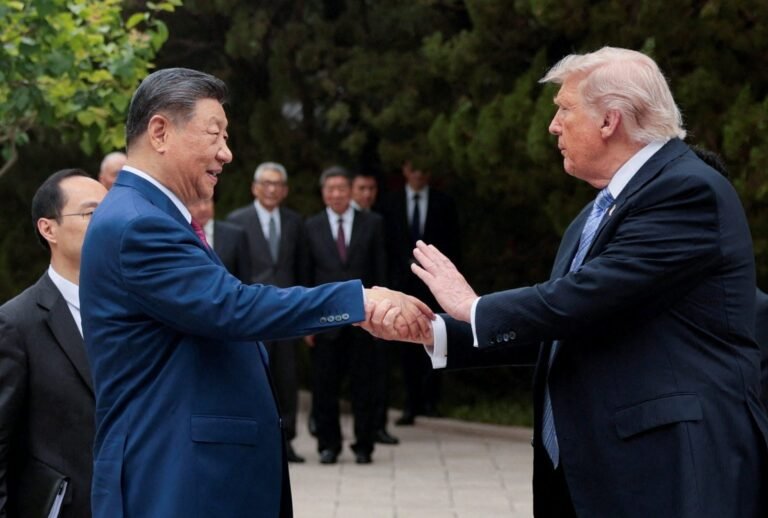
United States President Donald Trump left China on Friday following a two-day summit with Chinese counterpart Xi Jinping.

While Washington touts wins in terms of bilateral trade agreements, Beijing has warned the US against overstepping on the issue of Taiwan and stated that the US-Israel war on Iran should have never started.

Both sides have released statements detailing what Trump and Xi discussed, but they only overlap in limited areas. The two White House readouts published on Thursday addressed issues not mentioned in the Chinese Ministry of Foreign Affairs statements, and vice versa.

We break down what these issues are, what each side said and where they do align.

On trade deals

Trump said several business deals were struck between the US and China during the two days he was in Beijing. “We’ve made some fantastic trade deals for both countries,” Trump said in his remarks concluding the summit.

Xi also met with US business leaders who accompanied Trump on his trip.

Specifically, Trump told Fox News on Friday that China had agreed to buy 200 jets from US aviation manufacturer Boeing – fewer than half the 500 Boeings predicted by markets, which led to Boeing shares falling by more than 4 percent on Friday. If this deal is happening, it will mark China’s first purchase of US jets in almost a decade.

However, China has not mentioned this deal or any other trade deals in its post-summit statement. Boeing has not confirmed this deal either.

Other trade deals have not been confirmed or announced by either side so far. There was also no indication of any breakthrough deal of the US selling advanced AI Nvidia chips to China, despite CEO Jensen Huang’s dramatic, last‑minute addition to the trip.

On Thursday, Xi said that China will open the door wider to US businesses, but did not clarify what this means in terms of trade deals.

“President Xi noted that China-US economic and trade ties are mutually beneficial and win-win in nature,” was all a statement published on the Chinese Foreign Ministry website on Thursday said.

A statement published by the White House on X on Thursday also said that the two sides had expressed “expanding market access for American businesses into China and increasing Chinese investment into our industries”. Additionally, the two sides discussed increasing Chinese purchases of US agricultural products.

However, the Chinese statements make no reference to any specific business or trade agreements between the US and China.

On drug trafficking

From the start of his second term as president in January last year, Trump alleged that China was to blame for a fentanyl crisis in the US. He said this was one of the reasons for imposing sweeping tariffs on Chinese exports last year.

Following the two-day summit this week, the White House stated, “The Presidents also highlighted the need to build on progress in ending the flow of fentanyl precursors into the United States.”

However, the statements published by the Chinese Foreign Ministry make no mention of fentanyl or the flow of drugs into the US.

On the Iran war

While both the US and China said in statements that the Iran war was discussed, their statements about what was said differ.

“Both countries agreed that Iran can never have a nuclear weapon,” the White House said in a statement posted to its X account on Thursday.

But a statement posted by the Chinese Foreign Ministry on X on Friday did not explicitly mention that Iran should never have a nuclear weapon. Instead, it said, “This conflict, which should never have happened, has no reason to continue.”

“It is important to steady the momentum in easing the situation, keep to the direction of political settlement, engage in dialogue and consultation, and reach a settlement on the Iranian nuclear issue and other issues that accommodates the concerns of all parties.”

Iran has never officially declared any intent to build nuclear weapons, and China previously worked with the US, European nations and Russia to secure the 2015 Barack Obama-era nuclear deal with Iran, which limited Tehran’s nuclear programme. Iran is believed to have about 440kg (970lb) of uranium enriched to 60 percent. A 90 percent threshold of enriched uranium is needed to produce a nuclear weapon.

The White House also said in a statement that “the two sides agreed that the Strait of Hormuz must remain open to support the free flow of energy”.

Since early March, Iran has restricted shipping through the strait, a narrow waterway linking Gulf oil producers to the open ocean and through which 20 percent of the world’s oil and liquefied natural gas (LNG) supplies were shipped before the war. Iran has allowed passage by vessels from select countries, but they are required to negotiate transit with the Islamic Revolutionary Guard Corps (IRGC).

In its previous proposals to end the war, Iran has proposed charging fees or tolls for vessels seeking to pass through the state. Washington has repeatedly rejected the prospect. In April, the US announced a naval blockade on ships entering or leaving Iranian ports, further adding to the disruption of global oil and gas supplies.

A White House statement following the Trump-Xi summit says: “President Xi also made clear China’s opposition to the militarisation of the Strait and any effort to charge a toll for its use, and he expressed interest in purchasing more American oil to reduce China’s dependence on the Strait in the future.”

But the Chinese statement does not mention Iranian tolls, the militarisation of the strait or China’s interest in purchasing more US oil.

It does acknowledge that “the conflict has put a heavy strain on global economic growth, supply chains, international trade order and the stability of global energy supply, which hurts the common interests of the international community”.

Trump and Xi held their final meeting at the Zhongnanhai complex, a former imperial garden housing the offices of Chinese leaders. During this meeting, Trump said that he and Xi felt “very similar” about Iran, but Xi did not directly confirm Trump’s claim.

On US-China relations

A statement released by the Chinese Foreign Ministry said, “The two presidents agreed on a new vision of building a constructive China-US relationship of strategic stability to provide strategic guidance for China-US relations over the next three years and beyond.”

The statements from the White House do not mention the three-year timeline and focus more on developing the economic relationship between the US and China, rather than on strategic stability.

On Taiwan

“President Xi stressed that the Taiwan question is the most important issue in China-US relations,” the statement published on the Chinese Foreign Ministry’s website says.

“If it is handled properly, the bilateral relationship will enjoy overall stability. Otherwise, the two countries will have clashes and even conflicts, putting the entire relationship in great jeopardy.”

The White House post-summit statements do not mention Taiwan, however, and Trump notably ignored a question from reporters about his stance on Taiwan during his time in Beijing.

While China claims Taiwan as part of its own territory, the Taiwanese government maintains that the self-governing island of 23 million people is a sovereign state.

The US government officially acknowledges that China views Taiwan as part of its territory, but it does not explicitly state whether or not it agrees with that stance.

The US formally severed official diplomatic ties with Taiwan – also known as the Republic of China – decades ago, but remains committed under the 1979 Taiwan Relations Act to supporting the defence of the self-governing democracy.

That law has enabled Washington to supply Taiwan with billions of dollars worth of weapons and to deepen cooperation in areas such as military training and intelligence sharing, moves Beijing regards as meddling in its internal affairs.

Where is the overlap?

Statements from both sides reported that Trump and Xi had discussed strengthening the relationship between the US and China, as well as “major issues” concerning the two countries and the world.

In its statements, Washington said the US and China were on the same page about several issues, and the Chinese Foreign Ministry echoed this, saying Trump and Xi “reached a series of new common understandings”.

Both sides also confirmed that Trump and Xi discussed the war in Iran, and mentioned concerns about the closure of the Strait of Hormuz.


Source link

Access Denied

0

Access Denied You don’t have permission to access “http://hindi.news18.com/cricket/ipl-2026-playoff-rules-for-rain-reserve-day-for-final-and-points-table-advantage-what-happens-if-rain-washes-out-ipl-playoff-matches-for-qualifier-and-eliminator-ws-n-10480560.html” on this server.

Reference #18.2f50db17.1778855378.36a64e2

https://errors.edgesuite.net/18.2f50db17.1778855378.36a64e2

Access Denied

0

Access Denied You don’t have permission to access “http://hindi.news18.com/cricket/virat-kohli-reveals-why-is-played-vijay-hazare-trophy-after-so-many-year-in-rcb-podcast-10480399.html” on this server.

Reference #18.490dde17.1778874107.456181a8

https://errors.edgesuite.net/18.490dde17.1778874107.456181a8

Session Theft, MaaS, and Rapid Evolution

0

Infostealer header

In recent months, a new infostealer malware known as REMUS has emerged across the cybercrime landscape, drawing attention from security researchers and malware analysts. Several technical analyses published in recent months focused on the malware’s capabilities, infrastructure, and similarities to Lumma Stealer, including browser targeting mechanisms, and credential theft functionality and more.

However, far less attention has been given to the underground operation behind the malware itself.

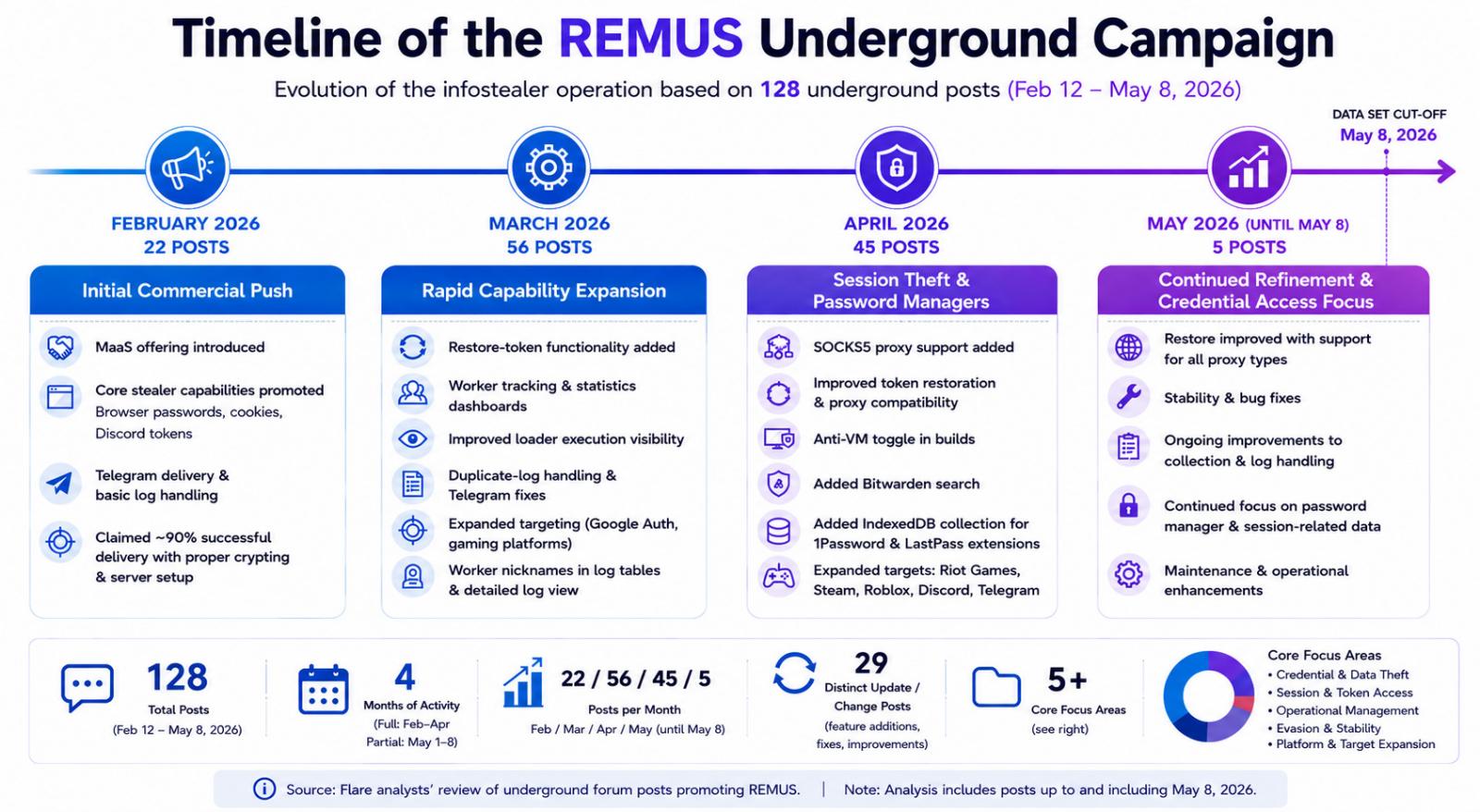
An analysis conducted by Flare researchers of 128 posts linked to the REMUS underground operation between February 12 and May 8, 2026, provides a rare look into how the group presents, develops, and operationalizes the malware within underground communities. By analyzing the actor’s advertisements, update logs, feature announcements, operational discussions, and customer-facing communications, the research helps map how the operation evolved over time and what priorities drove its development.

The findings reveal not only the rapid evolution of the stealer’s capabilities, but also a growing focus on commercialization, operational scalability, session theft, and password-manager targeting. More broadly, the activity offers insight into how modern malware-as-a-service (MaaS) operations increasingly resemble structured software businesses, with continuous development cycles, operational refinements, and features designed to improve usability, persistence, and long-term monetization.

Remus infostealer campaign

The underground activity reveals a highly compressed but aggressive development cycle, with the operator repeatedly publishing feature updates, operational refinements, and new collection capabilities over just a few months.

Rather than advertising a static malware build, the posts portray an actively maintained MaaS platform evolving in near real time.

  • February 2026 marked the initial commercial push. Early posts focused on establishing REMUS as a reliable and easy-to-use stealer, promoting browser credential theft, cookie collection, Discord token theft, Telegram delivery, and basic log management. The tone was highly promotional and customer-oriented. In one of the earliest posts, the operator claimed: “With good crypting and a dedicated intermediary server, the callback rate is ~90%.

    Another post marketed the malware as featuring “24/7 support” and functionality “simple enough that even a child can figure it out” highlighting a strong emphasis on usability and commercialization from the beginning.

  • March 2026 represented the campaign’s most active development period. During this phase, the operator introduced restore-token functionality, expanded log handling, worker tracking, statistics pages, duplicate-log filtering, and improved Telegram delivery workflows. Multiple posts focused not on theft itself, but on operational visibility and campaign management. One update added worker nicknames to log tables and statistics views, while another improved loader execution visibility so operators could better understand failed infections. The shift suggests REMUS was evolving into a broader operational platform rather than just a malware executable.

  • April 2026 showed a clear move toward session continuity and browser-side authentication artifacts. The operator added SOCKS5 proxy support, improved token restoration, anti-VM toggles, gaming-platform targeting, and password-manager-related collection. One update explicitly stated: “Added IndexedDB collection for 1Password and LastPass extensions.

    Another referenced Bitwarden-related searches. The posts increasingly emphasized authenticated sessions, restore workflows, and browser-side storage rather than standalone credentials alone.

  • By early May 2026, the operation appeared focused on refinement and operational stability. The remaining posts in the dataset referenced restore improvements, bug fixes, collection optimizations, and continued adjustments to delivery and management functionality, suggesting the operator was shifting from rapid feature expansion toward platform stabilization.

REMUS and Its Connection to Lumma

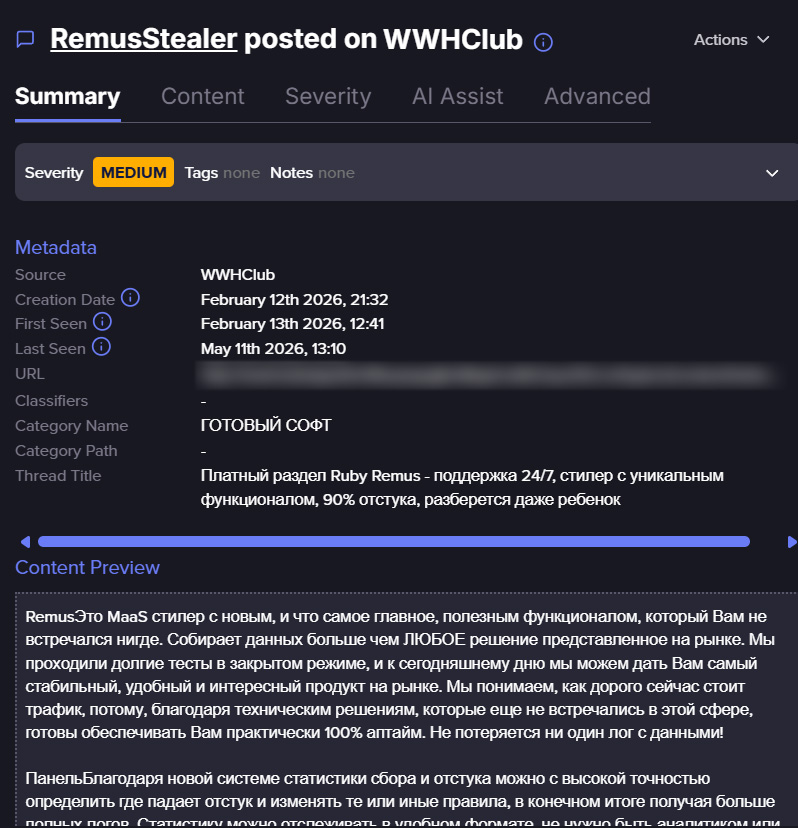
Screenshot from Flare's platform showing one of REMUS’s earliest posts. Sign up for the free trial to access if you aren’t already a customer.
Screenshot from Flare’s platform showing one of REMUS’s earliest posts.
Sign up for the free trial to access if you aren’t already a customer.

Public reporting has largely focused on REMUS as a technically significant successor or variant of the Lumma Stealer. Researchers described the malware as a 64-bit infostealer sharing multiple similarities with Lumma, including anti-VM checks, browser-focused credential theft, and browser encryption bypass techniques.

That technical overlap is important, but the underground data suggests the story extends far beyond malware lineage.

The analyzed posts show a threat actor aggressively building a commercial cybercrime product around the malware. The operation repeatedly promoted updates, customer support, performance improvements, and additional collection capabilities in a way that strongly resembles legitimate software development cycles.

In one early post, the operator claimed the malware could achieve approximately “90%” successful delivery rates when paired with proper crypting and an intermediary server, language clearly aimed at reassuring potential buyers about operational reliability.

Infostealers like REMUS don’t just harvest credentials anymore, they capture cookies, browser tokens, and authenticated sessions that bypass MFA entirely.

Flare monitors millions of stealer logs across dark web markets and Telegram channels continuously, so you can detect exposed sessions and credentials before attackers use them against you.

Detect your exposure for free.

A Shift Toward Session Theft and the Rising Value of Cookies

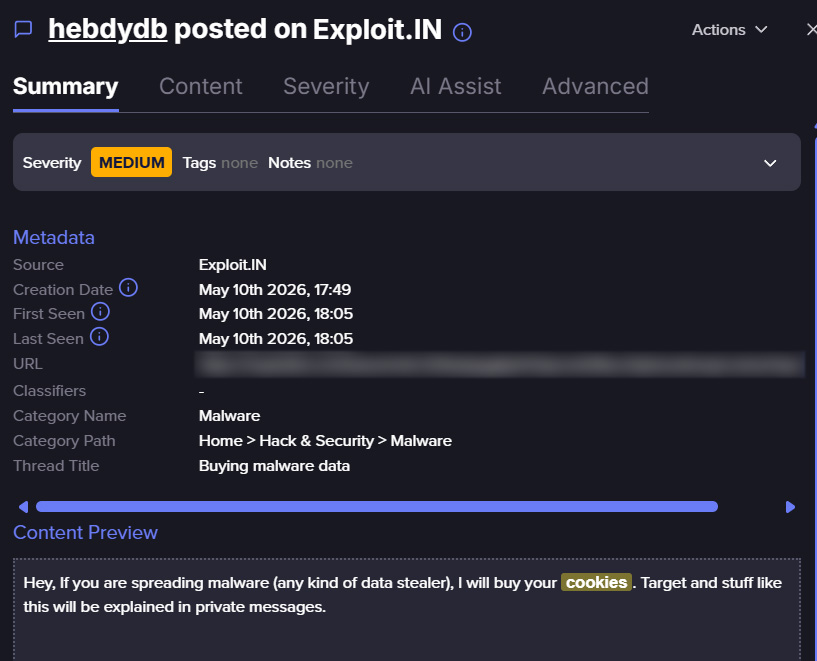
Screenshot from Flare’s platform showing an example of the high demand for “cookies.”
Sign up for the free trial to access if you aren’t already a customer.

One of the clearest themes across the REMUS campaign is the growing emphasis on session theft rather than traditional credential harvesting alone.
Historically, many infostealers focused primarily on usernames and passwords.

REMUS, however, repeatedly emphasized cookie collection, token handling, browser sessions, proxy-assisted restoration, and authenticated access continuity. From the earliest stages of the campaign, the malware promoted browser sessions and authentication artifacts as a core part of its value.

This reflects a broader shift across the underground economy, where stolen cookies and authenticated sessions have increasingly become a highly valuable commodity. Instead of stealing credentials and attempting to log in later, attackers increasingly seek already authenticated sessions that may bypass MFA prompts, login alerts, device verification, and risk-based authentication systems.

Multiple REMUS updates referenced “Restore” improvements, proxy compatibility, and support for multiple proxy types during token restoration workflows, strongly suggesting the operator viewed session persistence as a major selling point.

Several updates also focused on platforms where active sessions carry substantial value, including Discord, Steam, Riot Games, and Telegram-linked environments. Combined with cookie collection and restore functionality, the campaign increasingly appeared designed not just to steal credentials, but to preserve and operationalize authenticated access itself.

Password Managers Become High-Value Targets

The most significant late-stage evolution observed in the campaign involved password-manager-related collection. By April 2026, the operator was advertising support tied to Bitwarden, 1Password, LastPass, and IndexedDB browser storage. Password managers increasingly represent concentrated stores of valuable credentials and authentication material.

The references to IndexedDB are especially relevant because modern browser applications and extensions frequently use local browser storage mechanisms to retain application data and session information.
The posts do not prove successful vault decryption or direct password-manager compromise by themselves.

However, they clearly demonstrate that REMUS development was moving toward browser-side storage collection associated with password-management ecosystems.

The Operational Maturity Behind REMUS

The underground activity also demonstrates how modern MaaS ecosystems increasingly resemble legitimate software businesses.

Across the analyzed posts, the operator repeatedly published versioned updates, bug fixes, feature expansions, troubleshooting improvements, statistics enhancements, and operational visibility refinements.

Several posts also implied a multi-operator environment through references to workers, statistics dashboards, management visibility, loader monitoring, and log categorization. This operational structure aligns closely with broader MaaS trends where malware developers increasingly separate development, infrastructure, delivery, and monetization into specialized roles.

Final Thoughts

The REMUS campaign offers a revealing look into how modern infostealer operations are evolving far beyond simple credential theft.

Over just a few months, the underground activity analyzed by Flare analysts showed a clear transition from basic malware promotion into the development of a structured MaaS ecosystem focused on operational reliability, session persistence, and scalable data collection.

Perhaps most notably, the campaign highlighted the growing importance of authenticated sessions and browser-side authentication artifacts within the underground economy. The repeated emphasis on token restoration, proxy-assisted session recovery, and password-manager-related collection reflects a broader shift in cybercrime operations away from simply stealing passwords and toward maintaining direct access to already-authenticated environments.

The findings reinforce an increasingly important reality: infostealers are rapidly evolving into mature operational platforms that support persistence, automation, and long-term monetization workflows. As these ecosystems continue to professionalize, understanding how threat actors operationalize and commercialize malware may become just as important as analyzing the malware itself.

Learn more by signing up for our free trial.

Sponsored and written by Flare.


Source link

78 years later: Palestinians are still denied their right to return. | Newsfeed

0

NewsFeed

78 years ago, thousands of Palestinians were expelled from their land by zionist militias. Today, their grandchildren are still in refugee camps. Al Jazeera’s Leila Warah went to Aida refugee camp to ask what the right of return means to those still waiting for it.


Source link

Access Denied

0

Access Denied You don’t have permission to access “http://hindi.news18.com/cricket/chandu-sarwate-and-shute-banerjee-share-the-unique-world-record-in-first-class-cricket-for-being-the-only-no-10-and-no-11-batsmen-to-both-score-centuries-in-the-same-innings-10480470.html” on this server.

Reference #18.6e560e17.1778876676.134f4fbf

https://errors.edgesuite.net/18.6e560e17.1778876676.134f4fbf