Reference #18.2f50db17.1778772520.24f3843
https://errors.edgesuite.net/18.2f50db17.1778772520.24f3843
Reference #18.2f50db17.1778772520.24f3843
https://errors.edgesuite.net/18.2f50db17.1778772520.24f3843
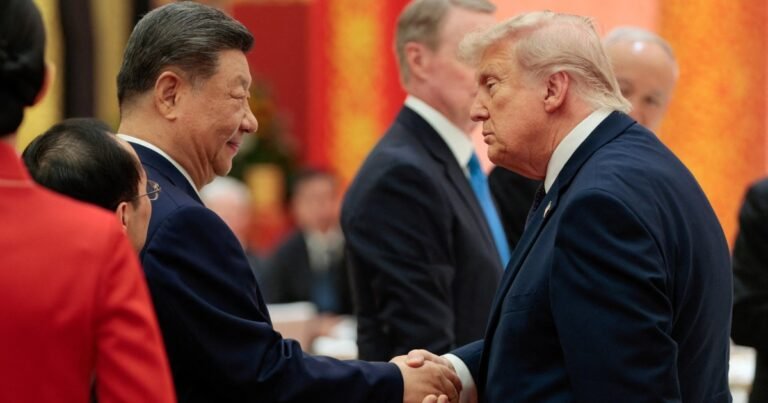
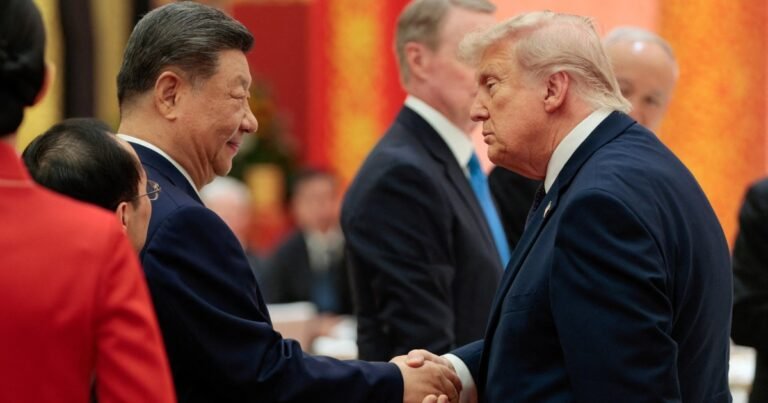
One day into US President Donald Trump’s visit to China for trade talks, both he and Chinese President Xi Jinping have exchanged toasts at a state banquet at the Great Hall of the People in Beijing, and hailed their relationship as the world’s most “consequential”.
On Thursday, following a visit to the Temple of Heaven, a 600-year-old landmark in the Chinese capital, Xi spoke of a “shared US-China future”, while also warning that failure to handle this bond would create a “very dangerous situation”.
“We must make it work and never mess it up,” he said.
Here’s a look at what each president have said about five key issues so far:
The US president described his Chinese counterpart as “my friend” in his opening remarks at the state banquet that Xi hosted for the American leader.
“We are going to have a fantastic future together. I have such respect for China, for the job you’ve done. You are a great leader,” he told Xi.
Trump also invited Xi and First Lady Peng Liyuan to pay a return visit to the White House on September 24.
For his part, the Chinese president said he was “very happy” to meet Trump in Beijing at a time of historic turbulence and when the “world stands at a new crossroads”.
He then posed a series of questions to the US president.
“Can we join hands to address global challenges and inject greater stability into the world?” he asked.
“Can we uphold the wellbeing of our respective peoples and the shared future of humanity, working together to create a bright future for our bilateral relationship?”
“These are, in essence, questions posed by history, by the world, and by the people, and they constitute the answer to our times that you and I, as leaders of major nations, must jointly write,” he added.
Reporting from Beijing, Al Jazeera’s Katrina Yu said that while the Chinese leader did not expand on his friendship with Trump, his reception underscored how highly Xi regards this visit.
“China is deeply invested in symbolism and visual optics, and it uses these details to convey the importance of a guest,” Yu said.
Trump was welcomed at the Great Hall of the People, the seat of power in China, “the equivalent of the White House and all other important centres of power combined”.
She added, “China is very aware that it wants to give Trump a spectacle. What we are seeing now is China rolling out the red carpet accordingly.”
Additionally, Vice President Han Zheng greeted Trump at the airport when he landed in Beijing on Wednesday, making him the highest-ranking Chinese official to ever welcome a US president.
Trump and Xi may meet again on at least two other occasions this year – the Asia-Pacific Economic Cooperation (APEC) leaders’ meeting, in Shenzhen, China, in November; and the Group of 20 (G20) summit in Miami, Florida in the US in December.
It would be unprecedented for the US president to travel to China twice in one year.
Xi and Trump agreed to frame their relationship as “constructive, strategic and stable” in a new positioning that is intended to guide US-China ties for the next three years and beyond, according to a Chinese Foreign Ministry statement about talks between the two.
Trump said the relationship between the two countries went back to the founding of the US, noting that the early American traders who visited China were described, by the Chinese, as “the new people”.
Today, he said, the two countries’ bilateral ties were among “the most consequential” in the world.
The Chinese president said the two countries should become partners, rather than rivals, adding that “mutual respect is key to stable China-US ties”.
“I have always believed that the common interests between China and the US outweigh the differences,” Xi said.
“Let 2026 be a historic and landmark year for Sino-US relations to carry on the past and open up the future.”
Trump and Xi discussed trade, with Xi saying that China’s door of opportunity will open wider.
What this means is not explicitly clear yet, but Trump will be hoping it includes a Chinese pledge to buy US soya beans, beef and aircraft. Officials in the Trump administration also hope to move towards setting up a Board of Trade with China to manage commercial disputes between the two countries.
Xi also met with US business leaders who have accompanied Trump on this trip on Thursday.
The US and China entered a tariff threat standoff last year, with each side imposing retaliatory tariffs on each other’s exports.
China also restricted exports of some rare-earth metals, which are crucial for technology manufacturing, in April. Later in the year, it announced plans to restrict several others. Those later plans are on pause since a truce was agreed between the two presidents in October last year on the sidelines of the APEC summit in South Korea.
In return for China’s agreement to pause restrictions on rare-earth metal exports, Trump dropped a threat of 100 percent tariffs on Chinese goods.
The Taiwanese government maintains that the self-governing island of 23 million people is a sovereign state.
During the meeting on Thursday, Xi reportedly warned Trump that the issue of Taiwan – which China regards as its own territory – could lead to conflict between Washington and Beijing if it is not handled carefully.
However, Taiwan was not mentioned in a joint statement following the meeting, and Trump notably ignored a question from reporters about his stance on Taiwan.
This is a tricky issue for the US.
While the US government officially acknowledges that China views Taiwan as part of its territory, it does not explicitly state whether or not it agrees with that stance.
The US formally severed official diplomatic ties with Taiwan – also known as the Republic of China – decades ago, but remains committed under the 1979 Taiwan Relations Act to supporting the defence of the self-governing democracy.
That law has enabled Washington to supply Taiwan with billions of dollars’ worth of weapons and to deepen cooperation in areas such as military training and intelligence sharing, moves Beijing regards as meddling in its internal affairs.
Xi has told Trump that the “Taiwan question is the most important issue in China-US relations”, Chinese Foreign Ministry spokesperson Mao Ning posted on X on Thursday.
“If it is handled properly, the bilateral relationship will enjoy overall stability. Otherwise, the two countries will have clashes and even conflicts, putting the entire relationship in great jeopardy,” she wrote.
Taiwan independence and peace in the Taiwan Strait are as “irreconcilable as fire and water”, Xi said.
Taiwan’s Foreign Ministry released a statement saying that China is “currently the sole risk to regional peace and stability”, after Xi warned Trump.
“Beijing has no right to make any claims on behalf of Taiwan internationally,” the statement added.
The US-Israel war on Iran, which entered its 76th day on Thursday, also came up in the meeting between Trump and Xi on Thursday.
In their joint statement, Trump and Xi agreed that the Strait of Hormuz must remain open and Iran should never have nuclear weapons.
US officials have previously said that they might need China’s help in convincing Iran to open the Strait of Hormuz. But analysts say Beijing will want concessions from the US, likely regarding Taiwan, in exchange for any aid in resolving the crisis.

Sometimes you have divisions in baseball that have everyone looking like juggernauts. Other times, they look like complete disasters. I personally think they should do away with divisions and just do league play, that way the best teams all get in. I suppose that the three Wild Card spots help. We aren’t here to debate the playoff and structure; we are here to cash a bet on the Mariners and Astros game.
Coming into this season, I felt that the biggest question about the Seattle Mariners would be how they could respond to falling short in the postseason. The other concern I had was the issue between Randy Arozarena and Cal Raleigh in the World Baseball Classic. The answer, for now, is that things are not going well. Perhaps there is no issue in the clubhouse with the players, but there certainly are issues on the field. The team is 21-23 overall and just 9-12 away from Seattle. For a lineup full of hitters, the team is hitting just .230.
CLICK HERE FOR MORE OUTKICK SPORTS COVERAGE
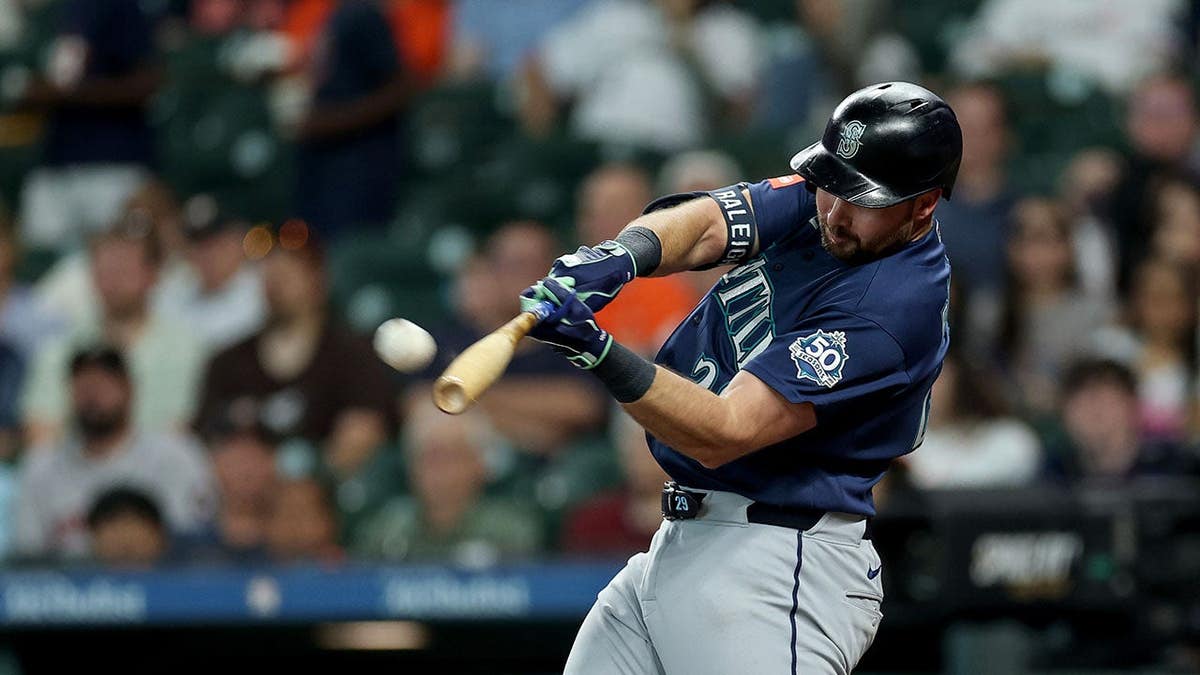
Cal Raleigh of the Seattle Mariners bats in the second inning against the Houston Astros at Daikin Park in Houston, Texas, on May 11, 2026. (Tim Warner/Getty Images)
Their pitching has continued to excel, which is probably the lone reason the team hasn’t been a complete disaster. As a team, they are pitching to a 3.63 ERA and a 1.23 WHIP. One guy who is hurting their numbers is today’s starter, Luis Castillo. For the year, he is 0-4 with a 6.57 ERA and a 1.62 WHIP. He has allowed four or more earned runs in three straight starts and four of his past six outings. The Mariners are just 2-6 in his eight starts this year. He hasn’t received a ton of run support, but he certainly has put them behind in the games. To make matters worse, Astros hitters are batting .274 against him.
The Houston Astros are also struggling to find their footing this year. For a long time, it seemed like no matter who was on the field or roster, they were able to make it work. They would lose big name after big name and keep winning. Unfortunately for them, it seems not to be the case this season. They are just 17-27 for the year and 10-12 at home. Offensively, they are fine — hitting .257 overall, but their pitching staff has been brutal with a collective ERA of 5.54 and a 1.58 WHIP.
ZERO BS. JUST DAKICH. TAKE THE DON’T @ ME PODCAST ON THE ROAD. DOWNLOAD NOW!

Houston Astros outfielder Yordan Alvarez hits a single against the Detroit Tigers in game one of the Wild Card round for the 2024 MLB playoffs at Minute Maid Park in Houston, Texas, on Oct. 1, 2024. (Troy Taormina-Imagn Images)
Their starter today is Mike Burrows, owner of a 2-4 record with a 5.04 ERA and a 1.48 WHIP. He has been worse on his home mound than on the road. At home, he has allowed 13 earned runs over 20.1 innings. He is coming off two strong starts in a row, both quality outings. This also includes his best start of the year with seven scoreless innings and just three hits allowed against the Reds. He faced Seattle earlier in the year and allowed 11 hits and six runs over six innings.
I have a player prop that I’m taking today — Yordan Alvarez 2+ total bases. He has feasted on Castillo’s pitching over the years, going 10-for-22 with four home runs and just two strikeouts. To me, that means he is putting the ball in play even if he isn’t always getting a hit. I like his odds at -123, and normally I only play props at plus money. His home run number is +235, which is worth a sprinkle.

Seattle Mariners starting pitcher Luis Castillo throws a pitch to the Minnesota Twins in the first inning of a baseball game in Minneapolis on July 24, 2023. (Bruce Kluckhohn/AP)
OUTKICK IS NOW ON THE FOX APP: CLICK HERE TO DOWNLOAD
I am going to take the Astros today. I really don’t like what I’ve seen out of Castillo. Burrows has some ugly numbers, but he may be locking in at the moment. Neither team is in great form, and the Astros finally broke their losing streak last night. I like the Astros at +108. Let’s take them to win.
For more sports betting information and plays, follow David on X/Twitter: @futureprez2024

PIF deal covers the 2026 World Cup being cohosted by US, Canada and Mexico, while Saudi Arabia is hosting 2034 edition.
Published On 14 May 2026
Saudi Arabia’s Public Investment Fund (PIF) has been named an official tournament supporter in North America and Asia for this year’s World Cup, as the country deepens its ties with international football ahead of hosting the 2034 tournament.
The 2026 World Cup – the first edition of the global showpiece to feature 48 teams – will be cohosted by the United States, Canada and Mexico from June 11 to July 19.
The partnership includes support for initiatives worldwide, spanning grassroots programmes, youth and women’s football, education projects, and efforts to enhance infrastructure and technical expertise, PIF and FIFA said.
No financial details or specific activations were disclosed.
The deal builds on PIF’s partnership with FIFA for the Club World Cup 2025 and highlights the fund’s deepening commercial ties with global football ahead of Saudi Arabia hosting the 2034 World Cup.
“PIF continues to accelerate the growth of football globally by expanding access to the game and creating opportunities that benefit players, fans and the wider football ecosystem,” said Mohamed AlSayyad, head of corporate brand at PIF, in a statement.
PIF, which has spent more than $5bn on LIV Golf since it launched in 2022, said last month that it would cut funding at the close of the 2026 season, leaving the breakaway circuit scrambling for new backers.
The sovereign wealth fund, chaired by Saudi Crown Prince Mohammed bin Salman, is involved in several other sports.
In its statement announcing it was cutting funding to LIV Golf, PIF added that it remained committed to deploying capital internationally in line with its investment strategy, “including current and future investments in various sports as a priority sector”.
Saudi Arabia, which parted company with head coach Herve Renard last month, start their World Cup 2026 campaign against Uruguay on June 15.
They complete their Group H matches against Spain and debutants Cape Verde.
A report by CNI InfoXchange projects that the Nifty 50 could potentially reach 40,000–42,000 by 2028–29 if strong foreign portfolio inflows and domestic investment momentum continue.
Nifty 50 could potentially scale 42,000 by 2029 if historical flow patterns and domestic growth momentum sustain, said a CNI InfoXchange report after analyzing past trends, especially post heavy selling by foreign portfolio investors.
According to the report titled Nifty’s Resurgence With the Return of FII, equities have increasingly become flow-driven rather than purely earnings-led over the last several years. The study noted that nearly $54 billion in FII inflows between 2019 and September 2021 helped power a 63 per cent rally in the Nifty, while another $45 billion in inflows during July 2022 to September 2024 resulted in a 68 per cent surge in the benchmark index.
Market structure has fundamentally strengthened due to expanding domestic institutional investor participation, systematic investment plan inflows and growing alternative investment fund activity, which have collectively reduced the market’s vulnerability to foreign selling. Even during periods of heavy FII outflows, market corrections remained relatively contained, it said.
The report projected that if the country attracts another $50 billion in FII inflows over the next two years, historical flow-to-return dynamics could push the Nifty toward 40,000-42,000 by 2028-29.
The CNI InfoXchange report highlighted several factors that could support such a rally. These include sustained GDP growth above 7 per cent, supportive RBI policy, large-scale infrastructure and manufacturing reforms, strong domestic liquidity and a continued capex cycle backed by government spending.
The report also expects India’s weight in the MSCI Emerging Markets Index to rise to 23.5-25 per cent by FY28, potentially overtaking China, while projecting total FPI and FDI inflow potential of $160-180 billion over FY27 and FY28.
The report said the bull case for Indian equities would require strong earnings growth, continued SIP inflows, a stable inflation environment and supportive global liquidity conditions.
Sectorally, capital goods, infrastructure, banking, real estate, defense and power emerged as the strongest outperformers across previous market upcycles. During the July 2022 to September 2024 phase, capital goods and infrastructure stocks surged 138 per cent, while realty stocks rose 132 per cent amid strong government capex, railway modernization and a recovery in residential demand. Banking and financials gained 98 per cent on improving asset quality and robust credit growth.
The report expects these sectors to continue leading the next phase of the rally. It highlighted infrastructure and defense as key beneficiaries of India’s manufacturing push and rising order books, while banking could benefit from higher credit-to-GDP penetration. Discretionary consumption and premiumisation trends are also expected to support autos and consumption-linked sectors.
At the same time, the report cautioned that the path to 42,000 will depend heavily on global macro stability. Risks, including oil price spikes, geopolitical tensions in the Middle East, a reversal in global liquidity conditions and disruptions in the global AI investment cycle, could lead to periods of volatility and valuation correction.
Still, the report maintained that India remains one of the few large global markets offering structural growth acceleration supported by favorable demographics, manufacturing expansion, domestic liquidity and rising global investor allocation.
Published on May 14, 2026
Science
SpaceX and Blue Origin may yet get a role in low Earth orbit rehearsal, readiness permitting
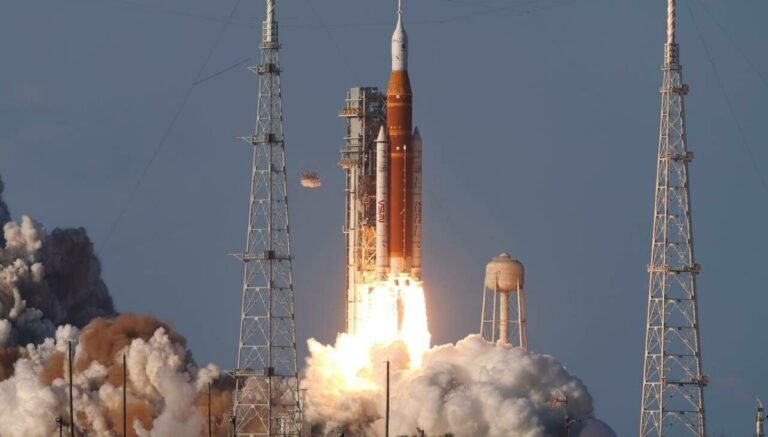
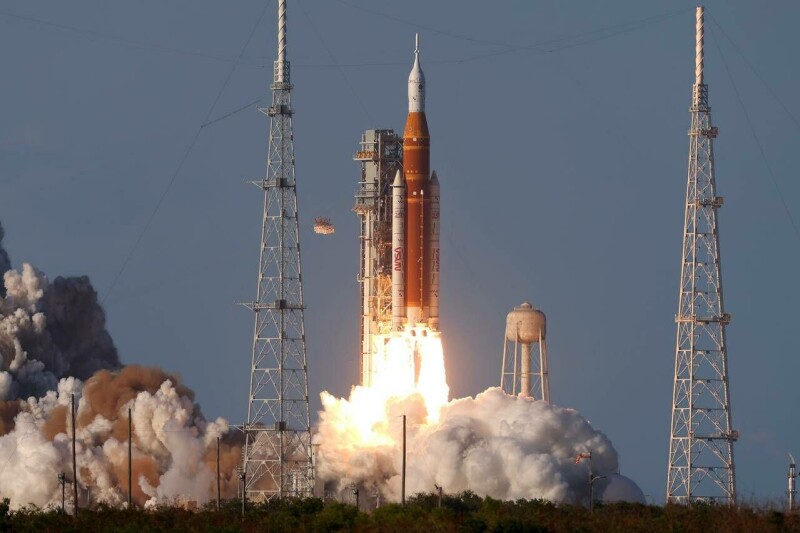
Artemis III is currently targeted for late 2027, and NASA has shared some of its plans for the mission, though exactly how SpaceX and Blue Origin will participate remains unclear.
The mission to low Earth orbit will be launched with a “spacer” rather than the Interim Cryogenic Propulsion Stage (ICPS) that would otherwise be used on lunar voyages to send the Orion capsule to the Moon. According to NASA, the crew will spend more time in the Orion capsule than the Artemis II astronauts to further test the spacecraft’s life support system. NASA will also demonstrate the docking system alongside an upgraded heat shield.
As for the lunar lander, NASA has remained tight-lipped, only saying that operations would be “informed by Blue Origin and SpaceX capabilities.” However, the agency stated that astronauts could potentially enter “at least one lander test article.” There might also be an opportunity to evaluate the interfaces of Axiom’s AxEMU spacesuit.
There could, in theory, be three launches during the Artemis III mission: one for Orion, atop the SLS (the core stage of which is in NASA’s Vehicle Assembly Building), with separate launches for SpaceX’s Starship human landing system pathfinder and Blue Origin’s Blue Moon Mark 2 landing system pathfinder.
Without an ICPS, the European-built Orion service module will provide propulsion to circularize the spacecraft’s orbit.
Artemis III was supposed to mark a crewed return to the lunar surface, but was changed earlier this year to be a test of commercial lunar lander technologies in low Earth orbit.
Jeremy Parsons of NASA’s Exploration Systems Development Mission Directorate called the development a “stepping stone” to a lunar landing, saying: “For the first time, NASA will coordinate a launch campaign involving multiple spacecraft integrating new capabilities into Artemis operations.”
Kind of. In 1965, NASA launched the first crewed flight of the Gemini program. Several stages in the program involved launching another spacecraft – the Agena target vehicle – followed by a crewed Gemini launch to demonstrate rendezvous and docking techniques. The final crewed flight, Gemini 12, was launched less than two hours after the Agena [PDF].
While NASA is unlikely to manage that sort of quick-fire launch cadence, the agency will also expect to avoid a repeat of the infamous Gemini 8 incident, in which a stuck thruster almost resulted in the loss of astronauts David Scott and Neil Armstrong. ®
Published On 14 May 2026
United States President Donald Trump has discussed the Strait of Hormuz and the US-Israel war on Iran during his meeting with China’s Xi Jinping as negotiations to end the conflict and open the waterway are stalled.
According to the White House, Trump and Xi had a “good” meeting on Thursday and agreed that the Strait of Hormuz “must remain open to support the free flow of energy”.
“President Xi also made clear China’s opposition to the militarisation of the strait and any effort to charge a toll for its use,” the White House said.
In a separate interview, US Treasury Secretary Scott Bessent said he believed Beijing would “do what they can” to open the waterway, which he said was “very much in their interest”.
Since the US-Israeli war on Iran began at the end of February, Tehran has all but closed the strait, causing disruptions to global energy supplies and raising fuel prices as oil tankers remain unable to pass.
But under special agreements, Iran has let some carriers sail through the waterway.
On Wednesday, a Chinese tanker transited through the strait, according to shipping data seen by the Reuters news agency. Iran’s Fars News Agency also reported on Thursday that there was an agreement to allow some Chinese ships to pass.
Moreover, Iran’s state broadcaster IRIB reported that about 30 vessels had transited through the strait since Wednesday evening.
Meanwhile, the US said on Thursday that it had so far redirected 70 vessels and disabled four others to enforce Trump’s blockade on ships travelling to or from Iranian ports through the Strait of Hormuz.
“As of today, CENTCOM forces have redirected 70 commercial vessels and disabled 4 to ensure compliance,” US Central Command (CENTCOM) said on X.
A ship anchored off the United Arab Emirates was seized and taken toward Iran and another was attacked and sank, authorities said on Thursday, in renewed escalation on shipping near the strait.
The United Kingdom Maritime Trade Operations reported that “unauthorised personnel” had taken over a vessel that had been anchored off the UAE port of Fujairah on Thursday and was heading towards Iran, without giving details about who the ship belongs to.
Meanwhile, an Indian-flagged wooden cargo vessel sunk on Wednesday while sailing through Omani waters following a fire from a suspected drone or missile strike. The vessel was sailing to the UAE from Somalia, India’s shipping ministry said in a statement. All 14 crew were rescued by the Omani coast guard.
There were no immediate claims of responsibility, but the incidents came as a senior Iranian official reiterated his country’s claim to the waterway and another said it had a right to seize oil tankers connected to the US.
Iran’s judiciary spokesperson Asghar Jahangir said on Thursday that the capture of “US tankers” violating his country’s regulations was being carried out under domestic and international law.
Reporting from Tehran, Al Jazeera’s Almigdad Alruhaid explained that Iranian officials have reiterated their stance that the waterway will be open for commercial vessels if they cooperate with Tehran’s naval authorities.
“Iranian officials are establishing a new mechanism for such cooperation. Ships are expected to submit detailed information in advance through what Iran calls the ‘Persian Gulf Strait Authority’,” he said.
“That includes cargo details, ownership information, destination and route plans, and transit timing. After that, vessels have to wait to see if authorities approve a transit permit,” Alruhaid said, adding that if a vessel is recognised as “hostile” towards Iran, it would not be allowed to pass.
But as the waterway remains relatively closed, the US and Iran are no closer to agreeing to a peace deal. Washington wants Tehran to hand over its enriched uranium, and Tehran wants a lifting of sanctions and its sovereignty over the Strait of Hormuz recognised.

Spanish international Lamine Yamal criticised for waving Palestinian flag during bus parade celebrating La Liga title.
Published On 14 May 2026
Israel’s defence minister has criticised Barcelona’s teenage star Lamine Yamal for waving a Palestinian flag during celebrations of the Spanish league title win, saying the act “incites hate”.
The 18-year-old Yamal waved a large Palestinian flag from an open-top bus during a victory parade by the team through Barcelona on Monday.
The parade drew about 750,000 people to celebrate the league title clinched the previous day, local authorities said.
“Lamine Yamal chose to incite hate against Israel while our soldiers combat the terrorist organization Hamas, an organization that massacred, raped and burned Jewish children, women and the elderly on October 7 [2023],” Israel Katz wrote on X on Thursday.
Yamal, who is Muslim, posted pictures of himself holding the flag on his Instagram account.
Spain’s government and a large part of its population have been highly critical of Israel’s genocidal war in Gaza, which has killed more than 72,000 Palestinians in response to the 2023 Hamas-led attacks on southern Israel.
There has been a global backlash against Israel over the humanitarian toll of the war in Gaza, which has spread to sport and culture. Protests have been seen in football, cycling and basketball.
Last year’s Spanish Vuelta was repeatedly disrupted by protesters angry with the participation of an Israeli-backed cycling team.
Spain is also one of five countries boycotting this year’s Eurovision Song Contest to protest Israel’s inclusion.
Yamal is set to star for Spain at the World Cup in June and July in North America.


The Belarus-aligned threat group known as Ghostwriter has been attributed to a fresh set of attacks targeting governmental organizations in Ukraine.
Active since at least 2016, Ghostwriter has been linked to both cyber espionage and influence operations targeting neighboring countries, particularly Ukraine. It’s also tracked under the monikers FrostyNeighbor, PUSHCHA, Storm-0257, TA445, UAC‑0057, Umbral Bison (formerly RepeatingUmbra), UNC1151, and White Lynx.
“FrostyNeighbor has been running continual cyber operations, changing and updating its toolset regularly, updating its compromise chain and methods to evade detection – targeting victims located in Eastern Europe,” ESET said in a report shared with The Hacker News.
Previous attacks mounted by the hacking crew have leveraged a malware family known as PicassoLoader, which then acts as a conduit for Cobalt Strike Beacon and njRAT. In late 2023, the threat actor was also observed weaponizing a vulnerability in WinRAR (CVE-2023-38831, CVSS score: 7.8) to deploy PicassoLoader and Cobalt Strike.
As recently as last year, Polish entities were at the receiving end of a phishing campaign orchestrated by Ghostwriter that exploited a cross-site flaw in Roundcube (CVE-2024-42009, CVSS score: 9.3) to run malicious JavaScript responsible for capturing email login credentials.
In at least some cases, the threat actors are said to have leveraged the harvested credentials to analyze mailbox contents, download the contact list, and abuse the compromised account to propagate more phishing messages, per a report from CERT Polska in June 2025. Towards the end of 2025, the group also began to incorporate an anti-analysis technique where lure documents relied on dynamic CAPTCHA checks to trigger the attack chain.
“FrostyNeighbor remains a persistent and adaptive threat actor, demonstrating a high level of operational maturity with the use of diverse lure documents, evolving lure and downloader variants, and new delivery mechanisms,” ESET researcher Damien Schaeffer said. “This newest compromise chain that we detected is a continuation of the group’s willingness to update and renew its arsenal, trying to evade detection to compromise its targets.”
The latest set of activities, observed since March 2026, involves using links in malicious PDFs sent via spear-phishing attachments to target government entities in Ukraine, ultimately resulting in the deployment of a JavaScript version of PicassoLoader to drop Cobalt Strike. The PDF decoy documents have been found to impersonate the Ukrainian telecommunications company Ukrtelecom.
The infection sequence incorporates a geofencing check, serving a benign PDF file to victims whose IP address does not correspond to Ukraine. The embedded link in the PDF document is used to deliver a RAR archive containing a JavaScript payload that displays a lure document to keep up the ruse, while simultaneously launching PicassoLoader in the background.
The downloader is also designed to profile and fingerprint the compromised host, based on which the operators may manually decide to send a third-stage JavaScript dropper for Cobalt Strike Beacon. The system fingerprint is transmitted to attacker-controlled infrastructure every 10 minutes, allowing the threat actor to assess whether the victim is of interest.

The activity primarily appears to center around military, defense sector, and governmental organizations in Ukraine, whereas the victimology in Poland and Lithuania is much broader, targeting industrial and manufacturing, healthcare and pharmaceuticals, logistics, and government sectors.
“FrostyNeighbor remains a persistent and adaptive threat actor, demonstrating a high level of operational maturity with the use of diverse lure documents, evolving lure and downloader variants, and new delivery mechanisms,” ESET said. “The payload is only delivered after server-side victim validation, combining automated checks of the requesting user agent and IP address with the manual validation by the operators.”
The disclosure comes as the Russia-affiliated Gamaredon hacking group has been tied to a spear-phishing campaign targeting Ukrainian state institutions since September 2025, with an aim to deliver GammaDrop and GammaLoad downloader malware through RAR archives that exploit CVE-2025-8088.
“These emails – spoofed or sent from compromised government accounts – deliver persistent, multi-stage VBScript downloaders that profile the infected system,” HarfangLab said. “There is little technical novelty here, but Gamaredon has never relied on sophistication. The group’s strength lies in its relentless operational tempo and scale.”
The findings also follow a report from Kaspersky that the pro-Ukraine hacktivist group known as BO Team (aka Black Owl) may be working with Head Mare (aka PhantomCore) in attacks aimed at Russian organizations, citing overlapping infrastructure and tools. Attacks orchestrated by the BO Team in 2026 have employed spear-phishing to serve BrockenDoor and ZeronetKit, the latter of which is capable of also compromising Linux systems.
Also observed in these attacks is a previously undocumented Go-based backdoor referred to as ZeroSSH that can execute arbitrary commands using “cmd.exe” and establish a reverse SSH channel. As many as 20 organizations have been targeted by the BO Team in the first quarter of 2026.
“The nature of the interaction between the groups remains unclear, but the recorded intersections of tools and infrastructure indicate at least the potential coordination of actions against Russian organizations,” Kaspersky said.
In recent months, Russian enterprises have also been targeted by a financially motivated group called Hive0117to steal over 14 million rubles by breaking into accountants’ computers via phishing campaigns and disguising transfers as salary payments. The phishing emails were sent to more than 3,000 Russian organizations between February and March 2026, per F6.
Besides Russia, the activity has also targeted users from Lithuania, Estonia, Belarus, and Kazakhstan. The attacks employ invoice-themed lures to distribute RAR archives that contain malicious files to drop DarkWatchman, a remote access trojan attributed to the group.
“Using remote access to online banking systems via compromised accountants’ computers, they initiated payments to be credited to bank accounts listed in the registry,” F6 said. “Formerly, this looked like a payroll transfer, but the registry listed the bank accounts of mules. If such payment transactions did not go through anti-fraud systems, the attackers were able to withdraw significant amounts from the companies’ accounts.”
Counter-terrorism officers in London have launched 11 investigations and arrested 35 people after “a sustained period of attack” upon the Jewish community, the head of the UK’s biggest police force has disclosed.
In one of his most stark comments on antisemitism in the UK Mark Rowley, the Met commissioner, told MPs in a letter: “British Jews are not currently safe in their capital city.”
The investigations, in which 10 people have been charged, include the attack on 29 April in Golders Green, in which two British Jews were stabbed, an arson attack on an ambulance and nine other incidents.
The letter was disclosed as King Charles visited Golders Green, in north-west London, on Thursday and met victims of the stabbings last month in a show of support to the community.
In a letter to the Commons home affairs select committee on Wednesday, Rowley wrote: “Over the last six weeks Jewish Londoners have been under a sustained period of attack.
“This has included the attack on a Hatzola ambulance on 23 March, nine other arson/attempted arson attacks, and most significantly the terrorist attack on 29 April in Golders Green, in which two British Jews were stabbed. British Jews are not currently safe in their capital city. This is unacceptable.
“In total, Counter Terrorism Policing is leading 11 investigations, including those relating to the arsons, the Golders Green terrorist attack, and a further investigation into several discarded items discovered in Kensington Gardens. Across these investigations, we have made 35 arrests. Ten individuals have been charged and one has been convicted to date.”
At the Jewish Care charity centre in Golders Green Charles met victims Shloime Rand, 34, and Moshe Ben Baila, 76, also known as Norman Shine, along with the chief rabbi of the United Hebrew Congregations of the Commonwealth, Ephraim Mirvis, and Rowley.
The chief rabbi told the king they “appreciate it enormously” that he had made the visit.
The king also spoke with members of the Jewish community police force Shomrim, who were involved in responding to the attacks on 29 April.
Shine, who was stabbed in the neck outside a bus stop during the attack, spoke about the “genuine warmth” he had felt from the king.
He said: “He was very concerned. The most inspiring thing was that he didn’t let go of my hand, I mean it was amazing, He is the king but I felt a genuine warmth and concern.”
He said that the visit felt “extremely important” for the whole Jewish community.
“We feel we have a genuine friend in the king,” he added.
After the meeting, Charles greeted the crowds gathered outside the charity centre on Golders Green Road and was presented with a loaf of traditional challah bread outside Grodz bakery on the high street. He also spoke to children from a local primary school.
The alleged Golders Green attacker Essa Suleiman, 45, has been remanded in custody accused of three counts of attempted murder.
Suleiman is accused of trying to kill his friend of 20 years Ishmail Hussein at his home in Southwark before stabbing the two people in the street on 29 April.
Suleiman was born in Somalia and came to the UK legally as a child in the 1990s. He was reported to Prevent, the UK government’s anti-extremism programme, in 2020 but the case was closed the same year.
