Gabbard says Pakistan missiles a future threat to US, but experts push back | Military News

0

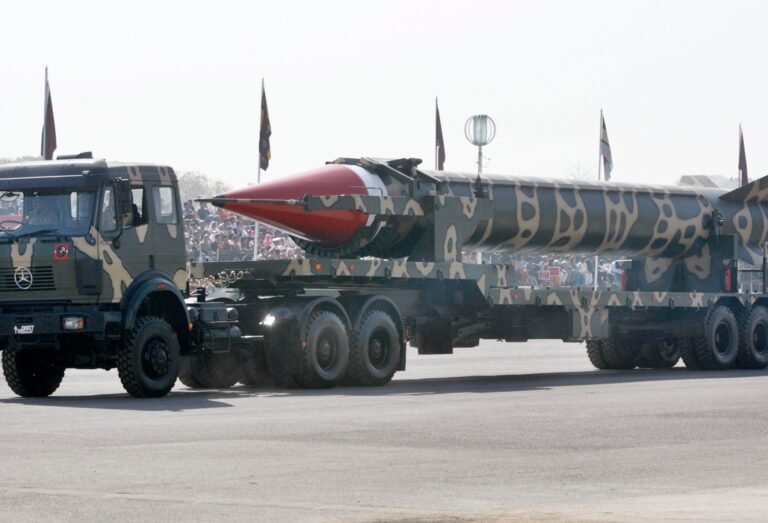
Islamabad, Pakistan – The United States’ top intelligence official has placed Pakistan alongside Russia, China, North Korea and Iran as a country whose advancing missile capabilities could eventually put US territory within reach.

Presenting the 2026 Annual Threat Assessment [PDF] before the Senate Intelligence Committee on Wednesday, Director of National Intelligence Tulsi Gabbard said the five countries were “researching and developing an array of novel, advanced or traditional missile delivery systems with nuclear and conventional payloads, that put our homeland within range”.

Recommended Stories

list of 4 itemsend of list

On Pakistan specifically, Gabbard told lawmakers that “Pakistan’s long-range ballistic missile development potentially could include ICBMs with the range capable of striking the homeland”.

The written assessment went further, placing Pakistan across multiple threat categories.

On missiles, it said Pakistan “continues to develop increasingly sophisticated missile technology that provides its military the means to develop missile systems with the capability to strike targets beyond South Asia, and if these trends continue, Inter-Continental Ballistic Missiles (ICBMs) that would threaten the US”.

On weapons of mass destruction, it assessed that Pakistan, alongside China, North Korea and Russia, would “probably continue to research, develop, and field delivery systems that will increase their ranges and accuracy, challenge US missile defences, and provide new WMD-use options”.

The report also flagged South Asia as a region of “enduring security challenges”, warning that India-Pakistan relations “remain a risk for nuclear conflict”.

It referenced last year’s Pahalgam attack in Indian-administered Kashmir as an example of how violence by armed groups can trigger crises, while noting that “President Trump’s intervention de-escalated the most recent nuclear tensions” and that “neither country seeks to return to open conflict”.

The assessment projected that threats to the US homeland could expand from more than 3,000 missiles today to at least 16,000 by 2035.

On Thursday, Tahrir Andrabi, spokesman for Pakistan’s Ministry of Foreign Affairs, said: “Pakistan categorically rejects the recent assertion by a United States official alleging a potential threat from Pakistan’s missile capabilities.”

Pakistan’s strategic capabilities are “exclusively defensive” in nature, he said, and are “aimed at safeguarding national sovereignty and maintaining peace and stability in South Asia”.

“Pakistan’s missile programme, which remains well below intercontinental range, is firmly rooted in the doctrine of credible minimum deterrence vis-a-vis India. In contrast, India’s development of missile capabilities exceeding 12,000 kilometres reflects a trajectory that extends beyond regional security considerations and is certainly a cause of concern for the neighbourhood and beyond.”

Pakistan, he said, remains “committed to constructive engagement with the United States, anchored in mutual respect, non-discrimination, and factual accuracy. We urge a more measured and considered approach that aligns with South Asia’s strategic imperatives and advances peace, security and stability across the region.”

Tughral Yamin, a former army brigadier and specialist on arms control and nuclear affairs, said Gabbard was not the first US official to raise such concerns, however.

“Similar remarks have been made in the past. Officially, Pakistan has countered such rhetoric by pointing out that Pakistani deterrence – both conventional and nuclear – is meant against India. Even with India, Pakistan seeks peace at honourable terms and not because US chose to identify Pakistan is a threat,” he told Al Jazeera.

Is Pakistan close to building missiles that can reach the US?

Gabbard’s remarks were framed around the future potential of Pakistan’s missile programme, rather than existing capability. But even from that futuristic prism, experts question the logic of the US intelligence assessment.

Pakistan’s longest-range operational missile, the Shaheen-III, has an estimated range of roughly 2,750km (1,710 miles), sufficient to cover all of India.

An intercontinental ballistic missile is generally defined as having a range exceeding 5,500km (3,420 miles), which Pakistan does not currently possess.

But even with shorter range ICBMs, Pakistan would not be in a position even close to reaching US shores: The distance between the two countries exceeds 7,000 miles (11,200km). Only Russia, the US, France, China and the United Kingdom have ICBMs that can travel that distance, while India and North Korea are developing missiles of that range. Israel is speculated to possess an ICBM – the Jericho III – that can travel a comparable distance.

In January last year, senior US officials, speaking anonymously at a briefing for nongovernmental experts cited by the Arms Control Association, assessed that Pakistan’s ability to field long-range ballistic missiles was “several years to a decade away”. Gabbard’s latest testimony suggests that assessment has not significantly changed.

Washington has nonetheless been closely monitoring Pakistan’s missile programme.

In December 2024, the Joe Biden administration sanctioned Pakistan’s National Development Complex, the body responsible for its ballistic missile programme, along with three private companies.

The US accused them of procuring items for long-range missile development, including specialised vehicle chassis and missile testing equipment.

Jon Finer, then US deputy national security adviser, said at the time that if current trends continued, Pakistan would have “the capability to strike targets well beyond South Asia, including in the United States”.

Pakistan pushes back

While Pakistan has previously described US sanctions as “biased and politically motivated”, accusing Washington of relying on “mere suspicion” and invoking “broad, catch-all provisions” without sufficient evidence.

Interactive_Pakistan_India_Missiles_August25_2025-1755868832

Jalil Abbas Jilani, a former Pakistani ambassador to Washington, rejected Gabbard’s new remarks in a post on X.

“Tulsi Gabbard’s assertion at the Senate hearing that the US homeland is within range of Pakistan’s nuclear and conventional missiles is not grounded in strategic reality,” he wrote. “Pakistan’s nuclear doctrine is India-specific, aimed at maintaining credible deterrence in South Asia, not projecting power globally.”

Abdul Basit, a former Pakistani high commissioner to India, also criticised the comparison.

“Pakistan’s nuclear programme has always been India-specific. Such self-serving and groundless assertions only betray Gabbard’s incorrigible biases,” he wrote on social media.

Pakistan has long maintained that its nuclear and strategic programmes are calibrated solely to deter India. Three months after its May 2025 conflict with India, Pakistan announced the formation of its Army Rocket Force Command (ARFC).

It has also accused Washington of double standards, pointing to deepening US strategic cooperation with New Delhi, including advanced defence technology transfers, while penalising Islamabad for pursuing what it sees as necessary deterrence.

Yamin said Gabbard “quite conveniently” overlooked India’s longer-range missile capabilities.

He pointed to systems such as the Agni-V, with a range of more than 5,000km (3,100 miles), and the Agni-IV, which can travel about 4,000km (2,485 miles). India’s Defence Research and Development Organisation – its government military R&D institution – is currently developing the Agni VI missile, an ICBM that could have a range of up to 12,000km (7,450 miles).

Debate over intent

Nevertheless, in a June 2025 article in Foreign Affairs magazine, Vipin Narang, a former US Department of Defense official, and Pranay Vaddi, a former US National Security Council official, wrote that US intelligence agencies believed Pakistan was developing a missile “that could reach the continental United States”.

They suggested Islamabad’s motivation might not be India, which its current arsenal already covers, but rather to deter Washington from intervening in a future India-Pakistan conflict or from launching a preventive strike against Pakistan’s nuclear arsenal.

Pakistani analysts have challenged that premise.

Rabia Akhtar, a nuclear security scholar, said Gabbard’s statement reflected “a persistent flaw in US threat assessments, which is substituting worst-case speculation for grounded analysis”.

“Pakistan’s deterrence posture is India-centric. Folding it into a US homeland threat narrative is misleading. The claim that Pakistan is pursuing capabilities to target the US ignores decades of evidence. Its nuclear programme, doctrine, and missile development have remained India-centric. Even its longest-range systems are calibrated to deny India strategic depth, not project power beyond the region,” she told Al Jazeera.

Still, Christopher Clary, a political scientist at the University at Albany, said Gabbard’s assessment clarifies an open question about the Trump administration’s stance.

“It was unclear up until now whether the Trump administration’s [decision to stay] quiet on alleged Pakistan ICBM development arose because the issue had gone away, perhaps because Pakistan quietly had settled US concerns,” he wrote on X. “But the US intelligence community assesses apparently that the issue persists.”

Akhtar, who is also the director at Centre for Security, Strategy and Policy Research, University of Lahore, reiterated that there is no evidence that Pakistan is designing missiles to reach beyond targets associated with India’s present or future capabilities.

“A more serious conversation would move beyond worst-case speculation and engage with the regional logic that actually drives nuclear decision-making in South Asia,” she said.

A complicated diplomatic backdrop

Gabbard’s assessment comes at a complex moment in US-Pakistan relations.

Over 2025, the two countries underwent a diplomatic reset, driven in part by the four-day conflict between India and Pakistan in May.

Trump has repeatedly cited his administration’s role in brokering the ceasefire between the nuclear-armed neighbours that brought the fighting to a halt, claiming credit on dozens of occasions. The episode helped open the door to a broader recalibration in ties, including Pakistan’s nomination of Trump for the Nobel Peace Prize. India has maintained that the ceasefire occurred without third-party involvement.

Relations appeared to warm further when Trump hosted Pakistan’s army chief, Field Marshal Asim Munir, for a private White House lunch in June. It marked the first time a US president had hosted a Pakistani military chief who was not also the head of state.

Munir visited Washington twice more later in the year, including a September meeting that also involved Prime Minister Shehbaz Sharif.

At the Sharm el-Sheikh summit in October aimed at ending Israel’s genocidal war in Gaza, Trump described Munir as “my favourite field marshal” and has praised him repeatedly.

Pakistan’s strategic relevance has also extended to the Middle East. Its ties with Gulf states and working relationship with Tehran have made it a useful interlocutor, including during the continuing US-Israeli strikes on Iran. In September, Pakistan and Saudi Arabia signed a mutual defence agreement, days after Israel struck Doha, Qatar’s capital, with a missile, raising concerns across the Gulf over whether regional nations could continue to depend on a US security umbrella.


Source link

Mike Pence calls for national voter ID law in exclusive interview

0

NEWYou can now listen to Fox News articles!

EXCLUSIVE: Former Vice President Mike Pence says that a national voter ID law “is truly an idea whose time has come.”

In an exclusive interview with Fox News Digital, Pence urged the Senate to “make voter ID the law of the land in all 50 states.”  The Senate is currently debating the SAVE America Act, which is strongly championed by Pence’s former boss, President Donald Trump.

The SAVE Act, which stands for Safeguard American Voter Eligibility, narrowly passed the GOP-controlled House in February mostly along party lines. But it’s stalled in the Senate, where Republicans hold a 53-47 majority in the chamber, far short of the 60-vote threshold needed to pass the bill.

The federal bill would require strict voter ID and proof-of-citizenship requirements across the country. Republicans say the bill is necessary to secure election integrity.

FIRST ON FOX: REPUBLICAN GOVERNORS URGE CONGRESS TO PASS SAVE ACT

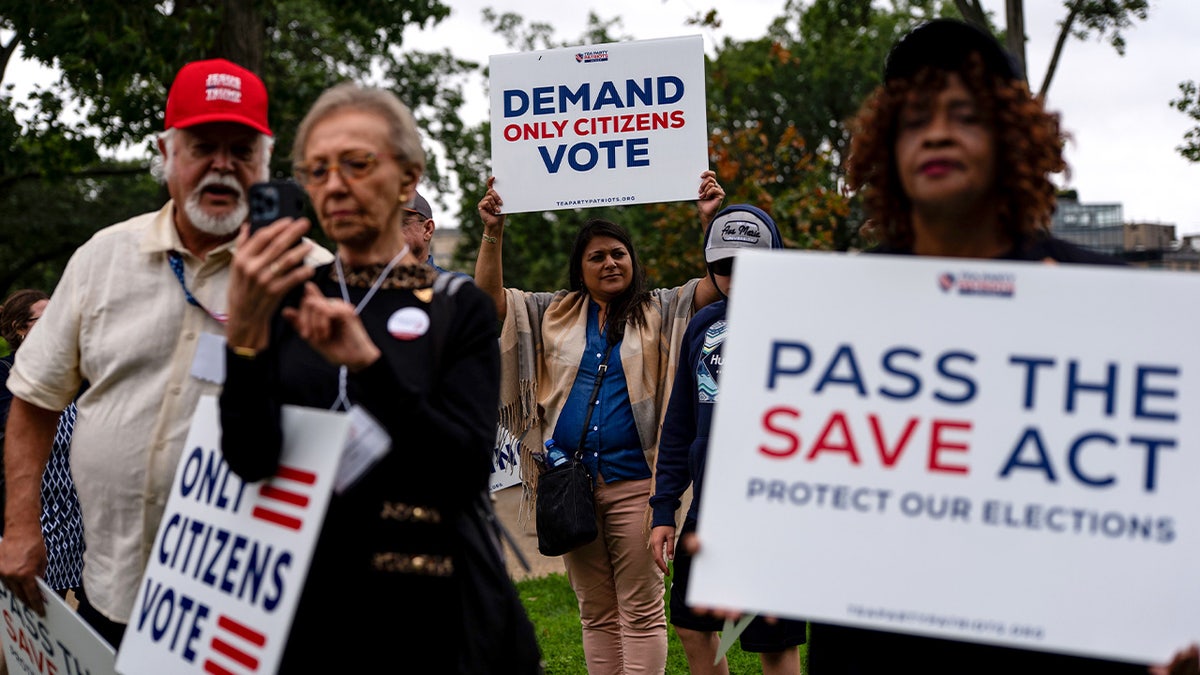
SAVE Act supporters holding signs

Supporters of the SAVE Act, a federal bill which would require strict voter ID and proof-of-citizenship requirements across the country, attend a rally outside the U.S. Capitol on Sept. 10, 2025, in Washington, D.C. (Kent Nishimura/Getty Images)

“I think requiring our voters to show photo ID at the ballot box or prove American citizenship is simply an idea whose time has come,” Pence emphasized.

And the former Indiana governor added, “I’m proud of the fact that the state of Indiana, 15 years ago, was one of the first states to adopt voter ID laws. Went all the way to the Supreme Court of the United States and was upheld. It became model legislation for many states around the country.”

While polls indicate the vast majority of Americans — regardless of the political affiliation — support voter IDs at the polls and preventing noncitizens from voting in federal elections, Democrats argue the bill is not needed, since citizenship is already a requirement to vote and instances of noncitizen voting are rare.

FLORIDA REPUBLICANS SEND SAVE ACT-STYLE PROOF-OF-CITIZENSHIP VOTING BILL TO GOV. DESANTIS’ DESK

Democrats and voting rights groups also charge that the federal bill would create unnecessary barriers, making it harder for voters to cast a ballot. And longtime Senate Democratic leader Sen. Chuck Schumer of New York has framed the SAVE Act as “Jim Crow 2.0.”

Pence noted that “the time, place and manner of elections under the Constitution is governed by the states. But the federal government has, under our Constitution, the ability to set certain conditions and parameters, and I believe the Save ACT falls well within the constitutional prerogative of the Congress.”

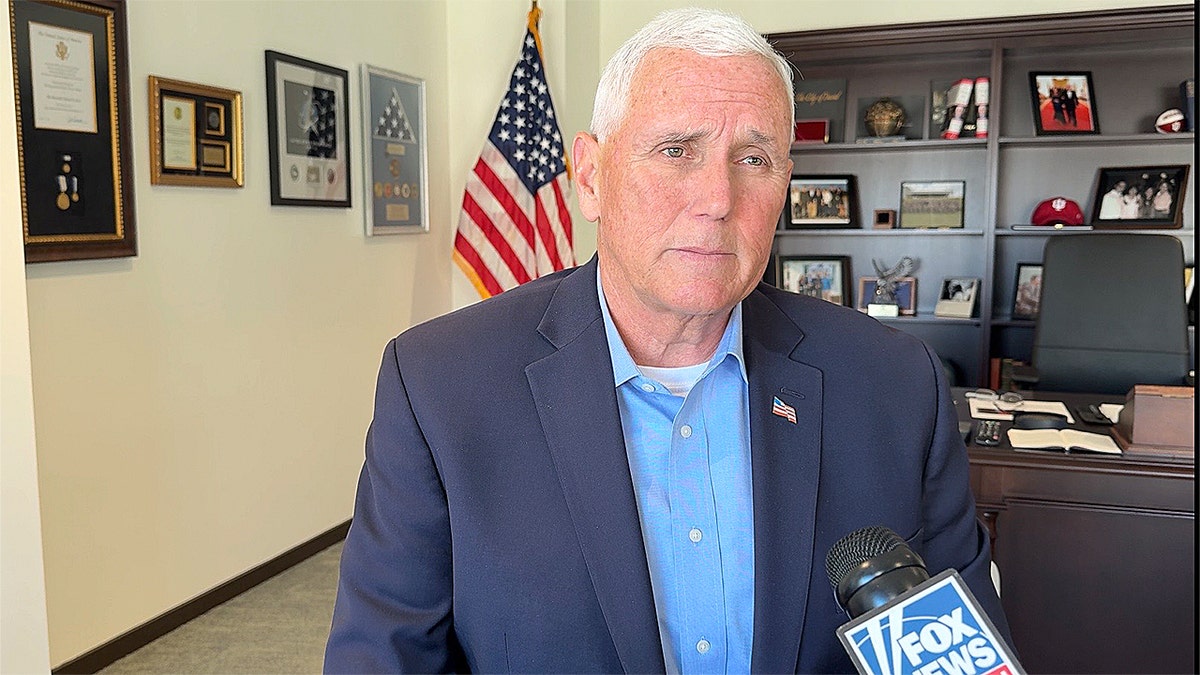
Mike Pence Fox News interview

Former Vice President Mike Pence is interviewed by Fox News Digital, on March 18, 2026, in Washington D.C. (Paul Steinhauser/Fox News )

The former vice president, through his policy and advocacy organization Advancing American Freedom, last month urged Congress to pass the bill.

Pence reiterated his stance in his Fox News Digital interview, noting, “We have championed the SAVE America Act since it was first introduced, and will continue to. I’d urge every member of the Senate to set politics aside, cast a vote to restore public confidence in election integrity in this country.”

SENATE GOP EYES BLAME GAME AS TRUMP-BACKED SAVE ACT HEADED FOR DEFEAT

Pence earned the ire of Trump’s supporters five years ago, when he dismissed the president’s unproven claims of massive voter fraud in the 2020 presidential election and certified former President Joe Biden’s electoral college victory. The certification was upended for hours by the Jan. 6 riots at the U.S. Capitol, during which some of the rioters chanted “Hang Mike Pence.”

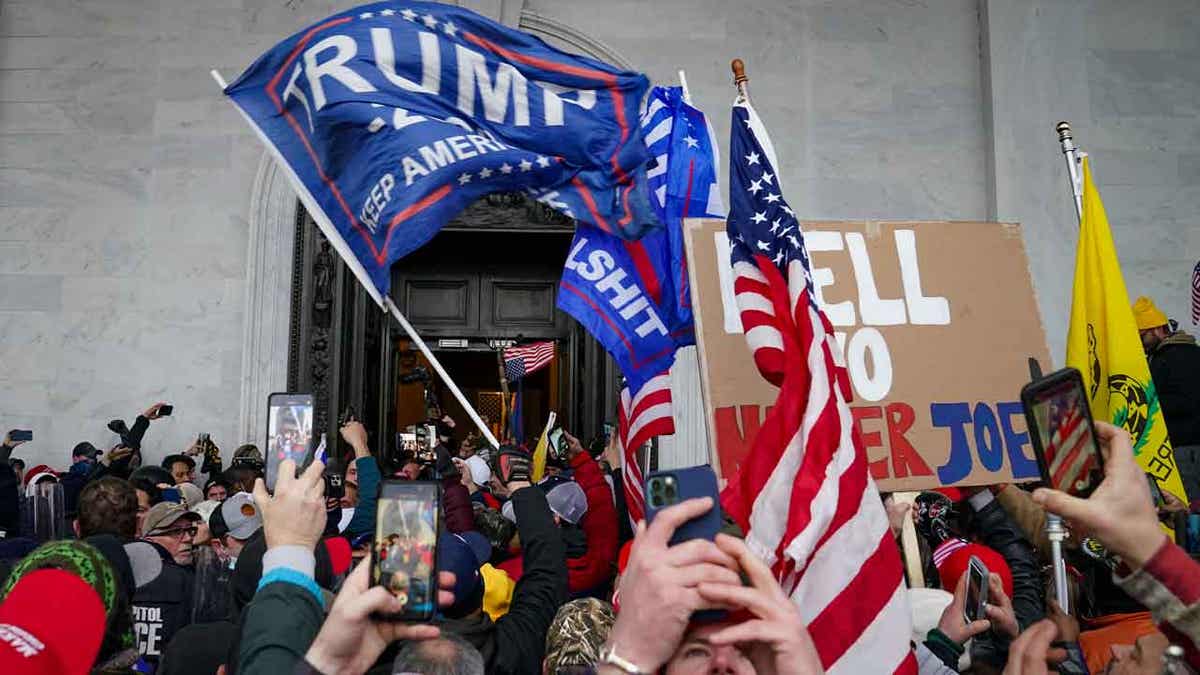
Protestors at Capitol on Jan. 6

Supporters of President Donald Trump assemble outside the U.S. Capitol before storming the building, on Jan. 6, 2021, in Washington, D.C. (AP Photo/John Minchillo, File)

“We all remember the election controversies of six years ago. We saw states that literally changed the rules in the midst of COVID for how votes would be counted,” Pence recollected. “There was never any evidence of widespread fraud that would change the outcome of the election, but it undermined public confidence, and it’s one of the reasons we’ve strongly supported election reform in states across the country.”

CLICK HERE TO DOWNLOAD THE FOX NEWS APP

And the former vice president reiterated, “I truly do believe that making sure the American people have confidence that those that are voting are citizens of this country, and that voter ID becomes the law of the land is truly an idea whose time has come.”


Source link

What did Arab and Muslim ministers discuss in Riyadh meeting on Iran? | US-Israel war on Iran News

0

As the United States-Israeli war on Iran approaches its fourth week after unleashing chaos across the Middle East, foreign ministers from Arab and Muslim countries have convened for urgent discussions in Saudi Arabia.

Talks were held on Wednesday as Iran was targeting several energy facilities across Saudi Arabia, the United Arab Emirates and Qatar in retaliation against Israel’s strike on the South Pars gasfield, Iran’s biggest source of energy. That attack came during a week marked by Israeli assassinations of top Iranian security official Ali Larijani, Basij paramilitary commander Gholamreza Soleimani and intelligence chief Esmail Khatib.

The meeting of top diplomats in Riyadh was aimed at mustering a common response to Iran’s increasing retaliation against US assets and infrastructure in the region, which not only threatens regional stability but is also causing disruptions to the global economy.

So what happened in Riyadh? How might these countries deal with Iran? And is Iran likely to listen?

Who was at the Riyadh meeting?

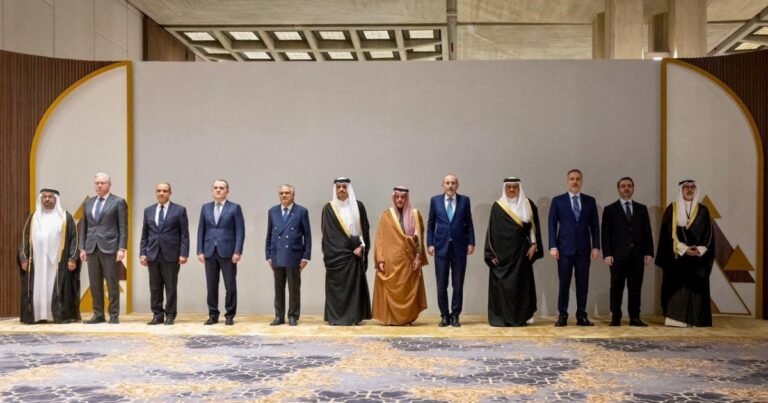
A joint statement issued on Thursday confirmed that foreign ministers from Qatar, Azerbaijan, Bahrain, Egypt, Jordan, Kuwait, Lebanon, Pakistan, Saudi Arabia, Syria, Turkiye and the United Arab Emirates attended the meeting on Wednesday.

All these countries have been impacted by the war, whether in terms of direct attacks from Iran, secondary threats from falling debris, dwindling energy supplies or looming mass displacement if the war continues.

Lebanon, in particular, has suffered heavy casualties since Hezbollah began strikes on Israel on March 2 in retaliation for its killing of Iranian Supreme Leader Ali Khamenei on the first day of the war two days earlier. Israel has carried out strikes in Lebanon that have killed at least 968 people in less than three weeks and has also launched a ground invasion in southern Lebanon.

What was decided in Riyadh?

The main takeaway from the meeting was that the 12 countries, which have broadly been sympathetic to Iran in the past, now assert “the right of states to defend themselves”, citing Article 51 of the United Nations Charter on defensive action.

They issued a collective condemnation of “deliberate Iranian attacks” with ballistic missiles and drones that have struck a range of targets, including residential areas, water desalination plants, oil facilities, airports and diplomatic positions.

Foreign ministers called on Iran to:

  • Halt its attacks.
  • Stop “provocative actions or threats” aimed at its neighbours.
  • Cease supporting, financing and arming pro-Iran proxy groups based in Arab states.
  • Refrain from actions or threats aimed at blocking the Strait of Hormuz or threatening maritime security in the Bab al-Mandeb strait.

They also condemned Israeli attacks on Lebanon and what they described as Israel’s expansionist policies in the region.

The meeting yielded a unified response to Iran’s increasingly unpredictable behaviour. But the joint statement was vague about how countries would follow this up.

What happens next?

Speaking early on Thursday after the meeting finished, Saudi Foreign Minister Faisal bin Farhan Al Saud did not elaborate on when his country might act to rein in Iran. “Do they [the Iranians] have a day, two, a week? I’m not going to telegraph that,” he said.

However, he left little room for doubt that Saudi Arabia and other Gulf states will act if necessary, adding that they have “very significant capacities and capabilities that they could bring to bear should they choose to do so”.

Emphasising his country’s right to defend itself, he said he hoped Iran had got the message and its leaders would “recalculate quickly and stop attacking their neighbours”.

But he added: “I am doubtful they have that wisdom.”

The Saudi foreign minister said that while the war would eventually come to an end, it will take time to restore relations with Iran because trust has been “shattered”.

Saudi Arabia’s relations with Iran have historically been rocky, but the two countries embarked on a Beijing-brokered rapprochement three years ago.

Reporting from Tehran, Al Jazeera’s Ali Hashem said the Saudi response “could be read as the end of the beginning of the Iranian-Saudi normalisation that started just a few years ago”.

How is Iran likely to respond?

With much of its leadership gone, the question of who is calling the shots in Iran is unclear.

New Supreme Leader Mojtaba Khamenei, who has not been seen in public since he was appointed to succeed his assassinated father, had never held government office before taking the top job.

Late on Wednesday, his official Telegram channel read: “Every drop of spilled blood comes at a price, and the criminal murderers of these martyrs will soon have to pay it.”

According to Iranian government figures, 1,444 people have been killed in US-Israeli strikes on Iran so far, with 18,551 injured.

Iran’s Islamic Revolutionary Guard Corps (IRGC) issued a statement saying: “Operation True Promise 4 against oil facilities associated with the US in the region was conducted with strength,” dedicating it to Khatib and “martyrs of the intelligence community”.

The statement, cited by Iran’s IRGC-affiliated Tasnim news agency on Thursday, said Iranian forces had responded to the “deceiving and lying enemy” that had targeted energy facilities in the country, referring to an Israeli strike on South Pars.

It added that it did not “wish to harm the economies of friendly neighbouring countries” but it had “entered a new phase of warfare” to defend Iran’s infrastructure.

Commenting on the escalation, Al Jazeera’s Hashem said: “It’s not any more the Iran that we know. There’s a new leadership, there’s a new mentality and the main issue is that Iran is now in the middle of a war.”


Source link

Pistons’ Cade Cunningham reportedly diagnosed with collapsed lung

0

NEWYou can now listen to Fox News articles!

As the Detroit Pistons have suddenly become a contender for the NBA title, their best player will be missing for the foreseeable future.

Cade Cunningham, who has thrust his name into the MVP conversation, has been diagnosed with a collapsed lung, according to ESPN, and is expected to miss an extended period of time.

The 24-year-old was the first overall pick five years ago out of Oklahoma State and has lived up to the billing, averaging 22.6 points, 7.9 assists and 5.4 rebounds per game in his career.

CLICK HERE FOR MORE SPORTS COVERAGE ON FOXNEWS.COM 

Cade Cunningham

Detroit Pistons guard Cade Cunningham (2) looks on during the first half against the Washington Wizards at Capital One Arena. (Daniel Kucin Jr./Imagn Images)

He has hit another level in the last two seasons, though, being named an All-Star each time — last year, he finished seventh in the MVP vote. Since the start of the 2024-25 season, he’s put up 25.4 points, 5.8 boards and 9.5 assists per contest.

Cunningham has seen the trials and tribulations of the Pistons, as it was just three seasons ago when they set the all-time record for the longest losing streak in NBA history at 28 games and finished 14-68 under Monty Williams, who had just signed, at the time, the richest contract for an NBA coach in history.

Cade Cunningham gets excited

Detroit Pistons guard Cade Cunningham (2) celebrates during the first half of an NBA basketball game against the Indiana Pacers in Indianapolis, Monday, Nov. 24, 2025. (AP Photo/Michael Conroy)

ICONIC SPORTS VENUE MADISON SQUARE GARDEN TO HOST NYPD, STAFF AT PRIVATE CONCERT AMID ‘THANK YOU’ EFFORT

But the following season, the Pistons earned the sixth seed in the Eastern Conference before losing to the New York Knicks in the first round. However, they’ve taken the next step and are running away with the East with a 49-19 record, good for a 3.5-game lead in the conference ahead of the Boston Celtics. The Knicks are five games back.

The playoffs are set to begin on April 18, meaning Cunningham’s first-round availability is certainly up in the air. For context, C.J. McCollum missed roughly two months with the diagnosis in 2021 and about one month two years later.

Cade Cunningham handles the ball

Cade Cunningham of the Detroit Pistons handles the ball during the game against the Utah Jazz on Dec. 21, 2023, at Little Caesars Arena in Detroit, Michigan. (Chris Schwegler/NBAE via Getty Images)

CLICK HERE TO GET THE FOX NEWS APP

So, it figures that if the Pistons make a run, Cunningham could return — but when certainly remains a question.

Follow Fox News Digital’s sports coverage on X, and subscribe to the Fox News Sports Huddle newsletter


Source link

Max severity Ubiquiti UniFi flaw may allow account takeover

0

UniFi

Ubiquiti has patched two vulnerabilities in the UniFi Network Application, including a maximum-severity flaw that may allow attackers to take over user accounts.

The UniFi Network app (also known as the UniFi Controller) is management software that helps configure, monitor, and optimize Ubiquiti UniFi networking hardware, such as access points, switches, and gateways.

“Combines powerful internet gateways with scalable WiFi and switching. Provides real-time traffic dashboards, visual topology maps, and optimization tips,” the networking device manufacturer says. “The preferred way to deploy UniFi Network is on a UniFi Cloud Gateway, rather than on a server, laptop, or other self-hosted environment.”

Tracked as CVE-2026-22557, the security flaw impacts UniFi Network application version 10.1.85 and earlier and is addressed in versions 10.1.89 or later.

Successful exploitation enables threat actors without privileges to exploit a path traversal vulnerability to access files on the targeted devices and potentially hijack user accounts in low-complexity attacks that don’t require user interaction.

“A malicious actor with access to the network could exploit a Path Traversal vulnerability found in the UniFi Network Application to access files on the underlying system that could be manipulated to access an underlying account,” the company says in an advisory published on Wednesday.

Ubiquiti also patched a second flaw in the UniFi Network app that attackers with low privileges can exploit for privilege escalation.

“An Authenticated NoSQL Injection vulnerability found in UniFi Network Application could allow a malicious actor with authenticated access to the network to escalate privileges,” the company explained.

In recent years, Ubiquiti products have been targeted by both state-backed hacking groups and cybercriminals who hijacked them to build botnets designed to conceal malicious activity.

For instance, in February 2024, the FBI dismantled a botnet of hacked Ubiquiti Edge OS routers used by Russia’s Main Intelligence Directorate of the General Staff (GRU) to proxy malicious traffic in attacks targeting the United States and its allies.

Malware is getting smarter. The Red Report 2026 reveals how new threats use math to detect sandboxes and hide in plain sight.

Download our analysis of 1.1 million malicious samples to uncover the top 10 techniques and see if your security stack is blinded.


Source link

Access Denied

0

Access Denied You don’t have permission to access “http://hindi.news18.com/cricket/anil-kumble-compare-abhishek-sharma-with-virender-sehwag-gave-big-advice-to-team-india-young-opener-ws-n-10289169.html” on this server.

Reference #18.6e560e17.1773932385.314c447

https://errors.edgesuite.net/18.6e560e17.1773932385.314c447

Iran’s dilemma in war and peace | US-Israel war on Iran

0

Ayatollah Ruhollah Khomeini, upon coming to power in Iran after the 1979 Islamic revolution, adopted a distinctly Shia-sectarian constitution. With its approval, all Iranian citizens who did not belong to the Shia sect became, in practice, second-class citizens. At the same time, he embraced the export of the revolution beyond Iran through his “tilling the land” programme. To this day, the peoples of the region continue to suffer from the consequences of this programme. Among its bitter outcomes was the creation of ideologically driven Shia militias, which have caused significant bloodshed in several Arab countries.

Today, the Iranian regime is increasingly exposed amid the ongoing war with the United States-Israel alliance. What it had long concealed about its intentions towards the Arab Gulf states and the excess power it possesses has now been revealed. It has failed to respect the rights of neighbouring countries, targeting civilian sites and economic infrastructure in Gulf cities.

Gulf-Iranian relations are among the most complex issues in the regional system of the Middle East. The image of Iran in Gulf political, media, and intellectual discourse has been shaped by this ideological and military legacy, whose foundations were laid by Imam Khomeini and later translated into realities on the ground by Ali Khamenei. These relations have been defined by repeated military and security confrontations, as well as political positions viewed by Gulf Cooperation Council states as a direct threat to their security and sovereignty. Official and media discourse in the Gulf tends to portray Iran as a regional actor seeking to expand its political and military influence at the expense of neighbouring states and their peoples.

Imam Khomeini left Ayatollah Ali Khamenei with three directives: killing Saddam Hussein, producing an atomic bomb, and occupying Mecca and Medina. These directives have deepened the crisis within the system of Guardianship of the Jurist. While Iran ultimately saw the execution of Hussein, its continued pursuit of the other two directives has placed it in a regional and international dilemma. Iran’s programme of exporting the revolution and establishing armed Shia militias in Iraq, Lebanon, Syria and Yemen over the past four decades, while funding and directing them, has brought it into direct conflict with regional countries, especially the Gulf states. Likewise, its pursuit of a nuclear programme has placed it in sustained confrontation with the international community.

Iran’s regional network of armed groups reflects this strategy clearly. In Lebanon, Hezbollah is not merely a party but a “super-state” that takes its orders from beyond its borders; in Yemen, the Houthis are not a Yemeni national project but a tool to export Iranian national security to the borders of Saudi Arabia and threaten navigation in the Red Sea; in Iraq, Iran has established Shia militias to which the state itself defers; and in Arab Ahvaz, demographic change and the destruction of Arab palm trees are carried out in the name of Persian national security.

The project introduced by Khomeini is not an Islamic project, even if it employs Islam to serve it. It is a new imperial project, driven by Persian ambitions, using religion as both cover and driving force. Khamenei is considered the true heir to the 1979 revolution and the continuation of this ideological project in all its dimensions.

Khomeini developed the theory of Wilayat al-Faqih, which did not exist in Shia doctrine before he came to power. Under this theory, Ali Khamenei, and after him Mojtaba Khamenei, acts as the “Guardian Jurist” on behalf of the hidden imam and receives directives from him directly. The Guardian Jurist is not merely a religious concept but a political, security, and military authority, leading an axis of followers across the region and pursuing a project of dominance at both regional and international levels. The “scorched earth” approach is one manifestation of this imam-centred project.

The supreme leader is also a religious authority within the Shia sect, surrounded by an aura of sanctity among Twelver Shia believers. The assassination of Ali Khamenei would therefore mean the loss of a central pillar of the Wilayat al-Faqih system.

Ali Khamenei oversaw Iran’s nuclear programme, missile capabilities, space programme, and regional influence, including figures such as Qassem Soleimani. The killing of Khamenei would close a major chapter of revolutionary logic in Iran and push the state towards a retaliatory path. Iran has already sought to prepare for this by accelerating allegiance to his son Mojtaba, although he does not possess his father’s charisma or influence. Iran before Khamenei will not be the same as Iran after him.

Iran’s dilemma in war

Western media coverage has portrayed Iran as a central actor in regional instability, focusing on its military capabilities, support for armed groups, and nuclear and missile programmes. These narratives have reinforced the image of Iran as a destabilising force and contributed to a climate in which the current war between the US-Israel alliance and Iran is accepted by Western public opinion.

The 2019 attacks on oil facilities in Saudi Arabia marked a turning point in Gulf discourse on Iran. Gulf leaders viewed them as a direct threat to regional and global energy security. These events reinforced perceptions of an Iranian threat and pushed Gulf states to strengthen military and security cooperation with regional and international partners.

The Strait of Hormuz remains one of the world’s most important strategic maritime passages, with about 20 percent of global oil trade passing through it. It is the main artery for exporting oil and gas from the Gulf to global markets, particularly Asia. If Iran were to close the strait or disrupt navigation, exports would be halted, global prices would rise sharply, and major economic disruption would follow, including inflation, financial instability, and slower growth. Food supply chains in Gulf countries would also be affected.

Such a move would provide internationally acceptable justification for the US to form a military coalition to protect navigation, potentially including the occupation of Iran’s Kharg Island. Gulf states would also be compelled to expand security cooperation and strengthen maritime defence capabilities.

Iran faces a complex military dilemma. It does not possess a modern air force capable of sustaining a prolonged conventional war against the US or Israel. Instead, it relies on ballistic missiles, drones, and asymmetric warfare, which serve as tools of deterrence rather than decisive victory. It also depends on proxy warfare through groups such as Hezbollah and militias in Iraq.

The Houthis remain a key escalation factor. Their entry into the war would depend on a decision by the leadership of the Islamic Revolutionary Guard Corps (IRGC), to which they are subordinate. If the US were to forcefully reopen the Strait of Hormuz, the Houthis could attempt to close the Bab al-Mandeb Strait as a final escalation step.

Iran avoids direct war because its infrastructure is vulnerable to precision strikes, its nuclear facilities are exposed, and its economy cannot withstand prolonged conflict. It therefore follows a strategy of escalation without direct war, relying on indirect pressure through its regional network, while the US-Israel alliance seeks to draw it into confrontation.

Iran’s dilemma in peace

Politically, Iran faces a degree of international isolation under Western sanctions. Its allies, Russia and China, do not want to engage in direct war with the West on its behalf. Despite some improvement in relations with Gulf states following the 2023 Beijing agreement with Saudi Arabia, Gulf states continue to rely on the US for security.

Internally, Iran faces recurring protests, a legitimacy crisis, divisions between reformists and hardliners, and opposition from secular and independent currents. Economic sanctions have led to inflation, currency depreciation, and reduced investment. Iran operates a war economy with limited capacity, relying on unofficial oil sales and discounted exports, particularly to China.

At the same time, Iran seeks to achieve rapid deterrence through missiles, drones, and its regional proxies, while signalling nuclear capability. This increases the likelihood of preemptive strikes and exposes it to multiple fronts.

Iran is therefore caught in three dilemmas: strong deterrence but weak war-fighting capability; wide regional influence but limited economic resources; and an escalation strategy that risks turning into a full-scale war it seeks to avoid. It pursues sustained pressure below the threshold of war, seeking to exhaust its adversaries without entering direct confrontation.

For Iran, victory in this confrontation means the survival of the Islamic republic. It considers US military bases in the region legitimate targets, arguing that it cannot strike the US directly. This has extended to the targeting of Gulf economic infrastructure, embassies, and hotels, on the grounds that they host a US or Israeli presence. This has created a clear gap between what the political leadership declares and what the IRGC carries out in practice.

The Gulf at a crossroads

The Arab Gulf states now stand at a crossroads. In response to Iranian missiles and drones targeting civilian and economic sites, they have strengthened their air defence capabilities through systems such as Patriot and THAAD, intercepting many of these attacks before they reach their targets. They have also expanded security partnerships with countries such as Pakistan and Turkiye.

However, Gulf states do not seek an open war. If escalation continues and crosses critical thresholds, they may be forced to move beyond defence towards preventive military action to neutralise threats before they reach their cities.

If Iran retains sufficient capability, it may attempt to target or even occupy Gulf territories and islands, leading to a dangerous escalation with unpredictable consequences. The region would then face a conflict with consequences that cannot be controlled.

The views expressed in this article are the author’s own and do not necessarily reflect Al Jazeera’s editorial stance.


Source link

Drivers accused of ‘culture of speeding’ as motoring offences hit record high | UK News

0

The number of motoring offences has risen 9% in a year to a record high across England and Wales, excluding London, according to latest official statistics.

Home Office figures show there were 2.93 million offences registered in 2024, the most since comparable statistics began in 2011, and up on 2.69 million the previous year.

The vast majority of offences – 2.53 million or 86% of the total – involved speeding, another record high.

Motoring groups said the figures are of “great concern” and are warning that a lack of “decisive intervention” from police risks “normalising dangerous driving habits”.

Fines were issued in 37% of all the offences, while 12% involved court action and 51% resulted in a driver taking a retraining course.

The figures exclude London, as the Metropolitan Police uses a different system to document offences.

But the Home Office said the capital’s force recorded nearly 600,000 motoring offences in 2024, a 19% increase from 2023.

Department for Transport figures show speed contributed to 59% of fatal crashes in Britain in 2024, more than any other factor.

Careless driving was among the most common offences in 2024, and saw a 27% increase on the year before. The use of handheld mobiles, which was up 11%. The “neglect of traffic signs and directions and of pedestrian rights” increased by 6%.

There was an 11% rise in offences involving handheld mobiles while driving. Pic: iStock
Image: There was an 11% rise in offences involving handheld mobiles while driving. Pic: iStock

Jack Cousens, head of roads policy at The AA, told Sky News the figures were of “great concern” and “more needs to be done to tackle these offences” by increasing the number of traffic officers.

“AA members say they regularly see examples of poor driving standards but rarely see traffic officers on patrol,” he said. “At the moment, too many people think they can get away with it.”

RAC road safety spokesperson Rod Dennis had a similar message: “Half of drivers believe there is a culture of speeding in the UK. We urge the government to work with police forces and take firm action.”

“While enforcement through speed cameras has its place, greater visibility of police officers can also make a significant difference in changing driver behaviour,” he added.

Read more from Sky News:
Learner arrested during driving test
‘Dashcam vigilantes’ behind driver fines
E-bike rider convicted after fatal collision

In the case of speeding, some offenders can avoid prosecution by attending a speed awareness course, costing between £80 and £120.

But Churchill Motor Insurance said it had commissioned a survey which indicated 31% of drivers who attended a speed awareness course in the past three years were caught speeding again.

William Porter, policy and public affairs manager at road safety charity IAM RoadSmart, said the Home Office figures showed there was “widespread disregard” for speed limits.

“Without decisive intervention, we risk normalising dangerous driving habits that have devastating consequences,” he added.

Separately, Transport for London (TfL) has announced it will partner with police to trial a new type of speed camera which does not require a visible flash to capture an image of a speeding vehicle.

Unlike conventional speed cameras, the radar-based system, which is being installed at up to 10 locations across the capital, can also cover up to five lanes of traffic in two directions.


Source link

House Democrats oppose Republican bill targeting attacks on police dogs

0

NEWYou can now listen to Fox News articles!

Nearly all Democrats opposed legislation Thursday targeting noncitizens who harm law enforcement animals. 

Lawmakers voted 228-190 largely along party lines to approve the measure, with just 15 Democratic lawmakers voting “yes.” All Republicans who voted supported the legislation.

The Bill to Outlaw Wounding of Official Working Animals (BOWOW) Act, introduced by Rep. Ken Calvert, R-Calif., would make any noncitizen who is convicted of or admits to harming animals used in law enforcement operations deportable and not allowed to return.

“The dogs and horses on the front lines of our federal law enforcement efforts alongside our officers deserve our protection,” Calvert said upon introducing the legislation. “[It] sends a clear message that we will stand up for our four-legged friends and have zero tolerance for any immigrants who assault them.”

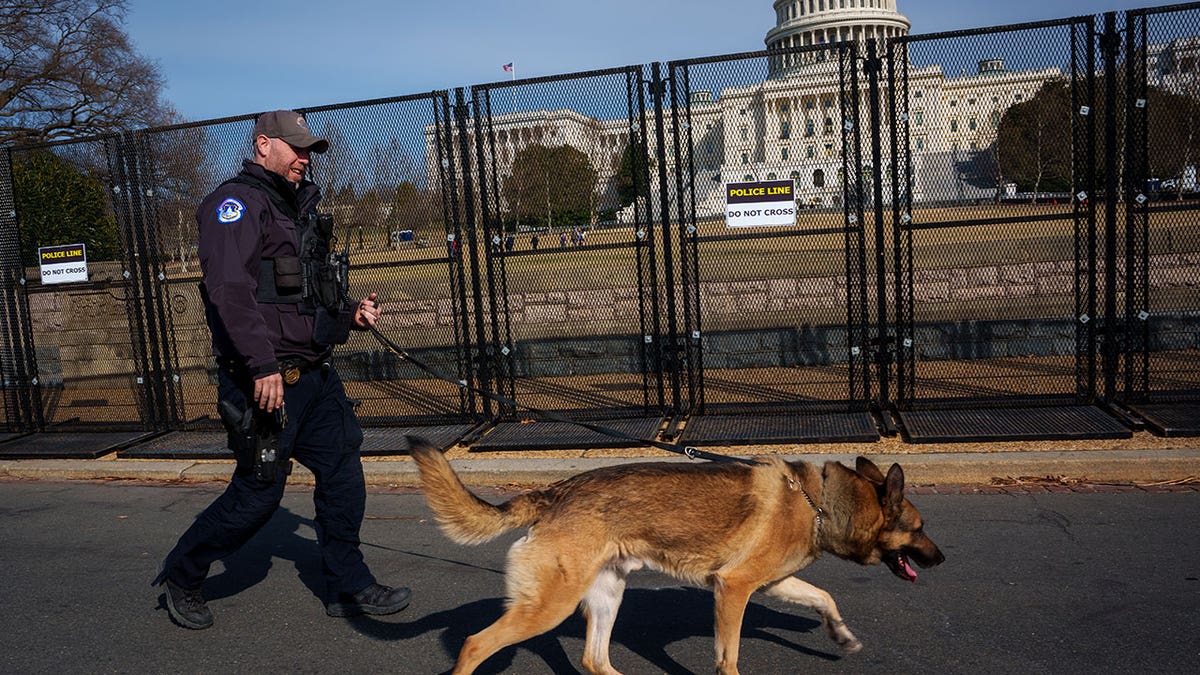
a Capitol police dog

The Dome of the U.S. Capitol building is visible through temporary protective fencing as a U.S. Capitol Police officer walks a dog along the West Front of the U.S. Capitol Building on March 4, 2025, in Washington, D.C. (Andrew Harnik/Getty Images)

POLICE DOG HELPS SNIFF OUT BURGLARY SUSPECT HIDING IN AIR VENT

Calvert cited an incident at Dulles Airport in June 2025 when Hamed Aly Marie, an Egyptian traveler, kicked a police K-9 that was screening his luggage and caught smuggled produce. The foreign national, who was promptly arrested by Customs and Border Protection (CBP), pleaded guilty to malicious assault on a police animal and returned to Egypt.

The California Republican’s legislation would have made Marie eligible for deportation and inadmissible to the United States.

“Can’t we at least all agree that kicking a 5-year-old beagle at an airport should disqualify a foreign national from entering our country ever again?” Rep. Tom McClintock, R-Calif, said in support of the measure Thursday.

A majority of Democrats opposed the legislation because they argued that offenders could already be deported under existing law.

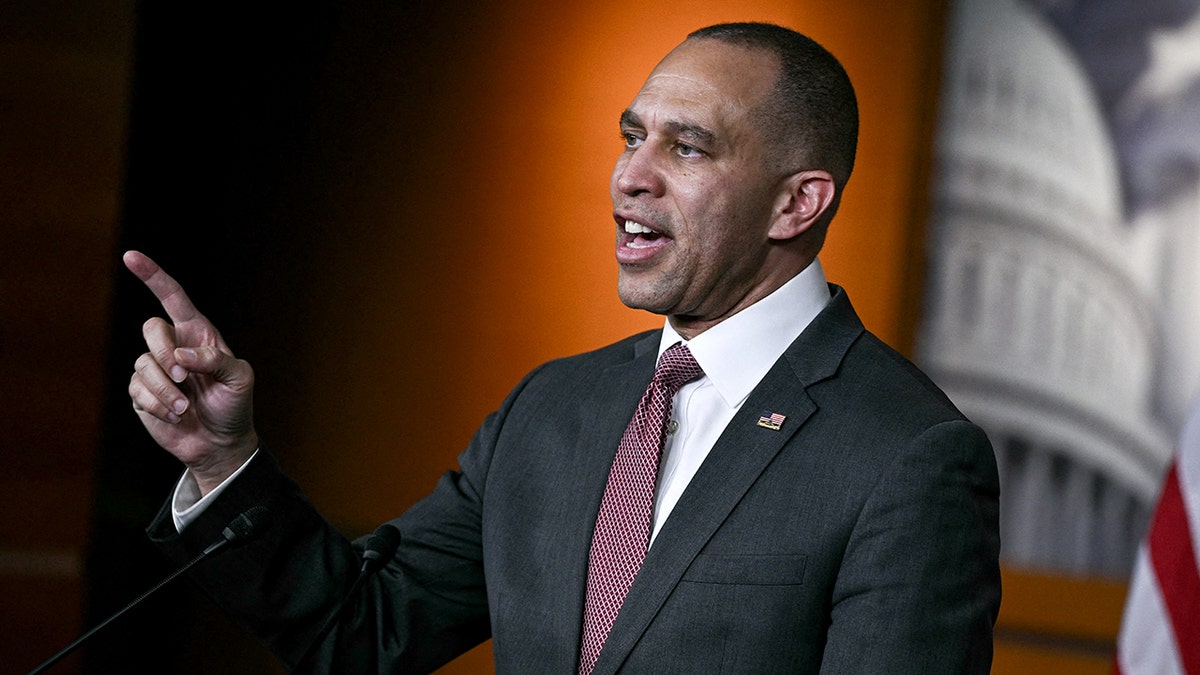
House Minority Leader Hakeem Jeffries speaks at a press conference.

House Minority Leader Hakeem Jeffries, Democrat from New York, speaks before an upcoming House vote on funding for the Department of Homeland Security on Capitol Hill in Washington, D.C., on March 5, 2026. (Brendan Smialowski/AFP via Getty Images)

SPARKS FLY AS GOP SENATOR REACTS TO BIDEN ADVISOR’S ‘I DON’T KNOW’ ANSWER ON ILLEGAL IMMIGRATION LAW

Democrats also raised concerns that Calvert’s measure would infringe on legal immigrants’ due process rights by allowing for their removal before obtaining a formal conviction.

“Here’s what America is talking about: Donald Trump’s unauthorized, undeclared war of choice,” Rep. Jamie Raskin, D-Md., said on the House floor Thursday. “What are MAGA Republicans in Congress talking about this week? They’re talking about the BOWOW Act.”

The legislation will likely be dead on arrival in the Senate given expected opposition from Democrats in that chamber. 

Rep. Jamie Raskin speaking to reporters outside House Speaker Nancy Pelosi's office in Washington, D.C.

Rep. Jamie Raskin, D-Md., speaks to reporters outside House Speaker Nancy Pelosi’s office in Washington, D.C., on July 22, 2021. (Anna Moneymaker/Getty Images)

CLICK HERE TO DOWNLOAD THE FOX NEWS APP

In addition to the BOWOW Act, House Republicans also passed legislation this week seeking to crack down on noncitizens who commit fraud in the United States. All GOP lawmakers — and 20 Democrats — supported a measure on Wednesday that would make noncitizens who are convicted of or admit to defrauding the government eligible for deportation and banned from future entry.

Rep. Marie Gluesenkamp Perez, D-Wash., one of the most vulnerable Democrats running for reelection, notably opposed the measure.


Source link

Access Denied

0

Access Denied You don’t have permission to access “http://hindi.news18.com/videos/ajab-gajab/bride-dance-in-sasural-in-blue-saree-amazing-moves-video-viral-10289289.html” on this server.

Reference #18.49200117.1773932779.d4b062c

https://errors.edgesuite.net/18.49200117.1773932779.d4b062c