Jennifer Siebel Newsom says evangelicals are ‘pulling us back as a country’

0

NEWYou can now listen to Fox News articles!

A resurfaced interview with Jennifer Siebel Newsom, wife of California Gov. Gavin Newsom, is drawing attention online after she said that evangelicals are “pulling us back as a country.”

In a 2022 interview with journalist Elex Michaelson when he was working at a local Los Angeles station, Siebel Newsom discussed her documentary, “Fair Play.” It was inspired by Eve Rodsky’s book of the same name, which examines gender roles in the home.

Siebel Newsom also discussed “redefining what pro-life is really about.” 

GOV NEWSOM AGREES WITH SHAPIRO THAT TRANS ISSUE IS ‘BARRIER’ FOR PEOPLE TO SUPPORT DEMOCRATIC PARTY

California Gov. Gavin Newsom and first partner Jennifer Siebel-Newsom embrace during a campaign event in support of Proposition 50 in San Francisco, Monday, Nov. 3, 2025.

California Gov. Gavin Newsom and wife Jennifer Siebel Newsom embrace during a campaign event in support of Proposition 50 in San Francisco, Monday, Nov. 3, 2025. (Gabrielle Lurie/San Francisco Chronicle via Getty Images)

“I appreciate that so many people, so many progressives, are leaning into redefining what pro-life is really about, and that’s what we’re doing in California,” Siebel Newsom said. “You know, pro-life is about prenatal care and universal preschool and universal after-school and universal healthcare and taking care of foster kids and feeding, you know, universal meals and childcare. Like, that’s pro-life. It’s not conception.”

She then criticized what she described as people on the “far right,” saying that they are “pulling us back as a country.”

“They’re living in this silo, this evangelical, conservative silo that, ultimately, is just pulling us back as a country to a time and a place where we don’t deserve to be, and we’re not going to be,” Siebel Newsom said. “Because honestly, young women and fathers of daughters are awake now, and they’re woke, and they’re not going to let us go back.”

She also said she has “so much hope because of that, and obviously California has a huge responsibility to lead.”

NEWSOM PUSHES THE DEMOCRATIC PARTY TO BE ‘MORE CULTURALLY NORMAL’ IF THEY WANT TO WIN

Jennifer Siebel Newsom speaks at Planned Parenthood funding bill signing ceremony

Jennifer Siebel Newsom speaks at a Planned Parenthood funding bill signing ceremony. (Screenshot/Gavin Newsom’s YouTube Page)

Siebel Newsom also drew attention last month after criticizing reporters during an event tied to a bill her husband signed into law providing funding for Planned Parenthood.

“We just find it incredulous [sic] that we have Planned Parenthood here, and women are 51% of the population,” she said. “And the majority of the questions — all of these questions — have really been about other issues. So, it’s just fascinating.”

“You have the incredible Women’s Caucus and all these allies, and you’re not asking about it. And this happens over and over and over and over again,” she said. “You wonder why we have such a horrific war on women in this country and that these guys are getting away with it. Because you don’t seem to care.”

‘THE DAILY SHOW’ ROASTS GAVIN NEWSOM ON HOMELESSNESS, HIGH-SPEED RAIL IN SATIRICAL ‘LEADING MAN’ VIDEO

Newsom China

California Gov. Gavin Newsom (R) and Jennifer Siebel Newsom (L) look on as Chinese President Xi Jinping (C) arrives at San Francisco International Airport to attend the Asia-Pacific Economic Cooperation (APEC) leaders’ week in San Francisco, California, on Nov. 14, 2023. (Frederic J. Brown/AFP via Getty Images)

Then Siebel Newsom added, “So, I just offer that with love. Ask about what we’re here for today, don’t you think?”

Fox News Digital reached out to Siebel Newsom and representatives for Siebel Newsom for comment.

CLICK HERE TO DOWNLOAD THE FOX NEWS APP


Source link

Trivy supply-chain attack spreads to Docker, GitHub repos

0

Trivy supply-chain attack spreads to Docker, GitHub repos

The TeamPCP hackers behind the Trivy supply-chain attack continued to target Aqua Security, pushing malicious Docker images and hijacking the company’s GitHub organization to tamper with dozens of repositories.

This follows the threat actor compromising the GitHub build pipeline for Trivy, Aqua Security’s scanner, to deliver infostealing malware in a supply-chain attack that extended to Docker Hub over the weekend.

Trivy has more than 33,800 stars on GitHub and is widely used for detecting vulnerabilities, misconfigurations, and exposed secrets across software artifacts and infrastructure.

Supply-chain security company Socket says in a report on Sunday that it identified compromised Trivy artifacts published to Docker Hub.

“New image tags 0.69.5 and 0.69.6 were pushed on March 22 without corresponding GitHub releases or tags,” Socket researchers say. According to their analysis, the two images contain indicators of compromise related to the infostealer that TeamPCP pushed after gaining access to Aqua Security’s GitHub organization.

The researchers note that the last known Trivy release is 0.69.3 and warn that even if they did not see any evidence of older images or binaries being modified after publication, “Docker Hub tags are not immutable, and organizations should not rely solely on tag names for integrity.”

Breaching AquaSec’s GitHub

On March 20, Aqua Security said that the threat actor gained access to the company’s GitHub organization due to incomplete containment of a previous incident targeting the same tool at the beginning of the month.

“We rotated secrets and tokens, but the process wasn’t atomic and attackers may have been privy to refreshed tokens,” Aqua Security

This allowed the attacker to inject into Trivy credential-harvesting code (TeamPCP Cloud stealer) and publish malicious versions of the tool.

Aqua responded to this incident by publishing new, safe versions of Trivy on March 20 and engaging the incident response firm Sygnia to assist them with remediation and forensic investigation.

However, via an update published today, Aqua noted that it identified additional suspicious activity on March 22, indicating that the same threat actors have re-established unauthorized access, and performed “unauthorized changes and repository tampering.”

The company noted that, despite this new development, Trivy was not impacted at this time.

An analysis from OpenSourceMalware, a community-driven malware intelligence platform, explains that TeamPCP gained access to the aquasec-com GitHub organization, where Aqua Security hosts its proprietary code, separate from the company’s aquasecurity GitHub organization for public repositories.

Using an automation script, it took the hackers about two minutes to add the prefix tpcp-docs- to all 44 repositories available in the company’s GitHub organization and change all descriptions to read “TeamPCP Owns Aqua Security.”

The researchers have high confidence that the attacker gained access by compromising a service account named Argon-DevOps-Mgt, which had access to both of Aqua Security’s GitHub organizations.

According to OpenSourceMalware, the targeted service account authorized actions based on a Personal Access Token (PAT) of a standard user instead of a GitHub App.

The issue is that PAT authentication functions like a password and is valid for a longer period than the token of a GitHub App. Additionally, a service account is typically used for automated tasks and does not have multi-factor authentication (MFA) protection.

To test that the account had admin permissions for AquaSec’s both public and private GitHub organizations, TeamPCP created a new update-plugin-links-v0.218.2 branch in the public aquasecurity/trivy-plugin-aqua repository, which they then deleted “at the exact same second.”

The researchers believe that hackers obtained the PAT for the Argon-DevOps-Mgt service account using the TeamPCP Cloud stealer, which collects GitHub tokens, SSH keys, cloud credentials, and environment variables from CI runners.

“As a service account that triggers workflows on trivy-plugin-aqua, its token was present in the runner environment,” OpenSourceMalware explains.

OpenSourceMalware has provided a set of indicators of compromise that can help defenders determine if their environments have been impacted by the supply-chain attack.

Aqua Security says that it has no evidence that the Trivy version used in its commercial products has been impacted. “By design, the forked version of Aqua’s commercial platform lags Trivy open source with a controlled integration process.”

However, the company promised to share updates as new details emerge and publish additional findings on Tuesday, at the end of the day.

Malware is getting smarter. The Red Report 2026 reveals how new threats use math to detect sandboxes and hide in plain sight.

Download our analysis of 1.1 million malicious samples to uncover the top 10 techniques and see if your security stack is blinded.


Source link

Robot tennis player shows real-time AI reactions

0

NEWYou can now listen to Fox News articles!

A humanoid robot is now rallying tennis shots with a human in real time. It runs without a script or remote control, so it can react instantly on a tennis court.

The robot stands about 4 feet tall, giving it a compact, human-like frame.  Galbot Robotics released a video showing its robot going shot-for-shot with a human player. The system behind it is called LATENT and runs on the Unitree G1.

And it is not just returning the ball. It is moving, adjusting and competing during live play.

Sign up for my FREE CyberGuy Report
Get my best tech tips, urgent security alerts, and exclusive deals delivered straight to your inbox. Plus, you’ll get instant access to my Ultimate Scam Survival Guide – free when you join my CYBERGUY.COM newsletter.

CHINA’S COMPACT HUMANOID ROBOT SHOWS OFF BALANCE AND FLIPS
 

A humanoid robot holds a tennis racket.

A humanoid robot rallies tennis shots with a human in real time, reacting without scripts or remote control during live play. (Galbot Robotics)

Why this tennis robot is different from others

Most athletic robots you have seen follow scripts. They perform pre-programmed actions or rely on a remote control. This one operates differently. It reacts to a human opponent in real time, tracking fast-moving balls, shifting across the court and returning shots with surprising accuracy. It also adjusts to changing trajectories and unpredictable shots during rallies. Researchers say it can sustain long rallies with millisecond-level reactions and full-body coordination. That marks a major step forward.

How the AI learned to play tennis

Training a robot to play tennis is extremely complex. Tennis involves:

  • Tennis ball speeds can reach up to 67 miles per hour
  • Split-second racket contact
  • Constant movement across a large court

Capturing complete human gameplay data is difficult. So the researchers used a different method.

Training the robot using motion fragments

Instead of recording full matches, they focused on small segments of movement:

  • Forehands
  • Backhands
  • Side steps

They gathered about five hours of motion data from five players. The sessions took place on a compact 10-by-16-foot court. That space is more than 17 times smaller than a standard tennis court.

RESTAURANT ROBOT GOES HAYWIRE, SENDS TABLEWARE FLYING BEFORE BREAKING OUT IN DANCE MOVES
 

Humanoid robots stand in a store.

Humanoid robots designed by Galbot Robotics select items from a shelf at the Shanghai New Expo Center in Shanghai, China, on July 26, 2025. Galbot Robotics also designed the tennis-playing robot that learns movement fragments and applies them in live competition. (Ying Tang/NurPhoto via Getty Images)


How the robot plays tennis during live rallies

The system first learns individual movements. Then it combines them into coordinated sequences. That allows the robot to:

  • Move toward the ball
  • Strike it with control
  • Recover and reposition

To improve performance, the team trained the model in simulation. They varied physical conditions such as mass, friction and aerodynamics. This helps the robot adapt to real-world unpredictability. As a result, the system responds dynamically instead of following a fixed routine. 

How well does it actually perform against humans?

In testing, the system achieved up to 96% success on forehand shots in simulation. In real-world trials, the robot can sustain rallies with a human and consistently return the ball across the net.

Watching the demo, it appears competitive. At times, the robot places shots away from the human player. That suggests more than a simple reaction. It points toward early forms of decision-making.

There are still limits. The robot can look unstable at times. Its motion is not yet as fluid as a trained athlete. High or unpredictable shots may still present challenges. Even so, the progress is clear.

Why this matters beyond tennis

This breakthrough goes far beyond tennis. It shows how robots can learn complex human skills without perfect data. The same approach could apply to:

  • Football
  • Badminton
  • Industrial work
  • Search and rescue

Any task that lacks complete motion data could benefit from this method. That is the bigger picture.

WORLD’S FASTEST HUMANOID ROBOT RUNS 22 MPH
 

A robot dances as a crowd looks on.

A robot dances at the launch ceremony of a Galbot Robotics retail store in Beijing, China, on August 7, 2025. The company has also designed a 4-foot robot that returns tennis shots with millisecond reactions and full-body coordination. (VCG/VCG via Getty Images)

Could robots compete with humans one day?

The path forward is becoming clearer. Today, the robot rallies. Next, it competes. In time, robots could train with or challenge professional athletes. Exhibition matches between humans and machines may become part of the sport. That future no longer feels far away.

Take my quiz: How safe is your online security?

Think your devices and data are truly protected? Take this quick quiz to see where your digital habits stand. From passwords to Wi-Fi settings, you’ll get a personalized breakdown of what you’re doing right and what needs improvement. Take my Quiz here: Cyberguy.com.

Kurt’s key takeaways

This demo shows how quickly things are changing. Robots are no longer stuck following scripts. They can now react, adjust and compete in real situations. What used to feel far off is starting to show up right in front of us.

So here is the question: If a robot could outplay you on the court, would you still want to compete, or would you rather train with it? Let us know by writing to us at Cyberguy.com.

CLICK HERE TO DOWNLOAD THE FOX NEWS APP

Sign up for my FREE CyberGuy Report
Get my best tech tips, urgent security alerts, and exclusive deals delivered straight to your inbox. Plus, you’ll get instant access to my Ultimate Scam Survival Guide – free when you join my CYBERGUY.COM newsletter.

Copyright 2026 CyberGuy.com.  All rights reserved.


Source link

Palantir CTO says AI enabled faster Iran strikes than any prior conflict

0

NEWYou can now listen to Fox News articles!

AI-powered battlefield technology is enabling the U.S. and its allies to carry out military operations faster and more efficiently than ever before, Palantir CTO Shyam Sankar said Monday, pointing to the Iran conflict as evidence of a seismic shift in modern warfare.

“The planning that happened was done in a fraction of the time it would have taken in prior conflicts of this scale, and we accomplished more than twice as much per day of strikes,” Sankar told “America’s Newsroom.”

“How do you do 2,000 strikes in 48 hours?” he asked. “It’s the sophistication of the technology, combined with service members who are better than we deserve. It has proven the deterrent capability.”

Questions about precision have surfaced following reports of a strike that hit an Iranian girls’ school, killing over 100 civilians.

PENTAGON’S AI BATTLE WILL HELP DECIDE WHO CONTROLS OUR MOST POWERFUL MILITARY TECH

Palantir's Shyam Sankar talks Artificial Intelligence

Shyam Sankar, chief technology officer of Palantir Technologies, during an interview in Costa Mesa, Calif., on Oct. 10. (Kyle Grillot/Bloomberg via Getty Images)

The Trump administration has said the strike was carried out by Iranian forces, but a Department of War (DoW) investigation into the incident is ongoing.

When asked about the incident, Sankar largely deferred to the DoW investigation, but noted technology’s history of “[reducing] collateral damage.”

“We forget that in World War II, only 6% of bombs dropped actually hit their target,” he said.

ALL 4 IRAN WAR ASSUMPTIONS DEAD WRONG — TRUMP PROVES EXPERTS GOT FOOLED AGAIN

iStock for military and AI

This stock image shows a close-up of a server hub employee in a soldier uniform typing on a laptop. Artificial intelligence is becoming increasingly prevalent in military operations under the Trump administration. (iStock)

“There were 50,000 French civilians that were killed in the prep fires for Normandy, so… if I was to speculate… the investigation will show that actually the incorporation of more sophisticated technologies would prevent collateral damage.”

AI-enabled systems, Sankar continued, allow military planners to quickly develop and refine operations, increasing both the speed and efficacy of modern combat.

“Instead of [having] a period of execution, instead of maybe one attempt at coming up with a plan, you have 30 attempts because of the leverage that you have from technology to do it, so you have a more refined plan, a more accurate plan, a more lethal plan that accomplishes your operational objectives,” he said.

CLICK HERE TO DOWNLOAD THE FOX NEWS APP

While advanced technology is playing a growing role on the battlefield, Sankar also emphasized that decision-making authority still relies on human judgment, describing the relationship between human and technology as a collaborative partnership rather than a replacement.

“I think a better way of thinking about it rather than a back and forth is Luke Skywalker and R2-D2. It’s a team. You’re building a team of human computer symbiosis. It’s an Iron Man suit for our uniform service members to get more done,” he said.


Source link

SoftBank builds AI mega-datacenter on nuke site • The Register

0

Softbank’s SB Energy is redeveloping Department of Energy (DoE) land in Ohio for a massive datacenter campus, adding extra generation facilities and power infrastructure alongside it.

The Japanese investment giant’s digital infrastructure and energy arm is leasing federal land at the former Portsmouth Gaseous Diffusion Plant in Piketon, Ohio, to build a 10-gigawatt (GW) server farm.

SB Energy will also build 10 GW of new generation capacity, at least 9.2 GW of it gas-fired, feeding both the local grid and the datacenter. Separately, SB Energy and American Electric Power (AEP) Ohio have struck a $4.2 billion deal to upgrade and expand electrical transmission infrastructure across Southern Ohio, a move both parties claim will lower utility bills for local homes and businesses. AEP expects power to reach the site by 2029.

The project is framed as consistent with President Trump’s Ratepayer Protection Pledge, which aims to shield consumers from price increases driven by surging AI infrastructure demand.

According to the DoE, SB Energy has also committed to funding accelerated cleanup of the Portsmouth site, which was formerly used to produce enriched uranium for both civilian nuclear power and the US weapons program.

SoftBank has announced a “Portsmouth Consortium” of companies and financial institutions interested in participating, including Japanese firms Hitachi, Mitsubishi Electric, Toshiba, TDK and Sumitomo Mitsui Banking, alongside US names Bechtel, Morgan Stanley, Goldman Sachs and J.P. Morgan.

The same site has separately been chosen by nuclear developer Oklo, in a joint venture with Centrus Energy, for a uranium processing facility, and by Meta as the location for a nuclear power campus targeting up to 1.2 GW of baseload power.

US Energy Secretary Chris Wright said the US Administration is using its assets, including federal land, to add power generation, create jobs, and ensure the country wins the AI race.

“By bringing new power online and upgrading our existing infrastructure, this investment supports the AI boom and cutting-edge technologies while strengthening our energy system and helping keep costs down for the American people,” he said.

SoftBank Group chairman and CEO Masayoshi Son, said: “AI will transform every industry, and the PORTS Technology Campus will help deliver the next-generation infrastructure needed to unlock those breakthroughs.” ®


Source link

How Iran conflict and Xi meeting delay could reshape US-China leverage

0

NEWYou can now listen to Fox News articles!

President Donald Trump’s decision to delay a planned meeting with Chinese President Xi Jinping as the U.S.’ conflict with Iran unfolds is raising a new question in Washington: whether pressure on global oil flows is factoring into U.S. leverage with Beijing. 

The summit originally had been planned for March 31 to April 2, but Trump said March 16 that he had asked China to delay it by “a month or so,” explaining, “We got a war going on. I think it’s important that I be here.” 

The following day, Trump said the meeting would instead take place in “about five or six weeks,” adding, “We’re working with China — they were fine with it.”

“The president has some things here at home in May that he has to attend to,” White House press secretary Karoline Leavitt told reporters March 16, adding that the two sides would set a date “as soon as we can.”

US INTEL SOFTENS ON CHINA THREAT, SAYS NO TAIWAN INVASION PLANNED BY 2027 DESPITE MILITARY BUILDUP

At the same time, U.S. strikes on Iran — and earlier pressure on Venezuela — have been affecting countries central to China’s energy supply, disrupting shipping and raising costs without fully cutting off flows. 

China remains the largest buyer of Iranian oil, and shipments are still moving despite the conflict. But increased risk, higher prices and logistical disruptions are squeezing one of Beijing’s most important energy lifelines — raising the prospect of Washington gaining leverage by driving up the cost and risk of the oil China depends on.

Pressure on China’s energy and influence

Oil tanker

China remains the largest buyer of Iranian oil, and shipments are still moving despite the conflict. (Farzad Frames/Getty Images)

In recent months, U.S. actions have hit two countries where China has built deep economic ties — Venezuela and Iran, both tied to Beijing through oil and investment.

In 2023, China helped broker a deal restoring relations between Saudi Arabia and Iran, a move widely seen as a sign of Beijing’s growing influence in the Middle East. That détente is now under strain as the conflict escalates, exposing the limits of China’s ability to sustain stability once fighting begins.

Those developments point to China’s position more clearly: a global power with significant economic reach, but limited willingness — and potentially limited ability — to shield its partners when conflict escalates.

“It is very much connected,” said Brent Sadler of the conservative Heritage Foundation Washington think tank. “It’s all connected to China at the end of it.”

For Beijing, the stakes are primarily economic. China is the world’s largest oil importer, and disruptions to Iranian supply can raise costs, complicate logistics and reduce access to discounted crude that has helped fuel its economy.

At the same time, the conflict itself is rooted in long-running tensions with Iran, including its nuclear program, missile capabilities and support for regional proxy groups.

“It’s not all about China,” said Piero Tozzi of the America First Policy Institute. “It’s primarily about Iran.”

That distinction — between what is driving the conflict and what it affects — has shaped the debate in Washington over how much the fallout could influence broader U.S.-China dynamics.

The delay adds another layer to that dynamic, coming as energy markets tighten and U.S.-China discussions continue.

Oil flows disrupted — but still moving

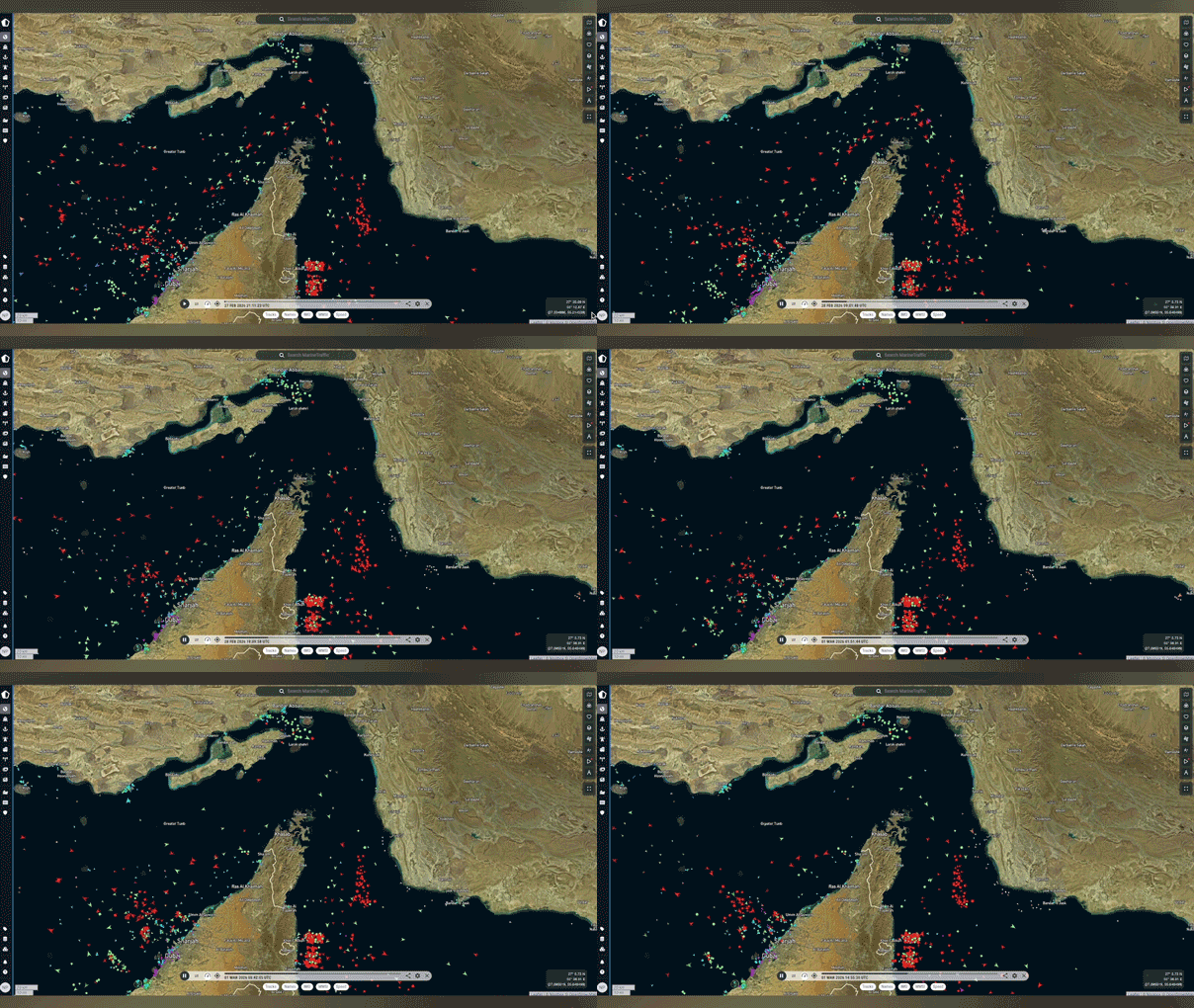
China’s dependence on Iranian oil remains a central vulnerability, even as the conflict disrupts shipping lanes and raises risks in the Strait of Hormuz, through which roughly half of China’s seaborne oil imports pass.

Shipping through the Strait of Hormuz has dropped sharply and become far more volatile, with only limited oil shipments still getting through under heightened risk.

Iran accounts for roughly 13% of China’s crude imports, while China remains Tehran’s largest customer, purchasing an estimated 80%–90% of its exports.

Much of that oil is sold at a discount — often $8 per barrel to $10 per barrel — giving Chinese refiners access to cheaper crude that is difficult to replace elsewhere.

US DESTROYS 16 IRANIAN MINE BOATS AS STRAIT OF HORMUZ OIL SHOWDOWN ESCALATES

Much of the trade is handled by smaller independent “teapot” refineries, allowing Beijing to maintain imports while limiting exposure of its state-owned energy companies to U.S. sanctions.

In many cases, those transactions are conducted in yuan rather than dollars, with proceeds often recycled into Chinese goods and infrastructure projects.

“One of China’s long-term objectives is challenging the supremacy of the dollar,” Tozzi said.

TRUMP ORDERS WAR DEPT TO POSTPONE STRIKES ON IRANIAN ENERGY SITES, CITING ‘PRODUCTIVE’ TALKS TO END WAR

“It’s going to be hard to turn off the supplier side of this,” Sadler said, pointing to the entrenched networks that keep crude moving despite sanctions and conflict.

Those networks — built over years of sanctions — allow Iranian oil to be rerouted through indirect channels, often using tankers that operate outside traditional tracking systems.

Xi walking with soldiers

Officials have not cited China as a rationale for the operation, but the overlap in resources and priorities has fueled debate in Washington over how to balance immediate threats in the Middle East with longer-term competition with Beijing. (Li Gang/Xinhua via Getty Images)

For China, that means continued access to supply, but at higher cost and greater risk, as shipments become more difficult to move and insure.

The result is sustained pressure rather than a cutoff: fewer shipments, higher prices and increased uncertainty around a supply line Beijing has come to rely on.

The Trump administration also has taken an unusual step to stabilize energy markets, temporarily easing sanctions on Iranian oil already loaded on tankers to allow those barrels to be sold. The short-term waiver, covering an estimated 140 million barrels, is aimed at easing supply disruptions caused by the conflict.

But it also widens access to oil that had largely been flowing to China, increasing competition for those barrels rather than allowing Beijing to remain the dominant buyer.

The U.S. also has eased some restrictions on Russian oil in recent weeks, allowing additional supply to flow to Asia. Taken together, the moves are reshaping global oil flows — forcing China to compete more directly for supply rather than relying as heavily on discounted crude.

U.S. intelligence assessments reflect similar limits, describing the China-Iran relationship as economically significant but largely transactional rather than a coordinated strategic bloc.

Combat experience — and a strain on stockpiles

The Iran conflict is giving U.S. forces real-world experience that cannot be replicated in training environments, allowing different branches of the military to operate together under live conditions and test how their systems perform.

“There’s a lot of real-world experience getting gained,” Sadler said. “We are refining our capabilities in a massive way.” 

But those gains come with costs. 

“We’re also wearing down our sailors, as well as the material, the aircraft and the ships.”

The same stockpiles being used in the Middle East would be needed to deter any conflict in the Indo-Pacific.

“We don’t produce munitions at the speed and capacity that we should be. It’s not a new problem,” Sadler said. “We’re going to go through a lot of our interceptor missiles very quickly.”

Marine vessels moving through the Strait of Hormuz in a timelapse video.

China’s dependence on Iranian oil remains a central vulnerability, even as the conflict disrupts shipping lanes and raises risks in the Strait of Hormuz, through which roughly half of China’s seaborne oil imports pass. (Kpler/Marine Traffic)

He warned that at current production rates, inventories could last only “maybe a week or two,” assuming they are used judiciously.

As of late 2025, the U.S. had roughly 414 SM-3 interceptors and 534 Terminal High Altitude Area Defense, or THADD, interceptors, according to the Center for Strategic and International Studies. THAAD is one of the U.S. military’s primary systems for intercepting ballistic missiles in their final phase of flight.

Those systems have been used heavily in recent Middle East operations, and they also would be central in any potential conflict with China, particularly in defending U.S. forces and allies in the Indo-Pacific from missile attacks.

Drawing down those stockpiles now raises a practical concern: the more the U.S. uses these interceptors in the Middle East, the fewer are immediately available for a high-end conflict with Beijing.

China keeps its distance

Beijing has avoided direct involvement in the U.S.–Israel conflict in Iran, focusing on diplomacy, with its deep oil reserves as a fallback. 

“They’re all very opportunistic,” Sadler said. “They don’t want to take any undue risk.” 

CLICK HERE TO DOWNLOAD THE FOX NEWS APP

“The more diplomatic noise they make, the more it draws attention from their incapacity to stand up for their partners,” he said.

The conflict’s effects extend beyond the region, testing China’s role as a global power while forcing the United States to weigh immediate military demands against its longer-term competition with Beijing.

Chinese officials said they were “highly concerned” by the escalation and urged an immediate halt to military operations, while Foreign Minister Wang Yi described the strikes as “unacceptable.”

The Chinese embassy could not immediately be reached for comment. 



Source link

An AI-powered phishing campaign has compromised hundreds of organizations

0

A phishing campaign tied to AI cloud-hosting service Railway has given hackers access to the Microsoft cloud accounts for hundreds of businesses, according to researchers at Huntress.

Rich Mozeleski, product manager for Huntress’ identity team, told CyberScoop the campaign is currently tied to a smaller actor and approximately a dozen IP addresses, but has managed to compromise hundreds of targets in the past few weeks.

In early March it was compromising a few dozen targets a day, but starting March 3, there was a “massive increase” in that tempo. Mozeleski said that in addition to being more sophisticated than usual, there were no identical emails or domains used, leading researchers to suspect that they may have been generated through artificial intelligence tools. The templates ranged from traditional email lures to QR codes and co-opted file-share sites.

“Just the amount of it was like Pandora’s Box had opened, and the efficacy was just through the roof,” Mozeleski said.

A custom file download phishing lure used in the campaign. Researchers believe the attackers used AI to generate unique lures at scale. (Source: Huntress)

A custom file download phishing lure used in the campaign. Researchers believe the attackers used AI to generate unique lures at scale. (Source: Huntress)

The phishing campaign exploits Microsoft’s authentication flow for devices such as smart TVs, printers and terminals, which gives the attacker valid OAuth tokens for that account for up to 90 days without needing a password or multifactor authentication.

Ultimately, Huntress has seen hundreds of its customers fall for the phishing scams, though they claim to have prevented post-compromise activity in all cases. But they also believe their customers represent only a small fraction of the likely total victim set, which could number in the thousands.

The affected entities span a range of sectors: construction and trade companies, law firms, nonprofits, real estate, manufacturing, finance and insurance, healthcare, government and public safety organizations were all among the 344 victims detailed in the Huntress blog.

To protect customers, Mozeleski said Huntress issued a conditional access policy update Wednesday to 60,000 Microsoft cloud tenants on emails coming from Railway domains, an act he described as “not anything we’ve ever done before.”

Weaponizing vibe-coded infrastructure

Researchers believe the attackers were weaponizing Railway’s Platform as a Service — built to help non-coders build websites and tools — to spin up credential harvesting infrastructure for the campaign.

By using compromised domains and pumping out bespoke lures, the phishing emails avoid most commercial email filtering solutions. It’s not clear if they used Railway’s AI tool or a separate one to generate the lures. Either way, all the attacks Huntress has observed are coming through Railway.com IP infrastructure.

In response to questions from CyberScoop on Friday, Railway solutions engineer Angelo Saraceno said the company is aware of the incident and was first contacted by Huntress on March 6 regarding phishing traffic originating from a specific IP address and three domains. “The associated accounts were banned and the domains were blocked,” Saraceno said.

“Our heuristics are built to catch correlations: repeated credit cards, shared code sources, overlapping infrastructure,” he wrote in an email. “When a campaign avoids those signals, it gets further than we’d like.”

Saraceno called Railway’s fraud detection “a balance” between catching bad actors and getting flooded with false positives, pointing to an incident in February when fine-tuning in the company’s automated abuse enforcement system led to a customer outage.

Earlier Friday, Mozeleski told CyberScoop that Huntress continued to see more than 50 compromises a day tied to Railway phishing domains. When asked what more Railway could have done to prevent abuse of their platform, he said vetting and validation on the free use of their product could be improved. He pointed to products with similar trials, like MailChimp and HubSpot, that have controls and oversight in place so users can’t “go pump in a million contacts and start spamming.”

“Do not allow anybody to come in, start a trial, spin up resources, and start using your infrastructure” for cyberattacks, he said.

One of the more striking contrasts of the campaign was the use of AI to create phishing infrastructure akin to a state-sponsored threat actor or advanced cybercriminal group in service of a garden-variety phishing scam.

It bolsters warnings coming from cybersecurity experts that low-level cybercriminals — often called “script kiddies” for their reliance on automated hacking tools — are poised to become one of the biggest beneficiaries of the generative AI era. Last month, John Hultquist, chief analyst at Google’s Threat Intelligence Group, said that he expects that AI tools will help “smaller cybercriminal outfits more than state-sponsored hackers.”

Testimonials on Railway’s website tout the service’s ability to deliver “vertical auto-scale out of the box”, while another said it “makes spinning up self-hosted third-party tools almost effortless.”

It may also give them a leg up on victim organizations that have more restrictive internal policies around the use of AI for cyber defense.

“We are seeing crooks as the first movers of AI,” said Prakash Ramamurthy, chief product officer at Huntress. “They don’t have any qualms about PII, they don’t have any qualms about model training … and this incident, just in the sheer pace at which it has evolved, is kind of a testament to that.”

Derek B. Johnson

Written by Derek B. Johnson

Derek B. Johnson is a reporter at CyberScoop, where his beat includes cybersecurity, elections and the federal government. Prior to that, he has provided award-winning coverage of cybersecurity news across the public and private sectors for various publications since 2017. Derek has a bachelor’s degree in print journalism from Hofstra University in New York and a master’s degree in public policy from George Mason University in Virginia.


Source link

How Israel is reacting to Trump’s ‘de-escalation’ with Iran | Conflict

0

NewsFeed

There is expected to be significant pushback from Israel following President Donald Trump’s move towards de-escalation with Iran. Al Jazeera’s Nida Ibrahim explains why Israeli officials appear unhappy with the recent developments.


Source link

Teenager described herself as ’embodiment of hell’ before launching far-right axe attack | UK News

0

A Nazi-obsessed teenager who launched a far-right axe attack on a random stranger has pleaded guilty to attempted murder.

Alina Burns, then aged 18, attacked Mohammed Mahmoodi, an Iranian Kurd, outside a barber’s shop in Bedminster, Bristol, on 2 August last year as he was chatting with a friend.

CCTV from inside the shop showed the 27-year-old turning and ducking at the last minute as she swung an axe at his neck.

The teenager then tried to strike Mr Mahmoodi again, before he managed to disarm her, escaping with only painful scratches to his neck and cheek.

She was then detained by police officers who had been on patrol nearby. They found a scalpel and several darts on her.

The attack took place outside BHK Barbers in Bedminster, Bristol. Pic: Google Maps
Image: The attack took place outside BHK Barbers in Bedminster, Bristol. Pic: Google Maps

Burns nodded when the arresting officer asked her if she had swung the axe at the man. When he asked her why, she said: “I wanted to cut his neck.”

Police later discovered an email she had written to an associate, saying: “Kill all Jews and Muslims in Britain, please”.

Burns, who hung an England flag above her bed, was a member of the Patriotic Alternative, a far-right group.

Serena Gates KC, told Bristol Crown Court that Burns had “a desire for a white England, achieved, if necessary, through terror”.

Police found messages in which Burns stated that she “realised my role in existence: I am the embodiment of hell, destined to annihilate everything holy I bear witness to”.

In another message, she referred to carrying out a “plan” – and said she wanted “all the credit and glory”.

An examination of her diary and notebooks revealed notes about Germany, Adolf Hitler and weaponry used by the Germans in the First and Second World Wars.

On 30 July, she looked up on Google “what age you buy an axe UK”. She also searched “how to properly use an axe for self-defence” before the attack.

Then, on 31 July, she looked online for YouTube videos, including one about Patrick Crusius, who killed 23 people during a mass shooting in a US Walmart supermarket.

There were also searches for a number of graphic “gore” videos, including one of a man fatally stabbed in the neck, and searches on how to use darts as a weapon

An email to herself on the day before the attack was titled “The dawn of civil war”. In the email, she said: “Land is reclaimed through terror.”

She added that it was “better if they flee out of fear rather than displace us in our own home”.

Read more from Sky News:
British couple detained in Iran feel ‘let down’
Owner of OnlyFans adult platform dies

Burns, who had bought an axe from Screwfix on the day of the attack, said that she intended to “kill him or injure the man”.

During an assessment by a mental health practitioner, Burns was asked how she felt about being arrested for attempted murder. She replied “fair enough”.

When asked if she had any thoughts or plans to harm others, she said she “would go on again but to succeed”.

She also asked if the attack was “in the news yet?”.

Burns pleaded guilty to attempted murder, and three charges of carrying a bladed weapon in a public place.

She denies having a terrorist motive. The judge will rule on the issue at her sentencing in May.


Source link

Passenger in LaGuardia plane crash describes ‘chaos’ of deadly impact

0

NEWYou can now listen to Fox News articles!

A passenger aboard the Air Canada jet that collided with a fire truck at LaGuardia Airport Sunday night described the instant of the deadly runway impact, saying the pilot “did the best thing he could” in the moment.

Jack Cabot, one of 72 people aboard the Air Canada Express flight, recalled “chaos” unfolding as the plane landed.

“As we were arriving, we came down really hard,” he said. “We stopped really quickly and about two seconds later we had an absolute slam. Everybody was flying everywhere, I mean, the plane started veering off left and right. And there was, it was just chaos.”

“It didn’t feel like anyone was in control of anything,” Cabot continued. “Looking back on it, the pilot did the best thing he could. He hit the brakes as hard as he could, and he knew it was going to be at the cost of his own life.”

LAGUARDIA PLANE CRASH AIR TRAFFIC CONTROL AUDIO REVEALS FRANTIC CALL FOR TRUCK TO ‘STOP, STOP, STOP’

emergency responders on runway with damaged plane and fire truck

An Air Canada Express CRJ-900 sits on the runway after colliding with a Port Authority fire truck at LaGuardia Airport on March 23, 2026, in New York City. (Michael M. Santiago/Getty Images)

Both pilots were killed in the collision. Their identities have yet to be released to the public, though the union representing them said both pilots “dedicated their careers to the safe transport of passengers.”

There were 72 passengers and four crew members aboard the CRJ-900 aircraft, officials have said.

Plane crash at Laguardia airport New York City

An Air Canada Express CRJ-900 sits on the runway after colliding with a Port Authority fire truck at LaGuardia Airport in New York on March 23, 2026. (Timothy A. Clary/ AFP via Getty Images)

Cabot described many of the passengers as bleeding from their heads after the impact.

“A lot of people got pretty hurt,” he said.

More than 39 passengers and crew and at least two Port Authority firefighters were hospitalized, some with serious injuries, according to officials.

President Donald Trump commented on the deadly collision Monday morning when responding to a question from the media.

“They made a mistake,” Trump said, without elaborating on who. “It’s a dangerous business. That’s terrible.”

FEDS INVESTIGATE ALARMING NEAR-MISS BETWEEN ALASKA AIRLINES JET, FEDEX PLANE AT BUSY NEWARK AIRPORT

Canadian Prime Minister Mark Carney said Canadian officials were working closely with their U.S. counterparts on the ground to investigate the “deeply saddening” collision.

The circumstances leading up to the collision remain unclear.

A Port Authority spokesperson said in a statement to Fox News Digital that the Port Authority Aircraft Rescue and Firefighting vehicle was responding to a separate incident as the aircraft was landing on Runway 4 at LaGuardia.

In one air traffic control audio clip from the moments before the crash, a controller can be heard on a radio transmission discussing the request for the emergency vehicle to cross part of the tarmac, then trying to stop it.

LISTEN TO AIR TRAFFIC CONTROL AUDIO:

“Stop, Truck 1. Stop,” the transmission said. “Frontier 4195, stop there please. “Stop, stop, stop, stop.”

“Truck 1, stop, stop, stop,” a controller was heard saying. “Stop truck one. Stop!”

In another audio clip from air traffic control, a controller is heard telling the pilot of another plane, “I messed up.”

CLICK HERE TO DOWNLOAD THE FOX NEWS APP

The National Transportation Safety Board and Federal Aviation Administration are investigating the collision.

LaGuardia was expected to remain closed until at least 2 p.m. Monday, officials said.


Source link