Reference #18.d1292117.1778670708.4a2f62b4
https://errors.edgesuite.net/18.d1292117.1778670708.4a2f62b4
Reference #18.d1292117.1778670708.4a2f62b4
https://errors.edgesuite.net/18.d1292117.1778670708.4a2f62b4
Reference #18.490dde17.1778691344.3c2eddf7
https://errors.edgesuite.net/18.490dde17.1778691344.3c2eddf7
The billionaire chief executive of the chipmaker Nvidia, Jensen Huang, has joined Donald Trump’s China delegation after a reported last-minute invitation, highlighting the US’s AI and tech ambitions.
Huang will join a roster of US bosses including the Tesla chief executive and X owner, Elon Musk, the Apple chief executive, Tim Cook, and Goldman Sachs’s David Solomon at Trump’s 36-hour meeting with the Chinese president, Xi Jinping.
The high-stakes summit is the first overseas trip for Trump since the US and Israel launched attacks on Iran in late February. The summit is expected to cover topics including that conflict, tariffs and China’s relationship with Taiwan.
Huang was not on the initial list of business delegates, according to reports. However, the Nvidia boss, whose company’s chips have been driving the AI boom, was reportedly seen boarding Trump’s presidential plane in Alaska, before Trump confirmed his participation in the summit on social media.
Huang has been pushing for greater access to the Chinese market that he has said represents a $50bn (£36.9bn) opportunity.
An Nvidia spokesperson said: “Jensen is attending the summit at the invitation of President Trump to support America and the administration’s goals.”
Trump wrote that the news outlet CNBC had “incorrectly reported that the Great Jensen Huang, of Nvidia, was not invited to the incredible gathering of the World’s Greatest Businessmen/women proudly going to China. In actuality, Jensen is currently on Air Force One.”
Trump went on to confirm he was also accompanied by bosses including BlackRock’s Larry Fink, Blackstone’s Stephen Schwarzman, Boeing’s Kelly Ortberg and Citi’s Jane Fraser.
Trump said in a post on his social media platform Truth Social: “I will be asking President Xi, a leader of extraordinary distinction, to ‘open up’ China so that these brilliant people can work their magic, and help bring the People’s Republic to an even higher level!”
Huang was declared the world’s seventh richest person earlier this week, overtaking the Dell founder, Michael Dell, on the back of Nvidia’s rising share price. According to Forbes’ real-time billionaire’s list, Huang’s net worth hit $191.5bn on Monday, thanks to the rising value of his 3% stake in the chipmaker.
His pay package over the 2026 financial year fell by 27% to $36.6m because of a drop in Nvidia’s stock value last year, as investors were spooked by chatter over an AI market bubble.
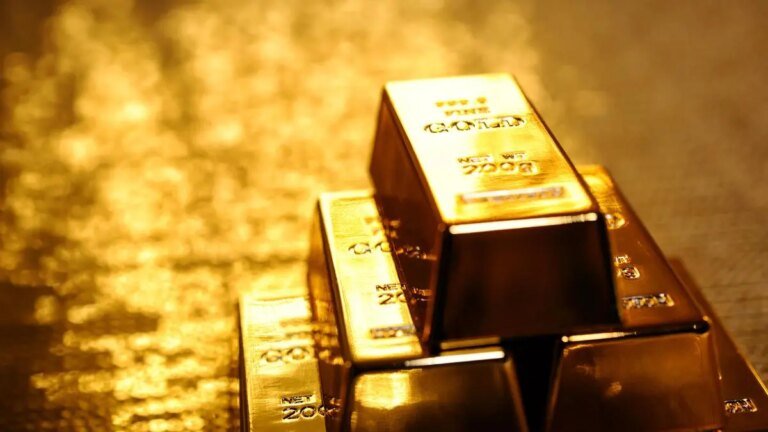
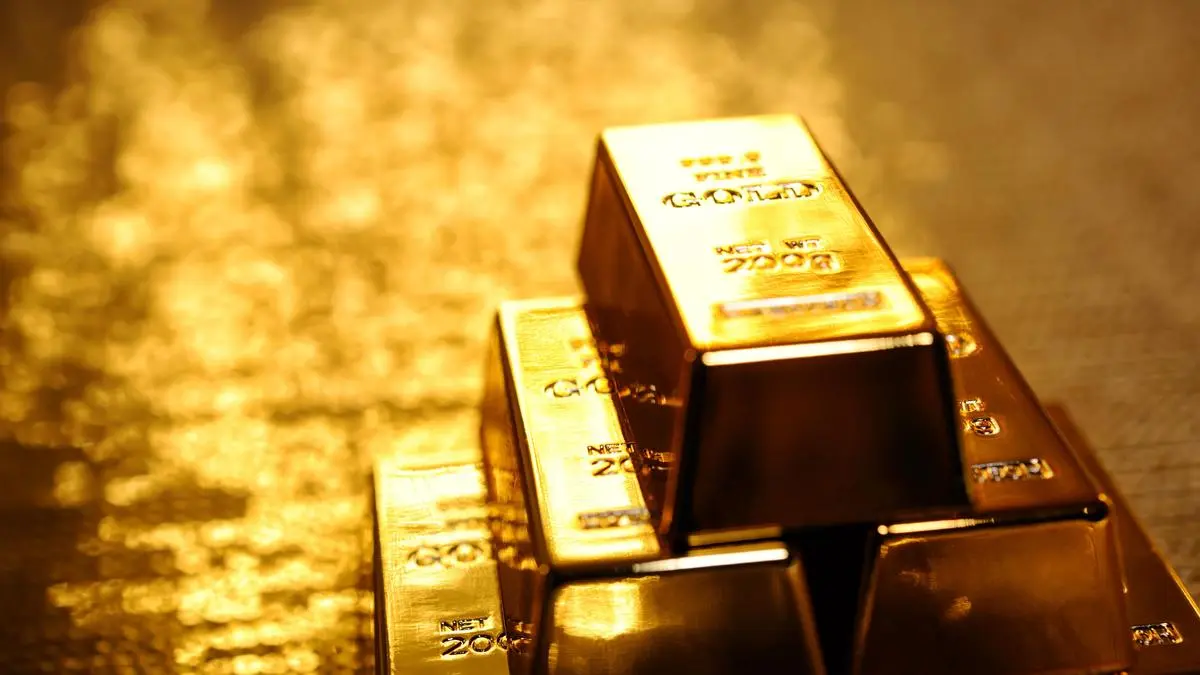
Stack of gold bars. | Photo Credit: brightstars
The significant increase in the import duty on gold from 6 per cent to 15 per cent may lead to an increase in imports from Dubai through the free trade agreement route, think tank GTRI said on Wednesday.
It said that the duty hike also sharply changes the economics of precious metal imports routed through the United Arab Emirates under the India-UAE Comprehensive Economic Partnership Agreement (CEPA).
India had allowed imports of gold from Dubai at tariffs one percentage point below the normal Most-Favoured-Nation (MFN) rate through a Tariff Rate Quota (TRQ) system.
The quota began at 120 tonnes annually in 2022 and is set to rise to 200 tonnes by 2027, nearly one-fourth of India’s annual gold imports.
“With the new MFN tariff structure taking effective duties to 15 per cent, gold imported under the UAE quota would enter at 14 per cent. The widening tariff gap could encourage greater routing of global bullion through Dubai, even though the UAE is not a miner of gold or silver,” the Global Trade Research Initiative (GTRI) said.
Under the CEPA, India had also agreed to gradually reduce import duties on silver from 10 per cent to zero over a 10-year period beginning in May 2022.
The concessional tariff on silver imports from the UAE currently stands at 7 per cent.
“With India now raising the general tariff to 15 per cent, the duty gap has widened to 8 percentage points, creating a major arbitrage opportunity for imports routed through Dubai. That margin is scheduled to widen further each year until CEPA tariffs fall to zero by 2031,” GTRI Founder Ajay Srivastava said.
Under the earlier regime, imports of gold and silver products attracted a 5 per cent Basic Customs Duty (BCD) and a 1 per cent Agriculture Infrastructure and Development Cess (AIDC), taking the total levy to 6 per cent.
After adding 3 per cent Integrated GST (IGST), the effective total import duty stood at 9.18 per cent. The revised structure doubles the BCD from 5 per cent to 10 per cent and raises the AIDC five-fold from 1 per cent to 5 per cent.
The combined customs levy has, therefore, jumped from 6 per cent to 15 per cent. Including IGST, the effective import duty has surged from 9.18 per cent to 18.45 per cent. The move comes amid a surge in precious metal imports.
In FY 2025-26, India imported nearly $72 billion worth of gold, around 25 per cent higher than the previous year. Silver imports crossed USD billion, recording an extraordinary 150 per cent increase annually.
Further, GTRI urged the Finance Ministry to simplify the language of notifications regarding these tariff changes, as they are extremely difficult to understand.
The current format forces importers, lawyers and consultants to trace references to customs notifications issued over the past 26 years, the think tank said, adding that determining the actual applicable duty now requires going through multiple layers of amendments, corrections and tariff changes issued over several decades.


Published on May 13, 2026
NEWYou can now listen to Fox News articles!
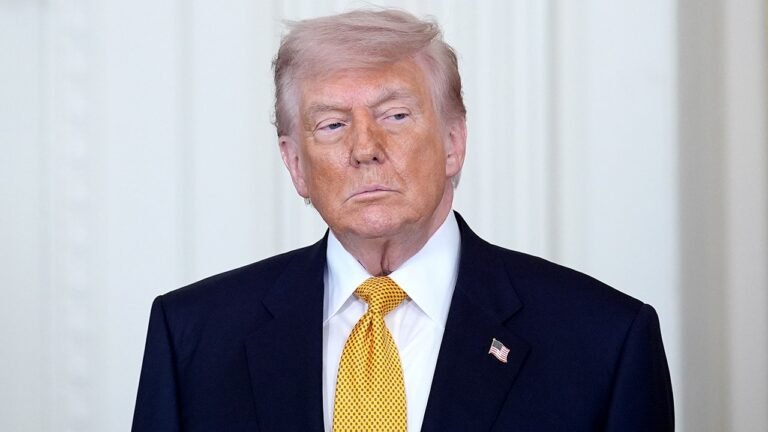
President Donald Trump likes to say that he holds all the cards in the Iran war. But at the moment that’s not true.
Iran has one card that has frozen the situation. The murderous mullahs are in no rush to make a deal, and may not even want one.
Trump said he didn’t even finish reading Tehran’s latest counter-proposal, calling it “garbage.” And he uttered his instantly famous line about the ceasefire being on “life support.”
As the war enters its third month, Trump’s upbeat talk has never been matched by Iran or its parliament speaker, Mohammad Ghalibaf. Its economy is seriously ailing. But their view is that as long as they get to keep their enriched uranium, some of which is buried, they’ll be fine.
WHY IRAN TALKS ARE IN LIMBO AS TRUMP SCRAMBLES FOR A WAY OUT OF THE WAR HE STARTED
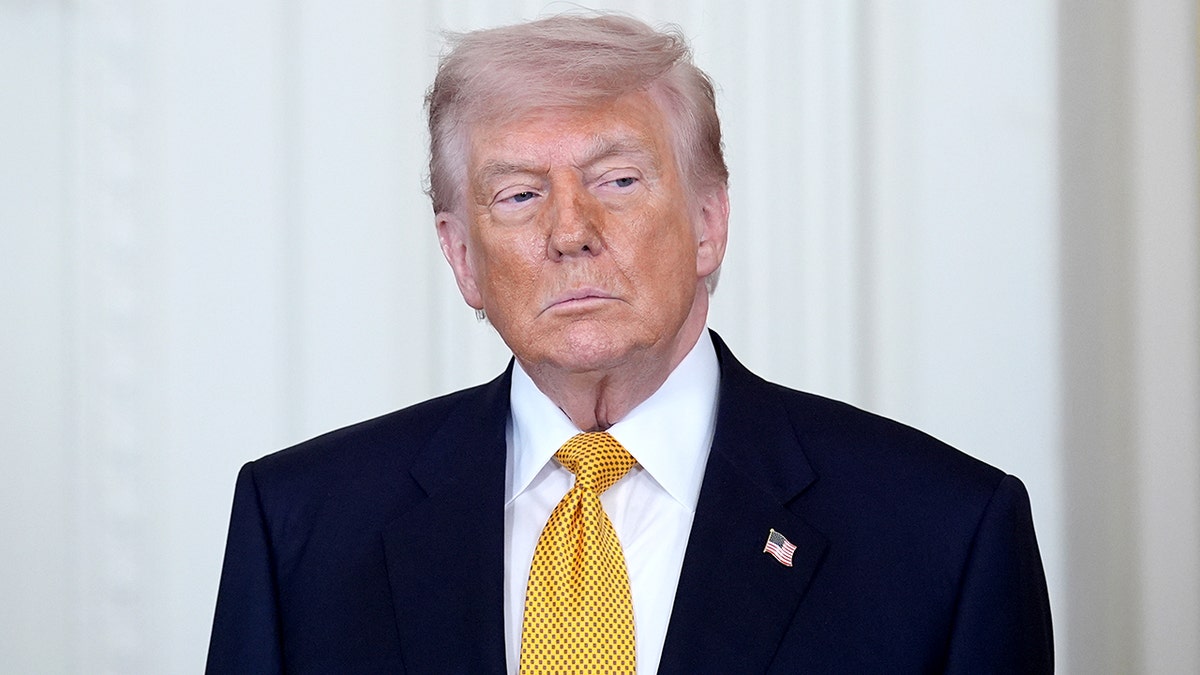
President Donald Trump’s upbeat talk on Iran has never exactly been reciprocated by the regime. (Yuri Gripas/Abaca/Bloomberg via Getty Images)
Trump keeps declaring victory, but since the main rationale for the invasion was to keep the Iranians from developing a nuclear weapon, anything less will be seen as a major failure.
Maybe this is just the president’s negotiating style, taking everything down to the wire. But the result is dueling blockades – Iran at the Strait of Hormuz, the U.S. at Iranian ports – that again has Trump issuing dire threats.
What really rankles Trump is that Iran is charging “friendly” ships – those not tied to the war – 100 percent to pass through a waterway that carries one-fifth of the world’s oil traffic. Others are blocked from the strait, where Iran has laid explosive mines.
So the two sides are eyeball to eyeball over who, if anyone, will back down.
As the Wall Street Journal puts it:
“The U.S. and Iran are locked in a diplomatic stalemate over issues that have bedeviled the two sides for years, as the conflict settles into a gray zone that is neither war nor peace.
“The ceasefire is entering its second month and, despite sporadic violence, has now lasted almost as long as the fighting which preceded it. There is little to indicate that either the U.S. or Iran is ready to compromise, but neither wants to start fighting again.”
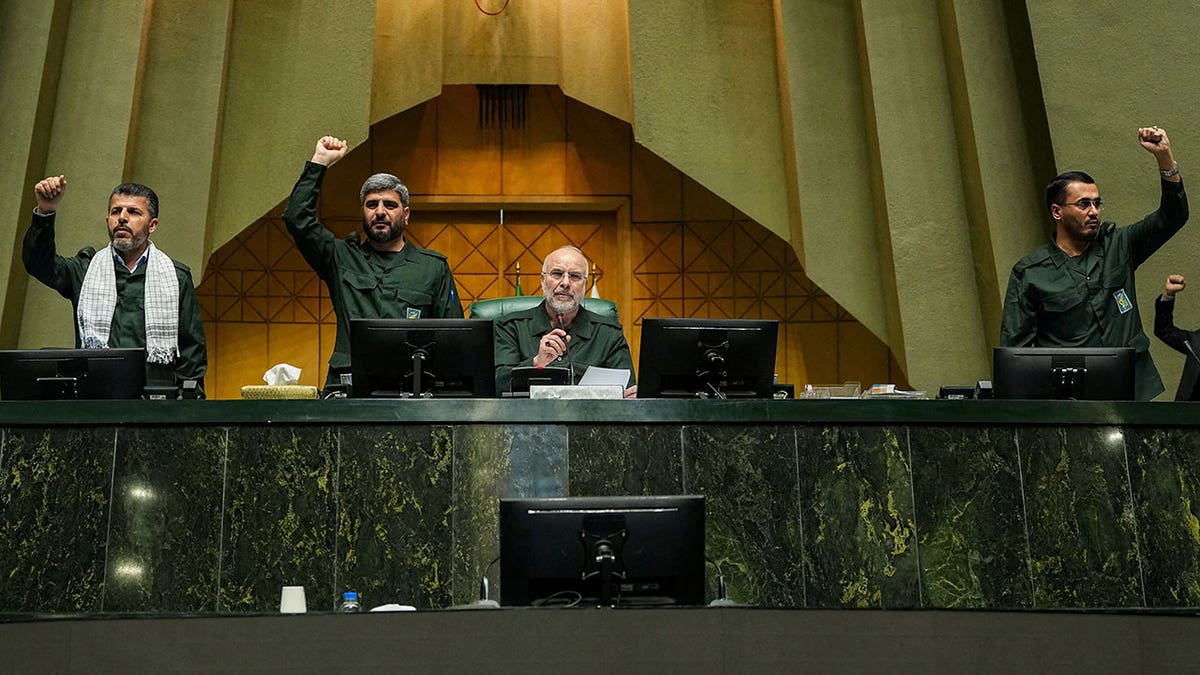
“Our armed forces are ready to deliver a well-deserved response to any aggression,” Iranian Parliament Speaker Mohammad-Bagher Ghalibaf posted Monday. (Hamed Malekpour/Islamic consultative assembly news agency/WANA (West Asia News Agency)/Handout via Reuters)
Trump told White House reporters that Iran believed he would get tired or bored of the conflict, or feel pressure to end it because of soaring energy prices.
“But there’s no pressure,” Trump said. “We’re going to have a complete victory.”
Iran, meanwhile, continues to portray itself as the winner of the conflict, its regime intact, its missile and nuclear programs still a threat. Ghalibaf warned the Americans against escalation in a Monday posting: “Our armed forces are ready to deliver a well-deserved response to any aggression.”
But instead of fighting, both sides have doubled down on dueling blockades that are hard to undo without one side blinking. The Trump administration has tightened a U.S. embargo of Iranian ports and vessels, while Iran has maintained its grip on the Strait of Hormuz.
The New York Times reported last night that U.S. intelligence officials, at odds with the administration’s public stance, say privately that Iran has restored operational access to 30 of its 33 missile sites along the Strait of Hormuz, “which could threaten American warships and oil tankers transiting the narrow waterway.”
TRUMP’S LAST-MINUTE DELAY: WHY HE WAS NEVER GOING TO OBLITERATE IRAN IN THE FIRST PLACE
Trump did orchestrate a three-day ceasefire – and prisoner exchange – between Russia and Ukraine, which was mainly about Vladimir Putin not being embarrassed during his scaled-down parade marking the Soviet victory over Nazism.
As for Trump’s meeting this week with Xi Jinping, already postponed once because of the Iran war, the atmosphere has definitely chilled.
After a couple of trade wars, “China increasingly casts itself not as a fading civilization trying to catch up to the West but as a superpower poised to surpass it.”
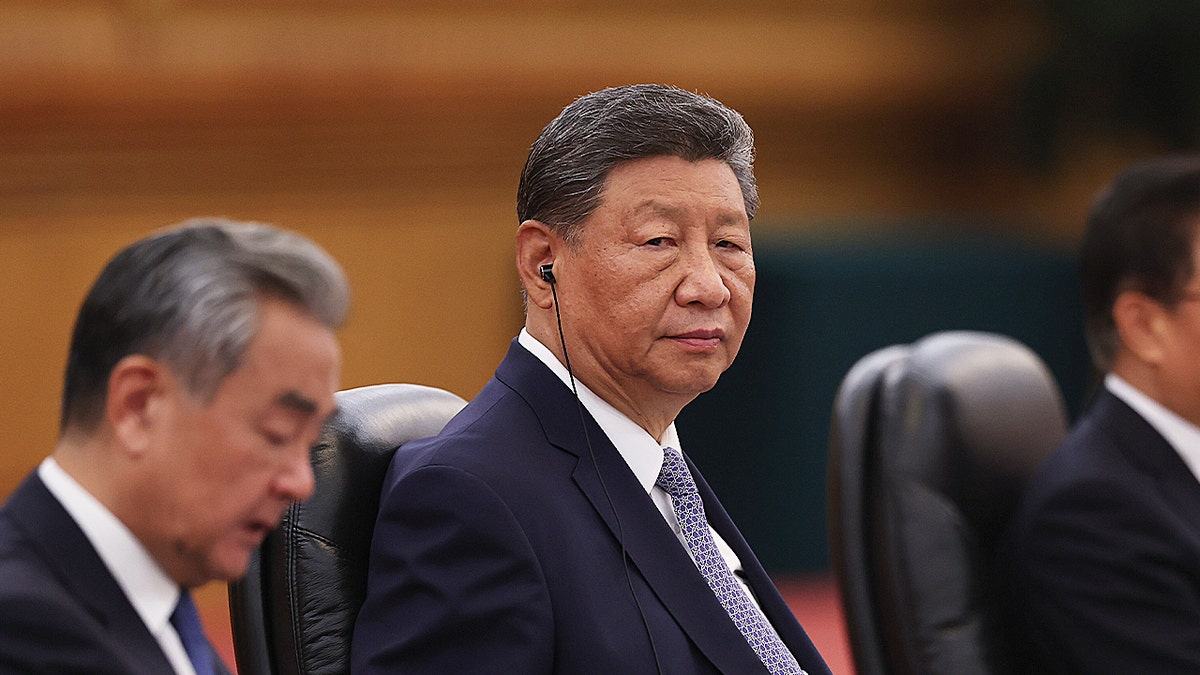
Per some reports, Xi Jinping-led China is angling to surpass the West. (Lintao Zhang/Getty Images)
A report from a Beijing think tank says the U.S. is “sliding toward polarization, institutional dysfunction and even “‘Latin American-style instability.” Such views are now increasingly being aired publicly rather than merely whispered.
The superpower’s propaganda machine, which plays up such tragedies as the Minnesota shootings, is acutely aware that the Iran war’s unpopularity is hurting Trump’s unpopularity as the midterms approach.
That’s one reason that Xi plans to pressure his counterpart about arms sales to Taiwan.
What’s more, China is building a new AI model that, while it still relies on chips from the American giant NVIDIA, shows that Xi is determined to blaze his own technological path.
SUBSCRIBE TO HOWIE’S MEDIA BUZZMETER PODCAST, A RIFF ON THE DAY’S HOTTEST STORIES
When asked yesterday whether China, which opposes the Iran war, could use its leverage, Trump said “no, I don’t think we need any help with Iran.”
CLICK HERE TO DOWNLOAD THE FOX NEWS APP
Meanwhile, as Pete Hegseth refused to provide details, a top Pentagon official testified yesterday that the cost of the Iran war has risen to about $29 billion.
Trump prefers not to use the term war, but that sure sounds like far more than an incursion or conflict. The fog of war even extends to the federal budget.
Fancy your chances in politics? Then perhaps you should change your name to Aaron Aaronson or Aaliyah Aardvark, figures from last week’s local elections in England suggest.
A Guardian analysis of election results compiled by the website Democracy Club points to a striking alphabet effect. In wards where a party fielded three candidates, those listed nearer the top of the ballot paper – with a surname nearer the start of the alphabet – finished ahead of their party colleagues in 2,200 cases, or 65% of the time.
By contrast, candidates listed third out of their party’s list – with a surname nearer the end of the alphabet – topped their party’s slate only 382 times, or 11%. If ballot order had no relationship with performance, the figures would be expected to fall much closer to one-third in each position.
The figures show that out of the main parties in England, Reform had the strongest relationship between where candidates placed among their party colleagues, and the initials of their surname. About 74% of alphabetically advantaged Reform candidates topped their party’s vote, compared with fewer than 8% of Reform candidates nearest the bottom of the ballot paper. The Green party had the second-strongest surname effect, followed by Labour.
Juliet Zhong, who unsuccessfully stood for Reform UK in Kensington and Chelsea in London, said: “In the Queen’s Gate ward, where I stood alongside my two fellow Reform UK candidates, Ms Noble and Mr Walker, all our leaflets displayed our three names together. However, the election results showed: Noble 120, Walker 115, and then Zhong (me) 102. That is about 15% to 18% less. It makes no sense at all, as all our campaign materials featured all three of our names.”
Zhong said that this phenomenon was being seen across the party. She added: “My party colleague, Henry Woodruff, also noted this in our group chat after the election. He secured 288 votes, while his wardmates trailed at 320 and 345. It’s no coincidence that the top scorer, Andrew Barclays (345 votes), sat comfortably at the summit of the ballot paper.”
She said candidates’ names should be grouped by party, rather than alphabetically, adding; “It would surely be more logical for voters to see candidates classified by their party rather than playing a game of ‘find the surname’. This would ensure a level playing field, regardless of whether a party is perched at the top or relegated to the bottom of the list.”
Election-winners whose names are near the top of the alphabet are less likely to think their surname is a factor in their success. Nick Abear, a Green party candidate who was elected to the Redhill West & Meadvale Ward in East Surrey, said: “I hadn’t really considered it because I think most people know who (or which party) they are going to vote for in advance of voting. The thought of someone turning up to vote and thinking: ‘I’ll just stick my X on the top line’ seems unlikely.”
Abear did, however, get more votes than his Green party colleague Elly Heaton.
Andy Adams won a council seat in Winchester for the Liberal Democrats last week, and said it was an issue he had known about for a while. “I have heard of this alleged effect before and I always regale staff at polling stations with it as I visit as the candidate, joking that I am living proof that it is by no means always true. I stood for Winchester city council 11 times and once for parliament before I was finally successful this year.”
Adams added that the effect could sometimes work: “In a very close election and at local level the numbers can be very close at times … a very long list would reasonably be expected to give rise to the effect. I would probably support randomising ballot papers in principle even if I would not stand to gain from such an innovation.”
He added: “My husband is a Wiggins and whilst we decided not to double-barrel, if he were interested in politics then he would be well advised to become an Adams-Wiggins, or so it seems.”
The system used across local elections varies depending on the council, with most urban areas electing three councillors for each ward, but some rural areas electing fewer. Last week, 864 wards had at least one party standing three candidates.
Another way of looking at it – looking across all wards – is to compare the average vote share each candidate got compared with the rest of their party. This shows a similar pattern: candidates with surnames near the beginning of the alphabet slightly outperformed the party average vote share, and those with surnames beginning W, Y and Z underperformed in their party.
Unfortunately, the results suggest that if your name is Zebedee Zurcher, you might want to consider a career outside of politics.
Reference #18.75560e17.1778661200.153be8c9
https://errors.edgesuite.net/18.75560e17.1778661200.153be8c9
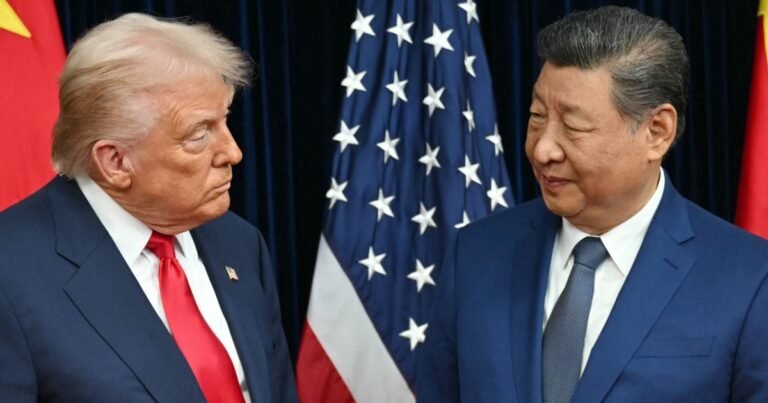
Taipei, Taiwan – Chinese President Xi Jinping is expected to seek concessions on Taiwan and US tariffs when he meets United States President Donald Trump for a high-stakes summit taking place in the shadow of the war on Iran.
Trump will arrive in China on Wednesday evening for a three-day visit that will mark the first trip by a US leader to the country since 2017, when Trump visited in the early days of his first term.
Unlike Trump, who is renowned for his mercurial policymaking, Xi is widely seen as predictable in his goals for the summit, particularly as they concern Beijing’s longstanding “core interests” related to national security and territorial integrity.
At the top of that list is Taiwan.
While Taiwan’s government considers itself the head of a de facto sovereign state, Beijing views the island as an inalienable part of its territory.
The US formally cut ties with Taiwan – also known as the Republic of China – decades ago, but is committed to aiding the self-governing democracy’s defence under the 1979 Taiwan Relations Act.
Under the law, Washington has provided Taiwan with billions of dollars in arms and pursued cooperation in areas such as military training and intelligence sharing, which Beijing considers interference in its internal affairs.
The US government officially acknowledges that China views Taiwan as part of its territory, but does not express a stance on whether it agrees.
Washington is also intentionally vague about whether it would intervene to defend Taiwan if China sought to annex it by force.
In a call with US Secretary of State Marco Rubio last month, Chinese Foreign Minister Wang Yi made clear that Taiwan would be raised at the summit, describing the issue as “the biggest risk in the China-US relationship”, according to a Chinese readout of the call.
China’s embassy in Washington, DC, reiterated that message after Trump’s departure for the summit on Tuesday, naming Taiwan as the first of “four red lines” that “must not be challenged”.
While analysts say it is unlikely that the US will change its position on Taiwan due to Chinese pressure, Trump said this week that the summit’s agenda would include US arms sales to the island, raising questions about the future of a stalled multibillion-dollar arms deal.
The US Congress approved the arms package reportedly worth $14bn earlier this year, but the sale still requires Trump’s final approval.
Xi will use his meetings with Trump to “influence and potentially convince Trump to agree to scale back, if not completely suspend, sales to Taiwan,” William Yang, a Taipei-based analyst at the Crisis Group, told Al Jazeera.
If Trump were to make concessions on weapons sales to Taiwan, he would be breaking with a longstanding policy against consulting with Beijing that dates back to former US President Ronald Reagan.
Cancelling or watering down the deal would be a serious blow to Taiwanese President William Lai Ching-te, who is locked in an intense fight with the opposition over defence spending, Yang said.
“They are hoping to first influence Trump’s decision around this issue and potentially create a situation where it will be much harder for [Lai’s] government to request more special defensive spending in the future,” Yang said.
Xi is also eager to smooth over US-China relations after a tumultuous 18 months that saw Trump launch a second trade war with the world’s second-largest economy, according to analysts.
The standoff saw each side roll out escalating tit-for-tat tariffs – briefly sending duties well above 100 percent – and other punitive measures, such as export controls, before Washington and Beijing hit pause in May.
During their last meeting in South Korea in October, Xi and Trump agreed to a one-year reprieve in their trade war, while keeping some trade measures in place, including certain tariffs and export controls.
Over the past month, the US has rolled out several rounds of new sanctions targeting Chinese firms, including refiners accused of buying Iranian oil and companies accused of helping Tehran obtain materials to build drones and missiles.
Earlier this month, Beijing issued a “prohibition order” directing firms to disregard the US sanctions on its oil refineries.
“Beijing wants predictability and certainty for the remainder of Trump’s term through January 2029, because Beijing needs to be able to plan its own economic policies,” Feng Chucheng, a founding partner of Beijing-based Hutong Research advisory, told Al Jazeera.
These policy considerations include understanding tariff levels the US will apply to China and its trade partners, Feng said.
Wang Wen, dean of the school for global leadership at Renmin University in Beijing, said China wishes to return to a relationship based on “peaceful coexistence, mutual respect, and win-win cooperation”.
“We hope that this meeting will bring the US policy towards China back to these three principles,” Wang told Al Jazeera.
The stakes are high for Beijing, where the view of Trump has shifted from a “predictable transactional counterpart” to a “more action-oriented and harder-to-restrain opponent,” Hung Pu-Chao, deputy executive director of the Center for Mainland China and Regional Development Research at Taiwan’s Tunghai University, told Al Jazeera.
Restoring the US-China relationship to a stable footing is one way to mitigate these risks, Hung said.
Rather than secure concessions, Hung said, China’s priority is “trying to adjust the current strategic position and negotiating pace that are unfavourable to it, and bring US-China interactions back into a framework that it can better control”.
At the summit, Xi is likely to agree to increase purchases of US agricultural exports and Boeing planes, Feng said, and could also back Trump’s plan to create a “Board of Trade” and a “Board of Investment” to oversee US-China economic ties.
But China is unlikely to make compromises on rare earths – a sector it dominates – unless the US makes major political concessions, Feng said.
The US-Israel war on Iran will loom large over the summit.
Although not a main player in the conflict, China has been hit by the economic fallout of the war and the shutdown of the Strait of Hormuz, through which one-fifth of global oil and natural gas supplies usually pass.
Beijing has called for negotiations and a comprehensive ceasefire since the start of the conflict, a message Xi is likely to reiterate in his talks with Trump, according to Jodie Wen, a postdoctoral fellow at the Center for International Security and Strategy at Tsinghua University in Beijing.
“Xi will talk about this issue with Donald Trump and say that we all know that the war has a huge impact on the world, on Asian countries and the US, so we must have dialogue,” Wen told Al Jazeera.
Trump said on Tuesday that he does not need China’s “help” resolving the war, though the White House has pressured Beijing to lean on Iran to reopen the strait.
Xi and his top diplomat, Wang, have met more than a dozen global leaders and high-level officials since the start of the war, playing a behind-the-scenes mediating role.
China has had a “comprehensive strategic partnership” with Iran since 2016, and buys more than 80 percent of its oil.
Wen, the postdoctoral fellow at Tsinghua University, said Xi is unlikely to agree to any involvement except as a mediator, which she described as consistent with China’s longstanding approach to global affairs.
“China’s foreign policy principle is non-intervention,” she said. “This is our principle.”
Reference #18.6e560e17.1778660162.f651403
https://errors.edgesuite.net/18.6e560e17.1778660162.f651403
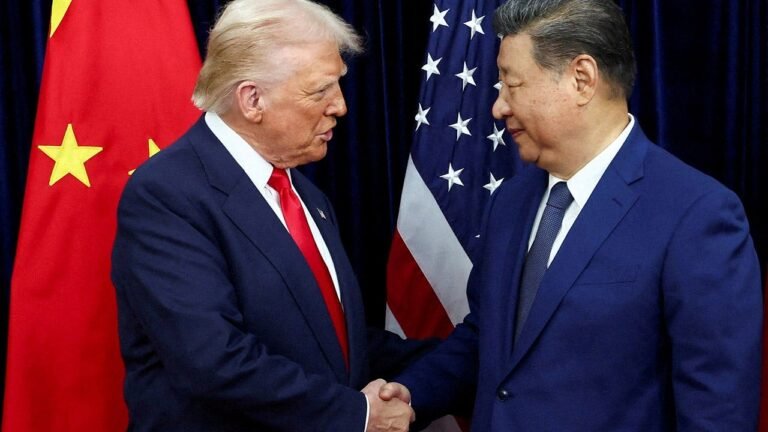
NEWYou can now listen to Fox News articles!
As President Donald Trump and hundreds of aides, security personnel and officials prepare to travel to China, many will leave behind one of the most basic tools of modern government: their everyday cellphones.
Instead, officials entering China often travel with stripped-down “clean” devices, temporary laptops and tightly controlled communications systems designed to minimize the risk of surveillance, hacking or data collection in what U.S. officials consider one of the world’s most aggressive cyber environments.
The precautions can transform even routine tasks into logistical headaches. Messages that would normally travel instantly through encrypted apps or synced devices are instead routed through controlled channels, temporary accounts or relayed in person.
CHINA-LINKED HACKING GROUP TARGETS PHONES BELONGING TO TRUMP FAMILY, BIDEN AIDES: REPORT
Contacts disappear. Cloud access is limited. Some officials operate for days without their normal digital footprint.
Current and former officials say the measures reflect a longstanding assumption inside the U.S. government: anything brought into China — phones, laptops, tablets or even hotel Wi-Fi connections — should be treated as potentially compromised.
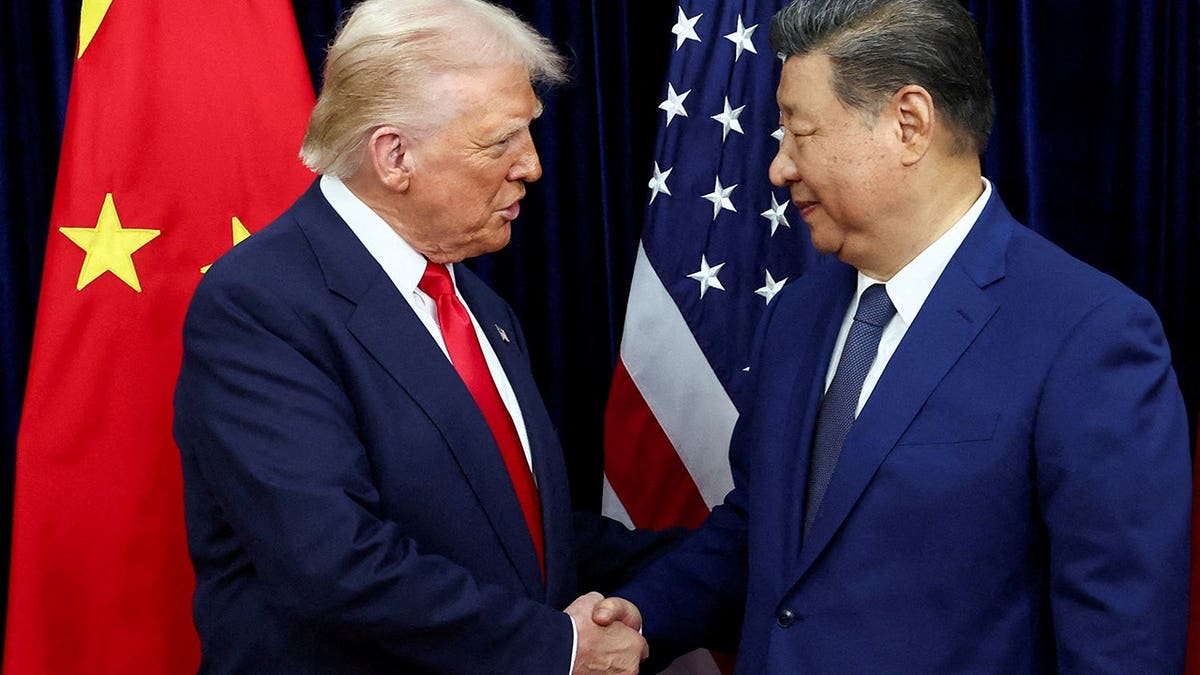
As President Donald Trump and hundreds of aides, security personnel and officials prepare to travel to China this week, many will leave behind one of the most basic tools of modern government: their everyday phones. (Evelyn Hockstein/Reuters)
“China is a mass surveillance state,” said Bill Gage, a former Secret Service special agent and now director of executive protection for Safehaven Security Group. “Briefings for U.S. officials begin well before the president arrives, and they make clear that everything is monitored.”
“We always tell people to assume everything you say and do — both in person and digitally — could be monitored,” said Theresa Payton, former White House chief information officer and CEO of cybersecurity firm Fortalice Solutions. “And to conduct themselves accordingly.”
Ahead of Trump’s high-stakes meetings with Chinese President Xi Jinping, the digital precautions underscore the broader mistrust shaping the relationship between Washington and Beijing, where cybersecurity, espionage and surveillance concerns now permeate nearly every aspect of official engagement.
TRUMP TO CONFRONT XI AT HIGH-STAKES SUMMIT OVER CHINA BACKING FOR IRAN, RUSSIA
The precautions will extend beyond government officials. The delegation traveling with Trump also is expected to include executives from major American firms, including Apple, Boeing, Qualcomm and BlackRock — companies operating at the center of the U.S.–China economic and technological relationship.
In Washington, officials are often told to leave their phones behind when entering places like the Chinese Embassy. Those same concerns are amplified when traveling to China itself, where U.S. officials operate under the assumption that devices, networks and even hotel rooms could be monitored.
Even charging a phone can become a security concern.
Federal cybersecurity guidance has long warned travelers to avoid plugging devices into unknown USB ports or untrusted charging systems because compromised hardware can potentially be used to extract data or install malicious software — a tactic commonly referred to as “juice jacking.”
As a result, officials traveling to high-risk countries often carry preapproved charging equipment, external battery packs and government-issued accessories rather than relying on local infrastructure.
“There are no safe electronic communications in China,” Gage said, noting officials are advised to limit digital activity to only what is necessary for the mission.
The Chinese government has rejected claims that it engages in improper surveillance.
“In China, personal privacy is protected by law,” Chinese Embassy spokesperson Liu Pengyu told Fox News Digital. “The Chinese government places a high priority on protecting data privacy and security in accordance with the law. It has never required—and will never require—enterprises or individuals to collect or store data in violation of the law.”
“China is a mass surveillance state,” said Bill Gage, a former Secret Service special agent and now director of executive protection for Safehaven Security Group. “Briefings for U.S. officials begin well before the president arrives, and they make clear that everything is monitored.” (iStock)
Payton said officials may also be issued temporary devices configured with known “golden images,” allowing security teams to detect whether a device has been altered or accessed during the trip.
“You may see executives issued loaner phones with a known ‘golden image,’ meaning security teams can compare the device before and after use to see if it’s been tampered with,” she said.
“There may be controlled ‘safe zones’ set up where officials can communicate back to the U.S., but everything is tightly managed,” Payton added.
When sensitive conversations need to happen, the logistics become even more complex.
U.S. officials traveling overseas frequently rely on temporary sensitive compartmented information facilities, or SCIFs — secure spaces designed to prevent electronic surveillance and eavesdropping. Those facilities can be established inside hotels or other controlled locations during major diplomatic trips.
“The White House Military Office and communications teams create controlled spaces where they can monitor both physical and digital access to ensure sensitive conversations remain secure,” Payton said.
The precautions can create a surprisingly analog environment for a modern presidential delegation. Paper documents become more common, digital access is restricted and aides accustomed to constant communication often operate through tightly controlled channels.

Officials entering China often travel with stripped-down “clean” devices, temporary laptops and tightly controlled communications systems designed to minimize the risk of surveillance, hacking or data collection in what U.S. officials consider one of the world’s most aggressive cyber environments. (iStock)
The White House could not immediately be reached for comment.
U.S. officials have spent years warning about Chinese cyber espionage campaigns targeting American government agencies, critical infrastructure, defense contractors and telecommunications networks.
Intelligence officials have accused Beijing-linked hackers of infiltrating everything from federal systems to power grids and water utilities, while repeatedly attempting to collect information on senior American officials and policymakers.
“China will conduct extensive research on every member of the U.S. delegation — from senior officials down to junior personnel,” Gage said, describing the level of intelligence targeting officials are warned about before traveling.
Payton said the high-profile nature of a presidential visit only increases the risk.
“This is a well-publicized event, so you have to assume everything from nation states to opportunistic actors may be trying to listen in,” she said.
CLICK HERE TO DOWNLOAD THE FOX NEWS APP
The issue exploded into public view in 2023, when a suspected Chinese surveillance balloon crossed the continental United States before being shot down by the U.S. military after traversing sensitive military sites. U.S. officials later said the balloon was part of a broader surveillance effort linked to Beijing.
More recently, federal officials have warned about sophisticated China-linked cyber groups such as Volt Typhoon and Salt Typhoon, which U.S. authorities say targeted critical infrastructure and telecommunications systems in ways that could support espionage or disruption during a future conflict.