Reference #18.50200117.1777658496.a2d40c04
https://errors.edgesuite.net/18.50200117.1777658496.a2d40c04
Reference #18.50200117.1777658496.a2d40c04
https://errors.edgesuite.net/18.50200117.1777658496.a2d40c04
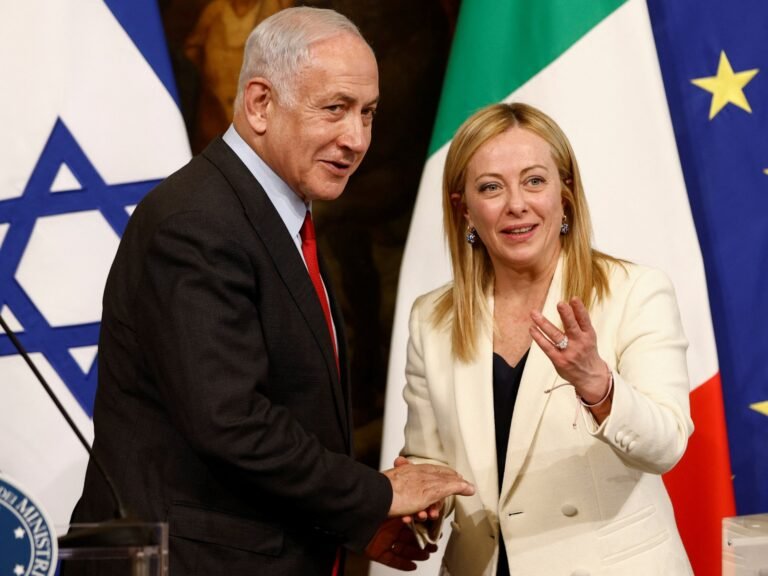
In 2014, during the Israeli assault on Gaza that killed more than 2,200 Palestinians, Giorgia Meloni, then just a member of the Italian parliament, wrote on social media: “Another massacre of children in Gaza. No cause is fair when it sheds the blood of the innocent.”
More than a decade on, that moral clarity is nowhere to be found.
As prime minister, Meloni’s remarks on Gaza have become increasingly cautious and equivocal, marked by the kind of “on the one hand, on the other” tone that frustrates many Italians. Her address on the war against Iran last March captured that ambiguity perfectly. She declared that she “neither condemns nor condones” the conflict, a sentence that managed to confuse many while clarifying nothing.
So when Italy announced earlier this month that it was suspending the automatic renewal of its defence pact with Israel, many observers hailed it as a turning point: Evidence, perhaps, that Meloni’s government was finally bending under the moral weight of Gaza’s destruction. Some hoped this gesture, however cautious, was a rare nod to the conscience of Italians who have marched for months, demanding an end to the war.
Yet it’s impossible to ignore the sequence that prompted the suspension. It did not follow the killing of some 75,000 Palestinians, nor the destruction of Gaza’s hospitals, schools and mosques. Meloni only acted after Israeli forces fired warning shots at a convoy of Italian United Nations peacekeepers in Lebanon, a follow-up to a 2024 incident in which two UNIFIL bases staffed by Italian personnel were struck by the Israeli army.
This pattern is telling. It took yet another direct affront to Italian personnel, not a humanitarian catastrophe, to move the Italian government.
The same reflex was visible when United States President Donald Trump insulted Pope Leo XIV. Only then did Meloni issue rare criticism of Trump, calling his words “unacceptable”. Up to that point, she had found his conduct in Gaza, Cuba, Venezuela and Lebanon quite tolerable. Once again, calculation intervened: She could not afford to alienate conservative Catholic voters who form the backbone of her political base.
Meloni’s foreign policy follows this script of moral performativity. Italy remains the only Western European and G7 nation to participate, even as an “observer”, in Trump’s so-called Board of Peace, a body that many Italian commentators have derided as cynical theatre, turning Italy into what one lawmaker called “a vassal of the United States”.
A European civil petition calling on the European Union to suspend its association agreement with Israel for “crimes in Gaza” gathered more than one million signatures; Italy ranked second in participation after France. This surge in public protest came after last October’s general strike in solidarity with the Global Sumud Flotilla, when more than two million Italians filled the streets, demanding an end to what many regard as genocide.
But the government’s symbolic gestures routinely dissolve once the spotlight shifts. Within days of suspending the defence pact, Italy quietly joined Germany in blocking the EU’s attempt, once again, to suspend the trade deal with Israel.
Meloni’s Italy, it turns out, performs dissent but practises obedience.
Just like when Foreign Minister Antonio Tajani loudly declared a halt to arms exports to Israel in January 2024, only for Defence Minister Guido Crosetto to clarify that the freeze applied solely to new licences, not existing contracts.
And this week, Meloni “condemned” Israel for seizing in international waters vessels from the Global Sumud Flotilla and detaining activists — including several Italians — yet took no concrete diplomatic action. Instead, she doubled down on her claim that the flotilla “doesn’t provide meaningful help to those in need.”But polls now show a widening gap between government rhetoric and public sentiment. Even many conservative voters who once sympathised with Israel have grown uneasy with the scale of civilian suffering, and a recent survey found that only 11 percent of Italians consider Israel “an ally”. For Meloni, who defines her leadership through nationalist pride and sovereignty, this unease is politically dangerous.
Symbolic posturing thus becomes vital.
Suspending an “automatic renewal” clause in a defence pact costs little. Israel’s own foreign minister admitted that the agreement had “no substantial content”. Trade and technology cooperation, by contrast, involves billions of euros and deep strategic coordination. While Rome’s announcement made front-page news, Italian diplomats in Brussels ensured that nothing of economic significance was jeopardised.
The reality is that Europe’s dependency on Israeli defence technology, cyber-intelligence and AI systems runs deep, and Italy is no exception. Italian industry giants Leonardo S.p.A. and Fincantieri maintain strong partnerships with Israeli firms such as Elbit Systems, with Leonardo producing components for the F-35 fighter jets heavily used in Gaza. Despite workers’ protests and petitions demanding a full severance of ties, those contracts continue unabated.
The contradictions extend into diplomacy. Italy has repeatedly abstained or voted against UN General Assembly resolutions calling for a ceasefire, refused to support Palestine’s bid for UN membership in May 2024, and sided with Israel against the International Criminal Court, with Tajani dismissing ICC prosecutor Karim Khan’s request for arrest warrants for Netanyahu and his defence minister as “unacceptable”.
Yet after the International Court of Justice recognised in January 2024 that there exists a plausible risk of genocide in Gaza, Italy, as a signatory to the Genocide Convention, became legally bound to act to prevent it. Continuing to supply weapons, munitions, explosives, and components facilitating Israel’s war effort constitutes not only complicity but a breach of international law. Each missed vote, each quiet licence renewal, reinforces that breach.
What, then, is Meloni’s endgame?
Sociologist Alessandro Orsini offers a fitting metaphor. In his book Gaza Meloni: The Foreign Policy of a Satellite State, he describes Meloni’s behaviour as a “viper strategy”: “When the sun is strong, the viper enjoys the light on the exposed rock. When the cameras shine on her, she says she ‘feels sorry’ for the Palestinians. But when the sun disappears, she retreats under the rock, just as she and Antonio Tajani do when political decisions in favour of Israel must be made.”
It’s a brutal but accurate portrait. Meloni’s humane instincts surface only when they carry no policy cost.
Part of this stems from Europe’s own collective guilt. The continent’s colonial and anti-Semitic histories have produced a moral timidity when confronting Israel. Another part is pure pragmatism: Energy dependence, defence cooperation, and intelligence sharing make Israel an indispensable partner for the EU project. European capitals, even when horrified by the images from Gaza or Lebanon, are reluctant to endanger that alliance.
Double standards, however, are corrosive, and this pattern of moral language masking self-interest seems to mirror Europe itself. France condemns Netanyahu one week and ships munitions the next. Germany cites historical responsibility to justify near-unconditional support. And Italy has allowed itself to become little more than a conduit of Trump and Netanyahu’s agendas.
Yet, as a country, we once played a unique role as a bridge between Europe and the Arab world, a role that combined pragmatism with empathy. That identity could still be rescued. But doing so requires more than ceremonial suspensions of defence pacts or carefully worded expressions of concern. It demands consistency, the courage to align foreign policy with declared values.
For Giorgia Meloni, that courage appears in short supply.
If Italy truly wishes to lead as a sovereign nation, it must rediscover the moral clarity Meloni once expressed as a young parliamentarian. The conviction that no cause is fair when it sheds the blood of the innocent. Until then, Italy will remain a bridge that no longer connects but collapses under the weight of its own hypocrisy.
The views expressed in this article are the author’s own and do not necessarily reflect Al Jazeera’s editorial stance.
NEWYou can now listen to Fox News articles!
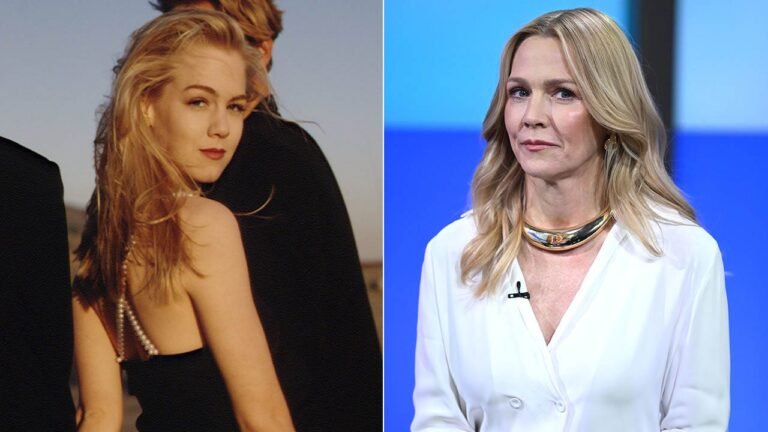
Jennie Garth recalled facing a “scary” financial transition after her “Beverly Hills, 90210” fame.
The 54-year-old actress starred as Kelly Taylor on the hit Fox drama for its entire run from 1990 to 2000. “Beverly Hills, 90210” became a cultural phenomenon and one of the defining teen shows of the decade, drawing millions of viewers at its peak.
By the later seasons, Garth was reportedly earning around $50,000 per episode. During a recent interview with Fox News Digital, Garth remembered how it was daunting to adjust from making a lucrative salary during her early 20s to a period without steady income after the show concluded.
“The security of being on a series is incredible, but inevitably, that series will come to an end,” she said during a recent interview with Fox News Digital. Garth, who recently released her new memoir “I Choose Me: Chasing Joy, Finding Purpose & Embracing Reinvention,” admitted that she had regrets over lacking financial knowledge during her youth.
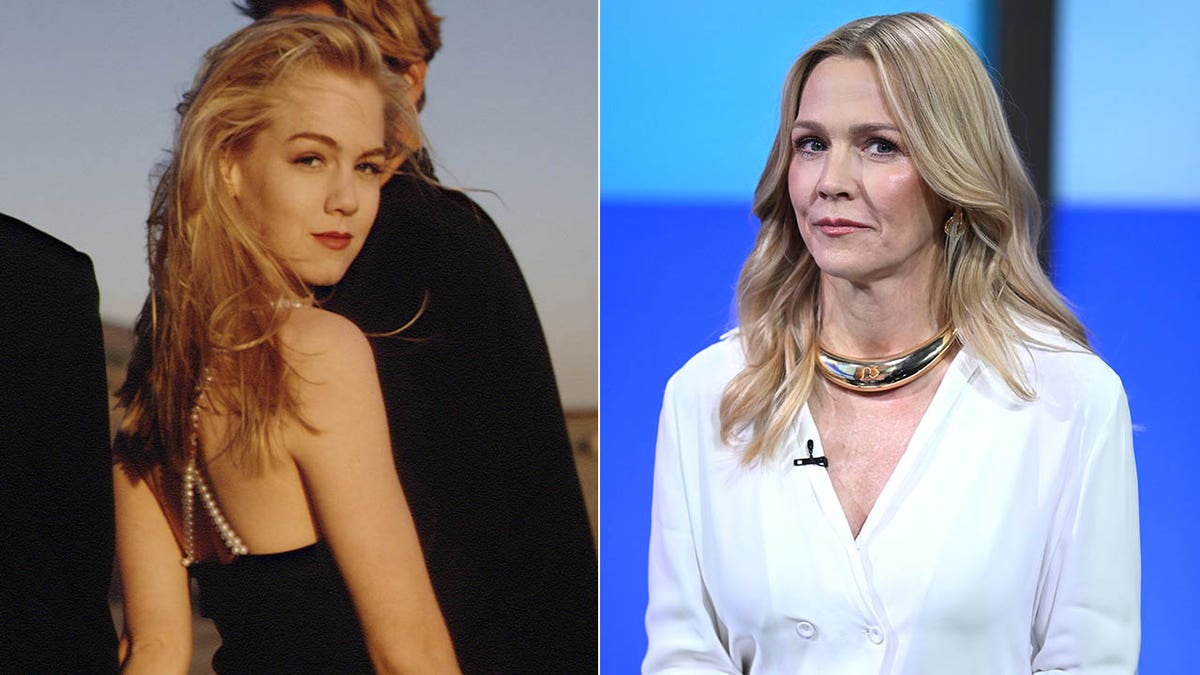
Jennie Garth opened up about facing a “scary” financial situation after her hit show “Beverly Hills, 90210” ended. (mikel roberts/Sygma via Getty Images; Michael Simon/Getty Images)
Her book, which is a mix of a memoir and inspirational guide, released on April 14.
“I luckily had great people helping me to plan and manage my money along the way,” Garth said. “I never knew much about it though. I sort of trusted them blindly, which I don’t recommend.”
“I wish I had gone to business school,” she added. “I wish had learned more.”
“There’s always time. Who knows?”
WATCH HERE: JENNIE GARTH ADMITS SHE ‘TRUSTED BLINDLY’ WITH MONEY AFTER ‘90210’ FAME
Garth said that her lack of financial confidence took on new urgency years later when she found herself fully responsible for her finances and future after her divorce from her ex-husband Peter Facinelli.
The “What I Like About You” alum and the “Twilight” actor wed in 2001 but finalized their divorce in 2013. The former couple share daughters Luca Bella, 28, Lola Ray, 23, and Fiona Eve, 19.
“I realized after my divorce — I think it was after my divorce from the girl’s father that I’m on my own, and it was this kind of really scary kind of concept at first,” she said. “But when you think about it, we’re born alone, really, we come into this world solo with the help of our parents, then we naturally leave our parents and go on about our lives and then we die alone.”
“When you have sort of an awareness of that and an acceptance of that…it makes you trust yourself more,” Garth continued. “You know you can rely on yourself. You know that you’re all you’ve got, really, at the end of the day. So you really start to have this newfound sort of respect for yourself and that you can figure anything out.”
“And especially when you go through troubling times, or you suffer loss, or grief, or career upsets, loss of a job, like all of that, you realize, ‘Look what I survived,'” she added. “You can look back on those things now and think, I handled all that. I’m still here. My kids are still breathing. Like, I’m doing great. There’s nothing I can’t handle. So everything gets a little less scary.”
While Garth faced financial challenges tied to inexperience and life changes, other stars from the 1980s and 1990s experienced far more severe financial setbacks, including bankruptcy, tax debt and the loss of entire fortunes.
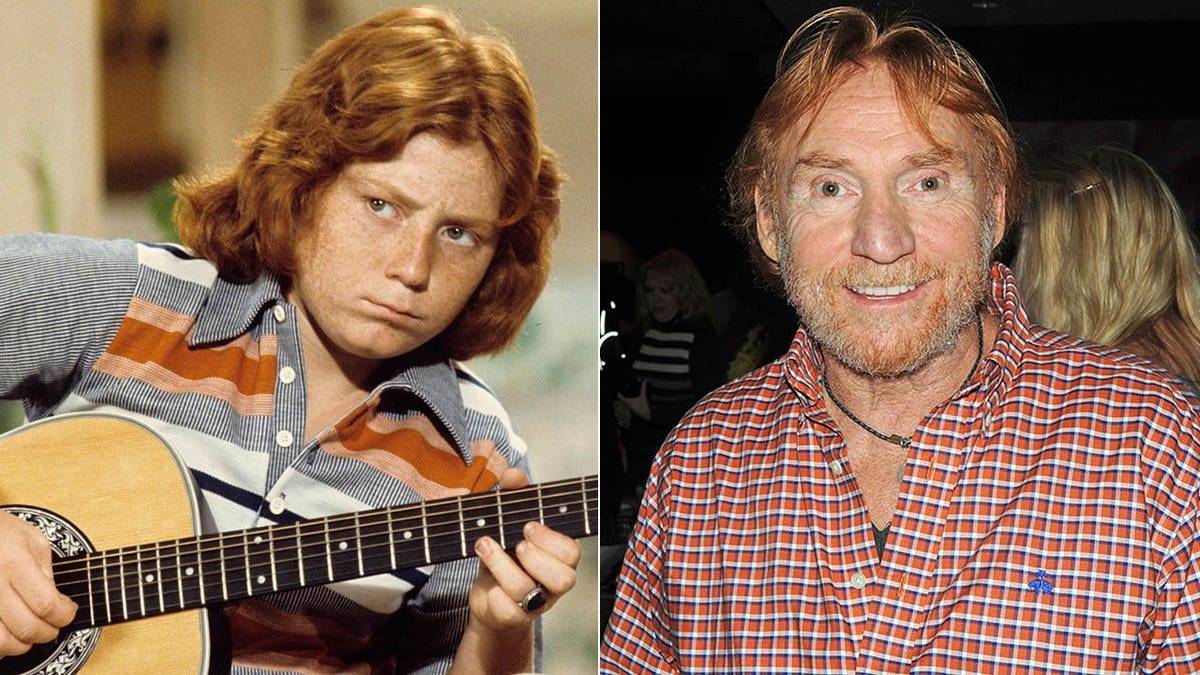
Danny Bonaduce faced substantial financial troubles after “The Partridge Family.” (Bobby Bank/Getty Images; ABC Photo Archives/Disney General Entertainment Content via Getty Images)
Danny Bonaduce rose to fame at the age of 11 when he played David Partridge in the hit sitcom “The Partridge Family” throughout its run from 1970 to 1974. However, Bonaduce previously revealed that he only made $400 an episode while starring on the show and faced difficulty finding work after it ended.
Bonaduce’s financial troubles were exacerbated by his struggles with drug and alcohol addiction. During a 2013 episode of Oprah Winfrey’s “Where Are They Now?,” Bonaduce recalled becoming homeless in his teenage years.
“I lived right behind this dumpster, but I lived in my car,” he said.
He explained that he would frequently sign autographs and pose with fans who were unaware that he was homeless at the time.
“When I was done or I knew they wouldn’t see me I would sneak back to my car,” he said. “It was totally embarrassing to be famous and homeless.”
Bonaduce also experienced a series of legal issues. In 1990, he was arrested for attempting to buy drugs while in Florida to speak at an anti-drug event. The next year, he was arrested again for robbing and assaulting a prostitute.
The actor began turning his life around in the late 1990s when he transitioned into radio hosting, which gave him steady work and structure after years of instability. By the early 2000s, he had stabilized both his career and personal life, leading to long-term financial and professional recovery.
In 2005, he starred in the reality show “Breaking Bonaduce” and in 2007, he was the host and judge of the VH1 series “I Know My Kid’s a Star.”
After decades in radio, he retired in December 2023 from his long-running morning show on Seattle’s KZOK-FM, which he had hosted since 2011.
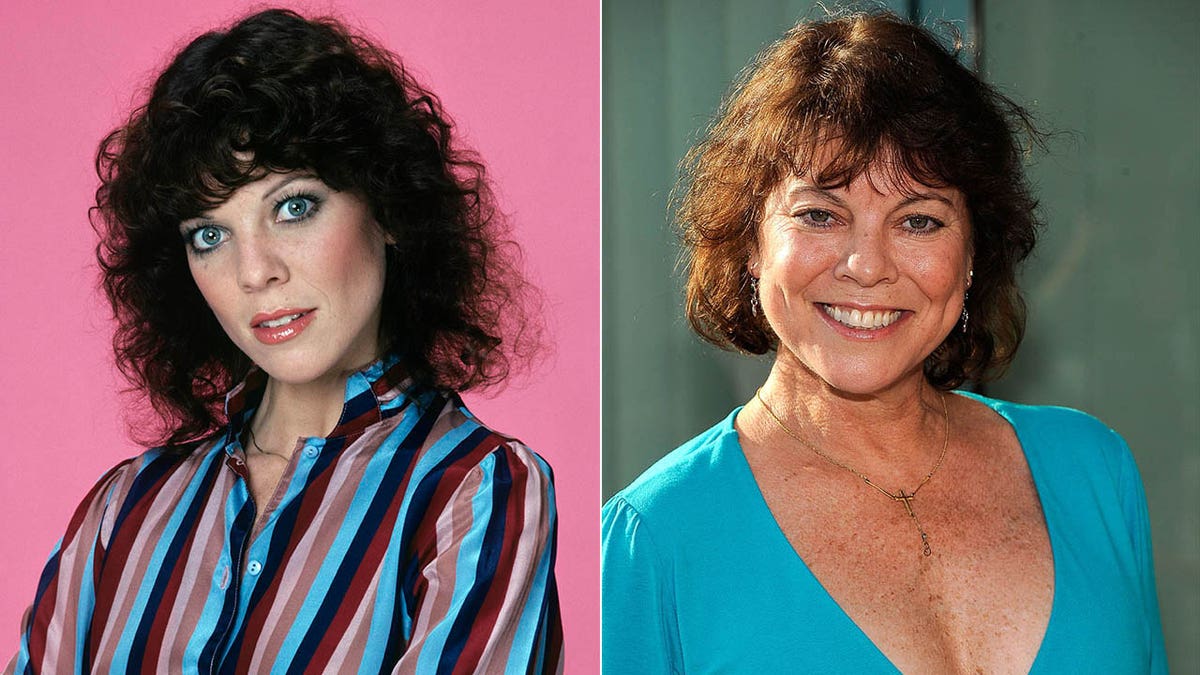
“Happy Days” star Erin Moran struggled to find acting work after the show ended and fell into poverty. (ABC Photo Archives/Disney General Entertainment Content via Getty Images; Frazer Harrison/Getty Images)
Erin Moran was best known for playing Joanie Cunningham on the hit show “Happy Days” from 1974 to 194, starting when she was 13. Moran went on to star in the short-lived spinoff “Joanie Loves Chachi” from 1982 to 1983 before returning for the final season of “Happy Days.”
In a 1988 interview with the Toronto Star via the New York Times, Moran said that she left Los Angeles behind and moved to the California mountains after suffering from depression and struggling to find acting work following the end of “Happy Days.”
She lost her California home to foreclosure in 2010 and eventually moved with her husband Steve Fleischmann, a Walmart employee, to Indiana, where they lived in a trailer with his mother. In 2012, she joined her “Happy Days” co-stars in a lawsuit against CBS over unpaid merchandising revenue, but each actor only received about $65,000 each in the eventual settlement.
Moran reportedly spent the settlement money quickly and experienced severe financial hardship in the years leading up to her death in April 2017 at the age of 56 due to complications of stage 4 throat cancer.
During a 2017 interview with The Sun, Moran’s brother Tony Moran reflected on her struggles after “Happy Days”
“Erin was a tortured soul who never recovered after Happy Days. Hollywood chewed her up and spat her out.”
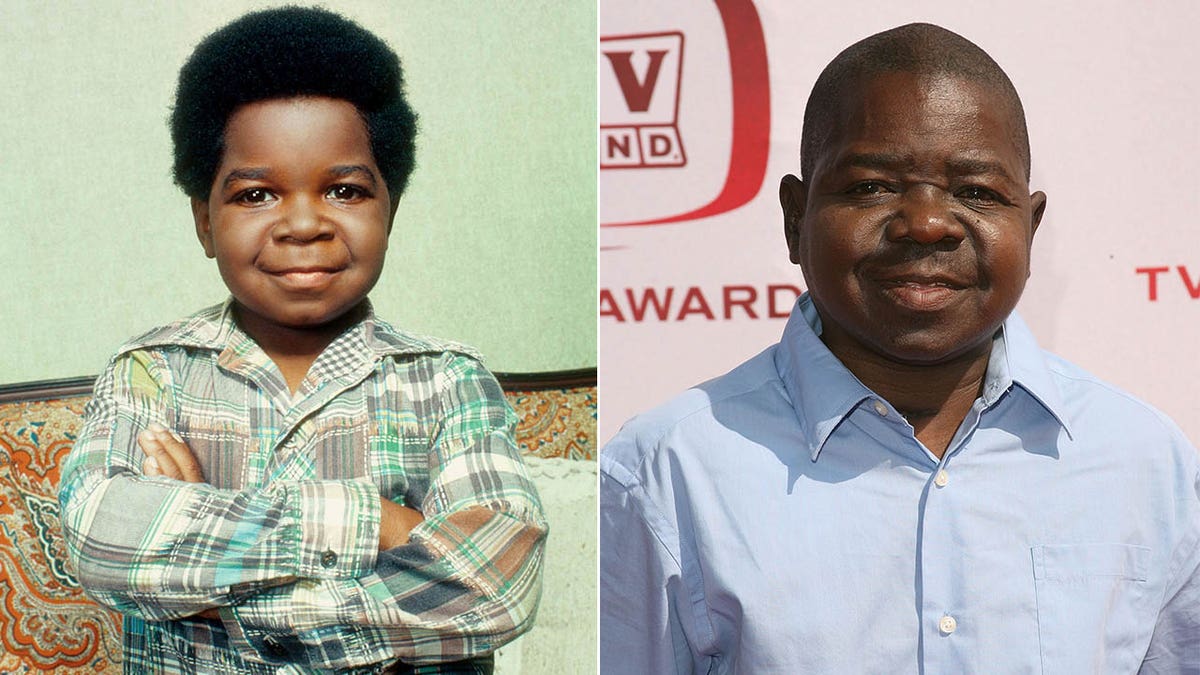
Former child star Gary Coleman sued his parents and manager for misappropriating his trust fund. (Jesse Grant/WireImage; Michael Ochs Archives/Getty Images)
Gary Coleman became a household name at age 10 when he played Arnold Jackson on the NBC sitcom “Diff’rent Strokes,” which aired from 1978 to 1986. At the height of his success, he was reportedly one of the highest-paid child actors on television, earning tens of thousands of dollars per episode. However, Coleman later said much of his fortune was mismanaged by Edmonia Sue Coleman and Willie Coleman along with his former business manager Anita DeThomas.
In 1989, he sued his parents and DeThomas for misappropriating his trust fund. He won a $1.28 million judgment in 1993, but much of the money was spent on legal fees and medical issues. Coleman suffered from congenital, progressive kidney disease throughout his life and underwent two failed transplants.
Coleman filed for bankruptcy in 1999, citing ongoing financial strain despite his earlier success. Reflecting on who was responsible for his financial struggles, he said, “I can spread that blame all the way around from me to accountants, to my adoptive parents, to agents to lawyers and back to me again,” according to E! Online.
In the years that followed, Coleman took on a variety of jobs to support himself, including working as a security guard and appearing in small television roles and commercials.
Coleman attempted to resurrect his career, but legal disputes dogged him repeatedly. He moved to Utah in 2005.
In September 2008, a dust up with a fan at a Utah bowling alley led Coleman to plead no contest to disorderly conduct. A lawsuit was settled out of court.
In early 2010, officers were called to assist or intervene with Coleman more than 20 times. Some of the disputes involved his wife Shannon Price, whom he met on the set of the 2006 comedy “Church Ball” and married in 2007.
Coleman died at the age of 42 in May 2010 after suffering a head injury from a fall at his home in Utah.
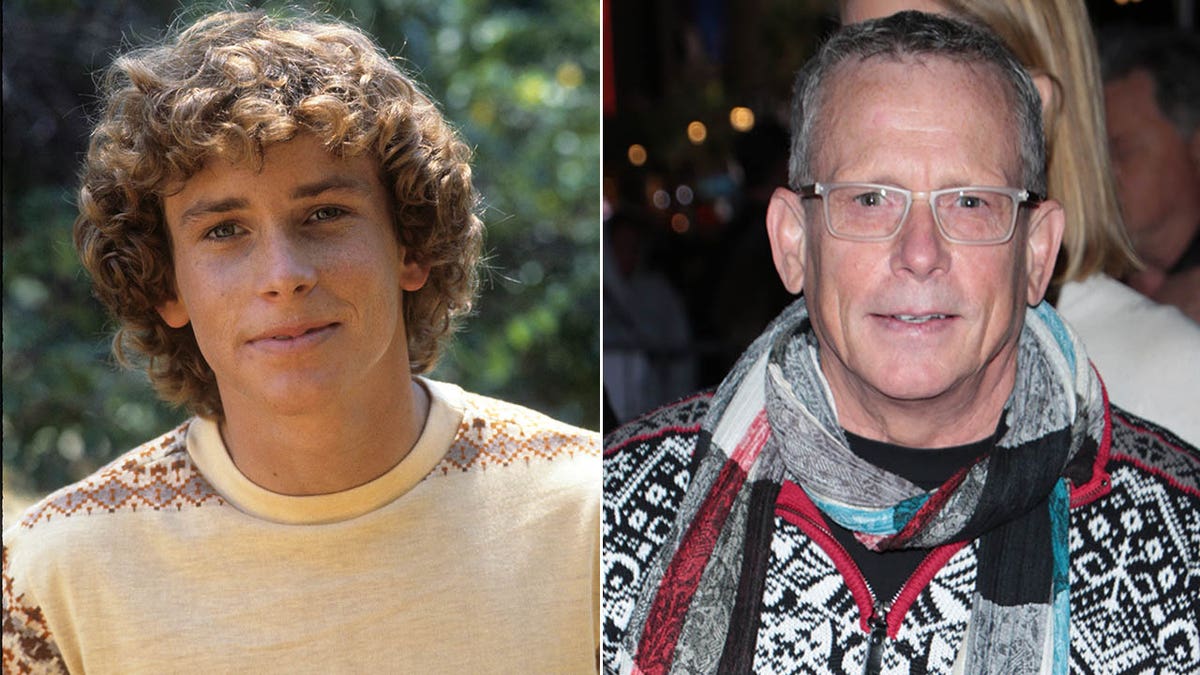
“Eight is Enough” star Willie Aames became homeless due to financial hardship and addiction issues. (ABC Photo Archives/Disney General Entertainment Content via Getty Images; GP/Star Max/GC Images)
Willie Aames is best known for playing Tommy Bradford in the hit TV series “Eight Is Enough” from 1977 to 1981 and Buddy Lembeck in the sitcom “Charles in Charge” from 1984 to 1990.
Aames’ financial struggles began in the 1990s as he struggled to find work as an actor and began struggling with substance abuse issues. The actor previously said that his financial situation had deteriorated significantly by the early 2000s due to poor financial decisions, lack of steady income and ongoing issues with addiction.
In 2008, he filed for bankruptcy and faced foreclosure on his home in Kansas, prompting him to sell personal possessions and memorabilia from his TV career. During an appearance on Entertainment Tonight, he revealed that he became “virtually homeless” in 2009.
“I stayed with friends when I could, slept in parking garages or slept in the park,” he said. “It was shameful. I remember laying underneath the bushes thinking, ‘Is this how it turns out? Is this how my life really turns out?'”
In 2010, Aames took on a job as a cruise director for Regent Seven Seas Cruises before later working for Oceania Cruises and Viking Cruises.
Aames returned to acting in small roles in 2016 and also became involved in counseling and motivational speaking, speaking publicly about his recovery and financial turnaround.
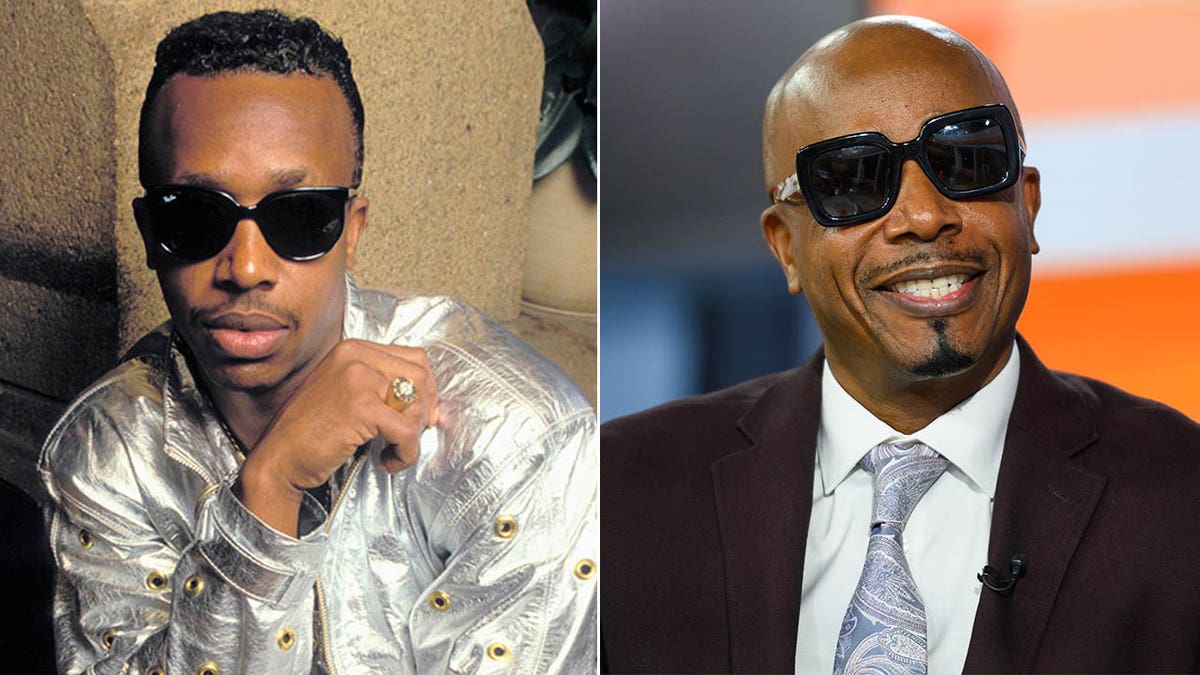
MC Hammer owed millions to the IRS due to lavish spending after early fame. (Frans Schellekens/Redferns; Nathan Congleton/NBC/NBCU Photo Bank via Getty Images)
MC Hammer became one of the biggest names in hip hop in 1990, following the release of his massively successful album “Please Hammer, Don’t Hurt ‘Em.” At the height of his career, he was earning tens of millions of dollars through music sales, touring and endorsements. However, Hammer also spent lavishly during this time. He employed a large entourage, maintained multiple properties and led an expansive lifestyle that required significant ongoing income.
Hammer’s finances began to collapse after his popularity declined in the mid-1990s. In 1996, he filed for bankruptcy with $13 million in debt. Hammer’s bankruptcy filing outlined substantial liabilities, including loans, back taxes and the costs associated with supporting a large staff.
In 2013, the IRS ordered Hammer to pay $800,000 in unpaid taxes for the years 1996 and 1997. Although the rapper tried to appeal the case, a federal judge ruled against Hammer in 2015.
Following his bankruptcy filing, Hammer worked to rebuild his financial footing by shifting into new areas, including technology, investing, and consulting. He remained active in media and business circles, often speaking about entrepreneurship and financial discipline.
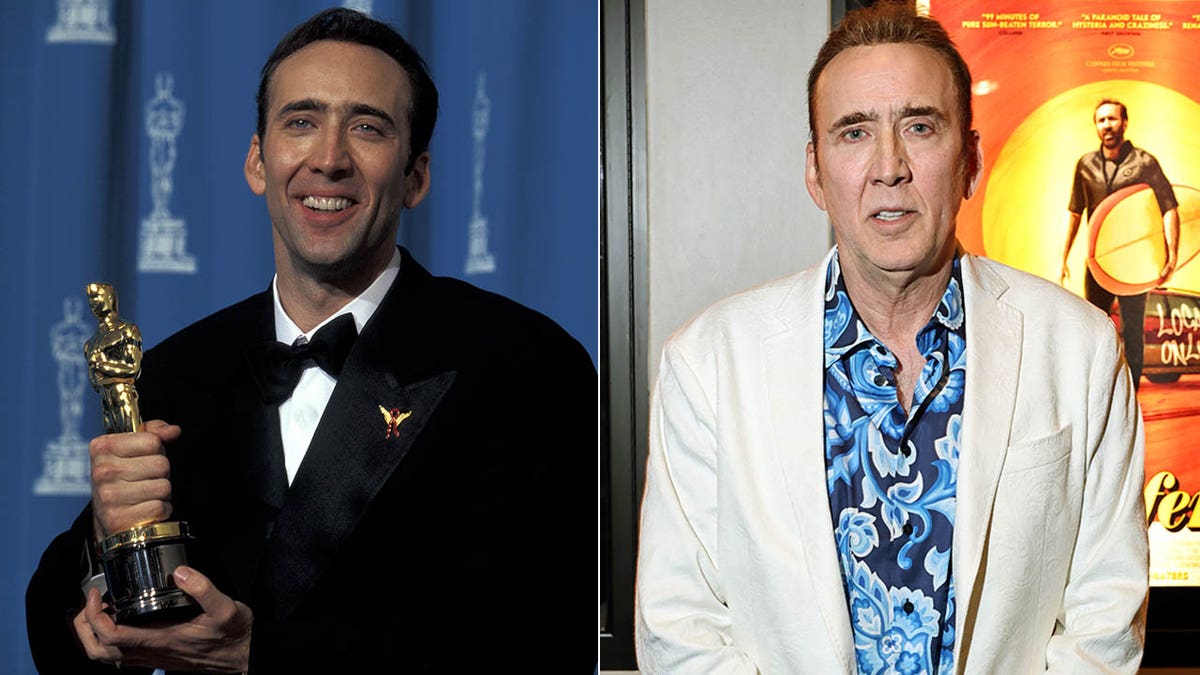
Nicolas Cage paid millions in tax debt after spending lavishly on property and rare artifacts including a dinosaur skull. (Eric Charbonneau/Roadside Attractions via Getty Images; Jim Smeal/Ron Galella Collection via Getty Images)
Nicolas Cage was one of Hollywood’s highest-paid actors in the late 1990s and early 2000s, earning tens of millions of dollars from major films and amassing a substantial fortune. At his peak, Cage’s fortune was estimated at $150 million.
However, his finances began to unravel in the late 2000s, largely due to heavy spending on real estate, rare collectibles and other high-cost purchases. The Academy Award winner famously bought castles in England and Germany, an island in the Bahamas and a mansion in New Orleans, Louisiana that is said to be haunted.
Some of his more unique purchases included a 67-million-year-old dinosaur skull which he bought at a Beverly Hills auction after outbidding Leonardo DiCaprio and genuine shrunken pygmy heads. Cage also owned an exotic animal collection that included an octopus and a crocodile.
By 2009, Cage was facing serious financial strain, including a dispute with the IRS over $6 million in unpaid taxes. He filed a $20 million lawsuit against his former business manager, Samuel Levin, alleging negligence and mismanagement, while also acknowledging his own role in the situation. During a 2023 appearance on CBS’ “60 Minutes,” he emphasized that his past financial struggles were due in part to his investment strategy, explaining that he had concentrated too much of his wealth in property at the wrong time.
MICKEY ROURKE’S LATEST CRISIS LEADS TO CROWDFUNDING CAMPAIGN FOR ALLEGED UNPAID RENT MONEY
“I over-invested in real estate,” he said. “It wasn’t because I spent $80 on an octopus. The real estate market crashed, and I couldn’t get out in time.”
In the years that followed, Cage worked steadily to recover financially, taking on a large number of film roles to repay his IRS debts.
“I paid them all back,” he said on “60 Minutes.” “It was about $6 million. I never filed for bankruptcy.”
Cage acknowledged that it was a “dark” period of time but staying busy with his acting career helped him.
“Work was always my guardian angel,” he said. “It may not have been blue chip, but it was still work.”
By the 2020s, Cage had largely stabilized his finances, continuing to act regularly while maintaining a more measured approach to spending.
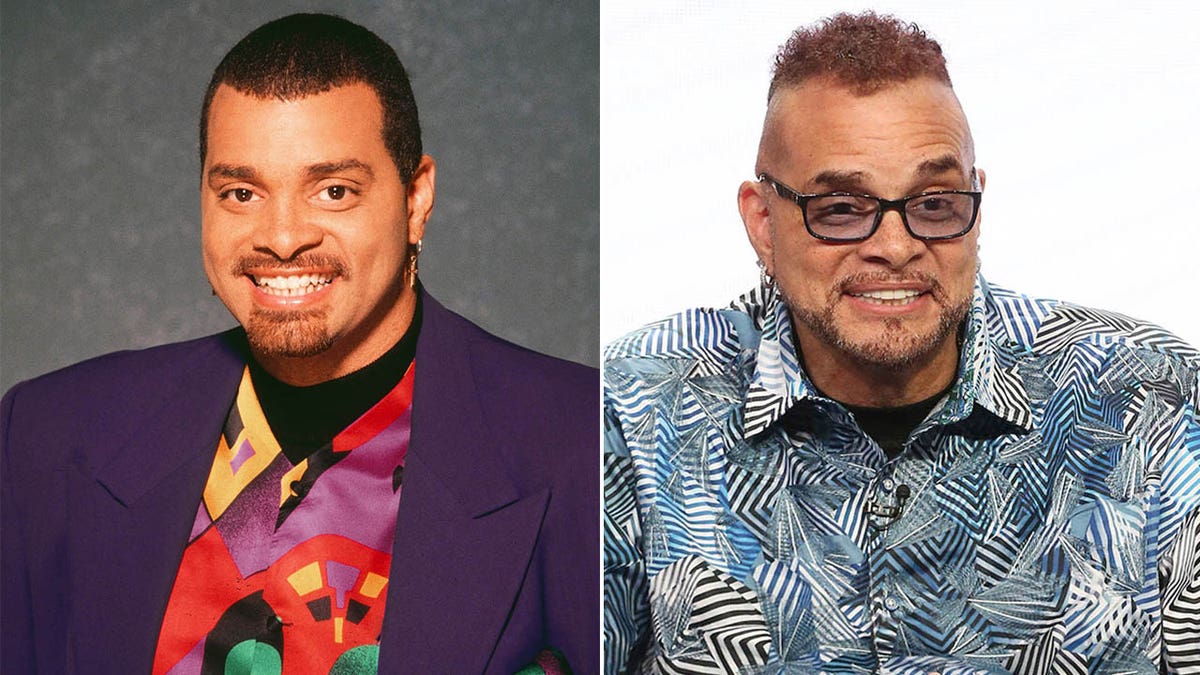
Sinbad paid off millions in IRS debt after his early success. (Harry Langdon/Getty Images; Frederick M. Brown/Getty Images)
Sinbad, the comedian and actor known for roles in films including “Houseguest” and the sitcom “The Sinbad Show,” enjoyed steady success in the 1990s but later faced significant financial problems tied largely to unpaid taxes.
According to court filings, he accumulated millions of dollars in tax debt to the IRS dating back to the 1990s and early 2000s. In 2009, Sinbad filed for Chapter 13 bankruptcy, reporting liabilities that included millions owed in back taxes. The case was dismissed after Sinbad failed to meet the court’s repayment plan requirements, allowing his tax debts to continue accumulating.
In 2013, he filed for bankruptcy again, listing $10.9 million in total debts of which approximately $8.3 million was owed to the IRS.
During a 2013 appearance on HuffPost Live, Sinbad said that he had expected he would be offered a role that would enable him to cover his spending.
“I spent money, and I kept thinking, ‘I get one more movie, and I’ll wipe these bills out,’ but that movie never came,” he said. “I said, ‘Man, I’m going to hang in there, I’m going to pay these bills.’ So you owe a million dollars. I can pay that. OK, fines, fees, now you owe two and a half million. ‘But I didn’t do nothin’!’ Now you owe four million.”
In the years that followed, Sinbad continued to work in entertainment, taking on stand-up performances and occasional acting roles. However, his financial recovery has been complicated by ongoing obligations and serious health issues after he suffered a stroke in 2020.
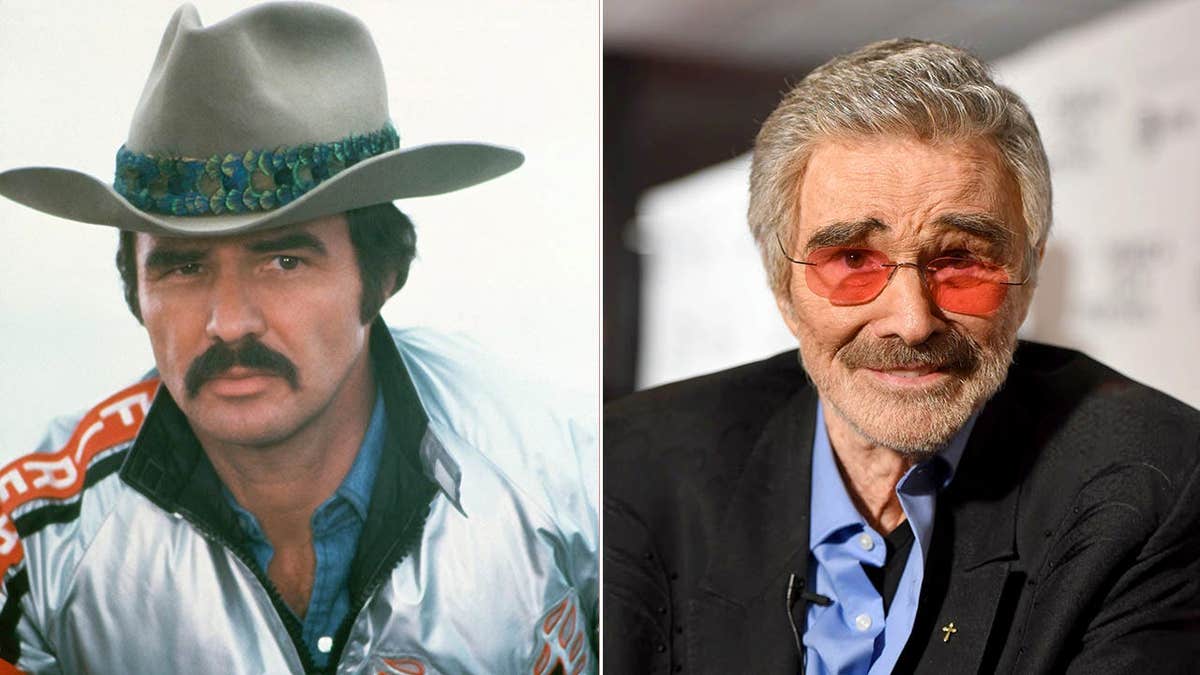
Burt Reynolds was one of Hollywood’s most in-demand actors before facing money troubles later in life. (Screen Archives/Getty Images; Noam Galai/Getty Images for Tribeca Film Festival)
Burt Reynolds was one of Hollywood’s biggest stars in the 1970s and 1980s, earning millions from box office hits including “Smokey and the Bandits” and “Deliverance. Reynolds became one of the industry’s highest-paid actors and his net worth was estimated at over $60 million at the height of his career, according to People magazine.
However, Reynolds began experiencing financial struggles in the late 1980s and early 1990s due to a combination of high spending, costly real estate holdings and a series of unsuccessful business ventures including his Southern-style, casual restaurant chain Po’ Folks.
His financial troubles were exacerbated by his high-profile 1993 divorce from actress Loni Anderson, which involved a costly settlement, as well as declining acting opportunities compared to his peak years.
In 1996, Reynolds filed for Chapter 11 bankruptcy, citing debts of more than $10 million.
“I lost more money than is possible because I just haven’t watched it,” he admitted during an interview with Vanity Fair in 2015. “I’ve still done well in terms of owning property and things like that. But I haven’t been somebody who’s been smart about his money.”
However, Reynolds continued working steadily in film and television, including a critically acclaimed role in 1997’s “Boogie Nights,” which helped revive his career. While he was able to regain some financial stability through consistent work, he never returned to the level of wealth he had once enjoyed before his death from a heart attack at the age of 82 in 2018.
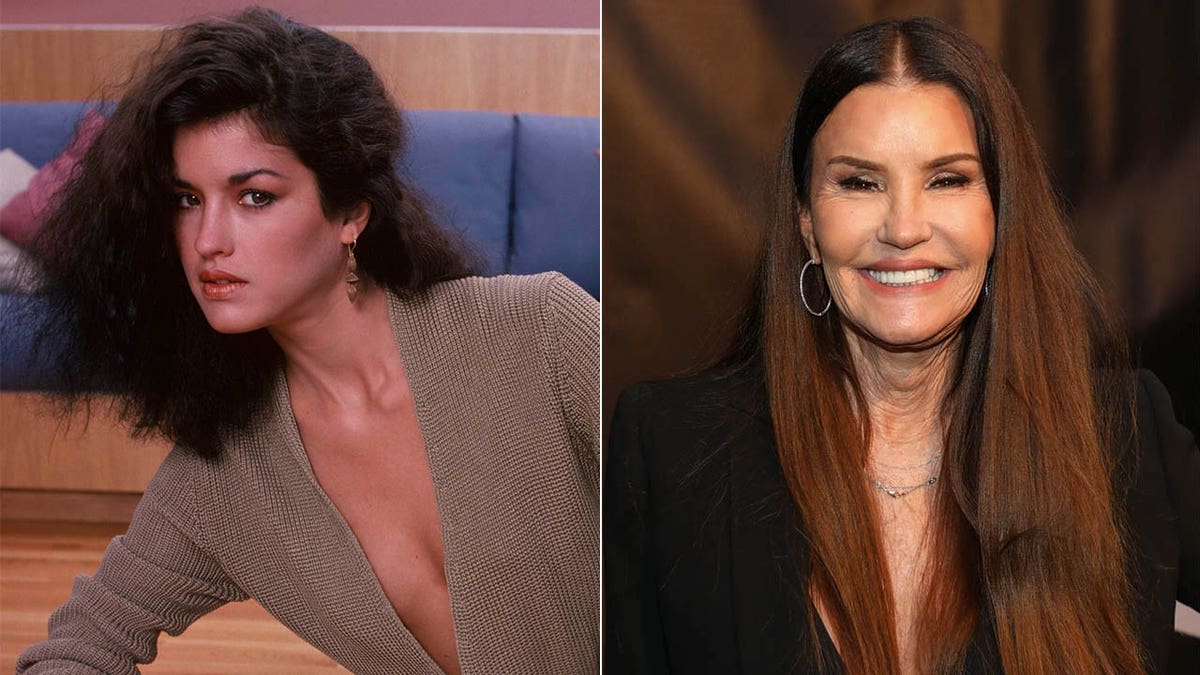
Janice Dickinson experienced financial woes after her success as a supermodel. (Susan Wood/Getty Images; Paul Archuleta/Getty Images)
Janice Dickinson rose to prominence in the 1970s and 1980s as one of the most recognizable supermodels of her era. At the height of her career, she earned substantial income from modeling, endorsements and media appearances. However, she began to experience financial issues in the mid to late 2000s due in part to inconsistent income, high expenses and mounting tax debt.
By 2013, Dickinson’s financial problems had become severe and she filed for Chapter 11 bankruptcy. Court filings showed she owed more than $1 million in back taxes, primarily to the IRS and the state of California, along with additional debts to other creditors.
“I had some trouble, so yes, it is true,” the former “America’s Next Top Model” judge told Radar Online at the time. “I am upset and taking every step to pay everyone back and I feel terrible about it.”
CLICK HERE TO SIGN UP FOR THE ENTERTAINMENT NEWSLETTER
In 2014, a bankruptcy judge approved a repayment plan, which allowed her to pay back a reduced portion of the debt over time rather than the full amount.
Following the bankruptcy, Dickinson continued working in television and media, including reality shows and public appearances.
LIKE WHAT YOU’RE READING? CLICK HERE FOR MORE ENTERTAINMENT NEWS
During a 2024 interview with the Telegraph, Dickinson reflected on her bankruptcy filing and past financial struggles.
“I lost track of what I was spending and it started to add up,” she said. “I went overboard and I couldn’t afford to cover my checks — my American Express bills, mostly.”
CLICK HERE TO DOWNLOAD THE FOX NEWS APP
The supermodel also shut down rumors that medical bills for plastic surgery procedures contributed to her financial woes.
“I’ve never paid for any plastic surgery,” she said. “Doctors approach me to offer me surgery, for the privilege of working on me.”


Microsoft has fixed a known issue causing newly introduced Windows security warnings to display incorrectly when opening Remote Desktop (.rdp) files.
This known issue affects all supported Windows versions, including Windows 11 (KB5083768 & KB5083769), Windows 10 (KB5082200), and Windows Server (KB5082063), on devices with multiple monitors and different display scaling settings.
Microsoft addressed the bug in the optional KB5083631 preview cumulative update for Windows 11, released on Thursday, along with 34 other changes.
“This update addresses an issue that affects the Remote Desktop Connection security warning dialog. The dialog could render incorrectly in multi-monitor scenario when the monitors had different scaling set,” Microsoft said. “This might occur after installing the April 2026 (KB5083769) security update.”
As Microsoft explained when it acknowledged the bug on Wednesday, the security warnings appearing when opening RDP files may not display correctly. On affected Windows systems, the buttons in the alert windows are misaligned or partially hidden, and the text is hard to read, making it difficult, and in some cases impossible, to interact with the security dialog.
These warnings were introduced on Windows systems with the April 2026 cumulative updates to disable risky shared resources by default as a defense against phishing attacks that abuse Remote Desktop connection (.rdp) files.

RDP files are commonly used to connect to remote systems in enterprise environments because they can be preconfigured to automatically redirect local resources to a remote host. However, threat actors have also increasingly abused them in phishing campaigns, including the Russian APT29 cyber-espionage group, which has used them to steal documents and credentials from victims’ devices remotely.
After installing the April security updates, a one-time educational prompt will appear when opening an RDP file for the first time, warning about the associated risks.
Afterward, a security dialog is displayed before any connection is made when opening RDP files, showing whether the file is signed by a verified publisher, the remote system’s address, and all local resource redirections (including drives, clipboard, or devices), with every option disabled by default.
If RDP files are not digitally signed, Windows displays a “Caution: Unknown remote connection” warning, with the publisher labeled as unknown. However, if they are digitally signed, Windows will warn users to verify their legitimacy before connecting.
According to user reports, the KB5083769 security update also breaks third-party backup apps from multiple vendors on Windows 11 24H2 / 25H2 systems due to a VSS (Volume Shadow Copy Service) timeout.
Last month, Microsoft also released out-of-band (OOB) updates to fix multiple Windows Server issues that caused restart loops and update installation failures after installing the April 2026 security updates.

AI chained four zero-days into one exploit that bypassed both renderer and OS sandboxes. A wave of new exploits is coming.
At the Autonomous Validation Summit (May 12 & 14), see how autonomous, context-rich validation finds what’s exploitable, proves controls hold, and closes the remediation loop.
Claim Your SpotThe Pentagon said on Friday it had reached agreements with seven leading artificial intelligence (AI) companies: SpaceX, OpenAI, Google, Nvidia, Reflection, Microsoft and Amazon Web Services.
“These agreements accelerate the transformation toward establishing the United States military as an AI-first fighting force and will strengthen our warfighters’ ability to maintain decision superiority across all domains of warfare,” the Pentagon said in statement.
The US Department of Defense is budgeting tens of billions of dollars for numerous technology firms’ cutting edge programs related to intelligence, drone warfare, classified and unclassified information networks and much more.
The plans have sparked disputes with some AI firms and controversy and concerns over public spending, global cyber security and the capacity for such technology to be used for domestic surveillance.
In January Pete Hegseth, the secretary of defense, unveiled a new “AI acceleration strategy” at the Pentagon that he said will “unleash experimentation, eliminate bureaucratic barriers, focus on investments, and demonstrate the execution approach needed to ensure we lead in military AI and that it grows more dominant into the future”.
On Friday, the department announced that the companies mentioned will be integrated into what it called the Pentagon’s “Impact Levels 6 and 7” network environments to “streamline data synthesis, elevate situational understanding, and augment warfighter decision-making in complex operational environments”, according to a federal statement.
“These agreements accelerate the transformation toward establishing the United States military as an AI-first fighting force and will strengthen our warfighters’ ability to maintain decision superiority across all domains of warfare,” the Pentagon’s statement added.
Another AI giant, Anthropic, has been in dispute with the Pentagon over guardrails for how the military could use its artificial intelligence tools, which led the Pentagon to label Anthropic a supply-chain risk last month, barring its use by the Pentagon and its contractors.
More details soon…
Reuters contributed reporting.
NEWYou can now listen to Fox News articles!
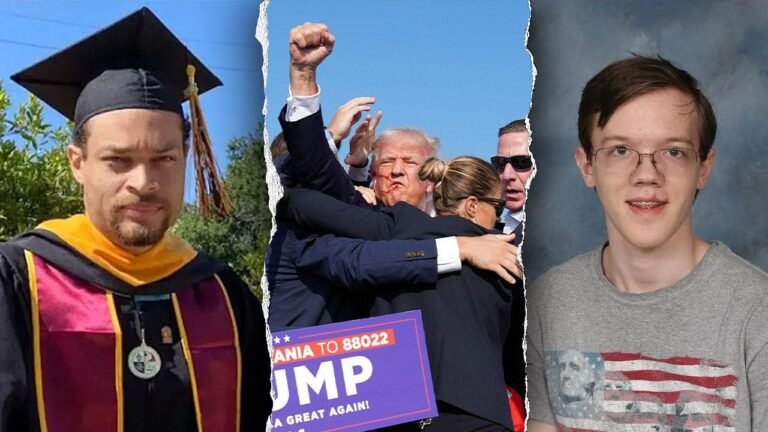
In a matter of days, authorities have revealed a trove of information about Cole Allen after he allegedly tried to assassinate President Donald Trump, while the public has learned little about Thomas Crooks nearly two years after his assassination attempt.
The contrast raises new questions about transparency and what remains unknown about Crooks’ shooting of Trump, and experts say the explanation may be simpler than it seems.
In the latest case, investigators quickly developed a clearer picture of the suspect’s apparent grievances, communications and alleged planning. But in the Crooks case, key questions about motive and mindset have lingered long after the shooting, fueling speculation about what investigators know and why the public still knows so little.
Experts who study assassination attempts and targeted violence say the difference often comes down to evidence.
ALLEGED WOULD-BE TRUMP ASSASSIN SHOT SECRET SERVICE OFFICER ‘POINT-BLANK’ IN DC HOTEL, DIRECTOR SAYS
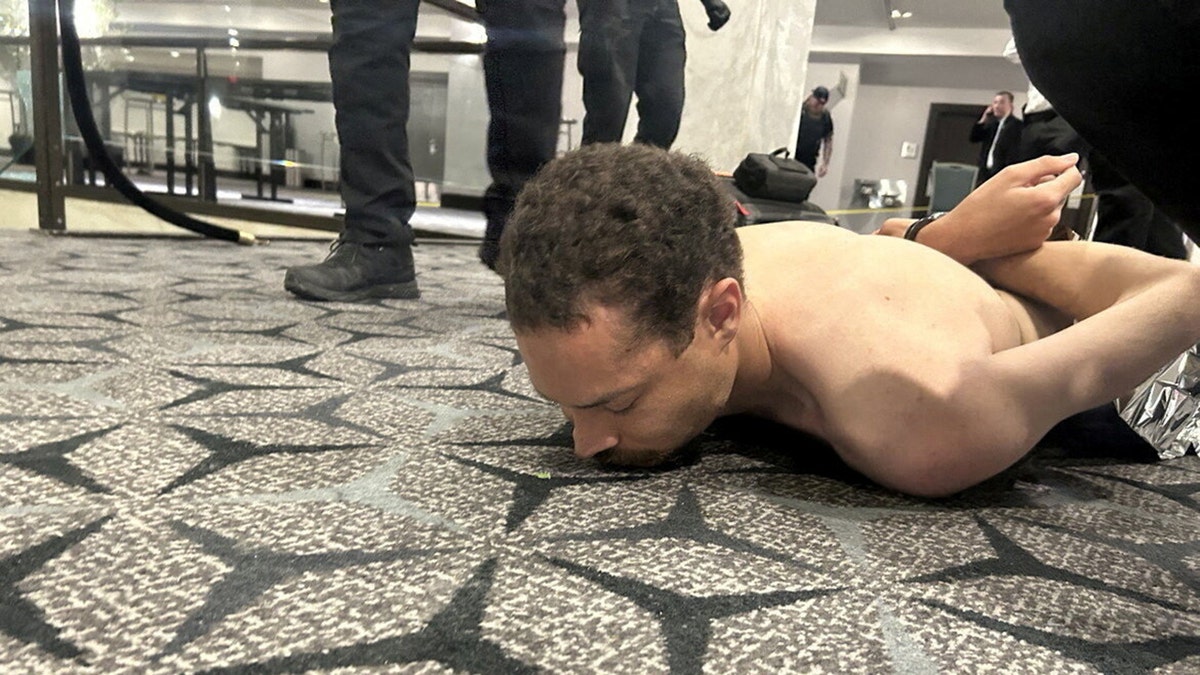
Law enforcement personnel detain Cole Tomas Allen, a suspect in the shooting incident at the White House Correspondents’ Association Dinner in Washington, D.C., on April 25, 2026. (Donald J Trump via Truth Social/Handout via Reuters)
Sometimes, they say, one offender simply leaves behind far more information than another.
Allen, a 31-year-old California computer scientist, is accused of opening fire at the White House Correspondents’ Association Dinner on Saturday, April 25, after allegedly rushing a Secret Service checkpoint armed with multiple weapons. He now faces federal charges, with more expected.
By contrast, Crooks, who carried out the 2024 assassination attempt against Trump at a rally in Butler, Pennsylvania, was shot and killed at the scene, limiting the scope of the investigation and what information became public.
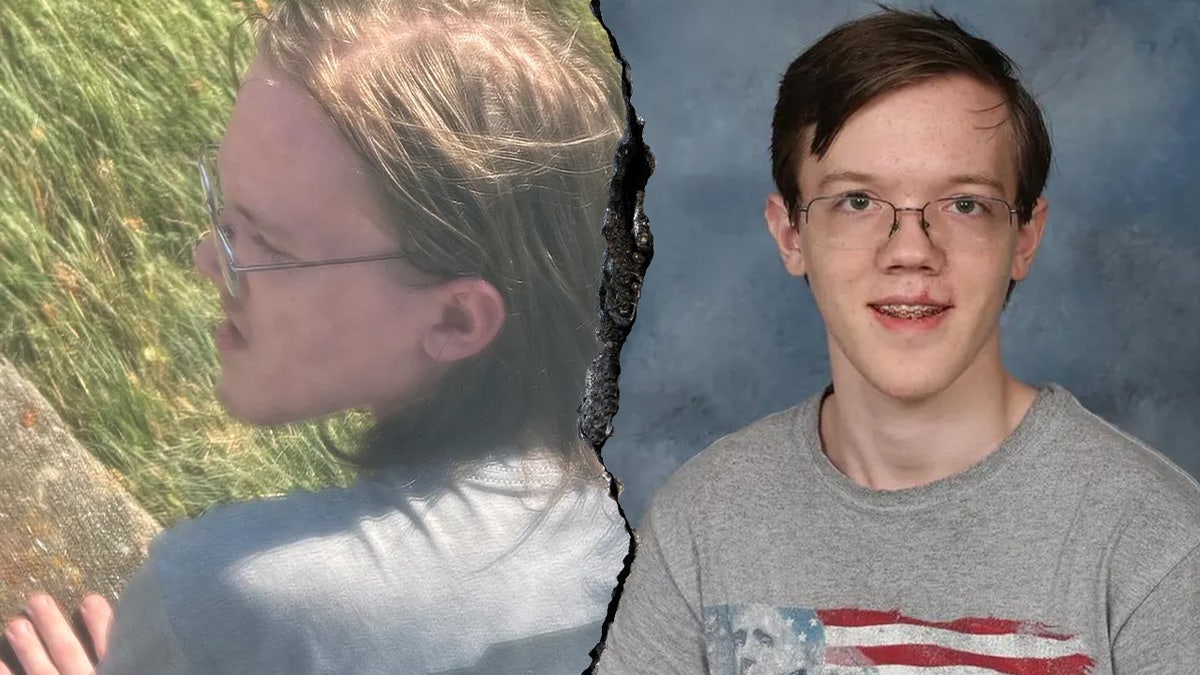
Thomas Matthew Crooks, a 20-year-old from Bethel Park, Pennsylvania, attempted to assassinate then-former President Donald Trump during a 2024 campaign rally before being shot and killed by Secret Service agents. (Obtained by Fox News Digital)
“There really just isn’t always an answer. There isn’t always a clear motive,” Nicole Parker, former FBI special agent, Fox News contributor and author of “The Two FBIs,” told Fox News Digital.
Parker said in some cases, investigators are left with very little to work from, especially when a suspect has few connections or leaves behind a limited digital footprint.
“I don’t believe the FBI is hiding anything,” Parker said. “There’s probably just not as much evidence in that case to point investigators in a clear direction.”
DC SNIPER INVESTIGATOR REVEALS LIKELY BREAKING POINT OF ALLEGED WOULD-BE TRUMP ASSASSIN
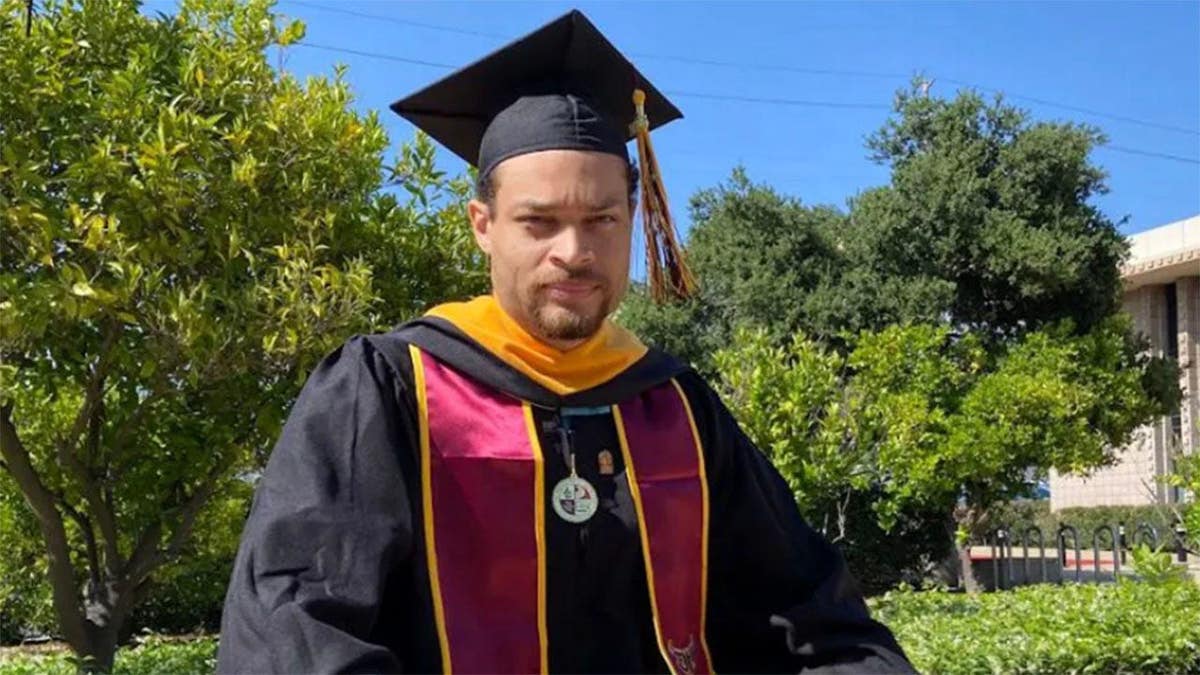
A photo of Cole Allen in a graduation gown and cap from 2025. (Cole Allen/LinkedIn)
At the same time, Parker said more information is emerging quickly in the Allen case, in part due to a broader push for transparency.
“The Trump administration is focused on getting facts out quickly to avoid conspiracy theories,” she said, noting officials are releasing information “to the extent possible without compromising the investigation.”
TRUMP ASSASSINATION ATTEMPT SUSPECT LEGAL TEAM BATTLES DOJ OVER EVIDENCE, TEST-FIRING GUN
“Every case is different,” the FBI said in a statement to Fox News Digital. “When a prosecution is pending, the FBI works closely with prosecutors on what can be released without interfering with the trial process. The FBI and the Department of Justice, along with our local partners, have had multiple press briefings since Saturday’s shooting. Because this is an ongoing investigation as well as ongoing legal process, the FBI cannot comment further at this time.”
Forensic psychiatrist Park Dietz, an expert on criminal behavior, said the difference between the two cases often starts with the suspect.
WATCH: Dana Perino: People who know better are doing this for clicks
Dietz, president of Park Dietz & Associates and founder of the Threat Assessment Group, has worked on some of the nation’s most high-profile criminal cases, including those involving Reagan shooter John Hinckley Jr., serial killer Jeffrey Dahmer and the Unabomber.
In Allen’s case, Dietz said, the suspect appears to have left investigators with far more to analyze.
“Allen left a bigger trail,” Dietz said. “He had contact with more people. He wrote a lot online. And he, of course, sent this missive at the last moment explaining his actions.”
WHITE HOUSE CORRESPONDENTS’ DINNER SHOOTING SHARPENS FOCUS ON TRUMP’S BALLROOM CONSTRUCTION PROPOSAL
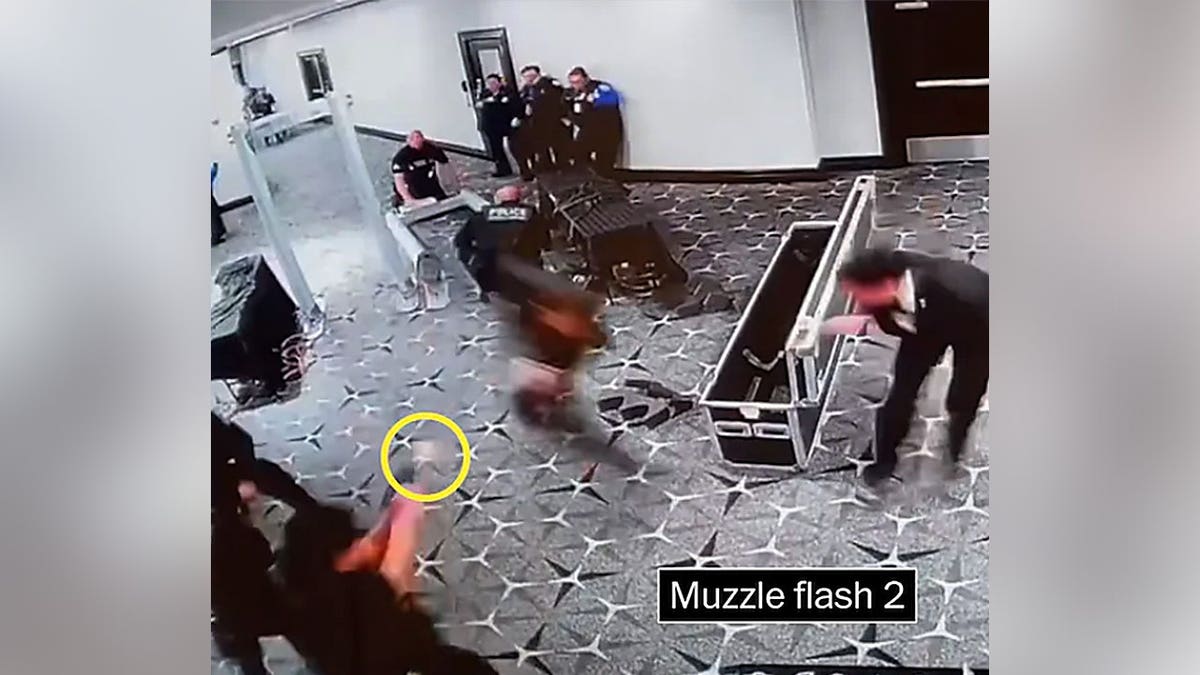
A Secret Service agent fires at Cole Allen, suspected in the assassination attempt of President Donald Trump, at the White House Correspondents’ Association Dinner on Saturday, April 25, 2026. (Obtained by The Washington Post)
Dietz said that kind of trail, communications, writings and personal contacts can accelerate how quickly investigators and the public understand a suspect’s mindset.
“Some of this is determined by the offender,” Dietz said. “How public are they going to be about their motives and nature of their grievances?”
Dietz said early indicators point to a familiar pattern seen in these types of cases.
WATCH: New video shows WHCA alleged shooter walking through hallways, charging security checkpoint
NEW BOOK DETAILS SECURITY LAPSES AHEAD OF TRUMP ASSASSINATION ATTEMPT: ‘CLEAR THERE WAS A PROBLEM’
“It’s very clear that this is primarily a grievance,” he said. “The fact that he wrote to his family, justifying his actions and explaining why he was taking them indicates that he’s aware that this is going to become public information, that it will be a historical document.”
“So there is a fame-seeking portion of this,” Dietz added. “But grievance is the primary motivation.”
Reid Meloy, a forensic psychologist and former consultant to the FBI Behavioral Analysis Unit, said the Crooks case differs in one key way — it never moved toward prosecution.
DEM AND GOP LAWMAKERS TRADE BLAME OVER RHETORIC AFTER WHCD SHOOTING: ‘IT IS DISGUSTING’
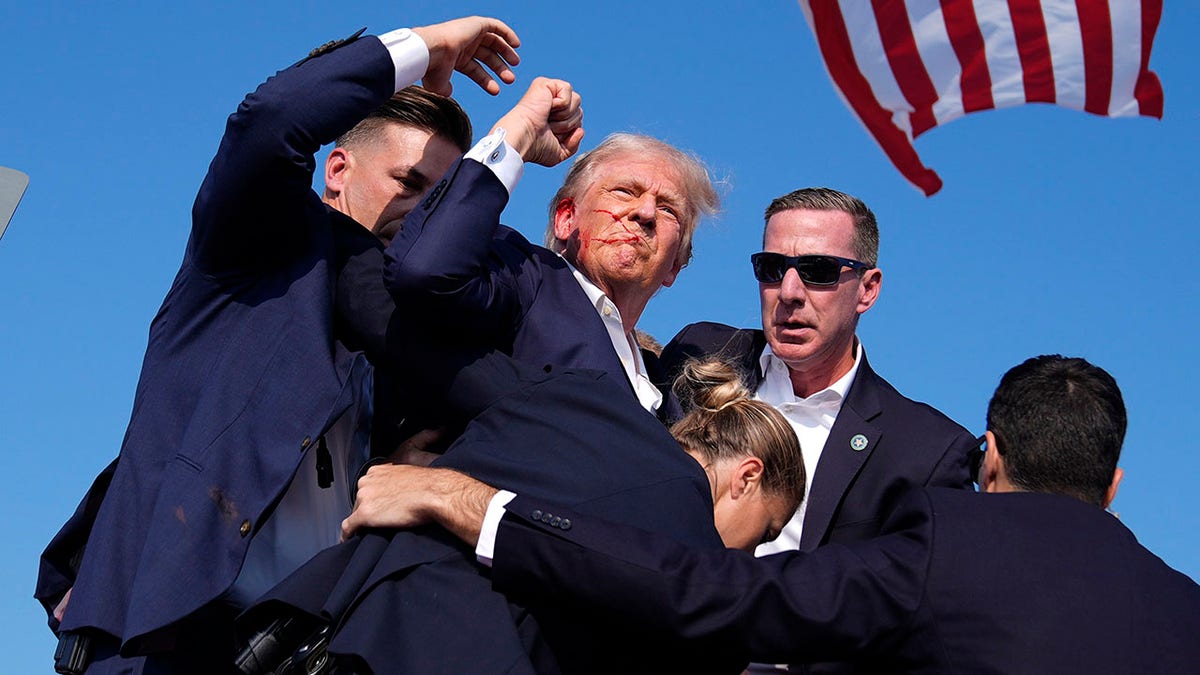
Former President Donald Trump pumps his fist with blood on his face while Secret Service agents rush him from the stage at a campaign rally in Butler, Pa., on July 13, 2024. (Evan Vucci/AP)
“Crooks obviously was killed by the Secret Service,” Meloy said. “So there is not going to be an active prosecution of an individual.”
That distinction, Meloy said, affects how much information is gathered and ultimately made public.
“With the Allen case, this will be headed for an active prosecution,” Meloy said. “And therefore the data gathering will typically be much more comprehensive and much more meticulous in order to gather evidence for the prosecution of the case.”
WATCH: Secret Service director confirms agent shot by suspected gunman at WHCA Dinner
“That’s probably the major reason you see differences in how much information and when it is presented to the press and the public,” Meloy added.
“That typically does not occur when there has either been the death of the perpetrator,” he said, noting those cases are generally limited to after-action analysis rather than full trial preparation.
Meloy said another key factor is how much information a suspect leaves behind.
“People need to appreciate that individuals who carry out these acts will vary greatly in how much data they’re going to leave behind,” he said.
Meloy added that some suspects leave extensive online activity and communications that can be analyzed, while others leave very little.
WATCH: DOJ releases new video of alleged WHCA dinner shooter in halls, storming checkpoint
“In other cases, there may be a very, very low amount of presented material online,” Meloy said. “Some of them will be very, very careful and engage in what we call operational security where they don’t want information to be left behind,” he said, noting that can leave investigators with little to reconstruct after the fact.
Even when warning signs exist, they are often missed.
“In 60 to 90 percent of the time, they will engage in what we call leakage,” Meloy said, referring to when individuals communicate their intent before an attack. “Sadly, that communication oftentimes doesn’t emerge until after the attack has occurred.”
Donald Trump’s announcement that he will lift punishing US tariffs on scotch whisky has been overshadowed by a row between rival Scottish party leaders over claiming credit for the decision.
The whisky industry and business leaders were delighted by the US president’s sudden announcement on his Truth Social network on Thursday that he would end the tariffs to mark the visit by King Charles and Queen Camilla.
“The King and Queen got me to do something nobody else was able to do, without hardly even asking!” Trump said.
The Scotch Whisky Association (SWA) estimates the 10% tariff, imposed by Trump last year, has cost producers about £150m in lost sales and led to hundreds of job losses. Shares in Diageo, the drinks giant that produces Johnny Walker, rose sharply on the news.
Graeme Littlejohn, the SWA’s director of strategy and communications, told BBC Radio Scotland the breakthrough was a “demonstration of the soft power of the monarch and what he can bring to the United Kingdom”. It had taken “months and months of work” to get negotiations to this point, he said.
The decision sparked a bitter dispute between the Scottish Labour party, UK government ministers and John Swinney, Scotland’s first minister, over Swinney’s insistence that his meeting with Trump at the White House last September played a significant part in it.
Labour and the Scottish National party, which Swinney leads, are in the final week of a lacklustre Scottish parliament election campaign in which Labour is fighting to prevent the SNP winning a fifth successive term in office.
Swinney was accused of being “shameless” by Scottish Labour’s deputy leader, Jackie Baillie, after he claimed the UK government had done little to raise the tariffs issue with Trump. Swinney said Trump had been unaware of it until they met at the president’s Aberdeenshire golf course last summer.
“As first minister, I have made it my mission to do everything possible to lift US tariffs on our whisky,” Swinney said on Thursday night.
“By meeting the president during his visit to Scotland and by going to Washington, to the Oval Office, we made Scotland’s case. And we used every chance to drive our point home, not least the state banquet hosted by His Majesty the King in London last September.”
Industry sources said UK officials and ministers had been pressing for whisky tariffs to be lifted since the state banquet at Windsor, to which Swinney was invited by the UK government. At the time, the two administrations were in an uneasy alliance to persuade Trump to act.
Douglas Alexander, the UK Labour government’s cabinet minister for Scotland, said trade agreements were the responsibility of the UK government, not Swinney’s devolved administration, and dismissed Swinney’s claims.
“The first minister can hold as many photoshoots and take as many day trips to Washington as he likes – this was delivered after relentless engagement and negotiation with our friends, partners, and allies in the United States,” Alexander said.
Baillie accused the SNP of hypocrisy. She said Stephen Flynn, the SNP’s Westminster leader, had called for Trump’s state visit last year to be cancelled after the president humiliated the Ukrainian leader, Volodymyr Zelenskyy, while an SNP candidate and former advisor to Swinney had called for an end to the monarchy several days ago.
Jack Middleton, the SNP candidate for Aberdeen Central, told a BBC Debate Night election special “the royal family have frankly brought nothing but embarrassment to Scotland and the United Kingdom.”
Baillie said the king’s visit to Washington was clearly instrumental in Trump’s decision. “John Swinney and the SNP’s record is so dismal that they are now trying to claim credit for work they are not responsible for.”
The US is the whisky industry’s largest market, worth about £1bn ($1.2bn) a year, and Scotland’s largest export market overall. Scottish whisky producers also buy about £220m worth of bourbon barrels from Kentucky, an essential component in maturing the raw spirit.
Industry sources said it could take months or years for it to recover the lost business. The tariffs “had led to the gradual erosion of market share versus other whiskies, in a very competitive market”, said one.

NEWYou can now listen to Fox News articles!
Here in the good old United States of America, we have a lovely holiday each September called Labor Day, on which we celebrate the contributions of the nation’s workers. We do not celebrate the communist holiday of May Day, as most of the globe does, at least not until recently.
Today, hundreds of leftist organizations and Damoractic Party adjuncts around the nation will rally, protest and cheer on May Day in an act of radical Marxist globalization. It should make Americans who are not fans of Mao’s little red book very nervous.
As usual, progressives want to destroy the wholesome homegrown aspects of our culture and replace them with cold, ugly, almost Soviet-style international slop, even though our American ancestors firmly rejected it.
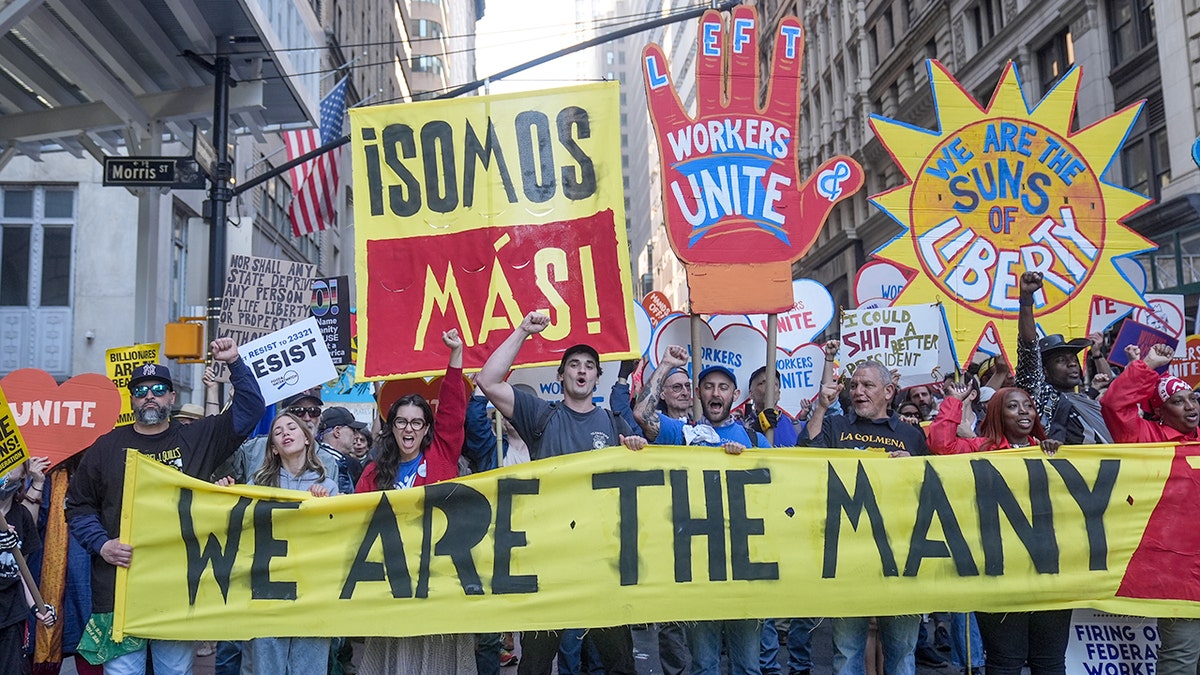
People take part in May Day rally and march in New York City to protest the Trump administration, New York, U.S., May 1, 2025. ( Selcuk Acar/Anadolu via Getty Images)
As it turns out, both Labor Day and May Day are of American provenance, with the former being a slightly older tradition from the early 1880s. It was an unofficial day to celebrate the working men and women of the country.
LABOR SEC CHAVEZ-DEREMER: OUR PLAN TO RESCIND THE BIDEN INDEPENDENT CONTRACTOR RULE
Then, on May 4, 1886, came the Haymarket Affair, in which an unknown person in Chicago threw dynamite into a crowd of police during a labor protest, killing several officers and civilians, in an act of political violence that feels all too familiar today.
Obviously, the version with massive political violence is the one that Marxists at the time favored, and they still do.
The riot and the subsequent arrests of several anarchists set the world ablaze, and almost instantly, May 1, or May Day, became a communist holy day, and eventually a national holiday in most of the Western world.
But by the 1890s, President Grover Cleveland and Congress had a choice to make: Should they codify into law the September Labor Day, or May Day, as the official holiday?
We all know how that one turned out, because we all know Labor Day as the unofficial end of summer, and also as a non-political day to give our nation’s workers a pat on the back and a barbecue.
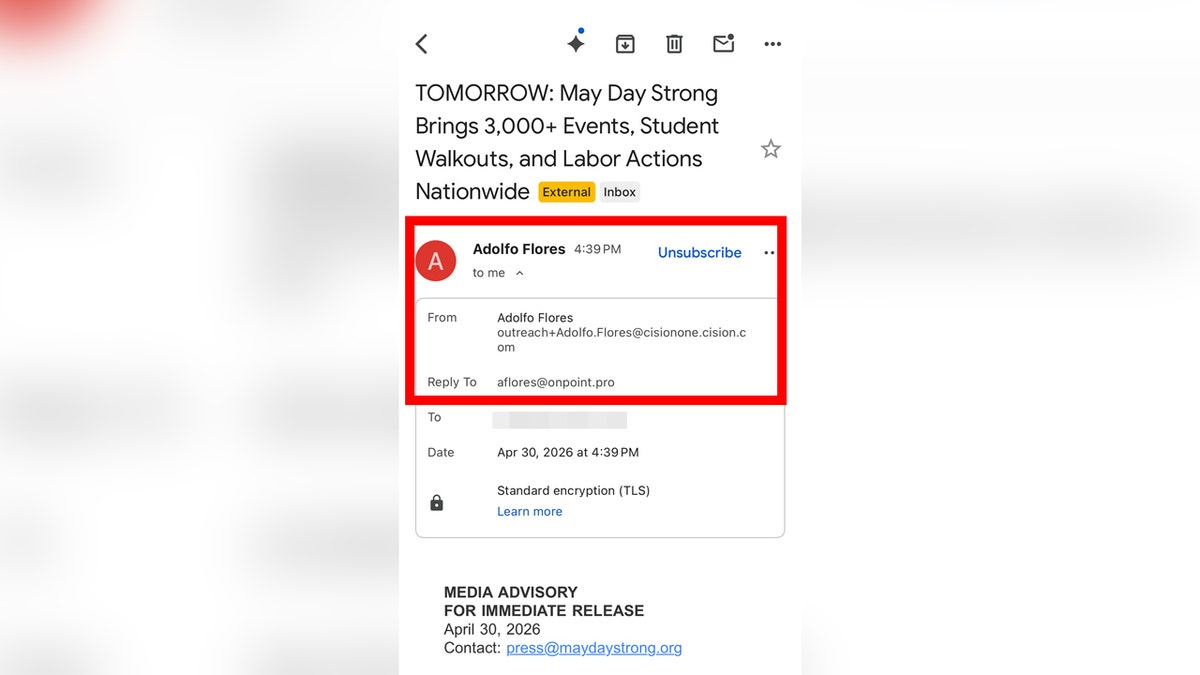
On the eve of May Day, organizers sent out a professionally coordinated media advisory with the email’s metadata directing readers to reply to a name associated with public relations for a Chicago teachers’ union. (Fox News Digital)
It is the political implications of Labor Day vs May Day that are crucial. The latter, in the image of the Old World, treats “workers,” as a solid political, generally Marxist, block, while Labor Day celebrates workers of any political stripe.
REVOLUTIONARY TOURISM:: INSIDE THE $600M MARRIAGE OF DARK MONEY AND FAR-LEFT AGITPROP
We can see this division in European and South American sports, where one team represents the workers and the Left, while another rival represents the wealthy. Here in America, Mets fans of all tax brackets just suffer together.
When we think of globalism, arguably the force that brought President Donald Trump and his populist agenda into power, we tend to think of 1990s White guys with big smiles and shiny broad lapels pushing free trade deals. But there is a Marxist version, as well.
Communist New York Mayor Zohran “Madman” Mamdani has already said that he believes Gotham is subject to international law, whatever the hell international law is, and obviously, leftist globalists think of our nation’s borders as but a mere suggestion.
SOROS-BACKED ‘NO KINGS’ RALLIES THREATEN AMERICA’S CITIES WITH PLANNED CHAOS
Replacing Labor Day with May Day, even unofficially, though some school districts have contemplated the switch, is just as much an attempt to divorce Americans from their own history as tearing down statues is.
These progressives don’t want you to have the American traditional Labor Day where you rip a few cold ones and think about your hard work and the fruit it bears for your family. They want you angry, out on the streets waving red flags and maybe tossing a few bombs for good measure.
This Marxist globalization is far more dangerous and older than the third way, neoliberal globalism of good haircuts and bad trade deals. Just look at how quickly Trump dismantled so much of that.
JASON CHAFFETZ: 2028 ELECTION WILL BE A REFERENDUM ON OUR AI-DOMINATED FUTURE
No, Marxist globalism is not just a new way to look at markets. It is an effort, as old at least as Leon Trotsky, to take over every aspect of our lives, not just our work, but also our holidays, and eventually our basic freedoms.
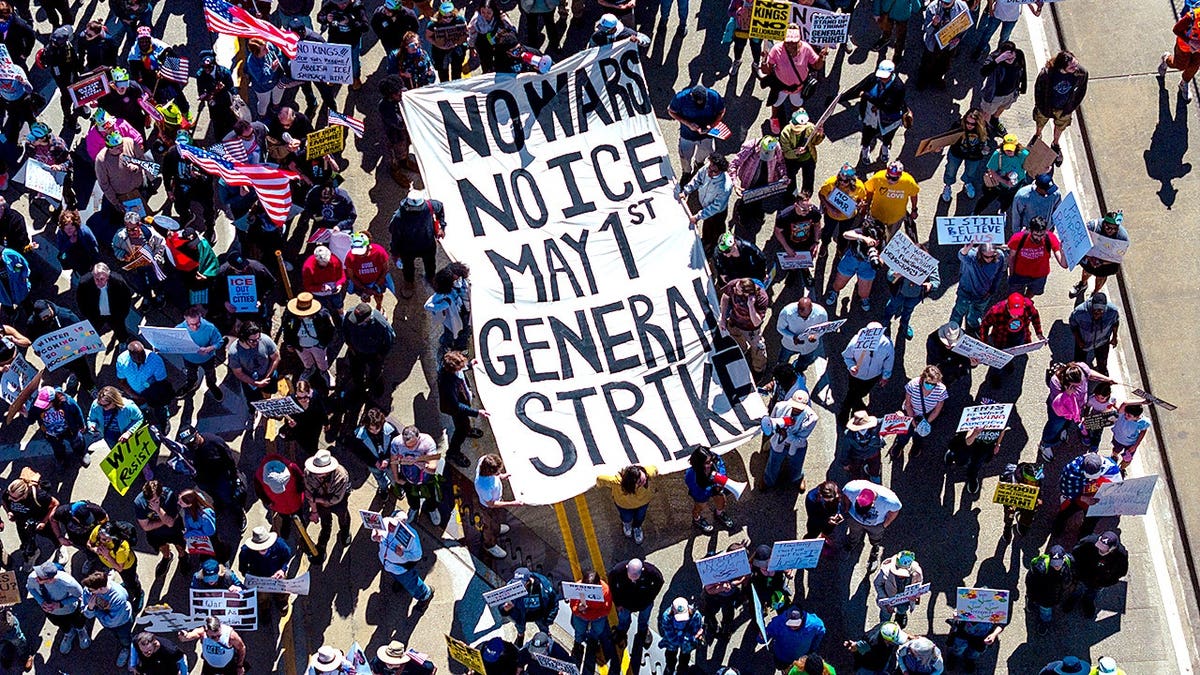
Activists are organizing nationwide May Day protests and boycotts under a “Workers Over Billionaires” message, drawing on a long history of labor demonstrations rooted in 19th-century struggles for workers’ rights. (Photo by Elijah Nouvelage / AFP via Getty Images)
Americans don’t need no stinking May Day. The American worker is no drone to put into a left-wing political box, nor is he or she a chess piece in a game of class warfare. They are our neighbors, friends, and family. It is all of us together.
CLICK HERE TO DOWNLOAD THE FOX NEWS APP
We must reject May Day here in the United States, as we did so long ago. We will continue to celebrate the worker, not to turn him into an agitator, which is exactly how it should be.
So come September, save me a hot dog, and keep up the tradition of the proud American worker who continues to make this the greatest nation on the face of the Earth.
Reference #18.94adc17.1777673892.202de2e
https://errors.edgesuite.net/18.94adc17.1777673892.202de2e

Microsoft is following through on its promise to prioritize Windows stability with its April 30 non-security update.
Ahead of Patch Tuesday, yesterday’s update was chock-full of fixes, including several for Windows Explorer.
According to Microsoft: “This update improves the reliability of relevant explorer.exe processes so they stop after closing File Explorer windows.”
And then there were “General Reliability” fixes. “This update brings underlying changes to help improve explorer.exe reliability, including at sign‑in, when interacting with taskbar menus and Task View, when unpinning items from File Explorer’s Quick Access, and more.”
Microsoft has also improved the performance of launching startup apps after device boot, and storage performance when viewing large volumes was made snappier. Speaking of storage, the maximum FAT32 format size limit from the command line has increased from 32GB to 2 TB: a small change, but a definite improvement in quality of life.
Other reliability tweaks include improvements to Windows Hello, the Microsoft Store, and the taskbar system tray.
Earlier this week, Microsoft CEO Satya Nadella said the company is working to “win back” fans. In March Windows boss, Pavan Davuluri acknowledged that Windows needs to be faster, more reliable, and contain a more targeted deployment of AI. He said at the time: “We are reducing unnecessary Copilot entry points, starting with apps like Snipping Tool, Photos, Widgets, and Notepad.”
The update delivers on the speed and reliability side of Davuluri’s promise, but AI remains inescapable. It should at least be less intrusive than that crowbarred into Notepad (and subsequently called “Writing Tools”). The taskbar gained the ability to display progress for AI agents – Researcher in the Microsoft 365 Copilot app is the first adopter – across both first- and third-party apps.
Also in the update was Enterprise State Roaming (ESR), which allows users to roam between devices and can now be managed through Windows Backup for Organizations. There was also policy-based removal of preinstalled Microsoft apps, as well as better security and performance for batch files. In the latter case, admins can enable a more secure processing mode for batch files, preventing them from changing during execution.
All told, it was a meaninful update and perhaps a sign that the Windows supertanker is slowly changing course.
But the goodwill it generates will evaporate quickly if it’s followed by another rushed out-of-band patch to fix the fixes. ®