Norway puts UN project funding on hold raising fears for plastics treaty talks | Plastics

0

The largest donor to the United Nations Environment Programme (Unep) has paused funding to the body before its revised budget on 12 May, triggering concern among member states and NGOs.

The news could carry significance for the already troubled plastic treaty negotiations being overseen by Unep. Since 2022 countries have been struggling to agree on how to deal with the volume of plastics being produced and used, a subject widely acknowledged to be one of the most serious environmental issues of the age, but despite six rounds of talks there has been no agreement in sight.

Unep’s executive director, Inger Andersen, met the director general of the Norwegian Agency for Development Cooperation (Norad) the week before last and was told that “all [funding] agreements are on hold” pending budget decisions, according to sources.

Norway has been the largest overall donor to Unep in recent years, contributing approximately $12m (£9m) annually to the fund over the three years to 2025. Norway also contributed $19m in 2025 to the Planetary Fund and another $7.8m in earmarked funds in 2025, meaning that even a pause introduces significant uncertainty for future functioning of the global environment agency with the wider UN already facing severe financial pressure.

In addition, the Guardian has obtained an email sent to NGOs by Norad advising them that it was postponing a funding call aimed at projects to combat plastic pollution in developing countries.

The programme is valued at £4m-£6m a year and, according to Norad, the funding can be used for projects that support countries in the plastic treaty process. Christina Dixon, ocean campaign leader at the Environmental Investigation Agency, said: “Any risk to funding could not come at a worse time for the negotiations … sustained funding would reinforce Norway’s longstanding leadership toward an ambitious plastics treaty.”

Norway is the co-leader with Rwanda of the high ambition coalition at the plastic treaty negotiations. The coalition says it is working for an “ambitious” and legally binding instrument on the “full life cycle of plastics”. This stands in contrast to a small group of petrostates, who are widely seen as blocking moves to put a cap on plastic production.

Last year, the chair of the process resigned suddenly, with the talks in disarray. This came just months after the previous round of talks collapsed with little progress and three years of negotiations. A new chair was elected this year, with negotiations expected to resume in early 2027.

Karen Landmark, managing director at GRID-Arendal, a Norwegian environmental foundation that works closely with Unep, said her organisation was concerned the funding pause could “give other countries an excuse to lower their level of ambition”.

“For years, Norway has played a clear and constructive leadership role in pushing for a strong global plastics treaty. When a country in that position signals hesitation or withdraws support, the consequences can extend far beyond its own borders,” she said.

Oil and gas is Norway’s largest sector with petroleum revenues amounting to £52m in 2025 alone, and last week the government was criticised for approving plans to reopen three of its North Sea gasfields to help fill the gap in energy supplies created by the Middle East war.

Frøya Skjold Sjursæther of the Green party said: “It’s a complete scandal if Norway moves to cut support for the global plastic clean-up effort. Norway has long worked for a global plastics treaty, and rightly so, given that Norwegian oil contributes to millions of tonnes of plastic every year.”

Norway’s reassessment of Unep funding comes amid a shifting domestic political and economic debate over climate and environmental spending. The country is governed by the centre-left Labour party, which has continued to position Norway internationally as a supporter of climate diplomacy, rainforest protection and efforts to negotiate a global plastics treaty. However, the Jonas Gahr Støre-led government, which was elected last year, is a minority administration and relies on agreements with other parties to pass budget measures.

When asked about the postponement of the plastics funding communicated to NGOs, Per Fredrik Pharo, head of Norad’s department for climate and nature, said there were several agreements for funding; that the main one was due to finish last year and had done so while another was “in an assessment process … where we need to determine the scale and scope of future cooperation”. That process will be finished mid 2026.

Another stream has been postponed but this work will be resumed “in the near future”. This adds to NGO confusion after a Norad minister recently noted in the Norwegian parliament that Norway would continue its funding to combat plastic pollution in developing countries, with an “ambition” to spend 1bn kroner (£79m) between 2025 and 2028.

Eirik Lindebjerg, conservation director of WWF Norway, issaid he was concerned by the “vague” language, adding: “If they are planning to continue with this, then why create so much uncertainty?”

Åsmund Aukrust, Norway’s minister of international development, said the Labour party governs in an “unpredictable economic situation” and that “every krone in the budget must be carefully considered”.

A Unep spokesperson said: “We have every faith that Norway will continue their strong environmental leadership.”


Source link
Access Denied


Access Denied You don’t have permission to access “http://news.sky.com/story/british-steel-to-be-nationalised-starmer-reveals-13542700” on this server.

Reference #18.c5d07868.1778499534.41e72e7c

https://errors.edgesuite.net/18.c5d07868.1778499534.41e72e7c


Source link

‘Bad people’: Alan Cumming criticises Bafta after N-word outburst | Movies

0

Alan Cumming has criticised the organisers of the Bafta film awards in February as “bad people who weren’t doing their jobs properly” after the N-word outburst by Tourette activist John Davidson, which was broadcast by the BBC during its coverage of the ceremony.

In an interview with the Sunday Times, Cumming, who was the host of the ceremony, said: “It was bad, bad, bad, bad leadership … Bad people who weren’t doing their jobs properly, who really had not prepared and let people down.”

Davidson, who attended the Baftas as I Swear, the film based on his life story, was nominated for a number of awards, shouted the N-word twice during the ceremony, as well as a slur aimed at Cumming. The BBC’s broadcast remained on BBC iPlayer overnight before the coverage was taken down. The BBC subsequently apologised, as did Bafta.

Describing the event as a “shitshow”, Cumming said he was not fully aware of what had transpired. “I had a thing in my ear and you can’t hear very specifically what’s happening. I haven’t actually asked them, but I don’t imagine that Delroy [Lindo] and Michael B Jordan heard the actual slur either.”

Cumming apologised during the ceremony, saying: “Tourette syndrome is a disability … we apologise if you are offended tonight.” He told the Sunday Times that neither he nor the audience had been warned by Bafta that Davidson might shout offensive slurs. “They just said, ‘There’ll be noise.’ You could say they didn’t know, but they clearly did, because apparently John had said the N-word at a party the day before.”

He added: “It was an international scandal. Then poor John gave this interview saying, ‘I’m not a racist. I called Alan Cumming a paedophile too.’  … Oh great! He’s equal opportunities and my name and ‘paedophile’ were in the same sentences all over the world.”

In an interview with Variety the week after the ceremony, Davidson said, “I can’t begin to explain how upset and distraught I have been as the impact from Sunday sinks in … I want people to know and understand that my tics have absolutely nothing to do with what I think, feel or believe. It’s an involuntary neurological misfire. My tics are not an intention, not a choice and not a reflection of my values.”

Cumming said he had no plans to host the Baftas again. “Right before it started, I said to my agent, ‘Remind me, I never want to do this again.’” He added: “It’s a tough gig. You’re trying to be funny for a bunch of people who are used to very generic, middle-of-the-road things, so you’re fighting against the quirky personality they want you to bring to it. That’s a battle.”

Bafta has been contacted for a response.


Source link

Hantavirus case confirmed in American who evacuated cruise ship, flew to Nebraska


NEWYou can now listen to Fox News articles!

One of the 17 American citizens evacuated from the MV Hondius cruise ship and flown back to the U.S. tested positive for hantavirus without symptoms, according to the U.S. Department of Health and Human Services, and another person had mild symptoms.

Those two Americans traveled in the plane’s biocontainment united “out of an abundance of caution,” HHS noted in a Sunday night post on X.

A motorcade of emergency vehicles drove the 17 Americans to ASPR Regional Emerging Special Pathogen Treatment Center (RESPTC) facilities at the University of Nebraska Medical Center/Nebraska Medicine in Omaha.

“Each individual will undergo clinical assessment and receive appropriate care and support based on their condition,” the post added.

CRUISE SHIP LINKED TO DEADLY HANTAVIRUS OUTBREAK ARRIVES OFF TENERIFE AS PASSENGER EVACUATION BEGINS

GIF shows hantavirus cruise ship passengers arriving at Nebraska hospital

Seventeen Americans who had been on board a cruise ship with a hantavirus outbreak arrived early Monday, May 11, 2026, at a hospital facility in Omaha, Nebraska. (Fox News)

The flight touched down early Monday morning. Three individuals died since the outbreak started.

“One passenger will be transported to the Nebraska Biocontainment Unit upon arrival, while other passengers will go to the National Quarantine Unit for assessment and monitoring,” a Nebraska Medicine Facebook post issued on Sunday night stated. “The passenger who is going to the Biocontainment Unit tested positive for the virus but does not have symptoms. They were managed separately from other passengers during transport using appropriate biocontainment measures. They will be monitored in the Biocontainment Unit out of an abundance of caution and follow-up testing will be performed.”

HANTAVIRUS OUTBREAK TIMELINE HIGHLIGHTS KEY MOMENTS IN DEADLY CRUISE CRISIS

Passengers evacuated from MV Hondius

Passengers carry their belongings in plastic bags after being evacuated from the MV Hondius after docking in the Granadilla Port on May 10, 2026 in Tenerife, part of the Canary Islands, Spain. (Chris McGrath/Getty Images)

A French individual tested positive and her health declined in the hospital overnight, French Health Minister Stephanie Rist French Health Minister noted Monday. The outlet reported that the individual was one of the five French people who had been passengers aboard the vessel who were repatriated Sunday. The woman developed symptoms while flying to Paris, Rist informed public broadcaster France-Inter.

“Andes virus is a type of hantavirus spread by rodents in South America and, less commonly, by other infected people. The rodents that carry Andes virus have not been found in the United States. It can cause a severe respiratory disease in people, called Hantavirus Pulmonary Syndrome (HPS),” according to the U.S. Centers for Disease Control and Prevention.

HANTAVIRUS IN THE US: WHERE THE RARE, SOMETIMES DEADLY DISEASE HAS BEEN FOUND

MV Hondius ship

This aerial picture shows a general view of the cruise ship MV Hondius stationary off the port of Praia, the capital of Cape Verde, on May 4, 2026. (AFP via Getty Images)

CLICK HERE TO DOWNLOAD THE FOX NEWS APP

“Andes virus is the only type of hantavirus that is known to spread person-to-person. This spread is usually limited to people who have close contact with a sick person. This includes direct physical contact, prolonged time spent in close or enclosed spaces, and exposure to the sick person’s body fluids,” the CDC explained.

The Associated Press contributed to this report.


Source link

Catherine West backs down from Starmer challenge but urges him to go by September | Keir Starmer

0

Catherine West, the Labour MP who announced a challenge to Keir Starmer’s leadership, has changed course and said she instead wants the prime minister to set a timetable of September for his departure.

West, the MP for Hornsey and Friern Barnet and a former Foreign Office minister, announced on Saturday that she would seek the gather the 81 Labour MPs’ names needed to formally challenge Starmer, while arguing that this was just a device to tempt others to stand, and that she did not wish to take over.

But in a statement released after Starmer’s speech on Monday morning in which he would fight on despite terrible results for Labour in elections last week, West called for an orderly process for Starmer to depart.

She said: “I have listened to the prime minister’s speech this morning. I welcome the renewed energy and ideas. However, I have reluctantly concluded that this morning’s speech was too little too late.

“The results last Thursday show that the prime minister has failed to inspire hope. What is best for the party and country now is for an orderly transition. I am hereby giving notice to No 10 that I am collecting names of Labour MPs to call on the prime minister to set a timetable for the election of a new leader in September.”

Under Labour rules, at least 81 MPs, or 20% of the total parliamentary party, need to back a challenge for one to happen. This means that West’s plan to gather names calling for a future contest would have no force under the rules, but would instead act as a de facto no confidence vote.

West’s change of plan potentially takes some of the urgency out of the situation, which has seen repeated speculation expected rivals like Wes Streeting, the health secretary, and Angela Rayner, Starmer’s former deputy, would launch imminent bids.

The prospect of a longer timetable would allow time for Andy Burnham, the mayor of Greater Manchester, to potentially return to parliament and join the contest although after his speech, Starmer said whether Burnham would be allowed to do this was still a matter for Labour’s national executive, which blocked him in January.


Source link

Biden blocking JetBlue-Spirit merger blamed for airline’s collapse


NEWYou can now listen to Fox News articles!

Summer is almost here and many Americans are worried they won’t be able to take a vacation. The cost of airfare alone is up a whopping 18% over the same time in 2025.

Flying to the beach or Disney World has become unaffordable for many middle-class families and the future looks bleak. Spirit Airlines, a major budget air carrier, canceled all flights and announced on May 2 that it’s going out of business, leaving fliers stranded with fewer low-cost options.

Spirit’s demise is the direct fault of the Biden administration, which killed a business deal that would have saved the airline. They were cheered on by key Democrats who need to be held accountable for their economic malpractice.

In 2022, Spirit and JetBlue announced they planned to merge into a new airline. The carrier would have combined the best of both businesses, leveraging JetBlue’s global scale in service of Spirit’s low prices.

DUFFY BLAMES BIDEN-BUTTIGIEG TEAM FOR SPIRIT AIRLINES COLLAPSE AFTER BLOCKED MERGER

Spirit Airlines plane flying

A Spirit Airlines Airbus A-320 departs from Harry Reid International Airport en route to Boise on March 15, 2025, in Las Vegas, Nev. (Kevin Carter/Getty Images)

Not only that, the deal would have created a budget competitor to the so-called Big Four — Delta, Southwest, American and United — driving down prices across the airline industry. Advantage: mom and pop flier.

More competition almost always equates to lower prices. Yet the Biden administration would spend the next two years harassing JetBlue and Spirit, blocking their merger because they decided the resulting company would be too big.

It takes a lot of nerve for a $7 trillion federal government to complain about a $3.8 billion business agreement, but then this was increasingly the norm in Washington. Helmed by left-wing radical Lina Khan at the Federal Trade Commission and then-Attorney General Merrick Garland and then-Assistant Attorney General for the Antitrust Division Jonathan Kanter at the Department of Justice, the feds’ standard for antitrust enforcement was shifting from “is this bad for the consumer?” to “are we in a mood this morning?”

TRUMP CAN REIN IN BIDEN’S OUT-OF-CONTROL ANTITRUST OPERATION

At one point, Khan and Biden had 40% of the companies on the S&P market cap under investigation. It was this arbitrary anti-business mentality that ultimately killed the Spirit-JetBlue merger. The Biden team convinced a liberal judge to rule against the deal and that was that. 

After the ruling, Garland boasted that the merger “would have caused tens of millions of travelers to face higher fares and fewer choices.” Reads a bit differently now that Spirit Airlines is dead, doesn’t it? 

It wasn’t just Garland. Pete Buttigieg, who served as Biden’s secretary of Transportation, bragged about joining the harassment campaign against Spirit and JetBlue, saying he was “supporting the DOJ’s lawsuit” as well as “using our own authorities.”

TRUMP HAS SET THE STAGE FOR AN AMERICAN COMEBACK AFTER BIDEN’S DISMAL ECONOMY

Democratic state attorneys general also fought the merger tooth and nail, with Colorado Attorney General Phil Weiser going so far as to call the successful challenge of the JetBlue/Spirit merger a one of the “guideposts on the road” for state enforcers to follow in the future.

And, of course, Democrat Massachusetts Sen. Elizabeth Warren tweeted that Biden’s lackeys “were right to stand up for consumers and fight against runaway airline consolidation.”

At one point, Khan and Biden had 40% of the companies on the S&P market cap under investigation.

In fact, it was the merger that was anti-consolidation by creating a new challenger to the Big Four. It was the merger that was pro-consumer by spurring competition and lowering airfares.

TRAVELER SLAMS ‘AWFUL’ EXPERIENCE OF CANCELED FLIGHTS AS BUDGET AIRLINE ANNOUNCES CREDITOR AGREEMENT

And it was the merger that would have kept Spirit Airlines alive, saving 17,000 jobs.

Only eight months after the JetBlue-Spirit deal was blocked, Spirit announced it was filing for bankruptcy. It would do so again less than a year later.

Now, not only is Spirit gone, JetBlue could be next. The company has been struggling financially since the merger was blocked, with one estimate placing JetBlue’s odds of filing for bankruptcy this year at “greater than 75 percent.”

As for summer vacationers, data from Cirium Analytics estimates that Spirit’s budget pricing helped lower airfares by 14%. Meaning the cost of flying is about to surge, again.

Such bedlam at the airport lies at the doorstep of Democrats, who see government bureaucrats as an enlightened caste able to better manage the lives of businesses and consumers. To them, antitrust is just another tool to be wielded by these benevolent overseers.

CLICK HERE FOR MORE FOX NEWS OPINION

The Spirit fiasco shows how wrong they are. What Buttigieg, Garland and Khan really gave us was less competition, fewer options for consumers, higher prices, fewer jobs and more economic power concentrated in established companies.

 Hopefully, the Trump administration uses this moment to institute a course correction.

CLICK HERE TO DOWNLOAD THE FOX NEWS APP  

The White House should use this moment in time to have a heart to heart with the lawyers and bureaucrats inside the Department of Justice and Federal Trade Commission, instructing them to only interfere in future mergers that pose clear demonstrable harms to consumers and the competitive marketplace.

It came too late to save Spirit, but the time is now to consign Democrat economics to the dustbin of history. Spirit Airlines — to say nothing of hard-working American families — deserved better. 


Source link

Linux kernel maintainers pitch emergency killswitch after CopyFail and Dirty Frag chaos

0


OSes

Instead of waiting for patch cycles, admins could simply shut down vulnerable functions before attackers get there

Linux kernel maintainers are considering giving admins a giant red emergency button to smash the next time another nasty vulnerability drops before patches are ready.

The proposed feature, named “Killswitch,” would let admins temporarily disable specific vulnerable kernel functions at runtime instead of sitting around waiting for fixes. The so-called patch was submitted by Linux stable kernel co-maintainer and Nvidia engineer Sasha Levin after a bruising couple of weeks for Linux security.

The proposal basically gives admins a way to pull the plug on vulnerable kernel functionality. If exploit code starts spreading before patches arrive, the targeted function can be disabled so calls to it immediately fail instead of reaching the vulnerable code.

“When a (security) issue goes public, fleets stay exposed until a patched kernel is built, distributed, and rebooted into,” Levin wrote. “For many such issues the simplest mitigation is to stop calling the buggy function. Killswitch provides that.” 

The past couple of weeks have not exactly been great advertising for the traditional “wait for patches” approach.

First we saw the disclosure of CopyFail, a Linux local privilege escalation bug that quickly moved from disclosure to active exploitation. Days later, Dirty Frag emerged: another Linux privilege escalation flaw with public exploit code and no official fixes, after coordinated disclosure efforts fell apart before patches were ready.

As Levin’s proposal itself puts it, organizations are often left exposed “until a patched kernel is built, distributed, and rebooted into.” Killswitch aims to fill that gap.

Killswitch would work through the kernel’s security interface and is mainly intended for subsystems that systems can survive without for a while. In practical terms, Levin’s argument is that temporarily losing some networking or crypto functionality is preferable to leaving known vulnerable code exposed on production systems.

However, the feature would not fix vulnerable code or replace it with safe code. It just slams the door shut on the dangerous bit until administrators can properly update their kernels.

Naturally, handing sysadmins the ability to selectively shoot pieces of the kernel in the head has already sparked debate among developers over stability, potential for abuse, and whether people can be trusted not to accidentally saw off important limbs in production. 

Still, after CopyFail and Dirty Frag, the kernel community increasingly seems to be arriving at the conclusion that running broken functionality may now be preferable to running weaponized functionality. ®


Source link

‘Truly terrifying’: Alberta voter data breach raises fears for Canada’s electoral integrity | Canada

0

The illegal use of voter information by rightwing separatists in the province of Alberta has raised fresh fears over Canada’s electoral integrity by making valuable and “incredibly confidential” personal data easily accessible to malicious actors, security experts have warned.

The data breach, one of the largest in Canadian history, has prompted warnings of a “truly terrifying” new battleground over information, persuasion and foreign interference in already weakened democratic systems.

Activists in the oil-rich province have in recent months increased their effort to force an independence referendum. But debates over secession – already rife with accusations of treason and internecine feuding – have been overshadowed by revelations that a separatist-linked organization gained illegal access to Alberta’s official list of electors. The database contains the names, home addresses and contact information for roughly 2.9 million voters.

Elections Alberta, the body that administers the vote in the province, says it has launched an investigation into how how a far-right group was able to access the database and use it for a campaign to reach voters.

Separatist leaders recently unveiled an initiative using data-driven campaigning and grassroots mobilization to connect with voters.

During an online meeting with supporters, Centurion Project organizer Emmott Kelsey told attendees the app would “revolutionize” how campaigns are run. He boasted that the software underpinning it is “so groundbreaking” that it had been presented to Donald Trump’s White House.

“And we’re kind of the guinea pigs with it,” he said. The Guardian asked Kelsey to clarify his remarks but did not receive a response.

One of the key figures of the Centurion Project is David Parker, a veteran Alberta political organizer with deep ties to the separatist movement, and to US MAGA activists and far-right figures such as Tucker Carlson. Parker has previously faced hefty fines from Elections Alberta over violations of voting laws.

“Parker is a shockingly effective political organizer. What he was doing was attempting to create a digital grassroots organizational tool. And on its face, there’s nothing wrong with that,” said Jen Gerson, an Alberta-based journalist. “But in order to populate the app that underlies the Centurion Project, he needed data.”

People gather outside the Alberta legislature to rally for Alberta’s independence on 3 May 2025. Photograph: NurPhoto/Getty Images

In March, Gerson was tipped off that the Centurion Project had obtained a copy of the province’s voter list. Her source said they had been able to access the Centurion Project’s database without using their real name name or any traceable personal information.

Gerson said the absence of any security or protection was astounding.

“Anybody with a burner account and no credentials could then access the file and potentially download information from it,” she said. “If you knew about it, you could anonymously access the entire data root file.”

Gerson reported her concerns to Elections Alberta in late March. But the oversight body responded that while her report was “compelling”, Parker could have obtained the list legally from a data broker and concluded there were “no reasonable grounds” to investigate.

A month later, however, EA obtained a court order to shut the database down and launched an investigation. Canada’s federal police, the RCMP, and Alberta privacy commissioner are also investigating the breach.

In order to prevent the improper sharing of voter lists, EA “seeds” voter lists with fake names, and the body was able to confirm that the CP list had originally been provided legally to the Republican party of Alberta, a fringe rightwing party, and then improperly shared.

The party said it had told Centurion Project not to use the data but did not say if the list had come from within the party. “We were proactive on that before the injunction today, and we’ll be fully complying with Elections Alberta,” leader Cam Davies told the Canadian Press.

The provincial government has blamed the elections agency for failing to investigate the breach when first notified. But EA says the provincial government weakened its investigative powers last year.

Elections Alberta says nearly 600 people accessed the voter list which it described as “incredibly confidential”, adding in a statement that it understood Albertans were “unhappy, scared and anxious” about the situation.

“We have heard countless stories about the risks people face having their information made public, including stories from domestic violence survivors, law enforcement, marginalized communities, and more,” the group said, calling on the government to amend existing laws to prevent a similar breach in the future.

Parker has denied that he used the Republican Party voter list and suggested the database was compiled from a third party.

“We have taken action to shut down the app until we can ensure that the dataset is compliant with Alberta and Federal privacy laws. The Centurion Project plans to fully comply with Elections Alberta’s investigation,” Parker said in a statement.

In the statement, Parker said volunteers with the Centurion Project “did not have access to phone numbers or emails” and the dataset was from a third party.

But during an online demonstration of the database for volunteers at an April 16 event , Parker showed how the personal information of any voter could be found on the database. One witness at the event – a member of the opposition NDP – was shocked when Parker pulled up the home address and phone number of Alberta’s former premier Jason Kenney. That witness then filed a report with the police.

Kenney has said he is hiring a lawyer for advice, warning that the breach may affect domestic violence survivors, journalists, activists, judges, and other public servants for years to come.

“This has been a real wake up call to the risks that we’re playing with here. We have to assume that all of our personal information and address are potentially available to bad actors,” said Gerson. “People are very angry and they’re very scared. But if you don’t want these guys in your house, why are you even thinking about letting them run your country?”

The leak has become a political flashpoint in Alberta, but the efforts to subvert election and privacy laws expose the immense value in voter lists and mirror a similar battle unfolding in the US.

An activist holds a sign outside the Alberta legislature on 3 May 2025. Photograph: NurPhoto/Getty Images

In recent months, the US department of justice has sued 30 states and the District of Columbia for failing to turn over full copies of their voter registration lists. States, including some controlled by Republicans, have pushed back, citing constitutionally guaranteed authority over election administration and worries over data security and privacy laws. Voting rights groups have sued the Trump administration over the requests for voter rolls, accusing it of laying the groundwork for voter purges ahead of the November midterms.

“Data is a major force in modern politics, especially in the ways it can be leveraged. Powerful actors and authoritarian regimes are very creative and have real designs on taking apart the last remaining liberal democracy in North America,” said Patrick Lennox, former manager of criminal intelligence for the RCMP’s federal policing programs in Alberta. “Since Trump came back into power, he has destabilized that democracy to the point where I don’t think you can legitimately call it a democracy any more … And I worry that’s exactly what the play is in Alberta.”

The Centurion Project has not said which company developed the underlying software it relies on, but sources familiar with the investigation say the company is based in the United States. When asked for comment by the Guardian, the company did not respond.

Lennox warned that if the file was stored without proper protections, it could be captured by American data brokers who are governed by less stringent privacy laws than in Canada. The breach also comes as the Trump administration has threatened to subjugate Canada and signalled its support for Alberta’s separatists.

“It’s not like the Americans will put put in digital sovereignty precautions for the voter list,” he said. “Because it’s important to remember: the United States is also trying to break our country.”

Washington is not the only outside actor paying close attention to Alberta’s secession movement. Researchers recently warned that the province is being targeted by covert influence campaigns run by countries such as Russia and China. The Global Centre for Democratic Resilience, the University of Regina and DisinfoWatch recently documented the scope of foreign interference campaigns alongside the proliferation of AI-generated videos and the threat over threats and interference from Donald Trump and his allies.

Brian McQuinn, co-director of the Centre for Artificial Intelligence, Data, and Conflict at the University of Regina pointed out that before Russia’s full scale invasion of Ukraine, researchers documented a spike in discussions about sovereignty in the country.

“There was this narrative that it was not actually its own sovereign country, that it’s just this sort of mistake of history. This is the exact same language the Americans are using around Canada,” he said.

Covert meetings between separatist activists in the Canadian province of Alberta and members of Donald Trump’s administration have already roiled the province.

“The Americans would like us to be as weak as possible – and a separation movement that harms us in negotiations is obviously really important,” said McQuinn. “They are advancing their own interests around this, when it comes to trade, when it just comes to weakening us in any way they can.”


Source link

Exercise may flush brain waste linked to Alzheimer’s, Penn State finds


NEWYou can now listen to Fox News articles!

Exercise is widely known to benefit the brain, and researchers at Penn State recently uncovered a surprisingly mechanical reason: Each time the body moves, the brain gets a kind of “rinse.”

According to a study published in Nature Neuroscience, the secret to this internal wash cycle may lie in the abdominal muscles.

In mice models, the researchers found that the brain is mechanically linked to the abdomen through a network of blood vessels that functions like a hydraulic system.

FITNESS EXPERT REVEALS SIMPLE RULE TO GET IN SHAPE WITHOUT DREADING THE GYM: ‘JUST MOVE’

“Every time the mice contract their abdominal muscles — like when they walk — blood moves from the abdomen into the spinal canal,” said lead study author Patrick Drew, professor of engineering science and mechanics, neurosurgery, biology and biomedical engineering at Penn State, in a press release.

This movement of blood applies a tiny amount of pressure to the brain, causing it to physically shift or “sway” slightly within the skull.

Mice lifting weights in a laboratory setting

The researchers found that in mice, the brain is mechanically linked to the abdomen through a network of blood vessels. (iStock)

This subtle brain movement occurs within a system where the brain is surrounded by cerebrospinal fluid (CSF), a clear liquid that acts as a cleaning agent.

CLICK HERE TO DOWNLOAD THE FOX NEWS APP

Scientists have long believed that CSF helps flush out cellular waste that, if left to accumulate, is linked to neurodegenerative diseases like Alzheimer’s, according to Drew.

By using advanced computer simulations, the team discovered that when the brain moves, it can drive fluid movement in the brain.

TEST YOURSELF WITH OUR LATEST LIFESTYLE QUIZ

The physical displacement drives the flow of CSF through the brain’s tissues, potentially carrying away harmful waste products.

“Our research explains how just moving around might serve as an important physiological mechanism promoting brain health,” Drew said.

Woman jogging in city

By using advanced computer simulations, the team discovered that when the brain moves, it can drive fluid movement in the brain. (iStock)

To confirm that abdominal pressure was the primary driver, the researchers tested the effect on the mice.

Even without exercise or general movement, simply applying gentle pressure to a mouse’s belly — less pressure than a human feels during a standard blood pressure test — was enough to shift the brain and trigger fluid flow, they found.

CLICK HERE TO SIGN UP FOR OUR HEALTH NEWSLETTER

“We were surprised at how tightly linked the brain motion was to the abdominal muscle contraction,” Drew said.

Female and male doctors examining a brain scan on a large screen

The researchers found that even without exercise or general movement, simply applying gentle pressure to a mouse’s belly was enough to shift the brain and trigger fluid flow. (iStock)

There were a few caveats, the researchers acknowledged. Because the study used mice and not humans, more research is needed to determine whether the results apply to people.

CLICK HERE FOR MORE HEALTH STORIES

Additionally, the researchers used simulations to track fluid movement rather than measuring the flow directly in a living brain.

Drew added, “Our research shows that a little bit of motion is good, and it could be another reason why exercise is good for our brain health.”


Source link

Who is Gerhard Schroeder, Putin’s pick for Ukraine peace talks mediation? | Russia-Ukraine war News

0

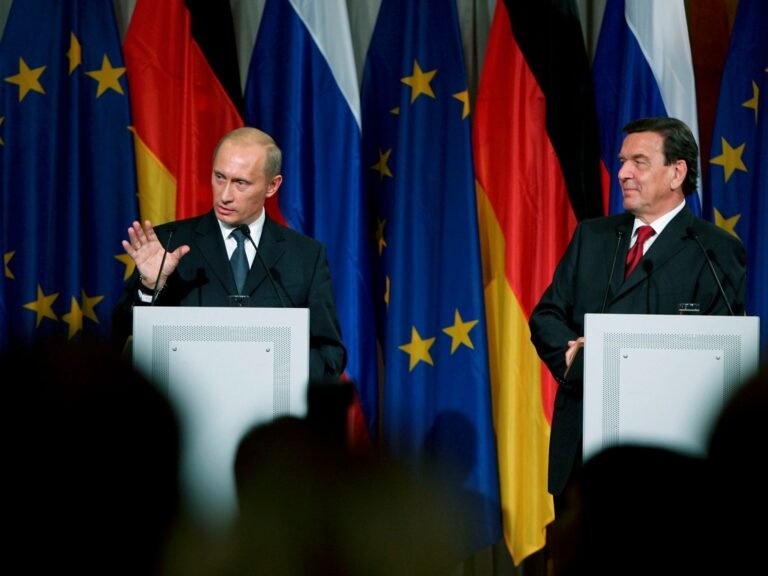
Russian ⁠President Vladimir ⁠Putin has suggested that former German Chancellor Gerhard Schroeder could coordinate talks with the European Union to secure a ⁠peace deal in Ukraine – a proposal met with scepticism by EU officials.

European Council President Antonio Costa said recently he believed there was “potential” for ⁠the EU to negotiate with Russia and to discuss the future of Europe’s security architecture.

Recommended Stories

list of 3 itemsend of list

Asked on Saturday whom he would like to see restarting talks with Europe, Putin said he would “personally” prefer Schroeder, who led Germany from 1998 to 2005 and has remained close to the Kremlin leader since leaving office.

A day later, the Russian leader said the ⁠four-year-old war may be “coming to an end”, adding that he was ready to hold direct talks with his Ukrainian counterpart, Volodymyr Zelenskyy, in Moscow or a neutral country.

Speaking after Saturday’s celebrations for Victory Day, which marks Russia’s victory over Nazi Germany in 1945 at the end of World War II, Putin added he would be willing to meet Zelenskyy only once the terms of a peace agreement had already been settled.

Russia had announced a unilateral two-day ceasefire on May 8-9 to mark Victory Day, while Zelenskyy countered it with his own proposed pause in fighting starting earlier, on the night of May 5-6.

As part of a broader Washington-led push for ⁠peace, United States President Donald Trump on Friday announced a three-day pause in the conflict, but both sides have since accused the other of breaking it.

As US-backed peace talks between Kyiv and Moscow stall, here is a look at who Schroeder is and whether he could be a trustworthy mediator.

Who is Gerhard Schroeder?

The 82-year-old leader of the Social Democratic Party (SPD) served as Germany’s chancellor from 1998 to 2005, focusing his political goals on European integration, reducing unemployment, liberalising German citizenship laws, curbing nuclear power and rebuilding the economy.

Disagreements over the Iraq war caused a serious rift in German-US relations in 2003, when Germany sided with France and Russia in opposing military intervention in the country over claims that the then-Iraqi president, Saddam Hussein, was producing weapons of mass destruction.

After leaving office in 2005, Schroeder ⁠almost immediately took a job as chairman of a controversial German-Russian ⁠consortium building a gas pipeline under the Baltic Sea. He held key roles in Russian energy projects, including work on the Nord Stream gas pipelines and a seat on the board of Russian oil firm Rosneft, which he gave up in 2022.

While he quit that role, the former chancellor has remained close to Putin, standing apart from most Western leaders since Russia invaded Ukraine in 2022 and facing heavy ⁠criticism in Germany.

His failure to publicly condemn Russia’s invasion of Ukraine has cost him several privileges normally granted to former chancellors, including receiving a state-funded office, making him a controversial figure at home.

What is his relationship with Putin?

Schroeder referred to Putin as “a flawless democrat” in 2004, declaring himself “thoroughly convinced that the Russian president wants to transform Russia into a democracy and that he is doing so out of a deeply held conviction”.

The then-German chancellor had little to say about Russian attempts to influence the elections in Ukraine during those years or about the Kremlin’s attacks on press freedom. On the contrary, under his leadership, Germany deepened its economic ties with Russia, grew trade and increased its dependency on Russian oil and natural gas.

In his book Klare Woerter (Straight Talk), Schroeder spoke about his relationship with the Russian leader, who worked as a KGB spy in the then-East Germany in the 1980s and is fluent in German.

“The most important thing for a friendship is a common language,” Schroeder, who has two adopted children from Russia – Viktoria and Gregor – said. “It makes everything easier.”

Their friendship reportedly continued to blossom over the years. Schroeder criticised moves to impose sanctions and eject Russia from the Group of Eight and even backed a Kremlin argument comparing the annexation of Ukraine’s Crimea region with NATO’s intervention in Serbia’s Kosovo province in 1999, which he himself helped lead as the German chancellor.

How are the Russia-Ukraine negotiations going?

The US-backed talks have faltered over the latest Russian offensive to seize the remaining parts of Ukraine’s eastern Donetsk ⁠region, which Moscow has demanded Kyiv cede before it considers ending its war. Meanwhile, the two sides continue to carry out strikes against each other, with Ukraine making significant inroads in destroying Russian energy infrastructure in recent weeks.

On Sunday, Ukrainian officials said Russian attacks had killed at least three people, and that close to 150 combat engagements had occurred on the front lines in the previous 24 hours, despite the three-day pause in fighting.

“In other words, the Russian army is not observing any silence on the front and is not even particularly trying to,” Zelenskyy said in his evening address, adding that Ukrainian troops were responding and defending their positions.

On Sunday, Russia’s Ministry of Defence accused Ukraine of violating the pause, saying it had ‌downed 57 Ukrainian drones over the past day and “responded in kind” on the battlefield.

Control of the Russian-occupied Zaporizhzhia Nuclear Power Plant, Europe’s largest, has also been a point of contention.

While Putin suggested the war was “coming to an end” on Saturday, Kremlin spokesman Dmitry Peskov said peace in Ukraine was a “very long way” away.

On Sunday, Russia’s Interfax news agency quoted Kremlin adviser Yury Ushakov saying that US envoys Steve Witkoff and Jared Kushner would visit Moscow “soon enough” to continue talks with Russia.

INTERACTIVE-WHO CONTROLS WHAT IN UKRAINE-1778056072

Are Ukraine and the West likely to trust Schroeder?

EU foreign policy chief Kaja Kallas reacted with scepticism to Putin’s proposal. “If we give the right to Russia to appoint a negotiator on our behalf, you know, that would not be very wise,” she told reporters on Monday in advance of foreign ministers’ talks in Brussels.

“Gerhard Schroeder has been a high-level lobbyist for Russian state-owned companies. So it’s clear why Putin wants him to be the person so that actually, you know, he would be sitting on both sides of the table,” she added.

Germany dismissed Putin’s suggestion on Sunday. The Reuters news agency quoted a German official as saying the offer was not credible because Russia had not changed any of its conditions, stressing that any talks with the EU would need to be closely ‌coordinated ‌with member states and Ukraine.

The official, who ⁠spoke on condition ⁠of anonymity, said Putin had made a series of bogus offers aimed at dividing the Western alliance.


Source link