Ivanti’s EPMM is under active attack, thanks to two critical zero-days

0

Attackers are again focusing on a familiar target in the network edge space, actively exploiting two critical zero-day vulnerabilities in Ivanti software that allows administrators to set mobile device and application controls. 

The vulnerabilities — CVE-2026-1281 and CVE-2026-1340 — each carry a CVSS rating of 9.8 and allow unauthenticated users to execute code remotely in Ivanti Endpoint Manager Mobile (EPMM). Ivanti did not say when the earliest known date of exploitation occurred but warned that a “very limited number of customers” were attacked before it disclosed and addressed the defects Thursday.

Ivanti’s post-attack warning marks a frequent occurrence for its customers, involving yet again highly destructive defects in its code that attackers exploited before the vendor caught or fixed the errors. 

The Cybersecurity and Infrastructure Security Agency has flagged 31 Ivanti defects on its known exploited vulnerabilities catalog since late 2021. At least 19 defects across Ivanti products have been exploited in the past two years. 

The agency added CVE-2026-1281 to the catalog Thursday, but not CVE-2026-1340. Both defects have been exploited, but they have not been chained together for exploitation, a company spokesperson said.

The latest code-injection vulnerabilities demonstrate attackers are focusing on EPMM in particular of late. Ivanti disclosed a separate pair of vulnerabilities in the same product in May 2025. 

Ivanti declined to say how many customers have been impacted by the recent zero-day attacks, but researchers warn a recurring pattern is emerging with mass exploitation observed shortly after public disclosure and the release of exploit code.

“This started as tightly scoped zero-day exploitation,” Ryan Dewhurst, head of proactive threat intelligence at watchTowr, told CyberScoop. “It has since devolved into global mass exploitation by a wide mix of opportunistic actors. That arc is depressingly predictable.”

Shadowserver said it observed a spike in CVE-2026-1281 exploitation attempts from at least 13 source IPs by Saturday. More than 1,400 instances of Ivanti EPMM are still exposed to the internet, according to Shadowserver scans, but it’s unknown how many of those are vulnerable or already compromised. 

“It’s important to remember that exposure does not equal exploitation,” Dewhurst said. “But any organization exposing vulnerable instances to the internet must consider them compromised, tear down infrastructure and instigate incident response processes.”

Ivanti advised all on-premises EPMM customers to apply patches, but warned that the script is temporary and will be overridden when customers upgrade software to a new version. The software packages that address the defects “takes only seconds to apply, does not cause downtime and significantly increases adoption and protection rates for customers,” a company spokesperson said. 

Ivanti said it will release a permanent fix for the vulnerability in a future update, but did not say when customers should anticipate that release.

The new Ivanti zero-days share many similarities to previous EPMM vulnerabilities, said Ryan Emmons, staff security researcher at Rapid7. “The line between attacker input and trusted code is blurred, resulting in the ability to execute malicious payloads.”

Remotely exploitable vulnerabilities in network edge devices are an appealing and effective attack vector for hackers looking to break into targeted networks. Multiple threat groups last year, including some linked to China, exploited another zero-day defect in Ivanti EPMM — CVE-2025-4428 — and a string of vulnerabilities in other Ivanti products.

“State-sponsored adversaries have generally made strong use of remotely exploitable vulnerabilities in Ivanti kit, which isn’t surprising,” said Caitlin Condon, vice president of security research at VulnCheck.

The latest actively exploited defects affecting Ivanti products reflect a continuation of a years-long battle between the vendor and threat groups that poses a consistent risk for customers. 

Some security researchers are more inclined to pin the blame for this sustained security problem on Ivanti itself, yet there is broad agreement these vulnerabilities were not easy for the company to discover prior to exploitation. 

Emmons described the defects as nuanced with an odd path to code injection. “With these vulnerable code patterns now known, the vendor’s security teams can more effectively hunt for these sorts of bugs in the future,” he added.

Dewhurst concurred the vulnerabilities were not easy to spot, but said that does not excuse the outcome. “Defensive engineering needs to assume attackers will find the non-obvious paths eventually, because they always do,” he said. 

Ivanti’s spokesperson said these types of vulnerabilities are difficult to find, and insisted the company’s security and engineering teams acted quickly to address the defects once they were identified.

Matt Kapko

Written by Matt Kapko

Matt Kapko is a reporter at CyberScoop. His beat includes cybercrime, ransomware, software defects and vulnerability (mis)management. The lifelong Californian started his journalism career in 2001 with previous stops at Cybersecurity Dive, CIO, SDxCentral and RCR Wireless News. Matt has a degree in journalism and history from Humboldt State University.


Source link

Saif al-Islam Gaddafi, son of Libyan former leader, killed

0

Saif al-Islam Gaddafi, son of former Libyan leader Muammar Gaddafi, has been killed in Libya, Al Jazeera Arabic reports.

Source link

Elon Musk’s xAI chatbot Grok faces ICO probe after allegedly creating sexual imagery of children | UK News

0

The UK’s information watchdog will investigate reports that Elon Musk’s AI chatbot, Grok, has been used to generate sexual imagery of children.

Grok was developed by Musk’s xAI in 2023, designed to be a “truth-seeking” assistant with a witty, rebellious personality.

Integrated into X, formerly Twitter, it uses real-time data from the platform to generate text, images and code.

But complaints have mounted that Grok was being used to generate sexual photos of real women and children, and now the Information Commissioner’s Office (ICO) is investigating.

Grok: ‘The creators don’t know how it works – or how to keep it under control’

The announcement comes on the same day the X offices in Paris were raided by French prosecutors examining similar allegations.

In a statement on its website, the ICO confirmed it had opened a formal probe into two X companies concerning their processing of personal data in relation to Grok, and the AI’s potential to produce harmful sexualised image and video content.

“We have taken this step following reports that Grok has been used to generate non‑consensual sexual imagery of individuals, including children,” the statement said.

“The reported creation and circulation of such content raises serious concerns under UK data protection law and presents a risk of significant potential harm to the public.”

File pic: Reuters
Image: File pic: Reuters

William Malcolm of the ICO said the investigation would probe whether X Internet Unlimited Company and xAI had complied with data protection laws, and provided sufficient safeguards.

He said: “The reports about Grok raise deeply troubling questions about how people’s personal data has been used to generate intimate or sexualised images without their knowledge or consent, and whether the necessary safeguards were put in place to prevent this.

“Losing control of personal data in this way can cause immediate and significant harm. This is particularly the case where children are involved.

“Our role is to address the data protection concerns at the centre of this, while recognising that other organisations also have important responsibilities.”

Ofcom also investigating

Another regulatory watchdog, Ofcom, also opened a formal investigation into X last month under the UK’s Online Safety Act, to determine whether the firm was complying with its duties to protect people from illegal content.

The European Commission launched a probe into Grok last month too, looking at whether it disseminates illegal content, such as manipulated sexualised images, in the EU.

The EU is one of a number of authorities around the world to have raised concerns about Grok, with government officials in Germany, Sweden, India, Japan, Malaysia, California, Indonesia and Philippines among those that have spoken out.

Mr Malcolm said the ICO was working closely with Ofcom and “international regulators”.

File pic: iStock
Image: File pic: iStock

Grok has restricted image editing but yet to say where

In a separate statement, regulator Ofcom said – while it was probing X – it was not investigating xAI, which provides the standalone Grok chatbot app.

Ofcom also said its investigation into X was still gathering evidence and warned the probe could take months.

On why it was not investigating xAI, the statement said: “When we opened our investigation into X, we said we were assessing whether we should also investigate xAI, as the provider of the standalone Grok service.

“We continue to demand answers from xAI about the risks it poses. We are examining whether to launch an investigation into its compliance with the rules.”

Ofcom is investigating the chatbot, and Sir Keir Starmer has insisted X must act to comply with UK laws ‘immediately’.

Ofcom said that because of the way the Online Safety Act relates to chatbots, it was currently unable to investigate the creation of illegal images by the standalone Grok itself.

xAI said on 14 January it had restricted image editing for Grok AI users and blocked users, based on their location, from generating images of people in revealing clothing in “jurisdictions where it’s illegal”. It is yet to identify the countries where those restrictions apply.

xAI earlier said it had limited the use of Grok’s image generation and editing features to paying subscribers only.


Source link

Cancer releases protein that fights Alzheimer’s disease, research revelas

0

NEWYou can now listen to Fox News articles!

Puzzling cancer and Alzheimer’s link explored in new study: ‘SHORT QUOTE’

A new study may help clarify a long-observed link between cancer history and reduced Alzheimer’s risk.

The research, published in the journal Cell, used mouse models to explore how the biological changes associated with cancer may affect the progression of the most common dementia type.

The findings suggest that certain cancers release a protein called cystatin-C that can travel through the bloodstream and enter the brain, an area that many Alzheimer’s treatments have difficulty reaching.

ALZHEIMER’S RISK TIED TO HOW THE BODY HANDLES SUGAR AFTER EATING, STUDY FINDS

Cystatin-C binds to harmful amyloid protein clumps linked to Alzheimer’s and activates a protein called TREM2, which acts like an on-switch for the brain’s immune cells. 

When activated, those cells begin clearing away existing amyloid plaques, a process that was associated with reduced plaque buildup and improved cognitive function, the study found.

Elderly woman sitting by a window at home, looking outside with a thoughtful expression.

New research suggests that cancer-related biological changes may help explain why a history of cancer is linked to lower Alzheimer’s risk. (iStock)

Dr. Bob Arnot, a Vermont-based internal medicine physician, told Fox News Digital that the findings help clarify a pattern doctors have observed for years.

CLICK HERE TO SIGN UP FOR OUR LIFESTYLE NEWSLETTER

“Scientists have long observed a puzzling statistical pattern known as ‘inverse comorbidity’ — people with a history of cancer are less likely to develop Alzheimer’s disease, and people with Alzheimer’s are less likely to develop cancer,” said Arnot, who was not involved in the study.

Doctors analyzing brain MRI scans on computer monitors in a hospital radiology control room.

Cystatin-C sticks to harmful amyloid clumps and turns on brain immune cells, helping them clear plaques and improve brain function. (iStock)

The findings suggest that biological signals tied to certain cancers may slow or reverse key features of Alzheimer’s disease.

CLICK HERE FOR MORE LIFESTYLE STORIES

Arnot said the research is notable because it identifies a specific biological pathway that could be targeted for future Alzheimer’s treatments.

“This approach targets existing amyloid plaquesnot just early prevention. That distinction could be critical for patients who already have established disease,” he said.

Nerve pain drug gabapentin linked to increased dementia, cognitive impairment risks

The results suggest that cancer-related biological signals may help slow or even reverse some core aspects of Alzheimer’s disease. (iStock)

Arnot cautioned that the findings do not mean cancer itself is protective.

“This study does not suggest that cancer is protective, desirable or a viable therapy,” he said. “Instead, it reveals that biological programs activated during cancer can inadvertently engage protective immune mechanisms in the brain.”

TEST YOURSELF WITH OUR LATEST LIFESTYLE QUIZ

The research suggests that future treatments could focus not just on slowing Alzheimer’s, but also on clearing harmful buildup in the brain, Arnot added.

CLICK HERE TO DOWNLOAD THE FOX NEWS APP

The results were based on experiments in animal models, and further research is needed to determine whether the same effects occur in humans, the researchers noted.


Source link

Wave of Citrix NetScaler scans use thousands of residential proxies

0

Wave of Citrix NetScaler scans use thousands of residential proxies

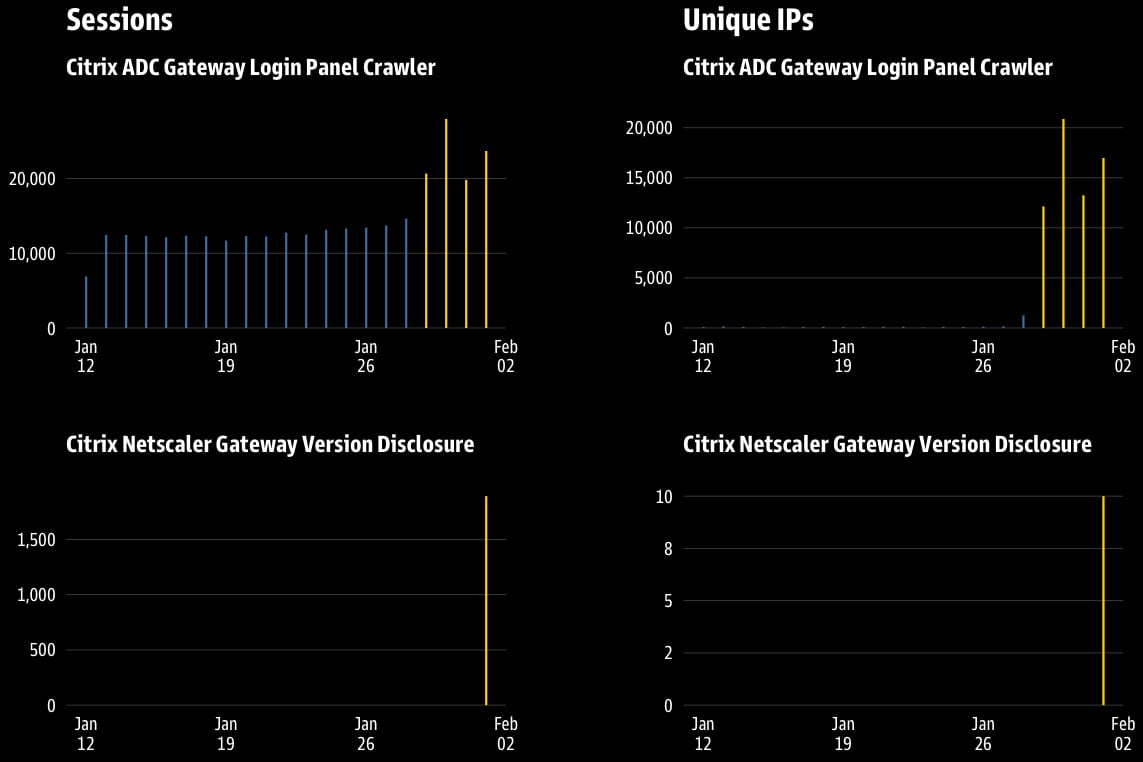
A coordinated reconnaissance campaign targeting Citrix NetScaler infrastructure over the past week used tens of thousands of residential proxies to discover login panels.

The activity was observed between January 28 and February 2, and it also focused on enumerating versions of the product, indicating an organized discovery effort.

Threat monitoring platform GreyNoise traced the source of the scanning traffic to more than 63,000 distinct IPs that launched 111,834 sessions. According to the researchers, 79% of the traffic was aimed at Citrix Gateway honeypots.

Wiz

Roughly 64% of the traffic came from residential proxies, with IPs spread across the globe, appearing as legitimate consumer ISP addresses and bypassing reputation-based filtering. The remaining 36% came from a single Azure IP address.

The activity strongly indicates pre-exploitation infrastructure mapping, rather than random internet scanning, GreyNoise says.

“The specific targeting of the EPA [Endpoint Analysis] setup file path suggests interest in version-specific exploit development or vulnerability validation against known Citrix ADC weaknesses.”

Observed activity
Observed reconnaissance activity
Source: GreyNoise

The two indicators of malicious intent are obvious, with the most active one generating 109,942 sessions from 63,189 unique IPs and targeting the  authentication interface at ‘/logon/LogonPoint/index.html’ to identify exposed Citrix login panels at scale.

The second indicator, observed on February 1st, was a six-hour sprint with 10 IPs launching 1,892 sessions focused on the URL path ‘/epa/scripts/win/nsepa_setup.exe’ to enumerate Citrix versions via EPA artifacts.

GreyNoise notes that the attacker employed a user agent for Chrome 50, released in early 2016. Targeting the EPA setup file may indicate an “interest in version-specific exploit development or vulnerability validation against known Citrix ADC weaknesses.”

“The rapid onset and completion suggest a targeted scanning sprint that may have been triggered by discovery of vulnerable EPA configurations or intelligence about deployment windows,” GreyNoise says.

The most recent critical-severity flaws impacting Citrix products are CVE-2025-5777, aka ‘CitrixBleed 2,’ and CVE-2025-5775, a remote code execution vulnerability that was exploited as a zero-day.

GreyNoise lists several detection opportunities for this latest activity, including:

  • Monitoring for the blackbox-exporter user agent originating from non-authorized sources
  • Alerting on external access to /epa/scripts/win/nsepa_setup.exe
  • Flagging rapid enumeration of /logon/LogonPoint/ paths
  • Watching for HEAD requests against Citrix Gateway endpoints
  • Tracking outdated browser fingerprints, specifically Chrome 50 (circa 2016)

Additionally, the researchers recommend that system administrators review the necessity of internet-facing Citrix Gateways, restrict access to the /epa/scripts/ directory, disable version disclosure in HTTP responses, and monitor for anomalous access from residential ISPs in unexpected regions.

GreyNoise has also shared the IP addresses used to launch the scanning activity.

Modern IT infrastructure moves faster than manual workflows can handle.

In this new Tines guide, learn how your team can reduce hidden manual delays, improve reliability through automated response, and build and scale intelligent workflows on top of tools you already use.


Source link

Sudan’s military breaks through years-long RSF blockade in Kadugli | Sudan war

0

NewsFeed

Sudanese military officials say they’ve broken through a siege by the Rapid Support Forces (RSF) paramilitary group of the South Kordofan capital of Kadugli. It’s the military’s second major advance in the Kordofan region in less than a week.


Source link

US aircraft carrier scrambles fighter jet to down ‘aggressive’ Iranian drone as tensions rise ahead of talks | US News

0

A US fighter jet has shot down an Iranian drone that was flying “aggressively” towards an aircraft carrier, the US military has said.

The incident in the Arabian Sea comes as Washington prepares for talks with Tehran later this week.

The Shahed-139 drone had approached the USS Abraham Lincoln with “unclear intent” before it was downed by an F-35C fighter launched from the vessel, US military spokesperson Captain Tim Hawkins said in a statement on Tuesday.

Iran threatens US with ‘regional war’

Capt Hawkins said the aircraft “continued to fly towards the ship, part of a “large armada” deployed in the region, despite de-escalatory measures taken by US forces operating in international waters”.

No US personnel were harmed, and no equipment was damaged, in the incident, about 500 miles (800km) from Iran’s southern coast, he said.

Reports in Iran appeared to dispute the US version of events, as ​media sources, including ​the semi-official Fars ‍news agency, said an ‌Iranian drone completed ​a “surveillance mission ⁠in international waters”.

‘Big powerful ships’ are heading in Iran’s direction

Hours later, Iranian forces, including a drone, harassed a US-flagged and crewed merchant vessel that was sailing in the Strait of Hormuz.

Two boats carrying Iran’s Islamic Revolutionary Guard Corps forces, and a Mohajer drone, approached the Stena Imperative “at high speeds, and threatened to board and seize the tanker”, Mr Hawkins said.

The destroyer USS McFaul responded, escorting the Stena Imperative “with defensive air support from the US Air Force”, the statement said, adding that the merchant vessel was now sailing safely.

What US forces are gathering in the Middle East?

White House ​Press ​Secretary Karoline ‍Leavitt, who confirmed the US had shot down the drone on Fox News, said talks with Tehran scheduled for later this week in Turkey, will still go ahead.

Tensions are high between the long-time enemies as US President Donald Trump tries to get Iran to make a deal over its nuclear programme.

On Monday, he told reporters that his administration had “talks going on with Iran. We’ll see how it all works out”.

He wouldn’t say what, if any, threshold he had for military action against the country, which Iran’s supreme leader, Ayatollah Ali Khamenei has said would lead to a regional war.

The drone shooting came hours after Masoud Pezeshkian, Iran’s president, said that he told the country’s foreign minister to “pursue fair and equitable negotiations” with the US, one of the first clear signs from Tehran that it wants to try to negotiate with Washington.

Read more:
Doctors’ disturbing accounts of crackdown
Iran heads for make or break this week

Iran’s government spent weeks putting down protests that began in late December against growing economic instability before broadening into a challenge to the Islamic Republic.

Anywhere between 33,000 and 50,000 people died in the violence, according to estimates from human rights organisations and doctors.

Tehran has admitted that 3,117 people have been killed, the majority of them being security forces and civilians, rather than protesters.

Mr Trump promised in early January to “rescue” Iranians from their government’s bloody crackdown.


Source link

Moms for America Action launches 2026 campaign against Chinese vapes

0

NEWYou can now listen to Fox News articles!

FIRST ON FOX: A group led by conservative moms is stepping into the fight against illegal Chinese-made vapes, inspired by the Trump administration’s efforts, and announcing it will be mounting an “aggressive” 2026 campaign to educate parents on the dangers of illegal e-cigarettes. 

Moms for America Action, the nation’s largest conservative mothers organization, announced in a press release it will make combating illegal Chinese vapes a top priority in the 2026 election cycle, mobilizing parents and placing ads nationwide to demand tougher enforcement and accountability for manufacturers flooding the U.S. market with illicit products.

The group says the action is in line with the Trump administration’s crackdown on illegal vape products manufactured in China that are marketed to children with a variety of flavors.

“For moms, this is personal,” Emily Stack, executive director of Moms for America Action, said in the press release.

DISPOSABLE VAPES MORE TOXIC AND CARCINOGENIC THAN CIGARETTES, STUDY SHOWS

Donald Trump arrives at North Carolina rally

President Donald Trump arrives to speak at a campaign event, Dec.19, 2025, in Rocky Mount, North Carolina.  (Alex Brandon/The Associated Press)

“Illegal Chinese vapes are showing up in our schools, our neighborhoods, and our homes every single day. Moms are fed up, and we’re taking action to stop these products from targeting our kids.”

Moms for America Actions says it will “mobilize moms” to “advocate for stronger enforcement, accountability for foreign manufacturers, and protections for children and families.”

In the press release, the group points out that many illicit Chinese vapes are “deliberately designed” to appeal to children and says that will be a main focus of their campaign’s pushback.

 “This is not an accident; it’s by design,” Stack explained. “China has built a billion-dollar industry on addicting American kids to illegal products that have no place in our communities. Moms are fed up, and we fully support the Trump Administration’s aggressive actions to shut down this black market.”

PRESSURE MOUNTS ON MAMDANI TO ‘CONTINUE THE FIGHT’ ON ILLICIT CHINESE VAPES FLOODING NYC

Vape cigarettes in woman hand

Moms for America Actions said that Chinese vap cigarettes are deliberately designed to appeal to children.  (iStock)

The group’s efforts are in line with the Trump administration’s push to combat illicit Chinese vapes, highlighted by an $86.5 million seizure of illegal vapes in Chicago last year that accompanied “Operation Vape Trail,” an operation by Trump’s Drug Enforcement Agency to stem illegal vape sales. 

“The Chinese are getting richer while our children get sicker,” HHS Secretary Robert F. Kennedy Jr. posted on X last September. “We’re putting an end to that.”

“We are targeting illegal Chinese vapes, and we will stop them from poisoning our children.”

CLICK HERE TO GET THE FOX NEWS APP

Chinese President Xi Jinping

Chinese President Xi Jinping speaks during an international business meeting at The Great Hall Of The People on March 28, 2025, in Beijing, China. (Ken Ishii – Pool/Getty Images)

China’s vape industry is estimated at $28 billion, and despite federal restrictions, government data indicates that two-thirds of its products reach U.S. consumers. More than 80 percent of vapes sold nationwide are illicit and not authorized for sale. 

“President Trump’s actions send a clear message: profiting off the addiction of our children will not be tolerated,” Stack said. “Moms want safe communities, honest enforcement of the law, and leaders who put American families first. We are committed to making sure these dangerous products are removed from our schools and neighborhoods for good.”


Source link

Hackers Exploit Metro4Shell RCE Flaw in React Native CLI npm Package

0

Ravie LakshmananFeb 03, 2026Open Source / Vulnerability

Threat actors have been observed exploiting a critical security flaw impacting the Metro Development Server in the popular “@react-native-community/cli” npm package.

Cybersecurity company VulnCheck said it first observed exploitation of CVE-2025-11953 (aka Metro4Shell) on December 21, 2025. With a CVSS score of 9.8, the vulnerability allows remote unauthenticated attackers to execute arbitrary operating system commands on the underlying host. Details of the flaw were first documented by JFrog in November 2025.

Despite more than a month after initial exploitation in the wild, the “activity has yet to see broad public acknowledgment,” it added.

In the attack detected against its honeypot network, the threat actors have weaponized the flaw to deliver a Base64-encoded PowerShell script that, once parsed, is configured to perform a series of actions, including Microsoft Defender Antivirus exclusions for the current working directory and the temporary folder (“C:\Users\<Username>\AppData\Local\Temp”).

The PowerShell script also establishes a raw TCP connection to an attacker-controlled host and port (“8.218.43[.]248:60124”) and sends a request to retrieve data, write it to a file in the temporary directory, and execute it. The downloaded binary is based in Rust, and features anti-analysis checks to hinder static inspection.

The attacks have been found to originate from the following IP addresses –

  • 5.109.182[.]231
  • 223.6.249[.]141
  • 134.209.69[.]155

Describing the activity as neither experimental nor exploratory, VulnCheck said the delivered payloads were “consistent across multiple weeks of exploitation, indicating operational use rather than vulnerability probing or proof-of-concept testing.”

“CVE-2025-11953 is not remarkable because it exists. It is remarkable because it reinforces a pattern defenders continue to relearn. Development infrastructure becomes production infrastructure the moment it is reachable, regardless of intent.”


Source link

Red Cross worker urges more aid access, recounts time in Gaza | Israel-Palestine conflict

0

NewsFeed

“Israel, as the occupying power, has the obligation to ensure the needs of people are met in Gaza.” As he prepared to leave Gaza, the Red Cross’s Patrick Griffiths is hopeful the Rafah crossing’s “opening” will give Palestinians a chance to heal, but says more must be done.


Source link