Reference #18.530dde17.1781285929.2d668f6c
https://errors.edgesuite.net/18.530dde17.1781285929.2d668f6c
Reference #18.530dde17.1781285929.2d668f6c
https://errors.edgesuite.net/18.530dde17.1781285929.2d668f6c

The 2026 FIFA World Cup will introduce one of the most noticeable in-game rule changes in modern tournament history: Mandatory hydration breaks in every match.
For the first time, players will be required to pause twice per game, once in each half, for a three-minute water break, regardless of weather conditions or stadium location across the United States, Mexico and Canada.
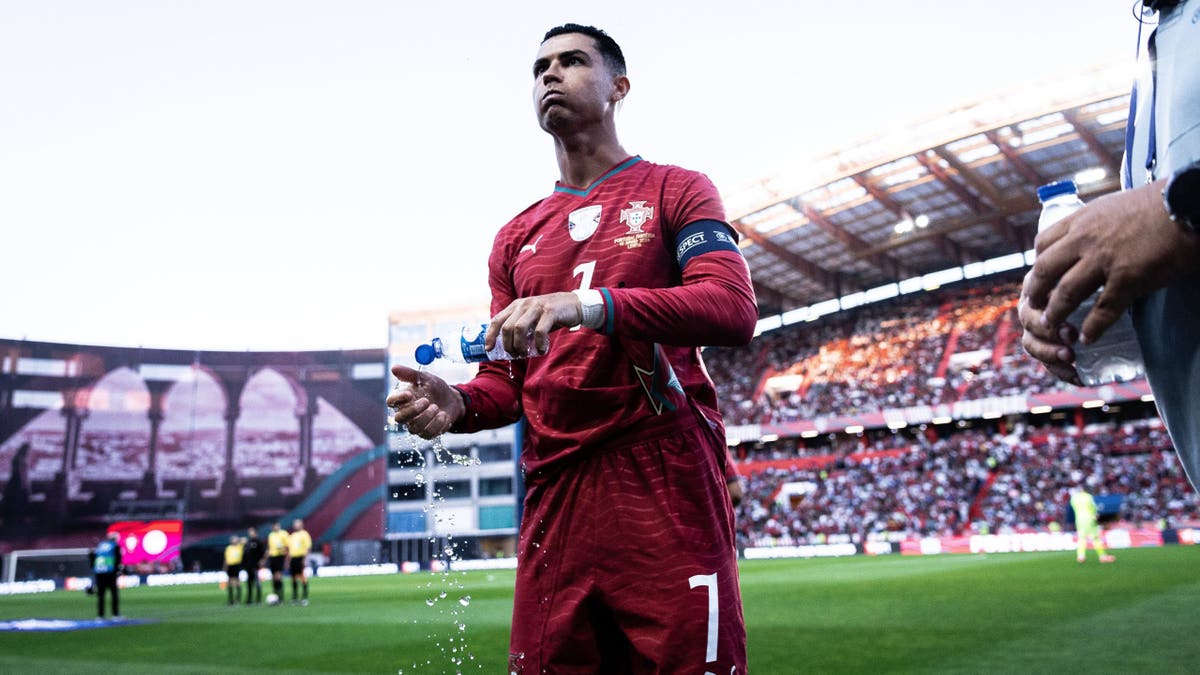
Cristiano Ronaldo of Portugal drinks and splashes water during the FIFA World Cup 2026 international friendly match between Portugal and Nigeria at Estadio Dr. Magalhaes Pessoa in Leiria, Portugal, on June 10, 2026. (Rodrigo Moreira/NurPhoto)
Under the new format, referees will stop play at roughly the 22-minute mark of each half. Players will remain on the pitch, where they can hydrate while coaches are able to talk strategy with their team, essentially making this a timeout like us Americans are used to in our major sports. There aren’t team-issued timeouts like in the NFL, NBA, and NHL by the way. Just a quick reminder for you Americans that only get excited about soccer when the World Cup rolls around, like myself.
WATCH THE WORLD CUP FINAL ON FOX ONE
An important note is that the stoppage time will be added back at the end of each half, ensuring the total playing time remains unchanged. FIFA has framed the change as part of its broader emphasis on player welfare, particularly given the expectation of high temperatures in several host cities during the summer tournament.
I just hope European fans take much-needed water breaks in the stands too. A group of English soccer fans posted a video talking about how hot it was for the England vs. New Zealand friendly at Raymond James Stadium in Tampa, Florida, home of the Buccaneers. It’s quite funny.
As for the response to FIFA’s decision, it has certainly sparked debate among fans and analysts, not only because of its impact on match rhythm, but also because it effectively standardizes interruptions that previously occurred only under extreme conditions.
Critics like U.S. men’s national team coach Mauricio Pochettino claimed the breaks “cut the rhythm of the game,” which has long been defined by continuous, uninterrupted halves. While Belgium coach Rudi Garcia was more positive, saying the breaks are useful because they allow coaches to “discuss strategy mid-game.”
FOX ONE’S NEW WORLD CUP VIEWING EXPERIENCE
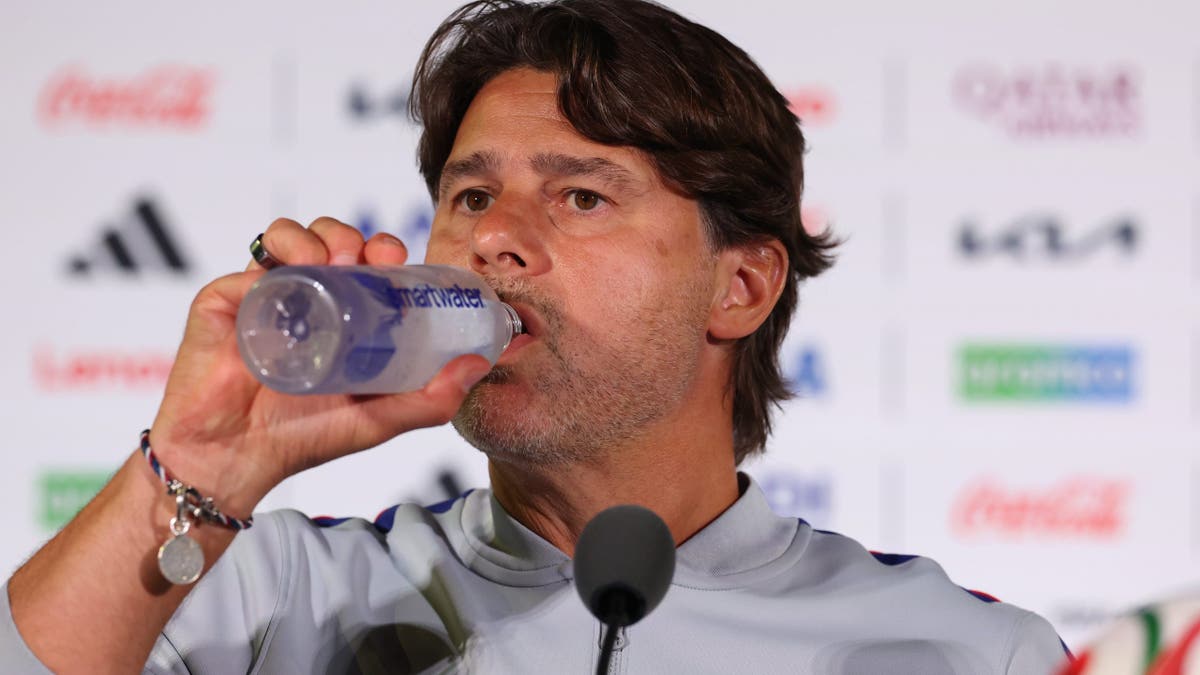
Mauricio Pochettino, head coach of the United States men’s soccer team, drinks water during a press conference in Los Angeles on June 11, 2026, ahead of the FIFA World Cup Group D match against Paraguay. (Alex Livesey/FIFA/Getty Images)
This decision is why FOX Sports soccer analyst Alexi Lalas made the joke, “At the end of the first quarter it’s Mexico-1 South Africa-0.” Soccer now feels a lot more like quarters due to the water breaks, again which Americans are used to in our major professional sports.
You might be thinking, “Wait a minute. I specifically remember water breaks in the 2014 World Cup hosted by Brazil.” You’d be right, but the rules in 2026 are much different.
WORLD CUP PLAYERS WHO COVER THEIR MOUTHS DURING CONFRONTATIONS COULD GET RED CARDS
During the 2014 World Cup in Brazil, FIFA implemented “cooling breaks” for the first time in tournament history. Those stoppages were not mandatory, though, like they are in every match in 2026. They were instead triggered by extreme heat conditions, typically when the Wet Bulb Globe Temperature (WBGT) exceeded safety thresholds. In those cases, breaks occurred around the 30th and 75th minutes and were primarily focused on player safety in the intense humidity and heat.
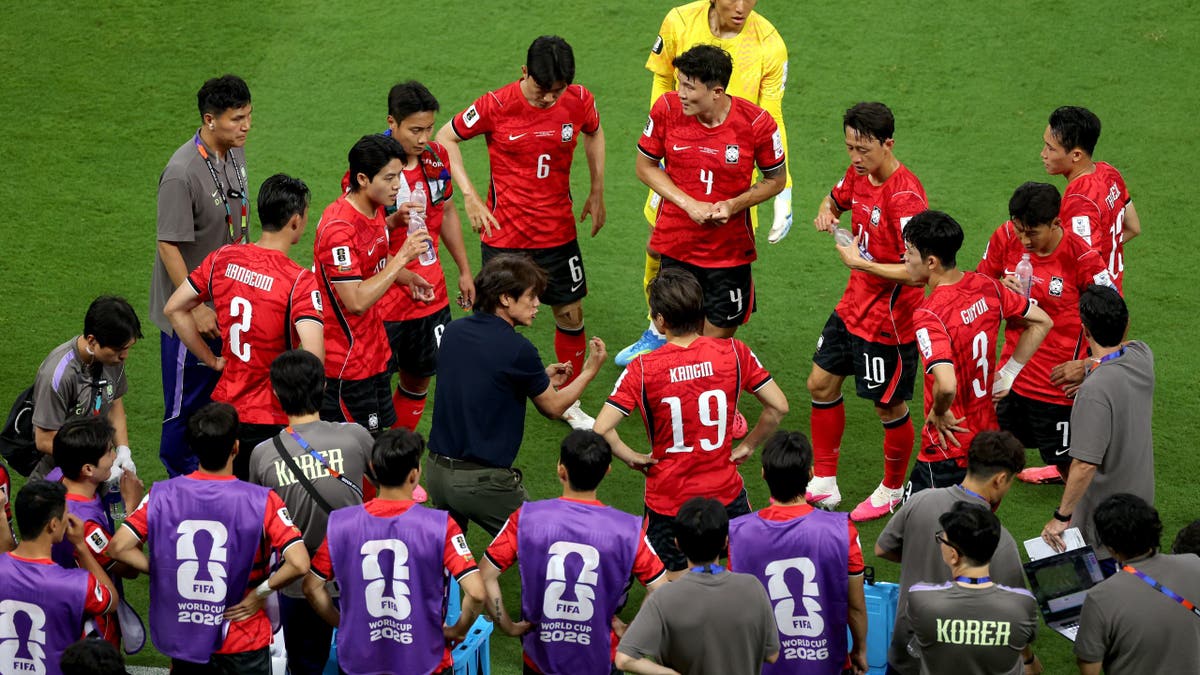
Myung-Bo Hong, head coach of Korea Republic, gives instructions to his players during a hydration break in the FIFA World Cup 2026 Group A match against Czechia at Guadalajara Stadium in Guadalajara, Mexico, on June 11, 2026. (Lars Baron/Getty Images)
The key difference in 2026 is consistency. Rather than being an occasional response to weather conditions, water breaks will now be built into every match as a permanent structural feature. FIFA officials argue this removes ambiguity for referees and ensures equal conditions across all matches, while also addressing modern concerns about player workload and heat stress.
Though FIFA does not explicitly say “this is an advertising break” in the laws of the game change, it’s fair to assume this is a way to generate more advertising dollars. It’s extremely valuable advertising real estate for broadcasting partners, similar to the Super Bowl. As you watch games, you’ll see split-screen advertising during these hydration breaks.
CLICK HERE TO DOWNLOAD THE FOX NEWS APP
It’s safe to say FIFA wouldn’t agree with Coach Boone from Remember the Titans when he said, “Water is for cowards. Water makes you weak.”
The United States kicks off its first World Cup match on Friday night against Paraguay at 9 p.m. ET.
Teenagers under the age of 16 are to be banned from accessing “high-risk” social media apps while safer platforms will be subjected to restrictions, under a sweeping government crackdown to be announced next week.
Under-18s will also be banned from using romantic or sexual AI chatbots following a consultation on keeping children safe online.
However, sources warned the government faced the threat of judicial review over its decision to ban some platforms and not others. Keir Starmer is to outline the plans on Monday but ministers will set out which specific platforms face an under-16 ban at a later date.
The measures to be announced by the prime minister include restrictions on “safe” social media apps, meaning under-16s will be banned from receiving or using disappearing messages, chats with adult strangers, and livestreaming.
The turnaround has been rapid, with the government setting out its response less than a fortnight after the consultation closed on 2 June. The government received more than 116,000 responses to the consultation and nine out of ten parents expressed support for an under-16 ban.
A Downing Street source said the prime minister had been clear since the closing of the consultation that the government’s action needed to be a “game-changer” and nothing was off the table.
“It’s not going to be an incremental change, this is not going to be half measures,” said the source. “The prime minister has listened to parents and he understands that they feel they are trying to do the right thing, but they are on their own against huge tech giants. He gets that technology can bring a lot of benefits to children but at the same time there needs to be robust action to keep them safe.
A senior figure in the government denied reports that No 10 was still debating what constituted “social media” at the 11th hour. “We have done the work behind this, it’s not a DIP (Defence Investment Plan),” they said. “We’ve done the work behind this and it’s properly thought through.”
A source close to Liz Kendall said the technology secretary had repeatedly said she would stand up to global technology giants. “Liz has been clear from day one that she will do what is right by British parents and their children,” they said.
Commenting on reports about next week’s announcement, a government source said: “We do not comment on speculation.”
In Australia, where an under-16 social media ban has been in place, the block applies to any service that allows social interaction between two or more users and if it allows users to post material. As a result, a broad range of apps are banned, from TikTok and YouTube to Snapchat, X, Instagram and Facebook.
Sources close to the pro-ban camp said they were cautiously optimistic about Monday’s announcement, but questions remained about whether the government had the stomach for a fight against tech giants including the Google-owned YouTube. “It won’t be enough to say that these sites have tools to keep children safe,” they said. “What about all the research that says they are desperately addictive and bad for kids?”
However, one source close to the process described the post-consultation outcome as arriving too quickly. “It all seems very rushed,” they said, adding that “the prospect of multiple judicial reviews seems high”.
Judicial reviews consider whether a public body has reached a decision in a legal manner – but does not judge the rights and wrongs of the outcome from a consultation. Mark Jones, a partner at the law firm Payne Hicks Beach, said the speed at which the decision was reached following the consultation was not sufficient grounds to succeed with a challenge.
“It is a high legal threshold, that the decision was irrational, procedurally unfair or illegal. Not only can such legal proceedings be costly, but such action would likely lead to public backlash as it is difficult to argue against child safety and illegal content protections,” he said.
The ban will raise more thorny questions about how age verification works in the UK and worldwide. As it currently stands, the online safety act requires platforms that offer access to pornography or content related to self-harm or suicide to verify that their users are over 18. In practice, companies such as Meta – the owner of Instagram and Facebook – do more than this to verify their users’ ages, including asking users to self-report their ages and using third-party technologies and their own age-verification methods.
Meta, in recent months, has been looking how more robust age-verification technology could work – and where the responsibility for protecting users might lie, for example, with device makers or with app stores. At stake will be whether big tech platforms might have to collect and store more extensive data on their users, which could have ramifications for privacy.

NEWYou can now listen to Fox News articles!
The two brothers of a Mississippi teen accused of killing an elderly couple allegedly attempted to gun down a sheriff’s deputy, who police said will “never walk again,” in a separate incident just days later.
Cordarius Hobbs, 17, allegedly broke into the home of 74-year-old Billy Blair and his 71-year-old wife Virginia Carol Blair on June 3 in Mendenhall, Mississippi, and killed them, WLBT reported.
Just days later on June 8, Cordarius Hobbs’ brothers, Cortavious and Cortavion Hobbs, allegedly tried to kill a Covington County, Mississippi, deputy. Covington County Chief Deputy Sheriff Ricky Lott told Fox News Digital the two men fled from deputies after a traffic stop that led to both Cortavious and Cortavion allegedly firing their weapons.
All three people are brothers, Mississippi Department of Public Safety Media and Public Relations Specialist Bailey Martin told Fox News Digital.

Cortavius Hobbs and Cortavion Dewayne Hobbs were arrested after allegedly trying to kill a deputy. (Covington County Sheriff’s Department)
Lott said Cortavious and Cortavion were initially pulled over by Deputy Yates Rodney for a seat belt violation, saying the suspects were initially “cordial, friendly and light-hearted,” adding the two men were coming back from a fishing trip.
The deputy sheriff also said that Cortavious and Cortavion had marijuana in the car, stating that Yates could see a blunt inside. When he questioned Cortavious and Cortavion about the drugs, Lott said the situation began getting tense.
LISTEN TO THE NEW ‘CRIME & JUSTICE WITH DONNA ROTUNNO’ PODCAST

Yates Rodney was shot on June 8, according to officials. (Covington County Sheriff’s Department)
A 2-to-3-mile-long high-speed chase ended when the driver got stuck in the mud, Lott said, adding that Rodney was shot in his shoulder. The deputy sheriff said the doctor told Rodney that he “will never walk again,” saying the bullet nicked his lungs and spine.
MISSISSIPPI SHERIFF’S DEPUTY SHOT, KILLED WHILE RESPONDING TO DOMESTIC CALL: ‘DIED A HERO’
Lott said Rodney has only been with the agency for around six months and recently got married. A GoFundMe set up for the injured deputy states that he “faces a long and challenging road to recovery.”
LIKE WHAT YOU’RE READING? FIND MORE ON THE TRUE CRIME HUB

Cordarius Hobbs faces murder charges in addition to several more felonies. (Rankin County Jail)
The deputy sheriff said Cortavious and Cortavion both have juvenile criminal records, but couldn’t give any more details.
Cortavious and Cortavion were charged with attempted capital murder and hindering prosecution, and Cortavion is also charged with felony fleeing.
CLICK HERE TO DOWNLOAD THE FOX NEWS APP

Billy Blair and Virginia Blair were killed on June 3. (Family Handout)
The shooting happened just days after the suspects’ brother, Cordarius, allegedly killed Billy and Virginia Blair. Deputies with the Simpson County Sheriff’s Office were called to the couple’s home at around 12:24 p.m. on June 3 after family members couldn’t reach the couple. Once at the house, according to officials, the deputies were met with gunfire.
Cordarius is charged with two counts of capital murder, one count of burglary, four counts of aggravated assault with a deadly weapon, four counts of aggravated assault on a law enforcement officer and two counts of aggravated assault over 65 years old.


More than 400 packages in the Arch User Repository (AUR) are distributing a Linux rootkit and infostealer malware targeting credentials and access tokens.
A report from the open-source intelligence community Independent Federated Intelligence Network (IFIN) notes that a new maintainer is spoofing a trusted publisher on the AUR platform to push infected packages.
The Arch Linux distribution is popular among power users and developers, using the AUR catalog to provide the latest versions for installed software, drivers, and the kernel.

AUR is a community-maintained repository for the Arch distribution that contains package build scripts (PKGBUILDs) with instructions for downloading, compiling, and installing software not available in Arch’s official repositories.
AUR is considered essential for any Arch-based distribution because it contains proprietary applications, beta/nightly versions of open-source software, niche utilities, and older versions of packages that retain functionality which may have been removed in later releases.
However, it is not a vetted space, and threat actors can use it to push malware through packages that change ownership without anyone noticing.
According to IFIN member Michael Taggart, the compromised packages are modified with preinstall scripts that download and execute a malicious npm package called atomic-lockfile.
Independent security researcher Whanos notes that one sample of the atomic-lockfile included a Linux ELF payload named deps, which was a “credential stealer with optional root-only eBPF [extended Berkeley Packet Filter] rootkit capabilities.”
“It is designed for developer workstations and build environments. It targets browser and Electron application data, Slack, Microsoft Teams, Discord, GitHub, npm, Vault, Docker/Podman, SSH, VPN material, shell histories, and other local developer secrets,” Whanos says in the report.
With eBPF technology present, the malware can run inside the kernel with elevated privileges and hide local processes.
Supply-chain management company Sonatype also published a report on a campaign targeting the AUR repository and delivering the malicious atomic-lockfile npm package, but using a different method.
Sonatype researchers say that the threat actor hijacked at least 20 orphaned packages on AUR and pushed atomic-lockfile by modifying the PKGBUILD file – a Bash script with the build information needed by Arch Linux packages.
According to the report, the attacker added a post-install script to invoke npm and retrieve the malicious package.
“The modified packages add a post-install script that invokes npm and installs atomic-lockfile during package installation,” Sonatype says.
However, analysis showed that the npm package installed a Linux executable with references to an eBPF rootkit that could hide processes, files, and network interfaces.
Additionally, the Linux binary indicates that it has infostealer functionality, targeting the following types of sensitive information:
Sonatype determined that the binary can archive data, handle multi-part files, and perform HTTP uploads, so the functionality for a typical exfiltration mechanism is present.
AUR maintainers are working to identify and remove all malicious commits, and to ban the accounts pushing them.
In a message to the community, Arch Linux package maintainer Jonathan Grotelüschen urged users to report any malicious package they find.
As a general rule, it’s recommended to only trust projects with frequent updates and an active community around them.
Arch users are advised to review the list of affected packages and look for the indicators of compromise provided in the report from Whanos.
Michael Taggart also pointed to a script that checks for the atomic-lockfile malware on the system.
If compromised packages are found, users should rotate all credentials and consider reinstalling Arch from scratch, since a rootkit may survive normal cleaning efforts.

Security teams log 54% of successful attacks and alert on just 14%. The rest move through your environment unseen.
The Picus whitepaper shows how breach and attack simulation tests your SIEM and EDR rules so threats stop slipping by detection.
Get the whitepaper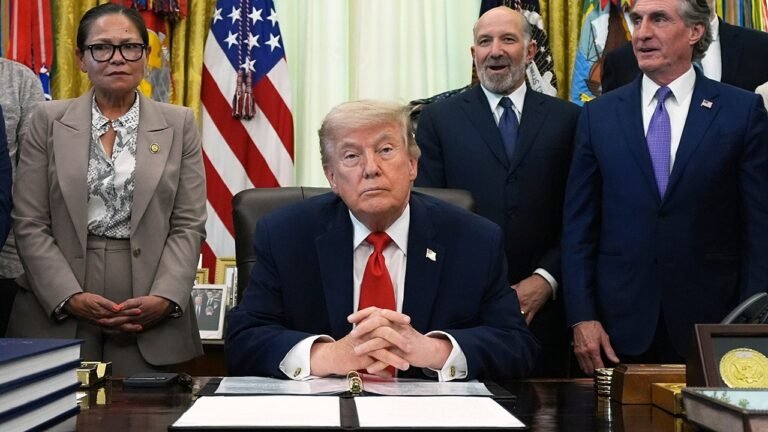
Chief Congressional Correspondent Chad Pergram reports from Capitol Hill on the ongoing debate surrounding the extension of the FISA surveillance tool.
NEWYou can now listen to Fox News articles!
One of the government’s most powerful surveillance tools will go dark this weekend, and lawmakers aren’t sure what that means for the nation’s intelligence-gathering authorities.
Democrats rejected attempts in the House and Senate to extend Section 702 of the Foreign Intelligence Surveillance Act (FISA) in an act of defiance against President Donald Trump, who tapped housing chief Bill Pulte to temporarily oversee the nation’s intelligence services.
But there are differing trains of thought on the ramifications of failing to renew the program. Some lawmakers argued that an extension was not necessary given that FISA courts had authorized continued intelligence gathering until March 2027.
SPY PROGRAM CREDITED WITH STOPPING TAYLOR SWIFT TERROR PLOT BARRELS TOWARD EXPIRATION
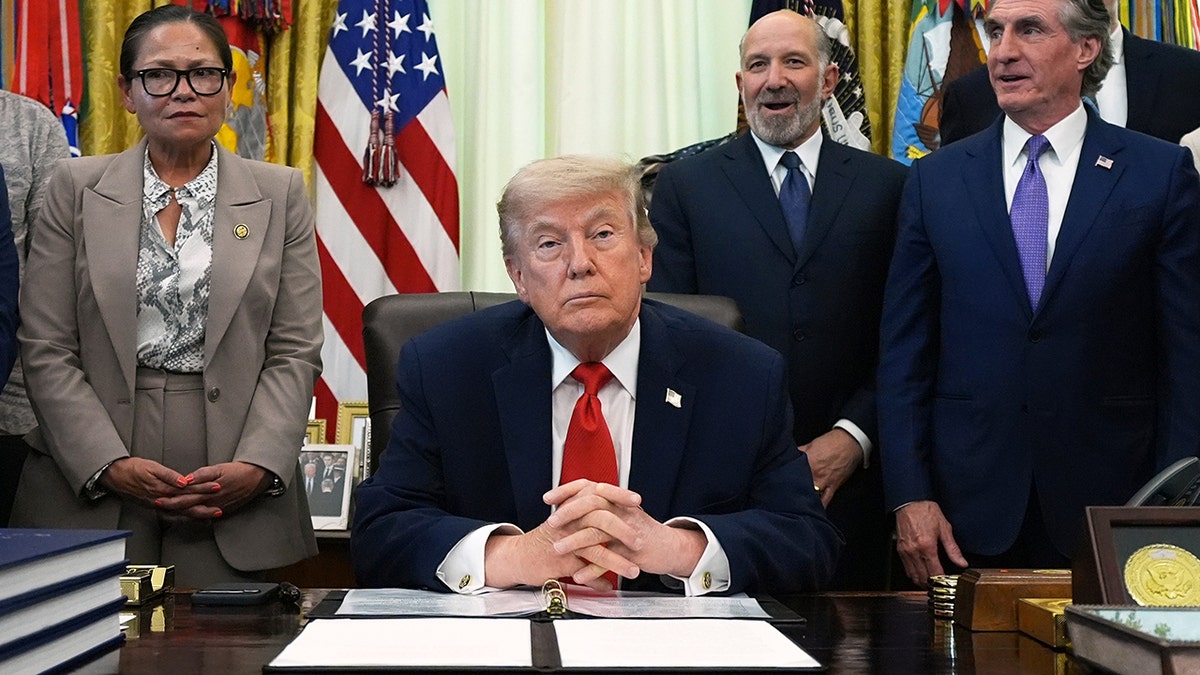
President Donald Trump signs a proclamation about the fishing industry as Del. Kimberlyn King-Hinds, Commerce Secretary Howard Lutnick, and Interior Secretary Doug Burgum listen in the Oval Office of the White House in Washington on June 11, 2026. (Jacquelyn Martin/AP)
Others say that it opens up the possibility for telecommunications and major tech companies like Google to decline handing over information without explicit direction from Congress.
“We don’t know the answer to that,” Sen. Mark Warner, D-Va., the top Democrat on the Senate Intelligence Committee, said. “But it is, obviously, a high-risk proposition.”
Boiled down, the Section 702 program allows the U.S. government to collect intelligence on foreigners abroad who are using U.S. communication systems, and it serves as a major part of Trump’s daily intelligence briefing.
But it also sweeps up communications from Americans who are talking to foreign suspects — a key issue that threatened reauthorization among privacy hawks in both parties well before Pulte’s appointment.
CONSERVATIVE FISA REVOLT POSES FRESH TEST FOR SPEAKER JOHNSON
“That is a gray area, and it’s one of the things that we’re going to have to work through,” House Minority Leader Hakeem Jeffries, D-N.Y., told Fox News when asked whether providers would still continue to share information with the government if the program was not authorized.
“What is clear is that we are going to have to address the issue of extending surveillance authority legislatively. And the problem is that the Trump administration has decided to toss this hand grenade into the middle of sensitive negotiations,” he added, referring to Pulte.
Sen. John Kennedy, R-La., contended that there were already thousands of FISA certifications approved, it’s just that new certifications wouldn’t be allowed until the program was reauthorized.
“It’s not like that will be the end of our ability to surveil foreign terrorists,” Kennedy said.
The standoff is not expected to end soon. Trump’s decision to nominate former Securities and Exchanges Commission Chairman Jay Clayton to serve as the permanent director of national intelligence also failed to soften Democrats’ opposition.
Many lawmakers remain unwilling to back a renewal of the program while Pulte continues serving in the acting role.
THE TOP 3 FACTORS HEIGHTENING THE RISK OF TERROR ATTACKS ON THE HOMELAND
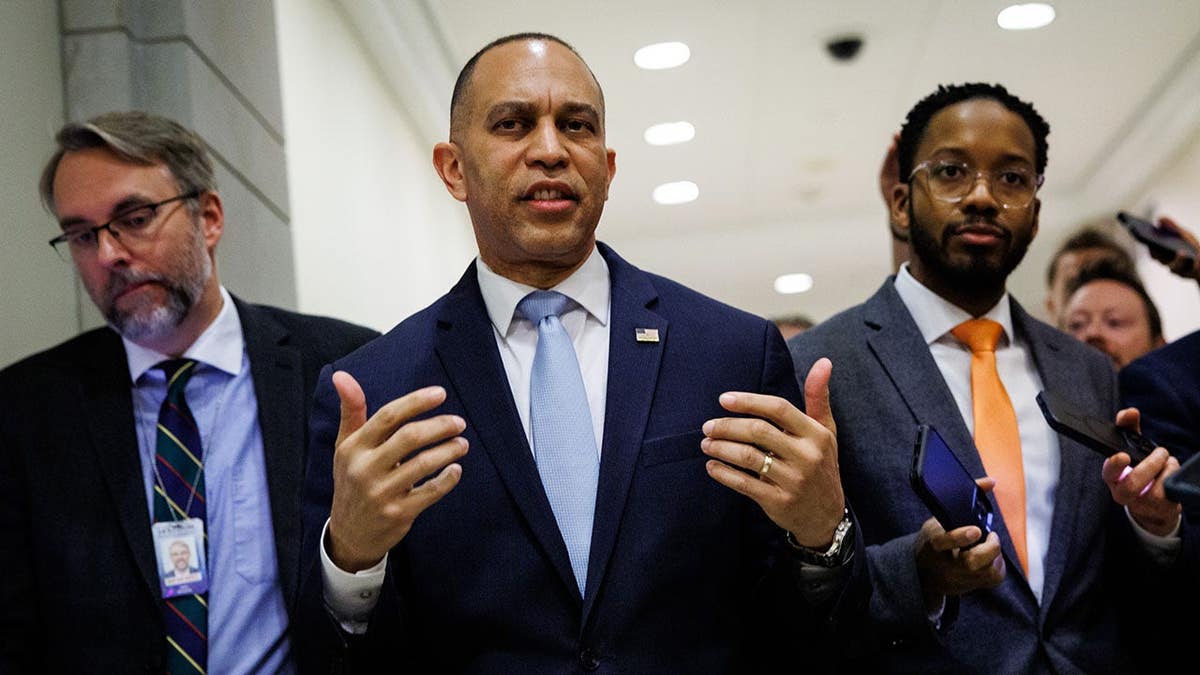
House Minority Leader Hakeem Jeffries, D-N.Y., speaks with reporters as he walks to his office after a press conference at the U.S. Capitol in Washington, D.C., on March 27, 2026. (Samuel Corum/Getty Images)
“Nobody disputes that FISA has been used to stop terrorist attacks on our homeland here,” House Majority Leader Steve Scalise, R-La., told Fox News Thursday. “And why would anybody vote to end that tool is beside me.”
Meanwhile, the House is scheduled to begin a week-long recess next week, meaning that even if there is a resolution in the Senate in the coming week, the program will likely remain dark until they return.
The program’s expiration marks the first extended lapse since it was enacted in 2008. The Trump administration has argued that the surveillance authority is a critical national security tool, crediting it with helping foil a mass-casualty terror plot targeting a 2024 Taylor Swift concert in Austria and combat North Korean hackers, among other successes.
The uncharted territory comes amid a heightened threat environment as the war with Iran continues and large-scale events, such as the World Cup and America 250 celebrations, are beginning to ramp up.
Senate Intelligence Committee Chair Tom Cotton, R-Ark., argued on the Senate floor in his bid to extend the program that there was a bipartisan bill waiting to be passed, but in the meantime, lawmakers should pause the partisan animosity and support an extension.
CLICK HERE TO DOWNLOAD THE FOX NEWS APP
“If we don’t extend it for at least a few weeks while we continue to try to work on our differences, the consequences could be severe,” Cotton said. “The consequences, to be frank, could be fatal.”
Still, Democrats counter that had Trump not appointed Pulte, or at least waited until the reauthorization was completed, Congress would not be in the current logjam.
“I cannot stress enough to you that none of this, none of this needed to happen,” Warner said.
Great news! Donald Trump has said the US and Iran are on the verge of a peace agreement. Oil prices are down, and the stock market is up. This comes only hours after Trump warned Iran was about to be struck “VERY HARD”, a threat which had sent oil prices up and stocks down.
It has been another ride on the Trump rollercoaster, keeping traders on edge, most of the world poorer, and people of the Middle East constantly whiplashing between fear and hope. But whether the ride veers up or down, the management always makes money.
This is the 39th time that the president has declared US-Iranian talks to be on the point of fruition (other counts have the figure higher – it depends on what you term a prediction or just a hint). On five of those occasions, the promise of peace has involved walking back the threat of mass devastation, including the destruction of critical civilian infrastructure, a near-certain war crime if carried out.
As he was menacing Iran with “very hard” strikes on Thursday night, Trump also pledged the US would take over “total control” of the country’s oil and gas markets and seize the island of Kharg. He has threatened the capture of Kharg, a focal point of Iran’s hydrocarbon industry, several times before, although in this instance the threat was delivered while actually bombing Iran, in a tit-for-tat exchange with Tehran in which a critical reservoir and water tanks were badly damaged in the drought-stricken south, a war crime if intentional.
By Thursday afternoon however, the prospect of mass destruction had evaporated as quickly as it had materialised.
“I have, as President of the United States of America, cancelled the scheduled strikes and bombings against Iran this evening,” Trump declared on his Truth Social platform as if providing his full capitalised title added any weight to the statement.
A signing ceremony could even take place in Europe this weekend, the president suggested in remarks later in the day. Tehran reacted sceptically, insisting that no deal was imminent, but the oil price fell below $90 (£67) a barrel nonetheless.
No matter how many times he predicts conflagration or diplomatic breakthrough, the markets still obediently bob up and down like a trained seal. It is a guaranteed response that represents an opportunity to make big, easy money for anyone with advance knowledge of presidential announcements
A recent BBC investigation found that multimillion-dollar trades have been made in global markets just before he makes major administration announcements, particularly involving oil trades on the futures market.
After so many false dawns and hoax armageddons, why are traders still reacting to Trump’s rhetoric? One theory is that, while individual traders are no suckers, they suspect that some of their competitors might be, so react rapidly to presidential statements to get ahead of the curve.
An alternative explanation, suggested by Australian-American economist Justin Wolfers, is what he calls the “known liar problem”. The markets know Trump is an unreliable narrator and heavily discount everything the president says, but the economic implications of war or peace in the Gulf are so enormous that even a heavily discounted reaction still moves the dial.
After all, one day there will be a deal. The president’s on-off signals are not being sent in a vacuum, but in the midst of talks between the two sides intended to turn the ceasefire, which has mostly held since April, into something more permanent.
According to reports from the region, the gaps in those talks are indeed getting smaller. The focus is on a limited memorandum of understanding (MoU), putting off nuclear negotiations for later and focusing on opening the Strait of Hormuz, a vital route for global trade.
The most immediate impasse is about cash. Tehran has no confidence Trump would keep his word in any deal so wants to be paid up front from a $24bn tranche of an estimated $100bn of its assets frozen around the world, in return for lifting its blockade on the Strait of Hormuz.
The US wants rewards to follow tangible progress, but the administration has a fundamental problem with releasing Iranian assets. Trump and other top Republicans have spent years lambasting Barack Obama for delivering unfrozen assets to Iran in the form of pallets of cash as part of a 2015 nuclear deal, which was successful in curbing Iran’s programme until Trump walked out of it in 2018.
The workaround being discussed according to a source briefed on the talks involves a line of credit from a bank in a Gulf state issued against Iran’s $100bn of frozen assets as collateral. It will fool only those who want to be fooled, but that would include the administration’s defenders on the American political stage.
The second major sticking point is how much detail about nuclear issues should be included in the MoU. The US wants concrete parameters including a moratorium on uranium enrichment of 15 years or so, and arrangements for the disposal of Iran’s stockpile of highly enriched uranium.
US officials focus on these two factors in briefings to the American press, but when the Iranians have briefed diplomats and experts lately, they have insisted such matters have hardly been mentioned and are pressing for only vague references to nuclear issues in the memorandum, leaving them to be negotiated in Geneva in the weeks after an MoU is agreed.
Trump may have shown the way for a possible fudge by insisting that the deal will ensure “Iran will never have a nuclear weapon”. That is something that Tehran might agree to. Iran’s renunciation of atomic arms was once reinforced by religious edict, or fatwa, but the supreme leader who issued that fatwa, Ali Khamenei, was killed by an Israeli bomb in the first seconds of the US-Israeli war on Iran on 28 February. Any Iranian pledge now is likely to be secular, and contingent on the MoU being upheld.
A compromise MoU along similar lines appeared close to agreement in late May, but Trump helped derail it by suddenly moving the goalposts, including the suggestion that the regional guarantors of the agreement normalise relations with Israel as a gesture of gratitude for the suspension of hostilities. The suggestion was greeted by a stunned silence across the Middle East.
Throwing last-minute surprises into negotiations has long been a Trump tactic in business and US politics. It has not worked in the Iran talks. Instead, the president has sometimes behaved as a finicky eater faced with a stark menu of two unpalatable options: all out war or messy compromise. He has noisily wavered between choosing one or the other in the hope of being presented with something more to his taste, but that has yet to happen.
“You have an impasse. Trump doesn’t have any good options. He’s come close to accepting an MoU, but then he’s backed away because it’s difficult for him to politically sell it at home and claim victory,” said Vali Nasr, a former state department adviser, who is now professor at Johns Hopkins University’s school of advanced international studies. “Trump wants an MoU in which he offers the Iranians nothing really, but gets a lot from them. The only offering that he’s giving is that he can make their life worse. And they’re not going to accept that.”
The US administration’s explanation for the long delay in achieving an MoU is a divided camp in Tehran, in which Iran’s chief negotiator, foreign minister, Abbas Araghchi, is constantly being second-guessed by Revolutionary Guard generals back home.
That may be true. The internal dynamics of the Tehran regime were murky before the bombing started, but now they are virtually a black box. The one certainty is that the Revolutionary Guard, the principal target of US-Israeli decapitation bombing, has emerged stronger in relation to the other power centre. It is unclear whether Khamenei’s successor, his badly injured son Mojtaba Khamenei, is any more than a figurehead.
However it organises itself internally, the regime has shown itself to be remarkably resilient. Dead leaders have been replaced and domestic unrest has been suppressed. The war has arguably made that suppression easier. The brunt of the economic war being waged by the US is being borne by the Iranian people but that has yet to turn into decisive pressure on the leadership.
Peace is likely to be more dangerous to the regime than war, as there will no longer be an external enemy to blame for runaway inflation and high employment. Nasr said that is why Tehran is so insistent on getting funds up front in any deal.
“Trump is basically saying: let’s go back to where we were before 28 February and there’s no stomach for that in Tehran,” he said. “They don’t want to go back after all of this fighting just to where things were before. They’ve incurred $200-300bn dollars of damage during the war.”
Despite Iran’s dogged survival in the face of a US-Israeli onslaught, in which the US alone claims to have bombed 13,000 targets, the Israeli leadership and Washington hawks are continuing to try to convince Trump that one more big push will finally bring down the regime.
“I think the president eventually is going to do a much bigger kinetic military strike,” Darin Selnick, a former Pentagon deputy chief of staff told BBC Radio 4. “[US forces] never finished the target list. So they have about 20% of the target list. They can start taking out what will really hurt, which is the various oil facilities … They can take out another level of military leadership. They could have taken out those who are at the negotiating table, but they wanted to have someone to negotiate with. They can take those guys out as well.
“Then they can forcibly reopen the strait themselves. If this trade opens … Iran would really have no ability to do anything but surrender.”
For all his past threats of civilisational erasure if Iran fails to acquiesce, Trump has so far shown himself reluctant to double down on a military bet that has already failed.
Ali Vaez, Iran project director at the International Crisis Group, argued that Trump’s latest threat of devastating strikes was performative.
“Trump is using the threat either to force the Iranians to make last minute concessions, or to justify a deal that he knows would be criticised by the hawks,” Vaez said.
Richard Nephew, a former Iran affairs director at the US national security council and now a research scholar at Columbia University, said: “I think he is probably poised to try and cut some sort of deal. He’s going to want to describe some sort of Iranian concession as coming from how loudly he barked.
“I think the Iranians will dispute that, but I think the bigger problem is that you start to see [the Revolutionary Guard] talking about preemptive military action.”
The Iranian military has managed to retain 70% of its missile arsenal from the start of the war, and might be tempted to use it before losing it, if it expected another mass US-Israeli attack.
Nephew called it a “preemption paradox”. Trump’s repeated threats might be discounted by traders, but if they were taken seriously by his adversary, his attempts to game the markets could easily run out of his control.


Security
Clinical trial participant data stolen, but pharma giant says exposed records were pseudonymized
Pharmaceutical giant Novo Nordisk says data related to clinical trial participants was stolen as part of a cyberattack.
The affected patient data was pseudonymized and not directly linked to names or other direct identifiers, the company said.
The maker of the Wegovy weight-loss drug said the affected data types include patient ID, information on trial participation, gender, year of birth, biomarkers, health/immunogenicity data, and lifestyle factors including smoking status, alcohol use, and BMI.
“This information is not directly linked to any patients by name or other direct identifiers,” the Novo Nordisk said on its dedicated page for the attack.
“Information about identity would therefore require access to underlying information, identifying patients by name etc. This information was not exposed. We therefore do not consider the incident to enable any third party to identify participants in our clinical trials.”
The same statement confirmed that the attack affected a “limited number of internal IT systems,” and the company said some systems have been taken offline as a precaution.
Although it does not believe there is an immediate risk stemming from the breach, it nonetheless warned patients to remain vigilant for anything that could be connected to the data stolen during the attack.
A separate letter sent to the company’s healthcare partners (HCPs) states that additional personal information may have been stolen and could lead to targeted phishing attempts.
Affected HCP data includes names and registration numbers, email addresses, phone numbers, WhatsApp details, and office locations.
“Based on the nature of the exposed data, the potential consequences of the incident include targeted phishing attempts through emails, phone, and WhatsApp, or fraudulent communications impersonating colleagues,” Novo Nordisk said in the letter.
“We recommend that you remain vigilant against unexpected messages or calls and report any suspicious activity to us.”
The pharma biz warned that it may take time to bring these systems back online, but it is working to do so “in a controlled and safe manner.”
Elsewhere, it all sounds like standard practice. Outside experts were called in to help investigate, and Novo Nordisk has not yet confirmed the scale of the breach, nor will it until the experts have more time to assess the damage.
Novo Nordisk added that the attack has had no impact on its core business operations, which remain running as normal.
The attack was announced on what should have been a day of celebration for the company, whose flagship semaglutide weight-loss and diabetes pill received the green light to become the UK’s first daily GLP-1 tablet hours earlier.
The Wegovy pill joins the list of approved weight-management treatments that act as agonists for the GLP-1 receptor. All the other approved treatments are injectables, including Wegovy and Ozempic, both of which are also developed by Novo Nordisk.
The Danish company employs roughly 67,900 people across 80 countries, and markets products in nearly every country globally. ®

Published On 12 Jun 2026
Pakistani Prime Minister Shehbaz Sharif has said a “final, agreed upon text of the peace deal has been reached” between the US and Iran.
Sharif made the statement in a post on X, after both US and Iranian officials warned against trusting reports speculating on the details of a new agreement.
“Pakistan is now working closely with both sides to finalize the next steps,” Sharif wrote on X. “Peace has never been this close as it is now.”
Sharif posted shortly after Iranian Foreign Minister Abbas Araghchi said a deal had “never been closer”.
The message was one of the clearest yet from Iran, indicating an agreement could be imminent. Trump reposted Araghchi’s message on his Truth Social account.
More to come…

SpaceX has now entered the elite trillion-dollar club and is set to become part of the Nasdaq 100 index, marking a major milestone for both SpaceX and the broader AI-space sector. | Photo Credit: Dado Ruvic
Shares of SpaceX surged on their market debut, opening at $150 against an IPO price of $135 and later climbing to $164, propelling the Elon Musk-led company to become the sixth-largest US firm by market capitalization.
The IPO saw massive interest from both retail and institutional investors as Musk prepares to take the AI battle to space with his ambitious plans to make orbital data centres.
SpaceX raised USD75 billion from the public by selling nearly 556 million shares priced at USD135 at a valuation of USD1.77 trillion. With the public listing, SpaceX has joined an elite club of companies having a valuation of over a trillion dollars. SpaceX also became the maiden US company to list with more than a trillion-dollar valuation.
Earlier, the company’s president Gwynne Shotwell rang the market opening bell with Musk participating in the event virtually from Texas. The SpaceX stock is trading under the ticker SPCX on Nasdaq, giving an opportunity to individuals to freely trade in the company’s shares.
The rocket, satellite and AI company, which was started by Musk 24 years ago, is at the frontier of space exploration with ambitions ranging from multiplanetary civilization to data centers in space. “SpaceX is about taking fiction out of science fiction,” Musk said during the opening bell ceremony.
Musk added that other companies were not working on technology that would “make life multiplanetary”. Musk said that he was not sure of SpaceX’s success but wanted to give it a try.
“I gave SpaceX less than 10% chance of succeeding at all. To be clear, in fact, Itold people this. I said, look, we’re probably going to fail, but you know, should give it a try bvecause if we don;y, if there’s not a new company that enters space, we will never be a truly space-beating civilization,” Musk said while celebrating the market debut of SpaceX with fellow colleagues in Texas.
With the blockbuster listing, Musk has become the first person on the planet to become a trillionaire. Majority of Musk’s wealth comes from his massive shareholding in SpaceX in which he also holds dominant voting rights that allows him to steer the company in the direction he wants.
Founded in 2002, SpaceX is the only company building the integrated hardware and software infrastructure of the future across space, connectivity, and AI, the company said in its prospectus.
The AI unit xAI was founded in 2023 and acquired by SpaceX in early 2026. The company is rapidly scaling its compute infrastructure and boasts one of the largest compute clusters – COLOSSUS and COLOSSUS II.
The company is also planning Terafab facility, a chip manufacturing initiative with Tesla and Intel that aims to further extend the vertical integration to chip design and manufacturing.
Musk upended the norms in IPO pricing by choosing a fixed price rather than opting for a range that lets gauging of investor interest at different price points. Musk chose a take-it-or-leave-it approach for the SpaceX IPO relying on the legion of supporters to back SpaceX just as they did to Tesla.
SpaceX will soon be a part of Nasdaq 100 index as the stock exchange changed its rules in March for speedier entry of megacap listings. The inclusion will automatically make SpaceX a part of many passive index funds indirectly making the company a part of many individuals’ portfolio.
The SpaceX IPO has also come as a boon for thousands of current and former employees by making them millionaires.
The SpaceX debut is happening at a pivotal moment for AI as the wave sweeps stock markets lifting many AI-linked shares to record highs. The listing will also be a test that will gauge investor appetite for upcoming big-ticket AI listings with Anthropic and OpenAI slated to go public later this year.
Published on June 12, 2026