The genocide is still taking Gaza’s mothers | Gaza

0

On May 10, many flowers and many boxes of chocolates will be gifted to mothers in the United States, Canada and elsewhere. Greetings will be filled with joy and gratitude for maternal presence. Mothers will wear their finest clothes to spend time with their children, receive gifts and enjoy a beautiful day.

It is no wonder most countries in the world have a Mother’s Day, even if it is on different dates. Motherhood is a wondrous thing, and it needs to be celebrated. But there is one place on Earth where it brings heartache to many.

In Gaza, where 22,000 women have been killed in two and a half years, many children dread this special day because it reminds them of intolerable pain. Too many mothers have died and many more are gravely ill.

My own mother, Najat, who is just 46 years old, is suffering from cancer, which was diagnosed quite late.

On March 21, when the Arab world celebrated their mothers, I did not say “Happy Mother’s Day” to mine. Instead, I silently prayed that she would remain with us a little longer. I did not think about celebrations; I thought about my own fears of losing her.

On Mother’s Day, my mother did not wear her finest clothes and did not join us for a special meal, smiling and looking happy. She was frail and worn down.

A week before Mother’s Day, she had undergone her third round of chemotherapy and had spent days bedridden, unable to move and barely able to speak. No words in the world would have been enough to tell her how much she meant to me that day. But I stayed silent. On the day when others celebrated their mothers, I held back my tears so I would not add to her pain.

My mother’s case is not unique. The genocide has brought immense suffering to Gaza’s mothers. And that pain, misery and death start from the moment women step into motherhood. Maternal death rates during childbirth increased threefold during the genocide. A recent report documented 220 Palestinian women dying while giving birth in Gaza between January and June 2025.

The famine disproportionately affected pregnant and breastfeeding women, putting them and their children at risk of death and various health complications. Mothers had to go through the pain of watching 70,000 children languish due to malnutrition. More than 150 mothers had to bury their children who succumbed to the famine.

More than 22,000 women have lost their husbands and are now forced to be the mothers and fathers of their children, carrying on their backs alone the excruciating task of survival amid a genocide. Many others may not have lost their husbands, but they still are the main caretakers of wounded and ill children or the elderly in their families.

Many have to live with the constant throbbing pain of losing their children in the Israeli attacks; more than 21,000 of the victims of the genocide were children.

All the while, the burden of running a household has grown immensely as there is no running water, electricity, or normal access to food. Life in tents that do not protect from the scorching heat or the freezing cold, from disease or pests, is intolerable. And so is the loss of loved ones. Even the most resilient mothers of Gaza are at the threshold of their strength.

It is no wonder that so many mothers are getting sick. But Israel has also made sure that they are not getting the treatment they need.

The Israeli army has bombed all hospitals in Gaza and destroyed the only specialised oncological hospital. That has meant that not only are cancer and chronic illness patients not receiving proper treatment, but also that, during the war, there was no way to carry out the necessary regular checkups that can catch diseases in early stages.

The doctors told my mother that her cancer had been growing in her probably for nearly two years. Early discovery could have made treatment much easier and improved her chances.

I am truly living the worst days of my life. I am torn between my fear for her and the need to muster the strength to replace her at home. I see her break every day, little by little, which breaks me.

I am the eldest daughter, and so the responsibility for the household has fallen on my shoulders. My mother used to do everything as if it required no effort at all, as if life simply moved on its own. Now I have stepped into her shoes and realised just how exhausting this work has been.

I look at my only sister, who is just three years old, and try hard to convince her that I am happy and that our mother is fine. I keep telling her that Mom’s hair will grow back long and beautiful again. On every chemotherapy day, my sister asks me, “Where did Mama go?” I take a deep breath before answering that she has gone to the doctor. It is not a simple question to answer while trying to keep in mind the pain of the reality it exposes.

I cook, clean, and take care of everyone at home. When I am done and it is time to take a break, my mind does not rest. It keeps asking incessantly: “Will she recover? Will she come back to us as she was? Will these heavy days pass?” Every possibility that crosses my mind exhausts me and weighs heavily on my heart. This is not a passing crisis. This is my mother, and this is cancer, and this is Gaza amid a genocide.

We are now waiting anxiously for her surgery – full mastectomy – to be scheduled.

Doctors have said my mother also needs radiation therapy, which is not available in Gaza now. She has been given a medical referral, which has not been approved yet. She is one of 20,000 Palestinians in Gaza in urgent need of evacuation, which has been purposefully made brutally slow.

Every now and then, my mother looks at the referral paper that confirms her urgent need to travel and sighs deeply with sorrow. I cannot tell what she is grieving most, her illness, the mastectomy, her changed appearance, or the restricted Rafah crossing.

I am almost certain that her heart cannot bear all of this and that her mind may one day collapse under the weight of all this pain. Her suffering – and that of so many other Gaza mothers – will not even be captured in a statistic. It will go unseen – just as the architects of the genocide intended.


Source link

Justice Ketanji Brown Jackson’s 5 solo Supreme Court dissents in one term


NEWYou can now listen to Fox News articles!

Justice Ketanji Brown Jackson stood out from her colleagues this week when she broke with them to rail against the high court’s decision to fast-track its landmark order dismantling a key provision in the Voting Rights Act. 

But Jackson’s solo dissent was far from the first time the Biden-appointed justice has been on an island, as she has routinely blasted the court for not asserting more judicial authority over President Donald Trump’s executive actions and drawn rebukes from her colleagues for taking what they have viewed as flawed positions.

Ideological divides over high-profile cases have been common. The trio of liberals has remained unified against the Trump administration by opposing decisions, including on the interim docket, to curb universal injunctions, allow states to ban transgender medical treatments for minors, permit Trump to fire members of independent agencies, authorize the government to cancel immigrants’ temporary protected status and more.

But even in some of those cases, Jackson goes on solo diatribes, highlighting a deeper internal divide within the liberal bloc.

WHY JUSTICE JACKSON IS A FISH OUT OF WATER ON THE SUPREME COURT

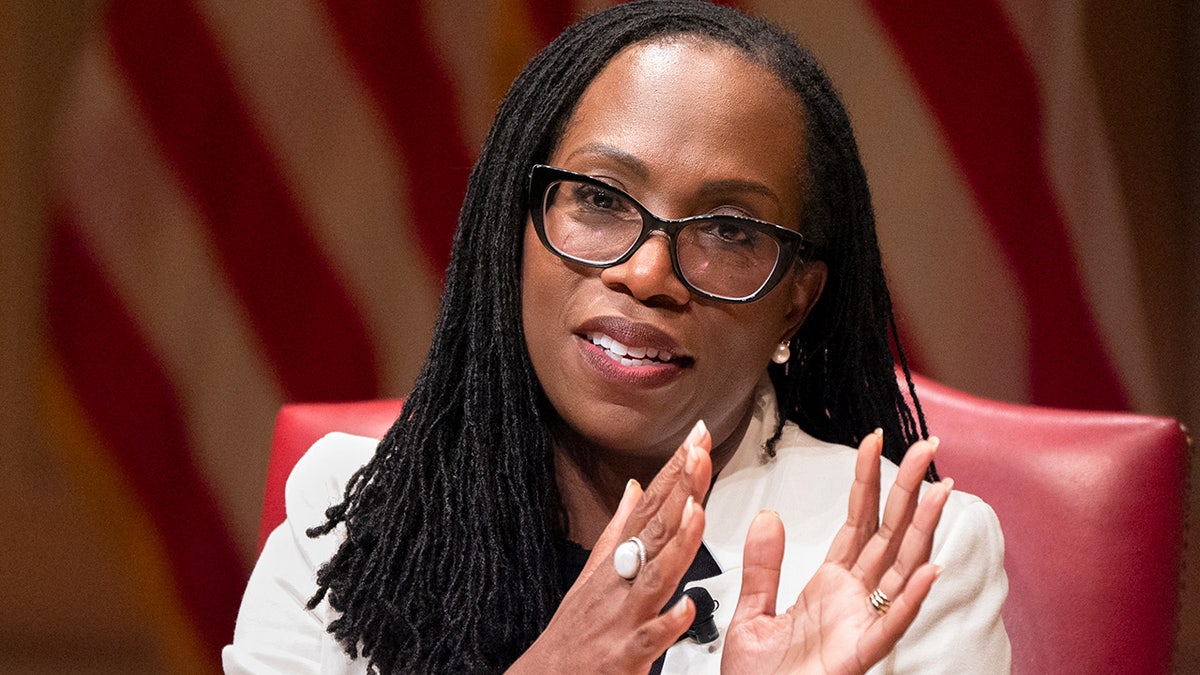
Supreme Court Justice Ketanji Brown Jackson speaking at the Library of Congress in Washington, D.C.

Supreme Court Justice Ketanji Brown Jackson speaks to the 2025 Supreme Court Fellows Program at the Library of Congress in Washington, D.C., on Feb. 13, 2025. (JACQUELYN MARTIN/POOL/AFP via Getty Images)

Below are five recent times Jackson gave lone opinions.

1. Louisiana redistricting judgment

The Supreme Court struck down Louisiana’s map last month, finding 6-3 it contained an unconstitutional racial gerrymander.

Upon request, the Supreme Court also decided 8-1 to fast-track the landmark decision — handing it down immediately rather than in roughly a month like it usually does — allowing several red states to more quickly attempt to implement new congressional lines after the high court weakened Section 2 of the Voting Rights Act by limiting the role race may play in congressional redistricting.

Jackson, the bench’s most junior justice, broke with her eight colleagues in that decision, saying the court improperly “[dove] into the fray” of active elections by handing its judgment down immediately.

“Not content to have decided the law, it now takes steps to influence its implementation,” Jackson wrote.

LATEST SCOTUS LEAK A GIFT TO LIBERALS ‘SALIVATING’ OVER CONTROL OF HIGH COURT NARRATIVE: EXPERTS

Justice Samuel Alito, joined by Justices Clarence Thomas and Neil Gorsuch, wrote a scathing concurrence for the sole purpose of ripping apart Jackson’s dissent, saying her claims were “groundless and utterly irresponsible.”

2. Universal injunctions

The Supreme Court is still weighing Trump’s signature plan to severely limit birthright citizenship, but it first entertained the subject last year by addressing how lower courts across the country uniformly issued nationwide injunctions against the plan. The high court decided 6-3 to ban such injunctions but left room for judges and plaintiffs to deploy other methods when seeking widespread relief.

Jackson gave a rogue, separate dissent in the case, drawing eyebrow-raising jabs from Justice Amy Coney Barrett.

U.S. Supreme Court Justice Amy Coney Barrett speaking at a conference in Chicago

Justice Amy Coney Barrett delivered remarks at the Seventh Circuit Judicial Conference at the Swissotel hotel in Chicago, Illinois, on Aug. 18, 2025. (Getty Images)

“We will not dwell on Justice Jackson’s argument, which is at odds with more than two centuries’ worth of precedent, not to mention the Constitution itself,” Barrett wrote in the court’s opinion in 2025. “We observe only this: Justice Jackson decries an imperial Executive while embracing an imperial Judiciary.”

Jackson wrote that nationwide injunctions should be permissible because the courts should not allow the president to “violate the Constitution.” 

Barrett disagreed.

“She offers a vision of the judicial role that would make even the most ardent defender of judicial supremacy blush,” Barrett wrote.

Supreme Court justices

Justices of the US Supreme Court pose for their official photo at the Supreme Court in Washington, DC on October 7, 2022. (OLIVIER DOULIERY/AFP via Getty Images)

3. National Institutes of Health grants

The high court fractured last August in dual 5–4 decisions that allowed the National Institutes of Health to cancel nearly $800 million in research grants.

Jackson, in one of her most memorable one-person dissents, appeared to boil over with frustration, observing that the majority “bends over backward to accommodate” the Trump administration.

“This is Calvinball jurisprudence with a twist. Calvinball has only one rule: There are no fixed rules,” Jackson wrote. “We seem to have two: that one, and this Administration always wins.”

Some of the canceled grants were geared toward research on diversity, equity and inclusion; COVID-19; and gender identity. Jackson argued the grants went further and that “life-saving biomedical research” was at stake.

4. Colorado conversion therapy case

When the Supreme Court sided 8-1 with a Christian counselor who challenged Colorado’s ban on counseling minors about sexual orientation and gender identity — which the state barred as conversion therapy — Jackson was the lone dissenter, warning that “to be completely frank, no one knows what will happen now.”

Jackson said the key free speech decision defied “treatment standards” and bucked the medical profession, leading an unlikely colleague, Justice Elena Kagan, to openly reject her dissent.

Kagan, an Obama appointee, said Jackson’s view “rests on reimagining—and in that way collapsing—the well-settled distinction between viewpoint-based and other content-based speech restrictions.”

5. Reasonable suspicion for police

In a lower profile case about police stops, Jackson conspicuously found in April that the high court overstepped its authority by improperly meddling in a lower court’s assessment of how Washington, D.C., police decided to stop a man in a suspicious vehicle.

The Supreme Court reversed the decision by the lower court, saying it should have weighed the “totality of the circumstances” surrounding the vehicle and approved of an officer’s decision to briefly detain the man.

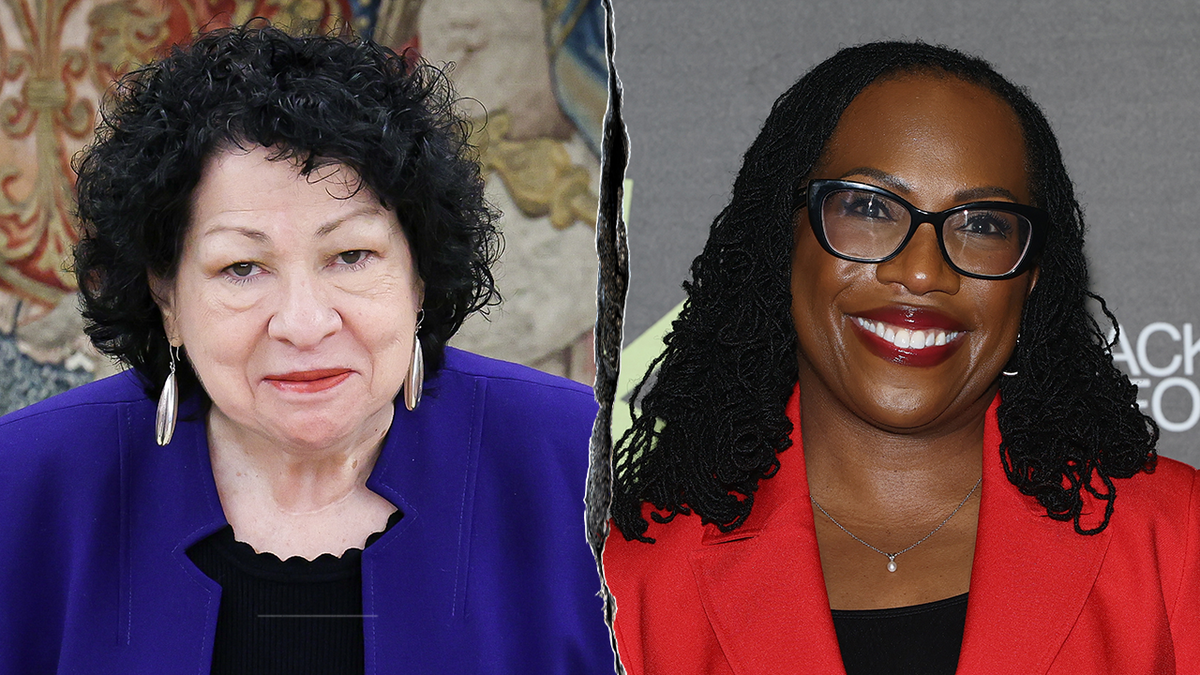
The decision was 7-2, but Justice Sonia Sotomayor opposed the ruling while also opting against joining Jackson’s dissent. Jackson accused the majority of trying to “wordsmith” and interfere with a typically routine evaluation of a police stop.

Sonia Sotomayor and Ketanji Brown Jackson standing together

Justices Sonia Sotomayor and Ketanji Brown Jackson are pictured together. (Getty Images)

“I cannot fathom why that kind of factbound determination warranted correction by this Court,” Jackson wrote.

Jonathan Turley, George Washington University law professor and Fox News contributor, said in an op-ed this month that Jackson has “quickly developed a radical and chilling jurisprudence.”

Despite establishing herself as an outlier, Jackson also has a swathe of supporters from civil rights groups to celebrities. She has been showered with praise on “The View,” nominated for a Grammy for her audiobook and drawn encouragement from Democratic lawmakers.

CLICK HERE TO DOWNLOAD THE FOX NEWS APP

Jackson said during her appearance this year on “The View” that “criticism is part of the job.”

“Dissents are an opportunity for the justices who disagree with the majority to really describe their view of the law but also their concerns,” Jackson said, adding that “you hope that your view will prevail in the long run.”

Fox News Digital reached out to the Supreme Court’s press office for comment.


Source link

Why is being a mother so expensive in the United States? | Infographic News

0

For millions of women in the United States, being a mother comes with an extraordinary price tag.

From the earliest stages of pregnancy through childbirth and into years of childcare, expenses for healthcare, delivery and raising a child are significantly higher in the US than in most other wealthy countries. Even basic needs like medical care and childcare can place a major burden on families.

Recommended Stories

list of 4 itemsend of list

At the same time, the US has one of the highest maternal mortality rates among high-income nations at 18.6 deaths per 100,000 live births, compared with fewer than three in countries such as Norway, Ireland, Switzerland and Italy.

Black women are about three times more likely to die from childbirth complications. In 2023, the maternal mortality rate was 50.3 per 100,000 live births for Black women, compared with 14.5 for white women and 12.4 for Hispanic women, according to the US Centers for Disease Control and Prevention (CDC).

As people celebrate Mother’s Day in the US, Al Jazeera breaks down the cost of giving birth, maternity leave policies and childcare costs in the country compared with the rest of the world.

The high cost of giving birth

In the US, the cost of childbirth can vary widely depending on insurance coverage and whether the hospital and doctors are “in network” or “out of network”.

In-network providers have agreements with a mother’s insurance company, which usually means lower, negotiated prices for patients. Out-of-network providers do not, so even insured patients face much higher bills or unexpected charges.

According to the US Census Bureau, about 92 percent of Americans in 2023 had health insurance coverage through public programmes, such as Medicaid and Medicare, or private insurance, meaning roughly 8 percent were uninsured.

Even insured mothers can face bills running into thousands of dollars for routine deliveries, emergency procedures and postnatal care.

According to data from FAIR Health, an independent nonprofit organisation that analyses health insurance claims data, the national median in-network charge for a vaginal delivery is $15,178, rising to $19,292 for caesarean section births.

The map below shows the in-network costs per state. The most expensive include:

  • Alaska – $29,152 (vaginal birth)  $39,532 (C-section birth)
  • New York – $21,810 (vaginal birth), $26,264 (C-section birth)
  • New Jersey – $21,757 (vaginal birth), $26,896 (C-section birth)
  • Connecticut – $20,658 (vaginal birth), $25,636 (C-section birth)
  • California – $20,390 (vaginal birth), $25,169 (C-section birth)

Maria Haris, 40, was born and raised in the US and now lives just outside Denver, Colorado.

She asked that her name be changed because she was worried that revealing her identity could lead to backlash in her community.

Maria has a three-year-old daughter and is now in a single-income household after being laid off just weeks before her due date.

Now that her daughter is in preschool, she is trying to return to her corporate career but is struggling despite having been in well-paying roles throughout her career.

Haris said that despite having top tier insurance coverage, her childbirth and post-birth care has been a big financial burden.

“It was about $40,000 for the three days that I was in the hospital and about $6,000 a night for the room,” Haris said, explaining her out-of-pocket costs for her natural birth were about $3,000 out of the total.

She said she was charged nearly $600 a tablet for over-the-counter pain medication that was barely $5 a bottle at the time in supermarkets.

“My daughter had jaundice, and right after we got back from the hospital, she had to go into the NICU [neonatal intensive care unit] the next day, and we got another ridiculous bill for the nearly three days she was in the hospital.” she told Al Jazeera.

“I still have payment plans from her NICU visit three years ago.”

In-network vs out-of-network care

Medicaid is the single largest payer for childbirth in the US, financing 40.2 percent of all deliveries in 2024.

Medicaid is a US government health insurance programme for low-income people with pregnant women typically qualifying if their household income falls around or below roughly 200 percent of the federal poverty level. On average, that works out to about $50,000 a year for a family of three.

Compared with countries where public healthcare systems cover most childbirth costs, many Americans navigate pregnancy through a patchwork of private insurance, deductibles and hospital charges that can leave families with long-term debt.

According to data from FAIR Health, the national median out-of-network charge for a vaginal delivery is $31,117, rising to $44,432 for C-section births.

The map below shows the out-of-network costs per state. The most expensive include:

  • Nevada – $49,699 (vaginal birth), $72,604 (C-section birth)
  • New Jersey – $42,712 (vaginal birth), $55,730 (C-section birth)
  • California – $42,078 (vaginal birth), $66,662 (C-section birth)
  • Florida – $39,256 (vaginal birth), $57,072 (C-section birth)
  • Alaska – $38,800 (vaginal birth), $55,997 (C-section birth)

“People should know there is a charge for the nurses in the NICU, and if there’s ever a doctor, each doctor has their own in-network plans. If a doctor comes in to see you and that doctor is not in [your] network, you are then responsible to pay out-of-network costs for that doctor,” Haris told Al Jazeera.

She said Colorado passed a law a few years ago that if doctors are out of a patient’s network, they have to let the patient know and the patient has to sign a document to essentially be responsible for the costs.

The difference between in-network and out-of-network care can mean the difference between manageable medical costs and a financial crisis.

In some US states, out-of-network childbirth costs can rise to several times the average monthly income, particularly in emergencies where patients have little control over where they receive care.

‘I wish I had more time with my new baby’

The US remains one of the few wealthy countries without federally guaranteed paid maternity leave.

While many European countries offer months, and in some cases more than a year, of paid leave funded through national systems, American workers often rely on unpaid leave, employer benefits or personal savings.

The federal Family and Medical Leave Act 1993 guarantees some workers up to 12 weeks of unpaid leave, but millions of employees do not qualify or cannot afford to take time off without pay.

Jade, 43, is an African American mother of two from Chicago, Illinois, who requested her last name not be used.

She said her maternity leave fell short when she last gave birth eight years ago. Although she received 12 weeks of paid leave at 60 percent of her salary, followed by an additional four weeks unpaid, it still wasn’t enough to fully cover her needs.

“I wish I had more time at home with my new baby. But I was worried that if I requested more time that they would not grant it or my job would no longer be there, not to mention that the loss of income would be hard for my family. So I returned to work when my baby was four months old, and in the US, that is considered a good amount of time off, but in my heart, I knew it was not,” Jade told Al Jazeera.

Her total bill for her last childbirth in 2018 was just over $46,000, of which she had to pay $18,000 herself.

Maternity leave policies vary dramatically around the world, but most wealthy nations offer far more generous protections than the US.

The Balkan region consistently offers some of the most extensive leave policies in the world, often surpassing Western Europe in their duration.

Bulgaria leads globally, offering nearly 59 weeks of leave at 90 percent of a woman’s salary, while countries like Germany, Austria and Luxembourg guarantee full pay for 14 to 20 weeks. In the Nordic countries, generous parental leave systems, often shared between both parents, can extend to a year or more.

Childcare costs in US among world’s highest

After childbirth, childcare costs continue to strain household finances across the US. In 2023, couples in the US spent about 40 percent of their disposable household income on childcare, the highest share among selected developed economies.

That was nearly double the rate in Ireland at 22 percent and far above countries such as Germany, Italy and Portugal, where net childcare costs are close to zero due to state subsidies and public support systems.

New York Mayor Zohran Mamdani, a democratic socialist, has launched New York City’s first free childcare for municipal workers after winning election on a platform of affordability.

The table below shows the net cost of childcare as a share of disposable household income for couples in selected countries worldwide in 2023.

Jade managed to keep her childcare costs down by relying on her mother-in-law as a caregiver when she first returned to work and has since hired an au pair.

Haris says childcare costs are extraordinarily high in her part of Colorado, which has a higher cost of living than most other US states. She pays at least $25 to $30 an hour, which, over a 40-hour week, amounts to roughly $4,000 a month.

The 40-year-old says her husband, who is from eastern Europe where maternity services and childcare are robust, says “he doesn’t love it here anymore”.

“I have a child, and no job, my entire perspective of the US has changed,” she tells Al Jazeera.


Source link

How to raise resilient kids in a world that watches their every move


NEWYou can now listen to Fox News articles!

Our kids are growing up in a world where everything can be seen, shared, praised, and criticized. Image is everything. When I was younger, I never could have imagined a world where life is on display like it is today. There used to be a quietness growing up, space to figure things out with a few close friends.

That way of life is gone.

Raising kids today often feels like an impossible task. They are growing up in a world where their every move, choice, or flaw can make them fodder for social media. Many moms I talk with feel a heavy burden to help their kids build an identity that can sustain attacks.

And as a parent, that responsibility can feel overwhelming.

DEMI TEBOW WARNS AGAINST SOCIAL MEDIA FOR SELF-WORTH, POINTS TO BIBLE’S ‘PERFECT PLAN’ FOR EACH LIFE

Matt and I have been married for 25 years. We dealt with our own share of scrutiny and public opinion throughout his career in professional baseball. We grew together, rooted in our faith, and learned to navigate the often harsh world of sports commentary.

But now, our two oldest boys, Jackson and Ethan, are on those same fields, playing in those same stadiums. They have the eyes of the fans, and what feels like the world, on them constantly.

When they have a bad day, it feels like everybody has an opinion about their worth. Scrutiny comes with the territory, as my boys are professional athletes. But as moms, we aren’t called to make their lives easier; we’re called to prepare them for the difficult seasons.

TIM TEBOW TELLS STORY OF JESUS THROUGH EYES OF THE CROSS IN REVEALING NEW BOOK

Consider Mary’s example as a mother. Talk about raising a child who would be publicly watched, misunderstood, and criticized. From the very beginning, her story didn’t fit neatly into people’s expectations. And as Jesus grew, the tension only increased. People questioned Him. Misunderstood Him. Eventually, they rejected Him.

Mary couldn’t shield Jesus from public criticism. She couldn’t control how people responded to Him. She couldn’t stop the hard parts of His story. And Mary had a front-row seat to all of it. But she stayed rooted. She stayed present. She was joyful. She trusted God with the boy who became a man right before her eyes. And that feels familiar.

Because we don’t raise strong, grounded kids by removing pressure. We raise them by helping them learn how to stand in it.

And maybe, in a world that watches everything, the most powerful thing we can do as parents is this: Create a home where our kids know they are seen for who they are — not for how they perform. A place where they don’t have to earn love. Where they can bring both their wins and their struggles. Where they know that when the noise of the world gets loud, they still have a place that is steady.

Drawing from scripture, Mary’s life and my own experience, I’d like to offer a few specific principles to help moms raise resilient, faithful kids in today’s world.

Lead with grace, even when you need to correct your kids

ERIKA KIRK SHOWS HOW WE SHOULD FORGIVE, ‘BECAUSE IT WAS WHAT CHRIST DID’

In Genesis, Adam and Eve are afraid. They’re ashamed. And they know they will face consequences for their sin. But God doesn’t start by sending them away. He meets them in the garden and, in their shame, speaks to them in love.

One way we’ve modeled this in our home is by eliminating timeouts. We couldn’t expect our children to understand God’s patient love for them if we modeled it by sending them to a corner when they disobeyed or didn’t listen. We lead with grace, even when correction is necessary — maybe even more so when correction is necessary.

The freedom of forgiveness is one of the most important things we gain as children of God. We can’t share it with our kids until we understand grace, forgiveness, and God’s mercy as true every day for ourselves and let them shape our lives. I didn’t do it right all the time, of course. But I didn’t have to. I was able to ask God for forgiveness. I was also able to talk to my kids about forgiveness and model it.

Perfection has never been a requirement in our home, and I’d encourage you not to make it one in yours. You have to show your kids that they won’t be right all the time and that they can and should ask for forgiveness. Lead them where you want them to go.

Use your home and your life to train your kids up, and trust the Lord to handle the rest

Consider Proverbs 21:31: “The horse is made ready for the day of battle, but victory rests with the Lord.”

Preparing a war horse is a long process built on grueling, intentional, consistent training required to make the animal battle-ready. Parenting is different in many ways, of course, but it demands the same kind of intentionality. It happens quietly, in the home, in the ordinary moments.

Every mom I meet feels a deep responsibility to raise her kids to live firmly in their identity as children of God. It’s easy to focus on that responsibility and overlook the second half of this verse. We prepare the horse, and we release the outcome. We do the work, and we surrender the results.

That’s a lesson worth learning for ourselves and passing on to our kids. They are called to show up, work hard, be prepared, and recognize that true victory belongs to the Lord. Train your kids.

But don’t train them thinking you’re going to determine their lives, or protect them from hardship.

Show them excellence – in others, in faith, in themselves

I wanted my kids to see great things and see great men. We wanted them around people who showed them how to lead, be a friend, and work hard. So they traveled with us and spent time with honorable, godly men who coached and played with their dad. We’ve encouraged them to follow the example of athletes like Adam Wainwright, Jaime Garcia, and others connected through Sports Spectrum who have navigated this career with faith and integrity, modeling how to live out their faith in the public arena — while also building relationships with men of faith who understand the high-pressure environment they’re in.

CLICK HERE FOR MORE FOX NEWS OPINION

As moms, we have the privilege of showing our kids where to look and how to see. Always call out awesomeness. Make sure your kids are around people who live admirable lives. Point out what others are doing well. After all, more is caught than taught. When they see greatness, they’ll want to emulate it.

No matter what advice you get, though, nothing can change the fact that motherhood is hard. The emotional difficulty for many women around Mother’s Day is often even harder.

CLICK HERE TO DOWNLOAD THE FOX NEWS APP

But we as mothers have the chance to leave a powerful legacy. That starts in our hearts and in our homes and in the unseen grace that pours out from God through us to the people we love.

So let God work through you. Let God make you His hands and feet. Let God bring peace, security and resilience to your children, whoever they may be, through your life.


Source link

Draymond Green apologizes to Barkley after on-air ‘Inside the NBA’ jab


NEWYou can now listen to Fox News articles!

Earlier this week, Draymond Green made headlines by criticizing the twilight of Charles Barkley’s Hall of Fame career.

Appearing in studio during Wednesday’s edition of “Inside the NBA,” Green pointed to Barkley’s four-year stint with the Houston Rockets.

“I think the goal is just to not look like you in the Houston Rockets uniform,” a follow-up to Barkley’s suggestion that the Golden State Warriors — Green’s team — are well past their championship window. Days later, as controversy mounted, Green clarified his remarks about Barkley.

“The reason that I would even say that is what Chuck makes fun about in his career is actually the last 2 years in Houston,” Green said during the latest edition of “The Draymond Green Show.”

CLICK HERE FOR MORE SPORTS COVERAGE ON FOXNEWS.COM

Green added: “Everybody tried to make it like this whole ‘Ahh man Draymond think he better than Chuck’… the disrespect ain’t the intent so if that’s the way it’s viewed as public disrespect, I can gladly public apologize, disrespect wasn’t my intent.”

Draymond Green reacting during a basketball game at Little Caesars Arena

Draymond Green of the Golden State Warriors reacts during a game against the Detroit Pistons at Little Caesars Arena in Detroit, Mich., on Jan. 9, 2025. (Nic Antaya/Getty Images)

Barkley suggested Green would have to leave the only franchise he’s ever played for to have a chance at a fifth championship, given the age of Golden State’s core.

“It’s over for the Warriors,” Barkley said on May 6. “No disrespect. It is for every old team. You have your run, you get old … it just passed you by. Y’all had one of the greatest runs ever.”

Barkley waited a couple of days to address Green’s comments, telling the “Bickley and Marotta” radio show on Arizona Sports 98.7 FM, “Draymond is a good player. We’re not on the same level … I can hear, but I don’t have to respond every time somebody says something about me.”

During a series of media interviews, Barkley continued to brush off Green’s remarks, saying he wasn’t offended by the criticism.

Charles Barkley entering Neville Arena through loading dock

Former NBA player and Auburn alum Charles Barkley enters Neville Arena through the loading dock before a game between the Oklahoma Sooners and Auburn Tigers in Auburn, Ala., on Feb. 4, 2025. (Stew Milne/Getty Images)

“He took a shot at me but I don’t get offended because ― I’ve said things about guys, they took personal shots at me,” Barkley told the “The Dan Patrick Show,” adding, “You know, it’s so funny, last time you had me on the show, I told you I regretted those Rocket years, especially the last two where I sucked as a player. But I wasn’t turning down no free money, I had two years left on my contract.”

Charles Barkley standing courtside at an NBA Cup game in Phoenix

Former Phoenix Suns player Charles Barkley attends an NBA Cup game against the Minnesota Timberwolves at Mortgage Matchup Center in Phoenix, Ariz., on Nov. 21, 2025. (Mark J. Rebilas/Imagn Images)

CLICK HERE TO DOWNLOAD THE FOX NEWS APP

Barkley joined the Rockets in the 1996-97 season after the Phoenix Suns traded him to Houston. He retired from the NBA at age 36. Green turned 36 in March, while his longtime teammate and two-time NBA MVP Stephen Curry turned 38 just under months ago.

Barkley’s 16-year NBA career ended in 2000 with career averages of 22.1 points and 11.7 rebounds.

Follow Fox News Digital’s sports coverage on X, and subscribe to the Fox News Sports Huddle newsletter.


Source link

Access Denied

0

Access Denied You don’t have permission to access “http://hindi.gadgets360.com/wearable/rollme-vistaview-ai-smart-glasses-price-dollar-100-with-13mp-camera-and-openai-assistant-launched-features-news-11475039” on this server.

Reference #18.84adc17.1778415001.153e1384

https://errors.edgesuite.net/18.84adc17.1778415001.153e1384

How did Gaza’s sea become a wall?

0

For 18 years, Israel has enforced a naval blockade around the Gaza Strip.

Source link

Access Denied

0

Access Denied You don’t have permission to access “http://hindi.news18.com/news/ajab-gajab/viral-86-year-old-zambian-grandmother-margaret-chula-legendary-glamma-viral-become-fashion-star-10462072.html” on this server.

Reference #18.bdf9dead.1778415701.d67fe40

https://errors.edgesuite.net/18.bdf9dead.1778415701.d67fe40

Access Denied

0

Access Denied You don’t have permission to access “http://hindi.news18.com/cricket/r-ashwin-eager-to-see-vaibhav-suryavanshi-playing-in-all-three-format-for-indian-cricket-team-says-he-is-box-office-player-10462953.html” on this server.

Reference #18.6e560e17.1778415317.a4b686a

https://errors.edgesuite.net/18.6e560e17.1778415317.a4b686a

Access Denied

0

Access Denied You don’t have permission to access “http://hindi.news18.com/news/uttar-pradesh/hardoi-goat-with-allah-name-mark-on-back-viral-news-local18-10462962.html” on this server.

Reference #18.490dde17.1778418683.2eefe5b3

https://errors.edgesuite.net/18.490dde17.1778418683.2eefe5b3