Reference #18.94adc17.1778406503.b78ef66
https://errors.edgesuite.net/18.94adc17.1778406503.b78ef66
Reference #18.94adc17.1778406503.b78ef66
https://errors.edgesuite.net/18.94adc17.1778406503.b78ef66

The early history of personal computers is stacked with systems such as the Apple II and the Commodore 64 that had the components living inside a keyboard. But as technology evolved, the keyboard became a peripheral and the PC itself was either in a separate box or the whole system was a laptop.
Now, HP has a new spin on this decades-old idea. It embeds a full-fledged AI PC inside a 101-key keyboard you can carry with you from the office to home.
Unlike ‘80s microcomputers or hobbyist-oriented products like the Raspberry Pi 500, the EliteBoard G1a is squarely targeted at business. The system is part of HP’s commercial lineup, alongside its EliteBook laptops, and, for better or worse, it comes with HP Wolf Security preinstalled. The company clearly hopes organizations will buy these in bulk. But to benefit from it, you really have to prefer a mobile keyboard to a traditional laptop, all money aside.
The EliteBoard G1a is trying to create a new niche.
When we talked with product managers at HP, they suggested IT departments would buy these computers for two types of workers.
The first group is so-called “dual deskers” – knowledge workers who have a desk with a monitor at work and another at home. The second group includes deep-pocketed call centers or environments where desk space is at a premium.
From time immemorial, dual-deskers have carried laptops and closed their lids when they docked to a monitor at work. With the EliteBoard, they could simply schlep the keyboard, which weighs a mere 1.49 pounds – about half the weight of a lightweight laptop. To make this situation work in companies with managed systems, we have to assume that either the IT department would give out monitors to use at home or offer some reason (a subsidy? a mandate?) for employees to buy their own for home.
The EliteBoard connects to monitors using its USB4 port, so its ideal monitor is one that has Thunderbolt or USB video connectivity built in. Less-expensive and older monitors don’t have this type of connectivity, but select configs of the EliteBoard come with an optional USB-to-HDMI adapter that you can use with other monitors, and it has a USB pass-through for power. That said, HP demonstrated the EliteBoard at numerous press events by showing how much desk space it saves by using a single USB cable to get power, video out, and connectivity to peripherals via the monitor. So if companies want employees to be able to take advantage of this scenario at home, that means shelling out another few hundred bucks for a modern monitor, or making employees do it.
Today, companies with limited desk space for a call center or another cramped work area could just buy a tiny desktop to sit behind the monitor or next to it. However, building all of the PC’s guts into the keyboard makes a lot of sense for space savers, because a keyboard is something every PC needs and a desktop chassis is not. If a company wanted to, it could give each employee their own EliteBoard, have them plug it into a monitor during work time and then have them stick it in a drawer when they go off shift and someone else comes on.

The problem for call centers is that the HP EliteBoard G1a is much more powerful and much more expensive than what they need. At press time, the G1a was priced at $1,499 for the lowest end config. And most companies probably don’t need employees to each have their own PC that they lock away after they punch out.
“The call center angle is probably the stronger pitch, but those buyers are shopping entry-to-mid-market. They want something cheaper and simpler than a mini desktop, not a Copilot+ PC with up to 64GB of RAM,” Kieren Jessop, a research manager with analyst firm Omdia. “HP has built an impressive piece of engineering in search of a problem that most enterprises have already solved with a laptop — or will solve with a thin client.”
HP makes the EliteBoard G1a in a variety of configurations that vary by market. Companies can get it with various AMD Ryzen CPUs, up to 64GB of RAM and an SSD up to 2TB in capacity. It comes with either a detachable or embedded cord, and optionally with a 32 WHr battery that promises up to 3.5 hours of endurance.
Why would you need a battery on a product that demands to be used at a desk and plugged in? The most likely reason is to let the keyboard go into sleep mode when it’s in your bag. Employees could also hook the EliteBoard G1a up to a portable monitor and use it unplugged that way, but then why not just buy them a laptop?
At press time, prices ranged from $1,499 to $3,423 in the US. The lowest-end config has a Ryzen AI 5 Pro 340, 16GB of RAM, an integrated cable, and a 256GB SSD. Fifty bucks more will get you the same configuration with a 512GB SSD, as per HP.com. The highest-end config listed comes with a Ryzen AI 7 Pro 350 CPU, 32GB of RAM, and a 512GB SSD, and sells for only $1,999 at B&H but a whopping $3,423 at HP.com.
Our review config, which sports 64GB of RAM, a Ryzen AI 7 Pro 350 CPU, and a 2TB SSD, has not been listed for sale in the US, and HP didn’t answer when we asked how much it would cost. However, we’d assume that it would cost a lot more than $1,999.
If all you do is dock your PC at home and at work, you might think, “why pay for a laptop when I don’t need a built-in screen?” But it’s hard to make that argument when the laptop is actually less expensive.
Right now, you can get an HP EliteBook 6 G1aN with the same AMD Ryzen AI 7 350 CPU, along with 24GB of RAM and a 512GB SSD, for just $1,299 – that’s actually less than the cheapest EliteBoard. A custom configured HP EliteBook 8 G1a with the Ryzen AI 7 Pro 350 CPU, 32GB of RAM, and a 512GB SSD is just $1,799.
If you’re comparing the total cost of ownership versus a laptop, also consider the price of a monitor if your users don’t already have one. While you could use an adapter, the ideal use case involves a USB-C monitor that transmits data and power over a single wire. The cheapest HP-branded USB-C monitor I could find at press time was the HP E27k 4K monitor, which was selling for $504. However, I saw a Dell-branded USB-C monitor, the S2725DC, on sale for just $236 at Amazon. If you’re an IT department and you’re kitting out someone for home and office use, you might need to buy them two monitors.
At 14.1 x 4.7 x 0.7 inches, the EliteBoard G1a is the size of a typical, full-size keyboard complete with numpad. It’s a boring but office-friendly dark gray color with a very thin bezel around the keys.
At first glance, there aren’t many ways to know that this is more than just a keyboard. There’s a power button / fingerprint reader that’s located in the upper right corner of the keyboard, though you might easily mistake it for just another key, until you press it and see the blue light turn on.
Turn the keyboard around and on the back lip and you’ll notice a thin vent for airflow. This computer definitely has a fan and you can hear it quite prominently at times. There are also two USB-C ports, a USB4 40 Gbps port and a 10 Gbps port, unless you have the embedded cable, in which case, you just have the 10 Gbps port. Clearly, the 40 Gbps port is the one you’ll want to use for docking, but you can use the 10 Gbps port to connect the dongle for the included wireless mouse or other peripherals.

There’s also a security cable lock slot on the left side. So if you want to chain this to a desk, you can, but we’d argue that defeats the point of the machine.
Since this is a computer-in-a-keyboard, the most obvious question we need to answer is “how’s the typing experience?”
Pretty decent.
On the bright side, the EliteBoard G1a has a generous 2 mm of travel, which is more than you’ll find on most laptops, where even 1.5 mm is deep. The keys feel pretty snappy and are in the same feedback league as those on my Lenovo ThinkPad X1 Carbon, but the ThinkPad’s keys have a more curved shape, which is better than the flat tops on the EliteBoard.
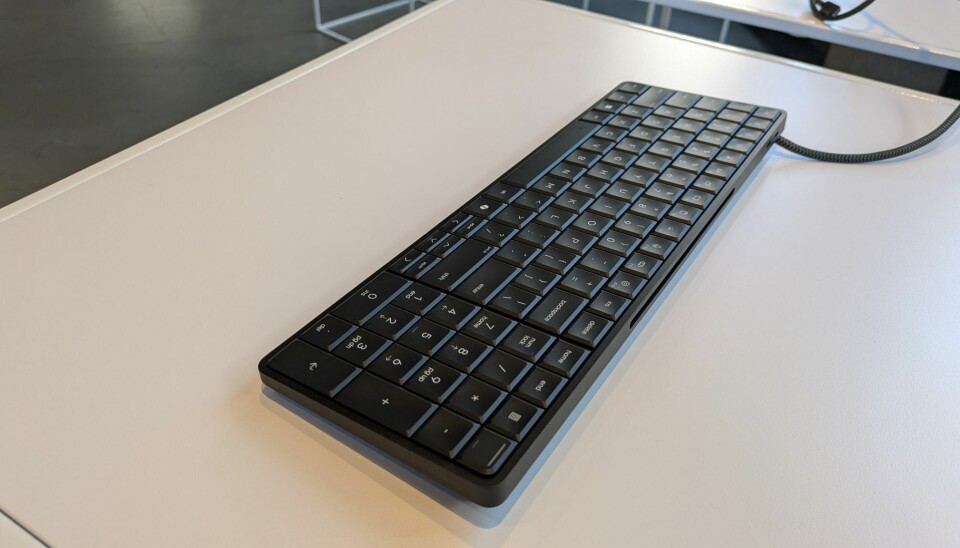
If you’re burning the midnight oil, there’s a built-in backlight which you can enable by hitting the F9 key. It has two different brightness settings so you can decide just how much you want it to shine through.
The layout is pretty standard for a full-size keyboard with a numpad. However, I don’t like how small the arrow keys are, and the Pg Up and Pg Dn are just tiny. There’s no empty space around these keys, which I use a lot when editing documents, so it’s far too easy to miss them. Even on most laptops, these keys are larger.
Another downer is the lack of flip-up feet on its bottom. I like to angle my keyboard up at a 15 to 30 degree angle, but this one is short and flat to the desk. To save my wrists, I always use a gel-filled wrist rest when I type and, without feet to elevate the keyboard, I’m typing down onto the keys because it’s so much lower than the gel pad. This won’t be as much of an issue for folks who don’t use wrist rests.
In short, if you’re used to laptop keyboards or the low-cost keyboards that come with most desktop computers, the EliteBoard G1a will probably seem like a nice step up. However, if you want the best possible typing experience, there’s an entire ecosystem of mechanical keyboards out there with much deeper travel and more feedback.
If you’re not a gamer and you want the best possible typing experience, I recommend a mechanical keyboard with either clicky or tactile switches. Unless you go for a low-profile keyboard, you’ll be getting between 3.6 and 4 mm of travel, so you won’t bottom out as easily when typing. I prefer clicky switches like the Kailh Box White (my favorite) or Cherry MX Blue, but those make some noise so, if you like quiet, Cherry MX Brown switches will do the trick.
To see the difference between my daily driver mechanical keyboard, an Akko 3098N with Kailh Box White switches, and the EliteBoard G1a, I performed the 10fastfingers.com typing test on both. On HP’s keyboard, I managed a strong 96 wpm, which is at the lower end of typical for me, with a six percent error rate. On my daily driver, the numbers were a better 101 wpm with a two percent error rate. Your mileage will vary.
The EliteBoard G1a has both built-in bottom-facing speakers and a microphone array. In our tests, the speaker was more than loud enough and it was clear enough for voice calls, though we wouldn’t recommend listening to music on it for too long. The drums in AC/DC’s Back in Black sounded a little tinny, though there was a clear separation of sound with the vocals appearing to come from one side while the percussion came from another.
The dual-array microphone was also passable, but not good enough for podcasts. When we talked to a coworker using the built-in mic, she said our voice was clearly audible but a little echoey.
Depending on which config you get, your HP EliteBoard G1a may come with a variety of different accessories in the box. All versions come standard with an HP wireless 675M mouse that connects either by Bluetooth or by an included USB-C wireless 5-GHz dongle. It is not a particularly fancy mouse but it has a couple of side buttons and a scroll wheel. I found myself using my Logitech MX Master 3 mouse instead, because it’s ergonomically shaped and highly programmable.
My review unit also came with the optional soft canvas cover sleeve you can use to protect the EliteBoard G1a while you’re carrying it around. I found this add-on to be about as useful as a laptop sleeve. It might offer some protection and padding for when you stick the EliteBoard G1a in an existing backpack, but it’s not going to replace your briefcase or your backpack when you’re commuting.
I also got the optional HDMI multiport hub, which is a must-have if you don’t already have a Thunderbolt or USB4 docking station or a monitor with that kind of connectivity built in. The hub connects to the USB4 40 Gbps port on the EliteBoard and features two USB-C ports (one for power, one for connectivity), an HDMI out cable for connecting to a monitor, an Ethernet port for wired networking, and an HDMI-in port for a second monitor.
There’s an optional, slim 65W USB-C power adapter that’s helpful if you aren’t connecting to a monitor or docking station that supplies power. If you don’t get one in the box, it’s easy enough to find one for $15 to $30 on Amazon.
Also, if your EliteBoard does not have an embedded cable — mine did not — you get a braided USB cable in the box. The less-expensive configs of the EliteBoard all have embedded cables, but we recommend getting a model without one because it’s easier to carry around without a cable hanging off of it.
HP does not preload a lot of software onto the EliteBoard but it does come with a three-year subscription to HP Wolf Security, which normally costs $36 a year for individual subscriptions. HP Wolf has a malware/virus scanner, a threat containment feature, a secure browser, OS resiliency (for recovering from corruption and doing a reinstall), and application persistence, which prevents unwanted changes to security software like HP Wolf itself.
Since it has an NPU (neural processing unit) that’s capable of more than 45 trillion operations per second (TOPS), the EliteBoard G1a qualifies as one of Microsoft’s Copilot+ PCs. This means that it has some added local AI features that not every PC gets from Windows 11, including Cocreate image generation in Paint, Windows Studio Effects handled locally for your webcam, translated Live Captions from any audio input, and Recall, a controversial feature that takes screenshots of all your work to help you “remember” what you were doing at any given time. Fortunately, Recall is disabled by default.
Equipped with an AMD Ryzen AI 7 Pro 350 CPU, 64GB of RAM, and a 2TB SSD, our review configuration of the EliteBoard G1a handled everything I threw at it. I used the system on and off as my daily driver PC for work for a period of several weeks and it was always smooth and responsive, even as I had dozens of Chrome tabs open and Slack running across two 4K monitors I had connected via Thunderbolt 3 docking station.
I should note that, no matter what I was doing, the fan on the EliteBoard G1a was frequently running and was often quite audible. It’s no louder than most notebooks I’ve tested, but if you’re expecting total quiet, look elsewhere.
My editorial workload is not nearly as demanding as some folks’ day jobs so, to see how the EliteBoard G1a stacks up, I ran it through a series of benchmarks and compared the results to those from two laptops I had access to: a Lenovo Yoga Slim 7x with a Qualcomm Snapdragon X Elite X1E-78-100 CPU, and a Lenovo ThinkPad X1 Carbon with an Intel “Meteor Lake” Core Ultra 7 165U processor.
The Ryzen AI 7 PRO in the EliteBoard debuted in 2025 with 8 cores, 16 threads, and a maximum boost clock of 5 GHz. It features built-in AMD Radeon 860M graphics and a Neural Processing Unit (NPU) that’s capable of achieving 50 TOPS for better local AI. Its DDR5 RAM runs at 5,600 MHz.
Released in 2024, the Snapdragon X Elite X1E-78-100 has 12 cores and threads with a boost clock that goes up to 3.4 GHz, along with an NPU that does 45 TOPS. It’s an Arm processor so the laptop that runs it uses Windows on Arm. The Yoga Slim 7x laptop that we tested had 16 GB of LPDDR5x RAM running at 8448 MHz.
The oldest of our test group, vintage 2023, the Intel Core Ultra 7 165U has 12 cores and 14 threads, but only two of those cores are performance cores that can boost up to 4.9 GHz, while the others are a mix of efficient cores and low-power efficient cores that boost up to 3.8 and 2.1 GHz respectively. The ThinkPad X1 Carbon we tested with it had 64GB of LPDDR5x RAM running at 6400 MHz.
In our tests, the EliteBoard G1a always eclipsed the ThinkPad X1 Carbon, which is not a surprise considering its much-older processor. However, the Snapdragon-enabled Yoga Slim 7x outpaced it on some benchmarks.

This test counts the prime numbers under one trillion and returns a result in millions of prime numbers per second. The benchmark is particularly heavy on SIMD instructions like AVX-512 or Arm’s Neon and SVE vector extensions, making it a good proxy for some of the more workstation-centric tests we’ll look at shortly. It runs across both single thread and multi-thread workloads, with big performance boosts for parallel processing.
Using just a single thread, the EliteBoard edged out the competition with 415 million primes per second (MPS), compared to the Slim 7x’s 352. However, the Slim 7x slightly outperformed it when using multithreading, delivering 2,686 MPS to the EliteBoard’s 2,145. One thing to note is that, while the EliteBoard has more threads, it has fewer actual cores. The X1 Carbon wasn’t even in the same ballpark. This will become a theme across our test suite.

3D rendering is always a challenge and, to be honest, it’s hard to imagine somebody buying an EliteBoard for this purpose. However, it’s always worth noting what the system can do.
We ran Blender, a very popular 3D modeling app, using three scenes: Monster, Junkshop, and Classroom. As you can see, the Slim 7x and its 12-core Snapdragon processor were anywhere from 34 to 75 percent quicker, depending on the content. Still, the EliteBoard turned in respectable scores on something you wouldn’t expect it to do.

Video transcoding is another resource-intensive task and one that occurs in many scenarios, including game streaming, video editing, and even video conferencing. To test how the EliteBoard handled video transcoding, we used Handbrake to convert a 4K 60 fps video to 1080p using an x265 encoder at the medium preset with a constant quality of 18. Our results are measured in frames per second (fps).
Again, the EliteBoard was far superior to the ThinkPad, but was a good 45 percent behind the Yoga Slim 7x. Still, this is solid performance that’s more than workable.

One local AI task you might want to conduct is running an open-source model as a chatbot on your PC rather than sourcing it from the cloud. This will give you more privacy than using OpenAI, Claude, or Copilot on the web and it’s completely free.
So we ran the GPT-OSS 20B open weights model using Llama.cpp as our client and timed the amount of milliseconds it took to generate the first token. Here we see that the Snapdragon processor and faster RAM on the Yoga Slim 7x gave it a definite advantage, taking 39 percent less time than the EliteBoard to get there. The EliteBoard also generated about half as many tokens per second. However, it beat the pants off the ThinkPad X1 Carbon, getting to the first token more than twice as quickly while generating 30 percent more tokens per second.
It’s worth noting that these tests were run on the CPU cores and didn’t harness the chip’s integrated GPUs or NPUs.

One common local AI workload a business person might use is transcription. Let’s say you had an audio file and you wanted to convert it into readable and editable text. You might use a tool based on Whisper, a popular free model from OpenAI.
For testing, we used Whisper.cpp, an implementation of Whisper written in C++, with the Whisper Medium EN model transcribing a 10-minute audio clip. Here, the EliteBoard transcribed the audio at 2.4x real-time speed, while the Yoga Slim 7x was faster at 3.4x. Those extra cores are doing a lot of heavy lifting here. That said, if you’re converting 10 minutes of audio in less than five minutes, that’s pretty good.

For those using the EliteBoard for programming, compile times matter. So, we compiled the LLVM toolchain from its source and measured the time. This isn’t a trivial compile job and therefore represents a worst case scenario for developers considering the EliteBoard. Here it took a modest 19 minutes and 44 seconds, which was more than double the time it took the Yoga Slim 7x.
On high-end desktop workstation hardware, this same workload can be completed in under five minutes, so if your day job regularly requires compiling large projects, you might want to spring for something more capable, or perhaps not. “My code is compiling” is a pretty good excuse for taking a 20 minute break.


Compression and decompression are very taxing on a CPU and are very common scenarios we see today. So we fire up 7zip and measure its ability to do both tasks in both single-threaded and multi-threaded scenarios.
With a single thread, the Slim 7x and the EliteBoard basically tie at compression, while HP’s computer holds the edge in decompression. However, when we move to multi-threaded scenarios, the Snapdragon X Elite’s 12 physical cores easily beat out the AMD Ryzen AI 7 Pro 350’s eight cores and 16 threads.

We tested how long it takes LibreOffice to convert 50 image-heavy ODT files into PDFs. This workload is lightly threaded so it favors higher clock speeds over more cores.
The results bear this out as the EliteBoard, with its Ryzen AI 7’s higher performing cores, beat out the Slim 7x by 22 percent. Despite its older processor, the ThinkPad actually manages to tie the Slim 7x in this test.

For IT departments that do their own service, the EliteBoard G1a has plenty to offer. Its back surface is held on by just four screws and pops off easily. Underneath, you get full access to the motherboard and a number of easily-removable components, including the DDR5 SODIMM RAM, the M.2 SSD, the WLAN card, the fan, the optional battery, and the speakers. You can even replace the keyboard itself and leave the computer part intact.
The HP EliteBoard G1a delivers strong performance in a unique and compact form factor that saves desk space and reduces the weight you carry back and forth. If you don’t want a laptop but do want a portable computer, this is your best choice. It provides a better typing experience than most laptops and a more space-efficient design than most desktops.
However, in the current marketplace, this device does not represent a significant savings over a similarly configured laptop. Depending on what laptop you choose to compare against, you might save a few hundred dollars, but when you add the cost of the monitors you need to pair with it – if you need to purchase those – it’s a wash.
HP has set out to make a unique product with the EliteBoard G1a and it has succeeded in building a very competent and capable computer-in-a-keyboard. If you’re an IT decision maker, you’d buy this device for folks who work out of one or two distinct locations (home and office or multiple offices) and never need to get online from the road or from a conference room. Whether that’s a common scenario in your workplace will determine if this product is right for you or your fleet. ®

Saudi Arabia will host the 2027 tournament from January 7 to February 5 and will face Palestine, Kuwait and Oman.
Published On 10 May 2026
Four-time winners Japan have been grouped with defending champions Qatar at the Asian Cup 2027 football tournament.
Saudi Arabia will host the 24-team tournament for the first time from January 7 to February 5.
The Asian Football Confederation (AFC) will be hoping the competition will be held without any further complications after the draw was delayed due to the US-Israel war on Iran.
The draw was originally set for April 11 but was postponed to May 9. The final field is still incomplete because the Lebanon-Yemen match was not played as scheduled on March 31 and has been postponed to June.
As well as Qatar, champions in 2019 and 2023, Japan will take on Indonesia and Thailand in Group F.
“Japan is one of the leaders in Asian football, always,” Qatar coach Julen Lopetegui said. “They have quality players, and we have to believe in ourselves.”
Saudi Arabia, which will also stage the FIFA World Cup 2034, will face Kuwait, Oman and Palestine in an all-West Asia group as they seek to win the title for the first time since 1996.
“When we reach the Asian Cup in our country, we will be ready to reach the final and to win the title,” said Giorgios Donis, who was appointed in April, replacing Herve Renard as Saudi Arabia coach.
Uzbekistan and Jordan are preparing for their first World Cup appearances in June, and were drawn in Asian Cup Group B along with North Korea and Bahrain.
Iran will face Syria and China.
In Group D, Australia were drawn with former champions Iraq, led by former Socceroos coach Graham Arnold, as well as Tajikistan and Singapore, who have qualified for the tournament for the first time since 1984.
South Korea have not won the tournament since 1960 and will meet the United Arab Emirates, Vietnam and the winners of the Lebanon-Yemen match.
The top two from each of the six groups of four will progress to the round of 16 along with the four best third-placed teams.

An attack by armed rebels has killed at least 69 people in Ituri province in the conflict-torn northeast of the Democratic Republic of the Congo (DRC), according to security officials.
For more than 30 years, the mineral-rich eastern DRC has been a battleground for various armed groups, vying for control of its many mines.
Two ethnic groups – the Hema and the Lendu – have been locked in a long-running violent conflict in Ituri, a gold-rich province that borders Uganda and South Sudan.
Armed men affiliated with the Cooperative for the Development of the Congo (CODECO) coalition of militia groups, which claims to protect the Lendu, carried out attacks in several villages on April 28, local and security sources told the AFP news agency.
These attacks followed an earlier assault by another armed group, the Convention for the Popular Revolution (CRP) – which says it fights for the Hema community – on positions held by the Congolese army (FARDC) near the locality of Pimbo, they said.
More than 70 people were killed when CODECO fighters launched the retaliatory attacks in late April, civil society leader Dieudonne Losa told AFP.
Two other security sources, talking on condition of anonymity, confirmed the attacks, with one stating a death toll of at least 69, including 19 militia members and soldiers.
The presence of CODECO fighters delayed the recovery of the bodies for several days, they said.
“Only 25 bodies have been buried,” Losa said on Saturday, adding several sets of remains had yet to be recovered.
A humanitarian source described bodies “strewn on the ground” near the village of Bassa, one of the areas targeted.
The United Nations Organization Stabilization Mission in the DRC (MONUSCO) said on April 30 it had rescued “nearly 200 people caught under fire” from the CRP assault on the FARDC.
On Saturday, it said it “strongly condemns the recent wave of deadly attacks targeting civilians” in the restive east.
The Ente association, a nonprofit representing the Hema community, described the killings as a “massacre”, urging its members to avoid retaliation.
Famous for its mineral wealth, ranging from cobalt and copper to uranium and diamonds, the former Belgian colony has long been beset by corruption and bloodshed.
Since early 2025, Ituri has seen a resurgence of the CRP, a group founded by convicted Congolese strongman Thomas Lubanga.
He was found guilty in 2012 by the International Criminal Court for recruiting children into his rebel army and released in 2020 on completion of his prison sentence.
Fighting between the CRP, the Congolese army, and the CODECO has been marked by widespread abuses and killings of civilians.
The region also faces ongoing attacks by the Allied Democratic Forces (ADF), a group formed by former Ugandan rebels that has pledged allegiance to ISIL (ISIS).
Rawya Rageh, a senior crisis adviser at Amnesty International, told Al Jazeera that government forces should be doing more to protect civilians in the region.
“There are multiple challenges facing the Congolese authorities. Eastern DRC is a vast area. There are multiple competing actors – M23, ADF, CODECO. With a group like ADF, for example, they capitalise on security gaps. Most of the forces are overstretched responding to the threat from M23,” she said.
“We do expect more from the security forces. In particular, with the confrontations with the ADF, we see entire areas that are emptied of troops that have been diverted to other front lines, leaving civilians completely vulnerable to ADF and other armed groups.”

Interim President Ahmed al-Sharaa replaces his brother and some governors and reshuffles cabinet ministers.
Published On 10 May 2026
Interim Syrian President Ahmed al-Sharaa has announced a series of government changes, including replacing his brother as head of the presidential office, the state news agency SANA reports.
Al-Sharaa appointed former Homs Governor Abdul Rahman Badreddine al-Aama as secretary-general for the presidency. The post was previously held by al-Sharaa’s brother Maher, an appointment that had drawn accusations of nepotism.
Saturday’s reshuffle was the first since the ouster of President Bashar al-Assad and comes about a year and a half into the five-year transitional period set in Syria’s constitutional declaration.
According to the report, presidential decrees appointed Khaled Zaarour as information minister, replacing Hamza Mustafa, who was moved to the Ministry of Foreign Affairs, and Bassel Sweidan, who heads a committee tasked with reaching settlements with business tycoons linked to the Assad-era elite, as agriculture minister.
Al-Sharaa also replaced governors in the provinces of Homs, Quneitra and Deir Az Zor, the eastern province where most of Syria’s oilfields are located.
No official reason was given for the changes, but Al Jazeera’s Resul Sardar Atas has previously reported that after al-Sharaa announced his new government in March last year, his choice of officials was criticised.
“People had criticised the president that he had previously appointed all of his close friends to all of the ministerial positions,” Atas said.
In recent months, protests and social media campaigns have emerged due to worsening economic conditions and what critics described as poor governance, suggesting another reason for al-Sharaa’s cabinet reshuffle.
Besides a government reshuffle, al-Sharaa’s government since last month has begun trials of Assad-era officials after facing criticism over delays in launching a promised transitional justice process following Syria’s 14-year civil war, in which an estimated half a million people were killed.
On April 26, trial proceedings opened in Damascus for Atef Najib, the former head of political security in southern Syria’s Deraa province.
He has been accused of overseeing a violent crackdown on protesters there during the 2011 uprising, which set off the civil war, and faces charges related to “crimes against the Syrian people”, according to SANA.
Najib, who is a cousin of al-Assad, was the sole defendant in court for the preparatory session of the trial, which is set to continue this month.
Charged in absentia are al-Assad and his brother Maher, former commander of the Syrian military’s 4th Armoured Division. Along with other former high-ranking security officials also charged in absentia, they are accused of killings, torture, extortion and drug trafficking.

Thunder use an explosive second half to beat LeBron James and the Los Angeles Lakers 131-108 as Ajay Mitchell scores 24.
Published On 10 May 2026
Ajay Mitchell scored 18 of his 24 points in the second half, as the Oklahoma City Thunder dominated the final 24 minutes en route to a convincing 131-108 victory over the Los Angeles Lakers in Game 3 of their Western Conference second-round series.
Shai Gilgeous-Alexander had 23 points and nine assists as defending champions Thunder took a commanding 3-0 series lead in the Playoff semifinals on Saturday.
Chet Holmgren had 18 points and nine rebounds, Cason Wallace added 16 points off the bench and Mitchell had 10 assists.
“The confidence I got from my teammates and our coaching staff has been amazing from Day 1,” Mitchell said. “That’s the key.”
The Thunder trailed by two points at half time before steamrolling Los Angeles 74-49 in the second half.
Rui Hachimura made five three-pointers and scored a team-high 21 points, and LeBron James added 19 points, eight assists and six rebounds for the Lakers. Luke Kennard had 18 points off the bench, and Austin Reaves had 17 points and nine assists for Los Angeles.
The Thunder can complete the sweep in Monday’s Game 4 at Los Angeles. No team in NBA history has come back to win a playoff series from a 3-0 deficit.
“Absolutely,” Gilgeous-Alexander said about wanting to complete the sweep. “You never want to waste an opportunity to win a basketball game. We just need to do the same thing we did [in] the first three games.”
The loss dropped the Lakers to 0-7 this season against Oklahoma City, with an average losing margin of 25.1 points.
“They are pretty good from top to bottom, and they don’t take their foot off the gas,” James said.

The Lakers once again missed NBA scoring champion Luka Doncic. Oklahoma is playing without its second-best player, Jalen Williams. Both players are sidelined with hamstring injuries.
Oklahoma City shot 56.4 percent from the field, including 17 of 38 from three-point range. Isaiah Hartenstein had 12 points and nine rebounds, Isaiah Joe scored 12 points on four three-pointers, and Luguentz Dort had 10 points. Wallace also made four three-pointers for the Thunder.
The Lakers made 46.9 percent of their attempts and were 14 of 30 from beyond the arc. Marcus Smart and Deandre Ayton added 10 points apiece for Los Angeles, which committed 17 turnovers, leading to 30 Oklahoma City points.
“The MVP [Gilgeous-Alexander] is 7 of 20 tonight, and they’ve kicked our a** three straight games,” Lakers coach JJ Redick said. “They are an incredible basketball team.”

On behalf of the President of India’s neighboring country Sri Lanka, Anura Kumara Dissanayake, the new Chief Minister of Tamil Nadu C. Joseph Vijay has been congratulated on his swearing-in. In his message, he said that Tamil Nadu and Sri Lanka have long had strong ties of history, culture, trade and people to people. He said that the relations between India and Sri Lanka are continuously strengthening and there is a lot of potential for economic cooperation and new opportunities between the two countries in the coming times.
The message also said that he is excited to work with the Government of Tamil Nadu for development, prosperity and progress under the strong India-Sri Lanka partnership. Congratulating the people of Tamil Nadu and Chief Minister Vijay, he said that the people of Sri Lanka also wish him a successful tenure.
Congratulations to Hon. C. Joseph Vijay on being sworn in as Chief Minister of Tamil Nadu.
Sri Lanka and Tamil Nadu are connected through history, culture, enterprise, and enduring people-to-people ties across generations. Our future holds immense economic promise and…
— Anura Kumara Dissanayake (@anuradisanayake) May 10, 2026
Ceremony in the presence of Rahul Gandhi
C Joseph Vijay took oath as the Chief Minister of Tamil Nadu in a colorful ceremony here on Sunday (May 10, 2026) in the presence of senior Congress leader Rahul Gandhi and with this, for the first time in 60 years in this southern state, a government of a party other than Dravida Munnetra Kazhagam (DMK) and All India Anna Dravida Munnetra Kazhagam (AIADMK) was formed. Actor (51) turned leader Vijay’s first cabinet is young and experienced. There are both types of leaders. The main team of Tamilaga Vetri Kazhagam (TVK) chief has also got a place in it.
What did Vijay say in his address?
In his first address, Vijay said that he was not from any royal family, but people accepted him. He said that he will not deceive the people by making false promises. He said that a new governance system has started and a new era of genuine, secular and social justice is beginning. Vijay’s father S A Chandrashekhar and his mother Shobha, top actress Trisha and a large number of invitees attended the swearing-in ceremony at the Jawaharlal Nehru Indoor Stadium. Vijay signed government files for the first time and promised to provide 200 units of free electricity to domestic consumers and to ensure safety of women. Governor RV Arlekar administered the oath of office and secrecy to Vijay and nine members of his cabinet. The ministers who took oath included veteran leader of Dravidian politics K A Sengottaiyan and young faces Dr T K Prabhu and S Keerthana.

NEWYou can now listen to Fox News articles!
President Donald Trump and Republicans are hailing the blockbuster ruling by the Virginia Supreme Court to strike down the state’s congressional redistricting ballot measure, which was a major setback for Democrats in the battle for the U.S. House majority.
“Huge win for the Republican Party,” the president proclaimed in a social media post on Friday minutes after Virginia’s highest court struck down the referendum passed by voters last month.
The new map drawn by the Virginia legislature would have given Democrats four more left-leaning House districts in the Commonwealth ahead of this year’s midterm elections, when Republicans will be defending their razor-thin majority in the chamber.
The Virginia ruling, along with the recent opinion by the conservative majority on the Supreme Court to slash a key Voting Rights Act protection, is giving Trump and the GOP a major boost in their ongoing political fight with Democrats to redraw congressional district maps ahead of the midterms. At stake in this nationwide redistricting showdown is which party will control the House during the final two years of Trump’s second term in the White House.
BLOCKBUSTER RULING: VIRGINIA SUPREME COURT STRIKES DOWN DEMOCRAT-BACKED CONGRESSIONAL MAP

The Virginia redistricting map that was approved narrowly by voters in a special election last month was struck down on Friday by the Virginia Supreme Court (Virginia Legislative Information System)
In Virginia, the decision means the map used in the 2024 elections will stay in place for the 2026 ballot box showdowns. Democrats currently control the state’s U.S. House delegation by a 6-5 margin. The now overturned map could have resulted in a 10-1 advantage for Democrats in the blue-leaning but competitive state.
In the wake of their latest legal setback, House Democratic Leader Rep. Hakeem Jeffries of New York said, “We are exploring all options to overturn this shocking decision.”
And the House minority leader vowed, “No matter what it takes, House Democrats will win in November so we can help rescue this nation from the extremism being unleashed by Donald Trump and Republicans.”
But the 2026 redistricting wars are far from over, and the political landscape may get even rougher for Democrats going forward.
Here’s where things stand.
The Supreme Court’s decision reshaped the landmark 1965 Voting Rights Act by ruling that race should not dictate the redrawing of legislative district maps. And the opinion specifically ruled that Louisiana’s congressional district map was unconstitutional.
Last week, the Supreme Court said that its decision declaring Louisiana’s map unconstitutional should go into effect immediately, breaking with its usual procedure of waiting roughly a month before its opinions become official.
That cleared the way for the GOP-controlled state legislature to begin the process of redrawing the map, and hearings got underway on Friday.

Republican Gov. Jeff Landry of Louisiana, right, a major ally of President Donald Trump, delayed his state’s U.S. House primaries as the GOP-dominated legislature redraws Louisiana’s congressional district map (Scott Olson/Getty Images)
Republican Gov. Jeff Landry, a top Trump ally, took swift action in the immediate aftermath of the high court’s ruling, when he delayed the May 16 U.S. House primary elections in Louisiana.
Louisiana Republicans are aiming to erase one or both of the two Black-majority House seats, which are represented by Democrats.
Republicans in Tennessee moved even faster.
The GOP-dominated Tennessee legislature on Thursday quickly adopted a new map that would eliminate the only Democrat-controlled congressional district in the state, and would likely give Republicans control of all nine districts.
TENN GOV LEE CALLS SPECIAL SESSION TO REDRAW HOUSE MAP IN GOP’S FAVOR 9-0

Rep. Justin J. Pearson, D-Memphis, center, marches with protesters before a special session of the state legislature to redraw U.S. Congressional voting maps, in Nashville, Tenn., Tuesday, May 5, 2026. (George Walker IV/AP Photo)
GOP Gov. Bill Lee quickly signed the new maps into law.
Democratic Rep. Steve Cohen, who represents the majority Black district that’s being carved up, vowed legal action.
“Trump knows he HAS TO rig the game to keep his majority in November. And the TN GOP was willing to go along with it. It’s shameful,” Cohen wrote on social media. “Next stop is the courts.”
Lawmakers in the Alabama legislature, where the GOP holds a supermajority in both chambers, are advancing legislation as they met this past week in a special session focused on redistricting. The new maps may result in eliminating one or both of the state’s two blue-leaning U.S. House districts.
The special session was called by Republican Gov. Kay Ivey.
But any new map passed by Alabama lawmakers will need to be greenlit by the Supreme Court. That’s because Alabama is currently prohibited by the high court from redistricting until 2030. It’s unclear if the court will lift its injunction.
Protests rocked both the Alabama and Tennessee legislatures as Republican lawmakers pushed forward the new maps.
In South Carolina, the GOP-controlled legislature returns in special session on Monday, as Republican lawmakers consider a new map that could put longtime Rep. Jim Clyburn, the only Democrat in the state’s seven-person House delegation, out of a job.
Republicans in Georgia are divided over GOP Gov. Brian Kemp of Georgia’s decision not to call state lawmakers back into a special session on redistricting.
The state’s primary is on May 19 and early voting is already underway in Georgia.
Meanwhile, Republican Gov. Ron DeSantis on Monday signed a bill passed last week by the GOP-dominated state legislature that redraws the red-leaning state’s congressional districts, adding four more right-leaning seats by eliminating districts currently controlled by Democrats.
Republicans currently control Florida’s U.S. House delegation by a 20-8 margin.
The battle over the maps ignited last spring when Trump, aiming to prevent what happened during his first term in the White House when Democrats reclaimed the House majority in the 2018 midterms, first floated the idea of rare, but not unheard of, mid-decade congressional redistricting.
The mission was simple: redraw congressional district maps in red states to pad the GOP’s fragile House majority to keep control of the chamber in the midterms, when the party in power traditionally faces political headwinds and loses seats.
When asked by reporters last summer about his plan to add Republican-leaning House seats across the country, the president said, “Texas will be the biggest one. And that’ll be five.”
Republican Gov. Greg Abbott of Texas called a special session of the GOP-dominated state legislature to pass the new map.
But Democratic state lawmakers, who broke quorum for two weeks as they fled Texas in a bid to delay the passage of the redistricting bill, energized Democrats across the country. Among those leading the fight against Trump’s redistricting was Democratic Gov. Gavin Newsom of California.
California voters in November overwhelmingly passed Proposition 50, a ballot initiative that temporarily sidetracked the left-leaning state’s nonpartisan redistricting commission and returned the power to draw the congressional maps to the Democratic-dominated legislature.
That led to five more Democratic-leaning congressional districts in California, which aimed to counter the move by Texas to redraw their maps.

California Gov. Gavin Newsom speaks during an election night press conference at a California Democratic Party office in Sacramento on Nov. 4, 2025. (Godofredo A. Vásquez/AP Photo)
But the fight quickly spread beyond Texas and California.
Republican-controlled Missouri and Ohio and swing state North Carolina, where the GOP dominates the legislature, drew new maps as part of the president’s push.
CLICK HERE TO DOWNLOAD THE FOX NEWS APP
But in blows to Republicans, a Utah district judge late last year rejected a congressional district map drawn by the state’s GOP-dominated legislature and instead approved an alternate that will create a Democratic-leaning district ahead of the midterms.
And Republicans in Indiana’s Senate in December defied Trump, shooting down a redistricting bill that had passed the state House.
Facing the president’s wrath, five of those Republican state senators in Indiana were ousted by Trump-backed challengers in last week’s GOP primary.
The cruise ship at the centre of a deadly outbreak of hantavirus has arrived in Tenerife for the evacuation of those onboard.
The ship arrived in the Canary Islands in the early hours of Sunday morning carrying 146 people, after three people died of the virus and eight more became ill.
While nobody onboard the vessel has symptoms, passengers and crew have been confined to their cabins in the last few days to help halt the spread of the virus, which is transmitted only through very close contact.
They were each being screened for hantavirus, which can cause flu-like symptoms leading to respiratory arrest and death in some cases.
The 19 passengers and three crew from the UK were to be flown from Tenerife to Merseyside for hospital quarantine at Arrowe Park hospital in Wirral.
Those from elsewhere will take separate flights to their home countries. The Spanish government and the World Health Organization (WHO) has said they will not come into contact with people in Tenerife.
Spanish citizens were to be the first to disembark, with Spain’s health minister, Mónica García, confirming their plane was ready to take off when the passengers arrived.
Next would be a flight to the Netherlands, which would transport citizens of Germany, Belgium, Greece and some of the crew.
Flights to the UK, Canada, Turkey, France, Ireland and the US would follow later on Sunday.
On Monday, a Dutch refuelling plane would pick up any passengers who had not yet been evacuated, authorities said.
The last scheduled flight would be to Australia with six people, departing on Monday afternoon.
They were being asked to isolate for 42 days from their point of potential exposure, which for most of the passengers would be many days ago.
The MV Hondius is anchored slightly offshore of the southern commercial port of Grenadilla, and passengers will be brought in groups of five to 10 to the dock by a small boat.
This would happen only when planes were on the asphalt ready to receive them, the president of the Canary Islands, Fernando Clavijo, said.
Flights to some countries were yet to be arranged as authorities scrambled to get planes in place on Sunday.
Winds off the coast of the island were expected to pick up from Monday, meaning any people from countries where flights were not arranged may be stuck onboard.
Authorities have sought to make clear that the virus, though serious, would not result in another pandemic.
However, the director general of the WHO, Dr Tedros Adhanom Ghebreyesus was asked at a press conference in Tenerife late on Saturday night whether allowing passengers to travel all over the world and relying on them to self-isolate with no oversight could cause further outbreaks.
“Based on our assessment, what you have said is not going to happen,” he said.
Some crew will stay aboard, going on to pick up supplies at Santa Cruz port in the north of Tenerife and then returning the ship to the Netherlands, where it is from.
The polar cruise ship arrived at the Canary Islands after spending days stranded off the coast of Praia, the capital of Cape Verde. Local authorities would not allow the ship to dock amid fears of a wider outbreak overwhelming the healthcare system of the small island nation.
Fears of a new pandemic were unfounded, the WHO said, because hantaviruses did not spread as quickly as Covid-19 and treatment was highly effective if the virus was caught quickly enough.
However, a broad incubation period, lasting between a few days and eight weeks, means infected people might have the opportunity to pass on the virus before any symptoms become apparent.
For this reason, the WHO is putting together an international co-ordinated response, particularly in tracing those who left the vessel since the onset of the outbreak more than a month ago.
Several countries have come together to solve the logistical challenge of tracing people who have been in close and prolonged contact with 29 people who disembarked on 24 April in the remote southern Atlantic island of St Helena.
Two British people are self-isolating in the UK because they could have been exposed to the virus before getting off about a month ago. Neither has symptoms.
A specialist army team and medical personnel have been parachuted on to the British overseas territory of Tristan da Cunha with medical aid and equipment, the Ministry of Defence (MoD) has said, after a British national disembarked on to the island, where they live, with a suspected case of hantavirus.
Experts in several countries are now trying to solve the mystery of how the virus, which originates from rats and mice, came to be on board the MV Hondius and how it has spread to so many people.
The first patient, a 70-year-old Dutchman, died on 11 April, with his 69-year-old wife also later becoming ill. She died on 26 April upon arrival at the emergency department of Johannesburg hospital.
On 2 May, a German passenger died aboard the ship after also testing positive for the virus.
As Keir Starmer faces the prospect of a leadership challenge, former Labour voters in a Birmingham constituency were last week feeling nervous about what could come next.
A month ago, the group from Birmingham Yardley had very little good to say about the prime minister, comparing him to a rat or a donkey. They said they felt he had let them down.
But the same constituents sounded distinctly worried about the idea of Labour MPs getting rid of Starmer when they gathered for a second focus group convened by More in Common in the week of the local elections.
Bob, an engineering manager, summed up what several members felt. “I don’t know if it would be better off without him, because it’s like, at the moment things aren’t good, but things could always get worse and you don’t really know.
“Sometimes it’s better the devil you know than whoever you don’t. Not that we know him, because he doesn’t say much.”
Emma, who works in a special educational needs school, spoke up in agreement: “I was going to say the same thing, the same phrase, better the devil you know sometimes.”
When discussing the alternatives, another member, Terry, a secondary school teacher, identified some of the possible contenders to replace Starmer and described two of them favourably – but he still wasn’t completely sure about the idea. “There’s Angela Rayner, his old deputy, and there’s – what’s his name? – the king of the north guy.”
He said Rayner and Andy Burnham were “very working class but they’re also very much more relatable”. But, he added: “As Bob says, would things actually be better? We don’t know what Keir Starmer’s doing … he may be a genius behind the scenes, and he may be actually the only thing keeping us out of an actual war. But all we hear about is the Mandelson scandal, and this scandal and that scandal … He needs to be more forthright about the good. If it was me, I’d be shouting the good all the time.”
Terry also raised the lingering memory of the mistakes Starmer made in his first months in power: “We’ve still got the bad taste of when they tried to take money from the pensioners when they first came in.”
A similar uncertainty about replacing Starmer was also expressed by Dean, a lorry driver, in spite of the Mandelson scandal and the impact it had on people’s respect for Starmer. “I think he’s managed to worm his way out of that one. Should he quit over it? I don’t know. Because you’re not going to find a perfect prime minister.”
Despite the qualms about Labour replacing Starmer, the group was still keen to see change. “I feel like we should shake it up a little bit,” said Kayla, who works in retail, and described her frustration that “everything’s going up – petrol, going out – apart from our wages.”
The group discussed their continuing sense of being utterly fed up with cost of living pressures and gave no indication that things had improved over the last month, with the Iran war dragging on.
Dan, a younger member of the group, said he was attracted to Reform but just wanted a more effective administration. “People want change, so whether you go Green or Reform, it’s something different. We don’t want the status quo to stay the same, we want change, so people are going to pick one of the two.”
He added: “If someone came out from any party tomorrow and said, we’re going to fix all the potholes, I’m going to take care of the rubbish from now on, they’d have my vote immediately. Doesn’t matter what party.”
Two others in the group – Terry and Emma – had a positive view of the Greens. Terry thought Zack Polanski was “very outspoken, he’s very clear in what his message is, and what he stands for”.
He added: “That’s what Labour hasn’t got, that is what’s missing in Labour … it seems that they’re more like Tory-lite now.”
Emma agreed, saying: “They [the Green party] seem to be more for the people, family, wages, the environment, things that impact us more on a day to day basis. Out of all of them, I feel like they give a little bit more hope … It seems like Labour has passed the baton on to the Greens now.”
Despite favouring a leftwing party, Emma did not have strong views against Reform. “If it’s change for the better, then I’m here for it,” she said. “If they come across as strong contenders, sometimes you’ve got to take that risk and hope for the best. If they were to come through and deliver on everything, that would be amazing.”
The voters’ desire for change, but confusion over who was best to carry it out, was borne out in Birmingham more widely. The city’s council is now split Reform, Labour, Conservatives, Lib Dems, Greens and independents. Deals, compromises and a new way of doing politics in Birmingham will inevitably follow.
