US Supreme Court rejects challenge to California redistricting bid | Elections News

0

The United States Supreme Court has ruled in favour of a California redistricting measure meant to net the Democratic Party more congressional seats, rejecting a challenge from the state Republican Party.

There was no dissent in Wednesday’s decision, and the conservative-majority court did not offer any explanation for its decision.

Recommended Stories

list of 3 itemsend of list

Instead, its order was comprised of a single sentence, stating that the Republican application “is denied”.

Previously, in December, the Supreme Court had allowed a similar redistricting measure, designed to benefit Republicans in Texas, to move forward.

Democratic officials in California have applauded Wednesday’s decision as fair, given that Republican President Donald Trump has led a nationwide push to redraw congressional districts in his party’s favour.

“Donald Trump said he was ‘entitled’ to five more Congressional seats in Texas,” California Governor Gavin Newsom said in a written statement.

“He started this redistricting war. He lost, and he’ll lose again in November.”

California’s Attorney General Rob Bonta echoed Newsom’s remarks, blaming Trump for launching a kind of redistricting arms race that threatened to disenfranchise Democratic voters.

“The US Supreme Court’s decision is good news not only for Californians, but for our democracy,” Bonta said in the statement.

The Supreme Court’s decision marks a win for Democratic efforts to counter the Trump-led redistricting efforts, which began last year in Texas.

In June last year, reports emerged that Trump had personally called Texas state politicians to redraw their congressional districts to give Republicans a greater advantage in Democrat-held areas.

Each congressional district elects one person to the US House of Representatives, which has a narrow Republican majority. Out of 435 seats, 218 are held by Republicans, and 214 by Democrats.

Texas, a Republican stronghold, proceeded to approve a newly revamped congressional map in August, overcoming a walkout by Democratic legislators.

That, in turn, prompted Newsom to launch a ballot initiative in California to counteract the Texas effort.

Just as the new Texas congressional map was designed to increase Republican seats by five, the California ballot initiative, known as Proposition 50, was also positioned to increase Democratic representation by five.

Voters in California passed the initiative overwhelmingly in a November special election, temporarily suspending the work of an independent redistricting commission that had previously drawn the state’s congressional maps.

Newsom, a possible 2028 presidential contender, framed Proposition 50 as a means of fighting “fire with fire”.

The new map approved under Proposition 50, however, will only be in place through the 2030 election, and Newsom has pledged to repeal it, should Republicans in Texas do the same with their new map.

The push to redistrict for partisan gain — a process known as gerrymandering — has long faced bipartisan pushback as an attack on democratic values.

Normally, redistricting happens every 10 years, after a new census is taken, to reflect population changes.

But this mid-decade redistricting battle comes before the pivotal 2026 midterm elections, which are slated to be a referendum on Trump’s second term as president. Trump has already expressed fear that he might be impeached, should Congress switch to Democratic control.

Partisan gerrymandering is not necessarily illegal, unless it purposefully disenfranchises voters on the basis of their race. That, in turn, is seen as a violation of the Constitution and the Voting Rights Act, an important piece of civil rights legislation from 1965.

In response to the passage of Proposition 50, Republicans in California sued Newsom and other state officials in an effort to overturn the new congressional map.

They argued the new map was created “specifically to favor Hispanic voters” and would dilute the representation of Republican voters in the state.

The Trump administration joined the lawsuit on November 13, backing the state Republicans.

But Bonta, the California attorney general, argued the redistricting process was legal. In court filings, he also maintained that Trump’s backing of the lawsuit was driven by self-interest.

“The obvious reason that the Republican Party is a plaintiff here, and the reason that the current federal administration intervened to challenge California’s new map while supporting Texas’s defense of its new map, is that Republicans want to retain their House majority for the remainder of President Trump’s term,” his court filing said.

Bonto also called on the Supreme Court not to “step into the political fray, granting one political party a sizeable advantage” by overturning Proposition 50.

The victory for California Democrats on Wednesday comes as redistricting fights continue across the country.

Already, states like North Carolina, Ohio and Missouri have adopted new congressional maps to favour Republicans. There has been pushback, though.

In December, Indiana’s Republican-led legislature voted down a partisan redistricting measure, despite pressure from Trump to pass it.


Source link

Washington Post: Sports section eliminated ahead of Olympic Winter Games | US News

0

US newspaper The Washington Post is making a third of its staff redundant, bosses at the title have said.

The long-rumoured layoffs, affecting almost all areas of the newsroom, were confirmed to employees in a video conference on Wednesday.

Afterwards, they received emails with one of two subject lines – telling them their role was either going or being kept.

Amazon founder and Washington Post owner Jeff Bezos at its new HQ in 2016. File pic: AP
Image: Amazon founder and Washington Post owner Jeff Bezos at its new HQ in 2016. File pic: AP
US President Richard Nixon during the Watergate Scandal in 1974. File pic: AP
Image: US President Richard Nixon during the Watergate Scandal in 1974. File pic: AP

Among the departments being scrapped is the sports section, along with several foreign bureaus and the newspaper’s books coverage.

In a note to staff, executive editor Matt Murray called the move painful but necessary to put it on a stronger footing and weather changes in technology and user habits, telling them the Post “can’t be everything to everyone”.

Mr Murray said: “Significantly, our daily story output has substantially fallen in the last five years”, adding: “And even as we produce much excellent work, we too often write from one perspective, for one slice of the audience.”

The layoff comes days after the more than 145-year-old newspaper scaled back its coverage of the 2026 Winter Olympics amid mounting financial losses.

Claire Parker, the paper’s Cairo bureau chief, announced her redundancy on X, along with all of the newspaper’s Middle East correspondents and editors, saying it was “hard to understand the logic”.

Some, including former editor Martin Baron, criticised owner Jeff Bezos.

Mr Baron, the Post’s first editor under the Amazon founder, said his former boss was guilty of “a case study in near-instant, self-inflicted brand destruction”.

Margaret Sullivan, a journalism professor and former columnist at the Post and The New York Times, said the layoffs were “devastating news for anyone who cares about journalism in America and, in fact, the world.

“The Washington Post has been so important in so many ways, in news coverage, sports and cultural coverage.”

Mr Bezos, who has not commented, has typically had a hands-off approach to the paper’s editorial policy since he bought the Post in 2013.

But this appeared to change during last year’s US presidential election when he blocked the Post’s editorial board from publishing an endorsement for Donald Trump’s rival Kamala Harris.

Read more on Sky News:
Winter Olympics – all you need to know
Internet watchdog investigates Grok

At 8pm UK time (3pm, Washington time), there was no mention of the layoffs on the paper’s home page or media index page, nor had they been announced on the title’s X account.

The Post is renowned for its coverage of the Watergate Scandal in the early 1970s, leading to the resignation of US President Richard Nixon.


Source link

Florida Lyft driver charged with battery by strangulation of passenger

0

NEWYou can now listen to Fox News articles!

A Florida rideshare driver is behind bars after allegedly choking and threatening to kill a passenger inside his car. 

The incident unfolded on Oct. 8, 2025, when Lyft driver Joaquin Mena Vazquez, 27, allegedly picked up a woman in his car and pulled into a grassy area to park, the Hillsborough County Sheriff’s Office said in a press release

Mena Vazquez then climbed into the backseat and began choking the woman while threatening to kill her, police said. 

KIEFER SUTHERLAND ALLEGEDLY PUNCHED, CHOKED UBER DRIVER BEFORE CHASE THROUGH LA STREETS: REPORT

Joaquin Mena Vazquez's Florida mugshot

Joaquin Mena Vazquez is charged with battery by strangulation and false imprisonment, according to HCSO.  (Hillsborough County Sheriff’s Office)

The victim told authorities she was able to convince Mena to stop attacking her, which allowed her to get out of the car.

“This victim simply wanted to get home safely, and instead, she was met with violence and fear for her life. This kind of predatory behavior will not be ignored,” Sheriff Chad Chronister said in a statement.

BIOTECH CEO SUES UBER AFTER ILLEGAL IMMIGRANT DRIVER ASSAULT CAUGHT ON CAMERA IN DOWNTOWN CHARLESTON, SC

A Lyft vehicle

Florida authorities allege Joaquin Mena Vazquez allegedly attacked a rider inside his Lyft vehicle last year.  (iStock)

“I commend the victim for coming forward. Her courage may have stopped this suspect from harming someone else. Predators who target innocent people have no place in our community.”

Following an investigation into the incident, authorities uncovered two previous complaints of inappropriate conduct filed by other Lyft riders regarding Mena Vazquez – both of which are now being looked into, police said.

“The behavior described is appalling and will not be tolerated,” a spokesperson for Lyft sai din a statement to Fox News Digital. “The driver was removed from the Lyft platform and we attempted to contact the rider to offer our support, and remain available. We have been in contact with law enforcement and stand ready to assist their investigation.” 

UBER DRIVER ACCUSED OF SEXUALLY ASSAULTING YOUNG WOMAN NOW FACES ICE ARREST DETAINER AFTER OVERSTAYING VISA

A Lyft vehicle

Joaquin Mena Vazquez allegedly parked his Lyft vehicle in a grassy area and began choking a female rider while threatening to kill her, according to authorities. (Serene Lee/SOPA Images/LightRocket via Getty Images)

Mena Vazquez was arrested on Jan. 29 and is charged with battery by strangulation and false imprisonment, according to HCSO. 

CLICK HERE TO DOWNLOAD THE FOX NEWS APP

HCSO did not immediately respond to Fox News Digital’s request for comment. 


Source link

Positron opts for laptop RAM over HBM to take on Nvidia • The Register

0

On paper, Positron’s next-gen Asimov accelerators, no doubt named for the beloved science fiction author, don’t look like much of a match for Nvidia’s Rubin GPUs.

Yet, the Arm-backed AI startup boasts its inference chip will churn out five times as many tokens per dollar while using one-fifth the power of Nvidia’s latest accelerators to do it.

Those are certainly some bold claims, which the company contends are possible because the chip was designed to support large-scale inference workloads. Another $230 million of fresh capital probably doesn’t hurt either.

Positron’s Asimov couldn’t be more different from the GPUs popularized by Nvidia and Arm.

Unlike its prior generation Atlas systems, which used high-bandwidth memory (HBM), the Asimov uses LPDDR5x memory, which can be expanded using Compute Express Link (CXL) from 864GB to 2.3TB per chip. Higher memory capacity means more room for LLM parameters and the key-value caches used to keep track of the model state.

But while LPDDR5x is both cheaper and higher capacity than HBM, it’s also glacially slow by comparison.

Nvidia’s newly announced Rubin GPUs pack 288GB of HBM4 good for 22 TB/s of peak bandwidth. By comparison, Asimov appears to top out at around 3 TB/s. The difference, the company claims, is its chips can actually saturate 90 percent of that bandwidth, while GPUs are lucky to hit 30 percent in the real world.

However, that stat appears only to apply to the on-package LPDDR5x memory. Any CXL memory expansion is going to be limited by the chip’s 32 PCIe 3.0 lanes, which are enough for about 256 GB/s of bandwidth. From what we gather, Positron aims to use this CXL memory pool to store key-value caches (KV-Cache), something that in theory should mitigate much of the complexity and overhead of KV-Cache offloading.

We’ll note that even if Positron’s assertion that HBM-based GPUs only manage about 30 percent of peak bandwidth is true, Rubin’s memory is still about 2.4x faster. And that’s not even taking into consideration compute, something that Positron seems to have glossed over in its marketing materials.

The company claims the 400-watt chip features a 512×512 systolic array running at 2 GHz that’ll support the TF32, FP16/BF16, FP8, NVFP4, and Int4 datatypes. This array is fed by a series of Armv9 cores, and can be reconfigured to something like 128×512 or 512×128 depending on which is more advantageous for the task at hand. But if you were hoping for a teraFLOPS figure, we’ve yet to see one.

Having said that, raw compute is only one piece of the puzzle. Few generative AI models are designed to run efficiently on a single chip. As we’ve seen time and time again with chips like Google’s TPU or Amazon’s Trainium, per chip performance is often less important than how efficiently they can scale.

Each Asimov accelerator will be equipped with 16 Tbps of chip-to-chip bandwidth. That works out to 2 TB/s, which means the interconnect is nearly as fast as the memory.

Four Asimov chips will form Positron’s Titan compute platform. But rather than a standalone system, these machines are a lot more like the compute blades in Nvidia’s NVL72 racks. The AI startup claims that up to 4,096 Titan systems can be combined into a single scale-up domain with more than 32 petabytes of memory on board.

This is achieved using a pure chip-to-chip mesh rather than the switched scale-up fabrics we see in Nvidia or AMD’s rack-scale architectures. In this respect, Positron’s scale-up fabric is really more akin to Amazon’s Trainium 2 clusters or Google’s TPUs, which use a variety of rings and 2D and 3D torus topologies.

While this approach eliminates the need for power-hungry packet switches, these meshes aren’t easily reconfigured. Google has gotten around this using optical circuit switches, which function a bit like a telephone switchboard to physically change the way chips connect to one another or to swap in fresh accelerators in the event of a failure. Amazon, meanwhile, has embraced switched fabrics with Trainium 3, arguing it offers better scalability for inference workloads.

Positron hasn’t said how it plans to handle cluster provisioning just yet, but it doesn’t look like we’ll have to wait long to find out. Asimov is expected to begin shipping next year. ®


Source link

AIPAC-linked PAC ups pressure on ‘moderate’ US Democrat in new strategy | Elections News

0

Washington, DC – A super PAC linked to the American Israel Public Affairs Committee (AIPAC) has made its first major venture into the United States midterm elections.

But this time around, the pro-Israel lobby group is not targeting a progressive candidate pushing to reset US-Israel policy, but a so-called “moderate” Democrat who tepidly questioned Washington’s unconditional military support amid the genocidal war on Gaza.

Recommended Stories

list of 3 itemsend of list

The $2.2m spending by the United Democracy Project (UDP) targeting former US Representative Tom Malinowski in advance of the Democratic primary in New Jersey on Thursday comes as polls have consistently shown surging dismay among Democratic voters over unwavering US support for Israel.

Amid shifting views, critics see the spending strategy as a wider message to candidates as they prepare for party primaries in the months in the run-up to the 2026 midterm elections, which will determine the makeup of the US Senate and House of Representatives.

“It shows that they are very concerned, obviously, about the shifting perspective of especially Democrats on funding for Israel, and they’re very, very keen to keep Democrats elected who are out of touch with the Democratic electorate more broadly,” Sadaf Jaffer, a former member of the New Jersey General Assembly, who has herself been a critic of Malinowski’s past refusal to take a harder line on Israel, told Al Jazeera.

Candidates in the 11-way primary are running to represent a largely suburban district in central New Jersey considered increasingly Democratic-leaning. The special election is scheduled for April 16.

However, UDP’s strategy appears focused on Malinowski, neither AIPAC nor its super PAC have explicitly endorsed Tehesha Way, the former lieutenant governor of New Jersey, although she has won the endorsement of another pro-Israel lobby group, the Democratic Majority for Israel (DMFI).

“It may be [AIPAC’s] sense is that this is a way to scare those in the middle of the road, who have started to express some concerns about what’s going on and the funding that’s being sent to Israel,” Jaffer said.

“It seems very excessive … but it may be an investment in trying to intimidate others who are watching,” she said.

A familiar strategy

Parts of the strategy have become familiar. In the US elections in 2024, the UDP poured about $35m into party primaries, with the biggest buys aimed at scuttling Democratic candidates who called for cutting off aid to Israel.

That included a combined $24m against progressive congressmembers Jamaal Bowman and Cori Bush, who both lost their races to opponents running to their right.

Like the messaging targeting those candidates, the advertisement campaign against Malinowski has not specifically referenced Israel; instead, it focuses on more domestic issues, including Malinowski’s past stock trades and his 2019 vote in support of an annual Department of Homeland Security (DHS) funding bill.

The line of criticism comes as support for US immigration, and the DHS sub-agency ICE, has tanked among Democratic voters amid the administration of US President Donald Trump’s mass deportation drive.

Usamah Andrabi, the communications director of Justice Democrats, an organisation that supports progressive candidates regularly targeted by AIPAC, called the approach particularly disingenuous, noting that AIPAC had previously endorsed Malinowski despite the DHS funding vote.

During his previous three runs for Congress, Malinowski received more than $378,000 from pro-Israel groups, including those affiliated with AIPAC.

“It’s interesting, as always, to see that again, you’re not going to see a single television ad actually talking about their, quote ‘single issue’: Israel,” he told Al Jazeera.

“Tom Malinowski is no champion for progressive values or for the Palestinian people, but he is not going to ask ‘how high?’ when they say, ‘jump’,” Andrabi told Al Jazeera. “And that’s not enough for AIPAC. They truly demand unconditional support for their policies.”

Malinowski had previously served as Washington director of Human Rights Watch, which, during his tenure, lobbied for US aid not to be used in Israeli abuses of Palestinian rights.

But as a congressman from 2019 to 2023, Malinowski took a distinctly divergent path in Congress, including petitioning against conditioning US aid to Israel.

Malinowski, who also served as assistant secretary of state for democracy, human rights, and labour under former President Barack Obama, has further enraged pro-Palestine advocates by suggesting that using the terms “genocide” and “apartheid” to describe Israel’s approach towards Palestinians in Gaza and the occupied West Bank fuels anti-Jewish sentiment in the US.

Nevertheless, the candidate has become a vocal critic of AIPAC’s approach in advance of Thursday’s vote, condemning the “dark-money” influence on the race.

“I committed one sin in their minds,” Malinowski told a small group of supporters in mid-January, as reported by the New Jersey Globe news site.

“I was not willing to tell them that I would unconditionally, unquestionably, blindly support any request for assistance that Prime Minister Netanyahu of Israel might make. That position puts me in the mainstream, not just of all Americans, but of the Jewish and pro-Israel community in this country,” he said.

‘A sour taste’

The UDP’s spending has also been condemned by other pro-Israel lobbying groups, including J Street, which supports Israel, but has staunchly criticised providing a “blank cheque” to the government of Israeli Prime Minister Benjamin Netanyahu.

“It weakens bipartisan support, alienates the next generation – Jewish and non-Jewish alike – and ties Israel’s fate to the most corrosive elements of American politics,” Jeremy Ben-Ami, the president of the group, which has endorsed Malinowski, said in a January post on Substack.

AIPAC and UDP did not respond to Al Jazeera’s requests for comment on the spending initiative’s objectives.

But Beth Miller, the political director of Jewish Voice for Peace Action, which advocates for Palestinian justice through US policy, saw the attack on Malinowski as in line with AIPAC’s increasing embrace of the Republican Party, which remains staunchly pro-Israel. She pointed to UDP’s history of relying on donations from wealthy conservatives to influence Democratic primaries.

Former assembly member Jaffer noted that the super PAC had not targeted Analilia Mejia, a progressive in the race who has won endorsements from US Senator Bernie Sanders and Representative Alexandria Ocasio-Cortez.

Some analysts have suggested AIPAC may see a win-win approach in targeting Malinowski, either leading to the success of a candidate like Way, who led the New Jersey-Israel Commission and has been embraced by many right-wing Israeli news outlets, or a candidate like Mejia, who could be seen as more vulnerable against a Republican in the general election.

Miller said the spending “should show every other candidate that there is no middle or centrist lane that will protect them from AIPAC spending attacks”.

“Democratic candidates watching the NJ special election should learn that the politically and morally correct move is to fully embrace Palestinian rights and demand an end to US complicity in Israel’s apartheid and genocide,” she told Al Jazeera.

Both Andrabi and former assemblywoman Jaffer, meanwhile, saw potential for the approach to backfire, particularly as AIPAC has become an increasingly toxic brand in some segments of the Democratic party.

“It’s definitely the most I’ve heard people who are not particularly interested in Israel-Palestine talking about AIPAC,” Jaffer told Al Jazeera, adding that outside spending in the race has left a “sour taste” for some New Jersey residents.

Andrabi added that it was “interesting to see the moderates of the world and the corporate Dems becoming willing to comment on [AIPAC] now that one of their own is getting eaten alive by this spending”.

That comes as AIPAC and UDP have amassed a $100m war chest heading into 2026.

“What [AIPAC] is really doing is expanding the base of people who don’t like AIPAC and who will vote against candidates for being supported by AIPAC,” he said.


Source link

MPs force Sir Keir Starmer to publish files about Peter Mandelson’s appointment as US ambassador | Politics News

0

Sir Keir Starmer will be forced to publish files related to Peter Mandelson’s appointment as the UK’s ambassador to the US after MPs passed a binding motion mandating the move.

The Conservative Party used an arcane motion known as a “humble address” to force the government to publish the documents amid outrage over revelations about the scale of Lord Mandelson’s relationship with convicted paedophile Jeffrey Epstein.

Although the government signalled on Tuesday that it would publish most documents after Labour MPs said they would not oppose the Tory motion, No 10 initially sought to amend it to prevent the publication of “papers prejudicial to UK national security or international relations”.

Tap here for the latest on the Epstein files

However, it triggered outrage from Labour MPs, and led the Tory leader to accuse the government of attempting to “cover up” documents it did not want parliament or the public to see.

Wednesday’s six-hour debate saw outspoken interventions from senior Labour MPs Angela Rayner and Dame Meg Hillier, and led to the government backing down after an afternoon of frantic negotiations with the opposition and their own backbenches.

A new government amendment was tabled at the 11th hour that will instead see documents related to “national security and international relations” passed to parliament’s independent Intelligence and Security Committee (ISC), which will decide what to do with them.

The change was enough to placate MPs on all sides of the House, and the amendment, along with the binding Conservative motion, was passed by the Commons without a vote – but it leaves Sir Keir in the most perilous position of his premiership so far.

Following the vote, a Downing Street spokesperson said that Lord Mandelson “lied to the prime minister, hid information that has since come to light and presented Jeffrey Epstein as someone he barely knew”, pledging to “comply with the motion” to publish the documents demanded by parliament.

But the Conservative Party said in a statement: “You could feel in the Commons that was the moment Labour MPs stopped backing the prime minister. The government have now had to cave to Kemi’s demand for all documents to go to the ISC. Starmer is no longer in control, Kemi is calling the shots.”

Rigby: PM in very sticky situation after Mandelson files vote

Police probe delays publication

However, it is unclear when any documents will be shared with parliament and published by the government amid a police investigation into Lord Mandelson for misconduct in public office.

The Metropolitan Police said in a statement this evening: “When approached by the UK government today with their intent to publish material, we reviewed it immediately and advised that the release of specific documents could undermine our current investigation. We therefore asked them not to release certain documents at this time.”

No 10 insists that it wants to release documents as soon as possible, because they say it will confirm Sir Keir’s statements at Prime Minister’s Questions earlier that the New Labour grandee had “lied repeatedly to my team when asked about his relationship with Epstein before and during his tenure as ambassador”.

Labour MP: ‘I am angry that we are here’

‘I regret appointing him’

The prime minister told the House of Commons that a due diligence process had taken place, but said: “What was not known was the depth, the sheer depth, and the extent of the relationship.

“He lied about that to everyone for years, and new information was published in September showing the relationship was materially different from what we’d been led to believe. When the new information came to light, I sacked him.”

He added: “I regret appointing him. If I knew then what I know now, he would never have been anywhere near government.”

In full: Starmer and Badenoch clash over Mandelson

Being named in the Epstein files is not a sign of wrongdoing, and Lord Mandelson has expressed regret about his past ties to the paedophile, saying in a statement: “I was wrong to believe Epstein following his conviction, and to continue my association with him afterwards. I apologise unequivocally for doing so to the women and girls who suffered.”

Lord Mandelson has not responded to the latest allegations. However, in an interview with The Times carried out last week, but published on Monday, he referred to a “handful of misguided historical emails, which I deeply regret sending”, and described Epstein as “muck that you can’t get off your shoe”.

How did we get here?

Lord Mandelson was appointed by the prime minister to take over as the UK’s top diplomat in Washington – a role he started in February last year just after Donald Trump’s second term in the White House began.

He was subject to “due diligence” checks by the Cabinet Office ahead of his appointment, after which he underwent “developed vetting”, which is an investigation into his life to determine if he could at risk of compromise, and is suitable for security clearance.

Downing Street concedes that the prime minister was aware of Lord Mandelson’s links to Epstein when his appointment was confirmed, but accused him of having “lied repeatedly” about the scale and nature of the relationship.

In September, new emails between the ambassador and Epstein were published, which led to the prime minister firing him.

Is Mandelson ‘biggest political scandal of century’?

Then, on Friday, the US Department of Justice published a tranche of over three million Epstein Files documents, which included emails that appear to show that Lord Mandelson shared sensitive internal government information with the paedophile financier while serving in Gordon Brown’s government.

It has led to the Metropolitan Police opening an investigation into Lord Mandelson for alleged misconduct in public office, which followed referrals from both the Cabinet Office and Mr Brown.

Sky News has approached representatives for Lord Mandelson for comment on the leaking of sensitive information claims.

Lord Mandelson resigned his membership of the Labour Party on Sunday night. He denied any record or recollection of the payments, but said he did “not wish to cause further embarrassment to the Labour Party”.


Source link

Iran nuclear talks moved to Oman from Istanbul amid regional tensions

0

NEWYou can now listen to Fox News articles!

The U.S. military has bolstered its presence across the Middle East amid escalating tensions with Iran, as nuclear talks were thrown into uncertainty Wednesday before being moved to Oman.

U.S. and Iranian officials had been expected to meet Friday in Istanbul, with several Middle Eastern countries participating as observers.

A senior U.S. official confirmed to Fox News Digital that the talks, focused on restarting negotiations over Iran’s nuclear program, will now take place in Oman.

“The agreement to move forward with this happened only after several Arab country leaders lobbied the Trump administration today – making the case the US should not walk away,” the source said.

US MILITARY WARNS IRAN IT WILL NOT TOLERATE ANY ‘UNSAFE’ ACTIONS AHEAD OF LIVE-FIRE DRILLS IN STRAIT OF HORMUZ

Muwaffaq Salti Air Base Aoi Two

Satellite imagery shows American military assets at the Muwaffaq Salti Air Base Aoi Two in Jordan as diplomatic efforts continue. (Planet Labs PBC)

Satellite imagery from Plant Labs shows U.S. aircraft, naval vessels and logistical platforms positioned throughout the region at the end of January.

“The military buildup is consistent with a force preparing for a variety of potential strike options,” Philip Sheers, a research associate with the Defense Program at the Center for a New American Security, told Fox News Digital.

Sheers cautioned that visible movements alone do not indicate a strike is imminent, saying “positioning of platforms is not the only precondition to preparedness for a strike.”

“Additional maintenance equipment, munitions and intelligence, among other elements, may still be needed before a desired strike can be executed,” he said, adding that “operational details will be classified and are difficult to discern based on aircraft and ship movements alone.”

U.S. naval assets in the region include the aircraft carrier strike group centered on the USS Abraham Lincoln, operating in the Arabian Sea, as well as destroyers deployed throughout the eastern Mediterranean and Red Sea region.

USS ABRAHAM LINCOLN AIRCRAFT CARRIER STRIKE GROUP MAKES MOVE AMID THREAT FROM IRAN

Ospreys Duqm Airport

Military assets are deployed across the Middle East, including Ospreys Duqm Airport in Oman, as nuclear negotiations are moved amid escalating tensions. (Planet Labs PBC)

The images of Duqm Airport in Oman appear to show a U.S. V-22 Osprey aircraft, which Sheers, who viewed the images, said could support “search-and-rescue missions to recover personnel after a mission.”

Images from Muwaffaq Salti Airbase in Azraq, Jordan, appear to show C-130 aircraft, which Sheers said could be used for “search and rescue at sea or for other logistics operations.”

“It’s clear that there are multirole combat aircraft stationed here, which would support ground strikes and defensive counterair operations,” Sheers added while stating that helicopters were also visible, though their type, he said, could not be determined from the available imagery.

Sheers also cited the presence of Iran’s Shahid Bagheri drone carrier, saying its potential role could be to “harass, fatigue or distract U.S. surface ships in the area” and force U.S. forces to expend time and munitions defending themselves.

IRAN RESPONDS TO TRUMP PRESSURE WITH WARNING OF RETALIATION: ‘FINGERS ON THE TRIGGER’

Muwaffaq Salti Airbase

Satellite images show the Muwaffaq Salti Airbase in Jordan  and C-130 aircrafts.  (Planet Labs PBC)

Wednesday also saw Secretary of State Marco Rubio say the U.S. would only engage in meaningful talks if they addressed Iran’s ballistic missile program, support for militant groups across the Middle East and its treatment of its own people, in addition to its nuclear activities.

“If the Iranians want to meet, we’re ready. They’ve expressed an interest in meeting and talking. If they changed their mind, we’re fine with that, too. We prefer to meet and talk,” Rubio told reporters at the inaugural Critical Minerals Ministerial meeting at the State Department.

As previously reported by Fox News Digital, U.S. Central Command warned Iran against what it called “escalatory behavior” in international waters, vowing the United States would protect its personnel and assets.

On Tuesday, U.S. forces also shot down an Iranian drone that approached the Abraham Lincoln in international waters, according to U.S. Central Command, underscoring rising tensions.

“What is clear is the United States is moving a variety of intelligence, logistics, search and rescue, strike and air defense platforms into the region,” Sheers added.

CLICK HERE TO DOWNLOAD THE FOX NEWS APP

“Those are clear signals to Iran of increasing U.S. strike capability, but the potential timing and targets of a possible strike are not clear and may not become clear,” he said.

Fox News’ Gillian Turner contributed to this report.


Source link

Return through Rafah: Palestinian women recount Israeli interrogation | Israel-Palestine conflict News

0

Khan Younis, Gaza Strip – When Rotana al-Raqab learned that her name and her mother’s were included on the first list of Palestinians allowed to return to Gaza through the Rafah crossing, she felt, briefly, that the long months she had spent stranded in Egypt were finally coming to an end.

But what she initially believed would be a path back to her five children instead turned into a gruelling ordeal of hours of waiting, body searches, interrogations, and humiliating treatment at the hands of Israeli forces.

Recommended Stories

list of 3 itemsend of list

Rotana, 31, left Gaza last March with her mother, Huda Abu Abed, 56, seeking urgent medical treatment after being told she needed a major heart operation.

They left behind Rotana’s six children with family members, who at the time were displaced in the al-Mawasi area of Khan Younis.

Throughout the separation, Rotana says the fear of what was happening at home – as Israel continued its genocidal war on Gaza – never left her.

“All that time, I was on edge, waiting for the crossing to open so that I could return to my children,” she told Al Jazeera.

“My husband was injured in an Israeli strike, and I was nearly going mad with fear and worry. I spoke with them every day despite how hard calls and internet access were.”

From Egypt to Rafah 

Rotana and Huda found out that they would be allowed to return to Gaza the day before the crossing partially opened on Monday.

They were contacted by the Palestinian embassy in Cairo, which gave them the news that they were among the names on the first list of those crossing.

The reopening of the crossing is part of the second phase of the Gaza ceasefire deal, which the United States said had begun in mid-January, despite the continuation of Israeli attacks on Gaza.

Rafah is the only border crossing from Gaza that does not cross Israeli territory. But it has been largely closed since Israeli forces took control of it in May 2024.

Multiple returnee testimonies indicate that the crossing is functioning only partially, allowing very small numbers of people to use it on each side.

Reports from the opening days show that some travellers were sent back at the Palestinian side of the crossing, despite having already cleared Egyptian procedures, often for unspecified “security screening” reasons, or over the size of their luggage, without a detailed official explanation from Israeli authorities.

According to Egyptian officials, roughly 50 people reached the Palestinian side of the crossing on Tuesday, but Israeli authorities forcibly returned 38 of them, permitting only 12 to enter Gaza after extensive searches, detentions, and interrogations.

Rotana describes approximately 50 travellers being present on the Egyptian side of the crossing on Monday.

After completing procedures there, the group waited for hours for the Palestinian side of the gates, under the control of Israel, to open, a delay that lasted until evening hours.

But even then, not everyone was allowed to pass.

“At first, they let nine people through and told [others] to wait. A little later, they let [some of us] pass, but the rest were sent back,” she said, adding that she believed Israel was behind the decision.

Egyptian media – citing Egyptian officials – also reported that roughly 50 people reached the Palestinian side of the crossing on Tuesday, but that Israeli authorities forcibly returned 38 of them, permitting only 12 to enter Gaza after extensive searches, detentions, and interrogations.

Since its partial reopening on Monday, the Rafah crossing between Egypt and Gaza has allowed only very limited movement.

In the first days of operation, just more than 120 people have crossed according to the Gaza Ministry of Interior – the majority of them returning to Gaza – while dozens more, including patients in need of urgent medical care, were prevented from crossing.

Palestinian health authorities report that tens of thousands remain on waiting lists, including more than 18,500 patients requiring specialised treatment unavailable inside Gaza, as a result of Israel’s devastation of the enclave.

Israel has framed the restrictions as being necessary for security reasons.

Body searches and interrogation

Finally, by Monday evening, Rotana and Huda were able to cross to the Palestinian side, where the European Union Border Assistance Mission for the Rafah Crossing Point (EUBAM Rafah) are operating.

Rotana thought that their ordeal was finally over – and that she would finally be able to reunite with her children and husband. Instead, she met a new phase of hardship.

“They put us into a vehicle flanked by Israeli army cars, one in front and one behind and then stopped us in an open area,” she said.

There, Rotana and the others were subjected to full-body searches carried out by a woman accompanied by two men who identified themselves as part of “counterterrorism forces” – an apparent reference to Palestinian militias working with the Israeli military in Gaza.

“One of them told us they were fighting terrorism and lived in a ‘humanitarian city’, welcoming anyone who wanted to join them,” she added.

“I didn’t engage with his remarks, and then they began scolding us because we wanted to return to Gaza.”

Following this, Rotana was taken for interrogation by an Israeli military officer, which she said lasted for three hours. “It was interrogation, pressure, and degrading language,” she recounted.

Rotana said she and the others were insulted by the officer, who attempted to provoke them, and called them “humiliated”.

She remembered being asked, “Why did you come back to Gaza? Do you want to live in a tent without water or electricity? Or on a roof that doesn’t exist?”

“I tried to hold myself together and not let his words affect me,” she said.

Huda described having her hands bound and eyes covered before she, too, was interrogated.

“[An Israeli soldier] even told me to tell my family to prepare immediately for forced relocation from Gaza,” she said, referencing the threat by the Israeli right-wing to force Palestinians to leave Gaza in what would be ethnic cleansing.

During her own two hours of detention, Huda was separated from her daughter and said the experience was frightening.

“I was terrified. The place around me was dark and empty like a desert, and I didn’t know where they had taken Rotana and the other women, until they released me and I saw them again in the bus,” she said.

Return

In a press statement, the International Commission to Support Palestinian People’s Rights (ICSPR) strongly condemned the strict Israeli restrictions on the operation of the crossing, saying that they had turned “travel and return [to Gaza] into a symbolic procedure that falls short of a genuine and comprehensive opening”.

The ICSPR added that Israeli restrictions – including requiring pre-approved security clearances, imposing strict passenger quotas, and enforcing complex procedures for travel – had turned the Rafah crossing “into a tool of control and domination rather than a humanitarian passage”.

The organisation also condemned the treatment of Palestinians at the crossing, including beatings, humiliating body searches, prolonged handcuffing, confiscation of personal belongings, and threats of arrest.

When Rotana and Huda were finally allowed to continue their journey, they found that Israeli forces had confiscated nearly all of what they had packed for the children.

“I brought toys and headphones for my daughters … things to make them happy,” Rotana said.

“They took everything. Even food was forbidden,” she explained. “I had promised my children sweets, something to celebrate with after months of hardship, but they took all of it.”

Despite it all, reuniting with Rotana’s children – Huda’s grandchildren – was at the forefront of their minds.

“I returned with my daughter even before I completed my treatment because her children couldn’t bear to be apart from her any longer,” Huda told Al Jazeera.

“In the end, we are returning to our country no matter what, so why were we treated this way?”

After a long and exhausting day, Rotana and her mum arrived in Gaza late at night on Monday, at the Nasser Medical Complex in Khan Younis.

“The journey was deadly … but thank God, we finally arrived and reunited with our loved ones,” Rotana said calmly.

“What happened to us was an attempt to discourage us from returning to our land. But where would we go? This is our home, no matter what.”


Source link

Baltimore health department separates employees by race in training

0

NEWYou can now listen to Fox News articles!

The Baltimore City Health Department (BCDHD) reportedly separated employees into a “White caucus” and “people of color caucus” for a series of taxpayer-funder diversity, equity and inclusion (DEI) practice.

According to Spotlight on Maryland, a joint investigation unit from The Baltimore Sun, FOX 45 News and WJLA records show the agency paid outside consultants to conduct racial equity training and then advised BCHD to host separate “White caucus” and “people of color caucus” meetings.

The records, obtained by the outlets, show how the city used taxpayer dollars to reportedly help White people understand their “own complicity and systemic racism.”

The exterior of the Baltimore City Health Department building in Baltimore, Maryland.

Records indicate that the Baltimore City Health Department paid outside consultants to conduct training that advised “White caucus” and “people of color caucus” meetings. (Google Maps)

VIRGINIA SCHOOL BOARD BANS EMPLOYEES FROM FORCING STUDENTS, TEACHERS TO USE PREFERRED PRONOUNS

According to invoices obtained by Spotlight on Maryland, BCHD reportedly paid roughly $50,000 between 2022 and 2024 for an “Undoing Racism Workshop” led by the Louisiana-based People’s Institute for Survival and Beyond.

In one internal email, a Baltimore City Office of Equity & Civil Rights employee described the organization as “OG radical organizers.”

DEI torn paper red

Spotlight on Maryland states that the organization paid the People’s Institute to attend and provide feedback for a monthly group. (Getty / Stock photo)

According to Spotlight on Maryland, the organization paid the People’s Institute to attend and provide feedback for its monthly “White Caucus Group,” which is a “group of White people who meet for the purpose of building analysis, awareness, stamina, and strategy to challenge systemic racism and internalized White supremacy.”

“These goals require some time and intentional spaces where White people can do the personal work of understanding our own complicity and systemic racism and build the skills necessary to challenge that complicity,” the agency’s description of the scheduled meetings reportedly said according to the local reports.

“White affinity groups allow us to examine our racial conditioning without relying on people of color for answers or subjecting them to our process.”

Receipts reviewed by the local outlet reportedly show that BHCD spent more than $2,000 in taxpayer funds on food for a three-day racial equity training hosted by the People’s Institute in November 2024.

SCOUTING AMERICA ‘ON THE CLOCK’ TO ROLL BACK DEI, WAR DEPT SAYS

Baltimore, Maryland City Hall

The cupola of Baltimore City Hall is seen amid the skyline in Baltimore. (REUTERS/Stephanie Keith)

A spokesperson for the People’s Institute defended its role, referring to the meetings as “affinity spaces.”

CLICK HERE TO DOWNLOAD THE FOX NEWS APP

“Affinity spaces, or employee resource groups as they are called in the corporate world, have been shown to increase employee engagement and retention. Research on affinity groups demonstrates that members feel more supported by colleagues after participating. These groups create opportunities to share ideas and offer feedback in smaller spaces, which then improves the quality of dialogue and problem solving across the department,” the spokesperson told the outlet.

Fox News Digital has also reached out to the BCDHD for comment.


Source link

Critical n8n flaws disclosed along with public exploits

0

Critical n8n flaws disclosed along with public exploits

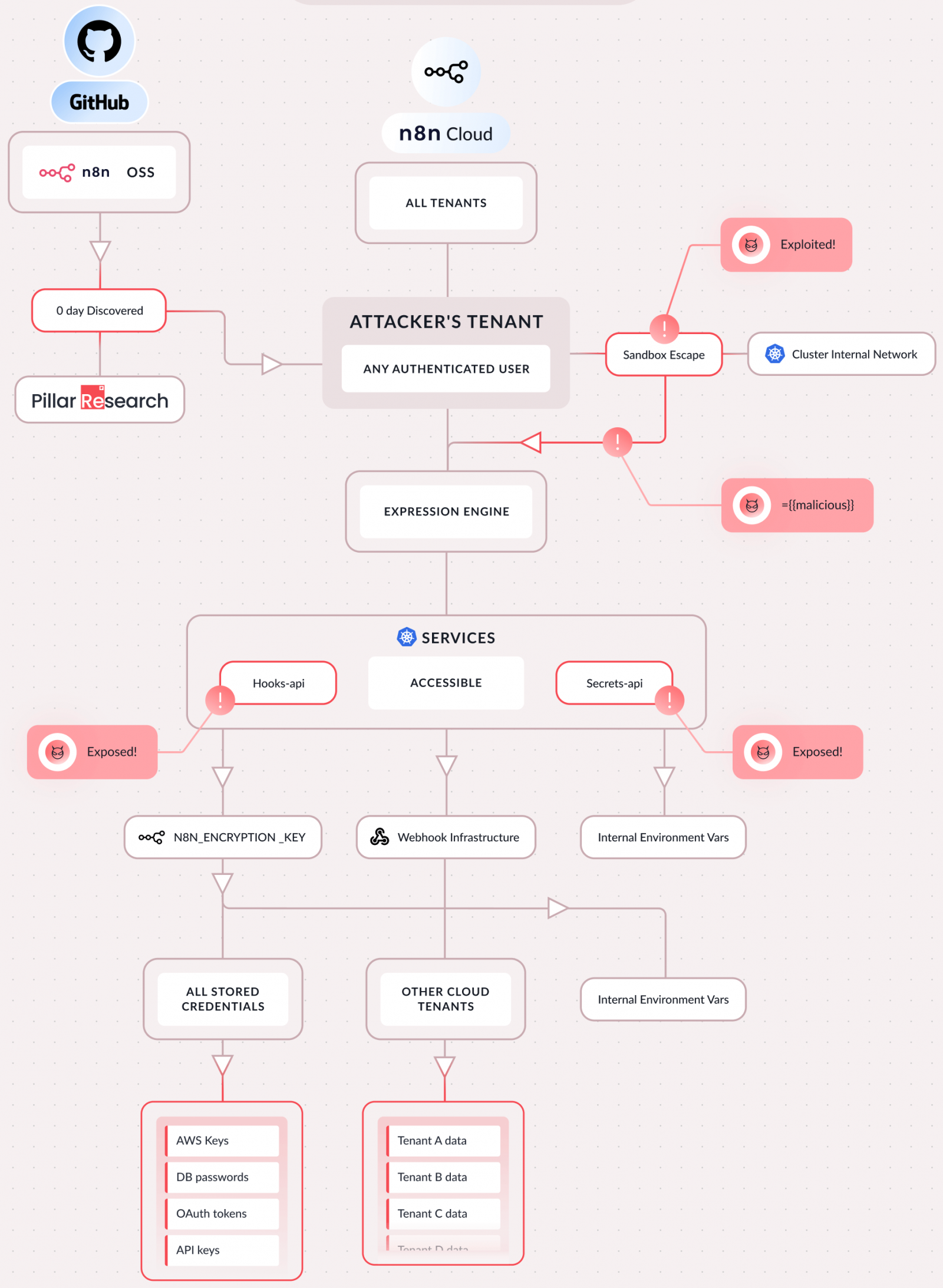
Multiple critical vulnerabilities in the popular n8n open-source workflow automation platform allow escaping the confines of the environment and taking complete control of the host server.

Collectively tracked as CVE-2026-25049, the issues can be exploited by any authenticated user who can create or edit workflows on the platform to perform unrestricted remote code execution on the n8n server.

Researchers at several cybersecurity companies reported the problems, which stem from n8n’s sanitization mechanism and bypass the patch for CVE-2025-68613, another critical flaw addressed on December 20.

Wiz

According to Pillar Security, exploiting CVE-2026-25049 enables complete compromise of the n8n instance and could be leveraged to run arbitrary system commands on the server, steal all stored credentials, secrets (API keys, OAuth tokens), and sensitive configuration files.

By exploiting the vulnerability, the researchers were also able to access the filesystem and internal systems, pivot to connected cloud accounts, and hijack AI workflows (intercept prompts, modify responses, redirect traffic).

As n8n is a multi-tenant environment, accessing internal cluster services can potentially allow pivoting to other tenants’ data.

“The attack requires nothing special. If you can create a workflow, you can own the server,” Pillar Security says in a report today.

Full attack chain
Full attack chain
Source: Pillar Security

Pillar’s report describes the problem as incomplete AST-based sandboxing and explains that it arises from n8n’s weak sandboxing of user-written server-side JavaScript expressions in workflows.

On December 21, 2025, they demonstrated a chained bypass to the n8n team, allowing sandbox escape and access to the Node.js global object, leading to RCE.

A fix was implemented two days later, but upon further analysis, Pillar found it incomplete, and a second escape via a different mechanism using equivalent operations remained possible.

n8n developers confirmed the bypass on December 30, and eventually, n8n released version 2.4.0 on January 12, 2026, addressing the issue.

Researchers at Endor Labs also discovered sanitization bypasses and demonstrated the CVE-2026-25049 vulnerability with a simple proof-of-concept (PoC) exploit that achieves remote code execution.

“In all versions prior to 2.5.2 and 1.123.17, the sanitization function assumes keys in property accesses are strings in attacker-controlled code,” says Cristian Staicu of Endor Labs.

However, while the check is reflected in TypeScript typings, it is not enforced at runtime, introducing a type-confusion vulnerability. This leads to bypassing the “sanitization controls entirely, enabling arbitrary code execution attacks.”

In a report today, researchers at SecureLayer7 provide the technical details that enabled them to achieve “server side JavaScript execution using the Function constructor.”

They discovered CVE-2026-25049 while analyzing CVE-2025-68613 and n8n’s fix for it. It took more than 150 failed attempts to refine a successful bypass.

SecureLayer7’s report also includes a PoC exploit and detailed steps for the initial setup and creating a malicious workflow that leads to full server control.

Recommended steps

n8n users should update the platform to the most recent version (currently 1.123.17 and 2.5.2). Pillar security also recommends rotating the ‘N8N_ENCRYPTION_KEY’ and all credentials stored on the server, and reviewing workflows for suspicious expressions.

If updating is not possible at the moment, the n8n team provides administrators with a workaround, which acts as a temporary mitigation and does not completely address the risk:

  • Limit workflow creation and editing permissions to fully trusted users only
  • Deploy n8n in a hardened environment with restricted operating system privileges and network access to reduce the impact of potential exploitation

Currently, there have not been any public reports about CVE-2026-25049 being exploited. However, n8n’s growing popularity appears to have caught the attention of cybercriminals in the context of the Ni8mare flaw (CVE-2026-21858).

GreyNoise this week reported seeing potentially malicious activity targeting exposed n8n endpoints vulnerable to Ni8mare, logging at least 33,000 requests between January 27 and February 3.

Although this probing could be due to research activity, scanning for the /proc filesystem indicates interest in post-exploitation potential.

Modern IT infrastructure moves faster than manual workflows can handle.

In this new Tines guide, learn how your team can reduce hidden manual delays, improve reliability through automated response, and build and scale intelligent workflows on top of tools you already use.


Source link