Reference #18.2d4adc17.1778100418.2911dd2
https://errors.edgesuite.net/18.2d4adc17.1778100418.2911dd2
Reference #18.2d4adc17.1778100418.2911dd2
https://errors.edgesuite.net/18.2d4adc17.1778100418.2911dd2

For the first time in 10 months, central banks turned net sellers of gold in March, data from the World Gold Council (WGC) showed.
Led by Turkey and Russia, central banks sold a net of nearly 30 tonnes of gold, offsetting purchases by other banks worldwide, according to Marissa Salim, Senior Research Lead, Asia Pacific region of WGC.
Turkey sold 60 tonnes of gold and Russia 6 tonnes in March, while data from the State Oil Fund of Azerbaijan showed net sales of 22 tonnes in the first quarter this year.
The National Bank of Poland continued purchasing gold, turning out to be the biggest buyer. It bought 11 tonnes. The Polish bank has been aggressively expanding its gold reserves for several years. It has been a consistent net purchaser of gold for over three years now. The National Bank of Poland has significantly accelerated the buying pace in the past 12 to 18 months. It is now the world’s leading central bank gold buyer.
Another consistent buyer of gold, the People’s Bank of China continued its gold buying spree for the 17th month in a row. In March, it picked up 5 tonnes. Among others, the Central Bank of Uzbekistan bought 9 tonnes, and the National Bank of Kazakhstan 6 tonnes.
Joining the top buyers of the yellow metal in March were Guatemala and the Czech Republic, which bought two tonnes each.
Turkey sold part of its gold reserves (60 tonnes) for foreign exchange and liquidity purposes. Ankara has so far sold 79 tonnes of gold from its reserves. In addition, the Central Bank of the Republic of Turkiye swapped 80 tonnes of gold to manage liquidity.
Experts said that, unlike other central banks that hold gold as a long-term passive reserve, the Turkish central bank uses gold as an active macro-financial buffer.
Russia sold 6 tonnes of gold, mainly since it relies on the precious metal to cover its budget deficits. Analysts said selling gold provided a solution to inject liquidity into the economy.
Central banks turning net sellers should not be surprising, as countries such as Turkey, Russia, Poland, Azerbaijan, and Kazakhstan, to defend their currencies, manage budget deficits, rebalance investment portfolios and tackle domestic inflation.
After soaring to a record high of $5,608 an ounce on January 29, gold has dropped over 15 per cent to around $4,675 an ounce currently. The precious metal, which has been rallying since 2024, is up over 7 per cent this year, despite shedding its gains.
As of March 31, Poland was the top buyer this year, purchasing 31 tonnes, followed by Uzbekistan (25 tonnes), Kazakhstan (13 tonnes) and China (7 tonnes), said Salim.
Central banks of the Czech Republic, Malaysia, Guatemala, Kyrgyz Republic, Cambodia, Indonesia and Serbia have also been net buyers.
Gold has rallied since 2024 due to hopes of interest rate cuts by banks, geopolitical crisis, trade disputes between the US and others, particularly China, and being seen as a strategic investment asset.
However, it has headed south since the Iran war broke out, as investors fear of inflation, slack economic growth and soaring crude oil prices that have led to investors’ shift to the fossil fuel complex.
Published on May 6, 2026
Reference #18.b3560e17.1778201168.dd4aa3d1
https://errors.edgesuite.net/18.b3560e17.1778201168.dd4aa3d1
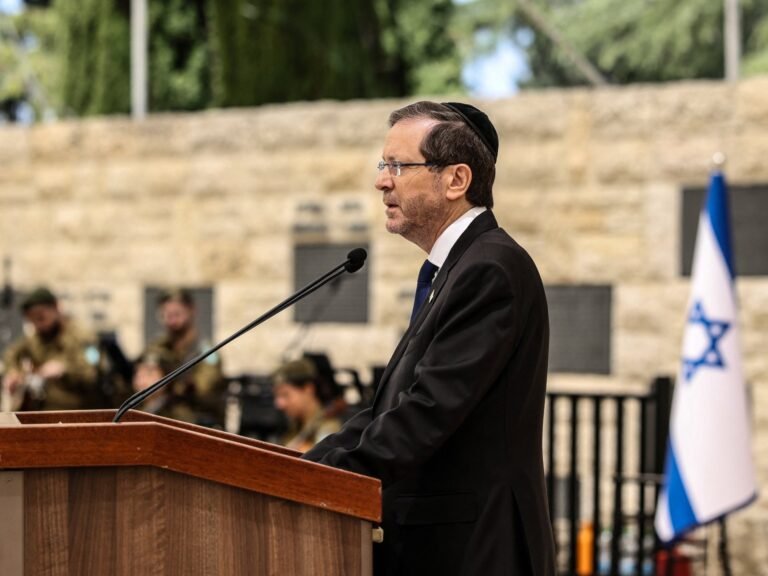
As Israel faces growing international isolation over its regional wars, President Isaac Herzog is set to visit two countries in Central America – Panama and Costa Rica – to boost ties.
“President Herzog’s visit to Panama and Costa Rica reflects the importance of Israel’s ties with countries across Latin America and the renewed momentum in Israel’s relations with Central and South American nations,” a statement from the Israeli Foreign Ministry reads.
Israel’s genocidal war on Gaza, which has prompted an International Criminal Court arrest warrant for Prime Minister Benjamin Netanyahu over alleged war crimes, has made it a source of growing opprobrium around the world.
But a handful of countries, most of them led by allies of United States President Donald Trump, have continued to tout their strong ties with Israel, which has sought to maintain those relationships via diplomatic outreach.
What will Herzog’s visit consist of, what will it seek to accomplish, and what can it tell us about Israel’s diplomatic goals in Latin America?
The Israeli Foreign Ministry has said that President Herzog will depart Israel on May 6 for a four-day official visit to Panama and Costa Rica.
The Israeli president will visit Panama first, meeting with President Jose Raul Mulino and government officials before continuing to Costa Rica to attend the inauguration of President-elect Laura Fernandez Delgado.
Herzog was invited to attend the ceremony by the outgoing pro-Israel President Rodrigo Chaves Robles and will also attend a dinner for heads of state. He will also meet with members of the Jewish community in both countries.
The Israeli Foreign Ministry has said that the Israeli president’s visit to Panama is the “first in history” and will help bolster ties with a country that it calls a “true friend of Israel and a current member of the UN Security Council”.
The meeting between Herzog and Mulino will follow up on discussions on bilateral ties held by the two leaders at the World Economic Forum in Davos in January.

As Israel faces growing isolation on the world stage, it has sought dependable allies at international fora such as the United Nations, and the Israeli Foreign Ministry’s statement notes Panama’s current two-year term as a non-permanent member of the UN Security Council.
While votes in the UN General Assembly have often gone overwhelmingly against Israel in recent years, Panama and Costa Rica have been among those who have joined with Israel and the US or abstained from voting.
Panama and Costa Rica both abstained from a 2024 United Nations resolution calling on Israel to end its illegal occupation of Palestinian territory, and Panama was one of just 12 countries to abstain from a September vote in support of a two-state solution.
Herzog’s visit may be an effort to ensure that Panama remains an ally of Israel during its time on the UNSC.
While the United States is, by far, Israel’s most important ally, it has also celebrated partnerships with countries such as the United Arab Emirates in the Middle East and Argentinian President Javier Milei in South America.
Many of Israel’s allies are also close partners of the US, and some countries in Central America — many of them small states that depend on US support and trade — may see a closer partnership with Israel as a means of signalling their alignment with US interests.
Herzog’s visit will seek to strengthen those relationships, with the Foreign Ministry stating that the trip will bolster “strategic partnership between Israel and the countries and peoples of the region” and underscore the status of those countries as important allies.
Israel has celebrated previous steps deepening relations with countries in the region, including a free trade agreement it signed with Costa Rica in December, along with the opening of a trade office in Jerusalem, which Israel claims as its capital but is considered illegally occupied under international law.
The US Department of State expressed support for those agreements, stating that they would “deepen cooperation between Israel and Latin America, grounded in shared interests and real potential for prosperity”.
Herzog’s trip may also seek to counter outspoken support for Palestine in Latin America, where leaders on the political left, such as Colombian President Gustavo Petro and Brazilian President Luiz Inacio Lula da Silva, have emerged as vocal critics of Israel.
President Lula recently condemned Israel’s seizure and detention of participants in a humanitarian aid flotilla bound for Gaza that included Brazilian national Thiago Avila, calling it an “unjustifiable action” that should be roundly condemned.
“The detention of the flotilla activists in international waters had already represented a serious affront to international law,” Lula said.


Motilal Oswal Financial Services maintained a Buy rating on the stock with a current market price of ₹2,528.
Shares of SRF Limited jumped sharply in early trade on Wednesday, rising 6.47 per cent to ₹2,685.90 on the NSE by 11.07 am, a day after the specialty chemicals conglomerate posted better-than-expected results for the fourth quarter and full year ended March 2026. The stock opened at ₹2,605, touched a high of ₹2,693.60, and was trading with a buy-heavy order book — 56.16 per cent buy versus 43.84 per cent sell — with traded value already crossing ₹494. crore by mid-morning.
The strong price action comes after SRF’s Q4FY26 results, released on Tuesday, showed consolidated revenue of ₹4,615 crore, up 7 per cent year-on-year, with EBITDA margins expanding 180 basis points to 25 per cent against analyst estimates of 23 per cent. Adjusted PAT grew 20 per cent year-on-year to ₹690 crore. For the full year FY26, revenue, EBITDA, and adjusted PAT grew 7 per cent, 27 per cent, and 51 per cent respectively.
Motilal Oswal Financial Services maintained a Buy rating on the stock with a current market price of ₹2,528 — now well below the trading price — noting that operating performance beat estimates across segments, led by the Chemicals business which reported EBIT margins of 32 per cent.
SBI Securities flagged two key capital allocation developments as neutral to positive in the short to medium term. The board has indefinitely deferred the ₹490 crore BOPP film manufacturing facility at Indore, citing a reassessment of investment timing. Simultaneously, the refrigerants project capex in Odisha has been revised upward significantly — from ₹1,100 crore to ₹2,285 crore — now covering a 20,000 MTPA HFO facility, a 30,000 MTPA new HF plant, and value-added HF derivatives, with completion targeted by February 2028.
The stock is currently trading well below its 52-week high of ₹3,325 hit in July 2025, and not far from its 52-week low of ₹2,355 touched in April 2026, giving it room to recover as investor sentiment improves on the back of margin expansion and strategic capex clarity.
Published on May 6, 2026
Reference #18.6e560e17.1778103709.40de7c8
https://errors.edgesuite.net/18.6e560e17.1778103709.40de7c8


Coforge reported Q4 FY26 EBIT margins of 16.6% — an all-time quarterly high — up 231 basis points sequentially and 430 basis points year-on-year
Shares of Coforge Limited opened sharply higher on the NSE Wednesday, hitting an intraday high of ₹1,295.80 — up over 8 per cent from the previous close of ₹1,168.80 — with traded value crossing ₹2,173 crore by mid-morning. The stock was last seen at ₹1,263.40 as of 10.53 am, buoyed by a strong set of Q4 FY26 results.
Motilal Oswal (MOFSL) maintained a Buy rating with a target price of ₹1,800, implying 54 per cent upside from Tuesday’s close, valuing the stock at 26x FY28E EPS. The brokerage increased EPS estimates by 3-4 per cent to reflect a meaningful upgrade in margin guidance, even after factoring in a 2-3 per cent revenue drag from Coforge’s planned exit of its low-margin India government pass-through business. MOFSL expects Coforge to be the growth leader within its coverage universe.
Choice Institutional Equities went further with a target price of ₹1,900 based on FY28E EPS of ₹67.8, reiterating a Buy and projecting revenue/EBIT/PAT CAGR of 21.2 per cent/25.7 per cent/29.9 per cent over FY26–FY29E. SBI Securities, while holding a neutral view, acknowledged the strong execution and noted the stock trades at 21.6x and 18.1x on FY27E and FY28E consensus earnings respectively.
Coforge reported Q4 FY26 EBIT margins of 16.6 per cent — an all-time quarterly high — up 231 basis points sequentially and 430 basis points year-on-year. Revenue in INR terms grew 30 per cent yoy to ₹4,450 crore. Adjusted PAT came in at ₹612 crore, rising 144.8 per cent sequentially, though the sharp jump was partly aided by a one-time reversal of deferred tax liabilities of ₹1,810 crore following the Cigniti merger. Normalized quarterly PAT was approximately ₹470 crore.
For full-year FY26, revenue grew 29.2 per cent in USD terms to $1.87 billion, while EBIT margins expanded 370 basis points to 14.4 per cent. The 12-month executable order book stood at $1.75 billion, up 16.4 per cent year-on-year.
Management guided for broadly flat Q1 FY27 revenue due to the India business exit, with a strong recovery expected from Q2 onwards, and EBITDA margins of 20.5–21 per cent for FY27.
Published on May 6, 2026
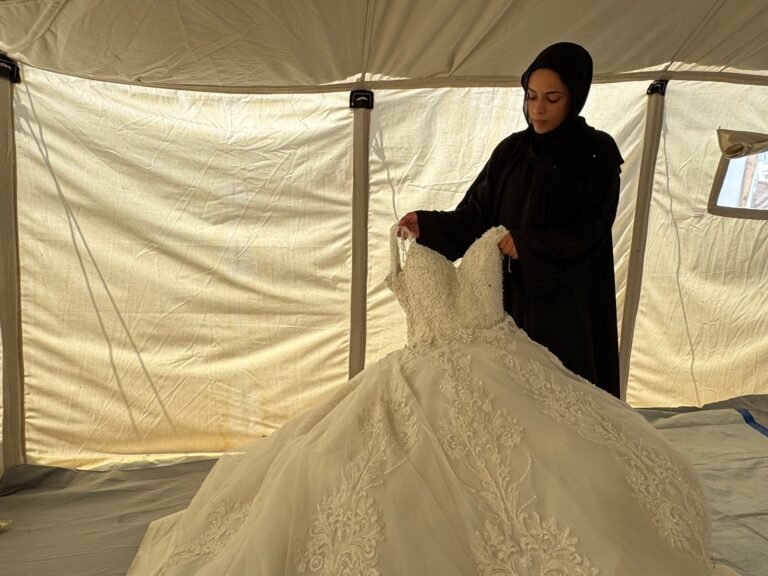
Deir el-Balah, Gaza Strip – With a weary expression, Saja arranges her few belongings inside the tent her fiance, Mohammed, has prepared for their wedding in just a few days.
There are two thin mattresses instead of a proper bed, a small cooking corner fashioned from wood and tarpaulin, and a makeshift bathroom that Mohammed also built from scraps of wood and plastic sheets.
The couple, Saja al-Masri, 22, and Mohammed Ahliwat, 27, got engaged a year ago while their families were displaced. They are still living in a camp in Deir el-Balah in central Gaza, forced into displacement by Israel’s genocidal war on Gaza.
Saja agreed to a modest dowry, but even that will only be paid by Mohammed in instalments.
Yet even this “simple beginning” has become unbearably expensive for Mohammed and many young men in Gaza, who are expected to shoulder the majority of the costs in Palestinian culture when they get married.
“I bought the tent for 1,500 shekels [about $509], the wood cost me around 2,500 [about $850], the tarpaulins exceeded 2,000 [about $679], and a simple bathroom cost another 3,000 [about $1,019],” Mohammed tells Al Jazeera. Before the war, apartments had previously been available for rent for between $250 and $300 a month.
“It’s not enough that I’m starting my life in a tent under harsh conditions, even this is unbearably expensive,” adds Mohammed, who works odd jobs like selling bread and canned goods or repairing bicycles.
“Everything I earn barely covers food and water. I tried to save a little for the wedding, but prices are so high, as if I were preparing a luxurious event.”
Before the war, Mohammed lived in a large seven-storey house in Bureij in central Gaza, and owned a fully furnished 170-square-metre apartment.
“When I remember my apartment in our home that was destroyed in the war, I feel deep sorrow … My brothers and I each had fully prepared apartments before marriage.”
“We had stability, and we owned poultry farms that supplied several areas in Gaza,” he says bitterly. “Today, I’m getting married in a tent.”
As for the wedding venue, Mohammed rented a small space that had been used as a cafe, unable to afford a wedding hall.
“A friend helped me rent this small place … for 1,500 shekels [$509],” he says. “It’s not a small amount considering how simple the place is. Wedding halls cost more than 8,000 shekels [$2,717].”
Mohammed’s situation is not exceptional in Gaza. Many weddings are now held in tents, with only the most basic preparations, amid soaring prices and a collapse of basic living conditions brought on by the war and the accompanying economic crisis.
Unemployment in Gaza has reached 80 percent, according to the Gaza Ministry of Labour, and poverty rates have risen to 93 percent.
![The couple, Mohammad Ahliwat and Saja Al-Masri, who are set to get married in a few days, are preparing for their wedding inside a tent in a displacement camp [Al Jazeera]](https://www.aljazeera.com/wp-content/uploads/2026/05/IMG_9173-1778007619.jpg?w=770&resize=770%2C578&quality=80)
Saja holds back her tears as she listens to her fiance.
What should have been the happiest moment of her life feels incomplete, and she has nothing to offer to ease Mohammed’s burden.
She understands the situation can’t be helped, and has tried to remain calm. But the difficulty in finding an affordable wedding dress broke her.
Dress shops have quoted her incredibly high prices to rent one – more than 2,000 shekels ($679) for one night.
“Everyone says crossings, goods, and coordination are expensive, so everything is overpriced,” Saja explains.
In an attempt to solve this, Mohammed brought a modest dress from an acquaintance “just to make the wedding happen”, placing her in what she describes as “a painful choice”.
“When I tried the dress yesterday, I felt so sad … I burst into tears. It was worn out, torn at the edges, and outdated,” Saja says, her voice breaking.
“I slept last night with tears on my cheeks … but there’s nothing we can do. This is what’s available.”
She points to the yearlong wait to have the wedding, after postponing it repeatedly because preparations were incomplete.
“The situation doesn’t improve … it only gets worse. Every time we say let’s wait, nothing changes. So we decided to get married next week,” says Saja, who studied graphic design for one year before the war forced her to stop.
Since then, she has been displaced with her family on a long journey that began in Beit Hanoon, in northern Gaza, passed through Gaza City, and ended in Deir el-Balah.
It’s not just the dress that worries her. Beauty salons charge nearly 700 shekels ($238) to prepare a bride.
“They tell us cosmetics are very expensive and unavailable, electricity and generators cost a lot, fuel is expensive … everything is expensive, and people like us are the ones who pay.”
“What did we do to deserve this?” she says.
![Saja and her mother, Samira, try to arrange her few belongings inside the tent, with the absence of a wooden wardrobe to store them [ Al Jazeera]](https://www.aljazeera.com/wp-content/uploads/2026/05/IMG_9163-1778007652.jpg?w=770&resize=770%2C578&quality=80)
Saja’s mother, Samira al-Masri, 49, interrupts gently, trying to console her, saying the conditions are the same for everyone in Gaza, where the majority of Palestinians have been displaced from homes destroyed by Israel, and more than 72,000 have been killed since October 2023.
“I married off four of my daughters: Ilham, Doaa, Ameerah, and now Saja, during the war, without joy,” Samira says, her voice trembling.
“Each wedding felt like a tragedy to me.”
“They all started their married lives the same way … in tents, with almost nothing.”
Samira describes her deep sadness at being unable to celebrate her daughters properly or give them the wedding they dreamed of.
“As you can see, there aren’t enough clothes, no proper items for a bride … no suitable dress, not even a wardrobe or a bed,” she says, while helping Saja arrange her few belongings.
Mohammed adds that bedroom furniture now costs between 12,000 and 20,000 shekels ($4,076 and $6,793) – before the war, the sets had cost around 5,000 shekels.
“Unbelievable prices, and there’s barely any goods in the market. We settled for mattresses on the ground.”
In Gaza, weddings are no longer joyful occasions; they are painful experiences repeated over and over.
Despite her natural desire as a mother to celebrate her daughter and give her a dignified start, Samira finds herself powerless, unable even to ask more from the groom.
“The situation is not normal … I can’t pressure him or ask what he did or didn’t bring. Everyone knows the situation … we’re all living it.”
Her worries extend beyond her daughters to her 26-year-old son, who is approaching marriage.
“I put myself and my son in the groom’s place: What does he have? Nothing. The same situation. Every time I see the costs, I step back from arranging his marriage.”
Amid this reality, Samira expresses deep sorrow for young men and women trying to marry today.
“I pray God helps them … our days were much easier … even the simplest costs have become unaffordable.
As her marriage shifts from a moment of joy into a heavy confrontation with reality, Saja tries to hold herself together despite having no real options.
She admits it is not easy, but Mohammed’s presence next to her gives her strength.
“Sometimes, I feel it’s a miserable beginning … but when I see Mohammed with me, I overcome my sadness,” she says with a faint smile as she looks at her future husband.
There are few signs that circumstances will improve anytime soon for the couple. Still, they try to achieve a balance between harsh reality and fragile hope.
“I feel things will stay the same, as is written for us,” Saja says, “moving from one tent to another.”
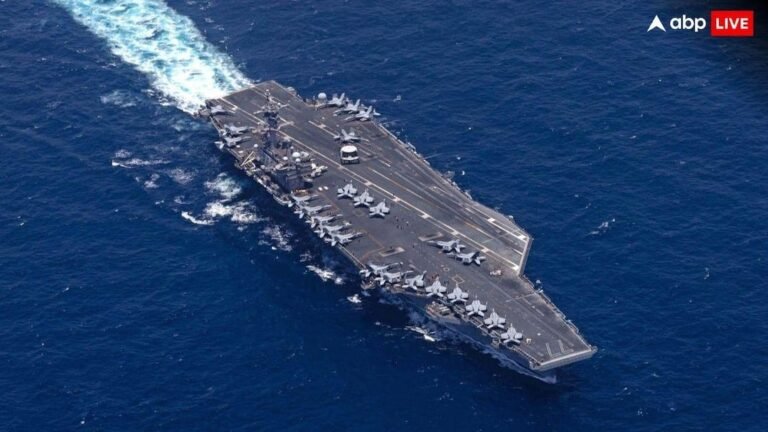
Iran has prepared a new system for the Strait of Hormuz. A new authority has been prepared for this. The ships which have to transit through the Strait of Hormuz will have to contact this authority of Iran. A new email was issued for this.
Ships wishing to transit through Hormuz will receive an email from info@PGSA.ir informing them of the transit rules. On the other hand, America launched a major naval operation in the Strait of Hormuz. ‘Project Freedom’ Started, the purpose of which was to safely take out the merchant ships stuck there and to restart the movement on one of the most important oil trade routes in the world. Although, US President Donald Trump Has said that talks with Iran to end the conflict are in the final stages, Operation ‘Project Freedom’ has been stopped for some time to finalize the agreement.
Trump said, “At the request of Pakistan and other countries, based on the tremendous military success achieved during the campaign against Iran, as well as the good negotiations with representatives of Iran regarding the peace deal, we have mutually decided that the blockade will remain in full force, but Project Freedom will be stopped for some time, so that it can be seen whether the agreement can be finalized or not.”
Project Freedom was launched on Monday to safely rescue ships stranded due to the closure of the Strait of Hormuz. Trump had announced this operation on Sunday and the US Central Command started implementing it from the next day. However, the project has led to tensions around the narrow sea route, which is a key route for transportation of one-fifth of global oil supplies. The United Arab Emirates (UAE) claimed that its ships were attacked by Iran. America also claimed to destroy several Iranian small boats.

BJP leader Shubhendu Adhikari’s PSO Chandranath Rath was shot dead in Madhyagram in North 24 Parganas district of West Bengal on Wednesday night. The attackers followed his car and opened fire in Dohariya area. According to local sources, four rounds of bullets were fired, out of which three bullets hit Chandranath’s head.
VIDEO | BJP leader Suvendu Adhikari’s personal assistant Chandranath Rath was shot at from close range by unidentified assailants in West Bengal’s North 24 Parganas district on Wednesday night, sources said.
(Source: Third Party)
(Full video available on… pic.twitter.com/L1QAKFI60N— Press Trust of India (@PTI_News) May 6, 2026